© 2018, IRJET | Impact Factor value: 6.171 | ISO 9001:2008 Certified Journal | Page 1521
Green building based on Building Information Modelling
Neelam Sharma
1, Er. Bhupinder kaur
2, Er. Sandeep Salhotra
31pursuing master of engineering, Dept. of Civil Engineering, Chandigarh University, Panjab, India 2Associate professor, Dept. of Computer Science Engineering, Chandigarh University, Panjab, India
3Head of Department, Dept. of Civil Engineering, Chandigarh University, Panjab, India
---***---Abstract
-
BIM represents a modification in the traditional process of building delivery. BIM is usual to change the architecture, engineering and construction industry in India. BIM can currently provide for the needs of approximately 60 percent of India’s population. In India BIM will grow by 20 percent in next few years, for account of environmental regulation and rising demand. Using BIM with sustainable design and green construction techniques including maximizing the conservation of resources is referred as Green BIM. Green BIM and new design societies are adopting this method to enable the integrated design, construction and maintenance concerning Net Zero Energy buildings. The use of Building Information Modelling has come to be more common during the building life cycle. The applications of BIM to supporting the design, construction, operation, and retrofitting processes of green buildings. It can recover the aesthetic view of the building, improve optical comfort and reduce the overall electrical lighting usage inside the building. The aims of green buildings becoming less costly than conventional buildings thus making them affordable for the common man.Key Words: BIM, sustainability, green building,
retrofitting, electrical lighting usage.
1. INTRODUCTION
Green building design discuss the process of designing buildings which are naturally responsible and resource efficient during the building’s life-cycle. Building information modelling simplify integration, interoperability and collaboration in the construction industry by providing 3D view of a project containing all the parameters and its mechanisms. BIM is ideally suited to the delivery of information enables to improve design and building performance. BIM based different software are used according to work type and task in general, resulting in data loss in the process of information exchange and this requires unnecessary duplication of work data restoration. The performance of BIM guide for a sustainable building are thermal, indoor air quality, acoustic, light /visual, spatial and building integrity conditions. Building automation/smart building system, building structural stability, fire safety earthquake resistance, maintainability, resource efficiency, and building security condition are examples of building integrity condition determinants. The impact of the AEC industry on the environmental is very high. The building materials manufacturing is used about 10% of the global energy, and operational phase produces at least 30% of all
greenhouse gas emissions and demolishing buildings is responsible for 40% of all solid waste. Building information Modelling is a dimensional tool which supports effective design and construction technique. It is one of the final documentation method useful for operational visualization, and construction method like estimating, scheduling and design coordination. Main purpose of employing BIM application is that which offers a visual method of building systems like Mechanical, Electrical, and Plumbing systems and additionally finds the matter of conflicts between the building systems. Lack of interoperability of sustainable data has the effect of limiting the application of BIM in design phase. BIM is a manipulation method and intellectual modelling package which can be effectively operating in 3D, 4D and 5D to increase production, to scale back value, operation prices and time during designing & construction. 2. MOTIVATION FOR GREEN BIM
© 2018, IRJET | Impact Factor value: 6.171 | ISO 9001:2008 Certified Journal | Page 1522 Source: - international energy agency
3. LITERATURE REVIEW
It provides a summary of built BIM solutions and integrated analysis tools which helps to evaluate building performance, arrange investments, and assess proposals to reduce operational costs, conserve energy, reduce water consumption, improve building air quality, and helping to meet sustainability energy efficiency goals. It discusses on BIM include advices for collaboration across organizational boundaries [7]. Some argue the new technologies offer an opportunity to the model shift of construction work practices, while others suggest that successful implementation of BIM needs the technologies and changes to the current work of team members [8]. Traditional design methods are restricted in term of frequently analyzing sustainability for the period of the design process due to continuous information [17]. A BIM model can be used as a database for data exchange and integration based on the IFC. About the design phase, BIM agrees for multi-disciplinary information to be covered on one model, which makes an opportunity for sustainability methods to be incorporated throughout the design process [5].BIM software provides various efficient solutions to ease these environmental
© 2018, IRJET | Impact Factor value: 6.171 | ISO 9001:2008 Certified Journal | Page 1523 BIM is known as an essential tool for the integration and
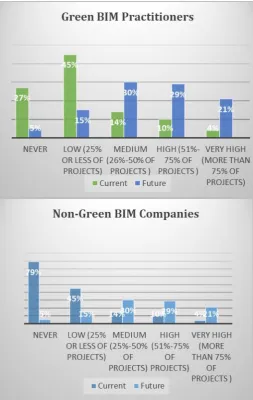
combination of intelligent and informative models, which can be built on important information and integrated within a common data environment. In many cases BIM has been leveraged to permit information sharing and reuse for interoperability between prevalent software tools in the AEC industry [16].95% of firms use the Green BIM technique for energy performance simulations within two year reached at 73% now. 79% of non-green BIM firms use these reproductions of planned to increase from 21% currently. This rapid increase reflects the growing importance of energy efficiency in buildings and capacity BIM tools used for this purpose [2]. The model can be effectively provided a fully corresponding set of conventional documents which is accurate and reliable [1]. BIM and sustainable design are connected by using the skills of the model to provide useful data for analysis of tools reported on a design estimated performance on important sustainable characteristics. For example, BIM provide tools which can convert the model into a non-proprietary format for sustainable design information [3]. Hence best opportunity is for sustainability measures and performance analysis to be integrated within the BIM model [18]. With the programs such as Autodesk Ecotect software that can import BIM models. Interior designers study the performance of interior environments important to formation of more comfortable, healthy, and sustainable spaces for its inhabitants [4].
IFC is a common language which can be used by all engineering fields, that permits sharing information between whole AEC/FM project members and store the entire valuable data in one virtual model unit which can be preserved and used beyond the life of the project.
Encouragement of the BIM to maximum possibility is difficult due to insufficient conversion of the energy simulation and BIM. However, the potential of using BIM for energy simulation is well known, whereas an organized method to transfer the essential information is yet missing. Data exchange between simulation programs and BIM is now restricted to the transfer of 3D views of the building projects.
4. METHODOLOGY
4.1 Selection of academic publications
The selection process of academic publications in this study draws on the methodology adopted in other review articles. The commonly adopted literature selection processes in review articles include several steps, namely defining the used literature database and search rules, preliminary search and double-check screening. In accordance with this principal, this study only reviews journal articles on green BIM. Then, a process similar adopted to conduct preliminary search and literature filtration, thereby identifying the articles most relevant to green BIM.
Step 1: Select target journals.
Step 2: Perform a search on BIM-related studies. Step 3: Identify the BIM application on green buildings based on the definition of green BIM.
4.2 Selection of BIM software used
In addition to academic studies, this study also reviews current BIM software and applications that are developed to improve the sustainability performance of buildings throughout their lifecycle phases. To this end, based on the definition of green BIM, 12 types of popular BIM software specifically designed and developed to address green and sustainable building issues were selected from the BIM Tools Matrix.
For structural engineering such as Tekla Structures and Robot Structural Analysis
For building service such as Revit MEP and Magi CAD.
For project management such as Synchro vico and BIM Measure.
For facilities management such as Bentley Facilities and Arts A. and
For sustainability analysis such as Green Building Studio and Design Builder
4.3 Daylight energy analysis
© 2018, IRJET | Impact Factor value: 6.171 | ISO 9001:2008 Certified Journal | Page 1524 Fig.2 The combination of these various software options
translates into a series of distinct rapid energy modeling workflows.
5.Current/Future use of BIM to simulate energy performance
[image:4.595.37.291.340.741.2]
Fig. 3 Source: McGraw-Hill Construction
6. CONCLUSION
BIM has the potential to become the leading technology of the building industry, and it is in the interest of most firms to begin their transformation towards its processes. The more BIM is used, and the more data that are collected and stored during the life of a project, and more benefits can be leveraged. When BIM is used, it is easy to see the significances of the decisions. BIM leads to a better communication with stakeholders, which is an essential element in creating a mutual understanding of aims of the project, and fulfill the requirements of the client. The quality benefits which can be BIM provides are most valuable for project managers concerning maintaining control of a project. During the design phase, the project manager can easily see how much the work has progressed in the building information model that gives the project manager a better basis for assessing the schedule and budget more accurately. BIM could facilitate data exchange and integration, which provide visualized building performance analyses, and enhance the communication & collaboration of various stakeholders during the lifecycle of green buildings.
ACKNOWLEDGEMENT
I would like to thank my supervisor (Er. Bhupinder Kaur) & co- supervisor (Er. Sandeep Salhotra) for their supervision and direction as well as providing necessary information for writing the review paper and also their support in completing the further research work.
REFERENCES
[1] Autodesk Revit white paper
[2] Smart Market Report, (prepared by: Harvey M. Bernstein F. ASCE, LEED AP, Stephen A. Jones, Michele A Russo, LEED AP.
[3] BIM for LEED, By Erin Rae Hoffer, AIA, LEED AP. [4] Poh Lam & Yeang, 2009; Azhar & Brown, 2009.
[5] Autodesk, Autodesk Ecotect Analysis. Sustainable Building Design Software, (2012).
[6] Basbagill, J., F. Flager, F., Lepech, M., Fischer, M., (2013) Lin, S.-H., Gerber, D.J., (2014).
[7] CURT, (2005). [8] Hartmann (2008).
© 2018, IRJET | Impact Factor value: 6.171 | ISO 9001:2008 Certified Journal | Page 1525 [10] Wong and Jan, 2003; Oyedele et al. “Total building
performance evaluation of academic institution in Singapore Build. Environ.” 38 (1), (2012).
[11] Mash, D., Reza Nassir (2011).
[12] Oti, A.H., “A critical analysis of building sustainability assessment methods for healthcare buildings” (2015). [13] Oyedele et al., 2012 “Total building performance approach in building evaluation: Case study of an office building in Singapore” ASCE J. Energy Eng., 138 (1) (2012), [14] Steel, J., Drogemuller, R., Toth, B., “Model interoperability in building information modelling, Software System Model”. (2012).
[15] Sacks, R., Dave, B., Koskela, L., Owen, R., (2009) Mahalingam, A., Yadav, A.K., Varaprasad, J. “The interaction of lean and building information modeling in construction' Journal of Construction Engineering and Management”, 136 (9) (2015).
[16] Stundon, D., Spillane, J., Lim, J.P., Tansey, P., Tracey, M., “Building information modelling energy performance assessment on domestic dwellings: a comparative study, Proceedings for 31st Annual ARCOM Conference” (2015) [17] Teicolz, P., Sacks, R., Liston, K., “BIM Handbook: A Guide to Building Information Modeling for Owners, Managers, Designers, Engineers and Contractors. 2nd Edition, Wiley, s Hoboken” (2011).