Munich Personal RePEc Archive
A Methodology for Neural Spatial
Interaction Modeling
Fischer, Manfred M. and Reismann, Martin
Vienna University of Economics and Business, Vienna University of
Economics and Business
2002
Online at
https://mpra.ub.uni-muenchen.de/77794/
Manfred M. Fischer and Martin Reismann
A Methodology for
Neural Spatial Interaction Modeling
This paper attempts to develop a mathematically rigid and unified framework for
neural spatial interaction modeling. Families of classical neural network models, but
also less classical ones such as product unit neural network ones are considered for the
cases of unconstrained and singly constrained spatial interaction flows. Current
practice appears to suffer from least squares and normality assumptions that ignore the
true integer nature of the flows and approximate a discrete-valued process by an
almost certainly misrepresentative continuous distribution. To overcome this deficiency
we suggest a more suitable estimation approach, maximum likelihood estimation under
more realistic distributional assumptions of Poisson processes, and utilize a global
search procedure, called Alopex, to solve the maximum likelihood estimation problem.
To identify the transition from underfitting to overfitting we split the data into training,
internal validation and test sets. The bootstrapping pairs approach with replacement is
adopted to combine the purity of data splitting with the power of a resampling
procedure to overcome the generally neglected issue of fixed data splitting and the
problem of scarce data. In addition, the approach has power to provide a better
statistical picture of the prediction variability, Finally, a benchmark comparison
against the classical gravity models illustrates the superiority of both, the
unconstrained and the origin constrained neural network model versions in terms of
generalization performance measured by Kullback and Leibler’s information criterion.
The authors gratefully acknowledge the grant no. P15575 provided by the Austrian Fonds zur Förderung
der wissenschaftlichen Forschung (FWF).
Manfred M. Fischer is Chaired Professor of the Department of Economic Geography &
E-Martin Reismann is research assistant at the same department. E-mail:
There are several phases that an emerging field goes through before it reaches
maturity, and GeoComputation is no exception. There is usually a trigger for birth of
the field. In our case, new techniques such as neural networks and evolutionary
computation, significant progress in computing technology, and the emerging data rich
environment inspired many scholars to revisit old and tackle new spatial problems. The
result has been a wealth of new approaches, with significant improvements in many
cases (see Longley et al. 1998, Fischer and Leung 2001).
After the initial excitement settles in, the crest breaking question is whether the new
community of researchers can produce sufficient results to sustain the field, and
whether practitioners will find these results to be of quality, novelty, and relevance to
make a real impact. Successful applications of geocomputational models and
techniques to a variety of problems such as data mining, pattern recognition,
optimization, traffic forecasting and spatial interaction modeling rang the bell
signifying the entry of GeoComputation as an established field.
This paper is a response to the perceived omission in the comprehensive
understanding of one of the most important subfields in GeoComputation. While
various papers on neural network modeling of unconstrained spatial interaction flows
have appeared in the past decade, there has yet to be an advanced discussion of the
general concepts involved in the application of such models. This paper attempts to fill
the gap. Among the elements which should be of interest to those interested in
applications are estimation and performance issues.
The paper proceeds as follows. The first section points to some shortcomings evident in
current practice and motivates to depart in two directions: First, to employ maximum
likelihood under more realistic distributional assumptions rather than least squares and
normality assumptions, and second to utilize bootstrapping to overcome the problems
of fixed data splitting and the scarcity of data that affect performance and reliability of
the model results. Section 2 describes classical unconstrained neural spatial interaction
models and less classical ones. Classical models are those that are constructed using a
single hidden layer of summation units. In these network models each input to the
product unit rather than the standard summation neural network framework for
modeling interactions over space.
Unconstrained – summation unit and product unit – neural spatial interaction
models represent rich and flexible families of spatial interaction function
approximators. But they may be of little practical value if a priori information is
available on accounting constraints on the predicted flows. Section 3 moves to the case
of constrained spatial interaction. To satisfactorily tackle this issue within a neural
network environment it is necessary to embed the constraint-handling mechanism
within the model structure. This is a far from easy task. We briefly describe the only
existing generic model approach for the single constrained case (see Fischer, Reismann
and Hlavackova-Schindler 2001), and present summation and product unit model
versions. We reserve the doubly constrained case to subsequent work.
We view parameter estimation (network learning) in an optimization context and
develop a rationale for an appropriate objective (loss) function for the estimation
approach in Section 4. Global search procedures such as simulated annealing or Alopex
may be employed to solve the maximum likelihood estimation problem. We follow
Fischer, Hlavackova-Schindler and Reismann (2001) to utilize the Alopex procedure
that differs from the method of simulated annealing in three important aspects. First,
correlations between changes in individual parameters and changes in the loss function
are used rather than changes in the loss function only. Second, all parameter changes
are accepted at every iteration, and, third, during an iteration step all parameters are
updated simultaneously.
The standard approach to evaluate the generalization performance of neural network
models is to split the data set into three subsets: the training set, the internal validation
set and the testing set. It has become common practice to fix these sets. A bootstrapping
approach is suggested to overcome the generally neglected problem of sensitivity to the
specific splitting of the data, and to get a better statistical picture of prediction
variability of the models. Section 5 illustrates the application of the various families of
neural spatial interaction function approximators discussed in the previous sections, and
presents the results of a comparison of the performance of the summation and the
cases] against the corresponding standard gravity models. The testbed for the evaluation
uses interregional telecommunication traffic data from Austria. Section 6 outlines some
directions for future research.
1. DEPARTURES FROM CURRENT PRACTICE
We will begin our analysis with the simplest case, namely that of unconstrained spatial
interaction. For concreteness and simplicity, we consider neural spatial interaction
models based on the theory of single hidden layer feedforward models. Current
research in this field appears to suffer from least squares and Gaussian assumptions that
ignore the true integer nature of the flows and approximate a discrete-valued process by
an almost certainly misrepresentative distribution. As a result, least squares estimates
and their standard errors can be seriously distorted. To overcome this shortcoming we
will develop a more appropriate estimation approach under more realistic distributional
assumptions.
Thus, throughout the paper we assume observations generated as the realization of a
sequence
{
Zk =(
X Yk, k)
,k =1,...,K}
of(
N+ ×1)
1 vectors(
N∈)
defined on aPoisson probability space. The random variables Yk represent targets. Their relationship
to the variables Xk is of primary interest. When E Y
( )
k < ∞, the conditionalexpectation of Yk given Xk exists, denoted as g =E Y X
(
k k)
. Defining( )
k Yk Xk
ε ≡ −g , we can also write Yk =g
( )
Xk +εk. The unknown spatial interactionfunction g embodies the systematic part of the stochastic relation between Yk and Xk.
The error εk is noise, with the property that E
(
εk Xk)
=0 by construction. Ourproblem is to learn (estimate, approximate) the mapping g from a realization of the
sequence
{ }
Zk .In practice, we observe a realization of only a finite part of the sequence
{ }
Zk , atraining set or sample of size K (i.e. a realization of
{
Z kk =1,...,K}
). Because g is anelement of a space of spatial interaction functions, say G , we have essentially no hope
of learning g in any complete sense from a sample of fixed finite size. Nevertheless, it
is possible to approximate g to some degree of accuracy using a sample of size K, and
There are many standard procedures of function approximation to this function g.
Perhaps the simplest is linear regression. Since feedforward neural networks are
characteristically nonlinear it is useful to view them as performing a kind of nonlinear
regression. Several of the issues that come up in regression analysis are also relevant to
the kind of nonlinear regression performed by neural networks.
One important example comes up in the cases of underfitting and overfitting. If the
neural network model is able to approximate only a narrow range of functions, then it
may be incapable of approximating the true spatial interaction function no matter how
much training data is available. Thus, the model will be biased, and it is said to be
underfitted. The solution to this problem seems to be to increase the complexity of the
neural network, and, thus, the range of spatial interaction functions, that can be
approximated, until the bias becomes negligible. But, if the complexity [too many
degrees of freedom] rises too far, then overfitting may arise and the fitted model will
again lead to poor estimates of the spatial interaction function. If overfitting occurs then
the fitted model can change significantly as single training samples are perturbed and,
thus shows high variance. The ultimate measure of success is not how closely the
model approximates the training data, but how well it accounts for not yet seen cases.
Optimizing the generalization performance requires that the neural network complexity
is adjusted to minimize both the bias and the variance as much as possible.
Since the training data will be fitted more closely as the model complexity increases,
the ability of the trained model to predict this data cannot be utilized to identify the
transition from underfitting to overfitting. In order to choose a suitably complex model,
some means of directly estimating the generalization performance are needed. For
neural spatial interaction models data splitting is commonly used. Though this
procedure is simple to use in practice, effective use of data splitting may require a
significant reduction in the amount of data which is available to train the model. If the
available data is limited and sparsely distributed – and this tends to be the rule rather
than the exception in spatial interaction contexts, then any reduction in amount of
training data may obscure or remove features of the true spatial interaction function
In this contribution, we address this issue by adopting the bootstrapping pairs approach
(see Efron 1982) with replacement. This approach will combine the purity of data
splitting with the power of a resampling procedure and, moreover, allows to get a better
statistical picture of the prediction variability. An additional benefit of the bootstrap is
that it provides approximations to the sampling distribution of the test statistic of
interest that are considerably more accurate than the analytically obtained large sample
approximations. Formal investigation of this additional benefit is beyond the scope of
this contribution. We have a full agenda just to analyze the performance of summation
and product unit neural network models for the cases of unconstrained and constrained
spatial interaction. But we anticipate that our bootstrapping procedure may well afford
such superior finite sample approximations.
2. FAMILIES OF UNCONSTRAINED NEURAL SPATIAL INTERACTION
MODELS
In many spatial interaction contexts, little is known about the form of the spatial
interaction function which is to be approximated. In such cases it is generally not
possible to use a parametric modeling approach where a mathematical model is
specified with unknown coefficients which have to be estimated to fit the model. The
ability of neural spatial interaction models to model a wide range of spatial interaction
functions relieves the model user of the need to specify exactly a model that includes all
the necessary terms to model the true spatial interaction function.
The Case of Unconstrained Spatial Interaction
There is a growing literature in geography and regional science that deals with
alternative model specifications and estimators for solving unconstrained spatial
interaction problems. Examples include, among others, Fischer and Gopal (1994);
Black (1995); Nijkamp, Reggiani and Tritapepe (1996); Bergkvist and Westin (1997);
Bergkvist (2000); Reggiani and Tritapepe (2000); Thill and Mozolin (2000); Mozolin,
Thill and Usery (2000). All these models are members of the following general class of
(
)
00 0 11 1
,
H N
H H
h hn n
h n
w w w x
Ω ψ ϕ
= =
= +
∑
∑
x w (1)
where the N-dimensional euclidean space (generally, N = 3) is the input space and the
1-dimensional euclidean space the output space. Vector x=
(
x1,...,xN)
is the input vector that represents measures characterizing the origin and the destination of spatialinteraction as well as their separation. H ≡
(
0, 1)
w w w is the
(
HN+ + ×H 1)
1 vector ofthe network weights (parameters). There are H hidden units. The vector w0 contains
the hidden to output unit weights, w0 ≡
(
w00,w01,...,w0H)
, and the vector w1 contains the input to hidden unit weights, w1≡(
w10,...,w1H)
with w1h ≡(
w1 1h ,...,w1hN)
. We allow a bias at the hidden layer by including w00. A bias at the input array may be taken intoconsideration by setting x1≡1. ϕ is a hidden layer transfer function, ψ an output unit transfer function, both continuously differentiable of order 2 on ℜ. Note that the model
output function and the weight vector are explicitly indexed by the number, H, of
hidden units in order to indicate the dependence. But to simplify notation we drop the
superindex hereafter.
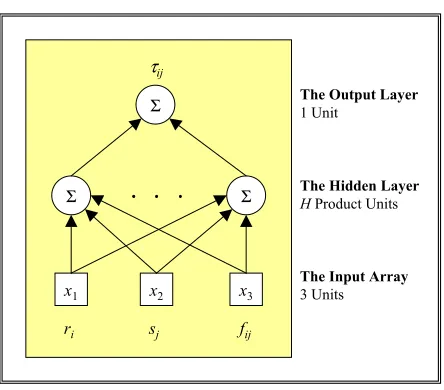
FIGURE 1 TO BE PLACED ABOUT HERE
FIG. 1 depicts the corresponding network architecture. Hidden units, denoted by the
symbol Σ, indicate that each input is multiplied by a weight and then summed. Thus,
models of type (1) may be termed unconstrained summation unit spatial interaction
models. The family of approximations (1) embodies several concepts already familiar
from the pattern recognition literature. It is the combination of these that is novel.
Specifically, 1
1
N
hn n n= w x
∑
is a familiar linear discriminant function (see Young andCalvert 1974) which – when transformed by ϕ – acts as a nonlinear feature detector.
The 'hidden' features are then subjected to a linear discriminant function and filtered
through ψ . The approximation benefits from the use of nonlinear feature detectors,
while retaining many of the advantages of linearity in a particularly elegant manner.
A leading case occurs when both transfer functions are specified as logistic
(
)
1 1
00 0 1
1 1
, 1 exp 1 exp
H N
L h hn n
h n
w w w x
Ω − − = = = + − + + −
∑
∑
x w (2)
that has been often used in practice (see, for example, Mozolin, Thill and Usery 2000;
Fischer, Hlavackova-Schindler and Reismann 1999; Fischer and Leung 1998; Gopal
and Fischer 1996; Black 1995; Fischer and Gopal 1994; Gopal and Fischer 1993;
Openshaw 1993).
Product Unit Model Versions
Neural spatial interaction models of type (1) are constructed using a single hidden layer
of summation units. In these networks each input to the hidden node is multiplied by a
weight and then summed. A nonlinear transfer function, such as the logistic function, is
employed at the hidden layer. Neural network approximation theory has shown the
attractivity of such summation networks.
In the neural network community it is well known that supplementing the inputs to a
neural network model with higher-order combinations of the inputs increases the
capacity of the network in an information capacity sense (see Cover 1965) and its
ability to learn (see Giles and Maxwell 1987). This may motivate to utilize a product
unit rather than the standard summation unit neural network framework for modeling
interactions over space. The general class of unconstrained product unit spatial
interaction models is given as
(
)
100 0 1 1 , hn N H w h n h n
w w x
πΩ ψ ϕ
= =
= +
∑
∏
x w (3)
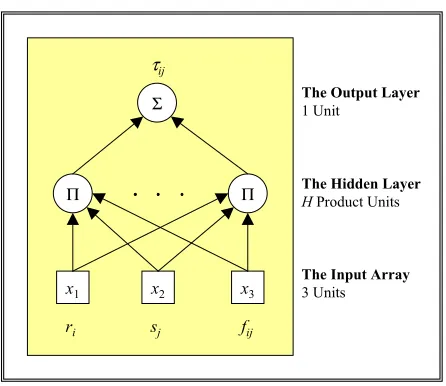
which contain both product and summation units. The product units compute the
product of inputs, each raised to a variable power. FIG. 2 illustrates the corresponding
network architecture.
Specifying ϕ
( )
⋅ to be the identity function and ψ( )
⋅ to be the logistic function weobtain the following special case of (3)
(
)
11
00 0
1 1
, 1 exp hn
N H
w
L h n
h n
w w x
πΩ
−
= =
= + − +
∑
∏
x w (4)
3. NEURAL NETWORKS OF CONSTRAINED SPATIAL INTERACTION
FLOWS
Classical neural network models of the form (1) and less classical models of the type
(3) represent rich and flexible families of neural spatial interaction approximators. But
they may be of little practical value if a priori information is available on accounting
constraints of the predicted flows. For this purpose Fischer, Reismann and
Hlavackova-Schindler (2001) have recently developed a novel class of neural spatial interaction
models that are able to deal efficiently with the singly constrained case of spatial
interaction.
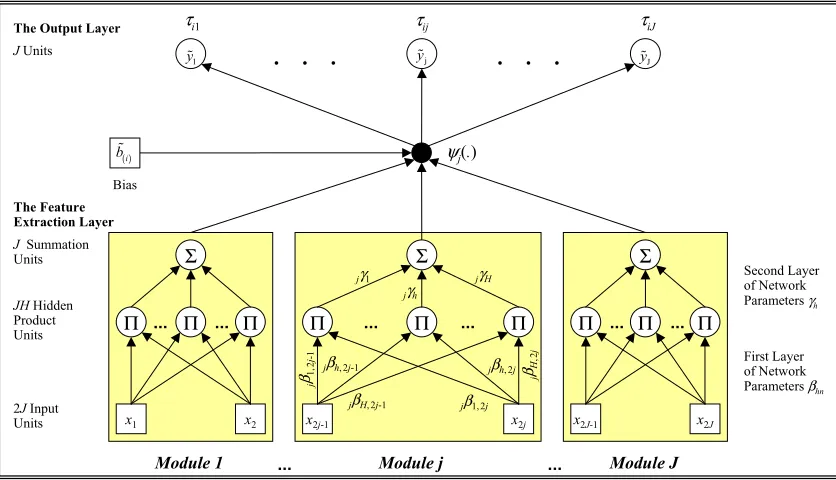
The models are based on a modular connectionist architecture that may be viewed
as a linked collection of functionally independent modules with identical feedforward
topologies [two inputs, H hidden product units and a single summation unit], operating
under supervised learning algorithms. The prediction is achieved by combining the
outcome of the individual modules using a nonlinear output transfer function multiplied
with a bias term that implements the accounting constraint.
Without loss of generality we consider the origin constrained model version only. FIG.
3 illustrates the modular network architecture of the models. Modularity is seen here as
decomposition on the computational level. The network is composed of two processing
layers and two layers of network parameters. The first processing layer is involved with
the extraction of features from the input data. This layer is implemented as a layer of J
functionally independent modules with identical topologies. Each module is a
feedforward network with two inputs x2j−1 and x2j[representing measures of
H hidden product units, denoted by the symbol Π, and terminates with a single
summation unit, denoted by the symbol Σ. The collective output of these modules
constitutes the input to the second processing layer consisting of J output units that
[image:12.595.121.356.645.712.2]perform the flow prediction.
FIGURE 3 TO BE PLACED ABOUT HERE
This network architecture implements the general class of product unit neural
models of origin constrained [OC] spatial interaction
(
)
21 2 1
, hn 1, ...,
j H
OC
j h h n
j
h n j
xβ j J
πΩ ψ γ ϕ
= = −
= =
∑
∏
x w (5)
with :ϕh ℜ → ℜ,ψj:ℜ → ℜ and x∈ℜ2J, that is x=
(
x x1, 2, ...,x2j−1,x2j, ...,x2J−1,x2J)
where x2j−1 represents a variable pertaining to destination j
(
j=1, ...,J)
and x2j a variable fij pertaining to the separation from region i to region j(
i=1, ..., ;I j=1, ...,J)
of the spatial interaction system under scrutiny. βhn
(
h=1, ...,H n; =2j−1, 2j)
are the input-to-hidden connection weights, and γh(
h=1, ...,H)
the hidden-to-output weightsin the j-th module of the network model. The symbol w is a convenient shorthand
notation of the (3H)-dimensional vector of all the model parameters. ψj
(
j=1, ...,J)
represents a nonlinear summation unit transfer function and ϕh
(
h=1,...,H)
a linear hidden product unit transfer function.Specifying ϕh
( )
⋅ to be the identity function and ϕj( )
⋅ a nonlinear normalizedfunction we obtain the following important special case of (5)
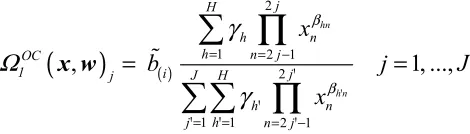
(
)
( )2
1 2 1 2
1 1 2 1
, 1, ...,
hn
h n
j H
h n
h n j OC
1 j i J H j
h n
j h n j x
b j J
where b( )i is the bias signal that can be thought as being generated by a ’dummy unit’
whose output is clamped at the scalar tii A more detailed description of the model may
be found in Fischer, Hlavackova-Schindler and Reismann (2001).
Summation Unit Model Versions
The summation unit version of the general class of product unit neural network
models of origin constrained spatial interaction may be easily derived from Equation
(5):
(
)
21 2 1
, 1, ...,
j H
OC
j h h hn n
j
h n j
x j J
ΣΩ ψ γ ϕ β
= = −
= =
∑
∑
x w (7)
where :ϕh ℜ → ℜ, :ψj ℜ → ℜ and
2J
∈ℜ
x as above. Specifying ϕh
( )
⋅ as logisticfunction for h = 1,...,N, and ψj
( )
⋅ as nonlinear normalized output transfer function weobtain the following origin constrained member of class (7)
(
)
( )1 2
1 2 1
1 2
1 1 2 1
1 exp
, 1, ...,
1 exp
j H
h hn n
h n j
OC
1 j i
j J H
h h n n
j h n j
x
b j J
x Σ γ β Ω γ β − = = − − = = = − + − = = + −
∑
∑
∑∑
∑
x w ' ' ' ' ' ' (8)4. A RATIONALE FOR THE ESTIMATION APPROACH
If we view a neural spatial interaction model, unconstrained or constrained, as
generating a family of approximations (as w ranges over W, say) to a spatial
interaction function g , then we need a way to pick a best approximation from this
family. This is the function of network learning (training, parameter estimation) which
might be viewed as an optimization problem.
We develop a rationale for an appropriate objective (loss, cost) function for this task.
is the most likely explanation of the observed data set, say M. We can express this as
attempting to maximize the term
( )
(
)
P M(
( )
( )
)
P(
( )
)
P M
P M
Ω
Ω w = w Ω w (9)
where Ω represents the neural spatial interaction model (with all the weights wH) in question, unconstrained or constrained. P M
(
Ω( )
w)
is the probability that the modelwould have produced the observed data M . Since sums are easier to work with than
products, we will maximize the log of this probability, and since this log is a monotonic
transformation, maximizing the log is equivalent to maximizing the probability itself. In
this case we have
( )
(
)
(
( )
)
(
( )
)
( )
lnP Ω w M =lnP M Ω w +lnP Ω w −lnP M (10)
The probability of the data,P M
( )
, is not dependent on the model. Thus, it issufficient to maximize lnP M
(
Ω( )
w)
+lnP(
Ω( )
w)
. The first of these termsrepresents the probability of the data given the model, and hence measures how well the
network accounts for the data. The second term is a representation of the model itself;
that is, it is a prior probability, that can be utilized to get information and constraints
into the learning procedure.
We focus solely on the first term, the performance, and begin by noting that the data
can be broken down into a set of observations, M =
{
zk =(
x yk, k)
k=1,...,K}
, each zk,we will assume, chosen independently of the others. Hence we can write the probability
of the data given the model as
( )
(
)
(
( )
)
(
( )
)
ln ln k ln k
k k
P M Ω w =
∏
P z Ω w =∑
P z Ω w (11)Note that this assumption permits to express the probability of the data given the model
given the model. We can still take another step and break the data into two parts: the
observed input data xk and the observed target yk. Therefore we can write
( )
(
)
(
( )
)
( )
ln ln k k and k ln k
k k
P M Ω w =
∑
P y x P xΩ w +∑
(12)Since we assume that xk does not depend on the model, the second term of the equation
will not affect the determination of the optimal model. Thus, we need only to maximize
the term ln
(
k k and( )
)
k P y x Ω
∑
w .Up to now we have – in effect – made only the assumption of the independence of
the observed data. In order to proceed, we need to make some more specific
assumptions, especially about the relationship between the observed input data xk and
the observed target data yk, a probabilistic assumption. We assume that the relationship
between xk and yk is not deterministic, but that for any given xk there is a distribution
of possible values of yk. But the model is deterministic, so rather than attempting to
predict the actual outcome we only attempt to predict the expected valued of yk given
k
x . Therefore, the model output is to be interpreted as the mean bilateral interaction
frequencies (that is, those from the region of origin to the region of destination). This is,
of course, the standard assumption.
To proceed further, we have to specify the form of the distribution of which the
model output is the mean. Of particular interest to us is the assumption that the
observed data are the realization of a sequence of independent Poisson random
variables. Under this assumption we can write the probability of the data given the
model as
( )
(
and)
( )
exp(
( )
)
!
k
y
k k
k
k k k
k P y x
y
Ω Ω
Ω =
∏
−w w
w (13)
and, hence, define a maximum likelihood estimator as a parameter vector ˆw which
(
)
(
( )
( )
)
max L , , max k yklnΩ k Ω k∈ = ∈
∑
−w W x y w w W w w (14)
Instead of maximizing the log-likelihood it is more convenient to view learning as
solving the minimization problem
(
)
(
)
min , , min L , ,
∈ = ∈ −
w W w W
x y w x y w
λ (15)
where the loss (cost) function λ is the negative log-likelihood L. λ is non-negative,
continuously differentiable on the Q-dimensional parameter space (Q=HN+ +H 1 in
the unconstrained case and Q=3Hin the constrained one) which is a finite dimensional
closed bounded domain and, thus, compact. It can be shown that λ assumes its value as
the weight minimum under certain conditions.
5. TRAINING THE NEURAL NETWORK MODELS
Since the loss function λ is a complex nonlinear function of w for the neural
spatial interaction models, ˆw cannot be found analytically and computationally
intensive iterative optimization techniques such as global search procedures must be
utilized to find (15). Simulated annealing, genetic algorithms and the Alopex2
procedure are attractive candidates for this task. We utilize the latter as described in
Fischer, Hlavackova-Schindler and Reismann (2001).
The loss function λ
( )
w is minimized by means of weight changes that arecomputed for the s-th step (s>2) of the iteration process as follows3,
( )
(
1)
( )
k k k
w s =w s− +δ s (16)
where δk
( )
s is a small positive or negative step of size δ with the following( )
with probability 1with probability k( )
( )
k k p s s p s δδ =+−δ −
(17)
The probability pk
( )
s for a negative step is given by the Boltzmann distribution( )
(
( ) ( )
)
11 exp /
k k
p s = + −C s T s − (18)
where
( )
( )
( )
k k
C s = ∆w s ∆λ s (19)
with
( )
(
1)
(
2)
k k k
w s w s w s
∆ = − − − (20)
and
( )
s(
s 1) (
s 2)
λ λ λ
∆ = − − − (21)
The parameter T in Equation (18), termed temperature in analogy to simulated
annealing, is updated using the following annealing schedule:
( )
( )
(
)
1
if is a multiple of
1 otherwise
s
k k s s S
C s s S
QS T s T s δ − = − = −
∑ ∑
' ' (22)where (Q=HN+ +H 1 in the case of the unconstrained models, and Q=3H in the
case of the constrained models) denotes the number of weights. When T is small, the
probability of changing the parameters is around zero if Ck is negative and around one
The effectiveness of Alopex in locating global minima and its speed of convergence
critically depend on the balance of the size of the feedback term ∆ ∆wk λ and the
temperature T. If T is very large compared to ∆ ∆wk λ the process does not converge. If
T is too small, a premature convergence to a local minimum might occur. The
procedure is governed by three parameters: the initial temperature T, the number of
iterations, S, over which the correlations are averaged for annealing, and the step size
δ. The temperature T and the S-iterations cycles seem to be of secondary importance
for the final performance of the algorithm. The initial temperature T may be set to a
large value of about 1,000. This allows the algorithm to get an estimate of the average
correlation in the first S iterations and reset it to an appropriate value according to
Equation (22). S may be chosen between 10 and 100. In contrast to T and S, δ is a
critical parameter that has to be selected heuristically with care. There is no way to a
priori identify δ in the case of multimodal parameter spaces.
The Termination Criterion
It has been observed that forceful training may not produce network models with
adequate generalization ability, although the learning error achieved is small. The most
common remedy for this problem is to monitor model performance during training to
assure that further training improves generalization as well. For this purpose an
additional set of validation data, independent from the training data is used. In a typical
training phase, it is normal for the validation error to decrease. This trend may not be
permanent, however. At some point the validation error usually reverses. Then the
training process should be stopped. In our implementation of the Alopex procedure
network training is stopped when κ =40, 000 consecutive iterations are unsuccessful.
κ has been chosen so large at the expense of the greater training time, to ensure more reliable estimates.
6. EXPERIMENTAL ENVIRONMENT, PERFORMANCE TESTS AND
BENCHMARK COMPARISONS
To illustrate the application of modeling and estimation tools discussed in the
The Benchmark Models
The standard unconstrained gravity model
1,..., ; 1,..., ;
grav
ij k ri s dj ij i I j J j i
α β γ
τ = − = = ≠ (23)
with
i j ij i j j
t k
r s dα β −γ
≠ =
∑∑
ii (24): ij
i j j
t t
≠
=
∑∑
ii (25)
serves as a benchmark model for the unconstrained neural spatial interaction models4,
that is, the classical models of type (2) and the less classical ones of type (4). grav ij
τ denotes the estimated flow from i to j, k is a factor independent of all origins and
destinations, α reflects the relationship of ri with grav ij
τ and β the relationship of sj
with τijgrav. γ is the distance sensitivity parameter, γ >0. ri and sj are measured in
terms of the gross regional product, dij in terms of distances from i to j, whereas tij in
terms of erlang (see Fischer and Gopal 1994 for more details).
The standard origin constrained gravity model
( ) 1,... ; 1,..., ;
orig grav
ij bi sj dij i I j J j i
α γ
τ = − = = ≠ (26)
with
( )i i j ij j i
t b
s dα −γ
≠
=
∑
i (27): i ij j i t t ≠ =
∑
i (28)
is used as benchmark model for the constrained neural spatial interaction models (6)
and (8). b( )i is the origin specific balancing factor. , ,α γ sj, dij and tij are defined as
above.
Performance Measure
One needs to be very careful when selecting a measure to compare different models.
It makes not much sense to utilize least squares related performance measures, such as
the average relative variances or the standardized root mean square, in the context of
our ML estimation approach. Model performance is measured in this study by means of
Kullback and Leibler’s (1951) information criterion (KLIC) which is a natural
performance criterion for the goodness-of-fit of ML estimated models:
( )
(
)
(
)
1 ' ' 1 1 1 ' '' 1 ' 1
ln , , Ω Ω − = − = = = =
∑
∑
∑
∑
U u u U u u U U uu u u
u u
y y
y KLIC M
y x w x w
(29)
where
(
x yu, u)
denotes the u-th pattern of the data set M , and Ω is the neural spatialinteraction model under consideration. The performance measure has a minimum at
zero and a maximum at positive infinity when yu >0 and Ω
( )
xuw =0 for any(
x yu, u)
pair.
The Data, Data Splitting and Bootstrapping
To model interregional telecommunication flows for Austria we utilize three
Austrian data sources – a (32, 32)-interregional telecommunication flow matrix
( )
tij , a(32, 32)-distance matrix
( )
dij , and gross regional products for the 32telecommunication regions – to produce a set of 992 4-tupel
(
r s d ti, j, ij; ij)
with(
)
, 1,...,322j 1
x − and x2j of the j-th module of the origin constrained network models, and the last
component the target output. The bias term b( )i is clamped to the scalar tii. sj
represents the potential draw of telecommunication in j and is measured in terms of the
gross regional product, dij denotes distances from i to j, while tij represents
telecommunication traffic flows. The input data5 were rescaled to lie in [0.1, 0.9].
The telecommunication data stem from network measurements of carried traffic in
Austria in 1991, in terms of erlang, an internationally widely used measure of
telecommunication contact intensity, which is defined as the number of phone calls
(including facsimile transfers) multiplied by the average length of the call (transfer)
divided by the duration of measurement(for more details, see Fischer and Gopal 1994).
The data refer to the telecommunication traffic between the 32 telecommunication
districts representing the second level of the hierarchical structure of the Austrian
telecommunication network. Due to measurement problems, intraregional traffic (i.e.
i = j) is left out of consideration.
The standard approach to evaluate the out-of-sample [prediction] performance of a
neural spatial interaction model (see Fischer and Gopal 1994) is to split the total data
set M of 992 samples into three subsets: the training [in-sample] set
(
)
{
}
1 u1, u1 with 1 1,..., 1 496 patterns
M = x y u = U = , the internal validation set
(
)
{
}
2 u2, u2 with 2 1,..., 2 248 patterns
M = x y u = U = and the testing [prediction,
out-of-sample] set M3=
{
(
xu3,yu3)
with 3 1,...,u = U3 =248 patterns}
. M1 is used only forparameter estimation, while M2 for validation. The generalization performance of the
model is assessed on the testing set M3. It has become common practice to fix these
sets. But recent experience has found this approach to be very sensitive to the specific
splitting of the data. To overcome this problem as well as the problem of scarce data we
make use of the bootstrapping pairs approach (Efron 1982) with replacement. This
approach combines the purity of splitting the data into three disjoint data sets with the
power of a resampling procedure and allows us also to get a better statistical picture of
the prediction variability.
The idea behind this approach is to generate B pseudo-replicates of the training,
validation and test sets, then to re-estimate the model parameters w on each training
out-of-sample performance of the test bootstrap out-of-samples. In this bootstrap world, the errors of
prediction and the errors in the parameter estimates are directly observable. Statistics on
parameter reliability can easily be computed.
Implementing the approach involves the following steps (see Fischer and Reismann
2000):
Step 1: Conduct three totally independent re-sampling operations in which B
independent training bootstrap samples, B independent validation bootstrap
samples and B independent testing bootstrap samples are generated, by
randomly sampling U1, U2 and U3 times, respectively, with replacement
from the observed input-output pairs M.
Step 2: For each training bootstrap sample the minimization problem (15) is solved
by applying the Alopex procedure. During the training process the KLIC
performance of the model is monitored on the corresponding bootstrap
validation set. The training process is stopped as specified in Section 5.
Step 3: Calculate the KLIC-statistic of generalization performance for each test
bootstrap sample. The distribution of the pseudo-errors can be computed,
and used to approximate the distribution of the real errors. This
approximation is the bootstrap.
Step 4: The variability of the B bootstrap KLIC-statistics gives an estimate of the
expected accuracy of the model performance. Thus, the standard errors of
the generalization performance statistic is given by the sample standard
deviation of the B bootstrap replications.
Performance Tests and Results
We consider first
to model the unconstrained case of spatial interaction, and then
• the modular product unit neural network version πΩ1OC [see Equation (6)] and
• the modular summation unit neural network version OC
1
ΣΩ [see Equation (8)]
of singly constrained neural spatial interaction models to model the origin constrained
case. Conventional gravity model specifications [see Equations (23)-(25) for the
unconstrained case and Equations (26)-(28) for the origin constrained case] serve as
benchmark models.
All the models were calibrated by means of the ML-estimation approach utilizing
the Alopex procedure to eliminate the effect of different estimation procedures on the
result. In order to do justice to each model specification, the critical Alopex parameter
δ [step size] was systematically sought for each model. The Alopex parameters T and
S were set to 1,000 and 10, respectively. We made use of the bootstrapping pairs
approach [B = 60] to overcome the problem of sensitivity to the specific splitting of the
data into in-sample, internal validation and generalization data sets, and the scarcity of
data, but also to get a better statistical picture of prediction variability.
It should be emphasized that the main goal of training is to minimize the loss
function λ. But it has been observed that forceful training may not produce network
models with adequate generalization ability. We adopted the most common remedy for
this problem and checked the model performance in terms of KLIC M
( )
2 periodicallyduring training to assure that further training improves generalization, the so-called
cross-validation technique.
Alopex is an iterative procedure. In practice, this means that the final results of
training may vary as the initial weight settings are changed. Typically, the likelihood
functions of feedforward neural network models have many local minima. This implies
that the training process is sensitive to its starting point. Despite recent progress in
finding the most appropriate parameter initialization that would help Alopex – but also
other iterative procedures – to find near optimal solutions, the most widely adopted
approach still uses random weight initialization. In our experiments random numbers
The order of the input data presentation was kept constant for each run to eliminate its
effect on the result.
The Case of Unconstrained Spatial Interactions: Extensive computational experiments
with different combinations of H- and δ -values have been performed on DEC Alpha
375 Mhz, with H∈
{
2, 4, 6,8,10,12,14}
and{
0.0005, 0.0010, 0.0025, 0.0050, 0.0100, 0.0250, 0.0500, 0.1000}
δ∈ . Selected results of
these experiments
[
H =2, 4, 6,8,10,12,14 and δ =0.0005, 0.0010, 0.0050, 0.0100]
arereported in TABLE 1. Training performance is measured in terms of KLIC M
( )
1 ,validation performance in terms of KLIC M
( )
2 and testing performance in terms of( )
3KLIC M . The performance values represent the mean of B=60 bootstrap replications, standard deviations are given in brackets.
PLACE TABLE 1 ABOUT HERE
Some considerations are worth making. First, the best result (averaged over the 60
independent simulation runs) in terms of average out-of-sample KLIC-performance was
obtained with H =12 and δ =0.0010 in the case of the summation unit neural network model, and with H =14 and δ =0.0005 in the case of the product unit neural network
model. Second, there is convincing evidence that the summation unit model
outperforms the product unit model version at any given level of model complexity.
This is primarily due to the fact that the input data of ΩL were preprocessed to
logarithmically transformed data scaled to [0.1, 0.9]. Third, it can be seen that model
approximation improves as the complexity of πΩL grows with increasing H (except H =
12). This appears to be less evident in the case of the summation unit model version.
Fourth, the experiments also suggest that δ =0.0010 tends to yield the best or at least rather good generalization performances in both cases of neural network models. The
poorest generalization performance of the summation unit network is obtained for
0.0005
δ = (except: H = 8) while δ =0.0100 leads to the poorest results in the case of
the product unit network model (except H = 2 and 12). Fifth, as already mentioned
above, forceful training may not produce the network model with the best
generalization ability. This is evidenced for H =2, 10, 12, 14 in the case of ΩL, and H =
variations in parameter initializations. Most of the variability in prediction performance
is clearly coming from sample variation and not from variation in parameter
initializations as illustrated in Fischer and Reismann (2000). This implies that model
evaluations based on one specific static split of the data only, the current practice in
neural spatial interaction modeling (see, for example, Bergkvist 2000; Reggiani and
Tritapepe 2000; Mozolin, Thill and Usery 2000), have to be considered with great care.
PLACE TABLE 2 ABOUT HERE
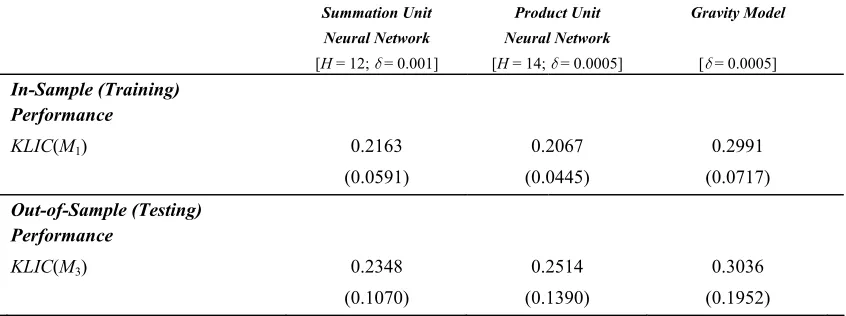
TABLE 2 summarizes the simulation results for the unconstrained neural network
models in comparison with the gravity model. Out-of-sample performance is measured
in terms of KLIC M
( )
3 . For matters of completeness, also training performance valuesare displayed. The figures represent averages taken over 60 independent simulations
differing in the bootstrap samples and in the initial parameter values randomly chosen
from [-0.3, 0.3].
If out-of-sample [generalization] performance is more important than fast learning,
then the neural network models exhibit clear and statistically significant superiority. As
can be seen by comparing the KLIC-values the summation unit neural network model
ranks best, followed by the product unit model and the gravity model. The average
generalization performance, measured in terms of KLIC M
( )
3 , is 0.2348 (H = 12),compared to 0.2514 in the case of πΩL (H = 14), and 0.3036 in the case of τgrav
. These
differences in performance are statistically significant6. If, however, the goal is to
minimize execution time and a sacrifice in generalization accuracy is acceptable, then
the gravity model is the model of choice. The gravity model outperforms the neural
network models in terms of execution time, the summation unit network model by a
factor of 50 and the product unit network model by a factor of 30. But note that this is
mainly caused by two factors: first, that our implementations were done on a serial
platform even though the neural network models are parallelizeable, and, second, that
we implemented a rather time consuming termination criterion (κ =40, 000) to stop the
training process.
The Origin Constrained Case of Spatial Interactions: TABLE 3 presents some
and δ∈
{
0.0005, 0.0010, 0.0500, 0.1000}
. Again some considerations are worth making.First, a comparison with TABLE 1 illustrates that the consideration of a priori
information in form of origin constraints clearly improves the generalization
performance more or less dramatically. Second, the best result (averaged over the 60
independent simulation runs) in terms of average KLIC M
( )
3 was achieved with H = 8 and δ =0.0500 in both cases, the origin constrained summation unit neural network model ΣΩ1OC, and the origin constrained product unit neural network model, πΩ1OC.Third, the summation unit model version slightly outperforms the product unit version.
Again this is primarily due to the logarithmic transformation of the input data in the
case of Σ OC 1
Ω . Fourth, model approximation improves as the complexity of the model grows with increasing H [up to H = 8, except H = 6 in the case of ΣΩ1OC]. Fifth, there is
clear evidence that δ =0.0500 tends to lead to the best results (except H = 6 in the case
of ΣΩ1OC), while δ =0.0005 tends to yield the poorest results, with only two
exceptions (H = 2 and 4) in the case of OC
1
ΣΩ . Sixth, there is strong evidence that the
origin constrained neural network models are much less robust with respect to the
choice of the Alopex parameter δ in comparison to their unconstrained counterparts,
while the variability in prediction performance over changes in training, internal
validation and test samples, and parameter initialization is lower. Finally it is interesting
to note that forceful training encourages πΩ1OC to produce the best generalization
ability in all cases considered.
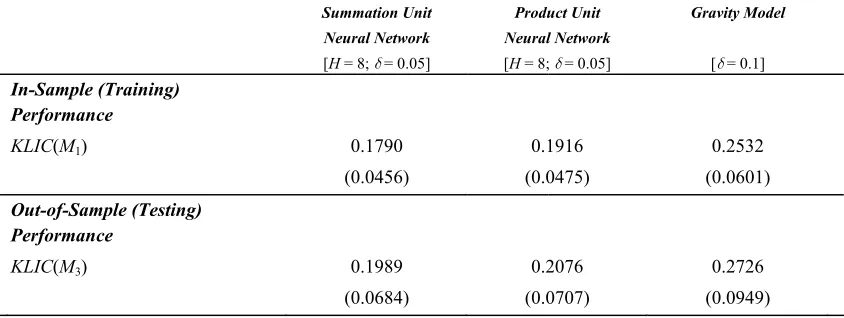
TABLE 4 reports the simulation results for the origin constrained neural network
models, ΣΩ1OC and πΩ1OC, in comparison with origτgrav. Training and generalization
performance are displayed. The figures represent again averages taken over 60
simulations differing in parameter initialization and bootstrap samples as in the other
tables. The modular summation unit neural network performs best, closely followed by
the product unit model version. Both outperform the gravity model predictions7. The
average out-of-sample performance of OC
1
ΣΩ with H = 8, measured in terms of
( )
3KLIC M , is 0.1989, compared to 0.2076 in the case of πΩ1OC with H = 8, and 0.2726
in the case of origτgrav
. The gravity model would be the model of choice if the goal
would be to minimize execution time and a sacrifice in generalization would be
7. SUMMARY AND DIRECTIONS FOR FUTURE RESEARCH
In this contribution a modest attempt has been made to provide a unified framework for
neural spatial interaction modeling including the case of unconstrained and that of
origin constrained spatial interaction flows. We suggested and used a more suitable
estimation approach than available in literature, namely maximum likelihood estimation
under distributional assumptions of Poisson processes. In this way we could avoid the
weakness of least squares and normality assumptions that ignore the true integer nature
of the flows and approximate a discrete-valued process by an almost certainly
misrepresentative continuous distribution. Alopex, a powerful global search procedure,
was used to solve the maximum likelihood estimation problem.
Randomness enters in two ways in neural spatial interaction modeling: in the
splitting of the data into training, internal validation and test sets on the one side and in
choices about parameter initialization on the other. The paper suggests the
bootstrapping pairs approach to overcome this problem as well as the problem of scarce
data. In addition one receives a better statistical picture of the variability of the
out-of-sample performance of the models. The approach is attractive, but computationally
intensive. Each bootstrap iteration requires a run of the Alopex procedure on the
training bootstrap set. In very large real world problem contexts this computational
burden may become prohibitively large.
Although the discussion has been centered on several general families of neural
spatial interaction models, only one of the vast number of neural network architectures
and only one – even though powerful – estimation approach were considered. Thus, we
emphasize that our results are only a first step towards a more comprehensive
methodology for neural spatial interaction modeling. There are numerous important
areas for further investigation. Especially desirable is the design of a neural network
approach suited to deal with the doubly constrained case. Another area for further
research is greater automation of the cross-validation training approach to control
maximum model complexity by limiting the number of hidden units. Finding good
global optimization methods for solving the non-convex training problems is still an
important area for further research even though some relevant work can be found in
deserves further research activities to come up with methods that go beyond the current
rules of thumb. We hope that this paper will inspire others to pursue the investigation in
neural spatial interaction modeling further as we finally believe that this field is an
Endnotes
1
Sigmoid transfer functions such as the logistic function are somewhat better behaved than many other functions with respect to the smoothness of the error surface. They are well behaved outside of their local region in that they saturate and are constant at zero or one outside the training region. Sigmoidal units are roughly linear for small weights [net input near zero] and get increasingly nonlinear in their response as they approach their points of maximum curvature on either side of the midpoint.
2
Alopex is an acronym for algorithm for pattern extraction. 3
For the first two iterations, the weights are chosen randomly. 4
There is virtual unanimity of opinion that site specific variables, such as sj in this case, are generally
best represented as power functions. The specification of fij is consistent with general consensus that
the power function is more appropriate for analyzing longer distance interactions (Fotheringham and O’Kelly 1989).
5
In the case of the summation unit model versions the input data were preprocessed to logarithmically transformed data scaled into [0.1, 0.9].
6
assessed by means of the Wilcoxon-Test (comparison of two paired samples). The differences between ΩL and
grav
τ are statistically significant at the 1 % level (Z = -3.740, Sig. 0.000) as are the differences between L
π
Ω and τgrav (Z = -3.269, Sig. 0.001). But the differences between ΩL and L
π
Ω
are not statistically significant at the 1 % level (Z = -1.436, Sig. 0.151). 7
The differences between OC 1
Σ
Ω and origτgrav are statistically significant at the 1 % level (Z = -6.684, Sig. 0.000) as are the differences between OC
1
π
Ω and origτgrav (Z = -6.714, Sig. 0.000), while the differences between the neural network models are not statistically significant at the 1 % level (Z = -2.481, Sig. 0.130).
REFERENCES
Bergkvist, E. (2000). “Forecasting Interregional Freight Flows by Gravity Models.”
Jahrbuch für Regionalwissenschaft 20, 133-48.
Bergkvist, E. and L. Westin (1997). Estimation of Gravity Models by OLS Estimation,
NLS Estimation, Poisson and Neural Network Specifications. CERUM Regional
Dimensions, Working Paper No. 6.
Bia, A. (2000). A Study of Possible Improvements to the Alopex Training Algorithm.
In Proceedings of the VIth Brazilian Symposium on Neural Networks, pp. 125-130.
IEEE Computer Society Press.
Black, W.R. (1995). “Spatial Interaction Modelling Using Artificial Neural Networks.”
Journal of Transport Geography 3(3), 159-66.
Cover, T.M. (1965). “Geometrical and Statistical Properties of Systems of Linear
Inequalities with Applications in Pattern Recognition.” IEEE Transactions on
Electronic Computers 14, 326-34.
Efron B (1982). The Jackknife, the Bootstrap and Other Resampling Plans.
Philadelphia: Society for Industrial and Applied Mathematics.
Fischer, M.M. and S. Gopal (1994). “Artificial Neural Networks: A New Approach to
Modelling Interregional Telecommunication Flows.” Journal of Regional Science
34(4), 503-27.
Fischer, M.M. and Y. Leung (1998). “A Genetic-Algorithms Based Evolutionary
Computational Neural Network for Modelling Spatial Interaction Data.” The Annals
of Regional Science 32(3), 437-58.
Fischer, M.M. and Y. Leung (eds.) (2001). GeoComputational Modelling: Techniques
and Applications. Berlin, Heidelberg and New York: Springer.
Fischer, M.M. and M. Reismann (2000). Evaluating Neural Spatial Interaction
Modelling by Bootstrapping. Paper Presented at the 6th World Congress of the
Regional Science Association International, Lugano, Switzerland [accepted for
Fischer, M.M., K. Hlavackova-Schindler and M. Reismann (1999). “A Global Search
Procedure for Parameter Estimation in Neural Spatial Interaction Modelling.”
Papers in Regional Science 78, 119-34.
Fischer, M.M., M. Reismann and K. Hlavackova-Schindler (2001). Neural Network
Modelling of Constrained Spatial Interaction Flows, Paper Presented at the 41th
Congress of the European Regional Science Association, Zagreb, Croatia [accepted
for publication in the Journal of Regional Science].
Fotheringham, A.S. and M.E. O’Kelly (1989). Spatial Interaction Models:
Formulations and Applications. Dordrecht, Boston and London: Kluwer.
Giles, C. and T. Maxwell (1987). “Learning, Invariance, and Generalization in
High-Order Neural Networks.” Applied Optics 26(23), 4972-8.
Gopal, S. and M.M. Fischer (1993). Neural Net Based Interregional Telephone Traffic
Models. In Proceedings of the International Joint Conference on Neural Networks
IJCNN 93 Nagoya, Japan, October 25-29, pp. 2041-4.
Gopal, S. and M.M. Fischer (1996). “Learning in Single Hidden-Layer Feedforward
Network Models: Backpropagation in a Spatial Interaction Context.” Geographical
Analysis 28(1), 38-55.
Kullback, S. and R.A. Leibler (1951). “On Information and Sufficiency.” Annals of
Mathematical Statistics 22, 78-86.
Longley, P.A., S.M. Brocks, R. McDonnell and B. MacMillan (eds.) (1998).
Geocomputation: A Primer. Chichester: John Wiley.
Mozolin, M., J.-C. Thill and E.L. Usery (2000). “Trip Distribution Forecasting with
Multilayer Perceptron Neural Networks: A Critical Evaluation.” Transportation
Research B 34, 53-73.
Nijkamp, P., A. Reggiani and T. Tritapepe (1996). Modelling Intra-Urban Transport
Flows in Italy. TRACE Discussion Papers TI 96-60/5, Tinbergen Institute, The
Netherlands.
Openshaw, S. (1993). “Modelling Spatial Interaction Using a Neural Net.” In
Geographic Information Systems, Spatial Modeling, and Policy Evaluation, edited
by M.M. Fischer and P. Nijkamp, pp. 147-64. Berlin, Heidelberg and New York:
Press, W.H., S.A. Teukolsky, W.T. Vetterling and B.P. Flannery (1992). Numerical
Recipes in C: The Art of Scientific Computing. Cambridge: University Press.
Reggiani, A. and T. Tritapepe (2000). “Neural Networks and Logit Models Applied to
Commuters’ Mobility in the Metropolitan Area of Milan.” In Neural Networks in
Transport Applications, edited by V. Himanen, P. Nijkamp and A. Reggiani, pp.
111-29. Aldershot: Ashgate.
Rumelhart, D.E., R. Durbin R., R. Golden and Y. Chauvin (1995). “Backpropagation:
The Basic Theory.” In Backpropagation: Theory, Architectures and Applications,
edited by Y. Chauvin and D.E. Rumelhart, pp. 1-34. Hillsdale [NJ]: Lawrence
Erlbaum Associates.
Thill, J.-C. and M. Mozolin (2000). ”Feedforward Neural Networks for Spatial
Interaction: Are they Trustworthy Forecasting Tools?” In Spatial Economic Science:
New Frontiers in Theory and Methodology, edited by A. Reggiani, pp. 355-81.
Berlin, Heidelberg and New York: Springer.
Young, T.Y. and T.W. Calvert (1974). Classification, Estimation and Pattern
List of Figures:
FIG. 1. Architecture of the Unconstrained Summation Unit Neural Spatial Interaction Models as Defined by Equation (1) for N = 3
FIG. 2. Architecture of the Unconstrained Product Unit Neural Spatial Interaction Models as Defined by Equation (3) for N = 3