Performance Study and Determining the
Strength of Concrete by Addition of Class-E
Glass Fiber
Dr.G.Gowthamakumar
1, Dr.K.Nirmalkumar
2*, M.Karthick
3Assistant Professor, Dept. of Civil Engineering, Institute Of Road and Transport Technology, Erode,
Tamil Nadu, India1
Professor, Dept. of Civil Engineering, Kongu Engineering College, Erode, Tamil Nadu, India2
P.G. Student, Dept. of Civil Engineering, Kongu Engineering College, Erode, Tamil Nadu, India3
ABSTRACT: Glass-fiber reinforced concrete (GFRC) is cementitious matrix composed of cement, sand, water and
admixtures, in which the glass fibres are dispersed. It has been used in the construction industry for non-structural elements, like facade panels, piping and channels. GFRC has advantages, such as fire resistant, good appearance and strength. Normally, concrete suffers from low tensile strength, limited ductility and little resistance to cracking. To improve these properties and an attempt has been made to study the effect of addition of glass fibers in Concrete. In this investigation, the Compressive Strength, Split Tensile Strength, Flexural Strength and workability of concrete containing varying proportions of glass fiber and 10mm of Coarse Aggregate is studied. The result of these parameters is compared w i t h standard M25 grade concrete. The addition of glass fiber decreases the workability of the concrete, so we added admixtures to the concrete. Class-E glass fiber used in this project at different percentages varying from 0% to 1.5% with the concrete mix. In this project, trial tests for concrete with glass fiber and without glass fiber is conducted to indicate the differences in compressive strength, flexural strength and split tensile strength by using specimen of varying sizes.
KEYWORDS:Glass Fiber, Reinforced Concrete, Class-E Glass Fiber, Workability and Admixtures.
I. INTRODUCTION
Fiber glass is a lightweight, extremely strong and robust material. Glass fiber reinforced polymer (GFRP) is being used in concrete structures, and this material has many advantages over conventional steel reinforcement. It has a high strength-to-weight ratio. Its bulk strength and weight properties are also very favorable when compared to metals and it can be easily formed using molding process. The addition of Glass Fibers on the Concrete gives desired strengths than the conventional concrete mixes So, it is used for concreting purpose. It has good insulating property so we can use this concrete in electrical pipe constructions.
II. TYPES OF GLASS FIBER
A-GLASS FIBER
It is window glass. Soda lime glass with high alkali content between 10-15%. Very poor mechanical properties but high resistant to chemical attacks.
C-Glass Fiber
This glass fiber shows better resistance to chemical impact. Mainly used in the form of surface tissue in the outer layer of laminates used in chemical and water pipes and tanks.
D-Glass Fiber
Improved dielectric glass developed for high performance electronic applications. E-Glass Fiber
R, S (or) T-Glass Fiber
Having higher Tensile strength and modulus than E-Glass, with better wet strength retention.
CHEMICAL COMPOSITION OF E-GLASS FIBER
Table 1: Chemical Composition of E-Glass Fiber
PROPERTIES OF E-GLASS FIBER:
Good electrical insulator High strength and High stiffness Low density and Non-flammable Resistant to heat and chemical attack
COMPARISON OF E-GLASS FIBER WITH OTHER GLASS FIBERS:
Table 2: Comparison of E-Glass Fiber with other Glass Fibers
Materials Density
(g/cm3)
Tensile strength (MPa)
Youngs Modulus (GPa) E-Glass 2.55 2000 80 S-Glass 2.49 4750 89 Alumina 3.28 1950 297 Carbon 2.00 2900 525 Kelvar 29 1.44 2860 64 Kelvar 49 1.44 3750 136
APPLICATIONS OF GLASS FIBER REINFORCED CONCRETE: Architectural Panels
Sound Walls Ducts and Channels Sewer Lining Seismic Retrofitting
III.MATERIALTESTANDTHEIRRESULTS
1.TEST RESULTS FOR CEMENT:
1.Consistency Test of Cement for the percentage of water added to the 5mm penetration is 32% 2.The Initial Setting Time of cement is 36 min 32 seconds.
3.The Final Setting Time of Cement is 86 min 20 sec (1Hr. 26Min. 20Sec) 2.TEST RESULTSFOR COARSE AGGREGATE:
1.The Specific gravity of Coarse Aggregate is 2.67 2.Aggregate impact value = 16.2%
3.Aggregate Crushing value = 19.4% 4.Water Absorption = 0.65%
3.TESTS FOR FINE AGGREGATE: 1.Specific Gravity = 2.52
Composition Percentage
SiO2 54%
Al2O3 14%
CaO + MgO 22%
2.Seive analysis values
Percentage of Gravel (>4.75mm) = 3.14% Percentage of Sand (4.75mm - 0 .75mm) = 96.84% Percentage of Silt + Clay (<0.075mm) = 0.02 Sand Zone = III 3.Water Absorption = 2.1%
4.Moisture Content in Fine Aggregate = 1.3%
MIX DESIGN
The process of selecting suitable raw materials to achieve required strength is termed the concrete mix design.
MIX RATIO:
Table 3: Mix Ratio
Water (litre)
Cement (kg/m3)
Fine Aggregate (kg/m3)
Coarse Aggregate (kg/m3)
138 320 320 640
0.5 1 1.4 2.5
EXPERIMENTAL INVESTIGATION OF FRESH CONCRETE:
1.Compacting Factor = 0.86 2.True Slump Value = 35mm
IV.PREPARATION,CASTINGANDTESTINGOFSPECIMENS
First we started with conventional concrete mix for M25 grade with 10mm Coarse aggregate, fine aggregate and 53 grade Cement. We mixed concrete with mixer machine and casted the conventional concrete mix. After 24 hrs we removed the mould and placed the cubes for curing for different intervals like 7 days, 14 days and 28 days. After curing process the specimens are taken for testing, for cubes compressive strength is tested.
After finishing and testing the conventional concrete mix, we add class E glass fiber into concrete mix it decreases workability, so to increase workability we added admixtures.
By adding Glass fiber to make concrete stronger than the conventional concrete. By adding different percentages of Glass fibers we found out in which percent concrete gets Maximum strength compared to other percentage. First started with 0.5% glass fiber.
A regular concrete mix started with mixer machine and 0.5% of Glass fiber is added after a well mix with fiber 20ml of admixture is added with the concrete mix and the concrete is poured to the moulds of cubes and cylinder , after 24hrs it is remoulded and then put into curing. These cubes are tested with different intervals like 7days, 14days and 28days. Results are noted. By adding 1% and 1.5% of Glass fibers the regular process happened and tested and the results are noted.
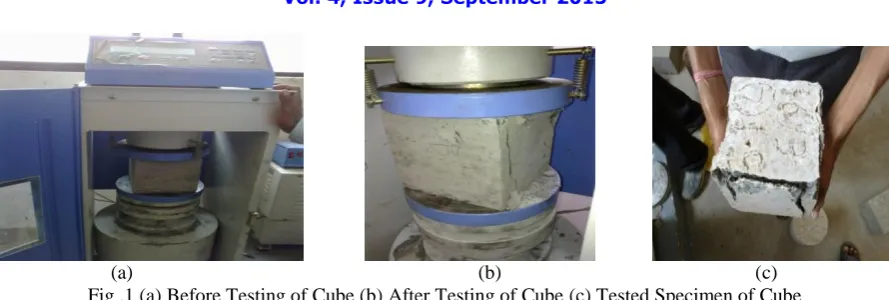
COMPRESSION TEST
Compressive strength is measured by breaking cube specimen by compression testing machine. The compressive strength is calculated from the failure load divided by cross section area resisting the load. Compressive strength test result are primarily used to determine that the concrete mix meets the requirements of specified strength.
The most common age at testing is 28 days, but tests can be made at 7 & 14 days also. At the time of testing the specimen is placed in a "Compression Testing Machine" with the position of cubes at right angles to the position of cast. The load is applied at a constant rate of stress within the range of 0.2 to 0.4 MPa/sec.
(a) (b) (c) Fig .1 (a) Before Testing of Cube (b) After Testing of Cube (c) Tested Specimen of Cube
Compressive Strength of Nominal Concrete
In order to compare the results obtained by adding varying amounts of glass fiber, Portland pozzolana cement concrete with 0% of the fiber is also prepared with the same material. The results of the compressive strength after 7 days 14 days and 28 days of curing are as presented in Table.
Table 4:Compressive Strength of Nominal Concrete
Specimen No.
Curing Days Compressive Strength
(N/mm2)
Average Compressive Strength (N/mm2)
1.
7
22.3
21.57
2. 21.0
3. 21.4
1.
14
27.5
26.2
2. 24.3
3. 26.8
1.
28
29.6
28.6
2. 28.2
3. 28
Table 5: Compressive Strength of Glass Fiber Concrete
Specimen No.
% of Glass Fiber
Curing Days
Compressive Strength
(N/mm2)
Average Compressive Strength
(N/mm2)
1.
0.5 7
28.4
25.16
2. 23.0
3. 24.1
1.
0.5 14
28.6
28.86
2. 28.4
3. 29.59
1.
0.5 28
31.8
31.6
2. 31
3. 32
2. 27
3. 28
1.
1 14
31
31.9
2. 33.2
3. 31.5
1.
1 28
35.6
34.23
2. 32.9
3. 34.2
1.
1.5 7
22.0
20.8
2. 20.1
3. 20.3
1.
1.5 14
31.6
29.83
2. 28.91
3. 29
1.
1.5 28
31.0
31.7
2. 32.6
3. 31.5
(a) (b)
(c) (d)
Fig.2 : (a) Seven Days Compressive Strength (b) Fourteen Days Compressive Strength (c)Twenty Eight Days (d) Compressive Comparison of Compressive Strength
Flexural Strength of Nominal Concrete
It is the measure of the tensile strength of concrete. It is a measure of an unreinforced concrete beam to resist failure in bending. It is measured by loading (150mm x 150-mm) concrete beams with a span length at least three times the depth. The flexural strength is expressed as Modulus of Rupture in MPa and is determined by standard test methods third-point loading or center-point loading. Flexural Strength of Concrete is about 10 to 20 percent of compressive strength depending on the type, size and volume of coarse aggregate used. However, the best correlation for specific materials is obtained by laboratory tests for given materials and mix design. The modulus of determined by third-point loading is lower than the modulus of rupture determined by center-point loading, sometimes by as much as 15%.
(a)
(b) (c)
Fig.5 (a)
Before Testing of Prism(b) After Testing of Prism(c)
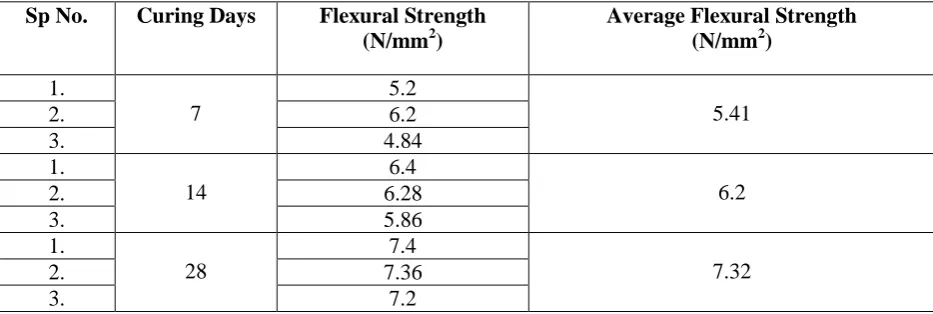
Tested Specimen of PrismIn order to compare the results obtained by adding varying amounts of glass fiber, Portland pozzolana cement concrete with 0% of the fiber is also prepared with the same material. The results of the Flexural strength after 7 days 14 days and 28 days of curing are as presented in Table.
Table 7: Flexural Strength of Nominal Concrete
Sp No.
Curing Days
Flexural Strength
(N/mm
2)
Average Flexural Strength
(N/mm
2)
1.
7
5.2
5.41
2.
6.2
3.
4.84
1.
14
6.4
6.2
2.
6.28
3.
5.86
1.
28
7.4
7.32
2.
7.36
3.
7.2
Table 8: Flexural Strength of Glass Fiber Concrete
Specimen No.
Percentage of Glass Fiber
Curing Days
Flexural
Strength(N/mm2)
Average Flexural
Strength(N/mm2)
1.
0.5 7
5.8
5.933
2. 6
3. 6
1.
0.5 14
7.3
8.02
2. 7
1.
0.5 28
8
8.1
2. 8.2
3. 8.1
1.
1 7
6.9
6.6
2. 6.5
3. 6.6
1.
1 14
7.3
7.16
2. 7
3. 7.2
1.
1 28
8.1
8.23
2. 8.2
3. 8.4
1.
1.5 7
6.3
6.33
2. 6.2
3. 6.5
1.
1.5 14
7.4
7.33
2. 7.2
3. 7.1
1.
1.5 28
7.4
7.46
2. 7.4
3. 7.6
(a)
(b)
(c) (d)
V. CONCLUSION
The addition of Glass Fibers into the concrete mixture marginally improves the compressive strength at 28 days. It is observed from the experimental results and its analysis, that the compressive strength of concrete, splitting tensile strength of concrete and flexural strength of concrete increases with addition of percentage of Glass Fibers. The addition of 1% Glass Fibers into the concrete shows better result than the other proportions.
Glass Fiber helps concrete to increase compressive strength until indicated limit. A limit exists to a particular percentage from Glass Fiber mixed with concrete because increasing it affects on the bond of materials as is seen in the result. For 1% of cementitious weight gained best results are obtained as compared to other results.
By using 10 mm of coarse aggregate more air entraining is decreased in the concrete.The use of Fiber Glass in concrete, not only improves the properties of concrete and can do a small cost cutting, but also provides an easy outlet of the efficient disposal of this environmental hazard.GFRC products have been used for architectural purposes for many years but the development and innovation of GFRC industries suggest many new applications like: water storage tanks, septic tanks, coastal and marine structures, water and waste water pipelines and etc.
REFERENCES
[1] Indian Standard Plain and Reinforced Concrete Code of Practice. IS 456:2000. [2] Indian Standard Recommended Guidelines for Concrete Mix Design.IS 10262:1982. [3] Indian Standard Concrete Admixtures-Specification. IS 9103:1999.
[4 ] M.S.Shetty, (2010), “Concrete Technology”, Theory and Practice.
[5 ] P.K.Mallick, (2012), “Fiber-einforced Composites” Materials, Manufacturing and Design, Third Edition.
[6] Eng. Pshtiwan N.Shakor and Prof.S.S.Pimplikar “Glass Fiber Reinforced Concrete Use in Construction” AKGEC Journal of Technology. Vol 2, No.1
[7] Deshmukh S.H., Bhusari J. P and Zende A.M, ( 2012), “Effect of Glass Fibres on Ordinary Portland cement Concrete”. IOSR Journal of Engineering, Vol 2(6) pp: 1308-1312.
[8] Yogesh Iyer Murthy, Apoorv Sharda and Gourav Jain, (2012), “Performance of Glass Fiber Reinforced Concrete”. International Journal of Engineering and Innovative Technology (IJEIT) Volume 1, Issue 6.
[9] Chandramouli.K., Srinivasa Rao.P., Pannirselvam.N., Seshadri Sekhar.T and Sravana.P, (2010), “Strength Properties of Glass Fiber Concrete”. ARPN Journal of Engineering and Applied Sciences. Volume 5, No.4
[10] Surendra P.Shah, James I.Daniel and Darmawan Ludirdja, (1987), “Toughness of Glass Fiber Reinforced Concrete Panels Subjected to Accelerated Aging” PCI Journal.
[11] K.Vijai, R.Kumutha and B.G.Vishnuram, (2012), “Properties of Glass Fiber Reinforced Geopolymer Concrete Composites”. Asian Journal of Civil Engineering (Building and Housing) Vol. 13, No. 4 Pages 511-520.