Improving the Recognition of Handwritten Characters
using Neural Network through Multiresolution Technique
and Euclidean Distance Metric
D. K. Patel
Department of AppliedMathematics, Institute of Technology, Banaras Hindu University,
Varanasi, India
T. Som
Department of AppliedMathematics, Institute of Technology, Banaras Hindu University,
Varanasi, India
M. K. Singh
DST Centre for Interdisciplinary MathematicalSciences, Faculty of Science, Banaras Hindu University,
Varanasi, India
ABSTRACT
Good recognition accuracy can be achieved through a combination of multiple classifiers rather than a single classifier. The present paper deals with the handwritten English character recognition using multiresolution technique with Discrete Wavelet Transform (DWT) and Euclidean Distance Metric (EDM). Recognition accuracy is improved by learning rule through the Artificial Neural Network (ANN) along with Euclidean distances in case of misclassification. Handwritten characters are classified into 26 pattern classes based on appropriate property i.e. shape. Features of the handwritten character images are extracted by DWT used with appropriate level of multi resolution technique and then each pattern class is characterized by a mean vector. Distances from unknown input pattern vector to all the mean vectors are computed by EDM. Minimum distance determines the class membership of input pattern vector.EDM provides a good recognition accuracy of 90.77%. In case of misclassification, the learning rule through ANN improves the recognition accuracy to 95.38% by comparing the generated recognition scores and then product of recognition scores with Euclidean distances further improves the recognition accuracy to 98.46%. Weight matrix of the misclassified class is computed using the learning rule of ANN, then the misclassified input pattern vector is fused with the computed weight matrix to generate the recognition score. Maximum score corresponds to the recognized input character.
General Terms
Discrete wavelet transform, Euclidean distance metric.
Keywords
Learning rule, Feature extraction, Handwritten character recognition, Bounding box.
1.
INTRODUCTION
The shape variation of handwritten characters causes the misclassification, therefore multiresolution of handwritten characters is important for the correct recognition. Using multiresolution [1,2] we can reduce the size of characters without losing the basic characteristics of characters, therefore more accuracy and better recognition rate can be achieved using multiresolution. The extensive applications of Handwritten Character Recognition (HCR)in recognizing the
2.
HISTORY OF RELATED WORKS
The researchers in the field of pattern recognition are referred to survey papers and text books for good exposure of the HCR system. In the earlier works, the automatic recognition of characters can be classified into two categories- recognition of the machine-printed characters and the recognition of handwritten characters [17]. Machine-printed character recognition systems generally used template matching in which an image is compared to a library of images. Handwritten characters used low-level image processing techniques on the binary image to extract feature vectors, which are then fed to statistical classifiers [17]. Now, writing has been the most natural mode of collecting, storing, and transmitting information in this world, it is used for communication among humans and also for communication of humans and computer systems [17]. The origins of character recognition can be found in 1870 when Carey invented the retina scanner, which is an image transmission system using a mosaic of photocells, and later in 1890 when Nipkow invented the sequential scanner which was a major breakthrough both for modern television and reading machines [22-25]. One of the earliest attempts in character recognition was that of the Russian scientist Tyuring in 1900 where he described a method to develop an aid for the visually handicapped [17,22]. Fourier d'Albe's Otophone in 1912 and Thomas' tactile "relief" device in 1926 were the next attempts in character recognition. In the middle of the 1940s, the first character recognizers were developed with the development of digital computers [17,26]. The commercial character recognizers appeared in the 1950s, when electronic tablets capturing the x–y coordinate data of pen-tip movement was first introduced. This innovation motivated the researchers to work on the on-line handwritten character recognition problem [17,27]. The commercial character recognition systems can be divided into four generations on the basis of versatility, robustness and efficiency. The first generation systems include the characteristics of constrained letter shapes which the character recognition systems read. Such machines were available in the beginning of the 1960s. IBM 1418 was the first widely commercialized character recognition system of this generation, which was designed to read a special IBM font, 407 [28,29]. The second generation is characterized by the recognition capabilities of a set of regular machine-printed characters as well as hand-printed characters. IBM 1287 was the first and famous character recognition system (restricted to numerals only) in this generation, which was exhibited at the 1965 New York world fair. Such machines appeared in the middle of 1960s to early 1970s [28,29]. This machine combined analog and digital technology in terms of hardware configuration. The first automatic letter-sorting machine for postal code numbers of Toshiba was also developed during this period. The methods were based on the structural analysis approach [29]. The third generation can be characterized by the character recognition of characters having poor print quality and hand-printed characters for a large data set of characters. Such machines were available during the decade 1975 to 1985 [28-31]. The fourth generation can be characterized by the character recognition of complex documents including text, graphics, table and mathematical symbols, unconstrained handwritten characters, color document, low-quality noisy documents likephotocopy and fax etc. [29]. Structural approaches in addition to the statistical methods [32,33] and shape recognition techniques were used during 1980 to 1990. These techniques suffered from the lack of powerful computer system and data acquisition devices. The character recognition systems really progressed during the period after 1990. New development tools and methodologies were used, which are empowered by the continuously growing information technologies. Image processing and pattern recognition techniques were used in the early 1990s [17]. Nowadays, more powerful computers and more accurate electronic equipments such as scanners, cameras, and electronic tablets are available. The methodologies such as neural networks (NNs), hidden Markov models (HMMs), support vector machines (SVMs), fuzzy set reasoning, minimum distance classifiers and natural language processing are used for the classification. In character recognition literature that has appeared so far, each recognizer is solely dedicated to a specific alphabet. So far we have seen systems that can recognize English (Latin), Japanese, Chinese, Cyrillic (Russian), Arabic, Indian and Greek characters [22]. Wunsch and Laine [34] used wavelet descriptors for multiresolution to recognized the hand printed characters in 1995. Wunsch and Laine described a character recognition system that relies upon wavelet descriptors to simultaneously analyze character shape at multiple levels of resolution. Shostakovich and Thrasher [35] described two algorithms at the core of the new Kodak Image link TM OCR numeric and alphanumeric handprint modules in 1996. Lee et al. [36] proposed two stages of character recognition system: a feature extraction stage for extracting multiresolution features with wavelet transform and a classification stage for classifying unconstrained handwritten numerals with a simple multilayer cluster neural network in 1996. In 1997, Morns and Dlay [37] used Fourier descriptors and a new form of dynamic semi-supervised neural network called the Dynamic Supervised Forward-Propagation Network (DSFPN), although based upon the unsupervised Counter propagation Network (CPN), trains using a supervised algorithm. Liu et al. [38] proposed a neural network architecture and multi resolution locally expanded high order neural network (MRLHONN) to solve the problem of handwritten numeral recognition in 1997. Jun et al. [39] used multiresolution hierarchy through wavelet transform for the recognition of handwritten Chinese characters in 1997. Chen et al. [3] developed a handwritten numeral recognition descriptor using multi wavelets and neural networks based on contour of the numeral in 2003. Pujari et al. [40] developed an intelligent character recognizer for Telugu scripts using wavelet multi-resolution analysis for the purpose extracting features and associative memory model to accomplish the recognition tasks. Chen et al. [41] proposed an invariant pattern recognition descriptor by using the radon transform, the dual-tree complex wavelet transform and the Fourier transform in 2009. Desai [16] proposed an optical character recognition (OCR) system for handwritten Gujarati numbers using multi layered feed forward neural network in 2010.
3.
THE PROPOSED HCR SYSTEM
Scanned handwritten character
Binarization, skeletonization and edge detection
Multiresolution using wavelet transform
Preparation of pattern classes and mean vector
Minimum distance classifier
Fusion of input image with weight matrix to generate recognition score in case of misclassification
Recognition of input handwritten character
Figure 1: A flowchart of handwritten character recognition system
4.
FEATURE EXTRACTION USING
WAVELET BASED
MULTIRESOLUTION
4.1
Data collection
First of all, the data of English characters is collected in the written form on blank papers by people of different age
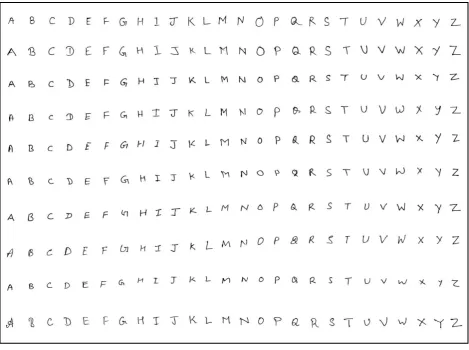
groups. These characters are written by different blue/black ball point pen. The collected samples of handwritten characters are scanned by scanner into JPEG format on 600 dpi [43]. Then all the characters are separated and resized into 100 by 100 pixel images. The example of the samples of handwritten characters is given below.
Feature extraction
Pattern classes and mean vector
Output Preprocessing Character resized into 100 by
100 pixels
Comparison of recognition scores along with Euclidean
Figure 2: Sample of characters written by different persons
Figure 3: Some original handwritten character images separated from the sample
100
100 100
100 100
100 100
100 100
100
[image:4.595.51.521.614.712.2]4.2
Preprocessing
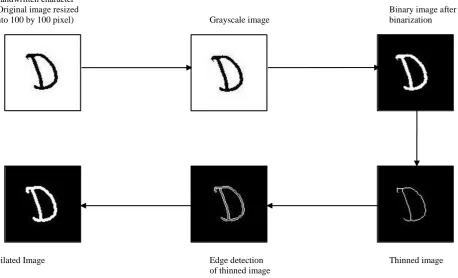
The separated RGB character images of 100 by 100 pixel resolution are converted into grayscale images and then the grayscale images is again converted into binary images using appropriate gray scale thresh holding. Now, binary image is
[image:5.595.60.519.161.439.2]thinned using skeletonization infinite times. Edges of these thinned images are detected using appropriate thresh holding and then further dilated using appropriate structure element [1,44,45]. These steps are known as preprocessing. The preprocessing steps are given in the following figure.
Handwritten character
(Original image resized Binary image after into 100 by 100 pixel) Grayscale image binarization
Dilated Image Edge detection Thinned image
of thinned image
Figure 5: Results of preprocessing steps applying on a handwritten character
4.3
Discrete wavelet transform
Representation of images in various degrees of resolution is known as multi resolution process. In multiresolution process, images are subdivided successively into smaller regions [34,46]. Wavelets are used as the foundation of multiresolution process. In 1987, wavelets are first shown to be the foundation of a powerful new approach to signal processing and analysis called multiresolution theory [2]. Multiresolution theory is concerned with the representation and analysis of images having more than one resolution. We use this technique in HCR. Multiresolution technique is applied on the preprocessed images and this is achieved by applying DWT [46,47]. Here, pattern vectors are generated that are used for training purpose for both EDM and ANN. DWT has given good results in different image processing applications [3,7,36,47,48]. It has excellent spatial localization and good frequency localization properties that makes it an efficient tool for image analysis. There are different multiresolution techniques such as image pyramids, subband coding and DWT. We have used DWT in this paper. DWT maps a function of a continuous variable into a sequence of coefficients. If the function being expanded is a sequence of numbers, like samples of a continuous function f(x, y), the resulting coefficients are called the DWT of f(x, y) [1,2]. DWT of an image f(x, y) of size M × N is defined as
1 0 1 0 , ,0
(
,
)
(
,
)
1
)
,
,
(
0 M x N y n m jx
y
y
x
f
MN
n
m
j
W
(4.3.1)
1 0 1 0 , ,(
,
)
)
,
(
1
)
,
,
(
M x N y i n m j iy
x
y
x
f
MN
n
m
j
W
,i = {H, V, D}(4.3.2)
for
j
j
0 and
m n
n m
j
x
y
n
m
j
W
MN
y
x
f
(
,
)
1
(
0,
,
)
, ,(
,
)
0
D V Hi j j m n
i n m j i
y
x
n
m
j
W
MN
, ,where,
j
0 is an arbitrary starting scale and)
2
,
2
(
2
)
,
(
2,
,
x
y
x
m
y
n
j j
j n
m
j
(4.3.4) and
)
2
,
2
(
2
)
,
(
2,
,
x
y
x
m
y
n
j j
i j i
n m
j
,i = {H, V, D}(4.3.5)
where index i identifies the directional wavelets that assumes the values H,V and D. Wavelets measure functional variations such as intensity or gray-level variations for images along
different directions. Directional wavelets are
H,
V andD
.
Hmeasures variations along columns (like horizontal edges),
V measures variations along rows (likevertical edges) and
D measures variations along diagonals [1,2].Eqs. (4.3.4) and (4.3.5) define the scaled and translatedbasis functions. f (x, y),
j,m,n(
x
,
y
)
and
ij,m,n(
x
,
y
)
arefunctions of the discrete variables x = 0, 1, 2, 3, …, M-1 and y = 0, 1, 2, 3, ..., N-1. The coefficients defined in Eqs. (4.3.1) and (4.3.2) are usually called approximation and detail coefficients, respectively.
W
(
j
0,
m
,
n
)
Coefficients definean approximation of f (x, y) at scale
j
0.W
i(
j
,
m
,
n
)
coefficients add horizontal, vertical and diagonal details for scalesj
j
0. We normally letj
0= 0 and select N = M =j
2
so that j = 0, 1, 2, 3, …,J - 1 and m, n = 0, 1, 2, 3, …,2
j- 1 [1,2]. Eq. (4.3.3) shows that f (x, y) is obtained via the inverse DWT for givenW
andW
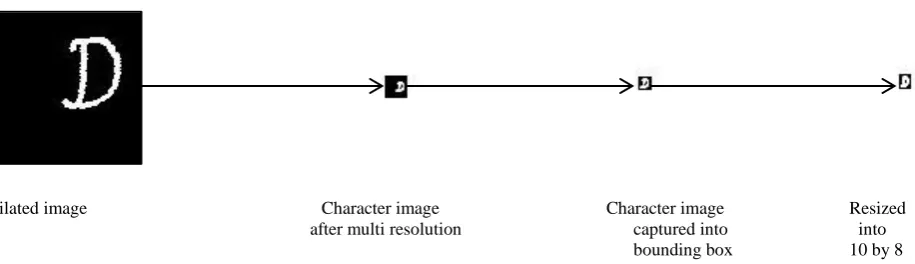
iof Eqs. (4.3.1) and (4.3.2).DWT can be implemented using digital-filters and down-samplers [1,2]. We have used MATLAB for programming [44]. DWT is applied three times on each dilated character image generated in the second part, and finally the reduced character image is captured into a bounding box and then, resized into 10 by 8 pixels image. The effect of multi resolution on the dilated character obtained in second part is given in the following fig. 6.Dilated image Character image Character image Resized after multi resolution captured into into
[image:6.595.61.519.362.494.2]bounding box 10 by 8
Figure 6: Character image after applying multiresolution and captured into bounding box
5.
CLASSIFICATION AND
IMPROVING RECOGNITION
ACCURACY
5.1
Classification using EDM
In this part, EDM is used to classify the unknown input pattern vectors. Pattern vectors generated in the third part are grouped into 26 classes based on their similar properties. Each class contains pattern vectors and mean vector of each class is computed i.e. each class is characterized by its mean vector. We prepare such a matrix whose rows are these mean vectors. Distance from input pattern vector to each mean vector is computed and minimum distance shows the class of input pattern vector to which it belongs [17, 22, 29, 49, 50].
The EDM is significantly simplified under the following assumptions [20,21]:
The classes are equiprobable.
The data in all classes follow Gaussian distributions.
The covariance matrix is the same for all classes.
The covariance matrix is diagonal and all elements across the diagonal are equal.
Given an unknown pattern vector
x
, assign it to classw
iif(
) (
T)
i i i j
x
m
x
m
x
m
x
m
,
j
i
(5.1.1)
Suppose,
p
ishows the pattern vector,w
jshows the patternclass,
m
jshows the mean vector of jth class andx
ishows the component of pattern vector. Mean vector is used as the representative of the class of vectors :
j i w
p i j
j
p
N
m
1
, j = 1, 2, 3, ………,W andi = 1, 2, 3, ………,
N
j(5.1.2)Where,
N
j is the number of pattern vectors in the classw
j andW is the number of pattern classes. Euclidean distance classifier is defined as:)
(
)
(
)
(
j j T jj
x
x
m
x
m
x
m
D
, j = 1, 2, 3, ………,W(5.1.3)
Where,
x
is the input pattern vector andD
j(
x
)
is the distance fromx
to mean vector of thejthclass. Input pattern vectorx
will belong to class wjifD
j(
x
)
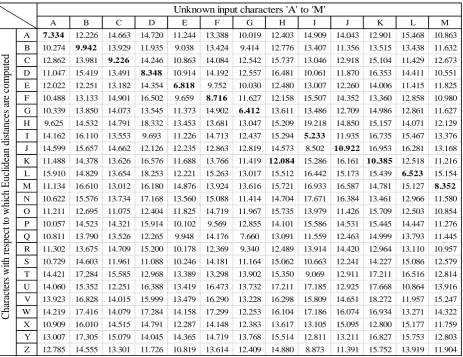
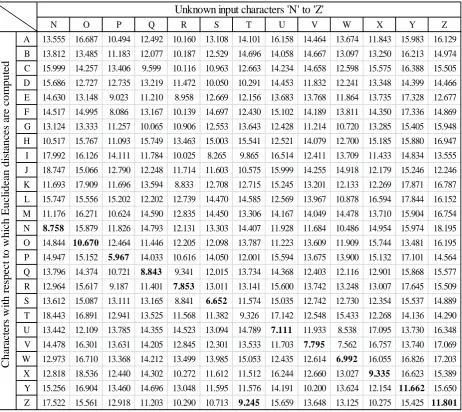
is the smallest [image:7.595.59.523.293.650.2]distance. The Euclidean distancesfrom the unknown input characters of a test sample of handwritten characters to the mean vector of each class are given in the following Tab. 1 and Tab. 2.
Table 1: Computed Euclidean distances from the unknown input characters ‘A’ to ‘M’ of a test sample of handwritten characters.
A B C D E F G H I J K L M
A 7.334 12.226 14.663 14.720 11.244 13.388 10.019 12.403 14.909 14.043 12.901 15.468 10.863
B 10.274 9.942 13.929 11.935 9.038 13.424 9.414 12.776 13.407 11.356 13.515 13.438 11.632
C 12.862 13.981 9.226 14.246 10.863 14.084 12.542 15.737 13.046 12.918 15.104 11.429 12.673
D 11.047 15.419 13.491 8.348 10.914 14.192 12.557 16.481 10.061 11.870 16.353 14.411 10.551
E 12.022 12.251 13.182 14.354 6.818 9.752 10.030 12.480 13.007 12.260 14.006 11.415 11.825
F 10.488 13.133 14.901 16.502 9.659 8.716 11.627 12.158 15.507 14.352 13.360 12.858 10.980
G 10.339 13.850 14.073 13.545 11.373 14.902 6.412 13.611 13.486 12.709 14.986 12.861 11.627
H 9.625 14.532 14.791 18.332 13.453 13.681 13.047 15.209 19.218 14.850 15.157 14.071 12.129
I 14.162 16.110 13.553 9.693 11.226 14.713 12.437 15.294 5.233 11.935 16.735 15.467 13.376
J 14.599 15.657 14.662 12.126 12.235 12.863 12.819 14.573 8.502 10.922 16.953 16.281 13.168
K 11.488 14.378 13.626 16.576 11.688 13.766 11.419 12.084 15.286 16.161 10.385 12.518 11.216
L 15.910 14.829 13.654 18.253 12.221 15.263 13.017 15.512 16.442 15.173 15.439 6.523 15.154
M 11.134 16.610 13.012 16.180 14.876 13.924 13.616 15.721 16.933 16.587 14.781 15.127 8.352
N 10.622 15.576 13.734 17.168 13.560 15.088 11.414 14.704 17.671 16.384 13.461 12.966 11.580
O 11.211 12.695 11.075 12.404 11.825 14.719 11.967 15.735 13.979 11.426 15.709 12.503 10.854
P 10.057 14.523 14.321 15.914 10.102 9.569 12.855 14.101 15.586 14.531 15.445 14.447 11.276
Q 10.811 13.790 13.526 12.265 9.948 14.176 7.660 13.091 11.559 12.463 14.999 13.793 11.445
R 11.302 13.675 14.709 15.200 10.178 12.369 9.340 12.489 13.914 14.420 12.964 13.110 10.957
S 10.729 14.603 11.961 11.088 10.246 14.181 11.164 15.062 10.663 12.241 14.227 15.086 12.579
T 14.421 17.284 15.585 12.968 13.389 13.298 13.902 15.350 9.069 12.911 17.211 16.516 12.814
U 14.060 15.352 12.251 16.388 13.419 16.473 13.732 17.211 17.185 12.925 17.668 10.864 13.916
V 13.923 16.828 14.015 15.999 13.479 16.290 13.228 16.298 15.809 14.651 18.272 11.957 15.247
W 14.219 17.416 14.079 17.284 14.158 17.299 12.253 16.104 17.186 16.074 16.934 13.271 14.322
X 10.909 16.010 14.515 14.791 12.287 14.148 12.383 13.617 13.105 15.095 12.800 15.177 11.759
Y 13.007 17.305 15.079 14.045 14.365 14.719 13.768 15.514 12.811 13.211 16.827 15.753 12.803
Z 12.785 14.555 13.301 11.726 10.819 13.614 12.409 14.880 8.873 11.391 15.752 13.919 11.904
Unknown input characters 'A' to 'M'
C
ha
ra
ct
er
s w
ith r
es
pe
ct
t
o w
hi
ch E
uc
lide
an di
st
anc
es
a
re
c
om
put
Table 2: Computed Euclidean distances from the unknown input characters ‘N’ to ‘Z’ of a test sample of handwritten characters.
N O P Q R S T U V W X Y Z
A 13.555 16.687 10.494 12.492 10.160 13.108 14.101 16.158 14.464 13.674 11.843 15.983 16.129 B 13.812 13.485 11.183 12.077 10.187 12.529 14.696 14.058 14.667 13.097 13.250 16.213 14.974 C 15.999 14.257 13.406 9.599 10.116 10.963 12.663 14.234 14.658 12.598 15.575 16.388 15.505 D 15.686 12.727 12.735 13.219 11.472 10.050 10.291 14.453 11.832 12.241 13.348 14.399 14.466 E 14.630 13.148 9.023 11.210 8.958 12.669 12.156 13.683 13.768 11.864 13.735 17.328 12.677 F 14.517 14.995 8.086 13.167 10.139 14.697 12.430 15.102 14.189 13.811 14.350 17.336 14.869 G 13.124 13.333 11.257 10.065 10.906 12.553 13.643 12.428 11.214 10.720 13.285 15.405 15.948 H 10.517 15.767 11.093 15.749 13.463 15.003 15.541 12.521 14.079 12.700 15.185 15.880 16.947 I 17.992 16.126 14.111 11.784 10.025 8.265 9.865 16.514 12.411 13.709 11.433 14.834 13.555 J 18.747 15.066 12.790 12.248 11.714 11.603 10.575 15.999 14.255 14.918 12.179 15.246 12.246 K 11.693 17.909 11.696 13.594 8.833 12.708 12.715 15.245 13.201 12.133 12.269 17.871 16.787 L 15.747 15.556 15.202 12.202 12.739 14.470 14.585 12.569 13.967 10.878 16.594 17.844 16.152 M 11.176 16.271 10.624 14.590 12.835 14.450 13.306 14.167 14.049 14.478 13.710 15.904 16.754 N 8.758 15.879 11.826 14.793 12.131 13.303 14.407 11.928 11.684 10.486 14.954 15.974 18.195 O 14.844 10.670 12.464 11.446 12.205 12.098 13.787 11.223 13.609 11.909 15.744 13.481 16.195 P 14.947 15.152 5.967 14.033 10.616 14.050 12.001 15.594 13.675 13.900 15.132 17.101 14.564 Q 13.796 14.374 10.721 8.843 9.341 12.015 13.734 14.368 12.403 12.116 12.901 15.868 15.577 R 12.964 15.617 9.187 11.401 7.853 13.011 13.141 15.600 13.742 13.248 13.007 17.645 15.509 S 13.612 15.087 13.111 13.165 8.841 6.652 11.574 15.035 12.742 12.730 12.354 15.537 14.889 T 18.443 16.891 12.941 13.525 11.568 11.382 9.326 17.142 12.548 15.433 12.268 14.136 14.290 U 13.442 12.109 13.785 14.355 14.523 13.094 14.789 7.111 11.933 8.538 17.095 13.730 16.348 V 14.478 16.301 13.631 14.205 12.845 12.301 13.533 11.703 7.795 7.562 16.757 13.740 17.069 W 12.973 16.710 13.368 14.212 13.499 13.985 15.053 12.435 12.614 6.992 16.055 16.826 17.203 X 12.818 18.536 12.440 14.302 10.272 11.612 11.512 16.244 12.660 13.027 9.335 16.623 15.389 Y 15.256 16.904 13.460 14.696 13.048 11.595 11.576 14.191 10.200 13.624 12.154 11.662 15.650 Z 17.522 15.561 12.918 11.203 10.290 10.713 9.245 15.659 13.648 13.125 10.275 15.425 11.801
Unknown input characters 'N' to 'Z'
C
ha
ra
c
te
rs
w
it
h r
e
spe
c
t t
o w
hi
c
h E
uc
li
de
a
n di
st
a
nc
e
s a
re
c
om
put
e
d
In the above tables, the minimum Euclidean distances are shown as bold. As we can see that all the characters except the characters ‗H‘ and ‗T‘ are recognized successfully. For example, suppose that the unknown input character is ‗A‘ then we can see from Tab. 1 that minimum Euclidean distance corresponds to the character ‗A‘, hence the EDM correctly recognize the input character as ‗A‘. Different character images are tested with this proposed HCR system and we find that the system has a high recognition accuracy. But there are some mismatches by the EDM, these are for the characters ‗H‘ and ‗T‘. The character ‗H‘ is wrongly recognized as ‗K‘ and the character ‗T‘ is wrongly as ‗Z‘. To improve the recognition accuracy further, the mismatched characters are compared by using recognition scores along with Euclidean distances [27-29]. The method used for this purpose is described in the next part.
5.2
Improving recognition accuracy using
ANN
pixels. We denote the weight matrix for the
k
th character byWM
k
. For the learning process, each pixel of the weight matrixWM
k
is initialized with zero. When a character pattern is introduced to the ANN, the values of the weight matrix will be changed by the ANN by using the following rule [45]. If the value of the
(
i
,
j
)
th
pixel of the character pattern is 1 then add +1 toWM
k
(
i
,
j
).
If the value of the
(
i
,
j
)
th
pixel of the character pattern is 0 then add -1 toWM
k
(
i
,
j
).
The above rules are repeated for different pattern vectors of the same class and the weight matrix for all the classes so formed are stored in the neural network to improve the recognition accuracy. The weight matrix formed after introducing 15 pattern vectors of the handwritten characters ‗H‘ and ‗T‘ is given below:
-3
1
3
3
3
3
3
3
3
7
9
11
11
13
11
11
5
15
15
15
13
15
15
15
5
15
15
15
15
15
15
15
5
15
15
15
15
15
15
15
5
15
15
15
15
15
15
15
5
15
15
15
15
15
15
15
5
15
15
15
15
15
15
15
5
13
15
15
15
15
15
15
3
11
15
15
15
13
13
13
-15
1
9
9
11
11
7
11
--15
7
13
13
15
15
11
9
--15
7
13
13
15
15
13
9
--15
9
13
15
15
15
13
7
--13
11
13
15
15
15
13
5
-5
15
15
15
15
15
15
9
13
15
15
15
15
15
15
15
13
15
15
15
15
15
15
15
13
15
15
15
15
15
15
15
13
15
15
15
15
13
13
11
[image:9.595.73.515.221.437.2]
WM
'
H
'
WM
'
T
'
Figure 7: Weight matrix for the handwritten character ‘H’ and ‘T’.
Here, the method used by the ANN to recognize the misclassified characters is described [16,54,55]. The weights
of different character patterns
WM
k
'
s
generated in this part are used for the recognition of the misclassified characters. Suppose the misclassified character is denoted by TV. Now,it is fused with the weight matricesWM
k
of different characters to generate the recognition scores. We denote therecognition score for the
k
thweight matrix with respect to the misclassified character byRS
ktv.The recognition score for the test image is generated by using the following equation: 10 8 1 1( , ) *
( , )
(
)
k i j tv k kTV i j
WM
i j
RS
WM
(5.2.1)where
(
WM
k)
is the sum of all the positive values ofk
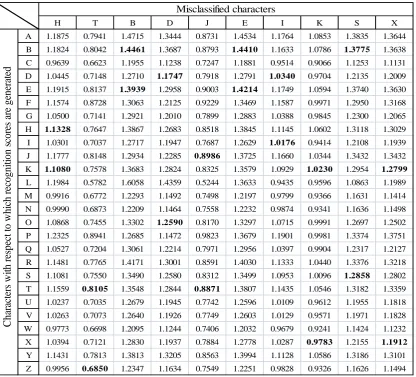
Table 3: Generated recognition score of the misclassified characters.
H T B D J E I K S X
A 1.1875 0.7941 1.4715 1.3444 0.8731 1.4534 1.1764 1.0853 1.3835 1.3644
B 1.1824 0.8042 1.4461 1.3687 0.8793 1.4410 1.1633 1.0786 1.3775 1.3638
C 0.9639 0.6623 1.1955 1.1238 0.7247 1.1881 0.9514 0.9066 1.1253 1.1131
D 1.0445 0.7148 1.2710 1.1747 0.7918 1.2791 1.0340 0.9704 1.2135 1.2009
E 1.1915 0.8137 1.3939 1.2958 0.9003 1.4214 1.1749 1.0594 1.3740 1.3630
F 1.1574 0.8728 1.3063 1.2125 0.9229 1.3469 1.1587 0.9971 1.2950 1.3168
G 1.0500 0.7141 1.2921 1.2010 0.7899 1.2883 1.0388 0.9845 1.2300 1.2065
H 1.1328 0.7647 1.3867 1.2683 0.8518 1.3845 1.1145 1.0602 1.3118 1.3029
I 1.0301 0.7037 1.2717 1.1947 0.7687 1.2629 1.0176 0.9414 1.2108 1.1939
J 1.1777 0.8148 1.2934 1.2285 0.8986 1.3725 1.1660 1.0344 1.3432 1.3432
K 1.1080 0.7578 1.3683 1.2824 0.8325 1.3579 1.0929 1.0230 1.2954 1.2799
L 1.1984 0.5782 1.6058 1.4359 0.5244 1.3633 0.9435 0.9596 1.0863 1.1989
M 0.9916 0.6772 1.2293 1.1492 0.7498 1.2197 0.9799 0.9366 1.1631 1.1414
N 0.9990 0.6873 1.2209 1.1464 0.7558 1.2232 0.9874 0.9341 1.1636 1.1498
O 1.0868 0.7455 1.3302 1.2590 0.8170 1.3297 1.0715 0.9991 1.2697 1.2502
P 1.2325 0.8941 1.2685 1.1472 0.9823 1.3679 1.1901 0.9981 1.3374 1.3751
Q 1.0527 0.7204 1.3061 1.2214 0.7971 1.2956 1.0397 0.9904 1.2317 1.2127
R 1.1481 0.7765 1.4171 1.3001 0.8591 1.4030 1.1333 1.0440 1.3376 1.3218
S 1.1081 0.7550 1.3490 1.2580 0.8312 1.3499 1.0953 1.0096 1.2858 1.2802
T 1.1559 0.8105 1.3548 1.2844 0.8871 1.3807 1.1435 1.0546 1.3182 1.3359
U 1.0237 0.7035 1.2679 1.1945 0.7742 1.2596 1.0109 0.9612 1.1955 1.1818
V 1.0263 0.7073 1.2640 1.1926 0.7749 1.2603 1.0129 0.9571 1.1971 1.1828
W 0.9773 0.6698 1.2095 1.1244 0.7406 1.2032 0.9679 0.9241 1.1424 1.1232
X 1.0394 0.7121 1.2830 1.1937 0.7884 1.2778 1.0287 0.9783 1.2155 1.1912
Y 1.1431 0.7813 1.3813 1.3205 0.8563 1.3994 1.1128 1.0586 1.3186 1.3101
Z 0.9956 0.6850 1.2347 1.1634 0.7549 1.2251 0.9828 0.9326 1.1626 1.1494
C
ha
ra
ct
er
s w
it
h r
es
pe
ct
t
o w
hi
ch r
ec
ogn
it
ion s
cor
es
a
re
ge
ne
ra
te
d
Misclassified characters
In the above tables, the recognition scores of the misclassified characters are shown as bold. These misclassified characters are from different test samples of handwritten characters. Tables of Euclidean distances for all the samples are not shown here except for a single test sample shown in the Tab.1 and Tab. 2. For example, suppose that the unknown input character is ‗T‘ then we can see from Tab. 3 that recognition score with respect to the character ‗T‘ is greater than with respect to the character ‗Z‘ while in Tab. 1 minimum Euclidean distance wrongly corresponds to the character ‗Z‘. Hence the ANN correctly recognizes the input character as ‗T‘. We can see from Tab. 3 that the misclassified characters ‗H‘, ‗T‘, ‗B‘, ‗J‘ and ‗K‘ are recognized correctly only by comparing the recognition scores generated by the learning rule of ANN. Other misclassified characters are correctly recognized by comparing the recognition scores along with the Euclidean distances [56,57]. Different character images are tested with this proposed HCR system and we find that the system has a high recognition accuracy. But there are some mismatches by the ANN, these are for the characters ‗S‘ and ‗X‘ of a test sample. The character ‗S‘ is wrongly recognized as ‗B‘ and the character ‗X‘ is wrongly as ‗K‘.
Euclidean distances from the misclassified character image TV to its class and the class of misclassification are measured by using the equation:
( (, ) (, ))2
) ,
(TV MV TV i j MV i j D
(5.2.2)
where, MV is the mean vector of the said class.
Suppose the Euclidean distances from the above said classes are
d
1
andd
2
respectively. Recognition scores of the input vector corresponds to the above said classes ares
1
and2
s
respectively. Then, we use the following condition to improve the recognition accuracy:if
2
1
d
d
, then the input character is recognized otherwise misclassified.else if
2
2
1
1
s
d
s
d
, then the character is recognized otherwise misclassified.6.
EXPERIMENTAL RESULTS
150 samples (3900 characters) were collected from 150 persons of different age groups, 26 from each. First, 100 samples (2600 characters) were used to train the proposed
HCR system and next 50 samples (1300 characters) were used to test the proposed HCR system. An analysis of experimental results has been performed and shown in the table given below.
Table 4: The Result showing the average recognition accuracy. Here, it is 98.46%.
Test Data Set (A – Z) Level of
Multiresolution Methods
Average Recognition Accuracy (%)
10 by 8 Pixels 3
Euclidean distance metric 90.77 Learning rule of neural network 95.38
Neural network along with
Euclidean distance metric 98.46
Here, we compare our results using the new approach with those of other authors. The method used by Chen et al.[3] gets recognition rate of 92.20% for handwritten numerals. The method of Romero et al.[47] gets 90.20% recognition accuracy over the test data for handwritten numerals. The method used by Pal and Singh [55] gets recognition accuracy of 94% for handwritten English characters. The method of Mowlaei et al. [46] gets recognition rates of 92.33% and 91.81% for 8 classes of handwritten Farsi characters and numerals respectively. Also the method in [46] yields are cognition rate of 97.24% for handwritten postal addresses.
7.
CONCLUSION
From the above Tab. 4, we observe that the recognition accuracy increases to 95.38% from 90.77% when we apply learning rule of neural network and it further increases to 98.46% when we incorporate Euclidean distances to the recognition scoresas a new approach.Work is going on, we are trying to further improve the recognition accuracy in terms of data samples and recognition process time using some other methods and techniques so as to get the consistency in recognition accuracy. In this paper, we introduced a new approach which is a combined effect of the Euclidean distance metric and artificial neural network. We used this new technique only for the unrecognized characters and get a very good recognition performance.
8.
REFERENCES
[1] Rafael C. Gonzalez and Richard E. Woods , 2002, ―Digital Image Processing‖, Pearson Education, South Asia.
[2] StephaneMallat, 2008, ―A Wavelet Tour of Signal Processing‖, Academic Press, Burlington.
[3] G.Y. Chen, T.D. Bui and A. Krzyzak, 2003, ―Contour-based handwritten numeral recognition using multiwavelets and neural networks‖, Pattern Recognition,36, pp. (1597-1604).
[4] Jaemo Sung, Sung-Yang Bang, Seungjin Choi, 2006, ―A Bayesian network classifier and hierarchical Gabor features for handwritten numeral recognition‖, Pattern Recognition Letters, 27, pp. (66-75).
[5] C.-L. Liu, H. Sako, 2006, ―Class-specific feature polynomial classifier for pattern classification and its application to handwritten numeral recognition‖, Pattern Recognition, 39, pp. (669-681).
[6] A. Broumandnia, J. Shanbehzadeh, 2007, ―Fast Zernike wavelet moments for Farsi character recognition‖, Image and Vision Computing, 25, pp. (717-726).
[7] Y. Mizukami, 1998, ―A handwritten Chinese character recognition system using hierarchical displacement extraction based on directional features‖, Pattern Recognition Letters, 19, pp. (595-604).
[8] A.-B. Wang, K.-C. Fan, 2001, ―Optical recognition of handwritten Chineses character by hierarchical radical matching method‖, Pattern Recognition, 34, pp. (15–35).
[9] H.-Y. Kim, J.H. Kim, 2001, ―Hierarchical random graph represetation of handwritten and its application to Hangul recognition‖, Pattern Recognition, 34, pp. (187-201).
[10] A. Cheung, M. Bennamoun, N.W. Bergmann, 2001, ―An Arabic OCR system using recognition-based segmentation, Pattern Recognition, 34, pp. (215–233).
[11] R.M.K. Sinha, H.N. Mahabala, 1979, ―Machine recognition of Devanagari script‖, IEEE Trans. SMC-9, 8, pp. (435–441).
[12] B.B. Chaudhuri, U. Pal, 1998, ―A complete printed Bangla OCR system‖, Pattern Recognition, 31(5), pp. (531–549).
[13] S.N.S. Rajasekharan, B.L. Deekshatulu, 1977, ―Generation and recognition of printed Telugu characters‖, Computer graphics and image processing, 6, pp. (335–360).
[14] B.B. Chaudhuri, O.A. Kumar, K.V. Ramana, 1991, ―Automatic generation and recognition of Telugu script characters‖, J. IETE, 37, pp. (499–511).
[15] M.B. Sukhaswami, P. Seetharamulu, A.K. Pujari, 1995, ―Recognition of Telugu characters using neural networks‖, Int. J. Neural Syst., 6 (3), (317–357).
[16] Apurva A. Desai, 2010, ―Gujarati handwritten numeral optical character reorganization through neural network‖, Pattern Recognition, 43, pp. (2582-2589).
[17] Nafiz Arica and Fatos T. Yarman-Vural, 2001, ―An Overview of Character Recognition Focused on Off-Line Handwriting‖, IEEE Transactions on Systems, Man, and Cybernetics—Part C: Applications and Reviews, 31(2), pp. (216-233).
[18] Sergios Theodoridis and Konstantinos Koutroumbas, 2010, ―An Introduction to Pattern Recognition : A MATLAB Approach‖, Elsevier, Burlington.
[20] S. Rajasekaran and G.A. Vijayalakshmi Pal, 2003, ―Neural Networks, Fuzzy Logic, and Genetic Algorithms‖, Prentice-Hall, India.
[21] Simon Haykin, 1998, ―Neural Networks: A comprehensive foundation‖, 2nd Edition, Prentice Hall.
[22] J. Mantas, 1986, ―An Overview of Character Recognition Methodologies‖, Pattern Recognition, 19(6), pp. (425-430).
[23] M.E.Stevens, 1970, ―Introduction to the special issue on optical character recognition (OCR)‖, Pattern Recognition,2, pp. (147-150).
[24] J. C. Rabinow, 1969, ―Whither OCR and whence?‖,Datamation. pp. (38-42).
[25] P. L. Andersson, 1969, ―Optical character recognition-a survey‖, Datamation, pp. (43-48).
[26] L. D. Earnest, 1963, ―Machine reading of cursive script,‖ in Proc. IFIP Congr., Amsterdam, The Netherlands, pp. (462–466).
[27] C. Y. Suen, C. C. Tappert, and T. Wakahara, 1990, ―The state of the art in on-line handwriting recognition‖, IEEE Trans. Pattern Anal. Machine Intell., 12, pp. (787–808).
[28] S. Mori, C.Y. Suen, K. Yamamoto, 1992, ―Historical review of OCR research and development‖, Proc. IEEE, 80, pp. (1029–1058).
[29] U. Pal, B.B. Chaudhari, 2004, ―Indian Script Character Recognition: a survey‖, Pattern Recognition, 37, pp. (1887-1899).
[30] S. Mori, K. Yamamoto, M. Yasuda, 1984, ―Research on machine recognition of hand-printed characters‖, IEEE Trans. Pattern Anal. Mach. Intell., 6, pp. (386–405).
[31] G. Nagy, 1992, ―At the frontiers of OCR‖, Proc. IEEE, 80 (7), pp. (1093–1100).
[32] A. Belaid and J. P. Haton, 1984, ―A syntactic approach for handwritten mathematical formula recognition‖, IEEE Trans. Pattern Anal. Machine Intell., PAMI-6, pp. (105–111).
[33] M. Shridhar and A. Badreldin, 1985, ―High accuracy syntactic recognition algorithm for handwritten numerals‖, IEEE Trans. Syst., Man, Cybern., SMC-15, pp. (152–158).
[34] Patrick Wunsch and Andrew F. Laine, 1995, ―Wavelet Descriptors for Multiresolution Recognition of Handprinted Characters‖, Pattern Recognition, 28(8), pp. (1237-1249).
[35] A. Shustorovich and C. W. Thrasher, 1996, ―Neural Network Positioning and Classification of Handwritten Characters‖, Neural Networks, 9(4), pp. (685-693).
[36] Seong-Whan Lee, Chang-Hun Kim, Hong Ma and Yuan Y. Tang , 1996, ‖Multiresolution Recognition of Unconstrained Handwritten Numerals with Wavelet Transform and Multilayer Cluster Neural Network‖, Pattern Recognition, 29(12), pp. (1953- 1961).
[37] Ian F. Morns and Satnam S. Dlay, 1997, ―Character recognition using Fourier descriptors and a new form of dynamic semi-supervised neural network‖, Microelectronics Journal, 28, pp. (73-84).
[38] Cheng-Lin Liu , Jin H. Kim and Ru-Wei Dai, 1997, ―Multiresolution locally expanded HONN for handwritten numeral recognition‖, Pattern Recognition Letters, 18, pp. (1019-1025).
[39] Yang Jun, Yu Songyu and Zhao Rongchun, 1997, ―Wavelet Analysis for Handwritten Chinese Character Recognition‖, IEEE International Conference on Intelligent Processing Systems, October 28 - 31. Beijing, China, pp. (1023-1026).
[40] Arun K. Pujaria, C. DhanunjayaNaidub, M. Sreenivasa Raoc and B.C. Jinagad, 2004, ―An intelligent character recognizer for Telugu scripts using multiresolution analysis and associative memory‖, Image and Vision Computing, 22, pp. (1221-1227).
[41] G.Y. Chen, T.D. Bui and A. Krzyzak, 2009, ―Invariant pattern recognition using radon, dual-tree complex wavelet and Fourier transforms‖, Pattern Recognition, 42, pp. (2013-2019).
[42] RejeanPlamondon and Sargur N. Srihari, 2000, ―On-Line and Off-Line Handwriting Recognition: A Comprehensive Survey‖, IEEE Transactions on Pattern Analysis and Machine Intelligence, 22(1) , pp. (63-84).
[43] E. A. Fadhel and P. Bhattacharyya, 1999, ―Application of a Steerable Wavelet Transform using Neural Network for Signature Verification‖, Pattern Analysis & Applications, 2, pp. (184-195).
[44] Rafael C. Gonzalez and Richard E. Woods , 2004, ―Digital Image Processing using MATLAB‖, Pearson Education, South Asia.
[45] Ryan E. Leary, 2009, ―Unrestricted Off-Line Handwriting Recognition: A Preprocessing Approach‖, unpublished paper written at Rensselaer polytechnic institute, pp. (1-11).
[46] Amir Mowlaei, Karim Faez and Abolfazl T Haghighat, 2002, ―Feature Extraction with Wavelet Transform for Recognition of Isolated Handwritten Farsi or Arabic Characters and Numerals‖, IEEE DSP, pp. (923-926).
[47] Diego J. Romero, Leticia M. Seijas, Ana M. Ruedin, 2007, ―Directional Continuous Wavelet Transform Applied to Handwritten Numerals Recognition Using Neural Networks‖, JCS, 7(1), pp. (66-71).
[48] J.C. Lee, T.J. Fong and Y.F. Chang, 2009, ―Feature Extraction for Handwritten Chinese Character Recognition Using X-Y Graphs Decomposition and Haar Wavelet‖, IEEE International Conference on Signal and Image Processing Applications, pp. (10-14).
[49] Trevor Hastie and Patrice Y Simard, 1998, ―Metrics and Models for Handwritten Character Recognition‖, Statistical Science, 13(1), pp. (54-65).
[50] Philippe Simard, Marcel Mitran, 1995, ―The Nearest NeighbourRule : A short Tutorial‖, For the course: Pattern Recognition, pp. (308-644), Taught by: Prof. Godfried Toussaint.
[52] Oh I.-S., Suen C.Y., 2000, ―A class-modular feed forward neural network for handwriting recognition‖, Pattern Recognition, 35(1), pp. (229-244).
[53] Faruq A. Al-Omari, Omar Al-Jarrah, 2004, ―Handwritten Indian numerals recognition system using probabilistic neural networks‖, Advanced Engineering Informatics, 18, pp. (9-16).
[54] S. K. Devi Reddy, S. A. Rao, 2009, ―Handwritten Character Recognition Using Back-Propagation Network‖, Journal of Theoretical and Applied Information Technology, pp. (257-269).
[55] Anita Pal &Dayashankar Singh, 2010, ―Handwritten English Character Recognition Using Neural Network, International Journal of Computer Science & Communication, 1(2), pp. (141-144).
[56] S. Basu, N. Das, R. Sarkar, M. Kundu, M. Nasipuri, D. K. Basu, 2009, ―A hierarchical approach to recognition of handwritten Bangla characters‖, Pattern Recognition, 42, pp. (1467-1484).