Event Evoked Signal Classification in Frequency Domain
for Brain Computer Interface
G. V. Sridhar;
M.E,Assoc Professor In Ece. Al-Ameer College Of Engg&It.Visakhapatnam,A.P,India
P. Mallikarjuna Rao.
Professor in ECE. A.U.College Of Engineering.Visakhapatnam,A.P,INDIA
ABSTRACT
Brain Computer Interface (BCI) is an emerging research area which tries to capture the motor imagery thought process from brain using Electro-encephalogram (EEG) and process the data using signal processing techniques to classify the motor imagery thought process. Physically impaired people without any muscular activity can carry on their day to day operation with the use of BCI as it can be used to control devices including computers using the thoughts of the person. Devices such as wheelchair have been successfully connected to BCI system and these devices can be controlled using thought. In this paper, it is proposed to investigate EEG signals, extract features of motor imagery in the frequency domain using Hilbert transform, compute the maximum and minimum energies and classify the brain signal activity using pattern recognition techniques.
General Terms
Pattern Recognition, Brain Computer Interface.
Keywords
Brain Computer Interface (BCI), Fast Hilbert Transform, Support Vector Machine (SVM), Pattern Recognition.
1.
INTRODUCTION
Brain computer interface is being widely used as a communication solution for physically impaired people without muscular activity to continue day to day operations. Patients suffering from lock-in syndrome have no voluntary muscle control, BCI enable communication without using peripheral muscular activity as it enables a subject to send commands to electronic devices by using the electrical signals generated in the brain for each thought process [1]. The key challenge in Brain Computer Interface is the classification of the brain activity patterns. The patterns refer to the activity the user‟s wishes to perform and translate the same into commands which can be used by a computer or electronic device. Many works are available in literature to the investigation and evaluation of classification algorithms [2, 3, 4] because of the increased interest for EEG-based BCI.
A BCI system records the brain signals and classifies the brain state by applying machine learning algorithms and performs a computer controlled action. Brain signals are recorded through non-invasive process using electrodes placed on the scalp, this recording is called Electroencephalography (EEG) [5, 6]. The EEG signals thus obtained are to be classified for performing tasks. The EEG signals contain a cluster of features and it is vital to extract the useful features from them for efficient working of the BCI system. Identifying and extracting good features from the signals is a crucial step in
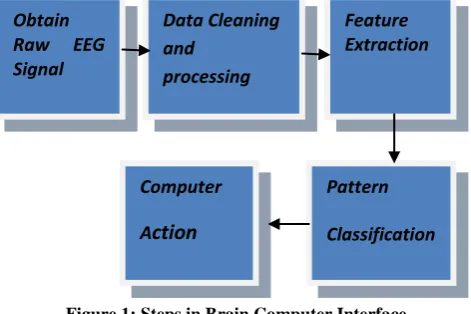
[image:1.595.310.546.272.429.2]the design of BCI [7]. The application phase of BCI is composed of the following modules as shown in figure 1.
Figure 1: Steps in Brain Computer Interface
Obtaining raw EEG signal: The EEG signals are obtained from the brain and the signals obtained are amplified and sampled.
Data cleaning and processing: The signals obtained are cleaned of noise included in the EEG signal during the recording session and processed to extract important artifacts.
Feature extraction: The feature extraction module extracts the EEG patterns. Features can be extracted in time domain as well as frequency domain.
Pattern classification: The signals are then classified to find out which kind of mental task the user is performing.
Brain states controllable by the user are suitable for BCI. Distinct repeatable and measurable patterns of brain states generated are captured in form of electrophysiological signals. Imaginations of body movements (motor imaginations) is the most commonly used brain states. Depending on the part of the body imagined, distinct spatial distributions are exhibited. Patterns are recognized and classified and then translated into control signals.
In this research, it is proposed to investigate extraction of useful features by converting the time series EEG data to frequency domain using Hilbert Transform. The features obtained are then classified using a Support Vector Machine (SVM).
Data Cleaning and
processing Obtain
Raw EEG Signal
Pattern
Classification Feature Extraction
Computer
2.
RELATED WORKS
Some of the works in literature explored the use of Hilbert Transforms for extraction of features from the EEG signals. Huang, et al., [8] investigated wavelet transform and Hilbert-Huang transforms (HHT) methods for processing EEG signal for the use of BCI. The experimental results showed that main features of the EEG are extracted efficiently in both the methods, however the HHT are more accurate when expressing the EEG distribution in time and frequency domain. HHT performs better due to its self adaptiveness and can concur with the signal data to obtain local and instantaneous frequency of EEG.
Lei Wang, et al., [9] proposed extracting features from EEG data based on motor imagery using Hilbert Huang transform (HHT). The BCI captures EEG signals when the user is imagining the movement of their limb, and this signal is converted into series of control signals. Features are difficult to extract due to the non-linear and non-stationary characteristics of the EEG data. The proposed method HHT is used with genetic algorithm (GA) for selection of the most relevant features from the frequency domain. Experiments based on the proposed method shows that HHT and GA gain much higher classification accuracy when compared with traditional frequency feature extraction methods.
Jesse Sherwood and Reza Derakhshani [10] presented classification results of EEG signals for various tasks support vector machine (SVM) classifiers. EEG was generated from imagined motor, cognitive, and affective tasks. Wavelet feature extraction method was applied on the data. Even in the presence of noise and when the classifiers were presented with contaminated training data the wavelet features performed satisfactorily. For six imagined motor tasks and for two affective tasks, classifier performances of better than 80% were achieved. Cognitive tasks were classified with 70% accuracy. The results demonstrated that the wavelet features with SVM provide efficient classification of imagined motor, cognitive and affective tasks.
Yong, et al., [11] developed a classification system for EEG signals using wavelet decomposition and SVM. The wavelet analysis localized event related desynchronisation of voluntary movement to form feature vectors. SVM was used for classification of feature vectors. Experiments were carried out using 516 single trials EEG. Classification accuracy of more than 91 % was achieved. Effectiveness of single trial classification system allows direct interaction and feedback BCI system.
Lal, et al., [12] proposed feature selection algorithms Recursive Feature Elimination (RFE) and Zero-Norm Optimization which are based on the training of SVM. The proposed method provides better solutions than standard filter methods for feature selection. The algorithms are adapted for the purpose of selecting EEG channels. The proposed method shows that the number of used channels can be reduced without increasing the classification error for motor imagery. Visualization of the dependent task specific information was achieved. The results showed that the proposed method can be used BCI research, particularly when no priori knowledge about the location of important channels is available.
Lee, et al., [13] presented methods for EEG pattern classification using principal component analysis (PCA) and Hidden Markov model (HMM). HMM is advantageous for EEG pattern classification as data is a multivariate time series data containing noise and artifacts. Two methods were proposed: (1) PCA+HMM; (2) PCA+HMM+SVM. Data
segmentation procedure to decompose time series data into overlapping blocks to extract principal components is employed. The principal components are fed into HMM for training with the SVM making the final decision of the likelihood scores computed by HMMs. Experimental results demonstrate that PCA features outperform other features.
Lotte, et al., [14] reviewed classification algorithms used EEG BCI systems to identify their critical properties. Based on the literature, performance was compared and guidelines were provided for choosing classification algorithm for a specific BCI. Linear classifiers, neural networks, nonlinear Bayesian classifiers, nearest neighbor classifiers and combinations of classifiers used in BCI were studied. The study showed that the SVM are particularly efficient for synchronous BCI. SVM perform better due to its regularization property and their immunity to the curse-of-dimensionality.
3.
METHODOLOGY
To investigate the proposed method publicly available dataset available in [15] was obtained. LabView was used to read the individual EEG signals and extract the minimum and maximum energies during the motor imagery cue.
3.1
Dataset
The IV A dataset used in the brain computer interface competition provided by Intelligent Data Analysis Group is used as dataset for experimentation [15]. This data set consists of recordings from five healthy subjects who sat in a chair with arms resting on armrests. Visual cues indicated for 3.5 s which of the following 3 motor imageries the subject should perform: (L) left hand, (R) right hand, (F) right foot. The presentation of target cues was intermittent by periods of random length, 1.75 to 2.25 s, in which the subject could relax. Given are continuous signals of 118 EEG channels and markers that indicate the time points of 280 cues for each of the 5 subjects (aa, al, av, aw, ay). Subject aa was used in our study. Labview was used to implement the Hilbert Transform for feature extraction. The maximum and minimum energy are computed for all the evoked responses. The frequency domain of a single channel for motor evoked imagery of „hand‟ and „foot‟ is shown in figure 2. Support Vector Machine (SVM) is used to train the features.
3.2
Fast Hilbert Transform
Hilbert transforms play an important role in signal processing. Analytic signal, bandpass sampling, minimum phase networks, and spectral analysis are based on Hilbert transform relationships.
The Hilbert transform [16] of a function x t
is given by
1 x
h t H x t d
t
Using the Fourier identities, the Fourier transform of the Hilbert transform of x t
id
sgn
h t H f j f X f
1 0sgn 0 0
1 0
f
f f
f
The obtained frequencies using Hilbert transform contains artifacts which are removed using a bandpass Chebyshev filter [17] such that all frequencies below 5 Hz and above 20Hz are eliminated. The Chebyshev response achieves a faster roll-off by allowing the ripple in the frequency response. Generally a ripple depth of between 0.1 dB and 3 dB is chosen. When the ripple is set at 0% it is called maximally flat or Butterworth filter.
The dB ripple for a Chebyshev filter is the peak-to-peak passband ripple. The parameter is determined as follows:
2
10log 1
dBripple
This can be solved for
to obtain10
10dB 1
Parameter his required for obtaining Chebyshev transfer functions, and is determined as follows:
1
1 1
tanh sinh h
n
where n is the order of low-pass filter.
3.3
Support Vector Machine (SVM)
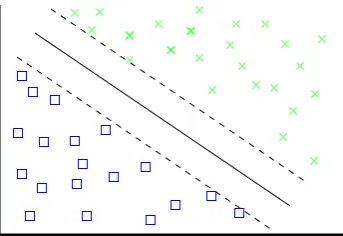
Given a set of features that can be represented in space, SVM maps non-linearly the features into n dimensional feature space. To avoid the high computation, a kernel is introduced as the algorithm uses only the scalar products of the inputs. The classification is solved by translating the problem into a convex quadratic optimization problem and a unique solution is obtained due to the convexity [18]. In SVM, the predictor variable is called an attribute; a feature is a transformed attribute. Vector is a set of features that describe an example. The features define the hyperplane. The goal of SVM is to find the optimal hyperplane that separates clusters of vectors with one class of attributes on one side of plane and the rest on the other side. The distance between the hyperplane and the support vectors is called margin. The SVM analysis so orients the margin that the margin between support vectors is maximized. Figure 2 shows a simplified overview of SVM process.
Figure 2. Support vector machine
Given a training set of
x yi, i
, 1, 2,....i lwhere n ix R and
1, 1ly , SVM has to solve the optimization problem [18] of:
, ,
1
1 min
2
l T
i w b
i
w w C
Subject to
T
1i i i
y w x b and i0.
The function maps the vectors xiin higher dimensional
space. C>0 is penalty parameter of the error term. A kernel
function is defined as K x x
i, j
xi T
xj . The four basic kernels used are linear, polynomial, radial basis function and sigmoid.Linear :K x x
i, j
x xiT jPolynomial:
,
T
d, 0i j i j
K x x x x r Radial Basis function:
2
, exp , 0
i j i j
K x x x x
Sigmoid:
,
tanh
T
i j i jK x x x x r
[image:3.595.316.542.471.679.2]4.
RESULTS
[image:3.595.77.249.612.730.2]Figure 3 shows the frequency output for two motor imagery evoked response (hand and foot).From figure 3 it can be seen that some sort of class difference exist between the two motor imagery thought process.
Figure 3. Frequency output for two motor imagery evoked response (hand and foot)
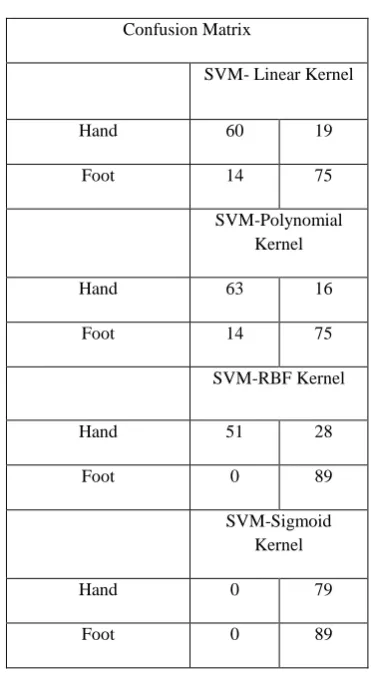
the classes in the case of linear and polynomial kernels. Sigmoid kernel fails to classify the second class totally.
Figure 4 : The classification accuracy of SVM with different Kernels.
TABLE I : CONFUSION MATRIX
Confusion Matrix
SVM- Linear Kernel
Hand 60 19
Foot 14 75
SVM-Polynomial
Kernel
Hand 63 16
Foot 14 75
SVM-RBF Kernel
Hand 51 28
Foot 0 89
SVM-Sigmoid
Kernel
Hand 0 79
Foot 0 89
5.
CONCLUSION
In this paper, it was proposed to extract features from EEG data by converting the time series EEG data to frequency domain using Hilbert Transform for BCI system. Energies were computed during the motor imagery period. 79 cues with hand motor imagery data and 89 cues with foot motor imagery was considered for feature extraction. Using ten fold cross validation the proposed system was tested using a SVM classifier with various kernels. The accuracy obtained is
comparable with the results obtained from other researchers in literature. The proposed method is extremely fast in both feature extraction and classification. Further work needs to be done to improve the classification accuracy.
.
6.
REFERENCES
[1] T.M. Vaughan et al., “Brain-computer interface technonolgy: a review of the second international meeting,” IEEE Trans. Rehab. Eng., vol. 11, pp. 94-109, 2003.
[2] W. D. Penny, S. J. Roberts, E. A. Curran, and M. J. Stokes. Eeg-based communication: a pattern recognition approach. IEEE Transactions on Rehabilitation Engeneering, 8(2):214-215, 2000.
[3] S. Sutton, M. Braren, J. Zubin, E. John (1965). Evoked-potential correlates of stimulus uncertainty. Science150(700):1187–1188.
[4] S. Nieuwenhuis, G. Aston-Jones, J. Cohen (2005). Decision making, the P3, and the locus coeruleus-norepinephrine system. Psychological Bulletin
131(4):510–532.
[5] E. Courchesne (1978). Changes in P3 waves with event repetition: Long-term effects on scalp distribution and amplitude. Electroencephalography and Clinical Neurophysiology 45(6):754–766.
[6] G. Pfurtscheller, G. R.Müller-Putz, J. Pfurtscheller, R. Rupp (2005). EEG-Based asynchronous BCI controls functional electrical stimulation in a tetraplegic patient. EURASIP Journal on Applied Signal Processing
2005(19):3152–3155.
[7] G. Pfurtscheller, C. Neuper (2001). Motor imagery and direct brain-computer communication. Proceedings of the IEEE 89(7):1123–1134.
[8] Manling Huang, Pingdong Wu, Ying Liu, Luzheng Bi, Hongwei Chen, "Application and Contrast in Brain-Computer Interface between Hilbert-Huang Transform and Wavelet Transform," icycs, pp.1706-1710, 2008 The 9th International Conference for Young Computer Scientists, 2008.
[9] Lei Wang; Guizhi Xu; Jiang Wang; Shuo Yang; Weili Yan; “Motor Imagery BCI Research Based on Hilbert-Huang Transform and Genetic Algorithm”, Bioinformatics and Biomedical Engineering, May 2011 5th international conference.
[10]Sherwood, J., and Derakhshani, R. 2009. “On classifiability of wavelet features for EEG based brain-computer interfaces.” International Joint Conference on Neural Networks, Atlanta, GA, June 2009, PP: 2895-2902.
[11]Y.P.A. Yong, N.J. Hurley, and G.C.M. Silvestre. Single-trial EEG classification for brain-computer interfaces using wavelet decomposition. In European Signal Processing Conference, EUSIPCO 2005, 2005.
[12] Lal TN, Schroder M, Hinterberger T, Weston J, Bogdan M, Birbaumer N, Scholkopf B. Support Vector Channel
Selection in BCI. IEEE Trans Biomed
[image:4.595.73.259.312.656.2][13]H. Lee and S. Choi. “Pca+hmm+svm for eeg pattern classification.” In Proceedings of the Seventh International Symposium on Signal Processing and Its Applications, 2003.
[14]Lotte F, Congedo M, Lecuyer A, Lamarche F and Arnaldi B (2007) “A review of classification algorithms for EEG-based brain–computer interfaces” J. Neural Eng. PP: 1-13.
[15]Guido Dornhege, Benjamin Blankertz, Gabriel Curio, and Klaus-Robert Müller. Boosting bit rates in non-invasive EEG single-trial classifications by feature combination and multi-class paradigms. IEEE Trans. Biomed. Eng., 51(6):993-1002, June 2004.
[16]Pei, S.-C.; Jaw, S.-B.; "Computation of discrete Hilbert transform through fast Hartley transform,"Circuits and Systems, IEEE Transactions on , vol.36, no.9, pp.1251-1252, Sep 1989.
[17]Steven. W. Smith, The Scientist and Engineer‟s Guide to Digital Signal Processing” 1997.