Privacy Protection through Anonymous Browsing
Harsh Kumar
1Sourabh Choudhary
21,2
UG Student
1,2
Department of Information Technology Engineering
1,2
Maharaja Agrasen Institute of Technology, GGSIP University, India
Abstract— The Web was the intend to abbreviate the
separation between Men to an extraordinary level. With this office likewise came cybercrime, fear mongering and other wonders of a moving society, completely mechanized and where the land outskirts are of little significance in constraining the dynamic operators, destructive or not, to this framework. As of late the world knew by the media, that its driving countries take after nearly their subjects, neglecting any good and innovative limit, that interior and outside security organizations nearly take after phone discussions, email, Web activity of their partners, utilizing capable checking and observation programs. In different corners of the globe, countries in turmoil or wrapped in the shroud of restriction oppress and deny uncontrolled Web access without hurtful repercussions to their residents. Worldlier, pears constrain and attack the security of associates and family, looking through each edge of their PCs and surfing propensities, authorizing brutality as feud. This work broke down the innovations that control the use of Web shoppers, arrangements that empower and allow some secrecy and security in Web activity. To help this investigation, an examination of stages that take into consideration unknown Web perusing, innovations and projects with potential PC interruption and infringement of protection by prominent countries, was made. This investigation planned to examine the PC observing and reconnaissance advancements and distinguish the accessible countermeasure innovations. Assets were incorporated in the model, created keeping in mind the end goal to furnish the client with an adaptable and lay approach to surf the Web in a protected and unknown condition. It was set up to work from the pendrive as virtual machine, in a PC. The model was tried and assessed by a gathering of natives to check its probability and adequacy. The work was done with the conclusions and the work to be created later on.
Key words: Privacy Protection, Anonymous Browsing
I. INTRODUCTION
Unknown web perusing alludes to use of the World Wide Web that conceals a client's actually distinguishable data from sites went by. Unknown web perusing can be accomplished through intermediary servers, virtual private systems and other secrecy projects, for example, Tor. These projects work by sending data through a progression of switches keeping in mind the end goal to smother the source and goal of data. Notwithstanding, there is never a surety of secrecy with these servers. These projects are as yet vulnerable to movement examination. Intermediary servers, which have an essential issue of learning, are likewise defenseless to accumulation of information by approval. In addition, treats, program modules, and other data can be utilized to particularly distinguish a client regardless of whether they have concealed their IP address.
At the point when a client opens a website page, his or her IP address and other PC data (e.g. gadget unique mark) wind up noticeable to the objective site page's server. This data can be utilized to track the client. The client's IP address can be concealed by means of an intermediary server or a VPN server, however this can be circumnavigate by simply utilizing the wrong program. These kinds of servers work by sending a demand to the objective server from itself instead of from the client straightforwardly. For instance, if a client solicitations to visit a connection on a page, the demand will—rather than being sent specifically to the site server—be sent to the intermediary server, which at that point send forward the demand to the focused on web server. This conceals the client's IP address from the objective server, as just the intermediary server's data is unmistakable.
Then again, gadget fingerprints are moderately impervious to anonymousness. While a few information can be covered up or ridiculed, this can really make a specific client atypical and along these lines less unknown. Administrations No Script and Tor, be that as it may, give off an impression of being extremely viable for making namelessness.
Mysterious web servers by and large work by putting an unknown intermediary between a client and the site he/she is going by. These servers can be utilized to go astray from confinements and visit destinations that may be hindered in a particular nation, office, or school. A few people exploit these servers thoroughly to secure their own online personality. Mysterious web perusing is helpful to Internet clients who need to guarantee that their get together can't be observed. For example, it is utilized to circumnavigate movement observing by associations who need to find or control which sites representatives visit.
On the off chance that law requirement authorities presume felonious movement, they can ask for logs from the client's Internet supplier. Web suppliers that emphasize security of individual information will commonly just spare their log records for a couple of days, at which time they are erased/overwritten by circumrotation. Numerous suppliers, nonetheless, keep log documents interminably. Two of the most mainstream instruments for doing as such on the web are Tor and I2P. Both will be thoroughly analyzed beneath.
A. What is Happening
have griped about before, however this examination is the first of note to affirm that 3.67% of the best 1,000 Alexa destinations (an administration that investigations web activity information) piece anybody endeavoring to get to them by means of a known Tor leave hub.
In case you're new to Onion systems, they basically let you surf namelessly by transferring your solicitations through intermediary servers that further scramble your information at each progression. The leave hub is the last advance, the last switch that permits you onto the Deep web. But clients are finding that they're looked with a substandard administration from a few sites, CAPTCHAs and other such disturbances from others, and in additionally cases, are denied get to totally. The analysts contend that this:
"Debased administration [results in Tor users] viably being consigned to the part of peons on the Internet." Two great cases of preference facilitating and content conveyance firms are CloudFlare and Akamai — the last of which either pieces Tor clients or, on account of Macys.com, boundlessly diverts. CloudFlare, in the interim, presents CAPTCHA to demonstrate the client isn't a vindictive bot. It recognizes a lot of activity from a leave hub, at that point doles out a score to an IP address that decides if the server has a decent or terrible notoriety.
This implies honest clients are dealt with an indistinguishable route from those with negative goals, since they happen to utilize a similar leave hub. A Tor client grumbled:
"CloudFlare seem open to cooperating in open discourse, they effectively make it almost difficult to peruse to specific sites, they intrigue with bigger observation organizations (like Google), their CAPTCHAs are dreadful, they piece individuals from our group via web-based networking media as opposed to drawing in with them and to be perfectly honest, they run untrusted code in a great many programs on the web for faulty security picks up."
We will start by looking at the fundamental innovation of the Tor connect with an eye towards how it attempts to ensure your namelessness on the web. The Tor arrange is contained three distinct kinds of hubs: catalog servers, leave focuses (additionally alluded to as exit transfers), and inside transfers. When you interface with Tor, the primary thing your customer does is obtain a present rundown of transfers from one of the put stock in index servers. The addresses of these servers are incorporated with the essential design records sent with the customer (obviously, as with any trustworthy security instrument, you have the alternative to adjust what index servers you trust to furnish you with substantial transfers).
Subsequent to recovering a rundown of right now operational transfers from the registry servers, your customer at that point decides the ideal course for your activity over the Tor Network lastly ending (from the Tor arrange viewpoint) at a leave hub. This circuit made comprises of your PC, the transfer to which you are interfacing and various inside transfers previously achieving a leave hub. Note this is generously unique that the conventional IP sending that happens between switches on the web. Conventional IP switches take after a most ideal course on a for each parcel premise, there are no "stateful" circuits from an IP point of view (as a qualifier to this
announcement, it is important to allow that it is inside the specialized domain of plausibility that each switch amongst you and the PC you are interfacing with could have single, static courses to each other, however by and by this is a close inconceivability). To put it plainly, for the life of a circuit, the greater part of your activity will take after a similar course inside the Tor system and exit at a similar point. Afterward, we will perceive how this is in a general sense diverse that the way the I2P organize works.
Amid the circuit creation process, your customer trades cryptographic keys with the principal transfer it associates with and starts scrambling movement forward and backward. Encourage each bounce in travel between the different transfers is scrambled utilizing those transfers' cryptographic keys. You can picture this as layers of encryption being wrapped around your information: this is the place the expression "onion steering" originates from while portraying the kind of system Tor sets up. At last, your encoded activity is decoded at the leave transfer where it is then sent out onto the "general" web. This is one of the ways that Tor keeps up your security online – each leave hub is accumulating movement from numerous other Tor clients and putting it out onto the web at the same time. Your activity turns into a little stream in the mammoth swath of information returning from and going into any given leave hub. It is likewise essential to take note of that your leave hub just knows which middle of the road hub to send accepting information back to (this is additionally valid for each interior to inner leg of the circuit). This means your character and the substance of your movement are cryptographically bifurcated – your entrance hub knows your identity however not what you are doing and your leave hub comprehends what you are doing yet not your identity. All the transfers in the middle of just know to forward the encoded payload to the following hand-off on the circuit. Expecting that the substance of your activity does not uncover your personality, this grants you to peruse the web totally secretly.
Tor additionally enables you to run and access what are called "shrouded administrations." These are servers that are available just from inside the Tor organize itself. While this isn't the basic role for Tor, it provides an open door for one to utilize committed in-organize benefits in a cryptographically secure way. Among the different shrouded administrations are different online journals, email servers, and discussions. We will see later how I2P gives a superior structure to giving these concealed administrations, yet in the event that one's essential objective is to get to "consistent" web benefits in a mysterious design, Tor is an indispensable apparatus in one's munititions stockpile.
B. Tor Users - Second-Class Citizons?
The claim isn't simply something that turned out from intrigue scholars. A paper entitled "Do You See What I See? "Differential Treatment of Anonymous Users, made by PC researchers from Berkeley and International Computer Science Institute, University of California, University College London, University of Cambridge was exhibited in the NDSS meeting held in San Diego.
sites square approaching associations from known Tor leave hub.
Moreover, it was discovered that right around 4 percent of the main one thousand Alexa-positioned sites piece Tor applications from getting in.
These limitations cause Tor clients as being dealt with as "peasants" on the Internet. Those who was unknown get a much lower online treatment, substantially less getting hindered from access, or consigned to being served a corrupted perusing knowledge.
Tor clients see "Access Denied" program prompts, and here and there they are liable to interminable CAPTCHA practices that get no place, as per the investigate the examination specified.
The inferior administration vanishes totally if a man visits the site without the utilization of Tor. Alarmingly, the quantity of sites that do this is developing in numbers step by step, to the impairment of Tor's helpfulness.
Unknown correspondence is exceptionally crucial and basic for individuals who sidestep limitations forced by their own particular governments, yet what happens if Tor clients get an "unspecial" treatment? Namelessness systems, for example, Tor will have extreme constraints if this keeps on happening.
C. Why are Tor Users Becoming Victims?
On the flipside of the coin, in any case, some need to remain covered up because of accursed purposes, and that is the thing that locales blocking clients are endeavoring to address.
Those running the destinations need their guests to be responsible for their activities: for what they do, and for what they say on the Internet. Government and open supported destinations — including the European Central Bank, senate.gov, and the US Mint — to a great extent deny Tor clients access, for instance. In any case, in numerous such cases, as healthcare.gov, guests utilizing the ordinary "Surface" web are promptly requested to enroll their email address (despite the fact that not doing as such doesn't forbid the utilization of the website all in all).
You could contend blocking unknown analysts is a method for battling trolls; making counterfeit profiles for oppressive reasons — sextortion, prepping, cyberbullying — has recently turned out to be illicit in the UK, and keeping in mind that Tor clients aren't totally untraceable, it would make work harder for trackers.
Blocking Onion systems isn't exclusively about remarks, however. It's additionally in an offered to ensure the site's administrations.
Hulu squares anybody utilizing Tor leave hubs, and when one client whined to them, the reaction was: "Tor's for the most part utilized for pilfering, that is the primary reason we're against it as an organization."
You may contend this is counter-gainful, however to lift the piece, despite everything you need to experience an extensive procedure with a specific end goal to be "whitelisted."
In the event that a site sees terrible movement from one IP address, they're naturally going to square it, regardless of whether that implies barring kindhearted Tor
clients as well. That is a reasonable right, particularly on the off chance that it stays away from digital assaults, for example, Distributed Denial of Service (DDoS) bargains, the like of which Moonfruit as of late endured.
D. What can we do about it?
Sadly, there's not an extraordinary give you can do. In any case, numerous are swinging to Tor's "Don't Block Me" anticipate, which depicts itself as:
"A social event of influenced client groups, the web everywhere, TPO speakers, and the focal Tor topics and utilize cases around the ListOfServicesBlockingTor with a specific end goal to urge these destinations to quit blocking individuals just to use Tor. This venture likewise creates, records, and advances Best Practices for administrations to use rather than aimlessly blocking Tor all in all. Another subproject attempts to expel Relays from RBL and different blocklists."
It's not worthless: while remarking and account join are still not permitted, the well-known gaming site, GameFAQs lifted the piece on Onion systems. CloudFlare are additionally apparently considering evacuating CAPTCHAs and different obstacles.
It merits discovering and additionally supporting those locales that are a piece of the "We Support Tor" crusade.
II. SOFTWARE AND HARDWARE REQUIREMENTS The Tor people group keeps up the accompanying three records - RBL squares, blocking programming, and Individual pieces.
A. List of RBL Blocking Services
A RBL is a "constant dark opening rundown" which is a DNS question based rundown used to label IP addresses as being malevolent or similar to a birthplace of spam. Because of the failure to channel or screen Tor client conduct over the whole system, numerous Tor leave transfer IPs will be set apart as debilitating (even unpredictably) which implies numerous honest to goodness web surfers will be by chance incorporated into such pieces. This is a subproject to routinely scan for and clear Tor transfer hubs from RBL and RBL-like records.
1) Organization:
[URL] - Description of administration/list, danger recognition and outcomes for Tor clients.
http://www.abuseat.org/ - Composite Blocking List (CBL) - A Division of SPAMHAUS. By approach, TOR hubs can't be expelled from the CBL list. - Thus, the correct explanation behind being recorded can never again be built up by the individual Tor .Exit Relay administrator. Thus, attempting to successfully deal with any 'mishandle' issues being lamentably executed from an individual Tor .Exit Relay has turned out to be progressively troublesome or inconceivable while referencing this asset.
to the official site. It isn't known whether this was an error or a malevolent site. Altered 10/5/2016)
https://www.blocked.com/ - Web ask for blocker against intermediaries and obscurity systems. The site itself isn't accessible over Tor.
http://blogspam.net/ - Blog and discussion content spam insurance.
https://www.dan.me.uk/dnsbl - Blocklist intended to recognize all Tor transfers, even ones that don't leave movement. There are both a rundown for exit transfers and for all transfers, however the supplier warns against utilizing the rundown of all transfers. The site itself isn't accessible over Tor.
https://www.norse-corp.com/ - Web and systems administration insurance including IP blocking. https://www.projecthoneypot.org/ - Honeypot for email
gatherers by posting one of a kind email addresses on site pages.
https://recaptcha.net/ - the CAPTCHAs given are, every so often, extremely troublesome and planned [last check: 2015-11-21]
http://stopforumspam.com/ - IP-construct blocking administration based with respect to gathering and blog spam. The site itself is accessible from some Tor Exits, however not others (403 Forbidden). [last check: 2015-09-15, 1/10 Exits Blocked]
B. List of Software used to Block Tor Sites
A posting of the product that has been recognized as being utilized by the administrations recorded underneath. This can introduce by means of another road to achieve the objectives of the DontBlockMe venture. The arrangement is: [URL] - How to distinguish the blocking programming
when utilized by an administration
http://akamai.com/Fifa.com, tdbank.com, expedia.com, www.ecb.europa.eu, discussions.apple.com appear to utilize Akamai and utilize a type of arrangement that squares Tor (not all Akamai locales piece Tor). Akamai pieces generally give an essential page saying "Access Denied" and a 'reference' note like "Reference #18..." You can authoritatively affirm whether a site utilizes the Akamai CDN by running a WHOIS on the site's space and searching for akam.net name servers. Akamai write about Tor movement.
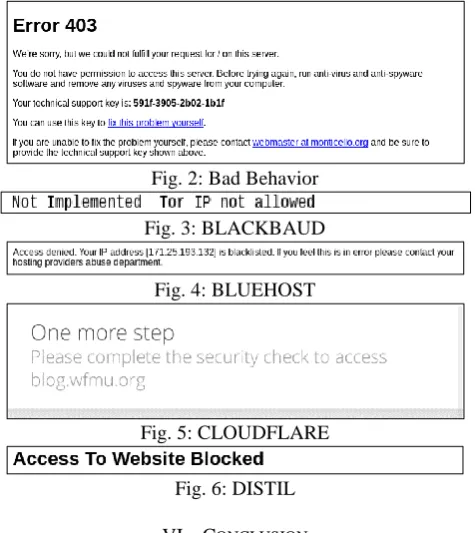
http://www.bluehost.com/ - Web facilitating organization. Square page has the expression "On the off chance that you feel this is in blunder please contact your facilitating supplier's manhandle office".
https://www.cloudflare.com/ - Announces itself as
Cloudflare. Blog entry on Tor:
http://blog.cloudflare.com/the-issue with-tor/.
https://www.incapsula.com/ - Announces itself as
Incapsula. Blog entry on Tor:
https://www.incapsula.com/blog/tor-does-not-equivalent deny-access.html.
Convio/Blackbaud - A web have for different charities. Pieces Tor particularly, restoring a HTTP 501 mistake: "Not Implemented Tor IP not permitted". A follow course prompts a subdomain of convio.net.
http://www.adl.org/is one influenced site [last check: 2015-07-15].
Distil Networks - Anti-scratching Company. Serves a captcha or square page with a shape to ask for
unblocking. Test square pages:
http://www.distilnetworks.com/distil_r_captcha.html, http://www.distilnetworks.com/distil_r_blocked.html, #Distil.
C. Hardware Requirements
Processor: PC with a Pentium II-class processor, 600 MHz (Recommended)
RAM: 1GB (Recommended) Hard disk: 160GB
III. STUDY
A. Tor Routing
Tor traffic is directed through 3 hubs of course: Guard, transfer, and exit. In ordinary activity, a given client just has 2 monitor hubs that they utilize only. The transfer hub is picked discretionarily, and the leave hub is picked by its leave strategy, which specifies which IPs and ports it will interface with. Ways are changed generally every l0 minutes.
This graph represents two imperative properties of Tor. To begin with, the two customers outline the multiplexing of different "circuits" over a solitary hub to-hub TLS association. Second, the base customer outlines the stream multiplexing ability: various TCP associations can be persisted a solitary Tor circuit. Every hub knows just the source and goal matching for a circuit.
B. Attacing Points
There are clearly a ton of assault focuses here, some more genuine than others, and some can be performed in a couple of various ways. The accompanying merit examining in broadened detail:
1) Application Layered Attacks:
These assaults rotate around bolstering the application some kind of information that either makes it sidestep intermediary settings, uncover pivotal client data, or generally out and out endeavor it. Note that there are really three positions that this sort of assault can be performed (leave, travel, and goal), and the sum total of what three have been seen in nature. An especially amazing case of this sort of assault is a leave hub spoofing a substance component from mail.google.com and bringing your Gmail account treat and downloading all your mail, despite the fact that you were not going by any Google-related locales at the time. Go0gle's request (and Yahoo's and Hotmail's too so far as that is concerned) on permitting non-https get to makes this assault a simple focus from Tor, as well as your neighborhood coffeehouse likewise (or the Defcon arrange). However another incredible motivation to clear your treats consistently.
2) Intersecting Attacks:
As I would see it, crossing point assaults are right now the second most unsafe assault against Tor, behind application layer assaults. Convergence assaults basically depend on associating a few unmistakable properties of Tor clients to coordinate pseudonymous Tor action to that client, and capacity best if there are few Tor clients utilizing the system. This clearly covers an extensive variety of solid assaults, yet the most amazing example I am mindful of is the situation of a college understudy who was directing an online trick some way or another identified with his or her college. [l] Since few individuals are as of now ready to endure Tor's moderate (and unpredictable) association speeds, it was an inconsequential issue for nearby system chairmen to cross examine the main two customary Tor clients on grounds. It is not necessarily the case that running tricks through Tor is something we might want to support or ensure, yet this underscores the way that Tor arrange notoriety is really a key segment of Tor organize security for others, who require more authentic secrecy
3) Circuit Failure Attacks:
Protect hubs can effectively fizzle circuits on the off chance that they don't stretch out to their conspiring peers. On the off chance that they can find a substantial side channel either inside the Tor convention or simply utilizing timing data, they might have the capacity to play out this assault at the monitor and leave position as it were. In the worsen case, in
any case, they can keep on failing each progressive circuit stretch out until the point when a conspiring peer is decided for that bounce. This assault underscores the way that dependability is yet another key factor of security in secrecy systems. Note that different properties of Tor make this assault marginally less clear by and by in any case. The client commonly has no less than 2, yet normally more protects, and the Tor customer will change to an arbitrarily chose monitor each time the circuit comes up short. Nonetheless, lying about transmission capacity to a degree corresponding to the level of circuits flopped before one succeeds can enable hubs to boost their potential for harm, since they will convey less traffic because of falling flat circuits making the customers now and again move somewhere else.
4) Time Correlating Attacks:
Timing relationship assaults endeavor to utilize association time, length, and flow qualities to correspond the customer's association with a monitor hub to an outside leaving association. A dynamic foe can likewise bring their own particular planning designs into this activity. Scholarly examinations have demonstrated that this assault can be to a great degree compelling in reproduction [3]. Be that as it may, despite everything it stays to be perceived how specific points of interest of the Tor arrange influence the capacity to complete this assault. Specifically, unanswered and intriguing examination questions include:
To what degree does Tor's stream multiplexing disappoint this?
when does the quantity of clients surpass the bits of data that can be
Reliably acquired from timing data in an aloof assault? How substantially more troublesome is it to play out
this assault remotely than inside?
Running Tor as both a customer and a hub ought to extraordinarily enhance your protection from both Internal and outside forms of this assault. ls this
quantifiable, however?
C. Centralizing Bandwidth and Load Scan
issues incorporate occasional, brief span filtering, and in addition just tallying insights for the center hub, who can't without much of a stretch perceive examined content.
D. Interesting Items Found during Network Scanning
Chinese ISP doing MITM on SSL
Regional ISPs embeddings popup blocker JavaScript into HTTP streams
DNS spoofing
Upstream reserves storing stale substance Verified reports of MITM on SSH, SSL
Disproved mistaken allegations of transfer speed lying Instances of over-burden hubs because of peculiar leave
arrangements and load adjusting bugs
E. Decentralizing Network Scan
Decentralized failure scanning is still in proposal form as part of the Two Hop Paths Tor Proposal. Google Summer of Code participant Johannes Renner is also conducting research on the effectiveness of node-based scanning as a part of his Master‘s Thesis on improving Tor's path selection
F. Tor’s Web Attack Profile
Ways to sidestep Tor/Proxy Settings
Java 1.5 Socket API enables code to supersede Java intermediary settings
Does this sound like a decent element for secured conditions when all is said in done??
Plugins handle their own particular system code and setting
Delayed execution until the point when Tor is incapacitated
meta-invigorate labels Timers and Events
m. Caught up with Waiting
2. Relationship of Tor versus Non-Tor Cookies
Exits can parody components from productive SSL-messy spaces, for example, mail.google.com
Cache Data
Cached items can contain intentionally developed one of a kind identifiers
3. History Disclosure
Enumeration of connection label style qualities in JavaScript
http://hackers.org/Weird/CSS-history-hackhtml Using CSS to get specific foundation pictures for went
to styles. No JavaScript required.
http://ha.ckers.org/bizarre/CSS-histoiycgi 4. Area curios
Time zone Locale, charset
5. Misc. secrecy set diminishment OS rendition/client specialist 6. History records/circle state
Some clients are in danger basically to use Tor. Their PCs might be confiscated/inspect
G. Tor Options
1) Disabling plugins according to Tor Usage:
This choice is vital to Tor security. Modules play out their own particular systems administration autonomous of the program, and numerous modules just incompletely obey even their own settings.
2) Isolating Dynamic Content to State:
Another significant choice, this setting causes the module to incapacitate JavaScript on tabs that are stacked amid a Tor state not the same as the present one, to forestall deferred brings of infused URLs that contain interesting identifiers, and to execute meta-invigorate labels. It additionally empowers a nslContentPolicy that keeps all brings from tabs with a contrary Tor state to square non-JavaScript dynamic substance, for example, CSS popups.
3) Hook Dangerous J JavaScript:
This fimction empowers the JavaScript snaring code. JavaScript is infused into the DOM (and afterward evacuated instantly in the wake of executing) to snare the Date question cover time zone, and to snare the pilot protest veil OS and client operator properties not took care of by the standard Firefox client specialist abrogate settings.
4) Disabling Updates During Tor setup:
Numerous augmentation creators don't refresh their expansions from SSL-empowered sites. It is feasible for vindictive Tor hubs to commandeer these augmentations and supplant them with noxious ones, or add malevolent code to existing expansions.
5) Disabling Search Suggestions amid Tor:
This discretionary setting represents in the event that you get Google look proposals amid Tor use. Since no treat is transmitted amid seek recommendations, this is a moderately kindhearted conduct.
6) Blocking History Reads amid Tor & Non-Tor:
In view of code contributed by Collin Jackson [5], this is really two settings, however are consolidated here for curtness since the impact is the same. Whenever empowered and the comparing Tor state is dynamic, this setting keeps the rendering motor from knowing whether certain connections were visited. This system crushes all record based history exposure assaults, including CSS-just assaults. 7) Blocking History Writes amid Tor & Non-Tor:
This setting keeps the rendering motor from recording went to URLs, and furthermore incapacitates download director history, frame field history, and handicaps recollecting login information. Note that on the off chance that you permit composing of Tor history, it is prescribed that you cripple non-Tor history peruses, since pernicious Websites you visit without Tor can inquiry your history for .onion locales and other history recorded amid Tor use, (for example, Google inquiries.
8) Disabling Session Saving:
9) Clearing History during Toggle:
This is a substitute setting to use rather than (or notwithstanding) blocking history peruses or composes. Square Tor circle store and clear all reserve on Tor Toggle. Since the program reserve can be utilized to store remarkable identifiers, reserve must not endure crosswise over Tor sessions. This choice keeps the memory reserve dynamic amid Tor use for execution, yet pieces plate access for storing.
10) Blocking plate and memory amid Tor:
This setting totally obstructs the store amid Tor, yet saves it for Non-Tor use.
11) Clearing Cookies on Toggle:
Completely clears all treats on Tor flip. 12) Storing Non-Tor treats in a jolt:
This alternative stores your steady Non-Tor treats in an extraordinary treat bump file, in the event that you wish to safeguard a few treats. Contributed by Collin Jackson.
13) Managing My Own Cookies:
This setting enables you to deal with your own particular treats with a substitute expansion, for example, Cookie Culler. Note this is especially risky, since vindictive leave hubs can parody record components that give off an impression of being from destinations you have safeguarded treats for.
14) Clearing treats on Tor & Non-Tor shutdown:
This setting utilizes the Firefox Private Data settings to clear treats on Tor as well as Non-Tor program shutdown. 15) Setting client specialist according to Tor utilization: Client specialist veiling is finished with making all Tor clients seem uniform. A current Firefox 2.0.0.4 Windows construct was mirrored for this string and supporting pilot, properties, and this rendition will continue as before for all T0rButton variants until the point that such time as specific contrariness issues are illustrated. Consistency of this esteem is clearly imperative to namelessness. Note that for this choice to have full viability, the client should likewise permit Hook Dangerous JavaScript guarantee that the navigator.* properties are reset accurately the program does not set some of them by means of the uncovered client operator abrogate inclinations.
H. JavaScript Hooking Technique
Firefox extension development is a maze of (extremely powerful) black voodoo magic and cryptic interfaces that allow you to customize just about every aspect of the browser and browser components via JavaScript and XML. However, the one thing they lack is the ability to configure your time zone. Hence, regular client-side JavaScript can query the Date object to determine your approximate geographic location. Luckily, it tums out that JavaScript is actually a pretty flexible language. Through a combination of object oriented functionality and lexical scoping, it is possible to create wrappers to existing objects while still concealing the original implementation, and to do all this at the same privilege level as client-side JavaScript without risk of subversion.
The approach is to create an nsIWebProgressListener to listen for location change events to alert you as soon as a new document's DOM is first created. At this point, you create a custom script tag, insert it
into the DOM (this causes the script to immediately run), then remove it. The key to the whole operation is to make sure that all of your references to the original object exist only as local variables that just happen to be in the same scope as the functions you are hooking (this works because of lexical scoping). In my case, this is what prevents the adversary from just calling the internal wrapped Date implementation. To make it a bit more difficult to fingerprint TorButton users, all other variables are direct properties of ‘Window’, and can be deleted from that object using the hash syntax and the delete operator. A skeleton sketch of the injected code is below. For the support code that does the injection, see the TorButton .xpi source code (in particular, t0rbutton_weblistener
IV. CODING wind0w._Ho0kObjects = work () { on the off chance that (_tb_set_uagent) { var tmp_0scpu = window._tb_oscpu;
navigator._defineGetter_("0scpu", work() { return tmp_oscpu;});/*/
}
var tmp = Date; Date = work() {
var d;/* DO NOT make 'd' a part! EvilCode will utilize it! */ var a = contentions;
if(arguments.length == 0) d=new tmp();/*/
Date.prototype.getYeaI:functi0n() {return d.getUTCYear();}
Dateprototype.getMonth=functi0n() {retum d. getUTCMonth();}
Dateprototype.getDate=function() {retum d. getUTCDate();}
Date.prototype.getDa§Pfi.1nction() {return d.getUTCDay();}
Date. Prototype = new Obj ect.prototype.toSource(); return d.t0UTCString();
}
Date.now=function() {return tmp.now();}
Date.UTC=functi0n() {return tmp.apply(tmp, arguments); } }
if (wind0w._HookObjects) { window._HookObjects(); delete window[‘_HookObjects‘]; delete wind0w[‘_tb_set_uagent‘]; delete window[‘_tb_oscpu']; }
V. SCREENSHOTS
Fig. 2: Bad Behavior
Fig. 3: BLACKBAUD
Fig. 4: BLUEHOST
Fig. 5: CLOUDFLARE
Fig. 6: DISTIL
VI. CONCLUSION
As indicated by Symantec, in the report of Insecurity of Internet of Things, in 2015 it is assessed that will be associated with the Web around 4.9 billion gadgets [Mario Barcena, 2014]. A considerable lot of these gadgets are gadgets that think it couple of dynamic and inactive security instruments, similar to the instance of cell phones, tablets and cell phones. Despite this viewpoint, regular a great many clients share data and information through these gadgets. At present associations have stopped to be the immediate focus of those devoted to robbery and abuse of data. The normal client has turned into an objective on the grounds that the measure of information is on the web, without having a feeling of their computerized impression. Additionally assaults on frameworks that give administration, for example, Webservers that store data about clients are under fire.in May 2015 the Alleged assault on the online Portuguese parcel eryplatform EuroMillions, was detailed by pplware.sapo.pt site in[Pplware,2015]. As per them, information from 20,000 clients had been com guaranteed. The assaults were not uncovered, having been uncovered information that might be utilized for future assaults. The data uncovered was comprised of username, hash, MD5 (MessageDigest5), salt, (email) and birth dates. In spite of the fact that these information may appear to be immaterial, these components permit interruption endeavors into email accounts that have birth dates as watchword, and the likelihood to recover another secret key from the Euro millions site, in the wake of utilizing the security system that utilizations safety efforts like inquiries, similar to affirmation of date of birth. The year2013 was rich in disclosure of occasions and exercises of North American security principals. As indicated by disclosures of Julien Assange [Julien Assange, 2013] on WikiLeaks (online stage for sharing data), secure Web perusing does not exist and even the area of clients isn't defended. As per him, a few
nations could get to the client information and concentrate important data.
ACKNOWLEDGMENT
It gives me enormous delight to express my most profound sense of gratitude and sincere thanks to my mentor Mr. Vinay Saini of IT, MAIT Delhi, for his/her valuable guidance, encouragement and help for completing this work. Her useful suggestions for this whole work and co-operative behaviour are sincerely acknowledged.
I also wish to express my indebtedness to my parents whose blessings and support always helped me to face the challenges ahead. I am thankful to my friends who were ready to help every time I was stuck with some problem.
REFERENCES
[1] Assange J.(2013). The Spy Files, https://twitter.com/wikileaks/status/3428124465342832 64.
[2] "About Tor UK – A Blog from the Tor UK Team and Authors". Tor UK. Pan Macmillan. 2014. Archived from the original on July 24, 2017.
[3] "Announcing Tor.com the Imprint". Tor.com. Macmillan. May 28, 2014. Archived from the original on January 24, 2018.
[4] Arkko, Jari (10 September 2015). ".onion". Retrieved 13 September2015.
[5] Alyson (3 December 2014). "Improved Security for Tor Users". Retrieved 11 September 2015.
[6] Barcena!M.!(2014).Wueest!C.,Insecurity of the Internet
of Things,
https://www.symantec.com/content/en/us/enterprise/me dia/security_response/whitepapers/insecurity-in-the-internet-of-things.pdf.
[7] Boavida F.(2013).Bernardes M., Vapi P.,Administração de Redes Informáticas, 2ª edição, FCA.
[8] "Baseline Requirements for the Issuance and Management Publicly-Trusted Certificates, v1.0" (PDF). Retrieved 13 September 2015.
[9] Carpenter T. (2011). Microsoft Windows Operating System Essentials, John Wiley & Sons
[10] Cryptography and Network Security: Principles and Practice, 5/e (Prentice Hall, 2010).
[11] Calling out security researchers who study non-problems (a fun piece by James Mickens, MSR). [12] "CA/Browser Forum Ballot 144 - Validation rules for
.onion names". Retrieved 13 September 2015.
[13] Deibert R.(2008).Palfrey J., Rohozinski R., Zittrain J., Stain ., Access Denied: The Practice and Policy of Global Internet Filtering, MIT Press
[14] Franceschi-Bicchierai, Lorenzo (10 September 2015). "Internet Regulators Just Legitimized The Dark Web". Retrieved 10 September2015.
[15] Internet Live Stats (2015). Data referent to internet
usage in 2015
-http://www.Internetlivestats.com/Internet-users. [16] IEEE Security & Privacy magazine tables of contents
[17] J.H. Saltzer, M.D. Schroeder. The protection of information in computer systems. Web version. Proc. IEEE 63(9):1278-1308 (Sept.1975). DOI: 10.1109/PROC.1975.9939.
[18] Jamie Lewis, Sarah (7 August 2016). "OnionScan Report: July 2016 - HTTPS Somewhere Sometimes". Retrieved 15 August 2016.
[19] Kuruvilla S. (2011). Lee!C., Gallegher M., From Iron Rice Bowl to Informalization: Markets, Workers, and the State in a Changing China, Cornell University Press [20] Kaufman, Perlman and Speciner, Network Security: Private Communications in a Public World, second edition (Prentice Hall, 2003).
[21] Locati F. (2015). OpenStack Cloud Security, Packt Publishing Ltd.
[22] Lopez,J., Ray I. Crispo B. (2014). Risks and Security of Internet and Systems! 9th International Conference, CRiSIS 2014, Trento, Italy, August 27-29, 2014, Revised Selected Papers, Springer
[23] Liptak, Andrew (May 2, 2017). "Tor Books announces a new fiction imprint dedicated to experimental storytelling". The Verge. Archived from the original on December 25, 2017.
[24] "List of client publishers". Melia Publishing Services. Archived from the original on December 27, 2017. [25] "Locus Award Winners by Category - Publishers". The
Science Fiction Awards Database. Archived from the original on September 4, 2017.
[26] Lee, Micah (8 April 2015). "Our SecureDrop System for Leaks Now Uses HTTPS". Retrieved 10 September 2015.
[27] Menezes, van Oorschot and Vanstone, Handbook of Applied Cryptography (CRC Press, 1996; 2001 with corrections),
[28] Mangu-Ward, Katherine (December 2008). "Tor's Worlds Without Death or Taxes". Reason. Archived from the original on August 11, 2017.
[29] Muffett, Alec (31 October 2014). "Making Connections to Facebook more Secure". Retrieved 11 September 2015.
[30] "Onion.cab: Advantages of this TOR2WEB-Proxy". Retrieved 2014-05-21.
[31] Review of 10 cryptography books (plus background introduction), Susan Landau. Bull. Amer. Math. Soc. 41 (2004), pp.357-367. Copyright 2004, AM
[32] Stallings' Network Security Essentials: Applications and Standards, 3/e (Prentice Hall, 2007).
[33] "Submitting a Novel to Tor UK". Blogs – Science Fiction and Fantasy. Pan Macmillan. January 29, 2013. Archived from the original on March 21, 2018.
[34] "Special-Use Domain Names". Retrieved 10 September 2015.
[35] Schuhmacher, Sophie (5 December 2014). "Blockchain.Info Launches Darknet Site In Response To Thefts Over TOR". Retrieved 20 September 2015. [36] Sandvik, Runa (2017-10-27). "The New York Times is
Now Available as a Tor Onion Service". The New York Times. Retrieved 2017-11-17.
[37] The limits of formal security models (Dorothy Denning, NCSS Award Speech, Oct.18 1999)
[38] "tor". Dictionary.com Unabridged. Random House. Retrieved March 21, 2018.
[39] Tor Books". The Encyclopedia of Science Fiction. December 20, 2017. Archived from the original on March 21, 2018.
[40] "Tor/Forge". MacMillan Publishers. Macmillan. 2014. Archived from the original on November 28, 2017. [41] "Top Science Fiction, Fantasy & Horror (SF/F/H)
Publishers". Worlds Without End. 2015. Archived from the original on March 22, 2015.
[42] "Top Science Fiction, Fantasy & Horror (SF/F/H) Publishers". Worlds Without End. 2018. Archived from the original on March 21, 2018.