©IJRASET: All Rights are Reserved
138
Study on Partial Replacement of Fine Aggregate
with Red Soil in Concrete
James Alexander.S1, Prof. Antony Godwin2, Dr.S.Alexander3 1,2
Department of civil engineering, Karunya University, Coimbatore, Tamilnadu, India. 3
Superintending Engineer (Retired), Tamilnadu P.W.D, Former Principal,Dean 3
Professor of Engineering Colleges, & Consulting Engineer (Civil) Tirunelveli, Tamilnadu, India.
Abstract - Many researchers are dealing with various types of admixtures to improve the mechanical and durability properties of concrete. In this present investigation, red soil is taken as an admixture to enhance the performance of concrete. An experimental investigation is carried out to study the behaviour of concrete by replacing the fine aggregate with locally available red soil. It involves a certain tests to find the quality improvement of concrete when red soil is added to it. The partial replacement of sand with red soil has been done according to the specific mix proportion to gain good strength in concrete and to calculate the imperviousness of red soil and also to find the special features of red soil which has the anti pest control in it. Mechanical properties such as compressive strength, split tensile strength, flexural strength and durability properties such as porosity, water permeability tests has been carried out for red soil mixed concrete and plain concrete to differentiate the strength and imperviousness in it . From the chemical properties of red soil, it is found that by replacing the fine aggregate with red soil turns the concrete as anti pest control. This red soil and river sand samples are first taken for preliminary test such as the sieve analysis test. Noticeably the red soil is of uniform size and so it is graded as poorly graded soil but the river sand is not finer as compared to the red soil. The partial replacement of sand in concrete has been done using red soil in a mix proportion of 1:1.5:2.75 which gives the significant improvement in strength and imperviousness. The characteristics of red soil has a great impact on strength, imperviousness and anti pest control. After conducting all these tests, red soil is found suitable for concrete as an admixture of it which can be used in construction of buildings.
Keywords: Red soil, River sand, Admixture, Partial replacement, Strength.
I. INTRODUCTION
The subject of utilizing the soil–cement mortar and concrete in the construction of buildings and other works happens to be of great importance and interest to civil engineers. However, due to want of essential technical data in the recognized literature. This subject remains dormant. This state of affairs needs to be changed.The project work now being started is only a beginning in this direction.Research has to be done intensively at different levels as follows.
B.Tech Level:Plain concrete and mortar; M.Tech Level: Reinforced concrete beams and slabs; Ph.D Level:Prestressed concrete beams; Post-doctoral level: Shell structures. Under this scheme the present project work covers unreinforced elements of concrete (rich and lean).
Red soils major advantage is its availability and highly effective for usage in concrete as a partial replacement and cement consumption is less when red soil is mixed, consumption of cement is less depending upon the variety of mix proportions. In this study 1:1.5:2.75 mix proportion is used and it enhances the performance of the red soil cement concrete,other mix proportions can also be tried. Red soil availability is in all kind of areas and it has unlimited resources in all areas which can be effectively used for admixture of concrete in constructing buildings. Red soil is formed due to weathering of igneous and metamorphic rocks. It is highly impervious after it is mixed with concrete because of its size and its colour is in red due to the presence of iron in it. In India regions, the availability of red soil is in Tamilnadu, Karnataka, Andhra Pradesh, Orissa, Jharkhand and it is also available throughout the world. In this study,red soil is taken from Karunya nagar, Coimbatore, Tamilnadu.
II. IMPORTANCEOFREDSOIL
A. Chemical Properties Of Red Soil
©IJRASET: All Rights are Reserved
139
Composition Percentage by weight (%)
Iron 3.61
Aluminium 2.92
Organic matter 1.01
Magnesium 0.70
lime 0.56
Potash 0.24
Soda 0.12
Phosphorus 0.09
Nitrogen 0.08
Its colour is mainly due to ferric oxides occurring as thin coatings on the soil particles while the iron oxide occurs as hematite or as hydrous ferric oxide, the colour is red and when it occurs in the hydrate form as limonite the soil gets a yellow colour. Ordinarily the surface soils are red while the horizon below gets yellowish colour.
B. Expected Benefits Through Red Soil And Properites To Be Studied
Expected benefits - Improvement in strength,significant improvement in imperviousness,more resistance to white ants (so as to avoid pest–control), Improvement in workability.
Properties to be studied - Flexural strength,Split tensile strength, Compressive strength, Water permeability,Porosity, RCPT. The target of this red soil cement concrete study is to obtain the strength, imperviousness and anti-pest control. Only the partial replacement of red soil is done and only 1/3rd of sand is replaced by red soil,we can also have 1/4th replacement and 2/3rd replacement of red soil. In this study only partial replacement of red soil is observed and full replacement of red soil is not done in this subject.
II. MATERIALSUSED A. Cement
The ordinary Portland cement of grade 53 is used in this study.
B. Fine Aggregate
Sand is used as one of the fine aggregate content in this study. Sand is sieved in 3.35mm sieve for using it in concrete mix. According to the mix proportion of fine aggregate 1.5, 1 is sand.
C. Coarse Aggregate
Coarse aggregate used in this study is sieved through 20 and 12.5mm sieve sizes. Coarse aggregate passing through 20mm sieve and retaining through 12.5mm sieve is sieved and used for concrete mix.
D. Red Soil
Red soil content used in this study is a partial replacement of fine aggregate. Red soil is sieved through 420micron sieve size for using it in concrete mix. According to the mix proportion of fine aggregate 1.5, 0.5 is Red soil.
E. Mixing Of Material
140
Fig 1. Red Soil and River sand (Left to Right)
III. METHODOLOGY
A. Sieve Analysis Test
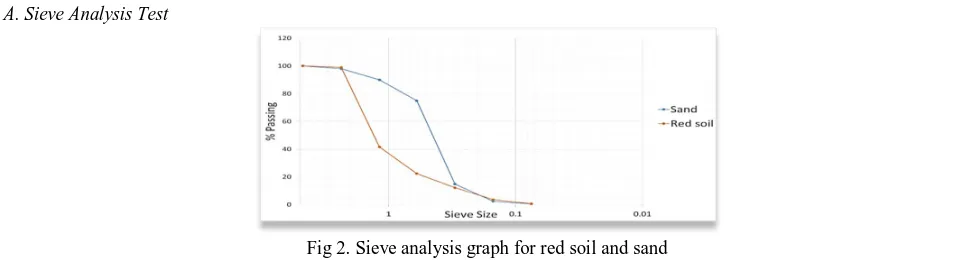
Sieve analysis is done for both sand and red soil as per IS 2386 (Part I)-1963. The first step involves arranging the IS sieves in the order of 4.75mm-2.36mm-1.18mm-600μ-300μ-150μ,75μ and pan. 1kg of fine aggregate is taken and placed on the top most
sieves. Sieving is done manually for fifteen minutes and weight retained on each IS sieve is found. Using the above values gradient curve is obtained and drawn in semi log graph sheet to check grade of sand and red soil.
B. Compressive Strength Test
The standard mould of size 150mm × 150mm × 150mm is used for casting. Curing is done for 14days for concrete cubes and the compressive strength test is done in (CTM) as per IS 516:1959 for ordinary mix and for the partial replaced samples.
C. Split Tensile Strength Test
The standard mould of size 150mm × 300mm is used for casting. Curing is done for 28 days. Split tensile test is done in compression testing machine (CTM) as per IS 5816:1999 for ordinary mix and for the partial replaced samples.
D. Flexural Strength Test
The standard mould of size 500mm × 100mm × 100mm is used for casting. Curing is done for 28days.flexural strength test is done as per IS 516:1959 in universal testing machine (UTM) for ordinary mix and for the partial replaced samples. Single point load test is done for ordinary mix and partially replaced samples.
E. Water Permeability Test
The standard mould of size 100mm × 100mm is used for casting. Curing is done for concrete cylinders and the water permeability test is done in concrete permeability apparatus for 14 days for ordinary mix and for the partially replaced samples. Test is done for 100 hours for each specimen. Formula- =
( × )
F. Porosity
The standard mould of size 100mm × 100mm is used for casting. Curing is done for concrete cylinders and porosity test is done in water tank for 24 hours and then in hot air oven for 24hours for 14days for ordinary mix and for the partially replaced samples.
IV. RESULT
A. Sieve Analysis Test
[image:4.612.62.550.581.711.2]141
graded soil.Red soil is much finer than the sand.
A. Compressive Strength of Cube
[image:5.612.188.425.213.551.2]Fig 3. Testing of Cubes
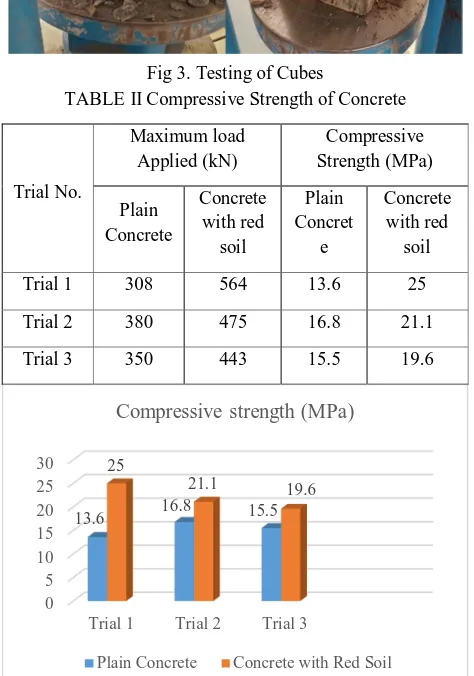
TABLE II Compressive Strength of Concrete
Trial No.
Maximum load Applied (kN)
Compressive Strength (MPa)
Plain Concrete
Concrete with red
soil
Plain Concret
e
Concrete with red
soil Trial 1 308 564 13.6 25
Trial 2 380 475 16.8 21.1
Trial 3 350 443 15.5 19.6
Fig 4. Compressive Strength of Cube
[image:5.612.191.417.594.699.2]B. Split Tensile Strength Of Cylinder
Fig 5. Testing of cylinders
0 5 10 15 20 25 30
Trial 1 Trial 2 Trial 3
13.6 16.8 15.5
25
21.1 19.6
Compressive strength (MPa)
142
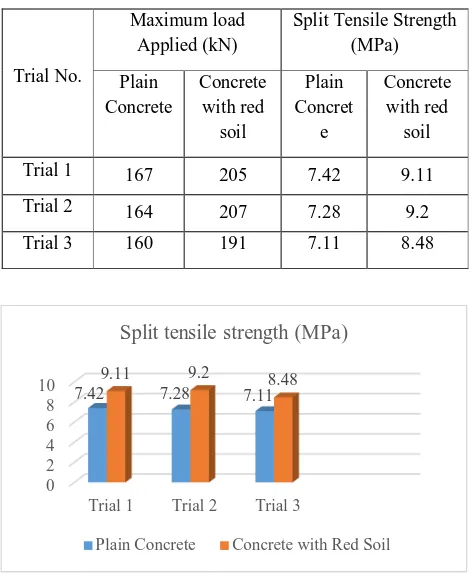
TABLE III Split Tensile Strength of Concrete
Trial No.
Maximum load Applied (kN)
Split Tensile Strength (MPa) Plain Concrete Concrete with red soil Plain Concret e Concrete with red soil
Trial 1 167 205 7.42 9.11
Trial 2 164 207 7.28 9.2 Trial 3 160 191 7.11 8.48
Fig 6. Split Tensile Strength of Cylinder
[image:6.612.188.424.86.373.2]C. Flexural Strength Of Beam
Fig 7.Testing of Beams
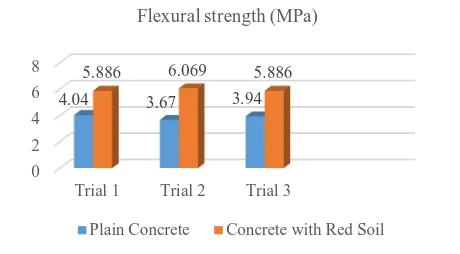
TABLE IVFlexural Strength of Concrete
Trial No. Maximum load Applied (N) Flexural Strength (MPa) Plain Concrete Concrete with red soil Plain Concret e Concrete with red soil
Trial 1 5395.5 7848 4.04 5.886
Trial 2 4905 8093.25 3.67 6.069
Trial 3 5258.16 7848 3.94 5.886
0 2 4 6 8 10
Trial 1 Trial 2 Trial 3
7.42 7.28 7.11
9.11 9.2 8.48
Split tensile strength (MPa)
[image:6.612.190.422.411.543.2]143
Fig 8. Flexural Strength of beam
D. Water Permeability Test
Fig 9. Water permeability apparatus and Tested material
TABLE V Water Permeability Test Results
Trial No.
Permeability Coefficient (×10-11) (cm/sec)
Plain Concrete Concrete with red soil
Trial 1 5.5 0.8
Trial 2 6.4 0.9
[image:7.612.60.555.406.655.2]Trial 3 7.3 0.7
Fig 10. Water Permeability
0 2 4 6 8
Trial 1 Trial 2 Trial 3
4.04 3.67 3.94
5.886 6.069 5.886
Flexural strength (MPa)
Plain Concrete Concrete with Red Soil
0 2 4 6 8
Trial 1 Trial 2 Trial 3
5.5 6.4
7.3
0.8 0.9 0.7
Water permeability ( x 10-11 cm/s)
144
F. Porosity Test [image:8.612.49.565.228.502.2]Fig 11. Curing and Hot air oven
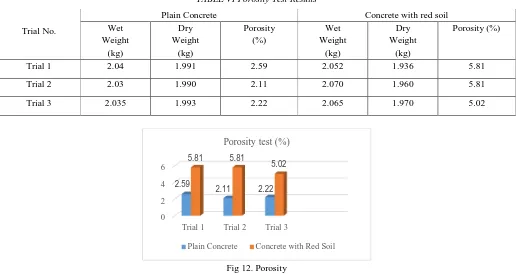
TABLE VI Porosity Test Results
Trial No.
Plain Concrete Concrete with red soil Wet Weight (kg) Dry Weight (kg) Porosity (%) Wet Weight (kg) Dry Weight (kg) Porosity (%)
Trial 1 2.04 1.991 2.59 2.052 1.936 5.81
Trial 2 2.03 1.990 2.11 2.070 1.960 5.81
Trial 3 2.035 1.993 2.22 2.065 1.970 5.02
Fig 12. Porosity Red soil is a porous and friable structure.
Red soil is a fine soil which holds large amount of water than the coarse soil.
In red soil mixed concrete, porosity is higher than plain concrete but the permeability is low in red soil compared to the plain concrete.
Due to tiny pores in fine soil it can hold water tighter in small pores, so that it is low in permeability It resists the fluid passage, hence it is impervious.
VI. CONCLUSION
A. The following test results of various tests explains that the Red soil mixed concrete is comparatively higher than plain concrete in strength and imperviousness.
B. In flexural strength, for plain concrete the actual value stops 3.67 – 4.04 N/mm2 but in red soil mixed concrete it has a good significant improvement in strength. The values of red soil mixed concretes flexural strength is 5.88 - 6.06 N/mm2.
C. In split tensile strength, for plain concrete the actual value stops at 7.11 – 7.42 N/mm2 but in red soil mixed concrete it has a good significant improvement in strength. The values of red soil mixed concretes split tensile strength is 8.48 – 9.2 N/mm2.
D. In compressive strength, for plain concrete the values are 13.6 – 16.8 N/mm2 but in red soil mixed concrete it has significant improvement, the values are 19.6 – 25 N/mm2.
0 2 4 6
Trial 1 Trial 2 Trial 3
2.59 2.11 2.22
5.81 5.81
5.02 Porosity test (%)
©IJRASET: All Rights are Reserved
145
F. In porosity, in red soil mixed concrete, porosity is higher than plain concrete but the permeability is low in red soilcompared to the plain concrete.Due to tiny pores in fine soil it can hold water tighter in small pores so that it is low in permeability, It resists the fluid passage. Hence it is impervious.
G. If this concrete is used in RCC, then there will be no corrosion in steel.
H. Due to its 0-permeability it can be used for building high rise building (multi-storied building).
I. Red soil can be used in RCC as well as prestressed concrete.
J. Follow of action is to be done in research for shell structures, prestress and RCC to confirm that red soil can be used in multi storied building.
VII. ACKNOWLEDGMENT
I wish to express my sincere thanks to Dr.S.Alexander (consultant) for his encouraging and a mindful support and it’s a great privilege for me to work with him in this project work and I wish my heartful thanks to my guide Prof.Mr.Antony Godwin for his firm guidance and I thank KARUNYA UNIVERSITY for providing me the timely needs to complete my project work.
REFERENCES
[1] Ashok Raajiv.v.s, Augustine Maniraj Pandian “Experimental investigation on the effects of using soil as a replacement of sand in concrete”ICETSH-2015, page: 66-69.
[2] Sunkarayashwant, Someswara Rao b., Venkata Rao G. “Experimental studies on laterite soil stabilized with cement and aggregate”, Indian Journal of Research Engineering and Technology” Vol. 04, August 2015.
[3] Joshua, Amusan, Fagbenle O.I &kukoyi P.O, “Effects of partial replacement of sand with lateritic soil in sandcrete blocks”, Covenant Journal of Research in Built Environment” vol.1, March 2014.
[4] Prakash.S, Rajeshkumar.K, Sakthi.S&ShembiangMarthong, Kumutha&Vijai k., “Feasibility study on utilisation of laterite soil for stabilized earth blocks”, Research Desk 2013,Jul-Sep (2)3.229-236 .