Seismic Performance of Bridge Bearings Using
Shape Memory Alloy- A Review
Mohammad Sharique1, Dilip J. Chaudhari2, Ashish. R. Akhare3 1, 2, 3
Department of Applied Mechanics, Govt. Engineering College Amravati, Maharashtra, India
Abstract: Shape Memory Alloys (SMAs) are unique materials with a paramount potential for various applications in bridges. The property of this material lies in its ability to undergo large deformations and return to its unreformed shape through stress removal (superelasticity) or heating (shape memory effect). This paper critically examines the fundamental characteristics of SMA and Mathematical modeling of hysteretic and superelastic properties of SMA also existing SMA models are discussed. Keywords: Base Isolation, Seismic Performance of Bridge, Shape Memory Alloy, SMA Modeling.
I. INTRODUCTION
Large proportions of the population in the world lives in seismic hazard regions are at risk from earthquakes of varying severity and frequency of occurrence. Every year earthquakes cause significant loss of life and damage to property. Progress in design and assessment methods of civil structures traditionally followed major earthquakes, whenever the need of improving the safety level of engineering structures became evident. When it was realized in the 1950s and 1960s that structures can survive levels of response accelerations apparently exceeding the ultimate strength level, concept of ductility was formalized and began to be adopted, attributing to the structures the capacity of deforming in elastically without significant strength loss, thus surviving high level earthquakes. It was also understood that a general improvement of the structural response could be obtained by modifying the structural dynamic characteristics and dissipating the seismic energy during the earthquakes.
Bridges play an important role in the transportation network on which goods and people are transported, and their failure will not only result in an interruption of this basic need but also impede the relief and rescue efforts. In the most recent 2008 Winchuan earthquake, many highway bridges were either severely damaged or completely collapsed in China, leading to not only significant economic losses but also large loss of lives due to the transportation supply disruption and the lack of access to medical care[1]. Seismic isolation has been considered as a reliable and cost-effective technology to alleviate the risks of seismic damages to highway bridges (D. Cardone)[2]
Laminated rubber bearings are one of widely used devices in seismic isolation of bridges and buildings. They are revealed the ability to carry vertical loads in compression and to accommodate shear deformations. The rubber layers, reinforced with steel shims, reduce the freedom to bulge by increasing the vertical stiffness of the bearing. Three types of laminated rubber bearings are widely used as seismic isolation devices: natural rubber bearing (RB), lead rubber bearing (LRB), and high damping rubber bearing (HDRB). RB occupies flexibility property and small damping and hence it has been used to accommodate the thermal movement, the effects of pre-stressing, creep, and shrinkage of superstructure of elevated highway or it has been used in seismic isolation by combining with other energy dissipation devices, such as lead, steel and viscous damper, etc. (Khan et al., 2015)[3]. Other two types of bearings possess high damping which are developed and widely used in various civil infrastructures including bridges in many countries, especially in Japan and USA (Khan, 2016). [4]HDRB possess a variety of mechanical properties, which are influenced by their compounding effect, nonlinear elasto-plastic behavior and temperature and strain-rate dependent viscosity property [5].
II. SHAPE MEMORY ALLOY (SMA)
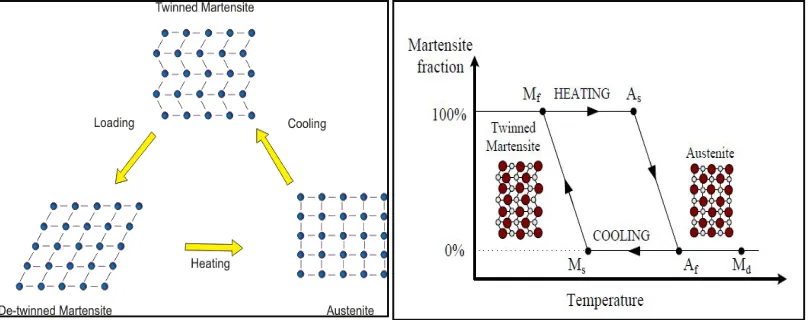
A shape-memory alloy (SMA, smart metal, memory metal, memory alloy, muscle wire, smart alloy) is an alloy that remembers its original shape and that when deformed returns to its pre-deformed shape when heated or stressed. The two main types of shape-memory alloys are (1) one way shape shape-memory alloy, and (2) Two way shape shape-memory alloy, Shape shape-memory alloys (SMAs) are one kind of smart and functional materials that can restore to their pre-determined and original shape after deformation via unloading or applying thermal load. They have two solid phases; martensite or unstable phase in which material is at low temperature and austenite, parent, or high-temperature phase.[8] In this regard, four characteristic temperatures are defined to determine the temperature ranges for starting and finishing the phase transformation between martensite and austenite. Figure 2.1 illustrates the martensite fraction in an SMA material as a function of temperature in the absence of applied stress. There are four characteristic temperatures at which phase transformations occur:
Austenite start temperature (As), where the material starts to transform from twinned martensite to austenite. Austenite finish temperature (Af), where the material is completely transformed to austenite,
[image:3.612.124.528.263.423.2]Martensite start temperature (Ms), where austenite begins to transform into twinned martensite, Martensite finish temperature (Mf), where the transformation to martensite is completed.
Figure 1 Schematic Working of SMA
Following are two properties of Shape Memory Alloy
A. Shape Memory Effect
The shape memory effect is the ability of SMA material to recover its original shape after being deformed through a thermal cycling. If the temperature is below Mf, the SMA is in its twinned martensite phase. When a stress above a critical level is applied, the material transforms to detwinned martensite phase and retains this phase upon the removal of the load. It can regain its initial shape when the SMA material is heated to a temperature above Af. Heating the material above Af results in the formation of the austenite phase and a complete shape recovery. By a subsequent cooling, the SMA transforms to initial twinned martensite phase without residual deformation. Figure 2.2 illustrates the shape memory effect on a stress-strain curve and a temperature diagram.
B. Superelastic Effect
(a) (b) Figure2 Properties of SMA; (a) Shape Memory Effect, (b) Superelastic Effect
III. MODELING
This modeling aims to studying the behavior of shape memory alloys materials. To understanding the behavior of SMA many researchers developed mathematical models by considering different property of SMA. Most basic mathematical model is suggested by Grasser and Cozzarelli.
A. Graesser and Cozzarelli SMA Model
Graesser and Cozzarelli[9] proposed a one dimensional model representing the stress strain characteristics of SMAs which is a modification of the rate independent Ozdemir’s model for the hysteresis behavior. The proposed model is given as
̇ = . ̇ −| ̇|. ………(3.1)
Where;
σ is the one dimensional stress,
E is the elastic modulus,
ε denotes strain,
Y is the yield stress,
nis a constant that controls the sharpness of the transition from the elastic state to the plastic transformation phase,
̇
and ̇ denote the ordinary time derivative of the stress and strain respectively, and
β is the one-dimensional back stress, given by,
= . { + . | ̇| . erf( . ) . [ (− ̇. )]}………(3.2)
Where ft, a and c material constants that determines the shape and size of the hysteresis, the amount of strain recovered during unloading, and the elastic modulus of the unloading stress plateau, respectively. The term α controls the slope of the stress-strain
curve in the inelastic range. εinrepresent inelastic strain, given by εin= ε – σ/E. u(x) is the unit step function and erf(x) is the error
function defined as,
u(x)= 1 x ≥ 0 0 x<0
( ) = 2
√ .
By proper choice of the elastic modulus, yield stress, inelastic modulus and the constants ft, α, c etc. it is possible to arrive at the
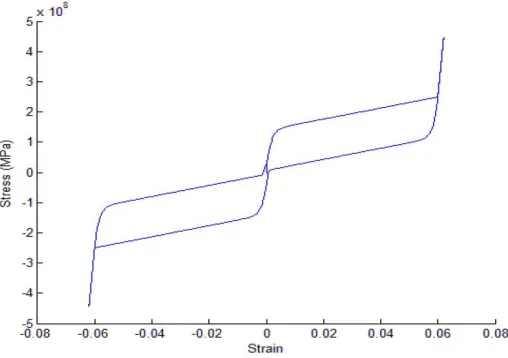
hysteresis property and the superelastic type of behavior of shape memory alloys. For example choosing ft = 0 will represent the hysteresis loop of the material in pure martensite form while ft > 0 will give us the superelastic behavior.
For the purposes of model demonstration, the material constants E, Y and are selected as E=28500 ksi, Y= 30 ksi and =0.0197 (Ey= E/(1+)= 550 ksi).
The overstress power is selected as n = 3 initially the constant ftis chosen as zero. This will eliminate the participation of the term
ranging from = -0.016 to = 0.016. The frequency of strain loading is taken as w = 1 radian/sec and the time step h = 0.025 sec is used in conjunction with 300 numerical integration time steps.
The hysteretic and superelastic behavior calculated using Equations. (3.1) and (3.2) for this set of conditions is shown in Figure 3.1.
(a) Hysteretic Effect
(bSuperelasticity) Effect
Figure3 G-C SMA model : (a) Hysteretic Effect, (b) Superelasticity Effect
B. Extended Superelastic Model of SMA or Wilde Model
This model is proposed by Wilde et al.[10](1997). In order to fully exploit the potential ofSMAs the martensite hardening effects need to be considered. Here the existing Graesser Cozzarelli model is extended to represent hardening of SMA after transition to martensite is completed. This model allows the use of SMAs in a wider range of strains and depicts properties that add to their benefits as base isolators. The modified model is of the form
̇= . ̇ −| ̇|. . ( ) + . ̇. ( ) + (3 . ̇ + 2 . ( ). ̇ + . ̇) ( )……….. (3.3)
Where backstress β is given by
= . { + . | ̇| . erf( . ) . [ (− ̇. )]} u1(ε), u2(ε) and u3(ε) are
= (1− (ε) − (ε))
u2(ε)=1, for |ε| ≥ εm
The signum function is given by
Sig(x) = -1 x < 0 0 x = 0
1 x > 0
[image:6.612.148.464.231.508.2]As depicted in Figure 3.2 the parameter Em represent elastic modulus in pure martensite state. The elastic Martensite behavior is included by incorporating the term ⋅ ̇⋅ 2( ) . This term is activated when the strain is higher than εm. εm is the strain where the complete martensite transformation is completed. The last term in the constitutive equation is added to obtain a smooth transition from the curve of slope Ey to the curve of slope Em and is evaluated only during loading and for the strain ε1<|ε|<εm. The limits are determined based on experiments conducted on that particular alloy. This transition phase is controlled by the constants a1, a2 and a3 included in the last term which are selected so that the slope of the function defined at the boundaries (i.e. at ε1 and εm) are consistent with the slopes of SMA plastic behavior and martensite elastic response.
Figure 4 Schematic Stress–Strain Relations of the Extended Hysteretic Model of Shape Memory Alloy.
After rearranging the equation we get stress;
= ̇ − ̇ .̇. ( ) .̇ . ( ).̇ .̇ ( )
. ( ) .|̇|
/
+ ……….….. (3.4)
Data consider for demonstration
t E Em Y α n a c ft
0-300
98300 MPa
98300 MPa
144.9
MPa 0.0197 1 900 0.001 0.08
Considering superelastic range m =0.05
Figure 5SuperelasticityBehaviour of SMA Wilde Model
IV. APPLICATION OF SMA
Sharad Ghodkeet, al. [11] studied response of the base-isolated benchmark building with Shape Memory Alloys (SMA) supplemented Elastomeric Rubber Bearing(ERB) isolation systems are carried out by time history analysis. An equivalent elastic-viscous model of SMA is proposed to simulate the nonlinear behavior of SMA. Authors proposed equivalent linear model is established by using system identification method; that model is valid for any type of isolated structures (i.e. Bridges, Buildings, Water tanks etc.). The proposed equivalent linear model of SMA is a modified form of AASHTO guidelines specifications, and therefore practicing engineers can freely use it in the design.
Eunsoo Choi, et. al,[12]illustrated the behavior of shape memory alloy in tension and discussed the variation of stiffness and stress on the hyteresis curves. A three-span continuous steel bridge was used for seismic analyzed to compare the performance of lead–rubber bearings (LRB) with the proposed bearings. Authors showed that large residual deformation of LRB occurred even with a weak ground motion of peak ground acceleration (PGA) of 0.2g. The proposed bearings effectively limited the relative displacement of the deck when tested for the strong ground motions and almost recovered the original.
NitinChavan, et, al.[13] Studied the effect of seismic isolation on the seismic response of bridge components. In this study, first existing bridge with Elastomeric bridge bearing is modeled and analyzed to get the seismic response of bridge components and then that results are compared with Elastomeric isolator in place of elastomeric bearing. Modeling and analysis of Highway Bridge is done with help of Structural Analysis and Program 2000 Software. Time history analysis of bridge is conducted for 1940 Imperial Valley earthquake ground motion record. It is found from analysis results that significant reduction in seismic response of bridge components can be achieved by replacing elastomeric bearing with elastomeric isolator.
A. M. Billah. et. al. [14] presented a paper for smart isolation system for highway bridges, consisting of superelastic Shape Memory Alloy (SE-SMA) had been explored and its performance had been compared to that of other two types of isolation devices, which are high damping rubber bearing (HDRB) and lead rubber bearing (LRB). Result shown the SMA isolator satisfactorily restrained the deck displacement and the relative displacement between deck and pier for strong ground motions. Also the SMA isolation system has inherent centring ability due to the superelastic response of the alloy.
V. CONCLUSION
This paper presents a review of the basic properties of shape memory alloys (SMA) and applications of shape memory alloys in civil structures.Shape memory alloy is a unique material and has found increasing application in many research areas. A shape memory alloy has an ability to undergo large deformation also studied the fundamental characteristic of shape memory alloy, some of the application of shape memory alloy in civil structures, and the constitutive modeling of shape memory alloys are discussed.
REFERENCES
[1] E. Choi, T.H. Namb, J.T. Oh, B.S. Cho, “An isolation bearing for highway bridges using shape memory alloys” , Materials Science and Engineering A 438–440 (2006) 1081–1084.
[3] Khan AKM TA; Bhuiyan, MAR and Alam, MS, “ Use of Ni-Ti shape memory alloy bars in seismic retrofit of multi-span elevated highway” , Proceedings of the National Conference of Earthquake and Environmental Disaster (NCEED - 2015), CUET, Chittagong, Bangladesh.
[4] Khan, AKM, TA. Use of Shape Memory Alloy in Seismic Retrofit of Multi-Span Simply Supported Elevated Highway, PGD Project Report, IEER, CUET, Chittagong, Bangladesh 2016.
[5] Bhuiyan, A.R., Okui, Y., Mitamura, H. and Imai, T. “A rheology model of high damping rubber bearings for seismic analysis: identification of nonlinear viscosity”, International Journal of Solids and Structures vol. 46, (2009) 1778-1792
[6] Hurlebaus, S. and Gaul, L. ‘‘Smart Structure Dynamics,’’ Mechanical Systems and Signal Processing, vol. 20, 2006. 255_281.
[7] K.M.Bajoria, ShreyaKaduskar. “A Review on: Shape Memory Alloy and Its Application in Civil Structures” IJER, vol. 5, pp: 721-724. 201
[8] O. E. Ozbulut, S. Hurlebaus, and R. Desroches. “Seismic Response Control Using Shape Memory Alloys: A Review”, Journal of Intelligent Material Systems and Structures 22: 1531, 2011.
[9] E. J. Graesser and F. A. Cozzarelli., “Shape-Memory Alloys As new Materials for Aseismic Isolation”, J. Eng. Mech., 2590-2608., 1991.
[10] Krzysztof Wilde, Paolo Gardoni, YozoFujino., “Base isolation system with shape memory alloy device for elevated highway bridges”, Engineering Structures 22 222–229., 2000.
[11] SharadGhodke, R.S. Jangid, “Equivalent linear elastic-viscous model of shape memory alloy for isolated structures”, Advances in Engineering Software 99 (2016) 1–8.
[12] Eunsoo Choi, Tae-hyun Nam, and Baik-Soon Cho, “A new concept of isolation bearings for highway steel bridges using shape memory alloys”, Materials Science and Engineering A · November 2006, 957-967.
[13] Nitin Chavan1, PraneshMurnal, “A Comparative Study on Seismic Response of Bridge with Elastomeric Bearing and Elastomeric Isolator”, Journal of Civil Engineering and Environmental Technology, Volume 2, Number 10; April-June, 2015 pp. 38-41