Stabilization of Expansive Clay Using RHA and
TSP
Md Abdul Shukoor1, J Chandini Devi2, Mycherla Chaitanya3, M Divya Tejaswi4 1,2,3,4
Civil Departments, Aditya College Of Engineering & Technology, Surampalem , JNTUK University
Abstract: Expansive soils are biggest concern for geotechnical engineers as they are highly susceptible to swelling because of the presence of montmorillonite mineral. Among all the clay minerals like kaolinite, illite, montmorillonite and hallosyte, montmorillonite has the highest swelling property which leads to unpredictable swelling and shrinkage in expansive soils. Several waste products are produced during the manufacturing and treating process in industries. Rice Husk Ash and Tandur Stone Slurry Powder are such waste products and disposing of these minerals is concern for the environment, so usage of these products to stabilize soil will improve not only the soil strength but also environmental friendly. In the present study, expansive clay is treated with RHA and the optimum mix is found out and it is further stabilized with Tandur Stone Slurry Powder to increase the CBR value of the soil.
Keywords: Expansive soil, Rice husk ash (RHA),Tandur Stone Slurry Powder (TSP), Soaked CBR
I. INTRODUCTION
Expansive soil is one among the problematic soils that has a high potential for shrinking or swelling due to change of moisture content. Expansive soils can be found on almost all the continents on the Earth. World over, problem of expansive soils has appeared as cracking and break-up of pavements, railway and highway embankments, roadways, building foundations, irrigation systems, water lines, sewer lines, canal and reservoir linings. The losses due to extensive damage to highways running over expansive soil sub-grades are estimated to be in billions of dollars all over the world. Various remedial measures like soil replacement, moisture control, pre-wetting, lime stabilization have been practiced with varying degrees of success. However, these techniques suffer from certain limitations with respect to their adaptability, like longer time periods required for pre-wetting the highly plastic clays, difficulty in constructing the barriers, pulverization and mixing problems in case of lime stabilization and high cost for hauling suitable refill material for soil replacement etc.
A. Material Used for Present Study
1) Expansive Soil: The soil used was a typical black cotton soil collected from KAKINADA, in East Godavari District, Andhra Pradesh State, India. The properties of soil are presented. All the tests carried on the soil are as per IS specification.
2) Rice Husk Ash(RHA): Rice milling generates a by-product know as husk shown in figure1. This surrounds the paddy grain. During milling of paddy about78% of weight is received as rice, broken rice and bran. Rest 22% of the weight of paddy is received as husk. This husk is used as fuel in the rice mills to generate steam for the parboiling process. This husk contains about 75%organic volatile matter and the balance 25% of the weight of this husk is converted into ash during the firing process, is known as Rice Husk Ash (RHA). This RHA in turn contains around 85% - 90% amorphous silica. So for every 1000 kg of paddy milled, about 220 kg (22%) of husk is produced, and when this husk is burnt in the boilers, about 55 kg (25%) of RHA is generated. India is a major rice producing country, and the husk generated during milling is mostly used as a fuel in the boilers for processing paddy, producing energy through direct combustion and/ or by gasification.
3) Tandur Stone Slurry Powder (TSP): TSP is produced from limestone, shown in figure2. Limestone has numerous uses: as a building material, as aggregate for the base of roads, as white pigment or filler in products such as toothpaste or paints, and as a chemical feedstock. Limestone is very common in architecture, especially in Europe and North America. Many landmarks across the world, including the Great Pyramid and its associated complex in Giza, Egypt, are made of limestone. Limestone is readily available and relatively easy to cut into blocks or more elaborate carving.
Fig2. Tandur Stone Slurry Powder
In the present study, it is attempted to study the effect of Rice husk ash(RHA) of 15%,20%,25%,30% and Tandoor slury powder(TSP) of 4%,5%,6%,7%,8%,9%,10% on the properties of expansive clay.
II. METHODOLOGY
The methodology of the present project work is shown below
Fig1. Methodology of work
A. Tests Conducted on Materials
Each mix underwent a series of tests. These tests were chosen to assess the individual characteristic of the additives mixed with Expansive soil. A complete list of the tests is given below
1) Differential Free Swell (DFS
2) Grain Size Analysis (Sieve Analysis
3) Atterberg Limits
4) Proctor compaction test result 5) ) California bearing ratio
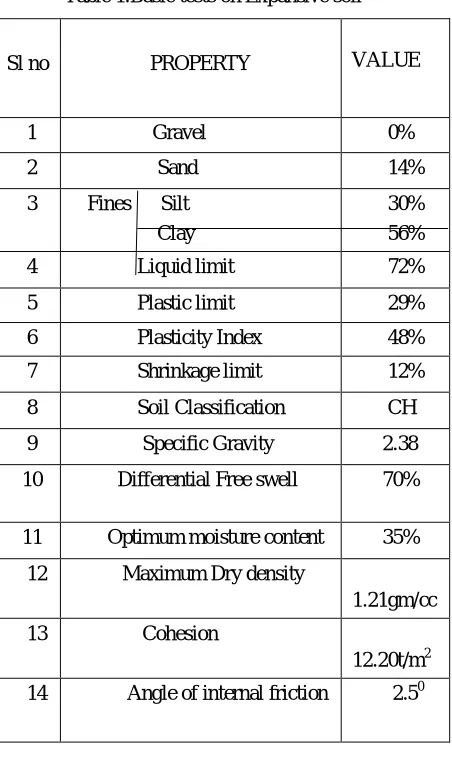
[image:4.612.205.431.216.596.2]The basic tests were conducted on clay and the results are presented in table1.
Table 1.Basic tests on Expansive soil
III.RESULTS&DISCUSSIONS
The laboratory tests are conducted on expansive clay treated with RHA to find the optimum content of RHA to increase the CBR values of the soil. Then it is further treated with varying contents of TSP, to find the optimum mix of expansive clay, rice husk ash and Tandur Stone Slurry Powder. The results are tabulated as below. The dry density is found to be maximum for a mixture of 75% Expansive clay and 25% of RHA and the corresponding CBR value is 8.46%. The optimum TSP is found to be 9% and obtained CBR value is 9.13.
A. Proctor compaction test results
Table 2 Optimum Moisture Content and Maximum Dry Density Values of Expansive Clay treated with different % of Rice Husk Ash
Sl no PROPERTY
VALUE
1 Gravel 0%
2 Sand 14%
3 Fines Silt Clay
30% 56%
4 Liquid limit 72%
5 Plastic limit 29%
6 Plasticity Index 48%
7 Shrinkage limit 12%
8 Soil Classification CH
9 Specific Gravity 2.38
10 Differential Free swell 70%
11 Optimum moisture content 35%
12 Maximum Dry density
1.21gm/cc
13 Cohesion
12.20t/m2
Table2. Dry density of Soil + RHA
Mix proportion Water Content (%) Dry Density(g/cc)
100%soil 35.00 1.21
85%soil+15%Rice Husk ash 27.20 1.458
80%soil+20%Rice husk ash 27.60 1.480
75%soil+25%Rice husk ash 30.12 1.5562
70%soil+30%Rice husk ash 27.14 1.48
Table3. Variation of soaked CBR values with Rice husk ash
Mix Proportion Water Content (%) CBR (%)
100%soil 36.00 2.618
85%soil+15%RHA 37.26 4.12
80%soil+20%RHA 36.88 5.28
75%soil+25%RHA 25.71 8.46
70%soil+30%RHA 39.55 6.66
Table4. Variation of Soaked CBR values of EC+RHA+TSP
(75%EC+25%RHA+)%TSP Water content (%) Soaked CBR
4%TSP 36.5 4.44
5%TSP 38.1 4.54
6%TSP 38.6 3.58
7%TSP 32.4 4.92
8%TSP 30.06 5.62
9%TSP 28.18 9.13
10%TSP 24.261 6.09
IV.CONCLUSIONS
A. It is found that when expansive clay treated with 25% RHA and 9% TSP the liquid limit and plasticity index of the expansive clay has been decreased by 51.90% and 31.4 % as compared to untreated expansive clay.
B. Found that the O.M.C of the expansive clay has been decreased by 29.93% on addition of 20% Rice husk ash and it has been
further decreased by 20.65% when 9% TSP is added.
C. C.B.R. value of the expansive clay has been increased to 8.46% on addition of 25% Rice Husk Ash and it has been improved
V. ACKNOWLEDGMENT
Let me take this opportunity to thank Chairman Sir, N. Sesha reddy and Vice Chairman Sir, N. Saltish reedy, ADITYA College of Engineering & Technology for the whole hearted support extended to us throughout the conduct of the research. We would like to thank the Principal Sir, Dr. T.K. Ramakrishna rao, ADITYA College of Engineering & Technology, for
Giving me an opportunity to carry out the research work through the esteemed institution.S. Sivacharan, Assoc Professor, ADITYA College of Engineering & Technology gave me lot of inputs and suggestions to
bring out the best in me and for referring the materials.
REFERENCES
[1] S.Sivacharan,”Strength and workability Assessment of ordinary Concrete and self-compacting concrete using Tandur Stone Slurry Powder-A comparison” , IJERT, Vol.5,Issue 11,Novememberv,2016.
[2] Bansal, R.K., Pandey, P.K. and Singh, S.K, “Improvement of a Typical Clay for Road Subgrades”, Proc. Of National Conf. on Problematic Subsoil Conditions, Terzaghi-96, Kakinada, India, 1996, pp. 193-197.
[3] D. KoteswaraRao, “The performance studies on Geo-grid as reinforcement in the flexible pavement construction”, IGC-2004.December 1987 [4] IS: 2720 part- 4 (1975): Grain size analysis.
[5] IS: 2720 part- 5 (1970): Determination of Liquid limit and Plastic limit. [6] IS: 2720 part- 6 (1972): Determination of Shrinkage limit.
[7] IS: 2720 part- 6 (1974): Determination of Dry density and Optimum moisture content. [8] IS: 2720 Part-16 (1979): Determination of California bearing ratio.