Temperature
Masaaki Yokota, Atsushi Ito, Norihito Doki
Department of Chemistry and Bioengineering, Iwate University, Morioka, Japan Email: [email protected]
Received 8 September 2015; accepted 20 October 2015; published 23 October 2015
Copyright © 2015 by authors and Scientific Research Publishing Inc.
This work is licensed under the Creative Commons Attribution International License (CC BY). http://creativecommons.org/licenses/by/4.0/
Abstract
Polymorphic transformation temperature of 2,2’:6’,2”-Terpyridine (terpy) has been studied. No transformation was observed for unground terpy (orthrhombic form) crystals, while the ground crystals may be transformed into monoclinic form. The transformation temperature was much lower than reported transformation temperature. In addition the transformation temperature decreased with increase of the grinding time. Factors influencing the transformation temperature of terpy were discussed.
Keywords
Terpyridine, Crystal, Polymorphic Transformation
1. Introduction
A given molecular species has possibility to take more than two crystal structures. This is called as crystal lymorphism. Polymorphism is one of the major research interests in the field of industrial crystallization. In po-lymorphism, one crystal structure may transform into another structure. This polymorphic transformation occurs via liquid phase and/or in solid state. Recently, solid state transformation has been applied for functional mate-rials such as phase memory and e-ink and this study focus on solid state polymorphic transformation.
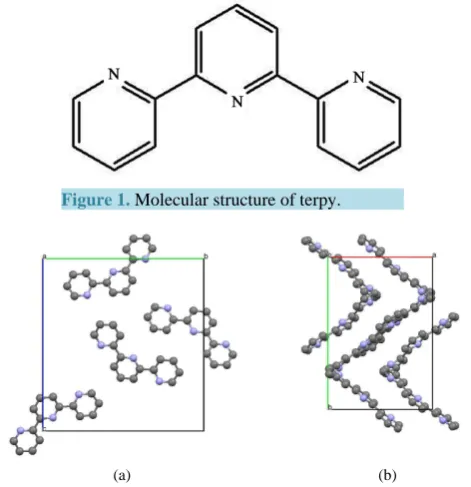
Figure 1. Molecular structure of terpy.
(a) (b)
Figure 2. Two crystal structures of terpy drawn using single crystal structure data [2] [3]: (a) orthrhombic form, (b) monoclinic form.
2. Experimental Section
2.1. MaterialTerpy (MW = 233.27, >98.0%) was purchased from Tokyo Kasei and was purified by column chromatography followed by recrystallization using toluene/hexane (1:1 vol/vol) mixed solvent. Structure of thus prepared crys-tals was evaluated as orthorhombic form and was used for following polymorphic transformation experiment.
2.2. Polymorphic Transformation Experiment
The starting terpy crystals, orthorhombic form, were ground for a given time manually using a mortar and pestle. The pre-determined grinding time is 0 - 90 min. About 10 mg of the sample powder was placed in an aluminum pan and differential scanning calorimetry (DSC) analysis was conducted on an EXSTER X-DSC7000 (Hitachi High-tech Science) under nitrogen atmosphere with a heating rate of 5˚C/min. Solid state transition temperature and melting temperature were determined by the intersection method. Powder XRD patterns of the crystals, sampled before and after a transition peak observed in the DSC, were measured by RINT2200 (Rigaku CuKα, λ = 1.5418 Å). Structure of the crystals was determined by comparing the measured XRD patterns with theoretical XRD patterns (orthorhombic and monoclinic) calculated using reported crystal structure data [2] [3].
3. Results and Discussion
3.1. Influence of Grinding on the Transformation Temperature
Figure 3. Effect of grinding time on DSC patterns of terpy crystals. (a) Unground; (b) 1 min ground; (c) 10 min ground; (d) 20 min ground; (e) 30 min ground; (f) 40 min ground; (g) 50 min ground; (h) 60 min ground; (i) monoclinic form unground crystals.
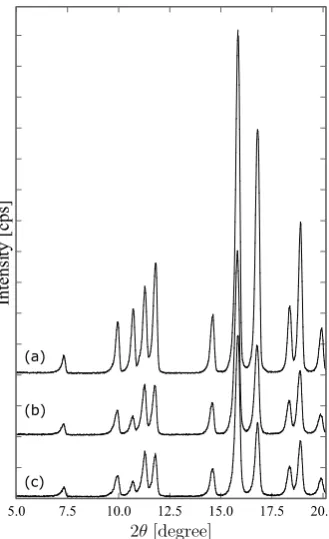
temperature control unit and only measurement at room temperature is allowed. Since the high temperature phase (monoclinic in this case) has possibility to transform back into the lower phase (orthorhombic). Thus care must be taken especially when the higher temperature polymorph are measured at lower temperature. For terpy, fortunately, monoclinic form (high temperature phase) do no transformed into orthorhombic form just by cool-ing. Therefore room temperature XRD measurement is appropriate for evaluation of temperature change of structure of terpy crystals.Figure 4(a) and Figure 4(b) show typical XRD patterns of crystals sampled before (a) and after (b) the transformation temperature (75.4˚C). It may be clearly seen that XRD pattern (a) is agreed with orthorhombic form (d), while that of (b) agreed with monoclinic (c). From this experimental results, the small DSC peak appeared before the melting temperature may be concluded as transformation from orthorhombic to monoclinic form. It is interesting in Figure 3, the transformation temperature shift to lower temperature with in-crease of the grinding time. It is clear that the transformation temperature may be correlated with grinding time as plotted as Figure 5.
3.2. Other Factors Affecting the Transformation Temperature
Figure 4. Powder XRD patterns of terpy crystals before (a) and after (b) transformation temperature. For comparison calculated XRD pat-terns of (c) monoclinic and (d) orthrhombic forms are shown.
[image:4.595.184.440.458.703.2]Figure 6. Relation between transformation temperature and average crystal size of terpy.
[image:5.595.230.395.420.690.2]grinding time. Comparing the three patterns, no apparent difference is found in width of any peak. This suggests us that crystallinity difference is not occurred among the crystals.
Finally, two possibilities are remains. One is introduction of internal stress and/or defect that is believed to in-fluence the transformation temperature. The other possibility is polymorphic transformation caused by grinding. In our previous study, we show existence of small amount of seed crystals of monoclinic form accelerate the transformation of orthorhombic form. Which factor is correct? To answer the question, we need more detailed examination. Anyway, small amount of internal stress and/or another polymorph that can not be detected by XRD measurement must influence the bulk transformation temperature. These results suggest us possibility of tuning a polymorphic transformation temperature without a help of additives.
4. Conclusion
Transformation temperature of terpy from orthorhombic to monoclinic form has been studied experimentally. The transformation temperature was found tunable depending on grinding time of the starting orthorhombic crystals. At this moment, the cause of the grinding time dependent transformation temperature is not clear, since obvious changes in crystalline state caused by the grinding are undetected experimentally. This suggests us un-detectable small amount of change in crystalline state triggered the polymorphic transformation.
References
[1] Mutai, T., Satou, H. and Araki, K. (2005) Reproducible On-Off Switching of Solid-State Luminescence by Controlling Molecular Packing through Heat-Mode Interconversion. Nature Materials, 4, 685-687.
http://dx.doi.org/10.1038/nmat1454
[2] Bessel, C.A., See, R.F., Jameson, D.L., Churchill, M. and Takeuchi, K.J. (1992) Structural Considerations of Terden-tate Ligands: Crystal Structures of 2,2′:6′,2′-Terpyridine and 2,6-Bis(pyrazol-1-yl)pyridine. Journal of the Chemical Society, Dalton Transactions, 22, 3223-3228. http://dx.doi.org/10.1039/dt9920003223
[3] Bowes, K.F., Clark, I.P., Cole, J.M., Gourlay, M., Griffin, A.M.E., Mahon, M.F., Ooi, L., Parker, A.W., Raithby, P.R., Sparkes, H.A. and Towrie, M. (2005) A New Polymorph of Terpyridine: Variable Temperature X-Ray Diffraction Studies and Solid State Photophysical Properties. CrystEngComm, 7, 269-275. http://dx.doi.org/10.1039/b502275d
[4] Baraldi, C., Gamberini, M.C., Tinti, A., Palazzoli, F. and Ferioli, V. (2009) Vibrational Study of Acetazolamide Poly-morphism. Journal of Molecular Structure, 918, 88-96. http://dx.doi.org/10.1016/j.molstruc.2008.07.014
[5] Kanata, T., Yoshikawa, T. and Kubota, K. (1987) Grain-Size Effects on Dielectric Phase Transition of BaTiO3