© 2016, IRJET | Impact Factor value: 4.45 | ISO 9001:2008 Certified Journal
| Page 1514
DCT & DWT based Digital Image Watermarking using Matlab
Poonam
1, Anurag sharma
21
M Tech, Dept. of ECE, Punjab, India
2
Head of Department, Dept. of ECE, Punjab, India
---***---Abstract -
A process to insert a secret message or logo intothe original image to provide a high level of security as the location of embedded information is secret and the watermark algorithm is not public that is known as watermarking [2].In this paper, image watermarking is done by two frequency domain techniques such as Discrete Cosine Transform (DCT) and Discrete Wavelet Transform (DWT).
Key Words: watermark embedding, watermark
extraction, DWT, DCT
I. INTRODUCTION
The advancement of system media frameworks and
blast of quick correspondence system has demoralized
and damped the media content supplier i.e. creators
,distributors to allow the circulation of their archive on
the system environment. [6]Watermarking has been
summoned as an apparatus for the insurance of
intellectual property right (IPR) of interactive media
substance. In view of their advanced nature, sight and
sound reports can be copied changed and diffused
effectively. In this setting it is vital to add to a frame
work for copyright security. Assurance against
duplication and verification of substance. Watermark is
extremely valuable in the examination paper since it
can be utilized for dating, recognizing sizes, plant
trademarks and areas We are living in the period of
data where billions of bits of information is made in
each portion of a second and with the appearance of
web, creation and conveyance of advanced information
(pictures, video and sound records, computerized
stores and libraries, web distributed) has developed
numerous fold. The computerized correspondence
innovation, similar to web innovation stands up to
different inconveniences identified with the protection
and security of the information. Security methods are
required as a result of unlawful access of information
without authorization. In this manner, it is important to
ensure in the web innovation. For giving the security of
advanced information different strategies are utilized
like
encryption,
unscrambling,
cryptography,
steganography and computerized watermarking.
Advanced watermarking is an extremely creating field
and utilized as a part of different applications which
have been ended up being effective. The computerized
watermarking has been connected in various picture
handling procedures. The point of each application is to
giving security of the computerized content. The
computerized watermarking applications are
Broadcast
Monitoring,
Digital
Fingerprinting,
Transaction Tracking, Copyright insurance, Temper
Detection, Data Hiding and Content Authentication and
so forth. More analysts are pulled in to the region of
picture watermarking as a result of the property of the
picture as it has a ton of excess data contained in it
which can be abused to be utilized for watermark
insertion. Numerous watermarking techniques for
pictures are proposed. Watermarking procedures are
comprehensively sorted into spatial area and change
space procedures. While the spatial area procedures
are having minimum intricacy and high payload they
cannot withstand low pass sifting and regular picture
preparing assault [3][4].
II. Techniques used
1.1 Discrete wavelet Transform
Discrete wavelet Transform (DWT) of the picture produces multi determination representation of a picture. The multi determination representation gives a basic system to
© 2016, IRJET | Impact Factor value: 4.45 | ISO 9001:2008 Certified Journal
| Page 1515
translating the picture data. The DWT investigations the signat numerous determinations
………(1)
...………(2)
………(3)
………(4)
Where J is the level of the 2-D DWT, h (n) and g (n) are the drive reaction. Figure 6 demonstrates the schematic outline of 2D wavelet change. By utilizing this figure we can dissect in which way the 2D wavelet change are performed [5].
1.2 Discrete-Cosine-Transform
Discrete-Cosine-Transform or DCT is a prevalent change area watermarking system. The DCT permits a picture to be broken up into various recurrence groups to be specific the high, center and low recurrence groups subsequently making it less demanding to pick the band in which the watermark is to be embedded. It forms some different qualities and points of interest, for example, vector base great encapsulation about picture data, little computational multifaceted nature, high pressure proportion, low blunder
rate, great disguising, et cetera, so it is viewed as the ideal change in the computerized picture preparing.[4]
The one dimensional DCT
…….1-D DCT
For µ=0, 1 ,2……N-1 similarly inverse transform is defined.
……….. Inverse transform [2].
III. Related work
Yadav S. et al [2015] this paper mainly deals with a different video watermarking technique based on frequency domain and their comparison is evaluated on the basis of Peak-Signal-To-Noise (PSNR) Ratio. This comparison is done in the MATLAB/Simulink which is an interactive tool for simulation purposes.
Gregory H. et al.[2014] provided a description of the application of digital watermarking for use in copyright protection of digital images The major processes involved in the watermarking processes are considered including , attack, an detection/extraction[1].
Gupta V. et al.[2014] purposed the various factors used in watermarking, properties and applications area where watermarking need to be used. and It classified watermarking technique algorithms based on the transform domain in which the watermark is embedded[2].
Ram B. [2013] purposed a new watermarking technique to add a code to digital images is presented: the method operates in the frequency domain embedding a pseudo-random sequence of real numbers in a selected set of DCT coefficient[3].
[image:2.595.48.256.427.585.2]Figure2: Discrete Wavelet Transform
© 2016, IRJET | Impact Factor value: 4.45 | ISO 9001:2008 Certified Journal
| Page 1516
IV Simulation Model
V Result & Discussion
This paper deals with the watermarking of still images for copyright protection. The watermarking information that will be used includes handwritten signatures and mobile phone numbers. The reason for this is they are more informative compared to pseudo random sequences. The watermarking information will be encoded before inserting it in the still images[8]. The embedding of the coded watermark information will be performed in the frequency domain rather than the spatial domain. The DCT will be used for this purpose. The watermarks should be invisible and cause minimal distortion [9] to the host images. The objective of this research is to develop new algorithms that can embed and extract the watermarking data and satisfy the above requirements. The performance of the developed algorithms will be assessed by testing them using a variety of grey level and color images. The aim of this research is to develop powerful watermarking techniques that preserve the intellectual property of still images. The new techniques utilized. Both one dimensional and two dimensional are used to improve the robustness of the watermarking algorithms. The algorithms embed the Walsh coded watermarks in the low frequency coefficients of the DCT blocks [7].
Figure 3(a) shows that original image taken from matlab directory that is cameraman image that image can be gray level or colored (RGB) image.
Figure 3(b) Applying DWT to the gray scale image after applying DWT image is divided into 4 parts ie.LL1, HH1, LH1, HL1. In numerical analysis and functional analysis, a discrete wavelet transform (DWT) is any wavelet transform for which the wavelets are discretely sampled.
Figure 4: Simulation Model of Watermarking
Figure 3(a): original image
[image:3.595.29.549.49.469.2] [image:3.595.28.257.98.418.2] [image:3.595.330.537.327.505.2]© 2016, IRJET | Impact Factor value: 4.45 | ISO 9001:2008 Certified Journal
| Page 1517
Figure 3(c) shows that selection of one sample from previousimage and apply DCT on it DCT breaks the image into two different frequency components: low frequency and high frequency. Low frequency component contains high energy, high frequency component as it contains the low energy
Figure 3(d) shows that image in which watermark is embedded by using block pro command. block Size is a two-element vector, [rows cols], that specifies the size of the block.fun is a handle to a function that accepts a block
struct as input and returns a matrix, vector, or scalar Y.
Figure 3(e) shows that rotation of image. When you rotate image, you specify the image to be rotated and the rotation angle, in degrees. If you specify a positive rotation
angle, the command “imrotate” rotates
the image counterclockwise; if you specify a negative rotation angle, the command “imrotate” rotates the image clockwise.
Figure 3(f) shows resizing of image resize the image again, this time specifying the desired size of the output image, rather than a magnification value.
Figure 3(c): Discrete Cosine Transform
Figure 3(d): Blockproc Command
Figure 3(e):Rotate Image
[image:4.595.316.527.59.266.2] [image:4.595.69.266.94.260.2] [image:4.595.69.255.398.578.2] [image:4.595.342.524.402.565.2]© 2016, IRJET | Impact Factor value: 4.45 | ISO 9001:2008 Certified Journal
| Page 1518
Figure 3(g) shows the output image in which watermark isdone.
EXTRACTION
In this paper, for the extraction of the watermark of the image the inverse discrete cosine transform (IDCT) technique is used.
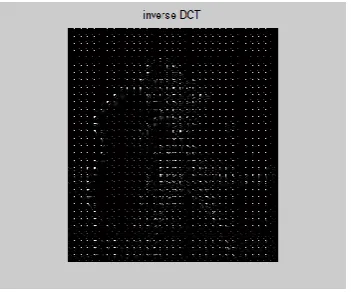
Figure 3(h) shows extraction process of the image using inverse DCT. The inverse DCT reconstructs a sequence from its discrete cosine transform (DCT) coefficients. The iDCT function is the inverse of the DCT function.
Figure 3(i) shows extraction of the watermark of the image.
VI CONCLUSION
Digital Image Watermarking provides and ensures security, data authentication and copyright protection to the digital media through its various techniques. All the techniques have their useful applications. But Spatial Domain techniques did not provide robustness to the digital image as provided by the Frequency Domain Techniques and discrete cosine transform having more energy compaction then other technique.
VII . REFERENCES
[1] Shanshan Z., Xiaohong W., Shizheng Z., “The Research of Image Watermarking Encryption Algorithm,”3rd international joint conference on computational and optimization ,2013.
[2] Kumar T Tribhuwan., Saxena V “An Improved and Robust DCT based Digital Image Watermarking Scheme,” International Journal of Computer Applications,Vol. 3, June 2010.
[3] Zhou Fu-an “A Robust Watermarking Scheme Based on Least Significant Bit and Discrete Cosine Transform,” International Journal of Security and Its Applications, Vol. 9, 2015.
[4] Kaushik Prashant., Er. Dua Shelza “Digital Image Watermarking Using BFO Optimized DWT and DCT & Comparison between DWT, DWT+DCT, DWT+DCT+BFO,” International Journal of Recent Research Aspects, Vol. 1, December 2014,
[5] Parashar P., and Singh k Rajeev “A Survey: Digital Image Watermarking Techniques,”International Journal of Signal Processing, Image Processing and Pattern Recognition, Vol. 7, 2014
[6] Akter A., Muhammed U.,“ A Digital Watermarking With A New Algorithm,” International journal of research in engineering and technology, Vol.4,2014.
Figure 3(g): Output Image
Figure 3(h): Inverse DCT
[image:5.595.62.540.45.281.2] [image:5.595.68.266.77.280.2] [image:5.595.75.251.412.558.2]© 2016, IRJET | Impact Factor value: 4.45 | ISO 9001:2008 Certified Journal
| Page 1519
[7] Chopra D., Gupta P., Gaur B.,Gupta A., “Grayscale ImageDigital Watermarking Technology Based On Wavelet Analysis,” International Organization of Scientific Research journals, Sep-Oct 2012.
[8] Yadav S., Anand P., “DCT Based Digital Video Watermarking Using MATLAB” International Journal of Advanced Research in Computer Engineering & Technology (IJARCET), Vol. 4, February 2015 .
[9] Schlauweg M., Pröfrock D., Zeibich B., Müller E., “Dual watermarking for protection of rightful ownership and secure image authentication,” 4th ACM Int. workshop on Contents protection and security, MCPS '06, Publisher: ACM, Oct. 2006.
![Figure 3: Discrete cosine transform[4]](https://thumb-us.123doks.com/thumbv2/123dok_us/8187411.812432/2.595.48.256.427.585/figure-discrete-cosine-transform.webp)