© 2015, IRJET ISO 9001:2008 Certified Journal
Page 483
OPTIMIZATION OF THE PROCESS PARAMETERS FOR MIG WELDING OF
AISI 304 AND IS 1079 USING FUZZY LOGIC METHOD
Prasenjit Mondal
1, Dipankar Bose
21
M.Tech scholar, Department of Mechanical Engineering, NITTTR, Kolkata, W.B, India
2
Professor, Department of Mechanical Engineering, NITTTR, Kolkata, W.B, India
---***---Abstract -
Dissimilar metal welded joints are integralparts of modern-day power and process plant equipment. Among the various types of material combinations, welded joints of austenitic stainless steels and mild steel are very common in nuclear and
chemical industries. The dissimilar metal joints have
been emerged as a structural material for various industrial applications which provides good combination of mechanical properties like strength, corrosion resistance with lower cost. Selections of joining process for such materials are difficult because of their physical and chemical properties. Dissimilar material joints of stainless steel and mild steel are commonly uses as structural applications. Joining of stainless steel and mild steel is very critical because of carbon precipitation and loss of chromium leads to increase in porosity which affects the quality of joint leads deteriorates strength. Shielding gases are necessary in GMAW process to protect the welding area from atmospheric gases such as nitrogen and oxygen, which can cause fusion defects, porosity and weld metal embitterment. In the present study, stainless steel plate of AISI-304 has been welded with mild steel plate of IS: 1079 by Metal Inert Gas (MIG) welding processes. The tensile strength and hardness of dissimilar metal joints have investigated. The results were compared for different joints made by MIG welding processes and finally optimize the best combination of input parameters.
Key Words:
SS 304, MS 1079, GMAW, Tensile,
Hardness, Taguchi, ANOVA, FUZZY
1. INTRODUCTION
Welding is a process of joining similar or dissimilar materials. Welding is carried out by the use of heat or pressure or both and with or without added metal. Joining of dissimilar metals is very indispensable in manufacturing and constructing advanced equipment and machinery. Different kinds of metals feature different
chemical, physical, and metallurgical properties are usually join through various metals joining process. Joining dissimilar metals is, therefore to compose different properties of metals in order to minimize material costs and at the same time maximize the performance of the equipment and machinery. Presently, the methods of joining dissimilar metals include fusion welding, brazing, and soldering. This article, however, discusses fusion welding only, because it is uses in wide range of industries. Dissimilar metal welding refers to the joining of two different alloy systems. Actually all fusion welds are dissimilar metal welds because the metals are being joined have a wrought structure and the welds have a cast structure. Frequently the matching composition of filler wire is deliberately altered from that of the base alloy [1]. The presence of nickel (6-22%), along with chromium (16-26%), enhances its corrosion and stain resistance.
MIG welding is an arc welding process where the heat for welding is generated by an arc between a consumable electrode and the work material. The electrode, a solid wire that is continuously fed to the weld area, becomes the filler metal as it is consumed. The electrode, weld puddle, arc and adjacent areas of the base metal are protected from atmospheric contamination by a gaseous shield provided by a stream of gas, or mixture of gases, fed through the electrode holder [2].
Gas metal arc welding overcomes the restriction of using an electrode of limited length, as in shielded metal-arc welding, and overcomes the inability to weld in various positions, which is a limitation of submerged arc welding.
2. LITERATURE REVIEW
© 2015, IRJET ISO 9001:2008 Certified Journal
Page 484
L.Suresh Kumar et al. [4] have investigated for weldingaspects of AISI 304 & 316 by Taguchi technique for the process of TIG & MIG welding. Mechanical properties of austenitic stainless steel for the process of TIG and MIG welding have discussed here. The voltage has taken constant and various characteristics such as strength, hardness, ductility, grain structure, tensile strength breaking point, HAZ have observed in these two processes.
Radha Raman Mishra et al. [5] have studied on dissimilar metal joint as a structural material for various industrial applications which provided good combination of mechanical properties like strength, corrosion resistance with lower cost. In the present study, stainless steel of grades 202, 304, 310 and 316 were welded with mild steel by Tungsten Inert Gas (TIG) and Metal Inert Gas (MIG) welding processes. The percentage dilutions of joints were calculated and tensile strength of dissimilar metal joints was investigated. The results were compared for different joints made by TIG and MIG welding processes and it was observed that TIG welded dissimilar metal joints have better physical properties than MIG welded joints.
Pawan Kumar et al. [6] have obtained the use of Taguchi’s parameter design methodology for parametric study of Gas Metal Arc Welding of Stainless Steel & Low Carbon Steel. The input process variables considered here include welding current, welding voltage and gas flow rate. A total no. of 9 experimental runs were conducted using an L9 orthogonal array, and calculate the signal-to-noise ratio. Subsequently, using Analysis Of Variance (ANOVA) the significant coefficients for each input parameter on tensile strength & Hardness (PM, WZ & HAZ) were determined.
Dinesh Mohan Arya et al. [7] have performed the optimization process parameters for Metal Inert Gas (MIG) Welding. This paper presented the influence of welding parameters like wire diameter, welding current, arc voltage, welding speed and gas flow rate optimization based on bead geometry of welding joint. The objective function have been chosen in relation to parameters of MIG welding bead geometry, Tensile strength, Bead width, Bead height, Penetration and Heat Affected Zone (HAZ) for quality target. Analysis Of Variance (ANOVA) has also applied to identify the welding current is the most significant factor. Experiment with the optimized parameter setting, which have been obtained from the analysis.
3. EXPERIMENTAL SETUP
The experiments have been conducted using a CPT 400 model having 400A maximum current with air type cooling and semi-automated Welding Set up. In this welding machine automated Metal Inert Gas torches as
well as automatic feeler wire feeding units have provided. For experimentation, servo motors are used for maintaining welding speed during actual welding.
3.1 Material selection
The present study has been carried out with mild steel plate of IS: 1079 Gr. O and stainless steel plate of AISI-304, having 3mm thickness. This material is used as general industrial purpose.
3.2 Proposed Design of Experiment
For the present investigation, three number of process parameters or control factors each having three levels is taken into consideration. The L9 (33 ) orthogonal array[8]
was used.
3.3 Experimental parameter
Input parameters: Welding current, welding voltage and weld speed.
Output parameters:Tensile strength and Hardness
3.4 Taguchi Methodology
The standard S/N ratios generally used are as follows:
Smaller is better
Larger is better
Nominal is best Material
composition
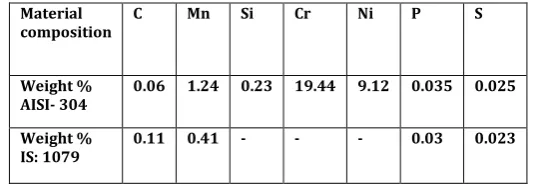
C Mn Si Cr Ni P S
Weight %
AISI- 304 0.06 1.24 0.23 19.44 9.12 0.035 0.025 Weight %
IS: 1079 0.11 0.41 - - - 0.03 0.023
Sl.
No Factors Symbol Unit Level 1 Level 2 Level 3
1 Weldin g Current
A Ampere 130 135 140
2 Weldin g Voltage
B Volt 22 24 26
3 Weldin
[image:2.595.301.568.254.347.2]g Speed C Cm/min 25 30 35 Table -1: Chemical compositions
[image:2.595.311.567.545.670.2]© 2015, IRJET ISO 9001:2008 Certified Journal
Page 485
The S/N ratio (η) is mathematically represented asη = -10log10 (MSD) [9]
Larger is better type:
Where yi = Observed data (quality characteristics) at the ith
trial
n = Number of trials
MSD= Mean Square Deviation from the desired value and commonly known as quality loss function.
3.5 Experimental Work
Welding specimen has been prepared to fabricate MIG welded joints. The specimen in the form of block with dimensions 125mm x 75mm x 3mm were considered for welding with butt joints.
Welding process has been carried out in MIG welding machine. Experiments were conducted based on full factorial design.
exp
no. A (welding current)
B (welding voltage)
C (welding speed)
tensile strength (MPa)
hardness (HRB)
1 130 22 25 458 96
2 130 24 30 451 94
3 130 26 35 454 100
4 135 22 30 466 110
5 135 24 35 444 107
6 135 26 25 451 102
7 140 22 35 433 114
8 140 24 25 420 98
9 140 26 30 440 102
4. EXPERIMENTAL RESULTS AND DISCUSSION
In the present investigation tensile strength and hardness for all the nine experiments already have been calculated separately. In this section Fuzzy Logic multi response
optimization, ANOVA and confirmation test have been done.
4.1 Fuzzy Logic for Multi Response Optimization
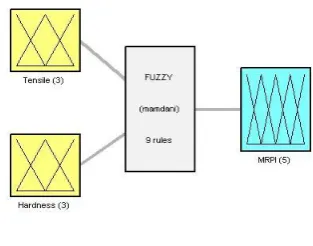
[image:3.595.344.501.251.374.2]In this experiment MAMDANI type of Fuzzy interference system with two inputs, one output and nine rules have been used to find out the MRPI (Multi Response Performance Index) of the best combination of hardness and tensile strength. The basic block diagram shown in Fig. 1.
4.1.1 Membership function
In this work triangular membership function have used for the representation of input and output functions. Three membership functions called NB (Negative Big), ZO (Zero) and PB (Positive Big) have used for the representation of each input and output function. For the representation of the combination of two output functions, five membership functions called NB (Negative Big), NS (Negative Small), ZO (Zero), PS (Positive Small) and PB (Positive Big) have used.
4.1.2 Decision maker rule base
The rules have been made here according to the various results of tensile strength and hardness from the nine different combinations of input parameters.
Hardness
Tensile
NB ZO PB
NB NB NS ZO
ZO NS ZO PS
[image:3.595.42.285.435.684.2]PB ZO PS PB
Table -3: Experimental Results
[image:3.595.333.559.658.751.2]Fig -1: System Fuzzy: 2 inputs, 1 output, 9 rules
© 2015, IRJET ISO 9001:2008 Certified Journal
Page 486
Fig.2 represents the surface view of the fuzzy inferencesystem. X-axis represents S/N ratio of tensile strength while Y-axis represents S/N ratio of hardness. Z-axis represents MRPI, which is actually output of the system.
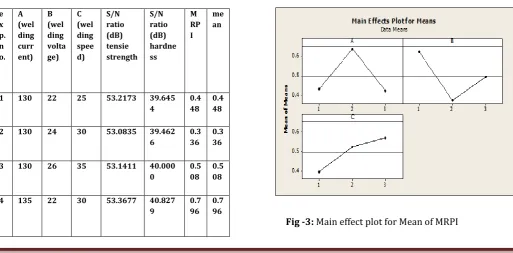
By applying decision maker rule base of FIS the MRPI (Multi Response Performance Index) [10] and the mean of all nine combinations of hardness and tensile strength have been calculated.
e x p. n o.
A (wel ding curr ent)
B (wel ding volta ge)
C (wel ding spee d)
S/N ratio (dB) tensie strength
S/N ratio (dB) hardne ss
M RP I
me an
1 130 22 25 53.2173 39.645 4
0.4 48
0.4 48
2 130 24 30 53.0835 39.462 6
0.3 36
0.3 36
3 130 26 35 53.1411 40.000 0
0.5 08
0.5 08
4 135 22 30 53.3677 40.827 9
0.7 96
0.7 96
4.2 ANOVA Analysis
The analysis of variance is the statistical treatment most commonly applied to the results of the experiment to determine the percent contribution of each factors [11]. Study of ANOVA table for a given analysis helps to determine which of the factors need control and which do not.
5 135 24 35 52.947 7
40.58 77
0. 5 8 4
0.5 84
6 135 26 25 53.083 5
40.17 20
0. 5 3 0
0.5 30
7 140 22 35 52.729 8
41.13 81
0. 6 1 6
0.6 16
8 140 24 25 52.465 0
39.82 45
0. 2 0 8
0.2 08
9 140 26 30 52.869 1
40.17 20
0. 4 3 8
[image:4.595.338.567.95.372.2]0.4 38
Fig -2: Surface view of FIS
[image:4.595.41.236.188.367.2] [image:4.595.37.551.513.766.2]© 2015, IRJET ISO 9001:2008 Certified Journal
Page 487
From Table 5 the maximum value and minimum value ofthe MRPI for all possible combinations of tensile strength and hardness are 0.796 and 0.208 respectively.
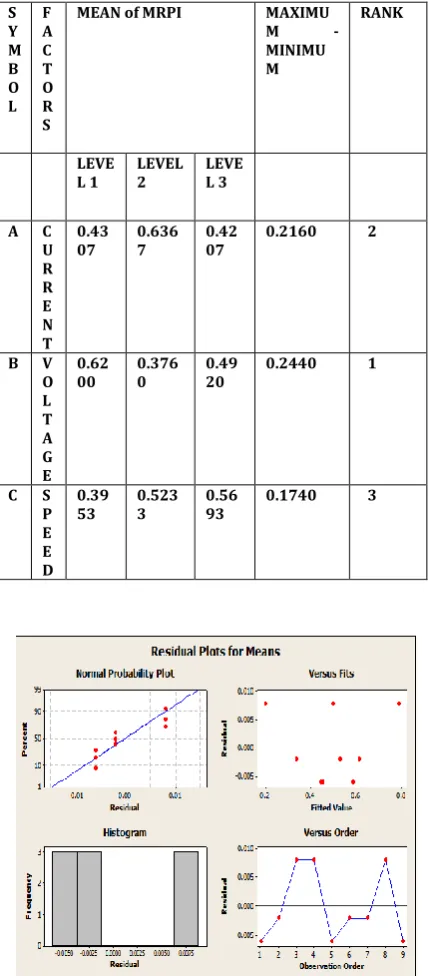
The maximum average MRPI for hardness has obtained at level 2 of welding current, levels 1 of welding voltage and
level 3 of welding speed, i.e. the optimum process
parameters setting for maximum hardness is .
From Table 6 it has clearly shown that for MRPI optimal current is 135 Amp, welding voltage is 22 volt, welding speed is 35 cm/min.
The percentage contribution of the three input parameters have calculated with the help of Analysis of Variance are given in Table 7.
Initial parameter setting
Optimal MIG welding parameters
Predict
value Experiment value Level A1B1C1 A2B1C3 A2B1C3
Tensile
Strength(MPa) 53.2173 53.4831 53.3677 Hardness(HRB) 39.6454 41.1063 40.9102
MRPI 0.448 0.834 0.813
Improvement of
MRPI 0.365
The MRPI of the combination of corresponding tensile strength value and hardness value for initial parameter setting, by prediction and by conformation test are given in Table 8. The conformation test indicates that it is possible to increase MRPI significantly by using the proposed statistical technique.
S Y M B O L
F A C T O R S
MEAN of MRPI MAXIMU M - MINIMU M
RANK
LEVE
L 1 LEVEL 2 LEVEL 3
A C U R R E N T
0.43
07 0.6367 0.4207 0.2160 2
B V O L T A G E
0.62
00 0.3760 0.4920 0.2440 1
C S P E E D
0.39
53 0.5233 0.5693 0.1740 3
sourc
e DF Seq SS Adj SS Adj MS F P Percentag e contr ibuti on A 2 0.089
192 0.089192 0.044596 285.87 0.003 39.18 %
B 2 0.089
376 0.089376 0.044688 286.46 0.003 39.26 % C 2 0.048
776 0.048776 0.024388 156.33 0.006 21.42 % Resid
ual Error
2 0.000
312 0.000312 0.000156 0.14 %
Total 8 0.227
[image:5.595.32.247.180.669.2]656 100 %
[image:5.595.309.566.194.420.2]Table -8: Conformation Test for MRPI Table -6: Response for the mean of MRPI
Table -7: Analysis of Variance for Mean of MRPI
[image:5.595.301.567.500.665.2]© 2015, IRJET ISO 9001:2008 Certified Journal
Page 488
5. CONCLUSION
The experiment designed by Taguchi method fulfills the desired objective. Fuzzy interference system has been used to find out the MRPI (Multi Response Performance Index) of the best combination of hardness and tensile strength. The all possible values of MRPI have been calculated by using MATLAB 7.5.0 software. Analysis of variance (ANOVA) helps to find out the significance level of the each parameter. The optimum value was predicted using MINITAB-16 software.
The improvement in MRPI from the starting welding parameters to the level of optimal welding parameters is 0.365 for the combination of tensile strength and hardness.
Welding current 135 Amp, welding voltage 22 volt and welding speed 35 cm/min have the optimal value of control factors for maximum MRPI.
The effect of parameters on the MRPI can be ranked in decreasing order as follows: voltage > current >speed. The experimental results confirmed the validity of the used Taguchi method for enhancing the welding performance and optimizing the welding parameters in MIG welding
REFERENCES
[1] Richard E. Avery (1991) “Pay attention to dissimilar metal weld and guidelines for welding dissimilar metals”, Nickel Development Institute, Series no. 14018, pp. 1- 6.
[2] Dr Mohammed Naeem, Richard Jessett, Kevin Withers (1908) “Welding Of Dissimilar Materials With 1kw Fiber Laser” JK Lasers, Warwickshire, UK.
[3] Vikas Chauhan, R. S. Jadoun (2014) “Parametric optimization of MIG welding for stainless steel (SS-304) and low carbon steel using Taguchi design method”, International Journal of Advanced Technology & Engineering Research (IJATER), vol. 2, no. 1, pp. 224-229.
[4] L. Suresh Kumar, S. M. Verma, P. Radhakrishna Prasad, P. Kirankumar, T. SivaShanker (2011) “Experimental investigation for welding aspects of AISI 304 & 316 by Taguchi technique for the process of TIG & MIG welding”, International Journal of Engineering Trends and Technology, vol. 2, no. 2, pp. 28-33.
[5] Radha Raman Mishra, Visnu Kumar Tiwari and Rajesh Singh (2014) “A study of tensile strength of MIG and TIG welded dissimilar joints of mild Steel and stainless steel”, International journal of advances in materials science and engineering (IJAMSE), vol.3, no. 2, pp. 23-32.
[6] Pawan Kumar, B. K. Roy, Nishant (2013) “Parameters optimization for gas metal arc welding of austenitic stainless steel (AISI 304) & low carbon steel using Taguchi’s technique”, International Journal of Engineering and Management Research, vol. 3, no. 4, pp. 18-22. [7] Dinesh Mohan Arya, Vedansh Chaturvedi, Jyoti
Vimal (2013) “Parametric Optimization of MIG Process Parameters Using Taguchi and Grey Taguchi analysis” International Journal of Research in Engineering & Applied Sciences, vol. 3, no. 6, pp. 1-17.
[8] Genichi Taguchi (1986), “Introduction to Quality Engineering: Designing Quality into Products and Processes”, Asian Productivity Organization. [9] M. S. Phadke (1989), “Quality Engineering Using
Robust Design”, Prentice Hall, Englewood Cliffs, New Jersey.
[10] D. Dubois, and H. Prade (1980), “Fuzzy Sets and Systems: Theory and Applications”, Academic Press, New York.
[11] K. Hafeez, H. Rowland, Kanji, S.Iqbal (2002), “Design optimization using ANOVA”, Journal of Applied Statistics, vol. 29, no.6, pp.895-906.
BIOGRAPHIES
Prasenjit Mondal
M.Tech scholar, Department of Mechanical Engineering NITTTR, Kolkata, W.B, India
Dipankar Bose