A delta F508 mutation in mouse cystic fibrosis
transmembrane conductance regulator results
in a temperature-sensitive processing defect in
vivo.
P J French, … , J Bijman, B J Scholte
J Clin Invest.
1996;
98(6)
:1304-1312.
https://doi.org/10.1172/JCI118917
.
The most prevalent mutation (delta F508) in cystic fibrosis patients inhibits maturation and
transfer to the plasma membrane of the mutant cystic fibrosis transmembrane conductance
regulator (CFTR). We have analyzed the properties of a delta F508 CFTR mouse model,
which we described recently. We show that the mRNA levels of mutant CFTR are normal in
all tissues examined. Therefore the reduced mRNA levels reported in two similar models
may be related to their intronic transcription units. Maturation of mutant CFTR was greatly
reduced in freshly excised oviduct, compared with normal. Accumulation of mutant CFTR
antigen in the apical region of jejunum crypt enterocytes was not observed, in contrast to
normal mice. In cultured gallbladder epithelial cells from delta F508 mice, CFTR chloride
channel activity could be detected at only two percent of the normal frequency. However, in
mutant cells that were grown at reduced temperature the channel frequency increased to
over sixteen percent of the normal level at that temperature. The biophysical characteristics
of the mutant channel were not significantly different from normal. In homozygous delta
F508 mice we did not observe a significant effect of genetic background on the level of
residual chloride channel activity, as determined by the size of the forskolin response in
Ussing chamber experiments. Our data show that like its human homologue, mouse delta
F508-CFTR […]
Research Article
Find the latest version:
J. Clin. Invest.
© The American Society for Clinical Investigation, Inc. 0021-9738/96/09/1304/09 $2.00
Volume 98, Number 6, September 1996, 1304–1312
Rapid Publication
A
D
F508 Mutation in Mouse Cystic Fibrosis Transmembrane Conductance
Regulator Results in a Temperature-sensitive Processing Defect In Vivo
Pim J. French,* J. Hikke van Doorninck,* Richard H.P.C. Peters,* Elly Verbeek,‡ Nadia A. Ameen,§ Christopher R. Marino,i
Hugo R. de Jonge,¶ Jan Bijman,* and Bob J. Scholte*
Departments of *Cell Biology, ‡Clinical Genetics and ¶Biochemistry, Erasmus University, 3000 DR Rotterdam, The Netherlands; §Department of Pediatric Gastroenterology, University of Miami, Florida 33136; and iDepartment of Medicine and Physiology, University
of Tennessee, Memphis Tennessee 38163
Abstract
The most prevalent mutation (∆F508) in cystic fibrosis pa-tients inhibits maturation and transfer to the plasma mem-brane of the mutant cystic fibrosis transmemmem-brane conduc-tance regulator (CFTR). We have analyzed the properties of a DF508 CFTR mouse model, which we described recently. We show that the mRNA levels of mutant CFTR are nor-mal in all tissues examined. Therefore the reduced mRNA levels reported in two similar models may be related to their intronic transcription units. Maturation of mutant CFTR was greatly reduced in freshly excised oviduct, compared with normal. Accumulation of mutant CFTR antigen in the apical region of jejunum crypt enterocytes was not ob-served, in contrast to normal mice. In cultured gallbladder epithelial cells from DF508 mice, CFTR chloride channel activity could be detected at only two percent of the normal frequency. However, in mutant cells that were grown at re-duced temperature the channel frequency increased to over sixteen percent of the normal level at that temperature. The biophysical characteristics of the mutant channel were not significantly different from normal. In homozygous DF508 mice we did not observe a significant effect of genetic back-ground on the level of residual chloride channel activity, as determined by the size of the forskolin response in Ussing chamber experiments. Our data show that like its human homologue, mouse DF508-CFTR is a temperature sensitive processing mutant. The DF508 mouse is therefore a valid in vivo model of human DF508-CFTR. It may help us to eluci-date the processing pathways of complex membrane pro-teins. Moreover, it may facilitate the discovery of new ap-proaches towards therapy of cystic fibrosis. (J. Clin. Invest. 1996. 98:1304–1312.) Key words: cystic fibrosis • chloride channel • antibody • animal models • patch clamp
Introduction
Cystic fibrosis is the most common lethal genetic disease in the Caucasian population (1, 2). It is caused by mutations in the gene encoding the cystic fibrosis transmembrane conductance regulator (CFTR)1 (3). CFTR is a cAMP-regulated chloride
channel, which is expressed in the apical membrane of many epithelia. The most common mutation in cystic fibrosis (CF) patients is a deletion of a phenylalanine at position 508 (DF508) (4). This mutation affects correct processing of the protein to its mature, fully glycosylated form (5, 6). The DF508 form of CFTR is retained in the endoplasmic reticulum and degraded, and does not reach the apical plasma membrane (7, 8). However, DF508-CFTR can function as a cAMP regulated chloride channel, both in the endoplasmic reticulum (9) and when expressed on the apical plasma membrane. The latter oc-curs when DF508-CFTR expressing cells are cultured at low temperatures (10) and when Vaccinia expression vectors are used (11). Cells cultured at lower temperatures, Sf9 insect cells (12) and Xenopus oocytes (13), also express functional D F508-CFTR on the plasma membrane when transduced with a DF508-CFTR expression vector. The clinical significance of this observation is that it may lead to a new approach towards the therapy of CF based on relieving the processing defect. In an attempt to facilitate research in this field we have recently reported the generation of a mouse model with the D F508-CFTR mutation using the “hit and run” mutagenesis proce-dure (14). In this model the intron structure is not disturbed in contrast to two similar models presented (15, 16). In our previ-ous studies we demonstrated severely reduced chloride perme-ability in several epithelial tissues, confirming a CF phenotype. However, in Ussing chamber experiments with intact gall blad-der and intestinal tissue from mutant mice we observed a small residual cAMP regulated chloride secretion, possibly due to the presence of some functional DF508-CFTR (14). Our present study shows that the mouse DF508-CFTR is not pro-cessed efficiently to the fully glycosylated form in vivo. How-ever, the mutant protein is expressed as functional chloride channels in the plasma membrane of cells cultured at reduced temperature. Furthermore, we could show that the electro-physiological characteristics of the mouse DF508-CFTR chan-nels were indistinguishable from normal.
Address correspondence to Dr. Bob J. Scholte, Cell Biology, Eras-mus University, P.O. Box 1738, 3000 DR Rotterdam, The Nether-lands. Phone: 10 408 7205; FAX: 10 436 0225; E-mail: scholte@ch1. fgg.eur.nl
Received for publication 4 March 1996 and accepted in revised form 19 July 1996.
Methods
Animals. All animal experiments were performed according to the guidelines issued by the Dutch government concerning animal care. Mice with the DF508 mutation were described by Van Doorninck et al. (14). Mice with a targeted disruption in the CFTR gene (cftrm1cam
knockout mice, CF2/2) resulting in complete loss of function were obtained from Ratcliff et al. (17). All animals were bred under patho-gen-free conditions in our transgenic unit. The genotype of each indi-vidual animal was tested by Southern blotting of tail DNA. The CF2/2
animals in our facility display less severe runting and lower mortality due to intestinal obstruction as reported for the Cambridge colony, which may be due to breeding conditions. All physiological parame-ters measured, nasal potential differences (PD), intestinal and gall bladder PD measurements (14, 17a), confirmed the CF2/2 pheno-type of these animals. The animals used for the experiments reported here were 5–6 wk old, without obvious signs of disease or discomfort, with an average weight of 2363 grams. All experiments involving
DF508 mice were performed with the strain in 129/FVB genetic back-ground (14) using littermates as control in parallel experiments. The experiments presented in Fig. 7 were performed with three different
DF508 CFTR mouse colonies as described in text.
Quantitative PCR analysis. Two mouse specific oligonucleotides MCF2 (59-AATGACCACAGGCATAATC-39), and MCF3 (59 -CAA-CACTCTTATATCTGTAC-39) were synthesized. The sequences are localized in exons 8 and 10, respectively, and generate a mouse CFTR mRNA-specific 403-bp fragment in RT-PCR analysis. Total RNA was isolated by extraction of various mouse tissues or cultured cells in guanidine isothiocyanate and centrifugation through a 5.2 mol/liter CsCl step-gradient. The RNA was reversed transcribed to cDNA by adding 10 U Avian myoblastoma virus reverse transcriptase (AMV-RT) in 20 ml cDNA buffer (7 mg heat denatured RNA, 0.8 mmol/liter antisense oligonucleotide primer MCF3), 1023 mol/liter dNTP’s, 0.05
mol/liter KCl, 0.02 mol/liter Tris-HCl pH 8.4, 0.0025 mol/liter MgCl2,
0.1 grams/liter bovine serum albumin and 20 U of RNasin for 1 h at 378C. The 50 ml PCR assay contained 0.3.1026 mol/liter sense and
an-tisense oligonucleotide primer (MCF2 and MCF3, 0.2.1023 mol/liter
dNTP’s, 4 ml cDNA mix, 0.05 mol/liter KCl, 0.02 mol/liter Tris-HCl ph 8.4, 2.5.1023 mol/liter MgCl
2, and 0.1 grams/liter bovine serum
al-bumin. After denaturing at 948C, 5 U Taq polymerase was added at 728C. Standard cycling program: 30 cycles of denaturation for 2 min at 938C, primer annealing for 2 min at 478C, and elongation for 4 min at 728C. Aldolase A oligonucleotide primers, which amplify a 442-bp cDNA fragment, were as in Bremer et al. (18). To check the quality of the RNA and the PCR procedure, the amplification of aldolase A sequences was done in parallel, under the same conditions as de-scribed above for CFTR. PCR products were separated on a 1.5% agarose gel. For quantitative analysis of the PCR reaction, equal amounts of total RNA isolated from different tissues were subjected to an RT-PCR protocol in parallel incubations. Aliquots were with-drawn at regular intervals from the PCR and subjected to Southern blotting. Radioactivity was measured with a Phosphorimager (Molec-ular Dynamics, Inc., Sunnyvale, CA).
Western blot analysis of oviduct. Female mice of different pheno-types were anesthetized with ether. The lower abdomen was opened and the oviducts were dissected. After rapid excision the oviducts from one mouse were pooled and immediately solubilized by vortex-ing followed by brief sonication in 30 ml of modified Laemmli sample buffer (Tris-HCl 0.06 mol/liter, 2% (wt/vol) SDS, 15% (wt/vol) Glyc-erol, 2% (vol/vol) b-mercaptoethanol, 0.05 grams/liter leupeptin, 0.05 grams/liter soybean trypsin inhibitor, 0.03 grams/liter phosphorami-don, 1024 mol/liter Pefabloc (Boehringer Mannheim, Mannheim,
Germany), 1023 mol/liter benzamidine, 0.1% (wt/vol)
bromophenol-blue, pH 6.8). The samples were incubated for ten minutes at 378C and centrifuged (2 min, 8,000 g). Samples of the supernatants (10 ml, containing about 20 mg protein) were separated on 6% poly-acryl-amide slabgels using a Bio-Rad Miniprotean apparatus (Bio-Rad Laboratories, Herfordshire, UK). Proteins were subsequently
electro-blotted onto nitrocellulose paper (0.1 mm pore size, Schleicher and Schuell, Inc., Keene, NH) in 0.025 mol/liter Tris, 0.192 mol/liter gly-cine, 20% (vol/vol) methanol. The blots were then incubated over-night at 48C with 0.02 mol/liter Tris-HCl, 0.5 mol/liter NaCl, 0.05% (wt/vol) Tween20 (TTBS), followed by an overnight incubation at 48C with a 1:3000 dilution of affinity purified antibody R3195 in TTBS. The blots were washed three times in TTBS, incubated with peroxidase conjugated anti–rabbit IgG (Tago Inc., Burlingame, CA; 1:3000 in TTBS for 2 h), and washed four times with TTBS. Peroxi-dase activity was detected with bioluminescence reagents (Amer-sham, Braunschweig, Germany) on x-ray film. The rabbit polyclonal antibody R3195 was developed against the 13–amino acid COOH-terminal peptide sequence of rodent CFTR, conjugated to bovine thyroglobulin. The antibody was affinity-purified on a peptide-epoxide activated Sepharose column, eluted with 4.9 mol/liter MgCl2,
dialyzed and concentrated.
Immunocytochemistry. Non-fasted mice were killed after inhala-tion anaesthesia. Intestinal tissues were quickly removed and frozen in OCT embedding medium (Miles Lab., Elkhardt, In.) using liquid nitrogen cooled 2-methylbutane. Cryosections (5 mm) were fixed with 3% (wt/vol) paraformaldehyde (10 min) and methanol (20 min), washed with phosphate-buffered saline supplemented with 1% bo-vine serum albumin and protease inhibitors before incubation with the anti CFTR antibody R3195 (1/500). Antibody labelling was de-tected with FITC conjugated anti–rabbit F(ab)2 fragments (Boeh-ringer, Mannheim, Germany).
Gall bladder epithelial cell culture. Gall bladders were removed from the animal. After the bile was washed out with RPMI-1640 me-dium supplemented with 100 U/ml penicillin, 0.1 grams/liter strepto-mycin, and 0.02 mol/liter Hepes pH 7.2, the gallbladders were cut into small pieces and embedded in 1 mm collagen gels (Sigma Chemical Co., St. Louis. MO; Calf skin type I). The explant cultures were incu-bated at 37 8C in a humidified 10% CO2/air mixture in Dulbecco’s
Modified Eagle’s Medium (DME) supplemented with 100 U/ml peni-cillin, 0.1 grams/liter streptomycin, 0.002 mol/liter glutamine, and 10% fetal calf serum. Mouse gall bladder epithelial cells could be cul-tured for up to 3 wk, with medium changes every 2–3 d.
Patch clamp analysis. Patch clamp experiments, data sampling and analysis were performed as previously described (19). Patch pi-pettes, borosilicate glass (Clark GC150-TF) were pulled to a resis-tance of 3-8 MOhm. Excised patches were transferred to a solution exchange compartment (19). This allowed us to add various sub-strates (ATP, protein kinase A) and to change the buffer composi-tion to a I2, F2, NO32, Br2, or gluconate buffer. Pipette (external) and bath (internal) solutions contained (mol/liter) 0.14 NaCl, 5.1023
KCl, 1.2.1023 MgCl
2, 0.15. 1023 CaCl2, 1023 EGTA, and 5.1023 Hepes.
Final Ca21 concentration was 1028 M, pH 7.4. Low chloride buffer
was identical except that it contained 0.14 mol/liter Na-gluconate in-stead of NaCl, except for the low chloride pipet buffer used to ana-lyzes normal mouse CFTR. This buffer contained (mol/liter) 0.140 N-methyl-d-glucamine (NMDG), 5.1023CaCl
2, 2.1023MgCl2, 1022 Hepes
and 0.1 D-Aspartic acid adjusted to pH 7.2, final chloride concentra-tion 49.1023. High (0.427 mol/liter) chloride buffers contained 0.420
mol/liter NaCl. In other buffers 0.140 mol/liter NaCl was replaced with either NaI, NaBr, NaNO3, NaF, or Na-Gluconate, all 0.140 mol/
liter. All experiments were performed at 378C. A List LM-EPC 7 (Darmstadt, Germany) amplifier was used for current amplification and voltage clamping. Data were digitalized (Sony PCM-F1) and stored on videotape. For analysis, data were filtered at 50 Hz, sample frequency 100 Hz, and transferred to a personal computer (Tulip 386sx). Pipette potential refers to the voltage applied to the pipette interior with respect to the (grounded) bath. Positive (upward) cur-rents represent negative charge flowing out of the pipette. VI50 was
corrected for the liquid junction potential. Experiments presented in Fig. 6 were performed blinded with respect to the genotype of the cells under study.
re-sponses to forskolin (1025 mol/liter) were determined as described by
van Doorninck et al. (14).
Statistical analysis. Significance analysis was tested with linear re-gression analysis for the current-voltage data presented in Fig. 5, and with a Student’s t test (unequal variance) for the channel frequency determination (Fig. 6)
Results
DF508 mice have normal CFTR mRNA levels. The DF508 mouse model from our laboratory was generated by the “hit and run” procedure. With this method the mutation is introduced in an otherwise normal mouse cftr gene. Therefore, CFTR mRNA transcription and processing rates are expected to be normal. This is particularly important as low DF508-CFTR mRNA lev-els were reported in tissues of two other DF508-CFTR mouse models which were made while introducing a selectable marker in the intron structure (15,16). To investigate this we have performed quantitative RT-PCR analysis with RNA iso-lated from heterozygous and homozygous DF508 mice. As controls we have used normal littermates and homozygous cftr knockout mice (17). The PCR product from the mutant allele contains an SspI restriction site which is not present in the wild type allele (14). This allowed us to accurately determine the ratio of normal and mutant CFTR mRNA in a single PCR ex-periment with RNA from a heterozygous animal. With this ap-proach we can rule out variations introduced by differences in reaction conditions and quality of RNA preparations. Our data show that the steady state levels of normal and D F508-CFTR mRNA are virtually identical in different regions of the intestine and in salivary gland (Fig. 1, A–C). Therefore, the mutation that we have introduced does not significantly affect mRNA synthesis processing or stability in epithelial tissues. In
experiments with RNA isolated from homozygous animals DF508-CFTR, mRNA levels did not differ significantly from normal values (Fig. 1, D–F). This confirms that also in ho-mozygous deficient animals expression of the gene in these tis-sues is not reduced.
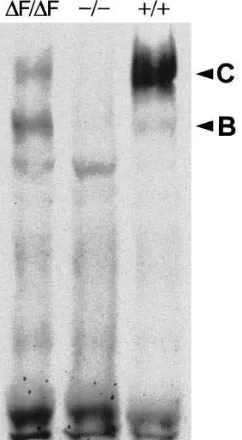
[image:4.612.59.443.58.286.2]Abnormal processing of DF508-CFTR in mouse oviduct. Western blot analysis (N 5 3) of mouse CFTR from normal oviduct (Fig. 2, 1/1) showed the characteristic pattern as ob-served for human CFTR, a core-glycosylated form (band B)
Figure 1. Quantitative analysis of CFTR mRNA expression. Total RNA from normal and mutant mice was isolated from different tissues and subjected to RT-PCR analysis in parallel experiments as described. Specific primers in mouse Cftr exons 8 and 10 yielded a 403-bp fragment, which contained an SspI site only when the product was initiated on a
DF508-CFTR mRNA (14). Sam-ples collected at different cycle intervals were subjected to South-ern blotting using the labeled 403-bp fragment as a probe. Data shown here represent the amount of radioactivity per band in arbi-trary units. Data from different panels are not corrected for dif-ferences in blotting efficiency. PCR products from heterozy-gous mice (DF/1) were digested with SspI before Southern analysis (A–C). Data indicate the amount of PCR product from the normal allele (403 bp, ) and from the DF508 allele (359 bp, ) when RNA was isolated from salivary gland (A), caecum (B), and jejunum (C) of heterozygous mice. PCR products from homozygous normal ( ) and homozygous DF508 mice ( ) were compared in parallel, using RNA isolated from salivary gland (D), caecum (E), and jejunum (F). The data show that there is no significant difference in the levels of mutant and normal CFTR mRNA. RNA from CFTR knockout mice (17) did not produce a PCR product in a parallel experiment whereas the aldolase primers produced comparable amounts of PCR product in all samples tested (not shown).
dd
mm
dd mm
[image:4.612.316.437.515.735.2]Figure 3. CFTR in mouse jejunum. Immunocytochemical detection of CFTR antigen in jejunal crypts from normal (A and B, 1/1 cftrm1cam
col-ony; E and F, 1/1DF508cftr colony), CFTR deficient (2/2 cftrm1cam) mice (C and D), and homozygous DF508 mice (G and H), and was
and forms containing complex N-linked oligosaccharides (band C) (3). In oviduct from a mouse with a complete loss of function mutation (Fig. 2, 2/2) (17) these bands were not ob-served. Oviduct from a homozygous DF508 mouse (Fig. 2, DF/ DF) produced a prominent band B and some band C antigen. The ratio of B over C is increased over 50-fold compared with the normal ratio as estimated by scanning the original radio-graph. This strongly suggests that processing and subsequent glycosylation of mouse DF508 CFTR is severely affected in this tissue, as described previously for the human form of DF508 CFTR (5, 6). Gallbladder, pancreas and intestine did not give reproducible data with this technique.
Mouse DF508-CFTR is not efficiently transported to the api-cal membrane. Immunocytochemical detection of CFTR anti-gen in normal jejunal crypt shows intense staining of the apical region of all crypts (N 5 7, Fig. 3 A, B and E, F). This is in ac-cordance with immunocytochemical localization studies pub-lished previously for human intestine (20). In jejunal crypts from mice with a loss of function mutation (17), no CFTR-spe-cific apical staining is observed (N 5 6, Fig. 3, C and D). This confirms the specificity of the staining. Jejunum crypts of ho-mozygous DF508 mice generally showed no clear apical CFTR antigen (N 5 6, Fig. 3, G and H). In some preparations (three out of six) a diffuse cytoplasmic stain was observed in the epi-thelial crypt cells. The immunocytochemical method used here
is characterized by an inherently nonlinear relationship be-tween signal intensity and local antigen density. Moreover the absolute level of staining intensity varies per experiment. Therefore we can neither quantitate the level of correct pro-cessing nor the level of antigen expression in homozygous DF508 mice with any accuracy. The data presented show that despite the normal CFTR mRNA levels in DF/DF mice (Fig. 1) the amount of apical CFTR antigen in the jejunum crypt is greatly reduced. This is in agreement with our functional stud-ies in intestinal tissue of mouse (14) and human (21) D F508-CFTR mutants. Moreover, it is in agreement with immunocy-tochemical studies in airway cells (22) and in cell culture (23). Other tissues that we have tested for CFTR specific staining with this method (gallbladder, cystic duct, pancreas) did not show consistent specific staining above background signals ob-served in tissues from knockout mice.
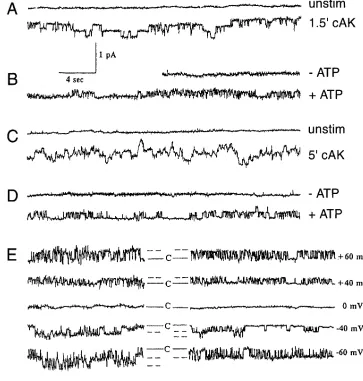
[image:6.612.52.415.366.747.2]Patch clamp analysis of mouse DF508-CFTR. CFTR mRNA is expressed in mouse gallbladder epithelial cells, both in situ and in primary culture (17a). We have determined the number and properties of normal and DF508-CFTR chloride channels by patch clamp analysis of mouse gallbladder epithelial cells in primary culture. In excised membrane patches from unstimu-lated normal (1/1 and 1/DF) cells, a linear 5.160.1 pS (SE) could be activated by the addition of protein kinase A in the presence of ATP (Fig. 4 A). In cell attached membrane
Figure 4. Characterization of nor-mal and DF508 CFTR chloride channel activity. Current tracings of CFTR activity in excised patches from normal (A and B) and DF508 (C and D) mouse gall-bladder epithelial cells cultured at 278C. Unstimulated excised, in-side-out patches from cultured gallbladder epithelial cells gener-ally showed no channel activity. Upon a short incubation with the catalytic subunit of protein kinase A (cAK, 2 mU/ml) in the presence of 2.1023 mol/liter ATP, a low
con-ductance channel was observed in both normal and DF508 cells (A resp. C). Active patches of forsko-lin stimulated cells became silent upon excision (B and D, 2ATP), but could be reactivated by the ad-dition of 2.1023 mol/liter ATP
alone both in normal (B) and
DF508 CFTR (D, 1ATP). (E) Current tracings at different hold-ing potentials from normal (left tracings) and DF508 CFTR (right tracings). Holding potential was
patches of forskolin-stimulated normal cells channels were ob-served at an average of 27.6616.5 (SEM) per patch (Fig. 6 left). Excision of the membrane inactivated the channel but it could be reopened by addition of ATP (Fig. 4 B). Considering the resemblance with human CFTR (3) we conclude that these linear chloride channels represent normal mouse CFTR. The only difference observed between mouse and human CFTR is the lower conductance of the channel (human CFTR 8.060.6 pS) (3). In homozygous mutant cells cultured at 378C the num-ber of functional CFTR channels per patch is about 1% of nor-mal (1/1 and 1/DF, P , 0.02) (Fig. 6), but not zero. These data confirm our conclusion that the expression of CFTR ac-tivity on the plasma membrane of homozygous mutant cells is greatly reduced but not completely absent (14). In cells ex-pressing human DF508-CFTR an increase of apical channel ac-tivity has been observed when cells were grown at reduced temperature, which is associated with a conversion of core-to-complex chain glycosylation and increased apical localization of DF508-CFTR (10). In normal (1/1) and heterozygote (DF/ 1) mouse gall bladder cells grown at 278C for 3–7 d we ob-served a twofold decrease in CFTR channel frequency com-pared to 378C (Fig. 6). In contrast, DF/DF cells cultured at 278C show a considerable increase in DF508-CFTR channel fre-quency compared to cells cultured at 378C (P , 0.05). The av-erage number of channels per patch was 16% of the avav-erage observed in normal cells cultured at 278C (Fig. 6). The high fre-quency at which the DF508-CFTR channel was observed in cells cultured at lower temperatures enabled us to study its properties in detail. DF508-CFTR could be observed in cell at-tached patches after addition of forskolin. The channel be-came silent upon excision but could be reactivated by the
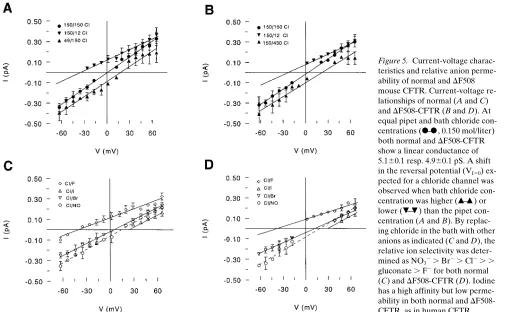
addi-tion of ATP (Fig. 4 D). Excised membrane patches from unstimulated DF/DF cells were silent, but CFTR-like channel activity was observed by the addition of protein kinase A plus ATP (Fig. 4 C). These data show that mouse DF508-CFTR has a normal protein kinase and ATP regulation. Mouse D F508-CFTR is a linear 4.960.1 pS chloride channel, similar to nor-mal mouse CFTR, 5.160.1 (SE) (Fig. 5, A–B). Lowering or in-creasing the chloride concentration in the bath results in a shift in the reversal potential (VI50), indicative for anion selectivity
(Fig. 5, A–B). The relative cation to anion permeability, Pcat/
PCl5 0.14 and 0.16 for normal and DF508-CFTR respectively
(calculated from the least permeant anion, i.e., F2). When
chloride was substituted for other monovalent anions the rela-tive permeability was determined as NO32 . Br2 . Cl2 . .
gluconate . F2 for both normal (Fig. 5 C) and DF508-CFTR
(Fig. 5 D). Iodine had a high affinity but low permeability for both normal and DF508-CFTR (Fig. 5, C and D) which is a characteristic for CFTR (3). The open probability (Po) of DF508-CFTR (0.3360.04) is comparable with normal mouse CFTR (0.3560.04) (n5 5, values6SE, excised patches from forskolin activated cells in the presence of ATP). The Po of both normal and mutant CFTR was voltage independent. Channel “flickering,” i.e., the number of closing events during a period of activation, also did not differ significantly between DF/DF (3.9960.70 s21, n 5 12) and normal (1/1) cells
(3.2360.55 s21, n5 7 patches, 6SE). We conclude that, similar
[image:7.612.56.563.424.736.2]to human DF508-CFTR, trafficking of the mouse D F508-CFTR to the plasma membrane is greatly increased at reduced temperature. Moreover, the biophysical properties of the mouse DF508-CFTR channel do not differ significantly from the wild type form.
Figure 5. Current-voltage charac-teristics and relative anion perme-ability of normal and DF508 mouse CFTR. Current-voltage re-lationships of normal (A and C) and DF508-CFTR (B and D). At equal pipet and bath chloride con-centrations ( , 0.150 mol/liter) both normal and DF508-CFTR show a linear conductance of 5.160.1 resp. 4.960.1 pS. A shift in the reversal potential (VI50)
ex-pected for a chloride channel was observed when bath chloride con-centration was higher ( ) or lower ( ) than the pipet con-centration (A and B). By replac-ing chloride in the bath with other anions as indicated (C and D), the relative ion selectivity was deter-mined as NO32 . Br2 . Cl2 . .
gluconate . F2 for both normal (C) and DF508-CFTR (D). Iodine has a high affinity but low perme-ability in both normal and D F508-CFTR, as in human CFTR.
dd
mm
Inefficient processing of mouse DF508 CFTR is observed in different genetic backgrounds. The most sensitive available measure of apical CFTR activity is probably the steady state response to forskolin in Ussing chamber experiments. Using this method, we have previously shown low but significant re-sidual DF508-CFTR activity in different tissues of homozygous DF508 mice when compared to cftrm1cam knockout mice that
showed no activity (14). Next, we studied whether genetic background influences the level of DF508-CFTR processing. The 129*FVB and 129*C57Bl/6 DF strains were obtained by introduction of the original mutant clone (129/Ola) in FVB and C57BL/6 blastocysts respectively, DF/1 (129*FVB) mice were crossed with cftrm1cam knockout mice (KO) that are
129*C57BL/6. The forskolin response of gallbladder and cae-cum of these different DF mouse strains was monitored in Ussing chamber experiments. For all strains the forskolin re-sponse was equally reduced in homozygous DF/DF and in DF/2 mice (Fig. 7). All individual measurements from DF mutant mice are in the same range with only one exception observed (Fig. 7). The data show no evidence for dominant alleles in ei-ther the 129/Ola, FVB or C57BL/6 inbred genetic backgrounds that significantly increase or reduce the level of DF508-CFTR processing. However, one homozygous DF/DF mouse in a 129*FVB background did show a response to forskolin in the normal range using gallbladder (Fig. 7 A) and ileum (not shown). Therefore, more complex relationships involving sev-eral genetic loci can not yet be excluded and require further study.
Discussion
CFTR mRNA expression is normal in mutant mice. Using the “hit and run” procedure, we have generated a DF508-CFTR mouse model without modifying the intron structure of the CFTR gene (14). Our quantitative PCR data show that in het-erozygotes the expression levels of normal and mutant alleles are comparable in intestine and salivary gland. Also in ho-mozygote normal and mutant mice the expression levels are not significantly different. In two other DF508-CFTR mouse models created by homologous recombination, low CFTR mRNA levels were reported in salivary glands and intestine (15, 16). In these models an expression cassette encoding a se-lectable marker was introduced into the flanking intron, in ad-dition to the DF508 mutation in exon 10. Comparison with our data suggests that the presence of this transcription unit affects the CFTR mRNA levels by interfering with RNA polymerase activity or RNA processing.
Maturation of mouse DF508-CFTR is abnormal. Immunochem-ical analysis of CFTR expression in intact mouse tissues is diffi-cult with the available antisera. This can be attributed in part to relatively low expression levels as in gallbladder tissue (17a) and to proteolytic activity, especially in intestinal tissue (H.R. de Jonge, unpublished data). This limits the scope of our inves-tigations to tissues that give consistent and reproducible data. We were able to make reproducible western blots of total ovi-ducts from normal and mutant mice with a purified antibody raised against the carboxy terminus of rodent CFTR (Fig. 2). The data show that CFTR antigen is produced in both normal (1/1) and mutant (DF/DF) mice, but not in CFTR deficient (2/2) mice. However, the proportion of mature, fully glycosy-lated CFTR is severely reduced in homozygous mutant. We conclude that the DF508 mutation in the mouse CFTR protein results in a processing defect similar to that observed with hu-man DF508-CFTR. The available evidence suggests that trans-fer to the Golgi system and subsequent full glycosylation of the human mutant protein does not occur, because proper
chaper-Figure 6. CFTR chloride channels in gall bladder plasma membrane. CFTR channel activity on plasma membrane of cultured gallbladder epithelial cells was recorded with patch clamp analysis as described. Cells were cultured either at 378C (left) or at 278C (right) for 3–7 d be-fore analysis. Forskolin stimulated cells were recorded for two min-utes in the on cell patch clamp configuration, followed by a 1–10-min recording in the excised patch configuration in the presence of 2 mM ATP. CFTR channel frequency was calculated from the equation n5
Ia/(I1*Po) where n is the calculated number of levels, Ia is the average
current in the patch, I1 is the current of one channel at holding
poten-tial, and Po is the open probability. When 4 or less levels of activity were observed in the patch the equation was not used, in these cases the number of channels correspond directly to the number of current levels observed. Patches which showed no CFTR activity were scored as zero. Cells were obtained from parallel cultures of littermates. (d)
Homozygous mutant, DF/DF (cells from 3 mice at 378C and 8 mice at 278C); (m) heterozygous mutant 1/DF (3 and 4 mice); (.)
[image:8.612.56.298.58.210.2]homozy-gous normal 1/1 mice (2 and 1 mice).
Figure 7.Forskolin responses in homozygous DF/DF mice gallbladder and caecum in mice strains with different genetic backgrounds. Gall-bladder (A) and caecum (B) of mice from DF508 CFTR strains with different genetic backgrounds were mounted in the Ussing chamber and monitored for their electrical response to forskolin (DPD, mV). 129/FVB and 129/Bl6 were obtained by blastocyst injection and cross-ing into FVB and C57BL/6 type animals. 129/FVB/Bl6 was obtained by crossing DF/1 (129/FVB) with 1/2 cftrm1cam (129/C57BL6). (m)
[image:8.612.313.555.59.203.2]onin-dependent folding is arrested in the endoplasmic reticu-lum (7, 8, 10). With the same antibody as used for western blot analysis, we could show specific staining of the apical region of normal mouse jejunum crypt epithelial cells (Fig. 3, A, B, E, and F). Specificity of the staining was verified with serum pre-absorbed with the antigenic peptide (not shown) and jejunum of CFTR-deficient mice (Fig. 3, C and D). This is in agreement with localization studies in human intestine (20) and rat (24). In jejunum crypts of mice homozygous for the DF508 mutation we did not observe a preferential staining of the apical region. Most crypts seemed devoid of specific staining. However, with this method we cannot rule out that cytoplasmic CFTR is present (note that also in control cells no specific cytoplasmic staining above background can be seen Fig. 3). In several prep-arations some crypts did stain more intensely than background but the signal was not concentrated to the apical region as in normal crypts. These observations are in agreement with a processing defect of mouse DF508-CFTR that prevents trans-location of the protein to the apical region.
Temperature dependent apical targeting of DF508-CFTR. Airway cells of DF508 mutant mice in primary culture have in-creased cAMP-induced chloride conductance when cultured at reduced temperature (16). We were unable to detect CFTR chloride channel activity in primary airway cells using patch clamp single channel analysis ( P.J. French, unpublished data). In contrast, cultured mouse gall bladder cells provide a conve-nient system for the study of CFTR with this method. This al-lowed us to show that the actual frequency of active mutant CFTR molecules at the plasma membrane is increased by in-cubation of the gallbladder cells at low temperature. In ho-mozygous mutant cells cultured at 378C few CFTR channels were observed, i.e., 1% of the normal level at this temperature (Fig. 6). The expression of DF508-CFTR channels increased to 16% of normal levels when cells from homozygous mutants were grown at 278C (Fig. 6). A similar behavior was observed with human DF508-CFTR (10).
Channel activity of DF508-CFTR. The channel conduc-tance and anion selectivity of mouse DF508-CFTR is in our analysis indistinguishable from normal mouse CFTR (Fig. 4). In addition, the open probability (Po) and number of closing events during a burst of activity of DF508-CFTR are normal. Studies of human DF508-CFTR are inconsistent at this point as two groups reported normal conductance but reduced Po for human DF508-CFTR (10, 11) whereas others claimed a normal conductance and Po (25). Since the activity of the CFTR chloride channel depends on a number of parameters in particular the state of phosphorylation of the protein, the re-ported difference in relative Po may result from differences in experimental conditions.
Residual activity of DF508-CFTR. Both Ussing chamber experiments (14) (Fig. 7), and patch clamp analysis (Fig. 6) in our model indicated a low but significant level of apical activity of mouse DF508-CFTR at physiological temperature. This is confirmed by the western blot analysis (Fig. 2), which shows a low level of fully glycosylated CFTR. Interestingly, a minority of human DF508 CFTR homozygotes possess a small residual intestinal chloride permeability, which correlates with a rela-tively mild clinical status (21). Unpublished data showed that in some, but not all, cases this activity is insensitive to the chan-nel blocker DIDS (H. Veeze, personal communications). This would suggest that in these cases the residual activity is due to DF508-CFTR. It is possible therefore, that a significant level of
correct processing is also present in a subgroup of human DF508 CFTR homozygotes. Immunocytochemical analysis of airway cells from DF508 CFTR patients seem to confirm this (26). It will be of great interest to analyze the genetic and envi-ronmental factors which contribute to this phenomenon. Our current data indicate that the level of mutant CFTR activity, as determined by Ussing chamber experiments, is quite constant in the different genetic backgrounds tested (Fig. 7). The one exception to this rule we found sofar is intriguing, but exten-sive further studies are required to establish a genetic basis for this effect. The level of DF508-CFTR processing could differ in various tissues and small variations in apical activity levels could have profound effects on pathology. Our electrophysio-logical data, supported by immunochemical data, show that in all epithelial tissues studied sofar the DF508 mice have se-verely reduced apical activity. However, a careful analysis of DF508-CFTR processing kinetics may reveal subtle differences between cell types.
open state of CFTR (39, 40) or inhibit protein phosphatases (41–43) are expected to improve the activity of both normal and DF508-CFTR. These studies may lead to new develop-ments, not only in our understanding of membrane protein processing, but also towards effective therapies for CF.
Acknowledgments
We thank Wendy Boomaars for expert technical assistance and Mirko Kuit for excellent photography. We thank Drs. W. Colledge, R. Ratcliff, and M. Evans (Cambridge, UK) for providing us with the cftrm1cam knockout mice.
This work was funded in part by HGO/TNO, SLW and the Clini-cal Genetics Foundation.
References
1. Boat, T., M.J. Welsh, and A. Beaudet. 1989. Cystic Fibrosis. In Metabolic Basis of Inherited Disease. C. Scriver, A. Beaudet, W. Sly, and D. Valle, editors. McGraw Hill, New York. 2649–2860.
2. Welsh, M.J. 1994. The path of discovery in understanding the biology of cystic fibrosis and approaches to therapy. Am. J. Gastroenterol. 89 (8):S97–S105. 3. Riordan, J.R. 1993. The cystic fibrosis transmembrane conductance regu-lator. Ann. Rev. Physiol. 55:609–630.
4. Kerem, B.S., J.M. Rommens, J.A. Buchanan, D. Markiewicz, T.K. Cox, A. Chakravarti, M. Buchwald, and L.C. Tsui. 1989. Identification of the cystic fibro-sis gene — genetic analyfibro-sis. Science (Wash. DC). 245:1073–1080.
5. Cheng, S.H., R.J. Gregory, J. Marshall, S. Paul, D. W. Souza, G.A. White, J. R. Riordan, and A.E. Smith. 1990. Defective intracellular transport and pro-cessing of CFTR is the basis of most cystic fibrosis. Cell. 63:827–834.
6. Gregory, R.J., D.P. Rich, S.H. Cheng, D.W. Souza, S. Paul, P. Manavalan, M. P. Anderson, M.J. Welsh, and A.E. Smith. 1991. Maturation and function of cystic fibrosis transmembrane conductance regulator variants bearing mutations in putative nucleotide-binding domain-1 and domain-2. Mol. Cell. Biol. 11:3886–3893. 7. Jensen, T.J., M.A. Loo, S. Pind, D.B. Williams, A.L. Goldberg, and J.R. Riordan. 1995. Multiple proteolytic systems including the proteasome, contrib-ute to CFTR processing. Cell. 83:129–135.
8. Ward, C.L., S. Omura, and R.R. Kopito. 1995. Degradation of CFTR by the ubiquitin-proteasome pathway. Cell. 83:121–127.
9. Pasyk, A.E., and J.K. Foskett. 1995. Mutant (DF508) CFTR Cl channel is functional when retained in endoplasmic reticulum of mammalian cells. J. Biol.
Chem. 270:12347–12350.
10. Denning, G.M., M.P. Anderson, J.F. Amara, J. Marshall, A.E. Smith, and M.J. Welsh. 1992. Processing of mutant cystic fibrosis transmembrane con-ductance regulator is temperature-sensitive. Nature (Lond.). 358:761–764.
11. Dalemans, W., P. Barbry, G. Champigny, S. Jallat, K. Dott, D. Dreyer, R.G. Crystal, A. Pavirani, J.P. Lecocq, and M. Lazdunski. 1991. Altered chloride ion channel kinetics associated with the DF508 Cystic Fibrosis mutation. Nature (Lond.). 354:526–528.
12. Li, C.H., M. Ramjeesingh, E. Reyes, T. Jensen, X.B. Chang, J.M. Rom-mens, and C.E. Bear. 1993. The cystic fibrosis mutation (DF508) does not influ-ence the chloride channel activity of CFTR. Nat. Genet. 3:311–316.
13. Drumm, M.L., D.J. Wilkinson, L.S. Smit, R.T. Worrell, T.V. Strong, R.A. Frizzell, D.C. Dawson, and F.S. Collins. 1991. Chloride conductance ex-pressed by DF508 and other mutant CFTRs in xenopus oocytes. Science (Wash. DC). 254 (5039):1797–1799.
14. Van Doorninck, J.H., P.J. French, E. Verbeek, R.P.C. Peters, H. Mor-reau, J. Bijman, and B.J. Scholte. 1995. A mouse model for the cystic fibrosis
DF508 mutation. EMBO (Eur. Mol. Biol. Organ.) J. 14:4403–4411.
15. Zeiher, B.G., E. Eichwald, J. Zabner, J.J. Smith, A.P. Puga, P.B. Mc-Cray, M.R. Capecchi, M.J. Welsh, and K.R. Thomas. 1995. A mouse model for the DF508 allele of cystic fibrosis. J. Clin. Invest. 96:2051–2064.
16. Colledge, W.H., B.S. Abella, K.W. Southern, R. Ratcliff, C. Jiang, S.H. Cheng, L.J. MacVinish, J.R. Anderson, A.W. Cuthbert, and M.J. Evans. 1995. Generation and characterisation of a DF508 cystic fibrosis mouse model. Nat. Genet. 10:445–452.
17. Ratcliff, R., M.J. Evans, A.W. Cuthbert, L.J. Macvinish, D. Foster, J.R. Anderson, and W.H. Colledge. 1993. Production of a severe cystic fibrosis muta-tion in mice by gene targeting. Nat. Genet. 4 :35–41.
17a. Peters, R.P.C., J.H. van Doornick, P.J. French, R. Ratcliff, M.J. Evans, W.H. Collins, J. Bijman, and B.J. Scholte. 1996. Cystic fibrosis transmembrane conductance regulator mediates the cAMP induced fluid secretion but not the inhibition of resorption in mouse gallbladder epithelium. Hepatology. In Press.
18. Bremer, S., T. Hoof, M. Wilke, R. Busche, B. Scholte, J.R. Riordan, G. Maass, and B. Tummler. 1992. Quantitative expression patterns of multidrug-re-sistance P-glycoprotein (MDR1) and differentially spliced cystic-fibrosis trans-membrane-conductance regulator messenger RNA transcripts in human
epithe-lia. Eur. J. Biochem. 206:137–149.
19. Kansen, M., R.B. Bajnath, J.A. Groot, H.R. De Jonge, B. Scholte, A.T. Hoogeveen, and J. Bijman. 1993. Regulation of chloride channels in the human co-lon carcinoma cell line HT29.cl19A. Pflugers Arch. Eur. J. Physiol. 422:539–545.
20. Crawford, I., P.C. Maloney, P.L. Zeitlin, W.B. Guggino, S.C. Hyde, H. Turley, K.C. Gatter, A. Harris, and C.F. Higgins. 1991. Immunocytochemical lo-calization of the Cystic Fibrosis gene product CFTR. Proc. Natl. Acad. Sci. USA. 88:9262–9266.
21. Veeze, H.J., D.J. Halley, J. Bijman, J.C. De Jongste, H.R. De Jonge, and M. Sinaasappel. 1994. Detection of mild clinical symptoms in cystic fibrosis pa-tients. Residual chloride secretion measured in rectal biopsies in relationship to the genotype. J. Clin. Invest. 93:461–466.
22. Puchelle, E., D. Gaillard, D. Ploton, J. Hinnrasky, C. Fuchey, M.C. Bout-terin, J. Jacquot, D. Dreyer, A. Pavirani, and W. Dalemans. 1992. Differential localization of the cystic fibrosis transmembrane conductance regulator in normal and cystic fibrosis airway epithelium. Am. J. Resp. Cell Molec. Biol. 7:485–491.
23. Dalemans, W., J. Hinnrasky, P. Slos, D. Dreyer, C. Fuchey, A. Pavirani, and E. Puchelle. 1992. Immunocytochemical analysis reveals differences be-tween the subcellular localization of normal and delta-Phe508 recombinant cys-tic fibrosis transmembrane conductance regulator. Exp.Cell Res. 201 :235–240.
24. Ameen, N.A., T. Ardito, M. Kashgarian, and C.R. Marino. 1995. A unique subset of rat and human intestinal villus cells express the cystic fibrosis transmembrane conductance regulator. Gastroenterol. 108:1016–23.
25. Li, C., M. Ramjeesigh, E. Reyes, T. Jensen, X. Chang, J.M. Rommens, and C.E. Bear. 1993. The cystic fibrosis mutation (DF508) does not influence the chloride channel activity of CFTR. Nat. Genet. 3:311–316.
26. Dupuit, F., N. Kalin, S. Brezillon, J. Hinnrasky, B. Tummler, and E. Pu-chelle. 1995. CFTR and differentiation markers expression in non-CF and DF508 homozygous CF nasal epithelium. J. Clin. Invest. 96:1601–1611.
27. Carnoy, C., R. Ramphal, A. Scharfman, J. Lo-Guidice, N. Houdret, A. Klein, C. Galabert, G. Lamblin, and P. Roussel. 1993. Altered carbohydrate composition of salivary mucins from patients with cystic fibrosis and the adhe-sion of Pseudomonas aeruginosa. Am. J. Respir. Cell Mol. Biol. 9:323–334.
28. Lo-Guidice, J., J. Wieruszeski, J. Lemoine, A. Verbert, P. Roussel, and G. Lamblin. 1994. Sialylation and sulfation of the carbohydrate chains in respira-tory mucins from a patient with cystic fibrosis. J. Biol. Chem. 269:18794–18813.
29. Dosanjh, A., W. Lencer, D. Brown, D.A. Ausiello, and J.L. Stow. 1994. Heterologous expression of DF508 CFTR results in decreased sialylation of membrane glycoconjugates. Am. J. Physiol. 266:C360–366.
30. Cheng, P.W., T.F. Boat, K. Cranfill, J.R. Yankaskas, and R.C. Boucher. 1989. Increased sulfation of glycoconjugates by cultured nasal epithelial cells from patients with Cystic Fibrosis. J. Clin. Invest. 84:68–72.
31. Zhang, Y., B. Doranz, J.R. Yankaskas, and J.F. Engelhardt. 1995. Geno-typic analysis of respiratory mucous sulfation defects in cystic fibrosis. J. Clin. In-vest. 96:2997–3004.
32. Bradbury, N.A., T. Jilling, G. Berta, E.J. Sorscher, R.J. Bridges, and K.L. Kirk. 1992. Regulation of plasma membrane recycling by CFTR. Science (Wash. DC). 256:530–532.
33. Prince, L.S., R.B. Workman, and R.B. Marchase. 1994. Rapid endocyto-sis of the cystic fibroendocyto-sis transmembrane conductance regulator chloride channel. Proc. Natl. Acad. Sci. USA. 91:5192–5196.
34. Schwiebert, E.M., M.E. Egan, T. Hwang, S.B. Fulmer, S.S. Allen, G.R. Cutting, and W.B. Guggino. 1995. CFTR regulates outwardly rectifying chloride channels through an autocrine mechanism involving ATP. Cell. 81:1063–1073.
35. Stutts, M.J., C. M. Canessa, J.C. Olsen, M. Hamrick, J.A. Cohn, B.C. Rossier, and R.C. Boucher. 1995. CFTR as a cAMP-dependent regulator of so-dium channels. Science (Wash. DC). 269:847–850.
36. Mills, C.L., J.R. Dorin, D.J. Davidson, D.J. Porteus, E.W.F. W. Alton, R.L. Dormer, and M.A. Mcpherson. 1995. Decreased beta-adrenergic stimula-tion of glycoprotein secrestimula-tion in CF mice submandibular glands: reversal by the methylxanthine, IBMX. Biochem. Biophys. Res. Comm. 215:674–681.
37. Sato, S., Ward, C.L., Krouse, M.E., Wine, J.J., and R.R. Kopito. 1996. Glycerol reverses the misfolding phenotype of the most common cystic fibrosis mutation. J. Biol. Chem. 271:635–638.
38. Gadsby, D.C., and A.C. Nairn. 1994. Regulation of CFTR channel gat-ing. Trends Biochem. Sci. 19:513–518.
39. Hwang, T.C., G. Nagel, A.C. Nairn, and D.C. Gadzby. 1994. Regulation of the gating of CFTR Cl channels by phosphorylation and ATP analysis. Proc. Natl. Acad. Sci. USA. 91:4698–4702.
40. Gribkoff, V.K., G. Champigny, P. Barbry, S.I. Dworetzky, N.A. Mean-well, and M. Lazdunski. 1994. The substituted benzimidazole NS004 is an opener of the cystic fibrosis channel. J. Biol. Chem. 269:10983–10986.
41. Hanrahan, J.W., F. Becq, J.H. Tabcharani, T.J. Jensen, X.B. Cheng, and J.R. Riordan. 1995. Use of phosphatase inhibitors as therapeutic agents to acti-vate mutant CFTR. Ped. Pulmonol. suppl 12:152–153.
42. De Jonge, H.R., A.G.M. Bot, P.J. French, J. Bijman, M. Sinaasappel, and H.J. Veeze. 1995. Synergistic activation of DF508-CFTR Cl-channels by cyclic AMP agonists and the tyrosine kinase inhibitor genistein. Ped. Pulmonol. suppl 12:186.