© 2016, IRJET | Impact Factor value: 4.45 | ISO 9001:2008 Certified Journal
| Page 403
CHARACTERIZATION AND PREDICTIVE OUTPUT BEHAVIOR OF SHAPE
MEMORY ALLOY
Mr. Mohd Azaruddin
1,
Dr. B M Rajaprakash
21
M.E Scholar, Manufacturing Science and Engineering, UVCE Bangalore
2Professor and Chairman, Department of Mechanical Engineering, UVCE Bangalore
Email: [email protected] [email protected]
---***---
Abstract -
This paper makes an attempt to developconstitutive model for Shape Memory Alloy (SMA) material behavior using Artificial Neural Network. The output behavior of Shape Memory Alloys is highly non-linear and their thermo-mechanical properties depends on many variables such as Pre-strain, applied stress and temperature, these variables are also inter-dependent and characteristics are studied by controlling a variable while allowing the remaining variable to vary, determining the material coefficients. Artificial Neural Network is used to learn complex non-linear relationship and store the knowledge in their connection weights which can be optimize accordingly to meet up the desired results. Customized Tensometer is designed to carry out Tensile Testing of SMA Nitinol Specimen and to do corresponding data acquisition. The obtained dataset is dumped into the Back-Propagation training mode of ANN, to train the network and corresponding values of invariant variables found accordingly. An algorithm determining the values of invariant variables is stored up in NEURAL NETWORK TOOLBOX. The paper also explain a work carried out to determine via experimentation how certain parameters affect a helical SMA actuator’s performance through findings of correlations between the parameters of a helical SMA actuator and its resultant dynamic response.
Keywords: Shape memory Alloy, Nitinol, Artificial Neural Network. Predictive Output behaviour, Non Linear Response, Reaction Times, Stroke Length.
I. INTRODUCTION
Shape Memory Alloys (SMAs) belongs to the class of Smart Materials. SMAs are actuators which have the capability to remember up to two trained shapes which they had previously occupied by proper mechanical and thermal actions. These materials can be deformed plastically beyond their elastic limit, but can regain their original shape back by heating them to certain temperature. These materials could able to sustain large inelastic strains which
can be further recovered back by heating or unloading. Shape memory alloys can exhibit two different crystal structures or phases which is function of temperature and amount of the applied load. These two crystal structures includes are Martensite phase and Austenite phase. Martensite is the phase which is present on the low temperatures and is known as ‘product phase’ while the high temperature low stress stable phase is Austenite which is also known as ‘parent phase’ [1].
The applications of SMA are generally characterized in terms of specific property of material being used. The most common properties which are broadly used are either thermal shape memory or mechanical shape memory (super-elastic). These properties classifies the general categories of SMA applications [2]. The thermal ability of shape memory material which tend to change the shape imparts several categories of applications that can be summarized as follows: applications that makes use of change in shape to display motion, application which exhibit actuation and application which harness stresses so far generated from constrained recovery because of shape memory effect.
I. GAP IN LITERARTURE
© 2016, IRJET | Impact Factor value: 4.45 | ISO 9001:2008 Certified Journal
| Page 404
to be chosen suitably, i.e. Contain sufficient informationabout the system for the Neural Network model to be as close to the true system as possible. The input-output set of the Neural Network should be chosen carefully according to the type of the system. In a simple system like a single-input function, the suitable single-input and output for the network can be easily recognized. However, for more complicated systems like an SMA-actuated system, finding an appropriate set is not a trivial task and different neural networks with diverse input-output sets and various structures are to be designed [2].
Thus by intense literature study it is concluded that in order to design out a simple process carried out by a SMA material, a highly complicated, non-linear, transient Constitutive Equation is needed to be formulate. Thus its make a very difficult for a basic engineer to go through all such complications and understand the equation. Henceforth, it is recommended to propose an Artificial Neural Network which helps and analyse in prediction of results which can later on trained and retrieved as and when required.
Furthermore, Shape memory alloy actuators strokes can be increased at the expense of recovery force via heat treatment to form compressed springs in their heat-activated, austenitic state. Using heat treatment techniques, a SMA actuator can be programmed to be a specific shape in its heat activated austenite phase; some shapes are more useful than others to perform mechanical work.
II. OBJECTIVES
The main aim of the paper is to develop a model which replaces the complex constitutive equations formulated by the various scientist describing the computation and non-linear behaviour of Shape memory alloys by a simple trained Back-Propagation Neural Networks, predicting the succeeding and preceding motions of the material.
As it is clearly depicted from the Gap in Literature survey of previous section, due to intense hysteresis and non-linearity in Shape Memory Alloy response, it is so difficult to find a mathematical model which can exactly predict the SMA behaviour in general. The characteristics nature of Shape memory alloy highly non-linear and their thermo-mechanical properties depends on many variables such as Pre-strain, applied stress and temperature. In turn, these variables are also inter-dependent. Henceforth in order to design a simple process carried out by a SMA material, a highly complicated, non-linear, transient Constitutive Equation is needed to be formulate. These Constitutive Equations are beyond the understanding level of basic engineering skills. Hence there required a methodology to overcome all these difficulties and to predict the complex
output behaviour of shape memory alloy. The Neural Network’s great ability to learn nonlinear relations has made it one of the first choices in modelling complicated systems where analytical expressions cannot be found or could take a long time to be simulated. The proposed technique makes use of Artificial Neural Network method which is used to learn complex non-linear relationship and store the knowledge in their connection weights which can be optimize accordingly to meet up the desired results.
The paper also aims to determine via experimentation how certain parameters affect a helical SMA actuator’s performance through findings of correlations between the parameters of a helical SMA actuator and its resultant dynamic response.
The experimentation mainly conducted to implicate, strokes of Shape memory alloy actuators can be increased at the expense of recovery force via heat treatment to form compressed springs in their heat-activated austenite phase to perform mechanical work. SMA wires also provide the highest recovery force, but unfortunately, have a low stroke; the recovery strain is typically less than 5%. Hence one option is proposed to amplify the stroke by shaping SMA wire into compressed helical springs. These springs can be made using straight wire with heat treatment techniques and do not require any amplification mechanisms, but as the internal stress is caused via torsional loading rather than axial loading, the stress is concentrated at the wire’s perimeter, rather than being evenly distributed along the wire’s cross-section. The recovery force decreases as a result. Furthermore, the dynamic response and energy efficiency is worsened, mainly due to the power exploitation, under torsional loading, of the material in the centre of the solid section, which adds to the cooling time and to the power consumption without contributing to the strength.
III. SCOPE OF THE WORK
Following are the some of the key areas where much attention is focussed on the project.
A specially designed Tensometer is build up to make out the tension testing of Nitinol specimen and corresponding data acquisition is done with the help of compatible controller linked with Computer.
The Back-Propagation training mode of ANN is used to train the network and corresponding values of invariant variables found accordingly.
© 2016, IRJET | Impact Factor value: 4.45 | ISO 9001:2008 Certified Journal
| Page 405
IV. METHODOLOGY
Following is the detailed view of procedure needed to be carry out in order to characterize and predict the output behavior of a SMA.
A standard test specimen of SMA material is prepared in two ways
I. To determine non-linear response - characterize material properties by means of standard Axial Tension.
II. To predict the output behaviour- implicate actuator response for various inputs.
DETERMINATION OF NON-LINEAR RESPONSE
A Tensometer is build up by making use of all necessary components and tension test is performed by varying temperature of SMA Nitinol specimen.
The readings of conducted tests are accessed or the data acquisition is done by a compatible controller tool and datasets are prepared for various values of inputs and corresponding outputs.
With the above datasets, the Neural Network model is prepared and the training is done accordingly by Back-Propagation training mode and algorithm is saved in NEURAL NETWORK TOOLBOX and can be used to determine the SMA parameters.
For any values of inputs, the corresponding output can be taken out as per Back-Propagation trained network.
PREDICTION OF OUTPUT BEHAVIOUR
A SMA helical spring actuator of different wire diameter and spring diameters are prepared and are subjected to different bias loads.
The apparatus was controlled using a specially coded PIC 18 Micro-Controller. The direct current was turned on and off using the Micro-Controller and a transistor.
To sense the position of the bias mass, an ultrasonic ranger was used. When the Micro-Controller detected a stationary bias mass, its input to the transistor switched from high to low or vice versa.
This experimentation mainly done to focus the helical SMAs performance namely the actuator’s heating time, cooling time and stroke, and parameters affect them.
Trials (one trial being one individual spring) were performed for each investigation, and every SMA spring was activated on and off for 5 cycles.
Only one variable would be manipulated at one time, while the remaining variables would be controlled.
V. EXPERIMENTAL SET UP
A. DETERMINATION OF NON-LINEAR RESPONSE
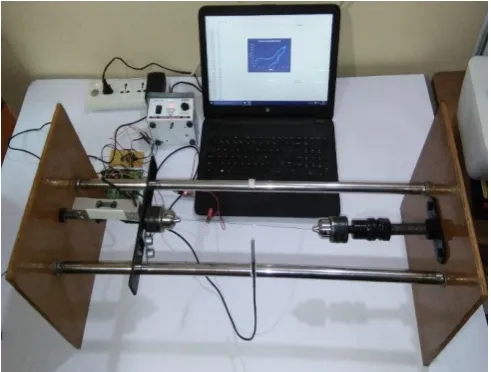
[image:3.595.308.554.216.402.2]The Tensometer setup, shown in Fig 1 has two fixed end plated where two cylindrical bars that are fixed to the end plates. Two sliding bars with fixtures to hold the SMA wire are mounted on the cylindrical bars, where one end is fixed and other end is allowed to slide over the cylindrical rod.
Fig 1: Tensometer Set up
SMA wire is fixed between fixtures, between the fixed end and movable end. The movable rod is connected to a lead screw, which has mechanical rotary actuator controls loading rate. Lead screw arrangement is used to transfer the force from rotary actuator from movable end. As a tensile force acts on the wire when the movable end is pulled as the actuator is subjected to a clockwise rotation.
© 2016, IRJET | Impact Factor value: 4.45 | ISO 9001:2008 Certified Journal
| Page 406
B. PREDICTIVE OUTPUT BEHAVIOUR
The overall testing apparatus is pictured in Fig 2, while Fig 3 gives a close-up of the electronic components (for an electronic schematic of the apparatus). The apparatus was controlled using a PIC 18 Micro-Controller. The power source had variable current settings, allowing the SMA wire to be activated using direct current of a constant magnitude. The direct current was turned on and off using the Micro-Controller and a transistor. To sense the position of the bias mass, an ultrasonic ranger was used. The code was written to detect when the bias mass was stationary, i.e., when a transformation has ended. When the Micro-Controller detected a stationary bias mass, its input to the transistor switched from high to low or vice versa.
[image:4.595.309.544.97.244.2]During a trial, the Micro-controller code was activated. The transistor’s base was initially turned high, allowing direct current to activate a MA transformation in a SMA spring. Taking the data from the ultrasonic sensor, the controller determined when the transformation is complete, upon which the Micro-Controller turned the transistor’s base low, allowing the SMA wire to cool back to its martensite form. The microprocessor logged the elapsed time, i.e., the heating time. When the SMA wire finished its AM transformation as determined by the micro-controller, the transistor’s base was turned to high, and the micro-controller logged the elapsed time, i.e., the cooling time. As mentioned, the martensite lengths, austenite lengths and strokes were measured using a stationary ruler by the operator.
Fig 2: overall testing apparatus
Each trial consisted of 5 cycles, giving 5 heating times, cooling times, martensite spring lengths, austenite spring lengths and stroke measurements. 5 cycles were
[image:4.595.343.524.396.506.2]performed not only for repeatability, but to also observe if the results changed after subsequent activation cycles due to training.
Fig 3: Close-up of the electronic components
VI. RESULTS AND DISCUSSION
C. UNIAXIAL TENSION TEST OBSERVATION
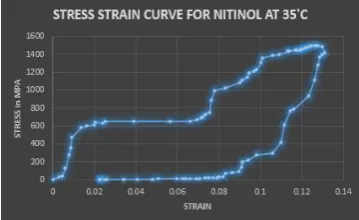
[image:4.595.35.268.465.623.2]The Nitinol wire specimen of 0.8 mm and 1.0 mm underwent Tension Test under customized designed Tensometer, as described well in the previous chapter. The test is carried out in three different levels of temperature viz, 27 °C, 35 °C and 40 °C. The following Stress-Strain Curves were observed.
Fig 4: Strain Curve for Nitinol at 27 °C
[image:4.595.344.524.544.654.2]© 2016, IRJET | Impact Factor value: 4.45 | ISO 9001:2008 Certified Journal
| Page 407
Fig 6: Strain Curve for Nitinol at 40 °CFig 7: Combined Strain Curve for Nitinol at all Working Temperature
The module i.e ratio of Stress to Temperature, is found to be increased with increase in temperature due to phase transformation. At relatively lower temperature, the material requires a less stress to get deform, and as and when temperature increases to a higher value, approaching towards austenitic range, the specimen about to regain the shape as it was about during that austenitic memory. Hence stress required to produce deformation will be maximum at higher temperature.
D. NEURAL NETWORK TRAINING
Fig 8: Validation Performance Curve
The above step represents the validation of the network to create a regression plot, which shows the relationship between the outputs of the network and the targets. The first three plots the represents training, validation and testing data respectively. The R value is an indication of the relationship between output and targets. On an Overall Average, the R value found to be 0.87 signifying almost near linear relationship between outputs and targets.
E. PREDICTION OF OUTPUT BEHAVIOUR
[image:5.595.73.255.253.380.2] WIRE DIAMETER
Fig 9: Plot of Wire Diameter V/S Time
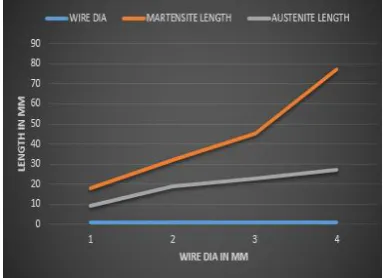
The reaction times were expected to increase in relation to an increased wire diameter, as the increase in volume leads to an increased thermal heat capacity, since the experimental results generally supported this correlation.
With regards to the stroke, had the change in moduli of rigidity been the only factor between phase transitions, the stroke would decrease with respect to an increasing diameter.As the wire diameter increases, the SMA spring’s internal shear stress decreases, which could limit the amount of martensite that can be de-twinned by the bias force and, consequently, limit the stroke in Fig 10.
[image:5.595.46.277.547.742.2] [image:5.595.343.535.581.720.2]© 2016, IRJET | Impact Factor value: 4.45 | ISO 9001:2008 Certified Journal
| Page 408
[image:6.595.57.261.92.260.2] SPRING DIAMETER
Fig 11: Plot of Spring Diameter V/S Time
[image:6.595.342.533.101.224.2]For the reaction times, projected that the heat times and cooling times would respectively increase and decrease with an increasing spring diameter. Larger spring diameters have a larger internal stress; larger stresses in turn cause the transition temperatures to increase. More time is thus needed to reach the MA transition temperatures during heating, while less time is needed to reach the AM transition temperatures during cooling.
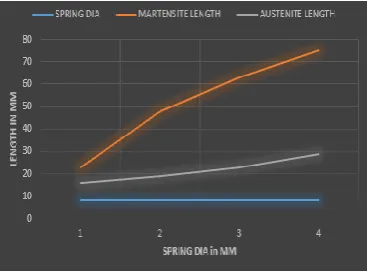
Fig 12: Plot of Spring DiameterV/S Length
Regarding the strokes as plotted on Fig 12, like the wire diameter manipulation, the stroke increased as the inner spring diameter was increased, but converged to a certain value, likely due to the increase in internal stress. Hence, permanent strain would therefore be expected and, thus, limit the maximum recoverable strain.
BIAS FORCE/WEIGHTS
[image:6.595.343.534.261.390.2]An increased bias force would induce a greater internal shear stress and, thus, increase the wire’s transition temperatures throughout the wire’s radius due to superelasticity. This projection was observed in the experimental results as plotted in the Fig 13.
Fig 13: Plot of Weight V/S Time
Fig 14: Plot of Weight V/S Length
Like the wire diameter and spring diameter manipulations, the stroke appears to converge to a set value. Also, like the wire diameter and spring diameter investigations, the cause of this convergence is likely due to the recoverable shear strain limit. At larger bias forces, the internal stress is greater and induces the martensite diameter to decrease and better disperse the stress. As already mentioned, the smaller martensite diameter would lead to a decreased elastic stroke, which in turn may have contributed to the stroke’s convergence.
DIRECT CURRENT
[image:6.595.70.254.402.538.2] [image:6.595.331.535.556.733.2]© 2016, IRJET | Impact Factor value: 4.45 | ISO 9001:2008 Certified Journal
| Page 409
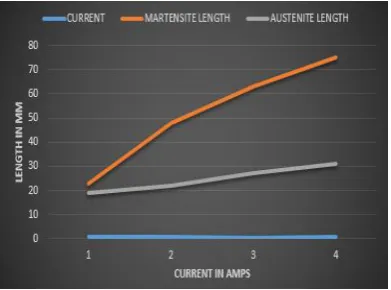
For the reaction times, with respect to an increasing direct [image:7.595.72.268.194.339.2]current magnitude, it was predicted that the heat times would decrease due to the increase of thermal energy, while the cooling times would remain constant, as the transformation would stop at the same final temperature regardless of direct current magnitude. Both predicted patterns were generally correct.
Fig 16: Plot of Current V/S Length
With regards to the strokes, it was anticipated that the strokes would be unaffected by a change in direct current, providing that the current is sufficient to induce the transformation.
VII. CONCLUSION
The proposed work carefully examine the difficulties faced by the engineers in order to sort out various constitutive equations defined by the different scientists across the globe in computing and modelling of Shape Memory Alloys. Hence it is found easy to develop a methodology to predict the output without using Constitutive Equation just by using ANN in order to model the SMA and later on to analyse the given specimen using trained model. Artificial Neural Network which is used to learn complex non-linear relationship and storing the knowledge in their connection weights, can be optimize accordingly to meet up the desired results. As it was mentioned in the objective of the work to find correlations between a SMA spring’s parameters and their dynamic response, hence this work successfully tested how variables i.e., wire diameter, spring diameter, bias force, direct current magnitude and transition temperature, independently affect the performance of SMA actuators in relation to their reaction times and strokes.
VIII. REFERENCES
[1] An Introduction to Smart Materials by Richard Lane and Benjamin Craig AMPTIAC Technical Staff, Rome, NY http://amptiac.alionscience.com.
[2] Encyclopedia of Smart Materials Volume 1 and Volume 2 by Mel Schwartz, A Wiley-Interscience Publication John Wiley & Sons, Inc. ISBN 0-471-17780-6 (cloth : alk.paper).
[3] Iman Kardan, Reza Abiri, Mansour Kabganian, Meisam Vahabi, “Modeling of Shape Memory Alloy Springs using a Recurrent Neural Network”, Journal of Theoretical and Applied Mechanics 51, 3, pp. 711-718, Warsaw 2013.
[4] Introduction to Shape Memory Alloys by P. K. Kumar and D. C. Lagoudas, TiNi Aerospace, 2235 Polvorosa Ave, San Leandro, CA 94577.
[5] A review of constitutive models and modeling techniques for shape memory alloys, by Cheikh Cisse, Wael Zaki, Tarak Ben Zineb International Journal of Plasticity, 28 August 2015, www.elsevier.com/locate/ijplas.
[6] Tan Wee Choon, Abdul Saad Salleh, Saifulnizan Jamian, Mohd. Imran Ghazali, “Phase Transformation Temperatures for Shape”, World Academy of Science, Engineering and Technology International Journal of Chemical, Molecular, Nuclear, Materials and Metallurgical Engineering Vol:1, No:1, 2007 Memory Alloy Wire.
[7] Three-dimensional modeling and numerical analysis of rate-dependent irrecoverable deformation in shape memory alloys by Darren J. Hartl, George Chatzigeorgiou, Dimitris C. Lagoudas, International Journal of Plasticity, 25 January 2010, www.elsevier.com/locate/ijplas.
[8] Brinson V, Review of Mechanics of Shape Memory Alloy Structures, Applied Mechanics Reviews, Vol.50, No.11, Part 1,November 1997,pp629-645.
[9] Brinson L C and Lammering R, Finite Element analysis of the behavior of Shape Memory Alloys and their Applications, International Journal of Solids and Structures, Vol.30, 1993,pp. 3261-3280.
[10] ] D Helm, “Pseudoelastic Behavior of Shape Memory Alloys Constitutive Theory and Identification of the Material Parameters Using Neural Networks”, TECHNISCHE MECHANIK, Band 25, Heft 1, (2005), 39– 58 Manuskripteingang: 2. August 2004.