Alternative expression of platelet glycoprotein
Ib(beta) mRNA from an adjacent 5' gene with an
imperfect polyadenylation signal sequence.
B Zieger, … , Y Hashimoto, J Ware
J Clin Invest.
1997;
99(3)
:520-525.
https://doi.org/10.1172/JCI119188
.
Glycoprotein (GP) Ib is a major component of the platelet membrane receptor for von
Willebrand factor, designated the GP Ib-IX-V complex. GP Ib is composed of two subunits
(GP Ib(alpha) and GP Ib(beta)) each synthesized from separate genes. The 206 amino acid
precursor of GP Ib(beta) is synthesized from a 1.0-kb mRNA expressed by megakaryocytes
and was originally characterized from cDNA clones of human erythroleukemic (HEL) cell
mRNA, a cell line exhibiting megakaryocytic-like properties. The cell line CHRF-288-11
also exhibits megakaryocytic-like properties, but synthesizes two related GP Ib(beta) mRNA
species of 3.5 and 1.0 kb. We performed cDNA cloning experiments to identify the origin of
the 3.5-kb transcript and determine its relationship to the 1.0-kb GP Ib(beta) mRNA found in
megakaryocytes, platelets, and HEL cells. Our cloning experiments demonstrate that the
longer transcript results from a nonconsensus polyadenylation recognition sequence,
5'AACAAT3', within a separate gene located upstream to the platelet GP Ib(beta) gene. In
the absence of normal polyadenylation the more 5' gene uses the polyadenylation site
within its 3' neighbor, the platelet GP Ib(beta) gene. This newly identified 5' gene contains
an open reading frame encoding 369 amino acids with a high degree of sequence similarity
to an expanding family of GTP-binding proteins.
Research Article
Find the latest version:
J. Clin. Invest.
© The American Society for Clinical Investigation, Inc. 0021-9738/97/02/0520/06 $2.00
Volume 99, Number 3, February 1997, 520–525
Alternative Expression of Platelet Glycoprotein Ib
b
mRNA from an Adjacent 5
9
Gene with an Imperfect Polyadenylation Signal Sequence
Barbara Zieger, Yoshimi Hashimoto, and Jerry Ware
Roon Research Center for Arteriosclerosis and Thrombosis, Division of Experimental Hemostasis and Thrombosis, Department of Molecular and Experimental Medicine, and Department of Vascular Biology, The Scripps Research Institute, La Jolla, California 92037
Abstract
Glycoprotein (GP) Ib is a major component of the platelet membrane receptor for von Willebrand factor, designated the GP Ib-IX–V complex. GP Ib is composed of two sub-units (GP Iba and GP Ibb) each synthesized from separate genes. The 206 amino acid precursor of GP Ibb is synthesized from a 1.0-kb mRNA expressed by megakaryocytes and was originally characterized from cDNA clones of human eryth-roleukemic (HEL) cell mRNA, a cell line exhibiting mega-karyocytic-like properties. The cell line CHRF-288–11 also exhibits megakaryocytic-like properties, but synthesizes two related GP Ibb mRNA species of 3.5 and 1.0 kb. We per-formed cDNA cloning experiments to identify the origin of the 3.5-kb transcript and determine its relationship to the 1.0-kb GP Ibb mRNA found in megakaryocytes, platelets, and HEL cells. Our cloning experiments demonstrate that the longer transcript results from a nonconsensus polyadenyl-ation recognition sequence, 59AACAAT39, within a separate gene located upstream to the platelet GP Ibb gene. In the absence of normal polyadenylation the more 59 gene uses the polyadenylation site within its 39 neighbor, the platelet GP Ibb gene. This newly identified 59 gene contains an open reading frame encoding 369 amino acids with a high degree of sequence similarity to an expanding family of GTP-bind-ing proteins. (J. Clin. Invest. 1997. 99:520–525.) Key words:
gene expression regulation • cloning, molecular • blood platelets • platelet membrane glycoproteins • cell division cycle proteins
Introduction
The GP Ib-IX–V complex is an essential platelet membrane receptor supporting platelet adhesion through its interaction with von Willebrand factor, an adhesive ligand of the blood and subendothelium (1, 2). The expression of the GP Ib-IX–V complex is dependent upon the coordinated assembly of at least three gene products, the a- and b-subunits of GP Ib, and GP IX (3). cDNA cloning experiments for these three subunits of the complex have utilized megakaryocytic-like cell lines and without exception the reported coding sequences have been representative of the mRNA species present in the
megakaryo-cyte and platelet (4–6). However, the megakaryocytic cell line CHRF-288–11 (7) is an exception containing two related mRNA species from the locus encoding the b-subunit of GP Ib (GP Ibb) (8). A short 1.0-kb transcript is consistent with the size of the megakaryocytic mRNA encoding platelet GP Ibb, whereas a longer transcript approximating 3.5 kb appears to be present in a wide variety of cell types but noticeably absent in megakaryocytes and other megakaryocytic-like cell lines (8, 9). Kelly et al. reported the cloning of a cDNA hybridizing to the platelet GP Ibb cDNA and suggested the 3.5-kb transcript expressed by endothelial cells possesses the potential to syn-thesize a novel 45-kD protein containing a carboxyl terminus of platelet GP Ibb polypeptide sequence (8). However, a num-ber of fundamental concerns were raised by their report. First, the cDNA sequence lacked a 39 polyadenylated sequence and contained z 600 base pairs of sequence 39 to the polyadenyl-ation recognition signal utilized by megakaryocytes. It was un-clear why endothelial cells would fail to recognize a consensus polyadenylation signal sequence unless the reported sequence was derived from a pre-mRNA species. A second concern was the presence of the single GP Ibb intron sequence within the proposed open reading frame of the related endothelial cell mRNA. This situation suggested an intron of a gene expressed by megakaryocytes is a translated exon when expressed by en-dothelial cells, an unusual form of alternative processing.
We sought to investigate the origin of the longer transcript in CHRF-288–11 cells. Now we report a number of key differ-ences from the sequence reported by Kelly et al. (8) and in the fundamental conclusions derived from their work. We show that a unique gene located 59 to the platelet GP Ibb gene uti-lizes two different polyadenylation sites. The more 59 polyade-nylation site results from an imperfect polyadepolyade-nylation recog-nition sequence, whereas the more 39 polyadenylation event results from a utilization of the consensus polyadenylation se-quence within the platelet GP Ibb gene. The use of the platelet gene’s polyadenylation sequence results in a 3.5-kb transcript containing an open reading frame encoding a polypeptide re-lated to GTP-binding proteins and a downstream open reading frame encoding platelet GP Ibb polypeptide. The potential to express platelet GP Ibb by cells other than megakaryocytes and platelets is discussed along with the identity of a unique gene residing 59 to the platelet GP Ibb gene.
Methods
RNA isolation and northern transfer. CHRF-288-11 cells were ob-tained from Dr. Michael Lieberman (Children’s Hospital Medical Center, Cincinnati, OH) and were cultured as described in the origi-nal description of the cell line (7). Total RNA was isolated by ultra-centrifugation through cesium chloride cushions using an established procedure (10). Poly (A)1 RNA was prepared by affinity
chromatog-raphy using oligo-dT cellulose columns purchased from Life Technol-ogies, Inc. (Bethesda, MD).
Address correspondence to Jerry Ware, SBR8/The Scripps Research Institute, 10550 North Torrey Pines Road, La Jolla, CA 92037. Phone: 619-784-9939; FAX: 619-784-2030; E-mail: [email protected]
Gel electrophoresis of poly (A)1 RNA was performed through
denaturing formaldehyde gels prepared as described by Lehrach et al. (11). Northern transfer and hybridization were performed using stan-dard methodologies (10). The hybridization probe for the Northern analyses illustrated in Figs. 1 and 4 was a full-length platelet GP Ibb
cDNA fragment isolated from a human erythroleukemia cell cDNA library prepared by the authors. The coding sequence for platelet GP Ibb within this cDNA fragment is identical to that described by Lopez et al. (5). After hybridization, the nitrocellulose filter was washed three times in 0.3 M sodium chloride/0.03 M sodium citrate/ 0.1% SDS (10 min, RT) and 1 time in 0.15 M sodium chloride/0.015 M sodium citrate/0.1% SDS (30 min, 558C). Less stringent washing con-ditions resulted in a relatively high background due to crosshybridiza-tion with 28S rRNA. After washing the nitrocellulose was analyzed by autoradiography using Kodak X-OMAT film.
cDNA library construction. CHRF-288–11 poly (A)1 RNA was
converted into cDNA and cloned into the bacteriophage l ZAP/Ex-press available from Stratagene Cloning Systems (La Jolla, CA). First-strand cDNA was synthesized using Stratascript RNase H-defi-cient reverse transcriptase (Stratagene) primed by poly(dT). The un-amplified cDNA library consisted of 1.5 3 106 plaque-forming units.
Random analysis of 20 independent clones revealed cDNA inserts in 18 clones ranging in size from 0.8-kb pairs to z 4 kb. 1 3 106
plaque-forming units were expanded into a high-titer stock of the CHRF-288–11 cDNA library.
Two additional cDNA libraries were also used in this project. The first was a library prepared by the authors from poly(A)1 mRNA
iso-lated from human endothelial cells. These cells were a gift from Dr. Eugene Levin (The Scripps Research Institute, La Jolla, CA) and were third-passage cells prepared from a donor umbilical vein. This library was also constructed in the lZAP/Express vector and con-tained more than 1 3 106 recombinant bacteriophage. An additional
fetal brain cDNA library was purchased from Stratagene.
Library screening and clone analysis. Screening of the library was performed using standard methodologies. A fragment of platelet GP Ibb cDNA was radiolabeled using a random priming system available from Stratagene. Positive clones were plaque-purified via four rounds of screening before performing analyses on the cloned cDNA frag-ments. Each cDNA insert was rescued from its recombinant lZAP/ Express vector via the in vivo excision protocol provided by Strat-agene. DNA sequence analysis was performed on single-stranded DNA templates from the rescued filamentous phagemids using dideoxynucleotides and Sequenase (U.S. Biochemical, Cleveland, OH; 12). All DNA sequence reported in this manuscript was deter-mined by analysis of both strands and from multiple runs of individ-ual sequencing reactions. The majority of sequence was generated us-ing sequence-specific primers synthesized after each individual DNA sequencing gel. In a few cases some confirming sequence data was ob-tained after subcloning individual restriction fragments in the fila-mentous phage, M13mp18 or M13mp19, and sequencing using stan-dard dideoxy methodologies (12).
Computer analysis of the DNA sequence was performed using the PC-based software, Lasergene (DNASTAR Inc., Madison, WI) and sequence comparison programs available through the Internet from the National Center for Biotechnology Information (http:// www.ncbi.nlm.nih.gov/).
Results
Origin of the 3.5-kb platelet GP Ibb-related transcript expressed by CHRF-288–11 cells. CHRF-288–11 cells were established from a metastatic tumor in an infant with acute megakaryo-blastic leukemia (7). These cells contain two mRNA species hybridizing with a full-length (1.0 kb) platelet GP Ibb cDNA probe (Fig. 1). The smallest transcript is z 1.0 kb and most
likely corresponds to the mature GP Ibb mRNA transcript
seen in other megakaryocytic cell lines, megakaryocytes, and
platelets (5, 9). A larger, less abundant species is z 3.5 kb and is not an expressed transcript seen in megakaryocytic RNA (8). To investigate the origin of the 3.5-kb transcript we pre-pared a CHRF-288–11 cDNA library and screened the library with the full-length platelet GP Ibb cDNA. Characterization of 17 hybridizing clones revealed that 14 contained cDNA fragments ranging from 0.9 to 1.0 kb corresponding to near full-length copies of the platelet GP Ibb mRNA. Of the re-maining three clones, two contained inserts z 1.9 kb and an-other was z 3.2 kb. The clone containing the longest insert,
bacteriophage l6C, was chosen for further DNA sequence
analysis.
DNA sequence analysis of l6C revealed a cDNA insert of 3,172 nucleotides (Fig. 2). The 39 portion of the insert, nucle-otides 1,866–3,172 corresponds to the GP Ibb genomic gene sequence as reported by Yagi et al. (9), yet lacking the single GP Ibb intron. Within this cDNA sequence is the major mega-karyocytic transcription start site of the platelet GP Ibb gene (nucleotide 2,218; 9), the complete coding sequence for the GP Ibb precursor protein (nucleotides 2,245–2,862), the platelet
GP Ibb polyadenylation recognition sequence (nucleotides
3,153–3,158) and a polyadenylated tail (Fig. 2).
The more 59 sequence within l6C contained an open read-ing frame encodread-ing a 385 residue polypeptide sequence and represented the only significant open reading frame within the more 59 sequence. Thus, this fragment contained an unusual
arrangement of cDNA sequence beginning with a unique 59
sequence contiguous with the platelet GP Ibb gene lacking its single intron. The possibility that the unique 59 sequence might be a cloning artifact resulting from the analysis of a single clone was dismissed with the characterization of the two re-maining clones purified during the initial screening of the same library, l11C, and l17C. Each of these clones contains varying lengths of the same cDNA sequence beginning at nucleotides 1,224 and 1,521 of l6C, respectively. Clone l17C contained an additional uncommon feature, the complete intron sequence of the platelet GP Ibb gene, suggesting that in the context of the longer transcript, the single intron within the platelet GP Ibb gene was not efficiently removed.
A gene residing 59 to the platelet glycoprotein Ibb gene uti-lizes two alternative polyadenylation recognition sequences.
To obtain additional information on the newly identified 59 se-quence, the CHRF-288–11 cDNA library, a fetal brain cDNA library and a human endothelial cell cDNA library were each
Figure 1.Northern analysis of CHRF-288–11 poly(A)1 RNA. Poly(A)1-selected RNA
screened with a 59 fragment of l6C. The fetal brain library was chosen based on the identification of more than 50 near-identi-cal matches of brain-expressed cDNA fragments within the ex-pressed sequence tag (EST)1 database (13). None of the
frag-ments identified in the EST database contained more 59
cDNA sequence than l6C. The endothelial cDNA library was
chosen based on the previous identification of a longer (z 3.5
kb) transcript within endothelial cells hybridizing with the
platelet GP Ibb cDNA (8). This screening yielded 8 more
unique cDNA clones.
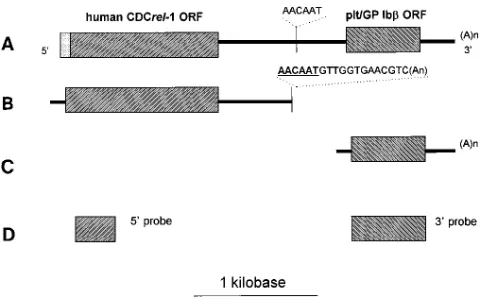
Several of the characterized clones contained a ated tail in which the last nucleotide preceding the polyadenyl-ated tail corresponded to nucleotide 1,994 within the sequence presented in Fig. 2. Since the 39 boundary of these new clones lacked adenines, these clones were not the result of oligo d(T) mispriming in the first-strand reaction, and most likely repre-sented cDNA products from an imperfect polyadenylation se-quence (59AACAAT39) 13 nucleotides upstream from the 39
end of each clone (nucleotides 1,976–1,981 of Fig. 2). Fig. 3 conceptually illustrates the origin of these clones as they align with the derived sequence from individual cDNA clones.
The utilization of this imperfect polyadenylation site
sug-gested a related mRNA transcript of z 2.3 kb would be
present in the poly (A)1 mRNA from CHRF-288-11 cells.
In-deed, Northern analysis identified a 2.3-kb transcript utilizing the 59 probe demonstrating that post-transcriptional modifica-tion of the primary transcript for the more 59 gene involves two different polyadenylation recognition sequences, its own im-perfect site or the polyadenylation recognition site within its 39
neighbor, the platelet glycoprotein Ibb gene (Figs. 3 and 4). Utilizing a 39 probe transcripts of 3.5 and 1.0 kb were ob-served, each presumably the product of different gene
[image:4.612.315.556.57.208.2]promot-1. Abbreviation used in this paper: EST, expressed sequence tag.
Figure 2. Nucleotide sequence of the platelet GP Ibb related-tran-script of CHRF-288–11 cells. The complete DNA sequence of a bac-teriophage l clone designated, l6C, is shown and contains two long open reading frames (ORFs). The first ORF, nucleotides 2–1,156, en-codes 385 amino acids sharing homology with a family of GTP-bind-ing proteins. The second ORF, nucleotides 2,245–2,862, is the com-plete ORF encoding the platelet GP Ibb precursor polypeptide. A poly (A)1 tail resulting from the polyadenylation signal sequence in
the platelet GP Ibb gene (underlined, nucleotides 3,153–3,158) repre-sents the most 39 sequence. The transcription initiation site of the platelet GP Ibb precursor transcript is highlighted by a double arrow (⇑) at nucleotide 2,218 (9). Thus, the longer transcript expressed by CHRF-288–11 cells contains a unique 59 sequence adjoining the platelet GP Ibb gene. An imperfect polyadenylation site within the more 59 sequence is double-underlined (nucleotides 1,976–1,981). Ac-cession number U59632 has been assigned by GenBank.
Figure 3. Diagrammatic representation of the GP Ibb-related tran-scripts. Three GP Ibb-related transcripts were identified by cDNA cloning experiments. Each of the three transcripts is schematically il-lustrated as they align to each other. (A) The 3.5-kb GP Ib-related transcript expressed by CHRF-288–11 cells contains two open read-ing frames. Based on the characterization of the cDNA clones l12F and l8EN (see Fig. 5) the 59 open reading frame has been designated hCDCrel-1. (B) The isolation of multiple clones containing a poly-adenylated tail after an imperfect polyadenylation sequence ( under-lined) suggests the longer transcript depicted in (a) is a result of the utilization of the consensus polyadenylation recognition sequence within the downstream platelet GP Ibb gene. The transcript depicted in (B) is z 2.3 kb and was identified by Northern analysis (see Fig. 4)
[image:4.612.59.297.59.426.2]ers, yet utilizing the same polyadenylation recognition se-quence (Figs. 3 and 4).
Sequence analysis of transcripts polyadenylated from the imperfect recognition sequence. A common cDNA sequence representing the 2.3-kb transcript is presented in Fig. 5. The presented sequence is a composite of two cDNA clones, desig-nated l12F and l8EN, isolated from fetal brain and endothe-lial cell cDNA libraries, respectively. Clone l8EN contained the sequence from nucleotide 83 to 2,032 (Fig. 5). Nucleotide
sequence 1–82 was derived from clone l12F. The sequence
contains an open reading frame encoding 369 amino acids with an initiating methionine codon (nucleotide 88–90) immedi-ately preceded by a consensus Kozak sequence (59CCACC39;
14). Thus, unlike the incomplete sequence derived from l6C this sequence contains the translational machinery to synthe-size the conceptual translation product presented in Fig. 5. The most 59 sequence illustrated in Fig. 5 differs from the 59 se-quence of l6C (Fig. 3). Specifically, the sequences are identical in the 39 direction starting at nucleotide 104 of the l6C se-quence (Fig. 2) and nucleotide 142 of the composite sese-quence presented in Fig. 5. Concerns that the more 59 sequence of l6C (nucleotides 1–103 of Fig. 2) might be a cloning artifact were dismissed by two additional clones containing 59 ends spanning
nucleotides 1–103 of l6C. Thus, the presented cDNA
se-quences most likely represent two different processing variants of the same gene.
Discussion
Our results provide evidence that a gene residing in close 59
proximity to the platelet GP Ibb gene directly influences the expression of the platelet GP Ibb gene. The utilization of the platelet GP Ibb polyadenylation sequence by the more 59 gene results from an imperfect polyadenylation recognition se-quence (59AACAAT39) in the more 59 gene. Indeed, in vitro
studies have confirmed that mutation of a consensus polyade-nylation sequence (59AATAAA39 → 59AACAAA39)
dramati-cally reduces the efficiency of polyadenylation (15, 16). In the present study, an imperfect polyadenylation sequence results in the alternative usage of a polyadenylation recognition site within a nearby 39 gene. The net result is a longer transcript, approximating 3.5 kb, and containing two open reading frames (Fig. 3).
[image:5.612.317.555.61.347.2]In the course of our analysis, we isolated multiple clones from the CHRF-288–11, endothelial cell and fetal brain cDNA libraries. In addition, we isolated and characterized more than 40 clones identified from the EST database and available through the cDNA consortium. It is clear from this analysis that the 59 sequence varies with a number of alternatively pro-cessed variants. In fact, a shorter exposure of the Northern blots presented in Figs. 1 and 4 suggests the 3.5 kb mRNA transcript is composed of several transcripts of slightly varying length. The sequences presented in Figs. 2 and 5 represent two of the more common processing variants identified. Whether these processing variants are specific for a particular cell type was not obvious from the characterization of our clones. Addi-tional length heterogeneity within the longer transcript was provided by our isolation of a single cDNA clone containing the complete intron within the GP Ibb gene (data not shown). The presence or absence of the GP Ibb intron would produce a 274 ribonucleotide length difference among the mature
Figure 4. Northern analysis illustrates the al-ternative usage of two polyadenylation se-quences. The utilization of an imperfect poly-adenylation site is confirmed by Northern analysis of CHRF-288–11 poly(A)1 RNA
and probes from the 59 region or 39 region of the longer transcript (see Fig. 3 d). As de-scribed in Fig. 1, the poly(A)1 RNA was
electrophoresed through a denaturing form-aldehyde gel, transferred to nitrocellulose, and hybridized with a probe representing with the more 59 sequence, or the 39 platelet GP Ibb probe. As predicted from the analy-sis of multiple bacteriophage l clones, the more 59 probe hybridizes with 3.5- and 2.3-kb species, resulting from the alternative usage of two different polyadenylation recognition sequences. The more 39 probe hybridizes with 3.5- and 1.0-kb species resulting from polyadenylation via the recognition sequence within the platelet GP Ibb gene. A photo-graph of the autoradiophoto-graph is shown along with the migrating positions of RNA molecu-lar weight standards.
Figure 5. Sequence analysis of an mRNA transcript originating from an imperfect polyadenylation signal sequence. Bacteriophage l
transcripts. Future studies characterizing genomic clones of this locus may aid in clarifying the identity of each processing variant.
A search of the current GenBank database with the polypeptide sequence derived from l8EN (Fig. 5) suggests the encoded polypeptide would be an additional member of a growing family of proteins related to the cell division cycle (CDC) proteins of yeast (17). We have designated this poly-peptide as human cell division cycle-related (hCDCrel) protein 1, anticipating additional variants and related human se-quences will be identified. Homologous proteins have been found in mouse and Drosophila and an alignment with the de-duced amino acid sequence of hCDCrel-1 is presented (18–20; Fig. 6). Experimental evidence for the Drosophila homologue confirms its role in cytokinesis suggesting that a unifying func-tional attribute of these proteins may be a role in some aspect of cell division (20, 21). Structurally, the unifying feature of these proteins is the presence of GTP- or phosphate-binding motifs (22, 23; Fig. 6). Whether the 59 gene and the platelet GP Ibb gene are related remains unknown. The imperfect poly-adenylation sequence within the more 59 gene is less than 250 nucleotides upstream of the megakaryocytic transcription initi-ation site within the platelet GP Ibb gene (Fig. 2). Indeed, in our own preliminary studies a fragment extending 262 base pairs upstream of the platelet glycoprotein Ibb transcription initiation site can support reporter gene expression in human erythroleukemia (HEL) cells suggesting it may represent a megakaryocytic promoter sequence.
Our analysis of l6C (Fig. 2) suggests some unidentified 59
sequence approximating 300 nucleotides remains to be identi-fied based on a mature transcript size of 3.5 kb. This analysis will be necessary to determine if the longer transcript contains the potential to encode a polypeptide differing at the amino terminus from hCDCrel-1. Certainly, a 3.5-kb transcript con-taining the potential to code for two proteins would be un-usual. Polycistronic units and internal ribosome binding sites in prokaryotes are common, but the translation of eukaryotic mRNA is most commonly initiated by ribosome binding to a 59
terminal cap structure and scanning for an initiation codon (24). According to this mechanism, we might predict for the 3.5-kb transcript illustrated in Fig. 3 efficient protein synthesis
from the more 59 coding sequence, and likewise, no protein synthesis from the more 39 open reading frame encoding plate-let glycoprotein Ibb. However, the initiation of translation in eukaryotic cells via a cap-independent method, or via an inter-nal ribosome entry site, is an efficient process for the synthesis of viral proteins dependent upon cellular not viral gene prod-ucts (25–27). Indeed, it has been suggested that eukaryotic in-ternal ribosome binding sites may be more widespread than previously recognized but lacking, to date, the description of a consensus motif (27). The synthesis of platelet glycoprotein Ibb from the longer transcript may represent an example of in-ternal ribosome binding and will be examined in future studies to determine if synthesis of this protein can occur via a cap-independent mechanism.
Kelly et al. reported the cDNA cloning of an endothelial cell-expressed form of the 3.5-kb GP Ibb transcript (8). How-ever, their cloning did not identify the 39 or 59 boundaries of the endothelial cDNA fragments. In fact, their reported se-quence contained z 600 nucleotides 39 to the platelet polyade-nylation site and was a composite of three overlapping cDNA fragments. They concluded that the longer transcript poten-tially expresses a 45–kD protein that is essenpoten-tially a fusion pro-tein composed of a unique amino terminus coupled to the platelet GP Ibb polypeptide sequence. This conclusion was based on immunoreactivity of a 45–kD protein present in en-dothelial cell extracts and recognized by a polyclonal anti-GP Ibb antibody. Their open reading frame for this protein as-sumed translation through the single intron within the platelet GP Ibb gene (9). Unlike the reported sequence of Kelly et al., our derived sequence does not contain an open reading frame capable of synthesizing the 45–kD polypeptide due to a num-ber of insertions and deletions differing from their reported se-quence. Including the present study, three different reports contain DNA sequence through the regions encoding the po-tential 45–kD protein. A comparison of the reported genomic sequence of Yagi et al. (9) to the cDNA sequence reported by Kelly et al. (8) reveals four discrepancies. Using the sequence of Kelly et al. as a reference, the differences are an inserted cy-tosine base at position 675, the absence of a cycy-tosine/guanine dinucleotide pair at postion 844 and a silent transversion at po-sition 1,275. Three of these differences are critical since they
Figure 6. Comparison of the conceptual translation product, hCDCrel-1, to simi-lar GenBank entries. The polypeptide, designated hCDCrel-1, shares homol-ogy with a family of GTP-binding proteins. Two mu-rine proteins, H5 and D6 (GenBank accession num-bers X61452 and D28540, re-spectively) and a Drosophila
peanut homologue (acces-sion number U08103) are aligned illustrating the con-servation of sequence through more than 300 amino acids of each se-quence. hCDCrel-1 is 75, 56, and 46% identical to H5, D6, and peanut polypeptides, respectively. Each of the aligned proteins contains motifs involved in GDP/GTP exchange (GX4GK[S/T]) or in
result in frame-shifts within the proposed open reading frame encoding the 45–kD polypeptide (8). Our sequence analysis agrees with that of Yagi et al. at these positions further sup-porting the conclusion that the synthesis of this 45–kD polypeptide is not possible. Thus, the immunoreactivity of a 45–kD endothelial cell protein most likely represents
cross-reacting material distinct from GP Ibb peptide. However,
based on this previous study there are z 50 EST database en-tries containing gene sequence identical to that presented in
Figs. 2 and 5, yet designated platelet GP Ibb precursor
polypeptide. Our data would support a renaming of these se-quences to hCDCrel-1 protein.
The current studies provide two directions for future re-search. First, we have identified a new gene within the 22q11.2 chromosomal locus. Initiatives to identify novel genes from this locus have been fueled by studies linking DiGeorge syn-drome and other cardio-facial abnormalities to this region of chromosome 22 (28, 29). The close relationship of DiGeorge syndrome and the platelet GP Ibb gene has been verified by chromosomal deletion of 22q11.2 in an individual diagnosed with both the Bernard-Soulier syndrome (congenital absence of the platelet GP Ib-IX receptor) and the DiGeorge syn-drome (30). Indeed, the sequence similarities between the
Drosophila peanut protein and hCDCrel-1 suggests a function for hCDCrel-1 in development since the expression of the pea-nut protein is linked to proliferation of the imaginal disc tis-sues of Drosophila (20). Thus, the identity of the 59 gene and its product should be characterized as another candidate gene for normal development. Finally, the identification of platelet GP Ibb coding sequence in cells of nonhematopoietic origin suggests the presence of this protein in cells other than mega-karyocytes and platelets. Thus, a previously unrecognized functional consequence for the expression of this protein may exist and should be examined.
Acknowledgments
The authors thank Dr. Mayumi Yagi (University of Washington, Se-attle, WA) for sharing unpublished genomic DNA sequence flanking the platelet GP Ibb gene. The authors are also grateful to the Sam and Rose Stein Trust Fund for support establishing the DNA Core Facility within the Department of Molecular and Experimental Med-icine at The Scripps Research Institute.
This work was supported in part by grant HL50545 from the Na-tional Heart, Lung, and Blood Institute of the NaNa-tional Institutes of Health. B. Zieger is a recipient of a DFG Scholarship from the Deutsche Forschungsgemeinschaft. J. Ware is a recipient of an Established In-vestigator Award from the American Heart Association.
References
1. Ruggeri, Z.M. 1991. The Platelet Glycoprotein Ib-IX Complex. In Progress in Hemostasis and Thrombosis. B.S. Coller, editor. W.B. Saunders Company, Philadelphia. 35–68.
2. Lopez, J.A. 1994. The platelet glycoprotein Ib-IX complex. Blood Co-agul. Fibrinolysis. 5:97–119.
3. Lopez, J.A., B. Leung, C.C. Reynolds, C.Q. Li, and J.E.B. Fox. 1992. Ef-ficient plasma membrane expression of a functional platelet glycoprotein Ib-IX complex requires the presence of its three subunits. J. Biol. Chem. 267:12851– 12859.
4. Lopez, J.A., D.W. Chung, K. Fujikawa, F.S. Hagen, T. Papayannopou-lou, and G.J. Roth. 1987. Cloning of the alpha chain of human platelet
glyco-protein Ib: A transmembrane glyco-protein with homology to leucine-rich alpha2-gly-coprotein. Proc. Natl. Acad. Sci. USA. 84:5615–5619.
5. Lopez, J.A., D.W. Chung, K. Fujikawa, F.S. Hagen, E.W. Davie, and G.J. Roth. 1988. The alpha and beta chains of human platelet glycoprotein Ib are both transmembrane proteins containing a leucine-rich amino acid sequence. Proc. Natl. Acad. Sci. USA. 85:2135–2139.
6. Hickey, M.J., L.L. Deaven, and G.J. Roth. 1990. Human platelet glyco-protein IX: Characterization of cDNA and localization of the gene to chromo-some 3. FEBS Lett. 274:189–192.
7. Fugman, D.A., D.P. Witte, C.L. Jones, B.J. Aronow, and M.A. Lieber-man. 1990. In vitro establishment and characterization of a human megakaryo-blastic cell line. Blood. 75:1252–1261.
8. Kelly, M.D., D.W. Essex, S.S. Shapiro, F.J. Meloni, T. Druck, K. Hueb-ner, and B.A. Konkle. 1994. Complementary DNA cloning of the alternatively expressed endothelial cell glycoprotein Ibb (GPIbb) and localization of the GPIbb gene to chromosome 22. J. Clin. Invest. 93:2417–2424.
9. Yagi, M., S. Edelhoff, C.M. Disteche, and G.J. Roth. 1994. Structural characterization and chromosomal location of the gene encoding human plate-let glycoprotein Ibb. J. Biol. Chem. 269:17424–17427.
10. Sambrook, J., E.F. Fritsch, and T. Maniatis. 1989. Molecular Cloning: A Laboratory Manual. Cold Spring Harbor Laboratory, Cold Spring Harbor, NY. 11. Lehrach, H., D. Diamond, J.M. Wozney, and H. Boedtker. 1977. RNA molecular weight determination by gel electrophoresis under denaturing condi-tions, a critical reexamination. Biochemistry. 16:4743–4751.
12. Sanger, F., S. Nicklen, and A.R. Coulson. 1977. DNA sequencing with chain-terminating inhibitors. Proc. Natl. Acad. Sci. USA. 74:5463–5467.
13. Adams, M.D., J.M. Kelley, J.D. Gocayne, M. Dubnick, M.H. Poly-meropoulos, H. Xiao, C.R. Merril, A. Wu, B. Olde, et al. 1991. Complementary DNA sequencing: expressed sequence tags and human genome project. Science (Wash. DC). 252:1651–1656.
14. Kozak, M. 1984. Compilation and analysis of sequences upstream from the translational start site in eukaryotic mRNAs. Nucleic Acids Res. 12:857–872. 15. Fitzgerald, M., and T. Shenk. 1981. The sequence 59-AAUAAA-39 forms parts of the recognition site for polyadenylation of late SV40 mRNAs. Cell. 24:251–260.
16. Sheets, M.D., S.C. Ogg, and M.P. Wickens. 1990. Point mutations in AAUAAA and poly (A) addition site: effects on the accuracy and efficiency of cleavage and polyadenylation in vitro. Nucleic Acids Res. 18:5799–5805.
17. Hartwell, L.H., J. Culotti, J.R. Pringle, and B.J. Reid. 1974. Genetic con-trol of the cell division cycles in yeast. Science (Wash. DC). 183:46–51.
18. Kato, K. 1990. A collection of cDNA clones with specific expression patterns in mouse brain. Eur. J. Neurosci. 2:704–711.
19. Nottenburg, C., W.M. Gallatin, and T. St. John. 1990. Lymphocyte HEV adhesion variants differ in the expression of multiple gene sequences. Gene. 95: 279–284.
20. Neufeld, T.P., and G.M. Rubin. 1994. The Drosophila peanut gene is re-quired for cytokinesis and encodes a protein similar to yeast putative bud neck filament proteins. Cell. 77:371–379.
21. Hartwell, L.H. 1971. Genetic control of the cell division cycle in yeast. IV. Genes controlling bud emergence and cytokinesis. Exp. Cell Res. 69:265–276. 22. Saraste, M., P.R. Sibbald, and A. Wittinghofer. 1990. The P-loop—a common motif in ATP- and GTP-binding proteins. Trends Biochem. Sci. 15: 430–434.
23. Bourne, H.R., D.A. Sanders, and F. McCormick. 1991. The GTPase su-perfamily: conserved structure and molecular mechanism. Nature (Lond.). 349: 117–127.
24. Kozak, M. 1989. The scanning model for translation: an update. J. Cell Biol. 108:229–241.
25. Macejak, D.G., and P. Sarnow. 1991. Internal initiation of translation mediated by the 59 leader of cellular mRNA. Nature (Lond.). 353:90–94.
26. Jang, S.K., and E. Wimmer. 1990. Cap-independent translation of en-cephalomyocarditis virus RNA: structural elements of the internal ribosomal entry site and involvement of a cellular 57-kD RNA-binding protein. Nature (Lond.). 353:90–94.
27. Mountford, P.S., and A.G. Smith. 1995. Internal ribosome entry sites and dicistronic RNAs in mammalial transgenesis. Trends Genet. 11:179–184.
28. Driscoll, D.A. 1994. Genetic basis of DiGeorge and velocardiofacial syndromes. Curr. Opin. Pediatr. 6:702–706.
29. Lindsay, E.A., R. Goldberg, V. Jurecic, B. Morrow, C. Carlson, R.S. Kucherlapati, R.J. Shprintzen, and A. Baldini. 1996. Velo-cardio-facial syn-drome: frequency and extent of 22q11 deletions. Am. J. Med. Genet. 57:514–522.