WEIGHALL, Anna R. and ALTMANN, Gerry T. M.
Available from Sheffield Hallam University Research Archive (SHURA) at: http://shura.shu.ac.uk/2724/
This document is the author deposited version. You are advised to consult the publisher's version if you wish to cite from it.
Published version
WEIGHALL, Anna R. and ALTMANN, Gerry T. M. (2010). The role of working memory and contextual constraints in children's processing of relative clauses. Journal of Child Language, p. 1.
Copyright and re-use policy
The role of working memory and contextual constraints in children’s processing of relative clauses.
Anna R. Weighall
Department of Psychology, Sociology & Politics, Sheffield Hallam University
and
Gerry T.M. Altmann
Department of Psychology, University of York
Send correspondence to:
Dr. Anna R. Weighall
Department of Psychology, Sociology & Politics
Faculty of Development and Society
Sheffield Hallam University
Collegiate Crescent Campus
Sheffield S10 2BP, UK
Tel: + 44 114 225 5563
Abstract
An auditory sentence comprehension task investigated the extent to which the integration of contextual and structural cues was mediated by verbal memory span with 32 English-speaking 6- to 8-year old children. Spoken relative clause sentences were accompanied by visual context pictures which fully (depicting the actions described within the relative clause) or partially (depicting several referents) met the pragmatic assumptions of
relativisation. Comprehension of the main and relative clauses of centre-embedded and
Introduction
Theories of parsing make assumptions about how sentence processing ability develops, yet until recently there was very little direct testing of how the findings in the adult literature extend to children (but see Felser, Marinis & Clahsen, 2003; Kidd & Bavin, 2007; Kidd, Brandt, Lieven & Tomasello, 2007;Snedeker & Yuan, 2008; Traxler, 2002; Trueswell, Sekerina, Hill and Logrip, 1999). Controversially, studies with spoken language have shown that whilst contextual cues (e.g., the number of available discourse
referents) are important in disambiguating syntactically ambiguous sentences for adults (Tanenhaus, Spivey-Knowlton, Eberhard & Sedivy, 1995; Trueswell et al., 1999) children instead rely upon statistically more reliable lexical cues. For example children seem to be particularly sensitive to the frequency with which verbs occur in certain syntactic structures (verb biases) (Trueswell et al., 1999; Snedeker & Trueswell, 2004; Weighall, 2008).
Processing differences between adults and children are predicted by theories of development which assume syntactic knowledge takes priority over pragmatic and discourse based information in the early stages of computing a syntactic representation of a sentence (parsing). It has been suggested that the latter does not influence immediate and online sentence processing until children are well into primary school (Goodluck, 1990); and the ability to integrate non-linguistic information develops slowly as
processing capacity increases (Felser et al., 2003; Fragman, Goodluck & Heggie, 2007).
In contrast, studies investigating children’s sensitivity to contextual information with
unambiguous relative clause sentences have claimed that children are able to make use of contextual cues from as early as the age of three- or four- years old (Correa, 1995;
Hamburger & Crain, 1982; Kidd & Bavin, 2002). Theories suggesting that children may adopt non-adult processing strategies when attempting to resolve relative clauses (e.g.,
Tavakolian, 1981; Sheldon, 1974) have been superseded by more recent work which suggests that children process relative clauses in an adult-like way, and that any observed
differences can be attributed to general cognitive capacity limitations rather than
preferences adopted by children for syntactically ambiguous relative clause sentences, and similar effects have been observed with adults (e.g., Swets, Desmut, Hambrick & Ferreira, 2007; Traxler, Williams, Blozis & Morris, 2005). However, memory span has not previously been investigated in relation to contextual integration. We used an offline comprehension task to investigate the influence of contextual information on
comprehension for unambiguous relative sentences that vary in complexity, and the extent to which memory span interacts with sentence comprehension.
The syntactic properties of relative clause sentences
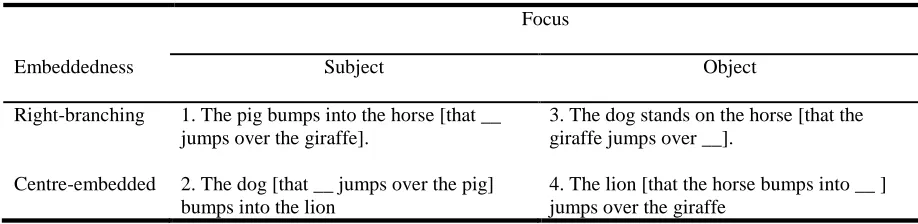
Extensive research with children has varied the complexity of relative clause sentences presented to children in order to investigate the extent to which the structural factors of focus and embedding affect children’s comprehension. Examples can be seen in table 1 below.
<insert table 1 about here>
Focus refers to the role that the head noun plays in the relative clause (as indicated by the underscore gaps). For example, in (1) the head noun (horse) is the subject of the relative clause, and the same is true of (2). In contrast, the head noun is the object of the relative clause in sentences (3) and (4). There is broad agreement that object-focused relatives are more difficult to process than their subject focused counterparts for both adults (e.g., Gordon, Hendrick & Levine, 2002; Gordon, Hendrick & Johnson, 2001; Mak, Vonk, & Schriefers, 2002; Traxler, Morris & Seely, 2002) and children (Kidd & Bavin, 2002; but see Kidd et al., 2007). Relative clause sentences also vary according to the embedding of the relative clause (where the relative clause occurs in the sentence). There is a further, dissociable, processing cost for adults associated with centre-embedded sentences (e.g., sentences 2 and 4), compared with their right-branching counterparts (e.g., sentences 1
The role of context in children’s relative clause comprehension
Many investigations into children’s processing of relative clause sentences have made use of the act-out task which requires children to manipulate an array of toys to demonstrate their interpretation of spoken sentences (see Kidd, 2003, for a review). Hamburger and Crain (1982) argued that much early research using this task violated the pragmatic assumptions associated with the use of relative clause structures, and as result
had underestimated children’s competence. The use of a relative clause (underlined in 5)
implies that there should be a referent set to be restricted in the referential context.
(5) The pig bumps into the horse that jumps over the giraffe
For example, sentence (5) presupposes there should be several horses in the discourse context, and ‘that jumps over the giraffe’ indicates which horse is the intended referent. Many studies with children violate this presupposition by providing only one to-be-restricted referent in the visual scene e.g., only one toy horse (Sheldon, 1974; Goodluck
& Tavakolian, 1982). Hamburger and Crain (1982) provided three tokens of the to-be restricted referent in their version of the act out task, also using toys. For a sentence like (5), one pig, one giraffe, but three horses were present in the array. Under these circumstances 3- to 5-year-olds performed significantly better and 5-year-olds achieved 92% correct, compared with a best case of 60% for equivalent sentence types in previous research (e.g., Goodluck & Tavakolian, 1982). Hamburger & Crain (1982) argued that providing appropriate context is imperative in order to gain a true appreciation of
children’s syntactic competence. Like adults, even young children have knowledge of the referential principle (Crain & Steedman, 1985) which means that when they are presented with two potential referents they expect the incoming language to differentiate between
them. Thus, referential context is seen to act as a salient cue for young children.
In contrast, research with ambiguous sentences has indicated that children may be
(6) Put the frog on the napkin in the box
They found that situational cues (e.g. whether there were one or two frogs present) were not effectively employed to avoid the temporary syntactic ambiguity, meaning that
children often erroneously interpreted ‘on the napkin’ as the destination for the frog,
rather than as modifying information specifying which frog was the intended referent. This ambiguity was almost entirely avoided by adults when the visual scene biased
toward a modifier interpretation of the sentence (i.e., when two frogs were present). Trueswell at al. (1999; see also Trueswell & Gleitman, 2004) interpret this finding in terms of constraint-based learning whereby the developing parser has access to the same mechanisms as adults but constraints are integrated differentially through development, reflecting changes in the reliability of cues dependent upon linguistic experience. A contrasting account claims that children’s sentence comprehension is sentence-oriented with syntactic cues taking priority over discourse context; the latter is
not automatically integrated into syntactic analyses (Fragman et al., 2007). Under this view, limited processing capacity prevents children from fully taking all possible constraints into account. The additional demands of resolving ambiguity may explain the differences in referential sensitivity observed by Trueswell et al. (1999) and Hamburger & Crain (1982).1 However, Hamburger and Crain (1982) did not directly compare a one-referent condition with their several- one-referent innovation, drawing their conclusions from comparison of their findings and those of Goodluck and Tavakolian (1982).
Eisenberg (2002) made a direct comparison and found no advantage for a two- referent condition in 3- 4-year olds suggesting that children’s sensitivity to pragmatic factors had been over-estimated by Hamburger and Crain (1982; but see Kidd, 2003, for arguments against this conclusion). Furthermore, the right-branching subject-relative
structure used by Hamburger and Crain (1982) was compared with its more complex centre-embedded counterpart (e.g., sentence (2) in table 1) but a processing difference
Correa (1995) designed an alternative act-out task which allowed children to process restrictive relative clauses as part of pragmatically appropriate discourse. Children heard two background sentences before the test sentence such as (7a):
(7a) A cat bumped a bear. Another cat kissed a sheep.
Background sentences were acted out for the child by the experimenter and the child was asked to act out the test sentences, such as (7b):
(7b) The cat that bumped the bear hugs the cow
Correa found that 3- to 6-year-old Portuguese-speaking children performed better than in standard act out studies. Correa manipulated both the focus and embedding of the sentences used and, as would be predicted based upon adult observations, found the right branching subject-focus structures were easiest to comprehend followed by centre-embedded subject-focus structures. Kidd and Bavin (2002) also demonstrated an adult like pattern (right-branching easier than centre-embedded) in a study using the alternative act out task with 3- to 5- year-old English-speaking children.
Providing appropriate discourse context for children appears to result in more
effective construal of relative clause sentences and performance consistent with the
processing preferences of adults. However, previous studies have not directly compared
different types of context within one study, and only Eisenberg (2002) systematically
varied the number of referents; these outstanding issues are addressed in the current
study.
The role of cognitive capacity in relative clause comprehension
Several theorists have implicated cognitive capacity in explanations of processing differences between adults and children (e.g., Felser et al., 2003; Fragman at al., 2007),
MacDonald, Just & Carpenter, 1992; Mendelsohn & Pearlmutter, 1999; Swets et al., 2007) and relative clauses in adults (Traxler et al., 2005) and children (Booth,
MacWhinney & Harasaki, 2000; Felser et al., 2003). Furthermore, several explanations of sentence complexity effects observed in adults rely at least in part upon some form of memory load account (e.g., Gibson, 1998; Gordon et al., 2001). A suggestion arising from the adult literature is that those with a high memory capacity may be better able to take account of non-linguistic constraints because they have the cognitive resources available to incorporate this information (e.g., Just & Carpenter, 1992; MacDonald et al.,
1992; Pearlmutter & MacDonald, 1995).
Experiments that have investigated the relationship between sentence
comprehension and memory in adults have typically used versions of the Daneman & Carpenter (1980) sentence span test of verbal working memory (e.g., Just, Carpenter & Keller, 1996; MacDonald, Just & Carpenter, 1992; Pearlmutter & MacDonald, 1995; Swets et al., 2007; Traxler et al, 2005). Span tasks are tests of complex memory,
involving both processing and storage elements and have been adapted in various forms for use with children (e.g., Gaulin & Campbell, 1994; Stothard & Hulme, 1992). The verbal listening span task devised by Stothard & Hulme (1992) requires children to assess the validity of a series of short spoken sentences (e.g., butter goes on bread, true;
processing) and to memorize the final word in each sentence for immediate serial recall (storage). Performance on this task has been found to accurately discriminate between children with good and poor comprehension abilities (Nation, Adams, Bowyer-Crane & Snowling, 1999); and span differences on a similar task (Gaulin & Campbell, 1994) were found to be related to attachment preferences for ambiguous relative clauses in 6- to 7-year-old children (Felser et al., 2003). In this study we investigated whether verbal memory span in 6- to 8-year-old children also interacted with the ability to integrate the kinds of contextual information described earlier, in the form of visual context.
Representing action: the current study
The current study directly compared different types of context and sentence
structure with 6- to 8- year-old children; verbal memory span was measured using a
right-branching subject-relative structures (like those used by Hamburger & Crain, 1982) was
compared with performance on embedded structures with the same focus (see examples
below figure 1). This study made use of an auditory comprehension task, similar to tasks
used by Felser et al. (2003) and Booth et al. (2000) enabling us to examine the
representation of each clause, and observe the effect (if any) of contextual information on
comprehension. This type of comprehension task has been used previously, in
conjunction with measures of online processing (Booth et al., 2000; Felser et al., 2003)
but was used as a purely offline measure in the present study. Importantly, this task
allows us to ascertain whether context influences comprehension even when this
information is not essential in meeting the task demands. Both the standard and
alternative act-out task force the child to establish reference as an integral part of the task - requiring selection of a referent (e.g. a cat) in order to act out the sentence. The task presented here did not necessitate this kind of referent selection; our question was
whether children would spontaneously integrate visual context with their linguistic
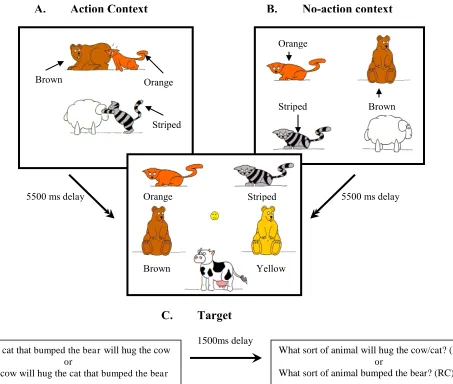
representation, even when the task did not demand it. An example of the visual contexts
that were used can be seen in figure 1, and the corresponding sentences are given below.
<insert Figure 1 about here>
In previous research, studies using the alternative act out task (Correa, 1995; Kidd & Bavin, 2002) fully met the felicity conditions of the relative clause (that there was more one cat, which had been previously mentioned in the discourse context as having bumped a bear) whereas Hamburger and Crain (1982) partially met them (by providing more than one cat in the visual array). In the current study context was provided by presenting pictures prior to auditory presentation of subject relative sentences. Hamburger & Crain (1982) demonstrated that young children can utilise visual context in their
comprehension. Furthermore, extensive evidence suggests that visual context (in the form of pictures, or an array of objects) can serve as referential context in much the same
in principle to the background sentences used by Correa (1995); for example a picture of a cat bumping a bear and another (visually distinct) cat kissing a sheep. For each sentence a corresponding no-action picture (shown in figure 1B) depicted the same animals (e.g. two cats, a bear and a sheep) but not interacting with each other. The no-action condition was analogous to that used by Hamburger and Crain (1982) in that two tokens of the to-be-restricted referent (e.g. the cat) were presented, this way felicity conditions were partially met.
Following exposure to either the action or the no-action context picture a target
picture was displayed while children simultaneously heard either an embedded (CE) or right-branching (RB) sentence followed by a question about either the main (MC) or relative clause (RC). The target picture contained both cats and the animal that was either the subject or object of the main clause (e.g. cow). The bear presented in the context pictures was also shown and a distracter bear was included. An example is given in figure 1C. Children were not required to interact with the stimuli, or to manipulate them in any way, but just to view and listen passively. Similar question-answering tasks have been used with adults (e.g., Bates et al, 1999; Sheldon, 1977) and children (Booth, MacWhinney & Harasaki, 2000; Felser at al., 2003; Townsend, Ottaviano & Bever, 1979) but this is the first study to our knowledge that incorporated visual context with spoken sentence comprehension.
Importantly, the questions asked what sort of animal (e.g., what sort of animal bumped the bear; answer = cat); this allowed the child to answer without reference to the visual stimuli. The questions did not ask which animal (which would require a specific answer, e.g., the striped cat). The child did not have to establish a unique referent, indeed it was possible for the question to be answered without reference to the visual stimuli. The question was whether we would observe a positive effect of context on comprehension performance under these circumstances.
The aims of this study were three-fold. First, to directly compare contexts which partially met the felicity conditions of the restrictive relative clause, with those where the
pragmatic requirements were fully met. We predicted that comprehension performance would be superior in the action condition, based upon previous findings with the
with sentence complexity. Given that cognitive resources are likely to be more taxed when processing the syntactically more complex embedded structure we predicted that context would exert less of an influence on comprehension of this structure, compared to the simpler right-branching sentences. Third, we investigated whether working memory
span influenced children’s ability to integrate contextual information with syntactic cues,
and comprehension performance more generally. Based upon previous research we predicted that children with higher memory spans would be better able to integrate contextual information than those with reduced memory resources.
Method
Participants
Thirty-two 6- 8-year-old children attending a primary school in North Yorkshire, UK, participated. They were drawn from years 2 and 3 and had a mean age of 7; 3 years with an age range of 6; 2 – 8; 2 years. The children were randomly selected from class lists; all were monolingual English speakers raised in English speaking households and possessed no known language or hearing difficulties. The gender split was 11 boys and 21 girls.
Sentence Comprehension Task
Design
The design was a repeated measures factorial design incorporating a pseudo-latin square. There were three repeated measures factors: Type of context picture (Action/No-action) x Sentence type (right-branching (RB)/centre-embedded (CE)) x Question (Main clause (MC)/Relative clause (RC)) and a between-subjects factor of listening span (high/low).
32 sentence pairs were created for the sentence comprehension task using the same
animals and verbs, and a question about both the main clause (MC) and relative clause
(RC) was devised. For each sentence pair, there were three associated visual stimuli:
Either an action picture or a no-action picture (only one of which was seen with a given
sentence on each trial) and a target picture (which was the same for any given trial across
necessary for each participant to experience each target picture twice across the whole
experiment. However, these targets did not appear in the same condition for any one
participant. The experiment was divided into two experimental sessions, and each target
was seen only once within each of these sessions. For example, if one participant heard a
RB sentence followed by a main clause question as trial 1 that item would be presented in
the second session as CE-no action followed by a relative clause question. Four lists
were constructed so that each item was presented in each of the 8 conditions, but so that
no individual participant experienced any item more than once in each session (and not
more than twice across the whole experiment). Each participant responded to 8 items in
each condition, yielding a total of 64 experimental trials per participant.
Stimuli
Examples are given below of one pair of centre-embedded (CE) and right-branching (RB) sentences and their corresponding main clause (MC) and relative clause (RC) questions, answers are indicated in parentheses. A full list of the sentences used can be found in the appendix.
1a: Centre-embedded (CE): The cat that bumped the bear will hug the cow.
Main clause question (MC): What sort of animal will hug the cow? (cat)
Relative clause question (RC): What sort of animal bumped the bear? (cat)
1b: Right-branching (RB): The cow will hug the cat that bumped the bear. Main clause question (MC):What sort of animal will hug the cat? (cow)
Relative clause question (RC):What sort of animal bumped the bear?(cat)
Each animal appeared in each noun position with equal frequency and was never an agent
more often than it was a patient. Animals and verbs were not repeated within a sentence and, importantly, no animal pair (e.g., cat-bear) appeared more than once. This was to
future tense, as it has not yet taken place in the discourse context. Sentences were pre-recorded by a male native English speaker and were played to the subjects via Psyscope (Cohen, MacWhinney, Flatt & Provost, 1993). For each sentence pair, there were three associated visual stimuli: Either an action picture or a no-action picture and a target picture. Examples of these stimuli are shown in Figure 1.
Action pictures depicted the action described in the relative clause of the
accompanying sentence (e.g. a cat bumping a bear), and a distractor action involving another token of the to-be restricted referent (i.e. another cat doing something else to a
bear). No-action pictures contained the same tokens as their action counterparts, but without depiction of the action event. Target pictures depicted the two to-be-restricted referents (e.g., the cats), the object of the relative clause (e.g., the bear), a distractor (a different bear), and the other animal mentioned in the sentence. The rationale was as follows: both cats were included so that there was a referent set to be restricted, ensuring that the restrictive relative clause was pragmatically relevant; the cow was included as it would be infelicitous to say the cow if there had been no cow in the present or preceding context. The bear was included so that all the animals featured in the sentence were represented, and the distractor bear was intended to prevent strategic question answering which may have arisen if there had been two cats and just one of all the other animals (a criticism of the standard act-out task levied by Eisenberg, 2002). The pictures were hand-sketched line drawings, which were scanned into the computer and coloured, compiled and edited using Graphic Converter with a 240-bit palette.
Twenty-four fillers were generated. The purpose of the fillers was to deter strategic responses. In the experimental stimuli the most common correct response is the first animal mentioned in the sentence. The fillers redressed this balance by asking subjects a question, which required the middle animal as the answer. Ideally, we would have included equal numbers of fillers and experimental items but pre-testing revealed
that this made the testing sessions too long for children of this age. The fillers mirrored the experimental items. For each set there was a CE and RB version of the sentence, and
an action/no-action picture. 12 fillers were used in each experimental session meaning that each filler target picture was seen twice in total, but under different conditions. An example of a set of filler items is given below.
RB Filler: The snake will bump the cat that pushed the hen
Question: What sort of animal will the snake bump? (cat)
CE Filler: The cat that pushed the hen will bump the snake
Question: What sort of animal did the cat push? (hen)
The filler action context pictures were created using composites of experimental context
pictures. The action parts of experimental stimuli that had not been mentioned in the
experimental sentences were used. To give an example, with reference to Figure 1, the
cat kissing the sheep was paired with another cat action to create a new filler picture.
Procedure
Children were tested on an individual basis in a quiet area of their school and the experiment was presented via Psyscope using a 14” screen Apple Macintosh lap top computer at a resolution of 640 x 480 pixels.
The experiment was run in two separate experimental sessions, plus a third session for the memory task. Each experimental session consisted of 44 items (32 Experimental and 12 fillers) and these two sessions were separated by a week. Within each session there were two blocks of 22 items (16 experimental and 6 fillers). The first block comprised all action context pictures, the second block contained no-action pictures. The two different types of pictures were presented in separate blocks to rule out the possibility that the presence of one type influenced performance on the other. Of
particular concern was the fact that because the no-action pictures do not help establish
reference they may lead participants to ignore all context pictures, including the action
contexts. With this in mind action contexts were always presented before no-action
contexts2. Participants were told that they would see a picture, and then another and that during this second picture they would hear a sentence and then a question about what
familiarise the participant with the task and followed the same format as the experimental items. The context picture was presented for 5500ms before being replaced by the target picture, previewed for 1000ms before the onset of the sentence. 1500ms after the offset of the sentence the question was presented (during this time the mouse was inactive to ensure consistent presentation times). The target picture remained on screen until the participants answered the question verbally, in their own time. The experimenter pressed the mouse for the next trial and a smiley face appeared on the screen allowing participants to pause between trials. The experimenter recorded the response given for
each trial. The experimental session lasted approximately 30 minutes with a short break half way through. When each experimental session was completed the children were given positive feedback and a small reward.
Verbal listening span task
Children undertook the Listening Span Task (Stothard & Hulme, 1992) as a
measure of verbal working memory span in a separate testing session one week after the
second experimental session. Participants listened to a series of short sentences, and were
required to judge each sentence to be true or false. After hearing each series they were
required to list in the correct order the last word of each sentence (e.g., Butter goes on
bread (true), giants are small (False) – recall: bread, small). Listening span was tested for
two, three and four sentences and two sets of sentences were presented at each span
length. If a child made three errors at a particular list length testing was discontinued.
Performance was scored by awarding 0.2 points for each set of terminal words recalled in
the correct order. Further details about this task can be found in Stothard and Hulme
(1992).
Results
Verbal listening span
On the basis of their VLS scores children were divided into two groups using a
median split3, those with a relatively high listening span (≥ 2) and those with a lower
listening span (≤ 1.8). Of the 32 children who took part in the experiment a listening
of the remaining 31 participants 13 were identified as high span (mean age: 7:2; range: 6:5 – 7;11; mean VLS: 2.5, range: 2 – 5.4) and 18 as low span participants (mean age: 7;3, range: 6;2 – 8;2; mean VLS: 0.93, range: 0 – 1.8). The VLS score differed
significantly between the two groups (t(29) = 9.526, p = < .001). Pearson’s R confirmed that listening span was not significantly correlated with age (r = .144, n= 31, p = .440).
Sentence comprehension
Comparision of low- and high- Span children
The percentage of correct answers in each condition was calculated for high- and low- span children and these are given in table 2. Comparison of both span groups revealed that overall high-span children performed better than low-span children on the
comprehension task. The pattern of responses is similar for both groups with
performance on the CE-relative clause and both the RB questions being roughly
equivalent, and poorest performance on the CE main clause. <insert table 2 about here>
Because the data are proportions all data analyses were conducted on the arcsine transformed data, but analyses of the untransformed data revealed the same patterns of significance. Analyses of variance (ANOVA) were conducted on the both the subject (F1) and item (F2) means for comprehension accuracy in each condition, only significant main effects and interactions are reported. A preliminary split plot ANOVA with VLS Span (low-span/high-span) entered as a between subjects factor, and the three within-subjects factors of context (action vs/no-action) sentence (CE/RB) and question (Relative clause/ Main clause) revealed a highly significant main effect of VLS group (F1 (1,29) = 6.994, p <.001, ηp2 = .194; F2 (1,31) = 36.786, p < .001, ηp2 = .543) high-span children answered more comprehension questions correctly overall. A significant main effect of context was found (F1 (1,29) = 6.921, p = .013, ηp2 = .193; F2 (1,31) = 6.555, p = .016,
sentence x question interaction question (F1 (1,29) = 43.892, p < .001, ηp2 = .616; F2 (1,31) = 13.423, p < .001, ηp2 = .798) suggested that relatively poor comprehension performance for the CE Main Clause compared to the other three sentence/question conditions explained these main effects. The 3-way VLS Group x Context x Question interaction was not significant by subjects but reach significance by items (F1 (1,29) = 2.039, p = .164, ηp2 = .066; F2 (1,31) = 5.505, p = .026, ηp2 = .098) and the 4-way VLS Group x Context x Sentence x Question interaction was significant by subjects (F1 (1,29) = 8.835, p = .006, ηp2 = .234), but not by items, (F2 (1,31) = 3.111, p = .088, ηp2 = .091).
The main effect of VLS group and the 4-way interaction in the subject analysis suggested that the two span groups performed differently on our experimental task. In order to investigate these differences two separate three way ANOVAs with the variables of Context x Sentence x Question were conducted for each VLS-span group.
High span children
For the high span children ANOVA revealed a significant main effect of context, (F1(1,12) = 12.037, p = .005, ηp2 = .501; F2(1,31) = 6.165, p = .019, ηp2 = .166) confirming that there were more correct answers in the action than no-action condition. There was also a main effect of sentence (F1 (1,12) = 5.893, p = .032, ηp2 = .329; F2(1,31) = 22.416, p < .001, ηp2 = .420) with RB engendering more correct answers than CE sentences and a main effect of question (F1(1,12) = 10.657, p = .007, ηp2 = .470; F2(1,31) = 4.559, p < .001, ηp2 = .532) indicating that more correct answers were given for the relative clause than the main clause overall. There was a highly significant sentence x question interaction (F1(1,12) = 30.321, p < .001, ηp2 = .716; F2(1,31) = 98.407, p < .001,
ηp2 = .760) and this can be explained because there was little difference in performance on the relative clause for CE and RB structures, whereas performance on the main clause is worse for CE than RB. A three way Context x Sentence x Question interaction
approached significance by subjects, but not by items (F1(1,12) = 4.082, p = .066, ηp2 = .254; F2 (1,31) = 1.361, p = 0.252, ηp2 = .042).
clause in both action (F1 (1,12) = 97.299, p < .001, ηp2 =.557 .; F2 (1,31) = 48.758, p <
0.001, ηp2 =.646) and no-action contexts (F1 (1,12) = 159.053, p <.001, ηp2 = .586; F2 (1,31) = 52.023, p < 0.001, ηp2 =.661) but a difference in the opposite direction when the question was about the relative clause which was not statistically reliable in the action context (F1 (1,12) = 4.253, p =.052, ηp2 = .061 ; F2 (1,31) = 1.106, p = .301, ηp2 = .040) but reached significance in the no-action context (F1 (1,12) = 11.258, p = .006, ηp2 = .128;
F2 (1,31) = 9.950, p = .004, ηp2 = .272).
These data indicate that high-span children found CE structures more difficult to
comprehend than RB structures, but that this difference was carried by a difficulty with the CE main clause coupled with good comprehension of the relative clause part of the sentence. There was also evidence that high span children were sensitive to the additional contextual information provided by the action pictures and that this information improved their comprehension performance.
Low-Span children
Consistent with the data from high span children ANOVA revealed a main effect of sentence (F1 (1,17) = 20.712, p < .001, ηp2 = .549; F2(1,31) = 57.205, p < .001, ηp2 = .649) with RB engendering more correct answers than CE sentences, and there was also a main effect of question (F1(1,17) = 36.273, p < .001, ηp2 = .681; F2(1,31) = 39.194, p < .001,
Post-hoc comparisons (Bonferroni adjusted alpha = 0.006) to investigate the sentence x question interaction confirmed that this effect was carried by significantly worse performance for CE than RB structures when the question was about the main clause for both action (F1 (1,17) = 99.760, p < .001, ηp2 = .528; F2 (1,31) = 121.637, p <
0.001, ηp2 = .661) and no-action contexts (F1 (1,17) = 52.921, p <.001, ηp2 = .373 ; F2 (1,31) = 91.433, p < 0.001, ηp2 = .595) but no difference when the question was about the relative clause in either action (F1 (1,17) = 1.313, p =.268, ηp2 = .014 ; F2<1) or no-action contexts (F1 <1. ; F2 (1,31) = 1.459, p = .236, ηp2 = .190.) Like high-span children, low
span children found CE structures more difficult to comprehend than RB structures, and this difference was explained by a difficulty with the CE main clause coupled with good comprehension of the relative clause part of the sentence.
Further post-hoc comparisons indicated that the question x context interaction arose because, for this group, context only had a positive effect on the relative clause questions for each sentence type. Mean performance was worse in the action condition than the no action condition for CE main clause questions, but this difference was not statistically significant (F1 (1,17) = 2.886, p = .108, ηp2 = .078; F2 (1,31) = 2.154, p = 0.152, ηp2 = .025). No significant difference was observed between performance in the action and no-action context for RB main clauses (F1 (1,17) = 1.029, p = .325, ηp2 = .029; F2 < 1). Whilst performance was significantly better in the action condition that the no
action condition for the CE Relative clause (F1 (1,17) = 15.385, p = .001, ηp2 = .313; F2 (1,31) = 16.049, p = 0.001, ηp2 = .158) the observed numeric advantage for RB relative clauses in the action condition was not statistically reliable (F1 (1,17) = 4.219, p = .056,
ηp2 = .111; F2 (1,31) = 9.004, p = .005, ηp2 = .095).
Error responses
It is often informative to analyse the errors children make across conditions on
linguistic tasks. However, in this study, 85% of errors involved naming the other animal mentioned in the sentence; this error occurred in all conditions and accounted for 97% of
the total errors made on the CE Main clause. Other errors were usually ‘don’t know’
reported here. The predominance of other animal errors for the interrupted main clause of the CE structure is consistent with the occurrence of comprehension errors resulting from a local attachment strategy (assume the second noun is the subject of the second verb).4 However, given that this error type appeared across conditions it could equally reflect a guessing strategy – if children cannot answer the question they simply name one of the animals recently mentioned. In the latter case we would expect a 50% correct response rate in the CE main clause condition, which is not observed here (performance is below 50% for both groups), even so, our data do not allow us be certain about what drives
children’s errors.
In summary, both groups found questions about the CE main clause very difficult to answer, moreover both groups demonstrated good comprehension of the relative clause part of CE sentences, and of both clauses within RB sentences. For high span children context had a small but significant positive effect on overall comprehension performance, however, this advantage was only statistically reliable for questions about the centre-embedded relative clause in low span children.
Discussion
Our study investigated three main research questions. With respect to our first prediction that comprehension performance would benefit from action contexts (which fully met the pragmatic presuppositions of the relative clause) we found that children with both high- and low- verbal memory spans demonstrated some ability to utilize this extra-linguistic information in comprehension. Our second aim was to investigate whether context effects would be observed even for complex embedded constructions. Action contexts facilitated comprehension for each clause of both sentence types in high span children, however, facilitation only occurred for questions about the relative clauses (which were directly represented in the action picture) in children with lower verbal
spans. The results suggest that contextual information can support comprehension, even for more complex sentences. Our third question concerned the interaction between
comprehension of the main clause suggesting that as memory span increases so does the ability to integrate context fully.
Independently of our context manipulation, both groups of children demonstrated the predicted processing advantage for the right branching, compared with the embedded structures. Crucially, children demonstrated good comprehension for relative clauses in both types of sentence, and for the uninterrupted main clause of right-branching
sentences. Therefore, the processing cost associated with embedded sentences can be attributed to difficulties in resolving the interrupted main clause, rather than to the lack of
understanding of the function of the relative clauses proposed in previous research (e.g., Freidman & Novogrodsky, 2004; Sheldon, 1981;Tavakolian, 1981). The results are consistent with those observed in studies using the alternative act out task with younger children (Correa, 1995; Kidd and Bavin, 2002) and with cross-linguistic studies that have suggested centre-embeddings are dis-preferred in languages with strong biases towards canonical word order (Bates & MacWhinney, 1989; Bates, d’Amico and Devescovi, 1999). Explanations of the differential effects of context and the observed patterns of comprehension will each be considered in turn.
Sensitivity to contextual information and the role of cognitive capacity
Fully meeting the pragmatic demands of the relative clause produced small but significant increases in comprehension performance for both high and low span children. The importance of presenting children with a pragmatically complete situation was implied by the improvement in performance observed in the alternative act out task (e.g. Correa, 1995; Kidd & Bavin, 2002) compared with the standard task (Hamburger and Crain, 1982), and the present study corroborates this finding. The data suggest that children can integrate referential information with their emerging representation of the incoming language and that this information can support comprehension. This is broadly
consistent with a view of a developing parser that is sensitive to extra-linguistic information, even during the initial stages of syntactic analysis (e.g., Trueswell &
given that the children tested were older than those in earlier research (6- to 8-years compared with children aged 3- to 5 in some studies) we cannot be sure just how early this interactive system develops in acquisition. However, contextual information was found to improve comprehension, under certain circumstances, even for children with a low VLS score. This may indicate that, even when memory span is limited, referential information can still be integrated with the emerging syntactic representation, in contrast to theories suggesting that contextual sensitivity only emerges as cognitive capacity increases.
Children in both groups exhibited a significant effect of context on
comprehension of the relative clause for CE sentences. However, children with a higher verbal memory span demonstrated an additional positive effect of context for main clause questions, which was not evident in lower span children. The action pictures were a direct visual representation of the relative clause but did not contain information directly relevant to main clause processing. However, they did meet a pragmatic constraint of relativisation in that there was more than one potential referent, and that the relative clause provided information allowing a unique referent for the main clause to be
identified. Children with a high memory span seemed to be able to use this information to support their comprehension of main clauses, particularly when the main clause
information was difficult to process because of an interruption. For low span children this additional information seemed to decrease performance when the processor was already heavily taxed by maintaining information across an interruption. It is suggested that children utilise context to support their unfolding linguistic abilities, and that they can do this even with relatively limited cognitive capacity. However, as memory span increases contextual information is integrated in a more sophisticated way. It is also possible that high span children are able to use context more consistently because higher span equates to a better ability to manage a more demanding cognitive load.
A question arises as to whether children needed to encode the visual scenes verbally in order to integrate them later with their interpretation of the test sentence5. If
explored in future research by directly comparing visual and verbal conditions. However, the adult literature investigating the mapping between the visual world and language suggests that adults do not necessarily verbally encode visual scenes in order to integrate them with language6.
A limitation of our study is that we used only the verbal listening span task as a measure of working memory. This specific measure was chosen because memory span measured in this way has been shown to affect the processing preferences of children for ambiguous relative clauses (Felser et al., 2003), and to differentiate between children
with good and poor comprehension skills (Nation et al., 1999). Furthermore, its reading-based equivalent (Daneman & Carpenter, 1980) has been associated with the extent to which various constraints can influence sentence processing (e.g., Just & Carpenter, 1992; MacDonald et al., 1992; Pearlmutter and Macdonald, 1995). However, we did not measure other aspects of working memory that may be less directly involved in language processing e.g., spatial memory. It has been suggested that verbal span tasks are
essentially language processing tasks and may be little more than domain specific
measures of language processing abilities (MacDonald & Christiansen, 2002). However, reading span tasks have been shown to correlate with non-linguistic measures (e.g., digit span in children, Booth at al, 2001; and spatial span in adults, Swets et al., 2007)
suggesting that such tasks may share a common general component of working memory. In order to gain a full picture of the role of working memory in contextual integration further research is required using more diverse measures of memory with both adults and children.
Sentence complexity effects
As predicted, children comprehended the right branching sentences more accurately than embedded structures. Intriguingly, this effect was entirely carried by
poor comprehension performance for the interrupted main clause of this structure, irrespective of verbal memory span. As such this processing cost can be seen as
effect does not interact with memory span as measured here. It is possible that resolving the interrupted main clause is so cognitively demanding that it over-taxed even the children in our sample with relatively high memory spans (who still have significantly reduced cognitive capacity compared to adults); or that this effect reflects a processing bias which is unrelated to memory span.
Our results are consistent with other studies which have used similar comprehension tasks with adults (Bates et al., 1999; Sheldon, 1977) and children
(MacWhinney & Pleh, 1988; Booth et al., 2000). Booth et al. (2000) included embedded
subject-relative (but not right-branching) structures in an offline comprehension task similar to the one used here. Eight- to 11-year-old children were asked to answer a true or false question about each clause. They demonstrated very poor performance on the second verb (comparable to the main clause question in our study) and most errors involved interpretation of the second noun as subject of the second verb (as in the present study). They suggest that children adopt a local attachment strategy such as that
proposed by Ford, Bresnan and Caplan (1982) taking the noun that is locally available over the noun that is syntactically correct. Based upon this claim Booth et al. (2000) predicted that children would have little difficulty with right-branching subject-relative structures, a prediction which is clearly borne out in the present study. Moreover, our data do not support the claim that main clause processing necessarily takes precedence over subordinate clauses, which are processed subject to sufficient cognitive resources (Correa, 1995; Townsend and Erb, 1975; Townsend, Ottaviano, & Bever, 1979).
Memory based accounts, originally proposed to account for the subject-object relative processing asymmetry in adults, can be extended to account for the findings observed here. The claim that the length unattached fillers must be carried for predicts cognitive load (Wanner and Maratsos, 1978) can be applied to the observed advantage that children have in processing right-branching structures, compared with embedded
structures. Given the examples accompanying Figure 1 the filler phrase the cat must be carried, unattached, for longer than in its right branching counterpart. Furthermore,
complexity can be compounded by the confusability of the referents mentioned in each noun phrase. Clearly, the referents used here are highly confusable; 97% of the errors made by children involved naming the wrong animal, suggesting that similarity may play a role in processing difficulty.
However, our results could be interpreted in terms of simple attachment
preference, such as the principle of late closure proposed by the garden path model (see
Frazier, 1987, for a review). The embedded structure requires high attachment linking
the cow as the object of the preceding clause; in comparison the right-branching structure
requires low attachment because bear is the object of the most recent clause. If a
representation was constructed based upon late closure, then the incorrect animal would
be construed as the subject of the main clause, as observed for the embedded structure in
our data with children. However, such an account does not predict the observed positive
influence of contextual information upon processing.
Further research will be necessary to establish whether simple local attachment or memory-based accounts provide the most parsimonious explanation for the processing cost of centre-embedding in adults and children. If attachment preference alone explains the effect then it should remain even if the semantic content of the interrupting clause is manipulated.
Conclusions
The results presented here suggest that 6- to 8-year-old children are sensitive to
the pragmatic constraints associated with the relative clause and that they can integrate
extra-linguistic context with the incoming language and utilize this information to
support their comprehension. These findings are broadly consistent with accounts that
portray language acquisition as developing via some form of constraint based learning
(e.g., Bates & MacWhinney, 1989; Seidenberg and MacDonald, 1999; Trueswell &
Gleitman, 2004). Consistent with adult findings, embedded structures were found to be
more difficult than right-branching sentences. Furthermore, there is clear evidence to
suggest that by around the age of 6-years-old children understand relative clauses within
both structures, and can consistently answer a comprehension questions about them
difficulty with centre-embedded relative structures, rather than any difficulty with
understanding the function of relative clause use. The present study provides important
evidence for continuity throughout development of the parser demonstrating that even
young children with relatively limited memory capacity can make some use of referential
context to support their comprehension, but as memory span increases so does a more
sophisticated ability to integrate context.
References
Bates, E., Devescovi, A. & D’Amico, S. (1999). Processing complex sentences: A cross-linguistic study. Language and Cognitive Processes 14, 69-123.
Bates, E. & MacWhinney, B. (1989). Functionalism and the competition model. In B. MacWhinney & E. Bates (Eds.), The Crosslinguistic Study of Sentence Processing, 3-73. Cambridge: Cambridge University Press.
Booth, J.R., MacWhinney, B. & Harasaki, Y. (2000). Developmental differences in visual and auditory processing of complex sentences. Child Development 74, 981-1003.
Cohen, J. D., MacWhinney, B., Flatt, M., & Provost, J. (1993). PsyScope: A new graphic interactive environment for designing psychology experiments. Behavioral
Research Methods, Instruments, and Computers 25, 257-271.
Correa, L.M. (1995). An alternative assessment of children’s comprehension of
relative clauses. Journal of Psycholinguistic Research 24, 183-203.
Crain, S. & Steedman, M.J. (1985). On not being led up the garden path: the use of context by the psychological parser. In D. Dowty, L. Karttunen & A. Zwicky (Eds),
Natural Language Parsing: Psychological, Computational, and Theoretical Perspectives,
320-358. Cambridge: Cambridge University Press.
Dahan, D., & Tanenhaus, M. (2005). Looking at the rope when looking for the snake: Conceptually mediated eye movements during spoken-word recognition.
Psychonomic Bulletin and Review 12, 453-459.
Eisenberg, S. (2002). Interpretation of relative clauses by young children: another look. Journal of Child Language 29, 177-88.
Felser, C., Marinis, T., & Clahsen, H. (2003). Children’s processing of
ambiguous sentences: A study of relative clause attachment. Language Acquisition 11,
127-163.
Ford, J.D., Bresnan, J.W., & Kaplan, R.M. (1982). A competence based theory of syntactic closure. In J.W. Bresnan (Ed.), The mental representation of grammatical relations, 727-796. Cambridge, MA:MIT Press.
Fragman, C., Goodluck, H., & Heggie, L. (2007). Child and adult construal of restrictive relative clauses: Knowledge of grammar and differential effects of syntactic context. Journal of Child Language 34, 345-380.
Frazier, L. (1987). Sentence processing: A tutorial review. In M. Coltheart (Ed.), Attention and Performance XII: The Psychology of Reading, Hillsdale, NJ: Erlbaum.
Friedman, N., & Novogrodsky, R. (2004). The acquisition of relative clause comprehension in Hebrew: A study of SLI and normal development. Journal of Child Language 31, 661-681.
Gaulin, C. A., Campbell, T. F. (1994). Procedure for assessing verbal working memory in normal school-age children: Some preliminary data. Perceptual and Motor
Skills 79, 55-64.
Gibson, E. (1998). Linguistic complexity: locality of syntactic dependencies.
Cognition, 68, 1-76.
Gibson, E., Hickok, G., & Schutze, C.T. (1994). Processing empty categories: A parallel approach. Journal of Psycholinguistic Research 23, 381-405.
Goodluck, H. (1990). Knowledge integration in processing and acquisition: Comments on Grimshaw and Rosen. In L. Frazier & J. De Villiers (Eds.), Language Processing and Language Acquisition. Dordrecht: Kluwer.
Goodluck, H., & Tavakolian, S. (1982). Competence and processing in children's grammar of relative clauses. Cognition 11, 1-27.
Gordon, P. C., Hendrick, R., & Levine, W. H. (2002). Memory load interference in syntactic processing. Psychological Science 13, 425– 430.
Hamburger, H. & Crain, S. (1982). Relative acquisition. In S. Kuczaj (Eds.), Language Development II. Hillsdale, NJ.: Lawrence Erlbaum.
Huettig, F., & Altmann, G. T. M. (2004). The online processing of ambiguous and unambiguous words in context: Evidence from head-mounted eye-tracking. In M.
Carreiras & C. Clifton (Eds.), The on-line study of sentence comprehension: Eyetracking, ERP, and beyond, 187-207. New York: Psychology Press.
Huettig, F., & Altmann, G. T. M. (2005). Word meaning and the control of eye fixation: Semantic competitor effects and the visual world paradigm. Cognition 96, B23-B32.
Huettig, F., & Altmann, G. T. M. (2007). Visual-shape competition during language-mediated attention is based on lexical input and not modulated by contextual appropriateness. Visual Cognition 15, 985-1018.
Just, M. A., & Carpenter, P. A. (1992). A capacity theory of comprehension: Individual differences in working memory. Psychological Review 99, 122–149.
Just, M. A., Carpenter, P. A., & Keller, T. A. (1996). The capacity theory of comprehension: New frontiers of evidence and arguments. Psychological Review 103,
773–780.
Kidd, E. (2003). Relative clause comprehension revisited: commentary on Eisenberg (2002). Journal of Child Language 30, 671-679.
Kidd, E. & Bavin, E.L. (2002). English-speaking children’s comprehension of relative clauses: Evidence for general cognitive and language specific constraints on development. Journal of Psycholinguistic Research 31, 599-617.
Kidd, E. & Bavin, E.L. (2007). Lexical and referential influences on on-line spoken language comprehension: A comparison of adults and primary school children.
First Language 27, 29-52.
Kidd, E., Brandt, S., Lieven, E. & Tomasello, M. (2007). Object relatives made
MacDonald, M. C., & Christiansen, M. H. (2002). Reassessing working memory: Comment on Just and Carpenter (1992) and Waters and Caplan (1996). Psychological
Review 109, 35–54.
MacDonald, M.C., Just, M.A., & Carpenter, P.A. (1992). Working memory constraints on the processing of syntactic ambiguity. Cognitive Psychology 24, 56-98.
MacDonald, M.C., Pearlmutter, N.J. & Seidenberg, M.S. (1994). Lexical nature of syntactic ambiguity resolution. Psychological Review 101, 676-703.
MacWhinney, B. & Pleh, C. (1988). The processing of restrictive relative clauses
in Hungarian. Cognition 29, 95-141.
Mak, W. M., Vonk, W., & Schriefers, H. (2002). The influence of animacy on relative clause processing. Journal of Memory and Language 47, 50–68.
Mendelsohn, A., and N. Pearlmutter (1999). Individual differences in attachment
preferences, poster presented at the 12th Annual CUNY Conference on Human Sentence Processing, New York.
Miller, G.A. (1962). Some psychological studies of grammar. American Psychologist 17, 748-762.
Nation, K., Adams, J.W., Bowyer-Crane, C.A. & Snowling, M.J. (1999). Working
memory deficits in poor comprehenders reflect underlying language impairments. Journal of Experimental Child Psychology 73, 139-158.
Pearlmutter, N. J., & MacDonald, M. C. (1995). Individual differences and probabilistic constraints in syntactic ambiguity resolution. Journal of Memory and Language 34, 521-542.
Seidenberg, M., & MacDonald, M.C. (1999). A probabilistic constraints approach to language acquisition and processing. Cognitive Science 23, 569-588.
Sheldon, A. (1974). The role of parallel function in the acquisition of relative clauses in English. Journal of Verbal Learning and Verbal Behavior 13, 272-281.
Sheldon, A. (1977). On strategies for processing relative clauses: A comparison of children and adults. Journal of Psycholinguistic Research 6, 305-318.
Snedeker, J. & Trueswell, J.C. (2004). The developing constraints on parsing decisions: The role of lexical-biases and referential scenes in child and adult sentence processing. Cognitive Psycholog, 49, 238-299.
Snedeker, J. & Yuan, S. (2008). Effects of prosodic and lexical constraints on parsing in young children (and adults). Journal of Memory and Language 58, 574–608.
Spivey-Knowlton, M. and Tanenhaus, M. (1994) Referential context and syntactic ambiguity resolution, in Perspectives on Sentence Processing (Clifton, C., Frazier, L. and Rayner, K., eds), 415–439, Hillsdale, NJ: LEA Press.
Stothard, S.E. & Hulme, C. (1992). Reading comprehension difficulties in children: The role of language comprehension and working memory skills. Reading and Writing 4, 245-256.
Swets, B., Desmut,T., Hambrick, D.Z. & Ferreira, F. (2007). The role of
working memory in syntactic ambiguity resolution: A psychometric approach. Journal of Experimental Psychology: General 136, 64–81
Tanenhaus, M.K., Spivey-Knowlton, M.J., Eberhard, K.M. & Sedivy, J.C. (1995). Integration of visual and linguistic information in spoken language comprehension. Science 268, 1632-1634.
Tavakolian, S. L. (1981). The conjoined-clause analysis of relative clauses. In S. L. Tavakolian (Eds.), Language acquisition and linguistic theory, 167-187. Cambridge, Mass.: MIT Press.
Townsend, D. & Erb, M. (1975). Children’s strategies for interpreting complex
comparative questions. Journal of Child Language 2, 1-7.
Townsend, D., Ottavio, D. & Bever, T. (1979). Immediate memory for words from main and subordinate clauses at different age levels. Journal of Psycholinguistic
Research 8, 83-101.
Traxler, M. (2002). Plausibility and subcategorisation preference in children’s
processing of temporarily ambiguous sentences: Evidence from self-paced reading. Quarterly Journal of Experimental Psychology 55A, 75-96.
Traxler, M.J., Morris, R.K. & Seeley, R.E. (2002). Processing subject and object relative clauses: Evidence from eye movements. Journal of Memory and Language 47
Traxler, M.J., Williams, R.S., Blozis, S. A. & Morris, R.K. (2005) Working memory, animacy, and verb class in the processing of relative clauses. Journal of Memory and Language 53, 204–224
Trueswell, J.C. & Gleitman, L. (2004) Children’s eye movements during listening: Developmental evidence for a constraint-based theory of sentence processing. In J.M. Henderson & F. Ferreira (Eds.), The Interface of Language, Vision, and Action: Eye Movements and the Visual World. New York: Psychology Press.
Trueswell, J.C., Sekerina, I., Hill, N.M. & Logrip, L. (1999). The
kindergarten-path effect: studying on-line sentence processing in young children. Cognition 73, 89-134.
Wanner, E., & Maratsos, M. (1978). An ATN approach to comprehension. In M. Halle, J. Bresnan, & G.A. Miller (Eds.), Linguistic theory and psychological reality, (pp. 119-161). Cambridge, MA: MIT Press.
Weighall, A. (2008). On still being led down the kindergarten path: Children’s
Notes 1
It has also been suggested that strong verb biases associated with the verb put may over-ride comparatively weak contextual constraints (see Snedeker & Trueswell, 2004, for further discussion of this issue).
2
One anonymous reviewer advised that we rule out fatigue effects as an explanation of the relatively poor performance in the no-action conditions, which always occurred second in the experimental sessions. An ANOVA comparing the first half of no-action trials with the second half from both of the two experimental sessions confirmed that
there was no main effect of trial position (F1(1,29) <1) nor did it interact with verbal listening span group (F1(1,29) <1).
3
In doing this we closely followed the approach taken by Felser et al. (2003). However, we accept that splitting continuous data in this way is not uncontroversial. In order to investigate the relationship between memory and performance in an analysis which respects the continuous nature of verbal memory span as a variable, a series of correlational analyses were performed between span score and comprehension
performance in each of the eight experimental conditions, as suggested by an anonymous reviewer. A positive significant correlation was found between VLS span and
performance on the CE Relative clause in the action condition (r = .426, n= 31, p < .05). Interestingly, this is the condition which demonstrated the greatest improvement in comprehension, compared to its no-action counterpart, in the low VLS group. All other conditions were found to have a weak (but non-significant) positive correlation with span score, with exception of the CE Main clause which had a non-significant negative trend (r = -.056, p > 1). However, these results must be interpreted cautiously as the range of span scores was quite limited and the number of participants rather small for a
correlational design. It should also be noted that an analysis of covariance (ANCOVA) is also consistent with the findings of the main ANOVA reported here.
4
Booth et al (2000) suggest this explanation for their observation of a predominance of this error type in response to embedded sentences in a similar comprehension task. 5
We thank an anonymous reviewer for raising this point. 6
Table 1: Relative clause types (adapted from Eisenberg, 2002).
Focus
Embeddedness Subject Object
Right-branching 1. The pig bumps into the horse [that __ jumps over the giraffe].
3. The dog stands on the horse [that the giraffe jumps over __].
Centre-embedded 2. The dog [that __ jumps over the pig] bumps into the lion
Table 2: Percentage of correct answers given by high- and low-span children in each condition.
High (n = 13 ) Low (n = 18 )
Sentence CE RB CE RB
Question MC RC MC RC MC RC MC RC
No-action 34 (41) 90 (15) 87 (18) 75 (26) 35 (22) 69 (24) 74 (22) 75 (19)
Action 41(39) 95 (8) 90 (9) 88 (18) 27 (29) 87 (16) 78 (27) 81 (24)
[image:36.612.86.529.130.237.2]Fig. 1. Example of stimuli used for each trial Experiments 1 and 2. Participants saw either the action
context or the no-action context picture, which was displayed for 5500 ms. They then saw the target
picture. After a 1000 ms preview they heard either the accompanying CE or RB sentence. 1500 ms after
the offset of the sentence, they heard the appropriate question, which they answered verbally. The target picture remained on screen until after the participants’ response. (Original in colour, labels indicate the colours as they appeared on screen).
< figure 1 to be displayed in color on the web>
5500 ms delay 5500 ms delay
Orange Brown
Striped
Yellow
Brown Orange
Striped
Brown
Orange Striped
A. Action Context
cccCCCContextContext
B. No-action context
C. Target
CE: The cat that bumped the bear will hug the cow or
RB: The cow will hug the cat that bumped the bear
What sort of animal will hug the cow/cat? (MC) or
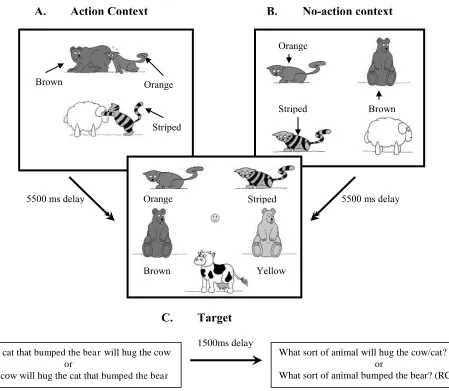
[image:37.612.80.533.208.592.2]Fig. 1. Example of stimuli used for each trial Experiments 1 and 2. Participants saw either the action
context or the no-action context picture, which was displayed for 5500 ms. They then saw the target
picture. After a 1000 ms preview they heard either the accompanying CE or RBsentence. 1500 ms after
the offset of the sentence, they heard the appropriate question, which they answered verbally. The target
picture remained on screen until after the participants’ response. (Original in colour, labels indicate the
colours as they appeared on screen).
<figure 1 black & white version for print >
5500 ms delay 5500 ms delay
Orange Brown
Striped
Yellow
Brown Orange
Striped
Brown
Orange Striped
A. Action Context
cccCCCContextContext
B. No-action context
C. Target
CE: The cat that bumped the bear will hug the cow or
RB: The cow will hug the cat that bumped the bear
What sort of animal will hug the cow/cat? (MC) or
[image:38.612.80.529.185.576.2]Acknowledgements
This research was supported by a BBSRC studentship awarded to Anna Weighall while
at the University of York. Andrew Thompson drew the pictures used in the experiment,
and in Figure 1. We thank the children who participated in the study and their primary
school for their involvement, and two anonymous reviewers for their insightful
Appendix
The experimental stimuli are set out below. There were 32 CE/RB sentence pairs and
each sentence was accompanied by an action or no-action context picture, followed by a
target picture. After hearing each sentence a comprehension question was asked about
either the relative or main clause. Questions took the form of ‘What sort of animal….’
Experimental stimuli
1a The cat that bumped the bear will hug the cow 1b The cow will hug the cat that bumped the bear
2a The bird that hugged the squirrel will hit the sheep 2b The sheep will hit the bird that hugged the squirrel 3a The rabbit that pushed the hedgehog will hug the pig 3b The pig will hug the rabbit that pushed the hedgehog 4a The dog that touched the crocodile will kick the hen 4b The hen will kick the dog that touched the crocodile 5a The monkey that kicked the dog will touch the rabbit 5b The rabbit will touch the monkey that kicked the dog 6a The crocodile that kicked the pig will bite the duck 6b The duck will bite the crocodile that kicked the pig 7a The pig that touched the tortoise will follow the cat 7b The cat will follow the pig that touched the tortoise 8a The cow that bit the horse will push the dog
8b The dog will push the cow that bit the horse
9a The elephant that hugged the rabbit will bump the horse 9b The horse will bump the elephant that hugged the rabbit 10a The squirrel that followed the mouse will hit the monkey 10b The monkey will hit the squirrel that followed the mouse 11a The horse that bumped the cat will hug the bird
11b The bird will hug the horse that bumped the cat 12a The mouse that pushed the pig will kick the lion 12b The lion will kick the mouse that pushed the pig
13a The hedgehog that followed the cow will touch the elephant 13b The elephant will touch the hedgehog that followed the cow 14a The kangaroo that bumped the monkey will bite the pig 14b The pig will bite the kangaroo that bumpe