April 28, 1997
SRC
Research
Report
145
Modularity in the Presence of Subclassing
Raymie Stata
d i g i t a l
Systems Research Center 130 Lytton AvenueSystems Research Center
The charter of SRC is to advance both the state of knowledge and the state of the art in computer systems. From our establishment in 1984, we have performed basic and applied research to support Digital’s business objectives. Our current work includes exploring distributed personal computing on multiple platforms, networking, programming technology, system modelling and management techniques, and selected applications.
Our strategy is to test the technical and practical value of our ideas by building hardware and soft-ware prototypes and using them as daily tools. Interesting systems are too complex to be evaluated solely in the abstract; extended use allows us to investigate their properties in depth. This experience is useful in the short term in refining our designs, and invaluable in the long term in advancing our knowledge. Most of the major advances in information systems have come through this strategy, including personal computing, distributed systems, and the Internet.
We also perform complementary work of a more mathematical flavor. Some of it is in established fields of theoretical computer science, such as the analysis of algorithms, computational geometry, and logics of programming. Other work explores new ground motivated by problems that arise in our systems research.
Modularity in the Presence of Subclassing
Raymie Stata
Publication History
This report is a revision of a thesis of the same title submitted to the Department of Electrical Engineering and Computer Science at the Massachusetts Instutite of Technology. This revision is also published by MIT as MIT–LCS–TR–711.
c
Massachusetts Institute of Technology 1996.
c
Digital Equipment Corporation 1997
Abstract
Classes are harder to subclass than they need be. This report addresses this problem, showing how to design classes that are more modular and easier to subclass without sacrificing the extensibility that makes subclassing useful to begin with.
We argue that a class should have two interfaces, an instance interface used by programmers manipulating instances of the class, and a specialization interface used by programmers building subclasses of the class. Instance interfaces are relatively well understood, but design principles for specialization interfaces are not.
In the context of single inheritance, we argue that specialization interfaces should be partitioned into class components. A class component groups part of a class’s state together with methods to maintain that state. Class components establish abstraction boundaries within classes, allowing modular replacement of components by subclasses. Achieving this replaceability requires reason-ing about each component as an independent unit that depends only on the specifications of other components and not on their implementations.
We introduce the concept of abstract representation to denote the view of a class’s state given in its specialization interface. This view is more detailed than the view used to describe instances of the class, revealing details that describe the interfaces between class components. It is less detailed than the actual implementation, hiding implementation details that should not be exposed even to specializers.
We also consider multiple inheritance, specifically, Snyder’s model of encapsulated multiple inheritance. We advocate separating class components into individual classes called mixins. In-stantiable classes are built by combining multiple mixins. With the mixin style of design, class hierarchies have more classes than in equivalent single-inheritance designs. These classes have smaller, simpler interfaces and can be reused more flexibly.
Acknowledgements
This report revises a PhD dissertation of the same title. My advisor, John Guttag, contributed to the thesis in innumerable ways. His own research on software engineering, and the courses he’s developed and taught, were important, technical influences. By turning my attention to the right issues, offering key, technical insights, keeping me focused at the right level of abstraction, and providing expert feedback on an endless stream of notes, papers, and drafts, he guided me in turning vague intuitions into useful ideas and eventually into a dissertation. By mixing unlimited freedom to explore ideas with invaluable wisdom and advice, he created a unique environment in which I could develop as a researcher. By offering encouragement, support, patience, and understanding, he made graduate school survivable. He made my graduate school experience irreplaceable.
Barbara Liskov also contributed to the thesis in essential ways. Her own work on programming methodology and language design, and the courses she’s developed and taught, influenced and inspired the thesis. As a member of my committee, she worked hard to help me extract, refine, organize and explain the central ideas of the thesis. Her effort went well beyond the call of duty, and the thesis is much better for it.
Luca Cardelli was also an invaluable member of my committee. Once again, his own work on the foundations of object-oriented programming and type systems influenced the thesis. In his insightful comments on papers and chapters, he brought a valuable perspective to the thesis. He asked incisive questions—and suggested important cuts—that improved many aspects of the thesis. My work benefited greatly from input from many people, including Steve Garland, Alan Hey-don, Daniel Jackson, Depak Kapur, John Lamping, Gary Leavens, Rustan Leino, Andrew Meyer, Greg Nelson, Nate Osgood, Anna Pogosyants, Yang-Meng Tan, Jim O’Toole, Franklyn Turbeck, John Turkovitch, Mark Reinhold, Mark Vandevoorde, Michael Vanhilst, and Jeannette Wing. David Evans in particular spent many hours discussing ideas and commenting on writing and presenta-tions. My work benefited from experience gained at Draper Labs, and from a productive stay at Digital Equipment’s System Research Center.
This work owes much to the seminal writing of Dijstra, Hoare, and Parnas. It also owes much to the people, past and present, who made MIT the great institution it is today, and in particular to those who made 6.001, 6.170, 6.035, and 6.821 such great courses.
Contents
1 Introduction 1
1.1 Language model . . . 3
1.2 Class components . . . 4
1.3 Overview . . . 7
2 Basic methodology 9 2.1 Instance interfaces . . . 9
2.2 Conventions for extensible state . . . 10
2.3 Specialization interfaces . . . 13
2.4 Abstract representations . . . 15
2.5 Summary . . . 17
3 Validating classes 19 3.1 Validation criterion . . . 19
3.2 Reasoning about local components . . . 20
3.3 Reasoning about subclasses . . . 22
3.4 Reasoning about instance interfaces . . . 27
3.5 Summary . . . 30
4 Formal specification and verification 33 4.1 Formal object specifications . . . 33
4.2 Formal specialization specifications . . . 35
4.3 Behavioral subclassing . . . 37
4.4 Verifying local components . . . 42
4.5 Shadowed components . . . 50
4.6 Specifying and verifying constructors . . . 52
5 Improving extensibility 55 5.1 Particular and assumed specifications . . . 55
5.2 Extensible specialization specifications . . . 57
6 Design implications 67 6.1 Design examples . . . 67
6.2 Control abstractions . . . 70
6.4 Language design . . . 75
7 Multiple inheritance 79 7.1 Mixins . . . 80
7.2 Specification and verification . . . 84
7.3 Program design . . . 85
7.4 Summary . . . 88
8 Conclusion 89 8.1 Summary . . . 89
8.2 Contributions . . . 89
8.3 Related work . . . 91
8.4 Future work . . . 92
8.5 Conclusion . . . 93
Chapter 1
Introduction
Reuse and modularity are two important principles for improving programmer productivity. Object-oriented class libraries support software reuse in two ways. First, they define “black boxes” that can be used as-is in a variety of contexts. Second, they define “extensible boxes” that can be customized via subclassing to fit the needs of a particular context. Achieving modularity for black-box reuse is well-understood, but we do not yet understand how to achieve modularity for extensible-box reuse. The goal of this report is to reconcile modularity with the extensibility afforded by subclassing.
Modular designs are composed of loosely coupled components. An important technique for decreasing coupling is to use specifications to draw abstraction barriers around components. (Spec-ifications are documentation that hides implementation details; we use the term “specification” and “documentation” interchangeably.) A component is said to be independent of other components if it depends only on their specifications and is said to break abstraction barriers if it depends on their implementations.
In existing programming methodologies, classes are treated as the unit of modularity. As a result, documentation for class libraries draws abstraction barriers around entire classes (see, e.g., [Borland94] and [Microsoft94]). This is fine for instantiators, clients whose code manipulates in-stances of a class. However, specializers, clients who create subclasses, use method override to replace parts of classes, and thus interact with classes at a finer granularity. For specializers, classes are too coarse a unit of modularity. As a result, when given documentation in terms of entire classes, specializers are forced to break abstraction barriers.
For example, consider a classIntSetof mutable integer-set objects. An informal specification forIntSetis given in Fig. 1.1. This documentation draws an abstraction barrier around the entire IntSetclass. Such documentation is fine for instantiators, but it does not answer the questions of specializers. For example, assume a programmer wants to build a multiset abstraction by subclass-ingIntSet. Can it be done? If so, which methods should be overridden? What constraints must be met by overridden methods? These questions are not answered by documentation that takes the entire class as the unit of modularity.
Because of method override, specializers need a unit of modularity smaller than the entire class. At first, one might think that individual methods should be the unit of modularity for specializers; after all, methods are what get replaced by method override. However, if methods were the unit of modularity, then the methods of a class would have to be independent of one another, i.e., they could not share any hidden implementation information. As we shall see, this is too strict. In particular, to support extensibility for state, methods cannot always be made independent of each other.
2 CHAPTER 1. INTRODUCTION
Documentation for the IntSet class:
IntSet objects are mutable, integer-set objects
public void addElement(int el) Modifies this
Effects Adds el to this.
public void addElements(IntVector els) Modifies this
Effects Adds elements of els to this.
public boolean contains(int el)
Effects Returns true iff el is a member of this.
public IntEnumeration elements()
Effects Returns an enumeration yielding the elements of this.
public boolean isEmpty()
Effects Returns true iff this is empty.
public boolean removeElement(int el) Modifies this
Effects If el in this, remove it and return true; otherwise, return false.
public void removeElements(IntVector els) Modifies this
Effects Removes elements of els from this.
public int size()
Effects Returns the number of elements in this.
public String toString()
Effects Returns a printable representation of this.
...other public methods elided...
protected void uncache(int el) Modifies this
Effects Invalidates the internal membership cache at el.
1.1. LANGUAGE MODEL 3
To reconcile modularity and extensibility, this report starts with the assumption that classes should have two interfaces, one for instantiators and one for specializers. The report proposes entire classes as the unit of modularity for instance interfaces and class components as the unit of modu-larity for specialization interfaces. After describing class components, the report pursues a number of additional results that follow from using them as the unit of modularity. The report describes both formal and informal documentation for specialization interfaces. It describes a validation cri-teria for classes built out of class components. Finally, the report presents advice, based on class components, about designing specialization interfaces that are both modular and extensible.
The next section describes the language assumptions of the report. Sec. 1.2 gives an overview of class components and how they facilitate documentation, validation, and design. Sec. 1.3 both describes the organization of the report and summarizes its results.
1.1
Language model
This report assumes a model of object-oriented programming based on objects, object types, and classes. The model is a standard, single inheritance model, except that, like Theta ([Day95]), it separates object types from classes and it associates behavioral specifications with object types. Chapter 7 considers multiple inheritance.
An object is a set of instance variables and code for its methods.
An object type describes the behavior of objects. Looked at the other way around, we say that an object implements an object type when the object behaves as described by the type. In most work on object-oriented programming, object types include only signature specifications that describe the types of method arguments and results. In this report, object types are also associated with object specifications that describe the behavior of objects. Object specifications consist of an abstract description of the object’s state together with descriptions of the behaviors of the object’s methods. The method descriptions are given in terms of the abstract state, not in terms of the instance variables used to represent that state. Object specifications are described in more detail in the next chapter, and a formal approach is described in Sec. 4.1.
A class is a template consisting of method and instance variables definitions. Instantiating a class creates a new object that has the instance variables and method code defined by the class. Instantiating a classCcreates a direct instance ofC. An instance ofCis a direct instance of eitherC or any subclass ofC. Where object types describe the behavior of objects apart from any implemen-tations, classes describe the implementations of objects. We say that a class implements an object type when all its direct instances implement the type.
4 CHAPTER 1. INTRODUCTION
Also in many languages, a method can be public, protected, or private, meaning, respectively, the method is visible to instantiators and specializers, is visible only to specializers, or is visible only inside the class itself. Except where explicitly noted, instance variables are private, i.e., only visible inside the class itself.
The instance interface of a class is the interface used by instantiators; the specialization inter-face is the interinter-face used by specializers and includes protected methods. The instance specification documents the instance interface of a class, while the specialization specification documents the specialization interface. Given our language model, one can see that specialization specifications need to document protected methods while instance specifications do not. We will show that there are other, more important differences between the two.
1.2
Class components
This report is centered around a simple idea: that classes should be built out of class components. A class component is a piece of state—called substate—and a set of methods responsible for main-taining that state.
Class components are illustrated in Fig. 1.2, which gives a partial implementation ofIntSet. In this figure,IntSethas two class components, one for the actual elements of the set, and another for a cache used to cache membership tests. The substate of the elements component is represented by anIntVectorobject, an array of integers whose size changes dynamically. This part of the representation is maintained by the methodsaddElement,removeElement, andelements. The substate of the cache component is represented by an integer and a boolean and is maintained by the methodscontainsanduncache. As this example illustrates, class components are very much like data abstractions: encapsulated state manipulated by a set of operations. This similarity explains why class components are good units of modularity.
Class components have historical roots in programming conventions for extensible state. In the context of subclassing, extensibility means allowing a subclass to provide its own implementation of some aspect of its superclass. Programming languages directly support extensibility for methods by allowing subclasses to provide their own implementations for superclass methods. However, lan-guages do not directly support extensibility for state: there is no mechanism that allows subclasses to provide their own representations of superclass state.
To address this asymmetry, programmers have developed class components as a convention that does allow subclasses to provide their own representations for superclass state. The key to this convention, as illustrated by IntSet, is that methods in the elements component call the methods of the cache component rather than accessing the instance variables representing the cache. Subclasses replace the representation of a superclass component by overriding the methods of a component with new code that uses a new representation. For example, IntSet2 in Fig. 1.3 replaces the representation of the cache by overridingcontains anduncache with code that represents the cache using a bit vector. This new representation can cache up to sixty-four hits, but it only caches hits on zero through sixty-three, soIntSet2 is best used where membership tests on small, positive numbers dominate. (IntSet2 inherits but does not use the instance variables c validandc val, the old representation of the cache. Sec. 6.4.4 explains how these orphaned instance variables can be optimized away.)
1.2. CLASS COMPONENTS 5
class IntSet f
// ‘‘elements’’ component
private IntVector els = new IntVector();
public overridable void addElement(int el) f
if (! els.contains(el)) els.addElement(el);
g;
public overridable boolean removeElement(int el) f
this.uncache(el); // Maintain cache validity
return els.removeElement(el); // Call remove method of IntVector
g;
public overridable IntEnumeration elements() f
return els.elements();
g;
// ‘‘cache’’ component
private int c_val; // Value currently in cache
private boolean c_valid = false; // True only if c_val is valid
public overridable boolean contains(int el) f
if (c_valid && c_val == el) return true;
for(IntEnumeration e = this.elements(); e.hasMoreElements(); ) if (el == e.nextElement()) f
c_valid = true; c_val = el; return true;
g;
return false;
g;
protected overridable void uncache(int el) f if (c_val == el) c_valid = false;
g;
..other methods elided
g;
6 CHAPTER 1. INTRODUCTION
class IntSet2 extends IntSet f
// Replace the ‘‘cache’’ component
private long c_bits; // Used as a bitmap; caches 0 - 63 only // If c_bits[i] is true, then i is in the cache
private final boolean c_test(int el)
// If el is in range, return c_bits[el], otherwise return false
f return 0 <= el && el < 64 && c_bits & (1 << el); g
private final void c_set(int el, boolean val) f // If el is in range, set c_bits[el] = val if (0 <= el && el < 64)
c_bits = (c_bits & ˜(1 << el)) | (val ? (1 << el) : 0);
g
public boolean contains(int el) f
if (c_test(el)) return true;
for(IntEnumeration e = this.elements(); e.hasMoreElements(); ) f c_set(el, true);
if (el == e.nextElement()) return true;
g;
return false;
g;
protected void uncache(int el)
f c_set(el, false); g; g;
1.3. OVERVIEW 7
individual methods are too small a unit of modularity. For example, consider the cache component
ofIntSet. The methods of this component,containsanduncache, share implementation
in-formation about the representation of the cache, e.g., thatc validandc valare used to represent the cache and thatc valis a cached hit only whenc validis true. This shared implementation information means thatcontains and uncache cannot be made independent of one another. However, the two methods taken together are independent: a specializer can replace them as a group with no knowledge ofc validandc val.
Thus, class components are ideal for reconciling extensibility and modularity. This realization leads to insights into design, documentation, and validation. For example, an important part of designing specialization specifications is deciding what state should be extensible. This extensible state should be subdivided into pieces that can be replaced independently, and each piece should be given its own class component. The documentation of specialization interfaces should identify the class components; this means documenting both the substate and the methods that make up the component. Class components should be independent of one another. This means that one component should not directly access the representations of other components but instead should access the substates of other components by calling their methods. For example, thecontains method ofIntSet does not directly access the representation of the elements of anIntSetbut instead callselements. Similarly, theremoveElementsmethod does not access the rep of the cache but instead callsuncache.
The need for independence feeds back into the design and documentation of specialization in-terfaces. If components are to be independent of one another, then each component must offer a sufficient interface to the others. For example, the existence ofuncacheis motivated by the de-sire to support independent access to the cache byremoveElement. Also, documenting class components in an independent manner often requires exposing aspects of a class’s state that is hid-den from instantiators. For example, documenting the component containinguncache requires exposing the existence of the membership cache to specializers even though this cache need not be mentioned in the documentation given to instantiators.
1.3
Overview
This report introduces class components and explains why we think that they are the right unit of modularity for specialization interfaces. The report also explores the implications of designing spe-cialization interfaces in terms of class components. The next chapter describes class components in more detail. It then describes how to document the specialization interface of classes built out of them. This documentation establishes abstraction boundaries around components, allowing sub-classes to replace them without looking at the code of supersub-classes. The chapter also describes the differences between instance and specialization interfaces, justifying our decision to separate them. Chapter 3 describes validation of specialization interfaces. This chapter first defines the val-idation criterion for specialization interfaces. Part of our criterion is the classical one for data abstractions: a class must implement the behavior described by its specification. Another part of our criterion is a new one introduced for specialization interfaces: the components of a class must be independent of one another. After defining this validation criterion, the rest of Chapter 3 focuses on the new aspect: reasoning about classes in a way that ensures the independence of components.
8 CHAPTER 1. INTRODUCTION
specifications in a way that improves the extensibility without sacrificing modularity.
Chapter 6 looks at design issues that arise in the context of specialization interfaces. First, it presents design guidelines for specialization interfaces, drawing on existing class libraries for examples. Next, it looks at the design of languages, presenting an extension to Java that supports class components.
Chapter 2
Basic methodology
Modularity is a product of both methodology and good design. Methodology defines the unit of modularity and the system of documentation. A good methodology allows modularity, but it does not necessitate it: good use of the methodology—i.e., good design—is required as well. This chapter focuses on the methodology side of modularity; the design side is discussed a bit here and more in Chapter 6. This chapter looks in particular at documentation for classes. A good system of documentation is important because it describes modules as abstractions apart from any particular implementation. This is central to achieving independence, allowing clients and implementors of modules reason about their code independently. It also is central to achieving good design by making interface designs more tangible and thus easier to evaluate.
There are two units of modularity in our methodology. For instantiators, the unit of modularity is the entire class. Sec. 2.1 describes how to document instance interfaces. For specializers, the unit of modularity is class components. Sec. 2.2 describes the programming conventions for class components, and Sec. 2.3 looks at documentation for specialization interfaces given in terms of class components. These sections also introduce examples used throughout the report.
Although the mechanics of specifying instance and specialization interfaces are similar, the information contained by their specifications is different. Sec. 2.4 looks at this difference.
2.1
Instance interfaces
Chapter 1 explains that classes need two interfaces, one for instantiators and another for specializ-ers. The one for instantiators takes the entire class as the unit of modularity. We draw abstraction boundaries around entire classes by documenting classes with object specifications. Object speci-fications describe the behavior of objects. The object specification documenting a class describes the behavior of direct instances of the class. (Documenting classes by describing their instances is nothing new and goes back at least to [Hoare72].)
IntSetISpec, an example object specification forIntSet, is given in Fig. 2.1. This is an informal specification, using the notation from [Liskov86] (formal specifications are described in Chapter 4). IntSetISpec illustrates the two basic parts found in all object specifications: the abstract state, which describes the state of objects, and the method specifications, which describe the behavior of the methods of objects.
The abstract state ofIntSetISpecis given in the state field declaration (in general, there can
10 CHAPTER 2. BASIC METHODOLOGY
object specification IntSetISpec f // Documents instance interface
state field elements; // A mathematical set of integers
public void addElement(int el); // Modifies: this.elements
// Effects: Adds el to this.elements.
public boolean removeElement(int el); // Modifies: this.elements
// Effects: Removes el from this.elements, returning true iff // el is in to begin with.
public IntEnumeration elements();
// Effects: Returns an enumeration of integers in this.elements.
public boolean contains(int el);
// Effects: Returns true iff el is in this.elements.
..other methods elided
g;
Figure 2.1: Instantiator’s view ofIntSet.
be multiple field declarations). These declarations declare abstract-state fields. Abstract-state fields are fields of objects much like instance variables, except that they do not exist at run-time. They are fictions created to abstract away from the details of instance variables. These fictional fields do not appear in any code, but they do appear in the specifications of methods.
Methods are specified in terms of pre-conditions that must be hold on entry to a method and post-conditions that are established on exit. The requires clause describes a method’s pre-condition, constraining the arguments on which the method is defined. The code calling a method is responsi-ble for establishing the method’s pre-condition. None of the methods inIntSetISpechave pre-conditions, which means they can be called with any arguments. The modifies and effects clauses together describe a method’s post-condition. The modifies clause constrains the behavior of the method by restricting what it is allowed to change: the method can only change what is listed in its modifies clause. The effect clause describes the behavior of the method, i.e., it describes in what ways the method changes objects and what values the method returns. In Fig. 2.1, the post-condition
ofaddElement says that addElement modifies theelements field of this by insertingel
into it.
2.2
Conventions for extensible state
2.2. CONVENTIONS FOR EXTENSIBLE STATE 11
categories.
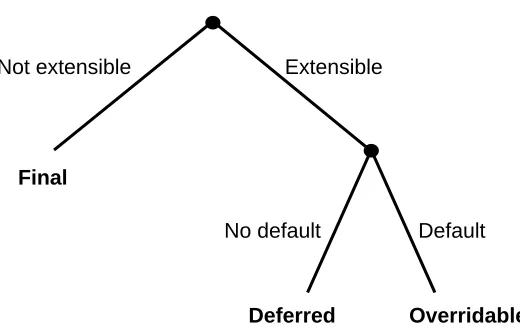
Overridable and deferred state is extensible: subclasses can provide their own representations for it. The overridable state of a class is state for which the class provides a representation that can be replaced by subclasses. The deferred state is state a class assumes exist but for which it provides no representation, depending instead on subclasses to provide representations. Final state is not extensible: subclasses cannot provide their own representations for final state but rather must inherit the superclass’s representation. Overridable, deferred, and final state are all supported by class components.
An overridable class component is a group of public and protected, overridable methods and a set of private instance variables maintained by them. Only methods in the component may access the instance variables assigned to the component. These methods are called the component’s accessors. If a method outside the component needs to access the state represented by these instance variables, it must call the accessors of the component rather than directly access the variables. Thus, for
exam-ple,removeElementinIntSet(Fig. 1.2) callsuncacherather than accessingc validand
c val, andcontainscallselementsrather than accessingels. As illustrated in byIntSet2 (Fig. 1.3), which represents the cache using a bit-map, a subclass replaces the representation of an overridable component by overriding all accessors of the component with new code that accesses the new representation.
For convenience, an overridable class component may contain helper methods, private, final methods that are useful for implementing the component’s accessors. For example, inIntSet2, the cache component contains the helper methodsc testandc setthat perform bit-level oper-ations. Helper methods may only be called by methods in their own component and may not be called by methods in other components.
A deferred class component is a group of public and protected, deferred methods. Deferred components are also associated with deferred state. Deferred state is assumed to exist by the code of final and overridable methods, but the class provides no representation for it. The final and overridable methods of a class access the deferred state of a component by calling the component’s deferred methods, which are also called accessors. A subclass provides a representation for deferred state by overriding these accessors with code that access a representation provided by the subclass. An example of deferred state is given in Fig. 2.2. This figure presents a partial implementation ofRd(“reader”), a character input stream inspired by the Modula-3 library [Brown91]. Different subclasses ofRdread characters from different sources, e.g., the source ofFileRd is disk files, while the source ofSocketRd is network connections. Buffering, using an internal array to fa-cilitate the reading of characters off devices in blocks rather than individually, is important to the performance of readers. The state associated with buffering—and the code that manipulates that state—is included inRdso it can be shared by all subclasses. The state associated with the source a reader is deferred because it is different in different subclasses. This deferred state is accessed by calling the deferred nextChunk (see, for example, the code ofgetChar). Subclasses pro-vide a representation for this deferred state by providing code for nextChunkthat accesses the subclass-provided representation.
12 CHAPTER 2. BASIC METHODOLOGY
class Rd f // Character input streams
// Rd class implements source-independent buffering.
// Deferred component: substate = char’s not yet read from underlying source protected deferred char[] nextChunk();
// Returns the next block of characters from the source.
// Subclasses override this accessor with code that directly accesses // the representation of the underlying source of characters.
// Final component: substate = buffer of characters private char[] buffered = new char[0];
private int cur = 0;
public final char getChar() throws EofException f
if (cur == buffered.length) f buffered = this.nextChunk(); cur = 0;
if (buffered.length == 0) throw new EofException();
g;
return buffered[cur++];
g;
..other methods elided
g;
2.3. SPECIALIZATION INTERFACES 13
in Chapter 6). In Fig. 2.2, the state associated with the buffer of a reader is final. This state is represented by the instance variablesbufferedandcur.
Because the final state of a class cannot be replaced by subclasses, it is safe for all methods of the class to directly access its representation. For example, if the cache ofIntSet(Fig. 1.2) were final rather than overridable, then the code ofremoveElementcould manipulatec validand c valdirectly instead of callinguncache. Thus, the purpose of grouping of methods into final components is not to enforce implementation restrictions but to help break up a class into smaller, more digestible pieces.
The conventions for extensible state can be summarized in two simple statements:
1. Partition methods and instance variables into final, overridable, and deferred components.
2. Implement each component independent of the the other overridable components in the class.
This second point is important to making an overridable component overridable: if subclasses of class C are going to replace component G and inherit other components, then C’s implementation of those other components must be independent of the way C happens to implement G. We have already described one aspect of establishing this independence: the instance variables of a compo-nent may be accessed only by the methods in the compocompo-nent. However, independence goes beyond not looking at instance variables, e.g., it also includes not depending on the code of methods. In general, one component is independent of another if it depends only on the specification of the other component, not on its implementation. The next section explains how to specify components. The next chapter looks the steps necessary to ensure that the implementation of a component depends only on these specifications and not on implementation details.
2.3
Specialization interfaces
An informal specialization specification forIntSet is given in Fig. 2.3. Specifications for spe-cialization interfaces have two parts: an object specification that describes instances of the class, and a division of labor that partitions this object specification into class components. The form for the object-specification part is the same as for all object specifications although, as discussed below, the content of the object specifications for the instance and specialization interfaces differ. The division of labor assigns each abstract-state field and method of the specialization interfaces’ object specification to one of the interfaces class components. As illustrated in Fig. 2.3, divisions of labor are given in the form ofcomponentclauses that group together substate field declarations, which indicate the abstract-state fields assigned to the component, and the method specifications of methods assigned to the component.
14 CHAPTER 2. BASIC METHODOLOGY
specialization specification IntSetSSpec f
state field elements; // A mathematical set of integers state field cache; // Also a mathematical set of integers
invariant cache ⊆ elements // All methods must preserve this
overridable component f
substate field elements;
public void addElement(int el); // Modifies: this.elements
// Effects: Adds el to this.elements.
public boolean removeElement(int el); // Modifies: this.elements, this.cache
// Effects: Removes el from this.elements, returning true iff // el is in to begin with.
public IntEnumeration elements();
// Effects: Returns an enumeration of the integers in this.elements.
g;
overridable component f
substate field cache;
public boolean contains(int el); // Modifies: this.cache
// Effects: Returns true iff el is in this.elements.
protected void uncache(int el); // Modifies: this.cache
// Effects: Removes el from this.cache
g;
..other methods elided
g;
2.4. ABSTRACT REPRESENTATIONS 15
We did not mention invariants when we introduced object specifications, but any object specifi-cation can have an invariant. An invariant describes a constraint on the specifispecifi-cation’s abstract-state fields that must be established by constructors and preserved by all methods. The invariant of an ob-ject specification is an implicit part of all method specifications: it may be assumed on entrance and must be preserved on exit. Thus, for example,containsmay assume the invariant even though it is not part of the explicit pre-condition ofcontains. Similarly,removeElementmust preserve the invariant even though it is not part of the explicit post-condition ofremoveElement. Invari-ants are just one of many different kinds of information that might be put into object specification. Other examples include constraints for establishing history properties [Liskov94] or complexity in-formation for bounding algorithms [Musser96]. We highlight invariants because, as discussed in the next section, they are particularly important in the context of specialization interfaces. For sim-plicity, we ignore other kinds of information that could be included in object specifications, but our results can be extended to handle additional information.
IntSetSSpec has two overridable class components, one associated with the elements
field and the other associated with thecachefield.RdSSpec(Fig. 2.4), a specialization specifica-tion forRd, illustrates documentation for final and deferred components. Documentation for class components lifts the programming conventions for components to the level of abstract state. Even though deferred components do not have an implementation, they do have abstract state. Thus, at the abstract level, rather than at the level of instance variables, it becomes possible to describe the state assigned to deferred components.
2.4
Abstract representations
Instance and specialization interfaces are both documented using object specifications. However, as indicated earlier, the specializer’s object specification is more detailed than the instantiator’s. The specializer’s object specification has a more detailed view of the class’s state and includes specifica-tions for protected methods. For example,IntSetSSpecreveals the existence of the membership cache to specializers and also includes the protected methoduncache. Similarly,RdSSpec re-veals that the source of a reader is split into the componentsbufferedandondevice and also includes the protected methodnextChunk(c.f. the instance specification in Fig. 2.5). The extra details found in the specializer’s object specification describe abstract interfaces that class compo-nents use to interact with each other.
Again, one way in which the specializer’s object specification is more detailed than the instan-tiator’s is by having a more detailed view of the class’s abstract state. We call this more detailed view the abstract representation. This term emphasizes that it is at a level of abstraction between the fully-abstract state given in the instance specification and the instance variables manipulated by code. As a slogan, we say that the abstract representation should expose the implementation strategy without exposing implementation details. Implementation strategies includes internal mechanisms such as caching (e.g., in IntSet), buffering (e.g., in Rd), or the fact that some structures are sorted. Such strategies are “implementation details” as far as instantiators are concerned, but they are important in terms of the interactions among components.
16 CHAPTER 2. BASIC METHODOLOGY
specialization specification RdSSpec f
state field buffered; // Sequence of characters state field ondevice; // Sequence of characters
final component f
substate field buffered;
public char getChar() throws EofException; // Modifies: this.ondevice, this.buffered
// Effects: If this.buffered and this.ondevice are both empty,
// signals EOF. Otherwise, first may (but may not) move a prefix // of this.ondevice onto the end of this.buffered, then removes // and returns the first character of this.buffered.
g
deferred component f
substate field ondevice;
protected char[] nextChunk(); // Modifies: this.ondevice
// Effects: Removes and returns a prefix of this.ondevice. // Returns the empty sequence only if this.ondevice is empty.
g
..other methods elided
g;
Figure 2.4: Informal specialization specification ofRd.
object specification RdISpec f
state field source; // Sequence of characters
public char getChar() throws EofException; // Modifies: this.source
// Effects: If this.source is empty, signals EOF. Otherwise, // removes and returns the first character of this.source.
..other methods elided
g;
2.5. SUMMARY 17
manipulate this state in ways not available to instantiators. Protecting accessors hides them from instantiators but exposes the full interface to subclasses. For example, theuncache accessor of IntSetmust be visible to subclasses because subclasses that replace theelementscomponent need to call it and because subclasses that replace thecachecomponent need to provide their own implementation for it. At the same time, this accessor should be hidden from instantiators because the cache is irrelevant to instantiators. A similar argument applies to thenextChunk accessor of Rd.
Another difference between the instantiator’s and specializer’s object specifications is the role played by invariants. In particular, in classes constructed from class components, invariants on the abstract representation serve in lieu of representation invariants. We call these invariants abstract representation invariants not only because they are invariants on abstract representations but also because of their role as surrogates for representation invariants.
Efficient implementations of methods must be able to make assumptions about the relationships among different parts of an object’s state. For example, inIntSet,contains assumes that the cache of a set is a subset of the set’s elements, andremoveElementassumes thatelscontains no duplicate entried (i.e., no number is stored inelsmore than once). In the context of classical data abstractions, both of these assumptions would be expressed as representation invariants. However, as discussed in the next few paragraphs, in the context of subclassing, not all such assumptions can be captured as representation invariants.
Even in the context of subclassing, representation invariants can still be used to capture as-sumptions that relate state within a component such as the “no duplicates” assumption from above. Such invariants can be established by data-type induction, i.e., by making sure that the methods that have access to the instance variables preserve the invariant. In our example, the no duplicates property can be established by ensuring thataddElement,removeElement, andelements all preserve it.
However, representation invariants cannot be used to capture assumption that relate state from multiple components such as the cache-validity property. This is because subclasses might replace the representations of some of the state involved. For example, consider a subclass of IntSet that replaces theelementscomponent and inherits thecachecomponent. The inherited code
for contains still assumes that cache is a subset of elements, but the representation of
elements has been replaced. Instead of expressing multi-component properties in terms of the concrete representation, they must be expressed in terms of the abstract representation. Thus, we see that the invariants on the abstract representation serve in lieu of invariants on representations to express properties that relate state from multiple components.
2.5
Summary
Classes have two interfaces, one for instantiators and once for clients. The unit of modularity for instance interfaces is the entire class. They are documented using object types.
18 CHAPTER 2. BASIC METHODOLOGY
Chapter 3
Validating classes
Validation is any activity intended to increase our confidence that a class behaves as intended. Val-idation typically consists of some combination of testing and reasoning. Testing involves placing the class in a particular context and seeing if it behaves as expected. Reasoning involves inspect-ing the implementation of a class and arguinspect-ing that it will behave correctly in all possible contexts. Reasoning can be done formally or informally. Much formal reasoning can be done mechanically. Mechanical reasoning can range from simple type checks, to anomaly checking, to full, formal verification.
All forms of validation depend on some notion of what it means for a class to “behave as in-tended.” We call this notion the validation criterion. Our starting point for defining such a criterion is the slogan “a class is correct if it meets its specification.” Sec. 3.1 looks at what it means for a class to meet both its instance and specialization specifications. The Sections 3.2 and 3.3 apply this criterion to informal reasoning about the correctness of class relative to its specialization interface. Sec. 3.4 explains how the correctness of a class relative to its instance interface can be deduced from correctness relative to its specialization specification.
3.1
Validation criterion
Recall that classes have two specifications, one for instantiators and one for specializers. The in-stance specification of a class consists of an object specification. A class implements its inin-stance specification if all instances of the class behave as described by the specification.
The specialization specification consists of an object specification together with a division of labor. The validation criterion for a class against its specialization specification is two-fold. First, instances of the class must behave as described by the object-specification part of the specialization specification. Second, each class component defined by the division of labor must be implemented independently of the implementations of the other overridable components in the class. This means that each class component can depend only on the specifications of other class components; it cannot depend on the implementations of methods nor on the representation of state assigned to other components. If components are independent, then subclasses can replace some of the components without breaking the others.
The following implementation ofremoveElementis behaves correctly but is not independent of the representation of another component:
20 CHAPTER 3. VALIDATING CLASSES
public overridable boolean removeElement(int el) f
boolean result = els.removeElement(el);
if (result) c_valid := false; // Bug: accesses rep of cache! return result;
g;
This code would be fine if the only validation criterion were that a class implement the object-specification part of its specialization object-specification. However, this code is not valid because it de-pends on the representation of the cache and thus is not independent of the implementation of the cache component.
The following code also behaves correctly but is also not valid, this time because it is not inde-pendent of the implementation of a method it calls:
protected overridable void uncache(int el) f
c_valid = false; // Invalidate even if el not in cache
g;
public overridable boolean removeElement(int el) f
boolean result = els.removeElement(el);
if (result) this.uncache(2); // Assume that uncache ignores the return result; // value of its argument.
g;
This version ofuncachealways invalidates the cache no matter what the value of its argument. Al-though not the most efficient thing to do, it is still correct. This version ofremoveElementtakes advantage of the fact thatuncacheignores its argument. Like the version ofremoveElement that accessed c valid, this version behaves correctly but is not valid because it depends on the implementation ofuncache.
3.2
Reasoning about local components
The implementation of a class contains two kinds of components: components implemented lo-cally and components inherited from a superclass. This section considers reasoning about local components. Local components include superclass components overridden by the class, deferred components of the superclass implemented by the class, and new methods defined by the class. We want to reason about the correctness of the local components of a class relative to the class’s specialization specification.
3.2. REASONING ABOUT LOCAL COMPONENTS 21
3.2.1
Calling methods
The first aspect of being independent of other components is to reason about calls to overridable methods in terms of specifications rather than implementations. Because calls to overridable com-ponents are reasoned about in terms of their specifications, these calls will still work as expected when subclasses replace the components with new code implementing the same specification.
3.2.2
Accessing state
Another aspect of being independent of other components is not depending on the representations of their state. This means that if the code in one components needs to access the state assigned to another, overridable component, it should do so by calling the methods of the other component rather than by accessing its instance variables. When done through methods, accesses of the state of an overridable component will still work as expected when subclasses replace the component.
Binary methods, generally a problem (see, e.g., [Liskov93] and [Bruce96]), must be treated with care. A binary method of classCis a method that takes one or more arguments of typeCin addition to this. In most languages, the code in binaryC’s methods has privileged access to all arguments of typeC, not just to this. In particular, this code can access the private instance variables of those arguments. This privileged access supports efficient implementations of some data types, but it must be used sparingly to to achieve independence.
Consider the following class:
class C f
// Overridable ‘‘count’’ component private int m_count;
public overridable getCount() f return m_count; g
public overridable addCounts(C o)
f return m_count + o.getCount(); g
...
g
The code for addCounts can safely access m count of this. However, this code should not accessm countforo. This is because the class implementingomay be a subclass ofCthat has replaced thecountcomponent with code that does not usem countto representcount. Instead of accessingm countforo,addCountsshould callgetCountinstead.
In short, instance variables representing overridable state should only be accessed for this and not for other arguments. For all of its arguments, a binary method can safely access the instance variables representing final state.
3.2.3
Assuming invariants
22 CHAPTER 3. VALIDATING CLASSES
In the context of class components, there are two kinds of implementation invariants. First, there are invariants that relate state within a single component, e.g., the “no duplicates” invariant. Such an invariant can be established by showing that it is preserved by the code of each of the component’s methods. For example, addElement, removeElement, and elements all preserve the no duplicates invariant. Because only the methods in a component access the instance variables of the component, only these methods need to be checked to establish an invariant on these instance variables.
The second kind of invariant relates state assigned to different components, e.g., thecache va-lidity invariant. As explained in the previous chapter, such invariants cannot be established directly on the instance variables. In place of such invariants, programmers must instead use abstract repre-sentation invariants, i.e., invariants on the abstract state of the object specifications of specialization specifications.
3.2.4
Abstracting state
When choosing a representation for a class and coding the class’s methods, the implementor has in mind an abstraction function, a relationship between the class’s instance variables and the class’s abstract state. For classical data abstractions, the abstraction function maps the entire representation to the entire abstract state. In the context of class components, each component needs its own subabstraction function. These subabstraction functions map the component’s instance variables to the abstract state assigned to the component.
For example,IntSet (Fig. 1.2) needs two subabstraction functions, one for theelements component and the other for thecachecomponent. The function for theelementscomponent returns the set consisting of the elements ofels. The function for thecachecomponent returns the empty set whenc validis false and the singleton set consisting ofc valwhenc validis true.
Subabstraction functions are central to formal verification of classes and will be discussed fur-ther in Chapter 4. However, even when classes are not formally verified, subabstraction functions are useful for informal reasoning, and it is a good idea for implementors to document the subab-straction function of each class component.
3.3
Reasoning about subclasses
Root classes are classes without superclasses, such asIntSetin Fig. 1.2. All non-deferred com-ponents of a root class are local, so root classes are easy to reason about: just reason about each local component as described in the previous section.
Subclasses are a little trickier. The validation criterion described in Sec. 3.1 applies equally to root classes and subclasses. Local components of a subclass—i.e., superclass components overrid-den by the subclass, deferred components of the superclass implemented by the subclass, and new local components—are still reasoned about as described in the previous section. However, unlike root classes, subclasses contain inherited components. Also, unlike root classes, subclasses can use super to call superclass versions of methods.
3.3. REASONING ABOUT SUBCLASSES 23
3.3.1
Reusing superclass code
Subclasses can reuse code of their superclasses, both by inheriting components and by using super to call superclass versions of methods. Superclass code reused by the subclass may in turn call code provided by the subclass; for example, an inherited method may call an overridden one. Code provided by the subclass must meet assumptions made about it by inherited superclass code. (In addition to this issue, reasoning about super entails other issues discussed in Sec. 3.3.4.)
Superclass code makes two assumptions that subclasses need to respect. First, superclass code assumes that the superclass invariant is preserved. If this code is going to work when reused by the subclass, the subclass will have to preserve the superclass’s invariant. For example, contains depends on the cache validity invariant; a subclass that inherits contains must preserve this invariant. To ensure that the subclass (and its subclasses) will preserve the superclass’s invariant, we require that the subclass’s invariant imply the superclass’s.
The second assumption made by superclass code is that the methods of this implement the spec-ifications given to them in the superclass. For example, the correctness ofcontainsin Fig. 1.2 depends on the behavior ofelements. If a subclass replaceselementsand inheritscontains, it should replaceelementswith code that does whatcontainsexpects it to. To ensure that the subclass’s code for methods implements the behavior expected by superclass code, we require that the subclass specifications of overridable and deferred methods imply their specifications in the superclass. This rule applies to all methods for which the subclass can provide code, not just to methods for which the subclass actually does provide code. Applying this rule to all methods en-sures that subclasses of the subclass, which can replace methods not replaced by the subclass, also respect assumptions made by the superclass.
3.3.2
Inherited methods
Local components are reasoned about by inspecting their code. However, recall that a goal of this report is to allow specializers to build subclasses without looking at the code of superclasses. We need a way to ensure that the code of inherited methods behaves as described by the subclass’s specification without actually looking at this code.
We are assuming that the superclass implements its specification. This means that inherited methods behave as described by the superclass’s specification. If this superclass specification im-plies the subclass specification, then the subclass specification will also describe the inherited code. Thus, we ensure that inherited methods meet their subclass specifications by requiring that their superclass specifications imply their subclass specifications.
This implication is opposite the implication in the previous subsection. There, subclass speci-fications imply superclass specispeci-fications to ensure that subclass-provided code behaves as expected by the superclass. Here, superclass specifications imply subclass specifications to ensure that superclass-provided code behaves as described by the subclass. Note that the implications of this subsection and the previous one both apply to inherited, overridable methods. This means that the specifications of such methods in the sub- and superclass interfaces end up being logically equiva-lent.
A subclass that inherits a component must inherit the component as a whole—it may not separate the elements of the component. For example, a subclass ofIntSet that inherited the
elementcomponent may not putaddElementandremoveElementinto separate class
24 CHAPTER 3. VALIDATING CLASSES
Method kind Implication(s) between specifications Final superclass⇒subclass
Inherited overridable superclass⇔subclass Overridden overridable superclass⇐subclass Deferred superclass⇐subclass
Table 3.1: Behavioral subclassing.
without overridingremoveElement, which would be an error. When a subclass replaces a com-ponent, it may break it up. In our example, a subclass that replaces the elements component could putaddElementandremoveElementinto separate class components.
3.3.3
Behavioral subclassing
Collectively, we refer to the rules from the previous two subsections as behavioral subclassing. In short, these rules are:
1. The specifications of overridable and deferred methods in the subclass must imply their spec-ifications in the superclass, and the invariant of the subclass must imply the invariant of the superclass.
2. The specifications of inherited methods in the subclass must be implied by their specifications in the superclass.
3. Components inherited from the superclass may not be broken up by the subclass.
These rules ensure that superclass code reused by the subclass behaves as expected. Table 3.1 summarizes the implications between the specifications of methods in the sub- and superclass spec-ifications.
To understand how behavioral subclassing works, consider a specialization specification that is the same asIntSetSSpec(Fig. 2.3) in every way except for the specification ofelements:
specialization specification IntSetSSpec2 f
...
overridable component f
...
public IntEnumeration elements();
// Effects: Returns an enumeration of the integers in // this.elements. This enumeration yields these integers // in ascending order.
g;
...
g;
3.3. REASONING ABOUT SUBCLASSES 25
subclass ofIntSet? The answer is “yes”—but only for subclasses that override theelement component ofIntSet. Because of rule (1), the subclass’s specification of elements can be stronger than the superclass’s only when the subclass overrides elements. This makes sense: Subclasses that inherit theelementcomponent cannot be specified byIntSetSSpec2because the inherited code forelements does not (necessarily) meet this stronger specification. A sub-class can strengthen the specification of supersub-class methods only when the subsub-class provides its own code for that method—code that meets the stronger specification.
Now consider another specialization specification, also the same asIntSetSSpecexcept for the specification ofelements:
specialization specification IntSetSSpec3 f
...
overridable component f
...
public IntEnumeration elements();
// Effects: Returns an enumeration of *some* of the integers // in this.elements.
g;
...
g;
This specification forelementsis weaker than the one inIntSetSSpec: it returns an enumer-ation that yields a subset of the elements in this.elements. Could this be the specialization spec-ification of a behavioral subclass ofIntSet? The answer here is “no” becausecontains—and perhaps other methods ofIntSet—depend on the stronger behavior ofelements. A subclass cannot weaken the specification of superclass methods because inherited methods may depend on the stronger behavior. (By adding more information to specialization specifications, we could allow subclasses to weaken the specification of superclass methods. Such information might include, e.g., the fact thatcontainsis the only method that callselements. However, we do not feel that the ability to weaken specifications is worth the extra complexity it would add to specifications and to reasoning.)
3.3.4
Shadowing components
Half way between inheriting a component on the one hand and completely replacing it on the other is to shadow a component. When a class shadows a superclass component, it replaces some of the component’s methods but does not replace the representation of the component’s substate. The class may also add new methods and new substate to a shadowed component.
CIntSet(Fig. 3.1) extendsIntSet to count the number of timesaddElement is called.
CIntSetshadows theelementscomponent ofIntSet: it does not replace the representation
ofelements but it extends the state of the component to include a counter. It also adds a new method. Notice that CIntSet uses super to invoke the superclass version of addElement. Shadowed components typically use super in this way.
The convention for shadowed components is as follows:
26 CHAPTER 3. VALIDATING CLASSES
class CIntSet extends IntSet f
// Shadowing ‘‘elements’’ component of IntSet: private int m_addCount;
public void addElement(int el) f m_addCount += 1;
super.addElement(el);
g;
public int addCount() f
return m_addCount;
g; g;
Figure 3.1: Subclass ofIntSetthat shadows a component.
• Because the superclass represents this substate using instance variables not visible to the subclass, the subclass cannot directly access the representation of this state. Instead, the subclass manipulates this state using super to call superclass accessors. In our example,
addElements calls the superclass version ofaddElements to update the elements
field.
• The subclass can add new substate fields to a shadowed components. These new fields are represented using subclass instance variables, and a local subabstraction function defines the new substate fields in terms of these instance variables. In our example, a newaddCount field is added to the state of theelementscomponent.
• The subclass need not override all methods of shadowed components. In our example,
removeElementandelementsare both inherited.
• A subclass cannot break up a shadowed component. That is, the component in the subclass must include at least the methods and substate fields of component in the superclass, although it may contain more. Our example follows this rule.
When super is used to call the superclass version of a method, the superclass’s specification of the method is used to reason about the call.
Super can only be used in shadowed components. Further, a shadowed component cannot call superclass versions of methods in other components, only of methods in itself. Other uses of super are not modular. For example, imagine that a subclass ofIntSet inherits theelements com-ponent but overrides thecachewith a version ofcontainsthat called theelementsmethod via super. This subclass would work fine. However, if a subclass of this subclass replaced the
elements component and inherited thecache component, then thecachecomponent would
no longer work because its call toelementswould invoke the wrong version.
More general mechanisms exist for invoking overridden code. For example, in C++, the invo-cation:
3.4. REASONING ABOUT INSTANCE INTERFACES 27
invokes the code for methodmprovided by classC, whereCis an arbitrary superclass ofo. Whereas super allows the invocation of only the immediate superclass’s version of a method, more general mechanisms such as the one in C++allows the invocation of any superclass’s version. The method-ology defined by this report supports the invocation of only the immediate superclass’s version of a method, not an arbitrary superclass’s version. This restriction follows from the philosophy that subclassing is an implementation issue: the superclasses of a class is not considered to be part of a class’s specification, so subclasses of the class should not be able to depend on those superclasses.
3.4
Reasoning about instance interfaces
So far, this chapter has looked at showing that a class implements its specialization specification. Reasoning about a class also includes showing that it implements it instance specification. The correctness of classes relative to their instance specifications cannot be reasoned about by inspecting code because the code of inherited methods is not available for inspection. Instead, we reason about the correctness of a class relative to its instance specification by relating the instance specification to the specialization specification.
The validation criterion for specialization interfaces says that a class must implement the object-specification part of its specialization object-specification. This fact can be used to reason about instance interfaces: a class will implement its instance specification if its instance specification is a behav-ioral supertype of the object-specification part of its specialization specification.
One object specification is a behavioral supertype another if it correctly describes all objects described by the other. The term supertype is used because object specifications are used to docu-ment object types. A behavioral supertype is a “more general” specification, i.e., it describes more objects. The behavioral subtype is “more specific.” Behavioral subtyping is discussed in detail in [Liskov94]; formal rules for behavioral subtyping are given in Sec. 4.1.2. For the purposes of this section, a simple rule suffices: a subtype must have a more detailed view of an object than its behav-ioral supertypes do. This has three implications: the subtypes has more methods; the subtype has more abstract-state fields; the subtype has a stronger invariant and stronger method specifications.
For example, the object specification in Fig. 2.1 is a behavioral supertype of the object specifi-cation part of the specialization specifispecifi-cation in Fig. 2.3. This is because the specialization speci-fication reveals more methods (uncache) and more state (the cache) and has a stronger invariant. Thus, if we assume thatIntSet(Fig. 1.2) correctly implements the specialization specification in Fig. 2.3, then it follows that it correctly implements the instance specification in Fig. 2.1.
In Java and most languages, the “class” construct defines both what this report calls a class and what this report calls an object type. That is, Java class C defines a type that is also named C. Inside the code of class C, this can be used wherever the type C is expected. In languages like this, good design practice requires that the instance specifications of all subclasses of C be behavioral subtypes of the instance specification of C. For example, code similar to the following appears in the ET++ Viewclass (ET++is a GUI framework [Weinand95]):
public ViewStretcher createStretcher() f
DocView dv = this.getDocView();
if (dv == null) return CreateViewStretcher(this);
else return CreateViewStretcherWithRect(this, dv.contentRect());