ISSN: 1992-8645 www.jatit.org E-ISSN: 1817-3195
57
OPERATING AN APPLICATION FOR MODELING PERSONA
BY USING ONTOLOGIES
GAOU SALMA 1 , EL MABROUK MAROUANE 2
1
. Faculty of Science (University Abdelmalek Essaadi) of Tetouan , MOROCCO
2
. Faculty of Science and Technology (University Abdelmalek Essaadi) of Tanger , MOROCCO
Email: [email protected], 2 [email protected]
ABSTRACT
Personas are a model used to describe users, the objectives of the creation and use of characters are centered on the possible user and communicate what we have learned with great design team. The problem of persona Being user-centered is not natural, users are complex and varied, those who may be doing user and market research are generally not the people who actually design and build the product and especially make a dinamic application pesona.
Semantic Web or any Web resources are described by metadata, which allows machines better use of these resources. Considering FOAF specification foundation (friend of a friend), we use semantic structures (RDFa) to create an ontology and technologies in which it operates. Using personas, we can develop an understanding of the goals of our users in specific contexts- an essential tool for the use of user research to inform and justify our designs. Create a conceptual model (ontology) for personas and their uses in the context of human-computer interaction, we present some screenshots of the application execution catches. In this article, we present the implementation we did, which was the first in the edition of our OWL ontology, followed by operations in an annotation application and creates a platform for working character who was developed in JSP, and the integration of the application developed in the persona platform, mak a dinamic site for persona.
Keywords: Semantic Web, FOAF, Persona, Vocabulary, Ontology, Application.
1.INTRODUCTION
Semantic Web technologies and Semantic Web offers us a new approach to managing information and processes, the fundamental principle is the creation and use of semantic metadata. Using the semantics, we can improve the way information is presented. At its simplest, instead of providing a linear search results list, the results can be grouped by meaning. The use of semantic metadata is also crucial for the integration of information from heterogeneous sources, either within an organization or across organizations. [1]
After be released all over the world to understand life, Motivations and around your users, a big question arises: How do you use the research data to arrive at a design that will result in a successful
product? You have notebooks full of
conversations and observations, and it is likely that each person you talked to is slightly different. It is difficult to imagine digging through hundreds
of pages of notes every time you have to make a design decision, and even if you had the time to do it, it is not quite obvious how these notes should inform your thinking.
Personas, like many powerful tools are a simple concept but must be applied with considerable sophistication. It is not enough to concoct a couple based on stereotypes and generalizations user profiles, it is not particularly useful to attach a photo to share a job title and called a “persona." For personas to be effective tools for design, considerable rigor and finesse should be applied to the process of identifying important and meaningful patterns in user behavior and turning them into archetypes that represent a wide range of users.
ISSN: 1992-8645 www.jatit.org E-ISSN: 1817-3195
58 We have some Analyse comparative but there are just proposals as pictures not application:
Personas Cooper [3]: It is characterized Pictures may be used for temporary personas emphsize besides the fact that they are not based on research (and therefore less "real"). Drawings of cars they really want to add a tangible example of their differences. Real Personas Cooper appears to be about four paragraphs of text with a name, age, and perhaps another character (ex: e -mail) at the top. I think this is a format (less digestible) works for them because personas are primarily used by their house design team, or shared with customers in a very interactive session. I do not think they have to convince people to use them as much as we (and many others) do. Obviously, these are not complete personas and many more details are needed.
Kivio Persona Table [4]: It is characterized a chart can be an interesting companion personas to help us understand their differences. Table format easy to see how personas are different. Table format allows users to easily select the information that is relevant to users. Table format allows the distribution of information in the categories that are important to the application / website is designed, can be good when there is a lot of important information that is parallel between personas . Personal / social life is included, but in table format can be ignored or skim. The format of the table , it is less the story as , and thus may be less convincing.
Todd Warfel Example Persona [5]: It is characterized beautiful categorization: "Professional moderately seasoned". Beautiful slogan: "I want to see a good, better, best." Displays scales Persona. The objectives are prominent. Important use cases highlighted in “primary use." Frustrations and pain points are important. Short narrative story about what is important to Michael. Big picture. Persona does not have a ton of personal details, so it can not be humanized as it could be. (But perhaps that is compelling enough without these details).
Viget Labs Persona [6]: It is characterized Beautiful photo, beautiful slogan, Beautiful categorization: "The busy student," simple but effective graphic design, Quick Stats gives you "at a glance" demographic info on Jack The objectives are to foreground, task List (sort of scenarios) the user may want to perform on the site, Pretty rudimentary not much information, it is not really humanized, it looks more like a user profile.
Persona for Student Assistant Tool [7]: I think you get an idea of what Mark is like despite the lack of narrative detail. It is enough story in each section to humanize, It is characterized Nice picture, no categorization of Mark (For example: "social drinker"), is education and education really Preview nécessair e, why the use of technology and the use of separate cells? Do not know if it makes sense to hobby so important. Could be part of personal information, slogan can be a bit artificial.
Razorfish Persona [8]: It is characterized beautiful categorization: "The Learner" Beautiful slogan, Good combination of narrative paragraphs and bulleted lists (although I think the bullets could be chosen a little better) Includes scenarios very well-developed, attributes seem a little repetitive background, it seems they could use graphic design to make better use of space.
ISSN: 1992-8645 www.jatit.org E-ISSN: 1817-3195
59 a conceptual model (an ontology) for personas and their uses in the context of human-computer interaction, we present some screenshots of the application execution catches. In this article, we present the implementation we did, which was the first in the edition of our OWL ontology, followed by operations in an annotation application and creates a platform for working character who was developed in JSP, and the integration of the application developed in the persona platform dynamic.
2.PERSONA
A persona is a typical user (the famous archetype), a fictional representation of target users, which can be used to set priorities and guide our design decisions interface [24].
The method is a technique personas Users centered design, initiated by Alan Cooper in 1999. This method can provide a common and shared vision of the users of a service or product, highlighting their goals, expectations and potential brakes, and offering a more engaging format. In the field of web persona is a fictional character who represents a targeted group. When designing a website, it may be necessary to define multiple personas that will represent each type of potential visitors. A good persona is not to stereotype users but to create users that seems real. That is why we have set goals and personality traits realistic. Based on the objectives of the persona and its specific characteristics (identity, age, familiarity with computers ...) you should check that the user interface to meet the needs of users represented by the personas [25].
Personas give us a precise way of thinking and communicating how users behave, how they think, what they want to accomplish and why. Personas are not real people, but they are based on the behaviors and motivations of real people that we have observed and represent them throughout the design process. They are composite archetypes based on behavioral data collected from many actual users encountered in the ethnographic interviews. Personas are based on patterns of behavior that we see in the research phase, so that we formalize in the modeling phase. Using personas, we can develop an understanding of the goals of our users in specific contexts - an essential tool for the use of user research to inform and justify our designs[25].
Personas are a model used to describe the objectives, skills, abilities, experience and technical context of the users. They are detailed descriptions of archetypal users built on
understanding, very specific data models on real people. A character is not based on an individual - he is a construct developed through a detailed process, not the result of a search for the "right" (see the character creation for more details). They are used by the design team (and largest project team) to describe and keep the foreground user (s) for which the system will be built [25].
Personas, like many powerful tools are a simple concept but must be applied with considerable sophistication. It is not enough to whip up a couple of profiles based on stereotypes and generalizations users, it is not particularly useful to include a photograph of a stock job title and call it a "persona." Personas to be effective tools for design, considerable rigor and finesse should be applied to the process of identification of significant and meaningful in user behavior trends and transform these into archetypes that represent a wide range of users [24].
3.THEGOALSOFPERSONA:
If personas provide the context sets of observed behaviors, goals are the drivers of these behaviors. Persona to objectives can still serve as a useful communication tool, but it lacks its usefulness as a design tool. User goals serve as a lens through which designers must take into account the features of a product. The function and behavior of the product must meet goals via tasks, usually as few tasks as absolutely necessary. Remember, tasks are only a means to an end, the end goals are:
3.1 The Goals motivate usage patterns
Objectives personas or motivate people to behave as they do. Thus, the objectives not only provide an answer to why and how personas want to use a product, but can also serve as a shortcut in the mind of the designer to the sometimes complex behaviors in which a persona book and , consequently, their duties . [2]
3.2 The Goals must be deducted from
qualitative data
ISSN: 1992-8645 www.jatit.org E-ISSN: 1817-3195
60
4.THEPERSONADATAMODELAND
[image:4.612.97.311.78.416.2]THEDIAGRAM
Fig. 1. Use case diagram of the Persona data model [28].
5.DESIGNINGPERSONAS
5.1 STRENGTHS Personas design:
Determine what a product should do and how it should behave. Persona goals and tasks form the basis of the design effort.
Communicate with stakeholders, developers and other designers.
Personas provide a common
language for discussing design decisions, and also help to keep the design centered on users at every stage of the process.
Establish a consensus and
commitment to the design. With a common language for a common understanding. Persona reduce the need for complex schematic models because, as the authors have found it is easier to understand the many nuances of user behavior through the narrative structures that personas employ .
Measuring the effectiveness of the design. Design choices can be tested on a persona in the same way they
can be presented to a real user during the training process. Although it does not replace the need to test on real users, it provides a tool for verifying the reality for designers who are trying to solve problems. This allows design iteration to occur rapidly and inexpensively at the whiteboard, and the result is a much stronger base of design when it comes time to test with real users. Contribute to other efforts related products such as marketing plans and sales. The authors have seen their customers repurpose personas within their organization, information marketing campaigns, organizational structure , and other strategic planning activities . Business units outside of product development desire a thorough knowledge of products and users see generally personas with great interest[27].
5.2 Using Personas design:
Use Personas to plan your product • Brainstorm possible features and functionality using your personas.
• Prioritize based on the needs of your personas functionality. Weighted priority matrix can be used to determine the significance of the feature. For an example, see the case of using liquid matrix created for a research project on content management in higher education.
• Analyze similar products through the eyes of your persona to get ideas on what you do and you do not want in your design.
Explore design solutions for your point of view personas
• Identify use cases for your design must support. • Create scenarios for your personas to understand how they need to do their job and in what context.
• Explore the mood boards and visual design with your personas in mind.
Rate your solutions from your point of view personas
• Complete cognitive walkthroughs and design reviews on your point of view personas.
• Use personas to help you create test scenarios and users think recruiting participants.
• Focus quality assurance and create case - based test persona persona labeling bug (23 Joe bugs, bugs Susan 43) [15].
5.3 Forces of personas as a design tool:
ISSN: 1992-8645 www.jatit.org E-ISSN: 1817-3195
61 problems that currently plague the development of digital products. Personas help designers:
• Determine what a product should do and how it should behave, Persona goals and tasks form the basis of the design effort.
• Communicate with stakeholders, developers and other designers. Personas provide a common language for discussing design decisions and also help to keep the design centered on users at every stage of the process.
• Build consensus and commitment to the design. With a common language for a common understanding. Personas reduce the need for complex schematic models, it is easier to understand the many nuances of user behavior through the narrative structures that personas employ.
• Measure the effectiveness of the design. Design choices can be tested on personas in the same way that they can be presented to a real user during the training process. Although it does not replace the need to test with real users, it provides a powerful reality check for designers trying to solve design problems. This allows design iteration to produce quickly and cheaply to the table, and the result is a much stronger base of design when it comes time to test with real people.
• Contribute to other efforts related products such as marketing plans and sales. The authors have seen their customers repurpose personas within their organization, information marketing campaigns, organizational structure, and other strategic planning activities. Business units outside of product development desire thorough knowledge of users of a product and usually consider personas with great interest. [15]
6.DEPLOYINGTHEAPPLICATION
PERSONA
[image:5.612.295.553.48.721.2]Persona web application developed using JSP and Servlet technologies. To be functional, it must be deployed in an HTTP application server with JSP / Servlet container. Apache Tomcat is both HTTP server (Apache) and Servlet / JSP container, which makes it an ideal candidate for the deployment of our application. The figure below shows the deployment scheme of Persona application.
Fig. 2. Diagram Of Deployment Persona
Application
The deployment of the application on Apache Tomcat persona is done by placing the directory containing the application files in the webapps directory of Tomcat.
7.IMAGESOFAPPLICATION
EXECUTION
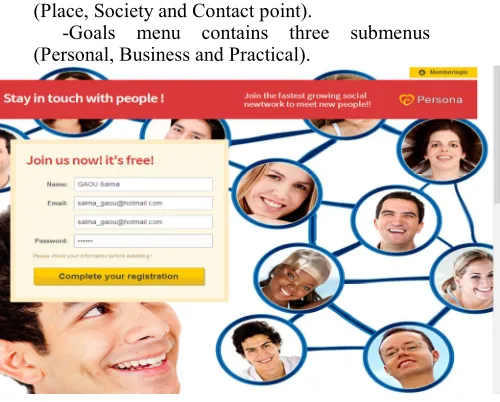
In what follows we will present some screenshots of execution of our application, the homepage is the first window website, where you can access the different menus of the site persona. It contains five main menus (Identity, Organization, Context, Event, and Goals).
-Context menu contains three submenus (Place, Society and Contact point).
-Goals menu contains three submenus (Personal, Business and Practical).
[image:5.612.304.523.71.307.2] [image:5.612.307.557.504.705.2]ISSN: 1992-8645 www.jatit.org E-ISSN: 1817-3195
[image:6.612.65.555.63.698.2]62
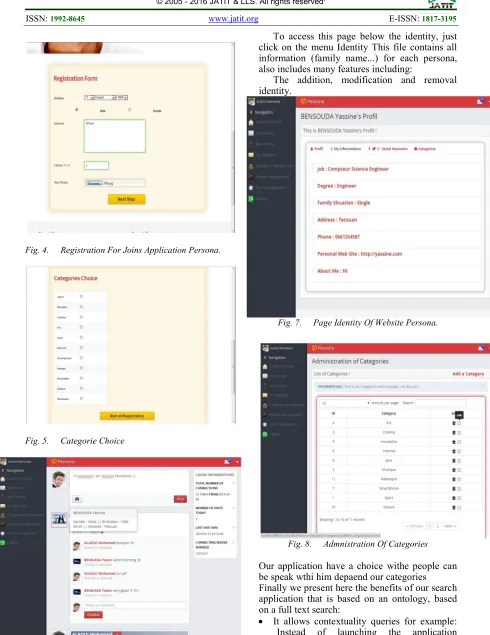
Fig. 4. Registration For Joins Application Persona.
Fig. 5. Categorie Choice
Fig. 6. the first page of website persona after identity
To access this page below the identity, just click on the menu Identity This file contains all information (family name...) for each persona, also includes many features including:
The addition, modification and removal identity.
[image:6.612.324.565.398.606.2]Fig. 7. Page Identity Of Website Persona.
Fig. 8. Admnistration Of Categories
Our application have a choice withe people can be speak wthi him depaend our categories Finally we present here the benefits of our search application that is based on an ontology, based on a full text search:
ISSN: 1992-8645 www.jatit.org E-ISSN: 1817-3195
63
• It allows a seems they could use graphic design to make better use of space.
• It allows giving Persona a ton of personal details, so it can also be humanized as it could be. (But perhaps that is compelling enough without these details).
• It can give the user the choice what type of goals will choose either individual or personal or businesse .
• In addition, the fact that our application is based on an ontology that has the advantage of sharing a common vocabulary between different types of users of the application that improves and facilitates improvement to users.
8. CONCLUSIONS
In this article, we introduced the notion of ontology and several methods and tools for ontology engineering. In our study, taking into consideration the characteristics and benefits of ontologies, we focused on the ontology to build a vocabulary of character.
Like many powerful tools, personas are a simple concept but must be applied with considerable sophistication. It is not enough for some based on stereotypes and generalizations user profiles; it is not particularly useful to attach photos to a job title and call it a "character". Personas to be effective tools for design , discipline and a lot of finesse to be applied to the process of identifying significant trends and user behavior and turn them into archetypes that represent a wide range of users, presented persona as a web application using the details of the application implementation , and will be used for the realization of our application: development tool JBuilder7, the Java virtual machine: J2SDK 1.4.2 , Tomcat JSP Web server 4.x libraries: Jena version 2.3 and Servlet / JSP Version 2.3/1.2 (included in Tomcat 4.x) .
Considering that we were able to achieve a large part of the objectives of this work, and we made the right choices regarding implementation tools, thus our work will be a very good track for future projects.
However, our work is not perfect and can be improved in several areas, and what is proposed is:
- Develop other ontologies and combine them with ours to enrich the vocabulary used for annotation and search.
- Test the possibility of reasoning provided by OWL.
- Reuse this ontology in a platform based on Semantic Web technologies - Use this ontology in achieving a document editor, and we put our application to navigation for user.
REFERENCES
[1] Semantic Web Technologies,trends and research in ontology- based systems,John Davies, BT, UK,Rudi Studer,University of Karlsruhe,Germany,Paul Warren,BT, UK [2] About Face 3 The Essentials of Interaction
Design Alan Cooper, Robert Reimann, and Dave Cronin, 2007.
[3] Günter Schmidt, emaro AG, Do Traditional
Design Processes Apply to Portal
Design?.Lecturer of Berufsakademie
Karlsruhe. May 21, 2001.
http://www.sapdesignguild.org/editions/editi on3/portal_process.asp.
[4] http://wiki.openusability.org/kivio/index.php /Personas
[5] Todd Zaki Warfel. Data Driven Personas .
covering how to do data-driven
design research personas. Principal Designer at messagefirst . on Jun 13, 2007. http://www.slideshare.net/toddwarfel/data-driven-personas
[6] Staab S, Stuber R (Eds). 2004. Handbook on ontologies. International Handbooks on Information Systems. Springer : ISBN 3-540-40834-7.
[7] STEPHANIE HAY.a DESIGN &
INTERACTIONblog—our three hundred foot view. primarily written by/for ux designers, visual designers, and front-end
developers. APR 22, 2008.
http://viget.com/inspire/why-personas-are-valuable.
[8] 10 February 2004, RDF is a standard model for data interchange on the Web. In ligne : http://www.w3.org/RDF/
[9] Semantic Web Programming,John
Hebeler,Matthew Fisher,Ryan
Blace,Andrew Perez-Lopez,septembrie 2009 [10]About Face 3 The Essentials of Interaction Design Alan Cooper, Robert Reimann, and Dave Cronin, 2007.
[11]Tim Berners-Lee, James Hendler, Ora Lassila The Semantic Web, Scientific American, May 2001
[12]Thomas R.Gruber. Ontolingua: A
mechanism to mobile ontologies.
Knowledge Systems Laboratory Technical Report KSL-91-66, Stanford University, version 3.0, CA, 1992.
ISSN: 1992-8645 www.jatit.org E-ISSN: 1817-3195
64 [14]Personas Added by Gary Thompson, last
edited by Daphne Ogle on May 25, 2010. [15]Riichiro Mizoguchi. The role of ontological
engineering in the field of ILE
[16]Natalya F.Noy and Deborah L.McGuinness. Ontology development 101: A guide to creating your first ontology.
[17]Michael k.Smith, Chris Welty, Deborah
L.McGuinness. OWL Web Ontology
Language-Reference.
http://www.w3.org/TR/2004/REC-owl-ref-20040210/ (online June 16, 2005).
[18]Tr.Gruber:. A translation approach to mobile
ontology specification. Knowledge
Acquisition 5 (2): pp. 199-220, 1993. [19]Gomez-Perez. Recent developments in
matters of design, maintenance and use of
ontologies. 3emes meetings TIA
Terminology and Artificial Intelligence, Vol 19, pp. 9-20, 2000.
[20]Sticef.org (2003) Apport de l'ingénierie
ontologique aux environnements de
formation à distance
[21]ATHENA WP4 SKOS Workshop Rome,
ICCU, 16-17 July 2009 in ligne : http://www.w3c.it/talks/2009/athena/slides.h tml#(52)
[22]D-FOAF - SECURITY ASPECTS IN
DISTRIBUTED USER MANAGEMENT SYSTEM, Slawomir Grzonkowski, Adam Gzella, Henryk Krawczyk, Sebastian Ryszard Kruk, Francisco J. Martin-Recuerda Moyano, Tomasz Woroniecki , Gdansk University of Technology, ul. Narutowicza 11/12, 80-952 Gdansk, Poland,
[23]Semantic Web for the Working Ontologist Effective Modeling in RDFS and OWL,
Second Edition, Dean Allemang,Jim
Hendler,2006.
[24]Linked Data Evolving the Web into a Global Data Space,Tom Heath,Christian Bizer, 2011.
[25]PERSONAS: définition et démarche. J.C. GROSJEAN. Quality Street, Coaching Agile, Management Agile & Lean, Expérience Utilisateur, Tests. 29 décembre 2008
[26]Gary Thompson, last edited by Daphne Ogle. Fluid, Personas May 25, 2010
[27]S. Gaou, K. E. El Kadiri, and S.CORNELIU BURAGA. Journal International Journal of
Computer Science Information and
Engineering Technologies l’article << USE
OF ONTOLOGIES IN MODELING
![Fig. 1. Use case diagram of the Persona data model [28].](https://thumb-us.123doks.com/thumbv2/123dok_us/8908774.958168/4.612.97.311.78.416/fig-use-case-diagram-the-persona-data-model.webp)