ISSN: 1992-8645 www.jatit.org E-ISSN: 1817-3195
600
A NEURO-FUZZY INFERENCE SYSTEM FOR THE
EVALUATION OF READING/WRITING COMPETENCIES
ACQUISITION IN AN E-LEARNING ENVIRONNEMENT
1YOUSSEF AIT OUGUENGAY, 2NOUR-EDDINE EL FADDOULI, 3SAMIR BENNANI
1,2,3
RIME-TEAM, Research Laboratory in Computer Science and Education –LRIE,Mohammed Vth University, Mohammadia School of Engineers (EMI),Rabat, Morrocco
1
Royal Institute of the Amazigh Culture (IRCAM), Rabat, Morrocco
E-Mail : [email protected], [email protected], [email protected],
ABSTRACT
In the field of education, the evaluation of learning is one of the most important operations through the learning process. The evaluation concern arises in a more enhanced way in online learning environment given the significant reduction in direct contact of the tutor with the learners. In this paper, we address the specific problem of educational assessment of reading/writing competencies acquisition in amazigh language, based on the interactions of learners with an assessment test which consists of different items and served in a LMS platform. An online model based on artificial intelligence techniques, specifically multi-input–multi-output adaptive neuro-fuzzy inference System noted also CANFIS for co-active ANFIS, is proposed. The training and testing data, generated from the study of the curricula and the referential framework, are presented to the designed system for the optimization of inference engine parameters. Results of training and testing the system show an acceptable accuracy of learning.
Keywords: Evaluation, Competency, Co-active ANFIS, Inference System, Machine Learning, E-learning.
1.INTRODUCTION:
The e-learning practices generate a large amount of data of different cognitive levels that circulate on the learning web platforms. The collection and analysis of those traces is a field of research in the data mining area that tends to extract knowledge from the data generated by users. The traces analysis is seen as a process from the handling of data, through pre-processing and modeling to evaluation and implementation of the results to the target systems.
Delivering the necessary information to different actors for the improvement of the learning process is of obvious importance. Hence, different actors of learning need a trace back of useful information, that is of a ‘pedagogical ' level and which is delivered in the right time. However, most of learning management systems are limited to supporting the tutor in his daily tasks but does not help, in general, in the decisions to be taken when it comes to the pedagogical aspects of learning. The field of trace analysis of interactions between
learners, tutor and content, offers to assist in realizing what is happening in the learning environment as well as the social, collaborative and cognitive aspects. The tutor being the most concerned actor by the level of learners during the learning operation, providing pedagogical level information on learning to the tutor is primordial for an efficient evaluation and regulation of learning.
We intend in this contribution to the particular problem of competencies acquisition assessment. The competency approach was adopted in Morocco since the National Charter of Education and Training approved in 1999. The acquisition of competencies in school is of fundamental importance. It is a requirement to continue learning and to have access to next level of education in all kinds of curriculum: formal, non-formal education and ongoing training [1].
ISSN: 1992-8645 www.jatit.org E-ISSN: 1817-3195
601 Specifically a neuro-fuzzy inference engine is trained and tested. The next section of this paper introduces the ANFIS approach, the role of the modeled system in its overall context is described in the third section. The fourth section details the educational aspects and methodology of formalizing the main study of competencies evaluation problem. The following section presents the architecture of the proposed ANFIS model and describes the results of training and testing the system. A discussion of this work is described before concluding and introducing some prospects of it.
2. THE ADAPTIVE NEURO-FUZZY INFERENCE SYSTEMS (ANFIS)
Although the Information Technologies give opportunities for advancing assessment, the educational competency assessment, due to its uncertain nature, is a complex process that should have the capability of giving the right assessment for a specific learner. The complex nature of the educational phenomena is one of the main reasons to appeal to several potential and complementary tools in the analysis systems, especially relating to artificial intelligence. The inference engine systems that combine the ANNs (Artificial Neural Networks) and Fuzzy Logic is one of the most adopted alternatives.
From a viewpoint of comparison between ANNs and fuzzy logic, we find ourselves before two mathematical models, each characterized by several advantages and limitations [2]. Regarding the problem addressed in this work, the great potential targeted of neural networks is their ability of classification, clustering and especially the reduction of the size of the problem, regardless of the input dimension size. But these advantages face the limitation of ANNs in the interpretation of results which makes their exploitation difficult in problems with fuzzy variables and which requires interpreted results. at this disadvantage, fuzzy logic resolves the issue of realistic variable that moves away from the strict mathematical aspects, and can process not clear data even contradictory and uncertain [3]. The combination of the tow techniques results the neuro-adaptive learning method based on ANFIS (Adaptive Neuro-Fuzzy Inference System)
Table.1: Ann’s features versus Fuzzy Logic (adapted from [4])
ANNs
Fuzzy logic
No Expert knowledge-based rules
Possibility of use of knowledge
Machine learning from scratch
No machine learning
Black box
Interpretable from the logical structure of fuzzy rules complicated
algorithm
Simple logic operations Reduction of the
problem dimension
Dimension depends on the number of variables difficult to
extraction of knowledge
Knowledge is possible to extraction
In a succint way, the basic structure of an ANFIS network is in the form of a conventional ANN that maps the input data to membership functions. The membership functions are, in their turns, linked to rules, the rules to a set of fuzzy output characteristics that are mapped to output membership functions. These are defuzzified and gives one or more output values.
Over the last years, real-world problems have been approached with ANFIS techniques. Neural Fuzzy techniques have been developed for several decades and related application affected several areas as the health field, industry, RH management etc. Recent surveys on the applications of ANFIS are stated by Prasath et al (2013) [5] and Navneet et al (2015) [6]. On the formal educational domain, applications has not been expended significantly. Yet, Tatjana and al. [7] constructed an ANFIS model to predict the quality of learner experience through the learner personality traits and the network irregularities. Prediction of student’s pedagogical acquisitions is easily approximated by construction of fuzzy rules with help of experts [8].
Many of competency-based selection of employees in professional field exist; Shahhosseini et Sebt (2011) uses an ANFIS model to competency-based selection for projects of constructions [9] and Lazarevic [10] has presented a selection fuzzy model for the optimization of judgment of the appropriateness of an employee to a given position. Similarly, Golec and al.[11] proposed a neurp-fuzzy based hierarchical structure for selecting and evaluating employees.
ISSN: 1992-8645 www.jatit.org E-ISSN: 1817-3195
602 problems. A competency is not "a number" giving an approximated "measure" of success; it is however actual and observable ability to perform the work successfully in a given situation, which gives it a real and demonstrable nature.
3.GLOBAL PREVIEW OF THE TRACE-BASED SYSTEM ARCHITECTURE
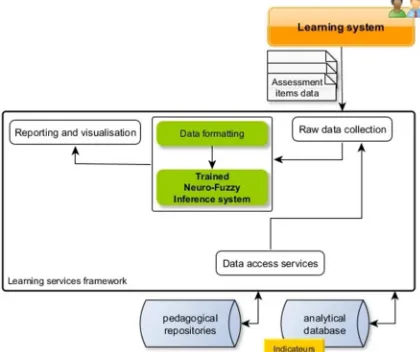
The figure below (figure1) shows the synthetic scheme of the service based architecture where the proposed ANFIS system to be integrated. The ANFIS based analysis system is integrated into a framework of a web service based e-learning platform [12]. An Earlier use case proposal based on the proposed system can be found in [13].
[image:3.612.90.300.444.620.2]The architecture is based on composed components. More technical aspects of integration can be found in Ait ouguengay et al [14]. The ANFIS system is integrated as a ‘trained’ on-line system. The adoption of SOA approach provides the trace-based system with possibilities of real-time processing. In fact, emerging learning environments both free and commercial solutions are based increasingly on the web 2.0 technologies, particularly web service architectures are in action. These are a better alternative to provide analysis capabilities desired data with a minimum of integration and intervention on the learning platform itself.
Fig 1: integration of the Inference system Block in the learning framework
Raw data is retrieved from the learning system or from other data sources that may be available (third party databases, web logs, surveys, questionnaires, etc.). Traces collected, involve interactions of learners with learning system. The structure of the collected data is determined by
indicators predefined by the analytical objectives of the targeted analysis problem. Items processed by the collection operation depend entirely on the definition of these indicators. A set of reusable models and indicators can be available to users of the system with the possibility to define other custom indicators according to the needs and objectives.
The data transformation service allows preparation of the collected data for the analysis process; it is about the verification of data for refinement and formatting in a way that can be communicated to the analysis component. The transformation of data depends strongly on the approach adopted and methods of analysis (statistics, Artificial Intelligences...). The analysis itself aims to measure predefined indicators and derive results regarding the evaluation of studied learning aspects.
4.ASSESSMENT OF COMPETENCIES ACQUISITION: CASE STUDY
A given competence has several manifestations. The fact to identify all aspects of a competence involves a significant mobilization of educational and material design and would therefore be a laborious purpose to completion. The evaluation of its aspects is, under most cases selective. In addition, the evaluation concerns the functional aspects of competencies [15] which is relatively easier to quantify [16]. From another perspective, developing a model to estimate competencies level is problematic due to the uncertainty associated with the cognitive characteristics of competencies and its variables. It is one of the real-world problems where vague and ambiguous input data should be handled for modeling. The appropriate system should be capable of distributed representation of information, parallel processing, learning and self-organization to achieve flexibility in information processing [17]. In this section we describe the main of the case study and its hierarchical aspects.
4.1. Reading And Writing Competencies In Amazigh Language:
ISSN: 1992-8645 www.jatit.org E-ISSN: 1817-3195
603 Basically as the Amazigh language curricula and teaching materials, for the six levels of primary education, in addition to the formation of a significant number of administrative and educational staff. The major aim of introducing amazigh in the educative system was to enhance communicative skills of students, considering the Amazigh language as a language of communication in everyday life. Particularly communicative competences are emphasized including: reading and writing, listening and speaking.
In qualitative terms, the work on assessing the quality of learning in the Amazigh language is still in its early. The only diagnostic study of the teaching/learning of the Amazigh language, stated by Ichou (2012), targeted the evaluation of teaching/learning of reading and writing of Amazigh in its authentic script Tifinagh, at CE2 level [18]. A second study is currently being published that targeted CE6 and CE4 levels [19]. Precisely, the present work is based on the referential framework of this latest study which is based on the competency driven approach.
4.2. Evaluation of Reading and writing competencies:
Traditional models of education are often in conflict with the skills; in the learning content based on competencies, only the learner outcomes that are highlighted. The content targeting competencies helps save time and resources in learning activities by eliminating content that has nothing to do with the necessary context. And given the multidisciplinary nature that must have the competencies evaluation situations, the competency-based education is not completely a disciplinary approach. The model calls for the convergence of disciplines as required as possible, unlike traditional models where disciplines are distinct.
In order to identify differences in levels of competencies among learners, the educational curriculum in question, should be based on a competencies approach. It is understood that evaluation in the context of active approaches such as those based on competencies is, firstly, to verify, upstream, whether, during learning, the student selects and uses well its resources or not and, secondly, through a summative evaluation, if he can successfully solve a task. The tutor can collect evidence of learning and student progress through indicators that he operate by comparing with criteria to measure the degree of mastery of the competency. By indicators, we mean all evidence
demonstrating learning and progression and, by criteria we mean referential expressions which allow the teacher to decide whether a student has reached a level expected and if the result is satisfactory. The tutor or the expert can set the criteria in reference to the steps he considers necessary for learning. The link between these criteria and indicators has been precisely the system design discussed in this work.
In a technical manner, one should not confuse, in absolute, the score given to a student following a review with his competency level. the latter is (must be) usually related to a linguistic variable, which expresses the level of acquisition of a particular skill. Value of this variable is relative to a predefined scale whose minimum value is a total failure and a maximum value corresponds to total satisfaction of the criteria of competence. The main feature of this evaluative indicator is the fuzzy measure which arises in the region that separates a given level to neighboring level.
4.3. Methodology of formalism
In the present study, the assessment material being the source of the established system, it consists of two tests on reading and writing Amazigh language in Tifinagh script [20] presented as a course package in the open source platform of learning Moodle. Tests are in the form of tow list of assessment items of different nature (true or false, single and multiple choice questions, Gap-fill text), the first one for reading and second one for writing assessment. Each question is attached to one criteria of one competency.
ISSN: 1992-8645 www.jatit.org E-ISSN: 1817-3195
604
Fig.2: Hierarchical Structure Of Competency Evaluation
The figure 2 shows how an estimation of the competency indicator is achieved from scores of assessment items; through primary indicators and criteria. If is a competence. is verified through the criteria , 1. . .. Each criteria is materialized by a vector of measures of indicators:
, , 1. .
Considered indicators in the current study are calculated from the scores of assessment items. We present the competency matrix as consisting of C column vectors:
.. (1)
, , ..
..
, ,
, ,
…
… ,, ,,
⋮ ⋱ ⋮
, , … , , !
"
Where is the number of criteria, is the number of indicators attached to the criteria . The matrix
, is a scalar weighting matrix of criteria determined by the referential framework. It gives every criterion its weight or importance in the evaluation of the competency.
5.STRUCTURE OF THE PROPOSED
ANFIS MODEL:
The multi-inputs multi-outputs ANFIS model, or CANFIS for co-active ANFIS, was developed using the open source ToolBox CANFIS [21] of MatLab software (version R2013a) based on [22]. The hybrid neuro fuzzy network uses the error back-propagation algorithm. A combination of two methods recursive least-squares and back-propagation gradient descent is implemented for
training the neural network parameters to estimate the set of training data.
Fig.3: Classic Architecture Of Co-Active ANFIS
The ANFIS model consists of 5 layers with specific tasks as shown in figure 3.
The first layer in input layer: every neuron receives
the value of input variables # (weights of neuronal links are always equal to 1).
Layer 2 is the fuzzification Layer. the output of
each neuron is a membership function of the input variables as :
$%&, ' (# )
Where $%&, correspond to the value of the &* linguistic term of the variable#. ' is the membership function. The construction of this layer is effected by digitalization of the membership functions, each neuron is then a fuzzy entry point. The level of error naturally depends on the sampling frequency (therefore the number of points of scanning) of the membership functions. The third layer is called ‘rule antecedent layer’. Each neuron represents the conditional elements of a fuzzy rule (' + , -). The outputs of this layer reflect the strength of the rule in question in relation to other opponents’ rules.
$%& ' (# )' (# ) … ' .# /0 12 34567
8 ' (# )
/0 12 3456
ISSN: 1992-8645 www.jatit.org E-ISSN: 1817-3195
605 of the different fuzzy rules, and also determining the degree of membership of the conditions ('. . + . . ,. . -) to opposite linguistic outputs. The number of neurons in this layer is equal to the number of the fuzzy rules used.
$%&9: ∑ $%&, $%& , /0 12 04<=6
The last layer of defuzzification has the fundamental role of evaluating inferred logical rules. Each neuron represents the logical result of the part(>*? @ , A). The used method of defuzzification used so far is the height method expressed with the equation:
$%& ∑∑/0 12 04<=6B 'B /0 12 04<=6
The parameters used for the ANFIS system are tuned from the used toolbox. The used membership functions are Gaussian functions and the input space is Grid-type partitioned, and three 3 linguistic terms are defined for each variable CDEEF, GH?FGI?, IEEJK.
5.1.
Training Data generation
The reference framework, designed by domain experts, was the main source of training data engineering. The methodology applied uses data generated by the summative test that will pass the pupils. The data is transformed into a digital matrix of vectors, each vector associated with one of the criteria. Each component in a given vector represents a possible value of the corresponding criterion. The aggregation of all the possibilities of this operation generates an initial matrix of scores associated with different items served in the test (Table 2). The output assessments; which are used in the system training and testing are also appraised in accordance with the objectives of the assessment: the various criteria are weighted and valued accordingly (equation 1).
Table.2: Extract From The Training Data (Input Values) Of The CANFIS System
x1
x2
x3
x4
x5
0 0,6 0 0,6 0,4
0.2 0,6 0 0,6 0,4
0 0,47 0 0,6 0,4
0.2 0,47 0 0,6 0,4
0 0,36 0 0,6 0,4
0.2 0,36 0 0,6 0,4
0 0,24 0 0,6 0,4
0.2 0,24 0 0,6 0,4
0 0 0 0,6 0,4
……
Training and testing data is prepared in a usable format by the ANFIS network.
5.2.
Characteristics of the model
implementation :
Input Space partitioning
Several methods of partitioning the input space of discourse for the ANFIS model exist. it can be generated by experts and inserted into the system. Another method is the clustering of input variables values (traditional K-means), but in this case the number of clusters is predetermined and the convergence of the system is biased. The method used in this case study is based on the grid partitioning of the input space of variables. This is a more natural way to handle possibilities of the system.
Terms of variables
Terms of variables, which represent different levels of the values of membership functions of different variables are proposed in the light of the assessment requirements determined by domain experts, and vary between three levels: poor, average, good.. as an example, Figure 4 shows the appearance of the membership function of the criteria ‘application’.
Fig.4. Membership Function Of ‘Application’ Variable
Fuzzy rules
ISSN: 1992-8645 www.jatit.org E-ISSN: 1817-3195
606 partitioning, number of rules is as : L04<=6 .L 345_5=0N67OPQRST. While the structure of the logic rules generated by the ANFIS model is as follows:
' #1 , #1UV<4=… … . G J #5 , #5UV<4= &*? XY , XYUV<4= G J XZUV<4=
5.3.Training the model: simulation results
As mentioned earlier, data used in training the model is prepared from the referential framework established for the reading and writing evaluation. A vector of 5 inputs (# , # , . . , #[) is simply constructed, where each one represent a criteria measure (figure 4). All the inputs are linguistic variables with three
linguistic values: poor, average and good. The inputs vector is divided on two sub-vectors: (# , # , #:) presenting the reading competency domain and (#\, #[) for writing domain.
Fig.4: competency evaluation system
The outputs vector (X], X^) is derived from different scoring items. X] is the reading competency score and X^ is the writing competency score. The combination of all possibilities is calculated from a total of 900 records in the input-output data. 500 records were used to train the system and 500 for testing.
At this stage, the proposed method is implemented for ranking of learners, based on their competency scores. The norm used for comparative evaluation of the performance of the model is the Root Mean Square Error (RMSE) according the equation:
_ `Z a1> b($%&c1d=<e $%&V 54V< dV5V)
Where 1 >⁄ is the frequency of sampling. The RMS error is presented in figure 5. As results of modeling it can be observed that the developed model results are satisfactory with an acceptable RMS error for training data witch reach 0.0685 (dotted line) and 0.1103 for testing data (magenta) in one epoch.
Fig.5: Root Mean Square Error (RMSE)
Moreover, figure 6 shows the performance of the developed model respectively for training and testing data. It details the comparison results of the fuzzy system and the expected results (actual data) for each record (respectively training and testing ones). For the Two graphics, the horizontal axis is representative of data number, and the vertical one presents the competency score. Moreover, test output results obtained show that the output values from the developed model are very close to the values proposed by the referential framework (Table 3).
Fig.6: convergence of the co-active ANFIS model through training
N°
Value of output
Reference
ANFIS
yL
yE
yL
yE
501
0.700 0.100 0.509 0.099
502
0.200 0.300 0.141 0.288
503
0.250 0.450 0.395 0.438
.
.
.
ISSN: 1992-8645 www.jatit.org E-ISSN: 1817-3195
607
Table3: Obtained outputs from the ANFIS model
6.DISCUSSION :
The information presented to the inference system is based on the referential framework; it is limited to information on the indicators values, calculated from score items, and the weight of each criterion. Parameters of the tuning of the CANFIS model are based on the expert information which consists of the partitioning of the space of discourse and the definition of linguistic variables and membership functions. The system being based on neural networks, it is expandable for the learning of further data so as more criteria can be integrated into the system without loss of information already learned.
Moreover, the capabilities of neuro-fuzzy networks are used to map input variables to output variables. Indeed, the proposed model does not require any initial preprocessing effort, once the data formatted; the remaining operations are carried by the designed network. This advantage match significantly with the context of integration of the system, which is based on a service based architecture. In addition, although this study has been performed for the reading/writing competencies, the proposed methodology can be applied for other competencies and different criteria.
7. . CONCLUSION AND FURTHER WORK
In this study, a co-active ANFIS model has been employed for reading and writing competency evaluation. The developed model gives adequate results in relation to the machine learning process and the validation of the system using testing data. Further work is necessary to compare efficiency of different ANFIS based models for approaching competencies in educational context. In a perspective of optimizing results of the system we envisage to integrate an automated fuzzy analytical hierarchy process (FAHP) approach for the preparation of fuzzified training data which may give a much better representation of the linguistics of competency evaluation problem. Comparison of the different spaces partitioning is necessary to research for the optimal point between number of fuzzy rules and degree of precision of the model outputs. The partitioning method used in this paper is of grid-partitioning type.
ACKNOWLEDGMENTS
The materials for this paper were extracted from the analytical report of “the assessment of Scholastic achievement among students of primary education on the amazigh language through reading and writing” [12]. A study realized in the CRDPP center of the Royal Institute of the Amazigh Culture (IRCAM), which was carried by EL Baghdadi Mhamed and Ichou Benaissa.
REFERENCES:
[1] Commission Spéciale d’Education et de Formation: COSEF. (1999). “Charte Nationale d'Education et de Formation”. Available on : http://www.men.gov.ma/ sites/fr/Lists/Pages/charte.aspx (last accessed :20th sptember 2015)
[2] Fuller, R., « Fuzzy logic and neural nets in intelligent systems », C. Carlsson ed., Information Systems Day, TUCS General Publications, Vol. 17, Turku Centre for Computer Science, Abo, [ISBN 951-29-1604-5], 1999 74-94
[3] Silvert, W., « Fuzzy Aspects of Systems Science”, Integrative Systems Approaches to Natural and Social Dynamics, 2001, Springer Berlin Heidelberg, chapter, pp 73-81
[4] Ajith Abraham, “Neuro Fuzzy Systems: State-of-the-Art”, Connectionist Models of Neurons, Learning Processes, and Artificial Intelligence, 6th International Work-Conference on Artificial and Natural Neural Networks, IWANN 2001 Granada, Spain, June 13–15, 2001 Proceedings, Part 12001, José Mira, Alberto Prieto, 2001.
[5] Prasath V., Lakshmi N., Nathiya M., Bharathan N., Neetha P., “A Survey on the Applications of Fuzzy Logic in Medical Diagnosis Support Systems Systems Decision,” International Journal of Scientific & Engineering Research, ISSN 2229-5518, Vol. 4, No. 4, pp. 1199– 1203, 2013.
ISSN: 1992-8645 www.jatit.org E-ISSN: 1817-3195
608 [7]Tatjana Vasileva-Stojanovska, ,Marina
Vasileva ,Toni Malinovski ,Vladimir Trajkovik, « An ANFIS model of quality of experience prediction in education », Applied Soft Computing, Volume 34, September 2015, pp 129–138
[8] Taylan O., “An adaptive neuro-fuzzy model for prediction of student’s academic performance,” Computers & Industrial Engineering, Elsevier, vol. 57, pp. 732-741, 2009.
[9] V. Shahhosseini, M.H. Sebt , « Competency-based selection and assignment of human resources to construction projects », Scientia Iranica, 2011, pp 163–180.
[10] Lazarevic, S.P. ‘‘Personnel selection fuzzy model’’, International Transactions in Operational Research, 8, pp. 89–105 (2001). [11] Golec, A. and Kahya, E. ‘‘A fuzzy model for
competency-based employee evaluation and selection’’, Computers & Industrial Engineering, 52
[12] Khalidi Idrissi, M; Merrouch, F; Bennani, S; (2009); “Analyse des situations e-learning : abstraction et modélisation» ; 2ère Conférence internationale, systèmes d’information et intelligence économique, SIIE 2009 Hammamet, Tunisie, 12-14 Février 2009 ; IHE édition, pp. 153-164; ISBN: 9978-9973-868-21-3
[13] Bennani, S.; Idrissi, M.K.; Fadouli, N.; Yassine, B.T.; Ouguengay, Y.A., "Online Project based learning driven by competencies: A systematic strategy proposal for assessment,"
in Interactive Mobile and Computer Aided
Learning (IMCL), 2012 International
Conference on , pp.92-97, 6-8 Nov. 2012
[14] Youssef Ait ouguengay, Nour-eddine El faddouli, Mohamed Khalidi Idrissi, Samir Bennani , « A service-oriented architecture for real time data collection in e-learning context: SCORM runtime environment case study », proceedings of the 3rd International conference on Applied Informatics and Computing Theory (AICT '12), 2012.
[15] Marie-Thérèse Célis-Geradin et Christiane Coopman-Mahieu, « Évaluer à partir d'un profil de formation structuré par compétences », chapter 4, Quel avenir pour les compétences?, By Christiane Bosman, François-Marie Gerard, Xavier Roegiers, de boeck, 2000, pp101-112.
[16] Rogiers, X., De Ketele, J.; “une pédagogie d’intégration”, Chapter 8, 2nd edition, De Boeck, 2001
[17] V. Sreekanth et al. “Generalized RBF feature maps for efficient detection”. In: Proceedings of the British Machine Vision Conference (BMVC). 2010.
[18] Ichou, B., « Le degré de maîtrise de la graphie tifinaghe dans l’enseignement/apprentissage de la lecture et de l’écriture en langue amazighe au Maroc : étude évaluative diagnostique », OLBI working papers , 2012 [19] El Baghdadi, M.; Ichou, B., “analytical report
on the assessment of Scholastic achievement among students of primary education on the amazigh language through reading and writing”,
[20] Ameur, M. et al “graphie et orthographe de l’amazighe”, IRCAM, 2006.
[21] Ilias Konsoulas, “Adaptive Neuro-Fuzzy Inference Systems (ANFIS) Library for Simulink”,
http://www.mathworks.com/matlabcentral/file exchange/36098-adaptive-neuro-fuzzy-
inference-systems--anfis--library-for-simulink, 09 Apr 2012 (Updated 01 May 2015), (last accessed: 22th September 2015) [22] Jang R. J.-S., Sun C.-T., Mizutani E., (1997),