DYNAMIC EFFECT OF KNOWLEDGE MANAGEMENT
SYSTEM ON SCHOOL MANAGEMENT
1PIN-CHANG CHEN, 2TIAN-SYUNG LAN, 3YU-HUA LAN, 4HUA-YING HSU
1Assistant Professor, Department of Information Management, Yu Da University of Science and
Technology, 36143 Miaoli, Taiwan
2Professor and Chairman, Department of Information Management, Yu Da University of Science and
Technology, 36143 Miaoli, Taiwan
3Lecturer, Center of General Education and Core Curriculum, Tam Kang University, 25137 New Taipei
City, Taiwan
4Graduate Student, Department of Information Management, Yu Da University of Science and Technology,
36143 Miaoli, Taiwan
E-mail: [email protected], [email protected] , [email protected], [email protected]
ABSTRACT
The main purpose of this study is to investigate the effect of knowledge management system on school management, as well as to use system dynamics as the main research method. This study selected a certain elementary school in Miaoli County in Taiwan as the research subject. This study used students’ sense of identification, parental satisfaction and teachers’ centripetal force to investigate the factors affecting school management. According to the research results, this study verified that innovative knowledge management is very important to school’s management effectiveness. Innovative knowledge management makes students more motivated, makes their learning effective better and increases the sense of identification of classes and schools. This study also verified that parental satisfaction and parents’ level of interaction have a mutual effect on each other. In addition, this study verified that, if teachers’ sense of teaching accomplishment is stronger, their centripetal force for school indeed will be increased.
Keywords: Knowledge Management, System Dynamics, Sense of Identification, Parental Satisfaction,
Centripetal Force.
1. INTRODUCTION
With the current booming development of information technology, some of the computer technologies and information application have been highly developed and created many benefits to all walks of life. With the rapid development of globalization and technology, the importance of knowledge has also gradually increased. Whether enterprises can effectively create, accumulate, utilize and manage knowledge and convert knowledge into a competitive weapon has become a key to the sustainable operation of enterprises. Therefore, an increasing number of enterprises have started to attach importance to knowledge management [1].
At present, the Department of Education of various counties and cities in Taiwan are promoting computerized knowledge management in elementary schools and junior high schools in order to use the characteristics of computer network to achieve the objectives of systematization and
sharing of knowledge management [2]. If schools can make the best use information technology to build school websites as “knowledge management platforms” to achieve the objectives of the idea of knowledge management including knowledge storage, exchange and sharing, it will be convenient for teachers, parents and students and will help improve the efficiency of school administration and teaching to maintain school competitive advantage [3]. It is hoped that computer network and real-time information exchange can be used to achieve the objective of information management [4]. In addition, during the promotion of knowledge management, schools also have to develop themselves into learning-based organizations. Schools should use team learning and the sharing of knowledge and experiences to develop the databases of learning and shared learning to enable all the teachers and students to develop a common vision [5].
management, and used system dynamics as the main research method. This study selected a certain elementary school in Miaoli County in Taiwan as the research subject, and used students’ sense of identification, parental satisfaction and teachers’ centripetal force to investigate the factor affecting school management.
2. LITERATURE REVIEW
System dynamics is a computer simulation model proposed by J.W. Forrester in Massachusetts Institute of Technology, U.S. in 1956. He suggests that system dynamics is not only a science for developing model, but also an approach to see the world, namely, a tool for observing the change of dynamic structure with the change of time. In 1968, Forrester further clarified its theory and methods in “Principles of System.” Forrester simulated worldwide problems using the concepts of system dynamics, and published his book titled “The Limits to Growth” to remind the government of various countries of limiting economic growth, as well as to remind various countries of paying more attention to the crises taking place in earth resources and environmental resources. This book caused extensive discussion in the society at that time, and made system dynamics attract more attention [6].
In the 1990s, P. M. Senge applied system dynamics to the field of organization-based learning. Therefore, the application of system dynamics was extended to the field of social science, including the comprehensive application of the field of management, production economics, macroeconomics and globalization issues [7]. For the past many years, many scholars have engaged in the studies concerning the issues of system dynamics methodologies, such as the concept and method of system dynamics, model development issue, model validity, theory and practice, case study, etc. After being developed for a half of century, system dynamics has become a mature science [8],[9].
Therefore, system dynamics is an approach to study and manage complicated feedback system, emphasize the overall consideration in the system and understand the interactions among all the variables in the system. Moreover, it uses computer simulation to reflect how variable structure, policy and delay affect one another, as well as the system development direction. Its focus is not to predict or to observe trend alone, but to probe into the nature behind complicated changes in problems [10].
3. RESEARCH METHOD
To fully grasp the dynamic relationships among various factors, this study used the research method of system dynamics and simulation operation of computer program to understand the characteristics of various feedback loops and time delays during system changes. This study used Vensim simulation software. Vensim software is developed by Ventana Systems, Inc. in the U.S. It is graphic interface software that can conceptualize, documentize, simulate, analyze and optimize system dynamics model. Vensim can provide an easy and flexible approach to develop relevant qualitative models, such as cause-and-effect feedback loops and flowchart. Various graphic arrow marks are used to connect various variables, and appropriate equations of the relationships among various variables are input into the model. The cause-and-effect relationships among various variables were also completely documented. Moreover, Vensim can also be used to develop dynamic model. As long as the equations of the relationships among various variables and parameters can be input into the model, a dynamic model can be developed. The cause-and-effect relationships and loops among various variables can be understood through the process of model development. Furthermore, the relationships between input and output of variables can be understood through the unique functions of the program to enable users to better understand the model framework, as well as to facilitate model creators to revise the model content [11].
Figure 1: Cause-and-effect Loop Diagram of the Relationship between Knowledge Management System
and School Management
Upon completion of the cause-and-effect loop diagram and confirmation of the accuracy of the cause-and-effect relationships among various variables, the system dynamics model diagram could be drawn, as shown in Figure 2.
Students’ sense of identification
Sense of teaching accomplishment
Parental satisfaction Class website
Convenience of use of the website <Time>
<Time>
Teachers’
centripetal force
time delay 2
time delay 1
time delay 3 Input 1
Level of use of the website
Exhibition of
learning outcomes Exhibition of profession
Teaching quality Level of
interaction Confounding
factors
Input 2
Input 3 Sense of identification Webpage update
Practicality of the KMS
Website click rate Service quality
[image:3.612.96.292.356.492.2]of the website
Figure 2: System Dynamics Model Diagram of Knowledge Management and School Management
4. RESULTS AND DISCUSSION
This study investigated the relationships among students’ learning outcomes, parental satisfaction and parents’ interaction with school, teachers’ centripetal force and sense of teaching accomplishment by developing the complete system dynamics model and inputting different parameters into the simulation test.
For the diagrams presented in this study, the horizontal axis denotes the cycles in the system dynamics simulation and represents the learning process. Semester is the unit, and the simulation cycle is 10 semesters, representing the use of innovative knowledge management system from grade 1 to grade 5 for 5 years. The vertical axis denotes the performance of dynamic behaviors in
each period of time and represents the cumulative number of changes in each period or the direction or trend of each period.
4.1 Students’ Sense of Identification and Exhibition of Learning Outcomes
The simulation results of this study showed that, the exhibition of students’ various learning outcomes had a significant effect on their sense of identification for school. With the increase or decrease in the number of exhibitions, students’ learning effectiveness would increase or decrease. This study found that the similarity of linear change was quite high, showing a significantly positive relationship. The linear height of students’ sense of identification for school was even higher than that of learning outcomes, suggesting that the exhibition of learning outcomes in lower grades did not have a significant effect on students’ sense of identification. During middle and high grades, students’ sense of identification for school could also be maintained at a certain level even though the opportunity of exhibition was decreased. Students’ sense of identification would not significantly decrease with the decrease in opportunity of exhibition. Students’ sense of identification and learning outcomes are shown in Figure 3.
Figure 3: Analysis on Students’ Sense of Identification and Exhibition of Learning Outcomes
4.2 Parental Satisfaction and Parents’ Level of Interaction with School
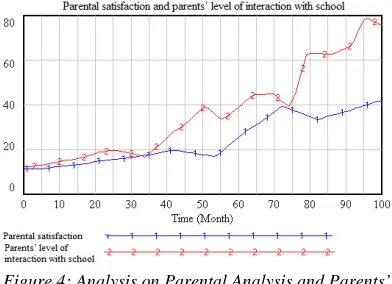
[image:3.612.323.513.450.587.2]improved and school management could be effective. Therefore, this study suggested that school and parents have to spend time developing a good interaction model during their mutual interactions and only by doing so can a win-win situation be created. After all, parents and school are the partners of education, and only good communication can students obtain the most favorable scenario. The parental satisfaction and parents’ level of interaction with school are shown in Figure 4.
Figure 4: Analysis on Parental Analysis and Parents’ Level of Interaction with School
4.3 Teachers’ Centripetal Force and Sense of Teaching Accomplishment
[image:4.612.96.292.240.382.2]In school education, if teachers have centripetal force for school and class and are enthusiastic about teaching, they naturally will attentively manage the class website. Under the situation where it is convenient to use website, teachers’ profession can be displayed, teachers can continuously interact with students and parents, their teaching quality can be improved and they can obtain a good sense of teaching accomplishment, which is a positive feedback loop. However, teachers’ centripetal force is also affected by workload, information literacy and administrative support. High workload, lack of information literacy, low administrative support and cooperation will lead to decreased teachers’ centripetal force. On the contrary, low workload, possession of information literacy and high administrative support and cooperation will lead to increased teachers’ centripetal force. Teachers’ centripetal force and sense of teaching accomplishment are shown in Figure 5.
Figure 5: Analysis on Teachers’ Centripetal Force and Sense of Teaching Accomplishment
5. CONCLUSION
This study verified that innovative knowledge management is very important to school management. With the increase in student participation and proportion of website activities, the importance of websites to students has increased gradually. If websites can exhibit students’ learning outcomes regularly and directly affect their reference for websites, students’ sense of identification for school can also be increased.
This study also verified that parental satisfaction and parents’ level of interaction with school have a mutual effect. Parents’ participation in school activities has a positive effect on parent-teacher relationship, parent-child relationship and students
’ learning effectiveness. Therefore, parents’ participation in school activities has become an important part of education policies. The specific interaction between school and parents is to build good websites. If parents find it convenient and easy to use website system, the service quality is good and they can understand children’s learning condition and teachers’ teaching idea in school, the website click rate will be increased, their quality of interaction with school will be improved, they will naturally agree with school management approach and they will be extremely satisfied with it.
Teacher’s centripetal force for school will only be increased and will not be decreased.
Therefore, schools should build school website as “knowledge management platform” to achieve the objectives of the idea of knowledge management including knowledge storage, exchange and sharing. A school website enables students to check the exhibition of the outcomes of their interactions with classmates. A class website also enables students to connect to and interact with mentor. Such a learning scenario makes students more motivated, makes their learning effectiveness better and improves their sense of identification for class and school.
REFRENCES:
[1] R. E. Slavin, (1995) Cooperative Learning:
Theory, Research and Practice (2nd ed.),
Englewood Cliffs, New Jersey, USA: Prentice Hall, 1995.
[2] M. Alavi, and D. E. Leidner, “Knowledge Management and Knowledge Management Systems: Conceptual Foundations and Research Issues”, Management Information
System Quarterly, Vol. 25, 2001, pp. 1-1.
[3] J. Galbreath, “Knowledge Management Technology in Education: An Overview”,
Educational Technology, Vol. 40, No. 2,
2000, pp. 28-33.
[4] H. Wenglinsky, “How Money Matter: The Effect of School District Spending on Academic Achievement”, Sociology of Education, Vol.67, 1997, pp. 221-237.
[5] C. Antonelli, E. Steinmueller, and A. Geuna, “Information and Communication Technology and the Production, Distribution and Use of Knowledge”, International
Journal of Technology Management, Vol. 20,
No. 1, 2000, pp. 72-94.
[6] J. W. Forrester, World Dynamics, Cambridge, USA: The M.I.T. Press, 1971.
[7] J. D. Sterman, Business Dynamics: Systems
Thinking and Modeling for a Complex World,
Boston, USA: Irwin McGraw-Hill, 2000. [8] G. Coyle, “Qualitative and Quantitative
Modelling in System Dynamics: Some Research Questions”, System Dynamics
Review, Vol. 16, No. 3, 2000, pp. 225-244.
[9] A. Rodrigues, “The Role of System Dynamics in Project Management”,
International Journal of Project
Management, Vol. 14, Iss. 4, 1996, pp.
213-220.
[10] J. M. Lyneis, “System Dynamics for Business Strategy: A Phased Approach”, System
Dynamics Review, Vol. 15, No. 1, 1999, pp.
37-73.
[11] R. L. Eberlein, and D. W. Peterson, “Understanding Models with Vensim”,
European Journal of Operational Research,