BEAM: BANDWIDTH EFFICIENT ACKNOWLEDGEMENT
BASED MULTICASTING PROTOCOL FOR SUB-URBAN
SCENARIO IN VANET
P.GOKULAKRISHNAN 1 , P.GANESHKUMAR 2
1 Department of Computer Science and Engineering, PSNA College of Engineering and
Technology, Dindigul – 624622, Tamilnadu, India. Email: [email protected]
2 Department of Information Technology, PSNA College of Engineering and
Technology, Dindigul – 624622, Tamilnadu, India.
Email: [email protected]
ABSTRACT
The purpose of this research work is to improve the performance of Vehicular Ad-hoc Networks (VANET) by reducing the number of in-network message transactions, and there by efficiently utilizing the bandwidth during an emergency situation. Bandwidth Efficient Acknowledgement based Multicasting protocol (BEAM) is proposed instead of the existing broadcasting protocol such as Acknowledged Broadcast from Static to highly Mobile (ABSM) an adaptive broadcast protocol. In BEAM, the emergency situations are predicted based on the status report send by the vehicles to the nearby Road Side Units (RSU). RSU (ie source) creates a multicast group, and sends an emergency message to all group members. The members reply with acknowledgements. Unlike ABSM protocol, with BEAM the vehicles decide whether to receive a message or not. The BEAM does not disturb all vehicles in the network and it helps conserve the bandwidth by exchanging minimum number of messages to multiple recipients
simultaneously. Performance of BEAM is evaluated based on the number of in-network message
transactions, involved in sub-urban scenario of VANET. BEAM reduces at most 13% of the in-network message transactions when compared to the existing broadcasting protocol.
Keywords: Bandwidth Efficiency, Emergency Messages, Status Report, Multicasting Group, Sub-urban Vehicular Ad-Hoc Networks, Intelligent Transportation System.
1. INTRODUCTION
Transportation system is a fundamental piece in modern societies. Most people use vehicles to go to work, or travel at their free time. Hence there are more vehicles on roads creating traffic jams. Accidents cause maximum number of deaths every year. There are several initiatives taken from the public and private sector to solve the problem. Vehicular Ad-hoc Network (VANET) [1, 2, and 24] is the key solution to resolve this problem. VANET is a technology that uses moving vehicles as nodes
to create a mobile network.
The idea is that the roads are equipped with fixed infrastructure called Road Side Unit
(RSU) and vehicles are equipped with
communication capabilities for sensing,
transmitting and receiving signals [3]. Vehicles will sense and transmit data to nearby RSU. The RSUs should collect, compute and distribute information to vehicles in the accident zone to improve safety, maintain better traffic efficiency and offers
improved driving experience to driver as well as safety to passenger.
The existing system uses an
acknowledgement - based broadcasting protocol such as Acknowledged Broadcast from Static to
highly Mobile (ABSM) protocol [4]. Broadcasting
protocols are suitable for all scenarios in VANET [6, 7]. Broadcasting is the process of sending a message from a source node to all other nodes in a network and it is often referred to as data dissemination [3].In order to achieve this kind of communication, the protocols should cope up with the mobility of vehicles and the dynamics of wireless signals. Vehicle movements are restricted by the road layout, traffic signals, and other vehicles movements. This leads to highly partitioned networks with non uniform distribution of nodes [2]. VANET encompass Vehicle to Vehicle (V2V) or Inter-Vehicle Communication
(IVC) and Roadside to Vehicle (RVC)
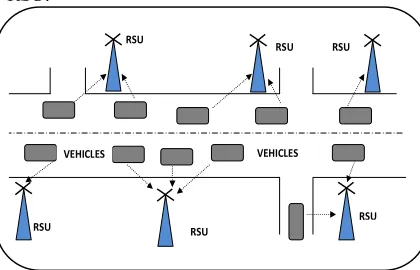
communication system [5,8,9] as in figure 1.1.
permits vehicles to communicate themselves without participation of any infrastructure such as RSU. Roadside to Vehicle (RVC) communication system involves RSU in communication that takes place between vehicles or between vehicle and RSU.
Figure 1: VANET Communication Architecture
In sub-urban vehicular networks the roads are least populated with vehicles, Hence the choice of a broadcasting protocol will be disadvantageous in this scenario because not necessarily all vehicles should be notified about a particular event [10,11]. As vehicles are far away from each other it is difficult to reach all vehicles in the network for notifications and acknowledgements. The existing broadcasting protocol such as Acknowledged Broadcast from Static to highly Mobile (ABSM) protocol, it handles many numbers of messages due to its broadcasting nature, which leads to an
overhead. It lacks in optimized network
performance and energy conservation in
broadcasting messages to all vehicles whether they are necessary or not. Therefore, Bandwidth Efficient Acknowledgement based Multicasting protocol (BEAM) a multicasting protocol with acknowledgement is most suitable for this scenario [12, 13, 14, 15, 22, 23 ]. In case of emergency event like heavy traffic, the vehicles in a particular region alone should to be notified. During such an event, the BEAM forms a multicasting group involving
nearby RSUs and surrounding vehicles.
Notifications are exchanged within the group. Multicasting messages will be forwarded through routers that are multicast-enabled [8].
2. RELATED WORK
In VANET, the most existing protocols are based on broadcasting approaches. As per our previous discussion the in-network message transactions are more in some of the existing protocols. A few years back, initiatives were taken to reduce the number of in-network message
transactions. In order to reduce the number in-network message transactions, the multicasting approaches are used so as to overcome the difficulties in broadcasting approaches.
Acknowledged Broadcast from Static to highly Mobile (ABSM) protocol [4] is an acknowledgement based broadcasting protocol. ABSM protocol broadcasts emergency messages to all the vehicles, whether the vehicles need the
message or not. ABSM also expects
acknowledgement from all the vehicles. In ABSM the numbers of in-network messages are more because of the broadcast nature of the protocol.
Context-aware multicast routing for ESM dissemination (CMED) protocol [16]. This protocol is basically a multicasting protocol. The objective of this protocol is to reduce unnecessary transmissions and to deliver Event Safety messages (ESM) or Emergency warning messages to the surrounding vehicles as fast as possible in order to warn those vehicles when an abnormal event occurs. The CMED protocol particularly focuses on the problem of disseminating ESMs in an efficient and timely manner. ESMs are very useful to prevent many vehicles from a multi-vehicle chain collision. An Electronic Emergency Brake Light (EEBL) application will trigger ESM dissemination if it detects a deceleration that exceeds a certain threshold. This protocol attempts to reduce the number of message transmission and focuses on efficient and fast ESM dissemination. The use of context information in CMED protocol requires a larger computational overhead compared to other protocols. Because of Interaction graph and multicast tree generations, the execution time of this algorithm takes more time. This protocol has not been experimented for complex scenarios.
Robust Scalable Geographic Multicast Protocol (RGSM) [17, 18] supports a two-tier membership management and forwarding structure. The first tier is based on the position information where a zone structure is built and when the zone has members, a leader is elected on demand. A leader manages the group membership and collects the positions of the members in its zone. In the second tier the leaders has a direct deal with the source. If the source needs to communicate a message, it sends the message to the leader and then it is the responsibility of the leader to transfer the message to its members in the group. In this two tier approach as the message transmission is carried out in two phases there is a possibility of more number of transmissions. Electing a leader on demand, zone management and handling empty zones are the problems of this work
RSU
RSU
RSU RSU
RSU RSU
The design of reliable and adaptive protocols in vehicular context is challenging, especially due to high dynamicity of the underlying topology and its intermittent connectivity in most scenarios [19]. VANET certainly provides traffic safety and improves traffic. The system uses the cellular network architecture, in which it has four components such as vehicles, personal devices, road-side equipment and central equipment. All information collected by the vehicles through the personal devices are transferred to the Road side equipment and then to the central equipment. The reverse communication takes place from the central equipment to the roadside equipment and then to the vehicle. This work uses the existing cellular network model. Although it is effective in-terms of performance, the communication results in more traffic in the network and it leads to more overheads.
The work Analysis of Routing Protocols for Highway Model without using Roadside Unit and Cluster focuses only on vehicle to vehicle communication in VANET without using any infrastructure [20]. It analyses various routing protocols without any roadside unit and cluster. For reliable vehicular communication the performance of routing protocol used for communication is very important. This work is based on broadcasting in a highway model of VANET.
BEAM attempts to overcome the
difficulties specified in the above works and shows positive signs on using a multicasting approach rather than a broadcasting approach.
3. OVERVIEW OF BEAM
Broadcasting is the task of sending a message from a source node to all other nodes in the network and it is also known as data dissemination as it disseminates information throughout the network [21]. Hence, broadcasting with acknowledgement causes many numbers of messages being transmitted in the network and it increases the in-network traffic thereby causing poor usage of bandwidth. Sometimes, the message might have to be buffered and carried by a vehicle until a new forwarding opportunity emerges. Topology changes due to frequent mobility of vehicles causing temporary disconnection of
communication links [22]. This results in poor
utilization of resources such as bandwidth and power in the performance of the network. Hence we are moving to the proposed multicast based
approach called Bandwidth Efficient
Acknowledgement based Multicasting protocol (BEAM). Unlike broadcasting in which all vehicles
receive messages irrespective of whether they require them or not, the multicasting vehicles have a choice to receive a message. Multicasting does not affect all the vehicles in the network. Thus it reduces the number of in-network message transactions and thereby efficiently utilizes the bandwidth.
In BEAM, our primary goal is to achieve efficiency in terms of bandwidth utilization by minimizing the total number of in-network message
transactions. In vehicle-safety-related
[image:3.595.301.548.436.565.2]communication services we need reliable and fast message delivery [8].Our focus is on efficient use of bandwidth, and therefore we concentrate on parameters such as heavy traffic, road conditions, emergency vehicle awareness, collision prevention and accidents. The above goal appears to be a challenging task. Let us take for example an emergency vehicle awareness system; it will alert all vehicles in the path of an emergency vehicle so that they are able to get out-of-the-way even before a siren or lights are noticed. It will make driving a safer experience as the driver need not have to look around where the emergency vehicle is approaching or not. It also alerts the driver who does not have direct vision of such event due to obstructions at intersections and prevent collision.
Figure 2: Illustration of an Emergency Event BEAM leads to traffic reduction and elimination of hidden terminal problem. A two-way communication is established between the RSU and
the vehicles by sending messages and
acknowledgements. As only intended receivers receive the relevant message, it conserves bandwidth and energy in the network. The Road
side unit broadcasts join control packets in its range
of communication. If a new vehicle enters into the
range of the RSU, it receives the join control
packet. If it wishes to receive the emergency
message, it sends a reply control packet to the RSU.
Once the RSU receives the reply control packet, the
RSU extracts the unique vehicle ID (VID) and
Emergency causing vehicle
Near-by RSU
Status Report
Emergency Message
checks the same in the group. If the VID is new, then it is added to the multicast group. With respect
to the life_timer and status_timer of the vehicle, the
RSU monitors the liveliness of the vehicle in the group. If the vehicle does not respond to the above timers then the VID of the vehicle is discarded from the group. Thus the multicast group is established dynamically.
Figure 3: Architecture of BEAM
Operations of various modules in BEAM are illustrated in figure1.3.The vehicle tends to cause an emergency situation and is identified by abnormal parameters such as a sudden increase or
decrease in speed and change in yaw-rate in the
middle of the path; it initiates an abnormal status report to the RSU. The RSU receives the current
status and compares it with the previous status
report. If the speed in greater by one third of the
reported speed and the current yaw-rate is 30
degrees greater than the previous reported yaw-rate
then the status is fixed as abnormal.Then the RSU
predicts it as an emergency situation and instantly generates an emergency message (E_msg) and the same is send to all the multicast group members. On receiving the emergency message the vehicles have to acknowledge within the time bound through the acknowledgement timer (ack_timer) and have to take preventive actions either by changing the
trackor by stopping.
4. DESIGN OF BEAM
The BEAM protocol is organized into two protocols. One is for the road side unit and the other is for the vehicle. Further, the protocol for RSU is organized into four modules such as (i) Dynamic Multicast Group Establishment Module (ii) Emergency Situation Prediction Module (iii) Member Lifetime verification Module and (iv) Acknowledgement module for emergency Message. Likewise the protocol for vehicle has two modules namely (v) Response Controller Module and (vi) Sense and Report Module. The functions of the modules are discussed below
Dynamic Multicast Group Establishment Module:
This module is further classified into two
sub modules. The first sub-module broadcasts join
control packets periodically. The periodic_timer is
used for specification of time and the same is set as 1 second. The second sub-module extracts the
vehicle ID (VID) from the reply control packet. If
the VID is new, then it is added to the multicast group. The dynamic multicast group adds and removes members dynamically as and when the vehicles enter and leave the group. To maintain the liveliness of the group, each member is set with a
life_timer. The life_timer value is set as 30 seconds
as it is assumed that a specific vehicle will be available within the range of a particular RSU only for 30 seconds. Communication Range of RSU is
fixed as 500 meters.As the message handling time
is too long in serial circulation, the messages are circulated concurrently among the group members.
Emergency Situation Prediction Module:
A status_timer is used to monitor the
reception of status of the vehicles. The status_timer
is set as 1 second. It is expected that the vehicles have to send their status report before the status_
timer expires. The status report comprises of two
parameters such as speed and yaw-rate. The status
is said to be abnormal if any one of the following cases arises:
Case 1: If the current speed is greater than
the reported speed by one-third.
Case 2: If the current yaw-rate is greater
than the reported yaw-rate by 30 degrees.
If any one of the above cases arises, then
an emergency message (E_msg) is multicasted to
the group members. In order to ensure the reception of the emergency message in the vehicles, an
acknowledgement timer (ack_timer) is used for
Member Lifetime Verification Module:
In case the vehicle is not sending the status
report to the RSU, the membership of the vehicle
has to be verified. If the status report is not send by
the vehicle before the status_timer and the
life_timer expires, then it has to be decided that the
vehicle has left out from the range of the RSU. Hence the VID of that vehicle has to be removed from the group.
Acknowledgement Module for Emergency Message:
In order to ensure the reliable delivery of
emergency message, an acknowledgement
mechanism is adopted. The vehicle is expected to send an acknowledgement once it receives the
emergency message and until the ack_timer
expires. The ack_timer is set as 1 second because
the acknowledgement should reach the RSU within
1 second. Otherwise, it is assumed that the E_msg
has not reached the destination. If the
acknowledgement is not received before the
ack_timer expires, a retransmission mechanism is
applied for one more attempt.
Response Controller Module:
Once the vehicle enters into the communication
range of the RSU, it receives a join control packet.
If the vehicle wishes to receive the emergency message from the RSU, it has to send a
reply control packet and make itself as a member of
the multicast group.
During the period of its membership, if the vehicle receives an emergency message then it has to send and acknowledge the RSU within the time
specified in ack_timer and the emergency situation
has to be reported to the driver of the vehicle to take preventive actions.
Sense and Report Module:
The vehicle has to read its current speed
and yaw-rate from its in-vehicle sensors and the
same has to be reported as status report to the RSU.
The status report has to be sent with respect to the
time scheduled in the status_timer.
PSEUDO CODE OF BEAM:
Initialize
S = Source (ie RSU). G = Set of group members.
Rc = List contains vehicles ID, which receives the emergency messages. NRc = list contains vehicles ID which may not receives the emergency messages. C= Communication range.
Definition
VID – Vehicle ID.
E_msg – Emergency Message.
ACK – Acknowledgement
Ack_timer – Acknowledgement timer ( Set as 1 second).
Periodic_timer – Set as 1 second.
Status_timer – Set as 1 second.
Life_timer – Set as 30 seconds.
Attempts – Set as 2.
PROTOCOL FOR RSU(S)
I. DYNAMIC MULTICAST GROUP ESTABLISHMENT MODULE:
SUB-MODULE I:
1. Sleep until the periodic_ timer expires.
1. Broadcast join control packet.
2. Return.
SUB-MODULE II:
1. If (reply control packet is received.)
1. Extract VID.
2. Check the VID in multicast group.
1. Return.
2. Else
1. Add the VID to the multicast group.
2. Set life_timer for VID.
3. Return.
II. EMERGENCY SITUATION PREDICTION MODULE:
1. If (status of the vehicle is received)
1. Extract the speed and yaw-rate.
2. If (current speed > (reported speed+(1/3) * reported speed))
1. Add the VID to NRc.
2. For each member in NRc.
1. Set Ack_timer.
2. Multicast E_msg to the members.
3. Return.
3. If (current Yaw-rate> (reported Yaw- rate+ 30 degrees))
1. Add the VID to NRc.
2. For each member in NRc.
1. Set Ack_timer.
2. Multicast E_msg to the members.
3. Return.
III. MEMBER LIFE TIME VERIFICATION MODULE:
1. Sleep until periodic_timer expires.
1. For every member in the current multicast group. 1. Check the status timer of the member. 2. If ( status_ timer expires)
1. Check the life timer of the member. 2. If ( life_timer expires)
1. Remove VID from the group. 2. Return.
3. Return.
IV. ACKNOWLEDGEMENT MODULE FOR E_MSG:
1. Sleep until the periodic_ timer matures.
2. For every member in the current dynamic multicast group.
1. If (ACK is received for this particular E-Msg.)
1. Stop the Ack_timer.
2. Move the respective VID from NRc to RC. 2. Else
1. Check the VID in multicast group. 1. If (Found)
1. Increment attempt value by 1. 2. If (Attempt greater than maximum)
1. Discard the VID from the current multicast group. 2. Return.
3. Else
1. Send E_msg to the vehicle.
2. Return.
PROTOCOL FOR VEHICLE;
I. RESPONSE CONTROLLER MODULE:
1. If (join control packet is received.)
1. If (vehicle wishes to receive an E_msg during an emergency situation.)
1. Send reply control packet.
2. Return.
2. If (an E_msg is received,)
2. Report the emergency situation to take preventive actions. 3. Return.
II. SENSE AND REPORT MODULE:
1. Sleep until the status_timer matures.
1. If (True)
1. Read speed and yaw-rate from in-vehicle sensors.
2. Send status report.
4.1. Working Of Beam
The BEAM maintains two lists namely Rc and NRc. The former contains members which have received emergency messages and later contains the members that have not received the emergency messages or the members who have not send the acknowledgement. The multicast group G is a summation of both Rc and NRc. Vehicles in the
group send their status to the source RSU
periodically. The status includes speed and
yaw-rate of the vehicle. The source analyses the status
and decides whether the status is normal or
abnormal. If the status is abnormal, then source
generates an emergency message (E_msg) and
multicasts it to all the members of the group so as to ensure proper reception at members. Two lists namely Rc and NRc with a timeout function say
acknowledgement timer (ack_timer) are used The
ack_timer is set as 1seconds. To start with, all VID
of members are put up in NRc and Rc will be
empty. Once source sends E_msg to a member and
if the acknowledgement is received, the VID is moved to NRc from Rc and the process is repeated for all members.
On the other way, the acknowledgements are sent by the members to the source. For this purpose, an acknowledgement timer is used. Once
the source transmits E_msg it schedules an
acknowledgement timer for that member. It is expected that the member has to send the acknowledgement within the time scheduled in ack_timer. It also depends on whether or not the vehicle is currently in the group. (Identified with the help of the life_timer.)
If any of the vehicle has not send the acknowledgement within the time frame of the
ack_timer, then the retransmission of emergency
message is initiated for one more time and the same is monitored by the maximum number of attempts set in the acknowledgement module for emergency message. Finally, if NRc is empty, it states that all
the vehicles in the group have received the E_msg.
If acknowledgements for multicast messages are
received, then ack_timer is stopped.
4.2. Creation Of Mobility Model
We have created a mobility model by using Manhattan Grid Model.
4.2.1. Manhattan Mobility (MH) Model:
The Manhattan model is used to emulate the movement pattern of mobile nodes on roads which are defined in maps. It can be useful in modeling movement in a sub-urban area where a pervasive computing service between portable devices is provided.
4.2.2. Important Characteristics:
Maps can also be used in this mobility model. However, the map is composed of a number of roads which may be horizontal or vertical. The mobile node is allowed to move along the grid of horizontal and vertical roads on the map. At the intersection of a vertical and a horizontal street, the mobile nodes can turn right, left or go straight with certain probability. Except the above constraint, the inter-node and intra-node relationships involved in this model are very similar to the Freeway model. Thus, the Manhattan mobility model is also expected to have high temporal and spatial dependence. Nodes mobility are influenced by geographical restrictions
4.2.3. Factors Affecting Mobility in VANETs:
The mobility pattern of nodes in VANET influences the route discovery and maintenance. It
should consider consistency and caching
mechanisms. Static or slow-moving nodes cause changes in topology and routing by acting as stable relaying points for packets to and from the neighboring nodes.
4.2.4. Road Layouts:
Roads force nodes to make their movements to well-defined paths. This constrained movement pattern of nodes determines the spatial distribution of nodes and their connectivity. Roads may either have single or multiple lanes and can allow either one-way or two-way traffic.
4.2.5. Traffic control mechanisms:
In most common traffic control
formation and queues of vehicles at intersections and subsequent reduction of their average speed of movement. The reduced mobility implies more static nodes and slower rates of route changes in the network. Cluster formation can also adversely affect network performance with increased wireless channel contention and longer network partitions.
4.2.6. Interdependent vehicular motion:
Movement of every vehicle is influenced by the mobility pattern of its surrounding vehicles. For example, a vehicle would try to maintain a minimum distance from the one in front of it, as well as increase or decrease its speed or may change to another lane [4].
4.3. Establishment Of Multicast Group
A multicast group is formed with an exchange of join and reply control packets in between the source node (ie RSU) and other nodes (ie vehicle members) which are intended to receive the emergency messages. Source assigns each vehicle a unique vehicle ID (VID) in the process of forming a group. This multicast group is created dynamically [13].
4.4. Sending Emergecy Messages And Receiving Acknowledgements
Source RSU sends messages to its group members through routers which are multicast enabled. Intended receiver will receive emergency messages by using unique group member ID in the message. Other nodes just reject the messages.
Once the vehicle receives the E_msg, it
sends acknowledgements to source. During transmission of message, if the message is lost, then it does not send any acknowledgement to the
source. After time out expiration (ack_timer) the
source retransmits the message to the vehicle for another attempt. After receiving the message, destination sends acknowledgement to source.
5. SIMULATION SETUP
The Manhattan Grid mobility model for sub-urban scenario is used in this simulation. This mobility model forms a grid structure. The vehicles will move on to the path of the grid. It also allows vehicles to make turns at each corner (ie intersection) of the road similar to freeway mobility model.
Tests have been performed to assess the performance of BEAM Protocol. The simulation work has been done with the Network Simulator
ns-2. We have used vehicles unique identifiers as keys. The position of the sender and its direction are included in periodic beacons. In addition, the data packets are forwarded with a network header that indicates the position and direction of the source node. Such information is used to derive the status of each vehicle.
Specific vehicular scenarios and
movements for sub-urban model are considered. A
square grid of 500m2 having been with two crossing
roads that converge at the center of the square is mounted. Each road has two lanes which are opposite to each other. Vehicles should stop at intersections when others are crossing, so that traffic jams take longer time than in the highway setup.
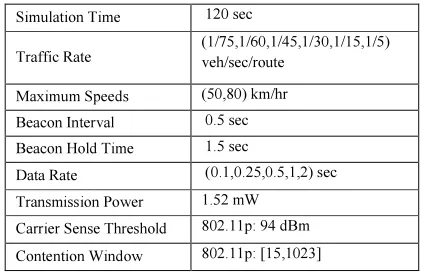
[image:8.595.304.515.482.618.2]In order to create suburban scenarios, as well as to generate the mobility traces for the vehicles, the SUMO microscopic road traffic simulation package has been employed. This mobility model allows in generating common vehicular situations which allow overtaking and stopping at intersections. This leads to an uneven distribution of vehicles. In this scenario, several routes have been defined, and they are used by the vehicles. SUMO injects vehicles in each route according to a given traffic rate, and is measured in injected vehicles per second. Table1 summarizes the main simulation parameters.
Table 1: Simulation Parameters for the Sub – Urban Vehicular Scenarios
In order to get a wide range of network connectivity, the traffic injection rate per route has varied. The higher traffic injection rate, increases the network density. In suburban scenario, more routes are defined, so that a lower rate (1/15) generates a network density comparable to the highway setup with higher rate (1/5).Two kinds of vehicles with maximum speeds of 50 and 80 km/h have been defined. The metrics such as number of message transmissions per involved vehicle
Simulation Time 120 sec
Traffic Rate (1/75,1/60,1/45,1/30,1/15,1/5) veh/sec/route
Maximum Speeds (50,80) km/hr
Beacon Interval 0.5 sec
Beacon Hold Time 1.5 sec
Data Rate (0.1,0.25,0.5,1,2) sec
Transmission Power 1.52 mW
Carrier Sense Threshold 802.11p: 94 dBm
measures the efficiency of the protocol and controls the overhead per vehicle. Since the protocols are localized, the overhead comes from the periodic exchange of status messages. The total number of bytes devoted to protocol information per simulated vehicle, during every run, is measured. Delivery latency is measured as the time, in seconds, since the data source issues the message until it arrives at every receiver.
6. RESULTS
For this experiment, the ack_timer is
assigned as 1 second to investigate how this value
influences the behavior of the protocol.
Performance comparison is made with the acknowledgement based broadcasting protocol Acknowledged Broadcast from Static to highly Mobile (ABSM). Efficiency results in the sub-urban scenario for different injection intervals are shown in table 2.
[image:9.595.299.514.77.262.2]The values in Table 2 show that BEAM performs well with the other protocol by achieving at most 13 percent of improvement. It is further noticed that the algorithm performs in average at various injection intervals.
Table 2 : Comparisons between ABSM and BEAM for the Sub-Urban Vehicular Scenarios.
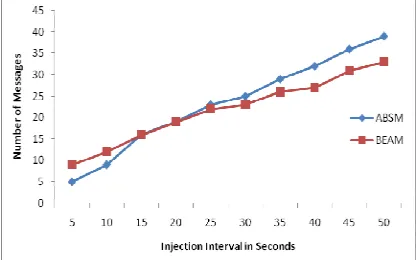
A graph is plotted between transmissions per involved vehicle (messages) and injection interval (seconds between injected vehicle per route) for sub-urban scenario in figure 4. This graph indicates that BEAM performs well when compared to other protocols by reducing the number of in-network message transaction while increasing the number of vehicles injected through the network.
Figure4: Number Of Data Transmissions In Different
Traffic Injection Intervals With Effect Of E_Msg And ACK Messages.
It has also investigated the overhead introduced in periodic messages by each protocol. This graph is plotted between control overhead (Kbytes) per vehicle in figure 5. The BEAM shows lower control overhead than other variants of ABSM because message header contains only sender id and message id, while other two protocols contain sender’s position included in header.
Additionally, ABSM shows higher
overhead as it includes control information inside data messages as it adds the list of whole one-hop neighbor-hood within beacon exchange. This graph shows that BEAM protocol has lower control overhead than ABSM protocol.
Figure 5: Number of data transmissions in different traffic injection intervals
When 20 vehicles are injected in the first case, with the existing broadcasting protocol it requires 40 messages for both emergency message and acknowledgement transactions. Whereas, with the proposed BEAM protocol if the group size is 10 vehicles against the network size of 20, it requires the same number of messages. In this case both the protocols perform even. In the second case, if the network size is 100, the existing broadcast protocol requires 200 messages for both emergency message and acknowledgement transactions whereas the
Interval ABSM BEAM Difference
75 94.3 ± 1.1 81.1 ± 1.6 14.0
60 95.8 ± 0.5 83.4 ± 0.6 13.1
45 96.2 ± 0.6 85.6 ± 0.5 11.0
30 99.9 ± 0.1 87.5 ± 0.2 12.5
15 100 ± 0 88.6 ± 0.1 11.4
[image:9.595.305.513.460.590.2]proposed BEAM protocol for a group size of 40 it requires 160 messages. It is observed that the performance of BEAM shows almost 14 percentage improvement. It is also noticed that control overhead is inversely proportional to the network density. That is if the number of vehicles injected in the network is lower than control overhead is high. Otherwise if the number of vehicles injected in the network is higher than control overhead is low.
7. CONCLUSION
In this work, a Bandwidth Efficient Acknowledgement based Multicasting (BEAM) protocol in Vehicular Ad-hoc Network is proposed. BEAM is an on-demand and dynamic protocol as it creates a dynamic multicast group as and when it is required. This protocol is suitable for sub-urban scenario where it reduces the control overhead and improves efficiency in terms of reduced number of in-network message transactions and by this means it efficiently utilizes the bandwidth. Although maintenance of multicast group is an overhead, the overall performance of the protocol is promising. The protocol is also analyzed when RSU takes part in transmission of emergency messages and reception of acknowledgements. As most of the computations are done in RSU, the vehicles are lightly loaded as they perform only sensing and responding operation for event detection and incoming queries respectively. Presently an emergency situation caused by one vehicle at a time is experimented and the results are analyzed. This result force as the motivating factor behind analyzing the emergency situation caused among multiple vehicles simultaneously. In future, it is
proposed to perform handover of vehicles and
transmission of emergency message from one RSU to its neighbors.
REFERENCES
[1] Sooksan Panichpapiboon and Wasan
Pattaraatikom, “A Review of Information Dissemination Protocols for Vehicular
Ad-Hoc Networks”, IEEE communications
surveys & tutorials, vol. 14, no. 3, third quarter 2012.
[2] Bhuvaneshwari S., Divya G., Kirithika K.B., and Nithya S, “A Survey On Vehicular Ad-Hoc Network”, International Journal of Advanced Research in Electrical, Electronics and Instrumentation Engineering, October 2013.
[3] Dr. Thimmaraju S.N., Abhilanchana N. Yashika and Nandini Prasad K S “Traffic Admission System For Ambulances Using NS-2”, International Journal of Engineering Research & Technology (IJERT), April 2013. [4] Francisco Javier Ros, Pedro Miguel Ruiz and
Ivan Stojmenovic “Acknowledgment-Based Broadcast Protocol for Reliable and Efficient Data Dissemination in Vehicular Ad Hoc Networks”, IEEE transactions on mobile computing, vol. 11, no. 1, January 2012.
[5] Anthony Busson, Alain Lambert, Dominique Gruyer and Denis Gingras, “Analysis of Intervehicle Communication to Reduce Road Crashes”, IEEE transactions on vehicular technology, vol. 60, no. 9, November 2011.
[6] A. Khan, I. Stojmenovic and N. Zaguia,
Parameterless broadcasting in static to highly
mobile wireless ad hoc, sensor and actuator
networks, in Proc. of 22nd IEEE International
Conference on Advanced Information
Networking and Applications (AINA), Ginowan, Okinawa, Japan, Mar.2008.
[7] K. Viswanath and K. Obraczka, “An adaptive approach to group communications in multi-
hop ad hoc networks”, International
Conference on Networking (ICN 2002), Atlanta, 2002; IEEE Int. Symp. Computers and Communications ISCC, Taormina, Italy, 2002, 559-566.
[8] D.Rajini Girinath and Dr.S.Selvan “Data dissemination to regulate Vehicular traffic using HVRP in urban mobility model”, International Journal of Recent Trends in Engineering.
[9] Buchenscheit A., Schaub F., Kargl, F., Weber M., “A VANET-based emergency vehicle
warning system”, IEEE Vehicular
Networking Conference (VNC), Oct. 2009. [10] Vinod Kone, Haitao Zheng, Antony
Rowstron and Ben Y. Zhao” The Impact of Infostation Density on Vehicular Data
Dissemination” Mobile Network
Applications, Springer November 2010. [11] Nicolas Cenerario, Thierry Delot, and Sergio
[12] Ewerton Longoni Madruga
“MULTICASTING IN AD-HOC
NETORKS”, UNIVERSITY OF
CALIFORNIA, SANTA CRUZ,
SEPTEMBER 2002.
[13] Chia-Cheng Hu, Eric Hsiao-Kuang Wu, and
Gen-Huey Chen “Bandwidth-Satisfied
Multicast Trees in MANETs”, IEEE
TRANSACTIONS ON MOBILE
COMPUTING, JUNE 2008.
[14] Adrian Holzer, Patrick Eugster, and Benoıˆt
Garbinato, “Evaluating Implementation
Strategies for Location-Based Multicast Addressing”, IEEE TRANSACTIONS ON MOBILE COMPUTING, MAY 2013.
[15] Behrouz A Forouzan “Data Communications and Networking” Fourth Edition, McGraw-HilI Forouzan networking series, 2007. [16] Alvin Sebastian, Maolin Tang, Yanming Feng,
and Mark Looi , “Context-Aware
Multicast Protocol for Emergency Message
Dissemination in Vehicular Networks”,
Hindawi Publishing Corporation
International Journal of Vehicular Technology Volume 2012.
[17] Xiaojing Xiang, Xin Wang, Yuanyuan Yang, “ Stateless Multicasting in Mobile Ad-hoc Networks”, IEEE transactions on computers, Volume 59, No. 8, August 2010.
[18] X. Xiang, X. Wang, and Y. Yang,”
Supporting Efficient and Scalable
Multicasting over Mobile Ad-hoc Networks”, IEEE TRANSACTIONS ON MOBILE COMPUTING, APRIL 2011.
[19] Arnaud Casteigts, Amiya Nayak and Ivan
Stojmenovic,” Communication protocols
for vehicular ad hoc networks”, WIRELESS
COMMUNICATIONS AND MOBILE
COMPUTING (2009) Published online in
Wiley InterScience
(www.interscience.wiley.com)
[20] B. Ramakrishnan, Dr. R. S. Rajesh and R. S.Shaji,” Analysis of Routing Protocols for
HighwayModel without Using Roadside Unit
and Cluster”, International Journal of
Scientific & Engineering Research, Volume 2, Issue 1, January-2011 1 ;ISSN 2229-5518 [21] Xiaomin Ma, Jinsong Zhang, Xiaoyan Yin,
and Kishor S. Trivedi, “Design and Analysis of a Robust Broadcast Scheme for VANET Safety-Related Services”, IEEE transactions on vehicular technology, vol. 61, no. 1, january 2012.
[22] C.Siva Ram Murthy and B.S. Manoj, “Ad-Hoc Wireless Networks – Architectures and Protocols”, Pearson Education, 2004.
[23] Ramadas Shanmugam,Padmini.R and Nivedita S. “Special Edition Using TCP/IP,
Second Edition” Available: