R E S E A R C H
Open Access
Intracluster correlation coefficients and
coefficients of variation for perinatal outcomes
from five cluster-randomised controlled trials in
low and middle-income countries: results and
methodological implications
Christina Pagel
1*, Audrey Prost
2†, Sonia Lewycka
2,3, Sushmita Das
4, Tim Colbourn
2,5, Rajendra Mahapatra
6,
Kishwar Azad
7, Anthony Costello
2and David Osrin
2Abstract
Background:Public health interventions are increasingly evaluated using cluster-randomised trials in which groups rather than individuals are allocated randomly to treatment and control arms. Outcomes for individuals within the same cluster are often more correlated than outcomes for individuals in different clusters. This needs to be taken into account in sample size estimations for planned trials, but most estimates of intracluster correlation for perinatal health outcomes come from hospital-based studies and may therefore not reflect outcomes in the community. In this study we report estimates for perinatal health outcomes from community-based trials to help researchers plan future evaluations.
Methods:We estimated the intracluster correlation and the coefficient of variation for a range of outcomes using data from five community-based cluster randomised controlled trials in three low-income countries: India,
Bangladesh and Malawi. We also performed a simulation exercise to investigate the impact of cluster size and number of clusters on the reliability of estimates of the coefficient of variation for rare outcomes.
Results:Estimates of intracluster correlation for mortality outcomes were lower than those for process outcomes, with narrower confidence intervals throughout for trials with larger numbers of clusters. Estimates of intracluster correlation for maternal mortality were particularly variable with large confidence intervals. Stratified randomisation had the effect of reducing estimates of intracluster correlation. The simulation exercise showed that estimates of intracluster correlation are much less reliable for rare outcomes such as maternal mortality. The size of the cluster had a greater impact than the number of clusters on the reliability of estimates for rare outcomes.
Conclusions:The breadth of intracluster correlation estimates reported here in terms of outcomes and contexts will help researchers plan future community-based public health interventions around maternal and newborn health. Our study confirms previous work finding that estimates of intracluster correlation are associated with the prevalence of the outcome of interest, the nature of the outcome of interest (mortality or behavioural) and the size and number of clusters. Estimates of intracluster correlation for maternal mortality need to be treated with caution and a range of estimates should be used in planning future trials.
* Correspondence: [email protected]
†Contributed equally
1Clinical Operational Research Unit, University College London, UK
Full list of author information is available at the end of the article
Background
Public health interventions are increasingly evaluated using cluster-randomised controlled trials (cRCTs) in which groups rather than individuals are allocated ran-domly to treatment and control arms. Cluster-randomised designs are pertinent to public health for three main rea-sons [1]. First, many contemporary public health interven-tions are large in scale, complex in nature, and‘unblinded’ in design because they require the active involvement of participants. It is often more appropriate and feasible to implement them‘with’groups or communities rather than to apply them‘to’individuals. Second, cRCTs have the advantage of minimising the risk of contamination that would occur if individuals from the same community were randomised to different treatment arms. Third, cRCTs enable policy-makers and researchers to assess the popula-tion-level effects of an intervention applied to a proportion of a population, giving more information about its effec-tiveness in real life settings. There are now numerous examples of well-conducted public health cRCTs from high, middle and low-income countries. The Mwanza study, for example, tested the impact of improved sexually transmitted infection (STI) case management on the inci-dence of HIV infection in Mwanza, Tanzania, by rando-mising 12 pair-matched communities to intervention or control arms [2]. Other, current cRCTs include a UK study in which deprived areas of London have been rando-mised to receive interventions promoting healthy eating, physical activity and mental health [3], and, in India, a trial in which urban wards of Mumbai were randomly allocated to a community mobilisation intervention for improved maternal and newborn health [4].
An important implication of cluster-randomised designs is that intervention recipients are often groups of individuals who share socio-economic and cultural characteristics and have similar health outcomes by vir-tue of living in the same area. Similarity between indivi-duals in the same cluster lessens the variability of responses within clusters (within-cluster variance), thereby artificially magnifying differences in outcomes between clusters and reducing the power of trials to detect true differences between intervention and control arms. An intracluster correlation coefficient (ICC) is commonly used to quantify how much more similar outcomes are for individuals within clusters than for those in different clusters [5,6]. The ICC is defined as the ratio of the between-cluster variance to the total variance (both between and within clusters), and there-fore has a value between 0 and 1. An ICC of 0 indicates that individuals within clusters are no more similar to each other than individuals from different clusters (there is no between-cluster variability), while an ICC of 1 indicates that individuals within the same cluster all
have identical outcomes (there is no within-cluster variability) [1].
The increase in variance due to clustering, or design effect, is given by1+ (m-1)ICC, wheremis the average cluster size [7]. Within-cluster correlation has a corre-late - between-cluster variation - which is commonly expressed as the coefficient of variation, k. For binary outcomes, the relationship between the ICC and khas
been defined as ICC=k2
π
1−π
, where π is the
probability of the binary outcome of interest [8]. Obtaining estimates of ICC orkis essential to calculate sample sizes for studies with clustered designs, but these are seldom available to researchers when designing trials and are often approximated from previous research or through modeling techniques [9-11].
Several community-based interventions to reduce mortality in mothers and neonates in low-resource set-tings have recently been evaluated through cRCTs, and there is increasing momentum to support health sys-tems in delivering components of these community pro-grammes at scale [12-17]. Designing adequately powered studies to measure the impact of programmes will be critical. However, most ICC orkestimates for perinatal health outcomes available in the literature come from hospital-based studies and may therefore not reflect out-comes in the community [18]. In this study, we report ICC andkestimates for perinatal health outcomes from community-based trials in three countries (Bangladesh, India, and Malawi) to help researchers planning efficacy and effectiveness evaluations of interventions to improve maternal and newborn health.
Methods
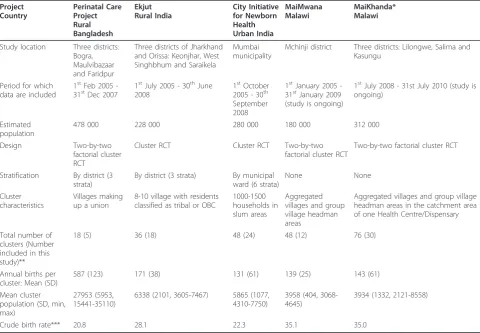
We estimated ICC and kfor a range of outcomes using data from five community-based cRCTs, three of which have not yet reported final results (MaiMwana and Mai-Khanda in Malawi, and the City Initiative for Newborn Health in India). All five trials sought to evaluate com-munity mobilisation interventions with women’s groups to improve maternal and newborn health outcomes. A version of this intervention was first tested in Nepal, where it achieved a 30% reduction in neonatal mortality [18]. Figure 1 shows the location of the trials included in the study. Table 1 describes their design, sample size, and the number and characteristics of study clusters.
insecticide treated bed nets in one site in Malawi, as these are important outcomes for African studies. We selected stillbirths and neonatal mortality because they are out-comes commonly used to calculate perinatal study sample sizes, maternal mortality because there are few reports of ICC orksince it is a rare outcome, and other outcomes as process indicators that may be increasingly used in the future to calculate sample sizes for effectiveness studies. We used the framework proposed by Campbell and collea-gues [19] to report ICC and provide: a description of the dataset from which estimates were drawn and a descrip-tion of the outcome characteristics; informadescrip-tion on how ICC was calculated; and information on its precision through a 95% confidence interval.
We chose to exclude data from the intervention clusters of the five trials from the main calculations of ICC andk for two reasons. First, three of the five trials had not yet reported results for their primary outcome (neonatal mor-tality) at the time of analysis. Second, we hypothesised that the interventions tested in these studies could influence ICC for perinatal outcomes, as they sought to increase care-seeking and institutional deliveries. We felt that dis-cussing the extent and reasons for variation between trial intervention and control clusters was beyond the scope of this paper and therefore opted to exclude data from the trial intervention clusters. However, recent research under-scores the importance of taking into account the likely effect of the intervention when estimating the between-cluster variability [20].
Data collection
In all five trials perinatal outcomes were measured using community-based prospective surveillance systems [4]. These systems differed slightly between sites and are briefly described here.
The Perinatal Care Project trial took place in three rural districts of Bangladesh. In each district, six unions per dis-trict (mean union population: 27 953) were purposively sampled for surveillance. In these unions, Traditional Birth Attendants (TBAs) prospectively reported births and deaths to women in pregnancy or up to six weeks after delivery within an area covering around 200 households. Interviewers then verified the births and deaths, paid the TBA an incentive for each correct identification, and com-pleted a questionnaire covering maternal background characteristics, the antenatal, delivery, and post-partum periods with the mother, or, in case of a maternal death, with a relative. All eligible women identified were also asked if they could identify any other pregnant women.
[image:3.595.58.539.88.346.2]for every correct identification. The interviewers adminis-tered a structured questionnaire to mothers at around six weeks after delivery to collect information about their socio-demographic characteristics and events during the antenatal, delivery and postnatal periods.
The City Initiative for Newborn Health in Mumbai monitored 48 urban slum clusters of about 1000 house-holds each (5500 population), selected randomly from a sampling frame of 92 clusters over six municipal wards. Births and deaths were identified by 99 locally resident women, generally two per cluster, each covering an average 500 households and receiving a fee for identifi-cation. Events were confirmed by 12 interviewers, each responsible for four clusters, who visited mothers at home and arranged follow-up interviews.
In the MaiMwana trial (Malawi), pregnancies were prospectively identified by a paid woman enumerator who visited all females aged 10-49 years once a month to ask about missed menses. Information was recorded in a register of all women of childbearing age and
updated monthly. Live births were followed up with interviews one month and six months after birth [23]. There were 48 women enumerators (one per cluster), and 48 interviewers (also one per cluster) who verified births and conducted post-partum interviews.
In the MaiKhanda evaluation, also in Malawi, the team selected health centre catchment areas with a typical population of 30 000. Within each of these, a population of 4000 was selected for surveillance by randomly choosing catchment populations of government commu-nity health workers that summed to roughly 4000. In each of these areas, 20-25 key informants reported data on births, deaths, and the antenatal and postnatal per-iod. In all sites, verbal autopsies were conducted for neonatal deaths, stillbirths, and maternal deaths.
Trial designs
[image:4.595.57.538.111.444.2]The trials used moderately different designs to arrive at one-to-one random allocation of intervention and con-trol clusters. In the Perinatal Care Project (Bangladesh) Table 1 Characteristics of studies used, prevalence, and rates, for key perinatal indicators from 5 community-based cluster RCTs
Project Country
Perinatal Care Project Rural Bangladesh
Ekjut Rural India
City Initiative for Newborn Health Urban India
MaiMwana Malawi
MaiKhanda* Malawi
Study location Three districts: Bogra, Maulvibazaar and Faridpur
Three districts of Jharkhand and Orissa: Keonjhar, West Singhbhum and Saraikela
Mumbai municipality
Mchinji district Three districts: Lilongwe, Salima and Kasungu
Period for which data are included
1stFeb 2005 -31stDec 2007
1stJuly 2005 - 30thJune 2008
1stOctober 2005 - 30th September 2008
1stJanuary 2005 -31stJanuary 2009 (study is ongoing)
1stJuly 2008 - 31st July 2010 (study is ongoing)
Estimated population
478 000 228 000 280 000 180 000 312 000
Design Two-by-two
factorial cluster RCT
Cluster RCT Cluster RCT Two-by-two
factorial cluster RCT
Two-by-two factorial cluster RCT
Stratification By district (3 strata)
By district (3 strata) By municipal ward (6 strata)
None None
Cluster characteristics
Villages making up a union
8-10 village with residents classified as tribal or OBC
1000-1500 households in slum areas
Aggregated villages and group village headman areas
Aggregated villages and group village headman areas in the catchment area of one Health Centre/Dispensary
Total number of clusters (Number included in this study)**
18 (5) 36 (18) 48 (24) 48 (12) 76 (30)
Annual births per cluster: Mean (SD)
587 (123) 171 (38) 131 (61) 139 (25) 143 (61)
Mean cluster population (SD, min, max)
27953 (5953, 15441-35110)
6338 (2101, 3605-7467) 5865 (1077, 4310-7750)
3958 (404, 3068-4645)
3934 (1332, 2121-8558)
Crude birth rate*** 20.8 28.1 22.3 35.1 35.0
* MaiKhanda data are provisional as verification of deaths and follow-up of missing women are still ongoing.
and the Ekjut trial (rural India), districts were identified and clusters purposively sampled, then randomised within each district. In the Bangladesh Perinatal Care Project, clusters initially randomised to the women’s group interventions were also re-randomised to receive training for Traditional Birth Attendants in a two-by-two factorial design. In the Mumbai City Initiative for Newborn Health trial, urban slum clusters were ran-domly sampled from a frame stratified by six purpo-sively selected municipal wards, and then randomly allocated to the intervention. MaiKhanda and MaiM-wana in Malawi used two-by-two factorial designs in which clusters were allocated randomly to a women’s group intervention or no intervention, and each group was stratified by the presence or absence of another intervention - a breastfeeding counseling intervention in the case of MaiMwana, or a Quality Improvement of maternal and neonatal facility-based healthcare interven-tion in the case of MaiKhanda. For the Bangladesh Peri-natal Care Project and the Malawi MaiKhanda and MaiMwana trials, we therefore only included in this study the clusters that were‘pure’controls. Details of stratification and number of clusters included are given in Table 1. Although all five trials included in the study had baseline data, we only included these for the‘pure’ control clusters of the MaiKhanda study in Malawi because it started later than the other trials and had fewer cases to contribute to the analysis. One of the other trials (PCP) had retrospective baseline data, which we decided not to include in order to preserve data quality.
Ethical approval
All trials from which data for this study were drawn were approved by the ethics committee of the Institute of Child Health and Great Ormond Street Hospital for Children (UK) and by the following research ethics committees: the ethics committee of the Diabetic Asso-ciation of Bangladesh (Perinatal Care Project, Bangla-desh Diabetes Somity or BADAS); an independent ethics committee in Jamshedpur, India (Ekjut trial); the Mumbai Independent Ethics Committee for Research on Human Subjects (City Initiative for Newborn Health trial, reference IEC/06/31); the Malawi National Health Sciences Research Committee (MaiMwana trial, refer-ence MED/4/36/1/167, MaiKhanda protocol #420). All trials were conducted in disadvantaged areas with high levels of female illiteracy; all participants gave consent in writing, by thumbprint or verbally.
Outcome definitions
We used the ICD 10 definitions of neonatal death, still-birth and maternal death [24]:
Stillbirth- “A stillbirth or foetal death is a death prior to the complete expulsion or extraction from its mother of a product of conception, irrespective of the duration of pregnancy; the death is indicated by the fact that after such separation the foetus does not breathe or show any other evidence of life, such as beating of the heart, pulsation of the umbilical cord or definite movement of voluntary muscles.” ICD classifies late foetal deaths (birthweight greater than 1000 gm or after 28 weeks) and early foetal deaths (500 to 1000 gm or 22-28 weeks). We use the ICD-10 criteria for stillbirth modified to include births after 28 completed weeks rather than 22 weeks.
Neonatal death: death within the first 28 days of an infant after“the complete expulsion or extraction from its mother of a product of conception, irrespec-tive of the duration of the pregnancy, which after such separation, breathes or shows any other evi-dence of life, such as beating of the heart, pulsation of the umbilical cord, or definite movement of voluntary muscles, whether or not the umbilical cord has been cut or the placenta is attached.” Maternal death:“the death of a woman while preg-nant or within 42 days of termination of pregnancy, irrespective of the duration and site of the preg-nancy, from any cause related to or aggravated by the pregnancy or its management but not from acci-dental or inciacci-dental causes.”
For postnatal outcomes (exclusive breastfeeding and postnatal check-up by a doctor or a nurse), we used data collected between one month and six weeks after birth, except in MaiMwana Malawi where data were available on exclusive breastfeeding up to six months.
Statistical analysis and calculations
We used two methods for estimating ICC: one-way ana-lyses of variance in STATA (Versions 10 and 11; Stata Corp., College Station, TX) using the loneway command as described by Hayes and Moulton [1], and estimation equations from Donner and Klar [25], p84-5. We calcu-lated estimates and confidence intervals for ICC within each stratum, then calculated the unweighted average of the ICC estimates and the lower and upper bounds of the confidence intervals across strata. For the ICC esti-mates calculated using Donner and Klar’s equations, we calculated 95% confidence intervals using Fisher’s method [26], which uses the following equation:
ICC±1.96V(ICC) where
V(ICC) = 2(1−ICC) 2
1 + (m−1)ICC2
m(m−1)n where m is
number of clusters in the control arm. Where the esti-mate for the lower bound of the confidence interval for ICC was negative, we set it to zero, assuming that the population within our clusters would not be more het-erogeneous than the entire study population.
For all outcomes, we calculatedkfrom the intracluster correlation coefficients by reversing the equation from
Hayes and Moulton [1]: k=
ICC×
1−π ˆ
π , where ICC is the estimated intracluster correlation coefficient and
ˆ
π is the observed proportion of the binary outcome for the entire population.
Several practical issues arose when calculating ICC using individual-level datasets in which the denomina-tors were births. For example, we recoded the vital sta-tus for mothers who died but had twins so that maternal deaths were not double-counted. In addition, calculating ICC for maternal mortality (where live births are the denominator) required adding antepartum deaths to the list of live births so that they could be counted.
Simulation experiments
In order to explore further the impact of cluster size and number on the reliability of estimates ofk, we ran two simple simulations for maternal and neonatal mor-tality in Microsoft Excel 2003 (Microsoft Corporation). In each simulation we considered a hypothetical study area with a given number of clusters and a given num-ber of live births per cluster. We set the maternal mor-tality ratio (MMR) at 300 deaths per 100 000 live births and the neonatal mortality rate (NMR) at 40 deaths per 1000 live births. For each run of the simula-tion, we randomly assigned neonatal and maternal out-comes for each cluster by generating random numbers and assigning outcomes according to the assumed mortality rates. By doing this, we made an explicit assumption that the outcomes of births were indepen-dent of the outcomes of other births, so that the coef-ficient of variation, k, for each simulation was identical to zero (individuals within clusters were set to be no more similar to each other than to individuals from different clusters). Each run of the simulation thus generated a hypothetical set of maternal and neonatal outcomes, from which we calculated the coefficient of variation k that would be estimated if these were real data, using the formula described by Hayes and Moul-ton [1, p.18]. The impact of cluster size and number of clusters is evaluated by comparing estimates of k to the ‘true’k of zero: the smaller the estimates and the narrower their range across simulations, the more reli-able the estimates.
Results
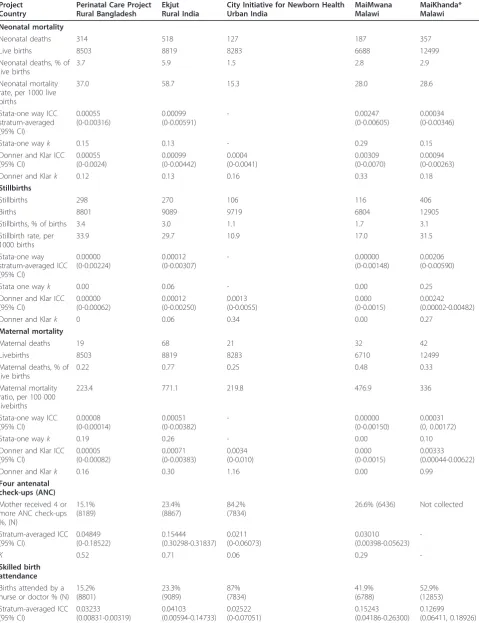
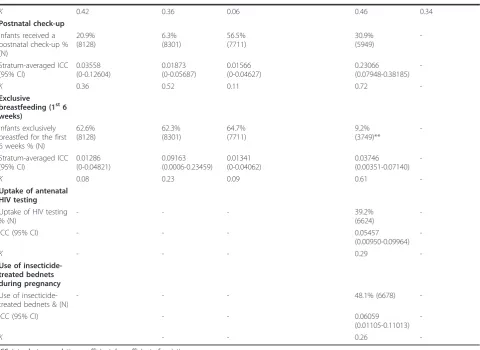
Prevalence and rates for selected perinatal indicators Table 2 shows the mortality rates or outcome preva-lence for our selected perinatal indicators within the five community-based samples, as well as corresponding estimates of ICC andk. We observed substantial differ-ences in maternal and neonatal mortality rates between the study sites: the rural Indian setting (Ekjut trial, Jharkhand and Orissa) had the highest maternal and neonatal mortality rates, while the urban Indian setting (City Initiative for Newborn Health, Mumbai) had the lowest. In some cases, we found large differences between our community-based mortality estimates and national Demographic and Health Survey (DHS) figures. In eastern India, among rural tribal communities, the NMR was 59.1, compared with 39 per 1000 reported as the state estimate for Jharkhand in the 2007 National Family Health Survey [27]. In both Malawian studies we found lower maternal mortality rates than the most recently reported DHS figure of 984 per 100 000 [28]. These differences may reflect national and regional dif-ferences, different sample compositions, different time frames or methodological factors. We also found differ-ences in key antenatal and care-seeking indicators between the study sites. Access to four antenatal care visits was low in all sites except Mumbai, reflecting greater access to private and public health services in urban areas. The prevalence of skilled birth attendance among mothers in Mumbai slums was four times that among mothers in eastern Indian tribal communities, and was much higher in rural Malawian than rural Asian settings.
Intracluster correlation coefficients for selected perinatal indicators
Overall, ICCs for mortality outcomes were lower than for process outcomes such as skilled birth attendance (SBA). Estimates of intracluster correlation for MMR and NMR were low in all sites. Estimates for maternal mortality were particularly unreliable, reflected in the broader confidence intervals, with a single maternal death having large impacts on ICC and k values. We noted that the ICCs estimated using the loneway com-mand (one-way analysis of variance) in STATA were very similar to those calculated using the equations of Donner and Klar, especially for the more common out-comes of neonatal death and stillbirth.
Table 2 Intracluster correlation coefficients and coefficients of variation for key perinatal indicators
Project Country
Perinatal Care Project Rural Bangladesh
Ekjut Rural India
City Initiative for Newborn Health Urban India MaiMwana Malawi MaiKhanda* Malawi Neonatal mortality
Neonatal deaths 314 518 127 187 357
Live births 8503 8819 8283 6688 12499
Neonatal deaths, % of live births
3.7 5.9 1.5 2.8 2.9
Neonatal mortality rate, per 1000 live births
37.0 58.7 15.3 28.0 28.6
Stata-one way ICC stratum-averaged (95% CI) 0.00055 (0-0.00316) 0.00099 (0-0.00591) - 0.00247 (0-0.00605) 0.00034 (0-0.00346)
Stata-one wayk 0.15 0.13 - 0.29 0.15
Donner and Klar ICC (95% CI) 0.00055 (0-0.0024) 0.00099 (0-0.00442) 0.0004 (0-0.0041) 0.00309 (0-0.0070) 0.00094 (0-0.00263)
Donner and Klark 0.12 0.13 0.16 0.33 0.18
Stillbirths
Stillbirths 298 270 106 116 406
Births 8801 9089 9719 6804 12905
Stillbirths, % of births 3.4 3.0 1.1 1.7 3.1
Stillbirth rate, per 1000 births
33.9 29.7 10.9 17.0 31.5
Stata-one way stratum-averaged ICC (95% CI) 0.00000 (0-0.00224) 0.00012 (0-0.00307) - 0.00000 (0-0.00148) 0.00206 (0-0.00590)
Stata one wayk 0.00 0.06 - 0.00 0.25
Donner and Klar ICC (95% CI) 0.00000 (0-0.00062) 0.00012 (0-0.00250) 0.0013 (0-0.0055) 0.000 (0-0.0015) 0.00242 (0.00002-0.00482)
Donner and Klark 0 0.06 0.34 0.00 0.27
Maternal mortality
Maternal deaths 19 68 21 32 42
Livebirths 8503 8819 8283 6710 12499
Maternal deaths, % of live births
0.22 0.77 0.25 0.48 0.33
Maternal mortality ratio, per 100 000 livebirths
223.4 771.1 219.8 476.9 336
Stata-one way ICC (95% CI) 0.00008 (0-0.00014) 0.00051 (0-0.00382) - 0.00000 (0-0.00150) 0.00031 (0, 0.00172)
Stata-one wayk 0.19 0.26 - 0.00 0.10
Donner and Klar ICC (95% CI) 0.00005 (0-0.00082) 0.00071 (0-0.00383) 0.0034 (0-0.010) 0.000 (0-0.0015) 0.00333 (0.00044-0.00622)
Donner and Klark 0.16 0.30 1.16 0.00 0.99
Four antenatal check-ups (ANC) Mother received 4 or more ANC check-ups %, (N) 15.1% (8189) 23.4% (8867) 84.2% (7834)
26.6% (6436) Not collected
Stratum-averaged ICC (95% CI) 0.04849 (0-0.18522) 0.15444 (0.30298-0.31837) 0.0211 (0-0.06073) 0.03010 (0.00398-0.05623)
-K 0.52 0.71 0.06 0.29
-Skilled birth attendance Births attended by a nurse or doctor % (N)
features (for example, the presence of a popular health facility) could influence the proportion of outcomes such as skilled birth attendance in each cluster, and thereby ICC andk.
It is likely that there were genuine differences in population heterogeneity across sites. For instance, urban slums are home to a range of communities that maintain to some degree patterns of behaviour imported from their places of origin; they also maintain their rural-urban links. Urban areas might therefore be expected to be more heterogeneous than rural villages. Equally, there might be cultural factors that lead women to care for their infants more or less similarly in differ-ent countries.
Areas with smaller cluster sizes tended to yield higher ICCs. In the MaiKhanda study in Malawi, the average cluster size in Lilongwe was about three-quarters that of the other two districts, and the ICC for Lilongwe was higher. Not surprisingly, estimates drawn from larger numbers of clusters were more reliable (narrower
confidence intervals) than those from small numbers. Esti-mates drawn from the Bangladesh Perinatal Care Project varied widely between districts and overall estimates appeared to have more face validity than district-specific data, which yielded more extreme values. This was espe-cially the case for the maternal mortality estimates. Strati-fication reduced ICC as well askvalues, but had a greater impact on ICCs. For instance, in the rural India trial, the estimate for ICC based on the average of estimates for ICC in each stratum for stillbirths was 0.00012, compared with 0.00033 when stratification was ignored.
[image:8.595.58.539.98.448.2]Measuring ICCs for rare outcomes: simulation results Neonatal and maternal deaths are relatively rare popula-tion events. A typical MMR in a low-income setting might be around 300 per 100 000 live births. If the total number of live births per cluster over the period of a trial is 400 to 2000, there will, on average, only be between 1 and 6 deaths per cluster. Given such small numbers, we would expect much variation in the actual Table 2 Intracluster correlation coefficients and coefficients of variation for key perinatal indicators(Continued)
K 0.42 0.36 0.06 0.46 0.34
Postnatal check-up Infants received a postnatal check-up % (N)
20.9% (8128)
6.3% (8301)
56.5% (7711)
30.9% (5949)
-Stratum-averaged ICC (95% CI)
0.03558 (0-0.12604)
0.01873 (0-0.05687)
0.01566 (0-0.04627)
0.23066 (0.07948-0.38185)
-K 0.36 0.52 0.11 0.72
-Exclusive
breastfeeding (1st6 weeks)
Infants exclusively breastfed for the first 6 weeks % (N)
62.6% (8128)
62.3% (8301)
64.7% (7711)
9.2% (3749)**
-Stratum-averaged ICC (95% CI)
0.01286 (0-0.04821)
0.09163 (0.0006-0.23459)
0.01341 (0-0.04062)
0.03746 (0.00351-0.07140)
-K 0.08 0.23 0.09 0.61
-Uptake of antenatal HIV testing Uptake of HIV testing % (N)
- - - 39.2%
(6624)
-ICC (95% CI) - - - 0.05457
(0.00950-0.09964)
-K - - - 0.29
-Use of insecticide-treated bednets during pregnancy Use of insecticide-treated bednets & (N)
- - - 48.1% (6678)
-ICC (95% CI) - - 0.06059
(0.01105-0.11013)
-K - - 0.26
-ICC: intracluster correlation coefficient;k: coefficient of variation.
number of deaths reported in each cluster and, conse-quently, significant random variation in estimates of intracluster correlation. This is shown with our estimate of ICCs for observed maternal mortality in Table 2.
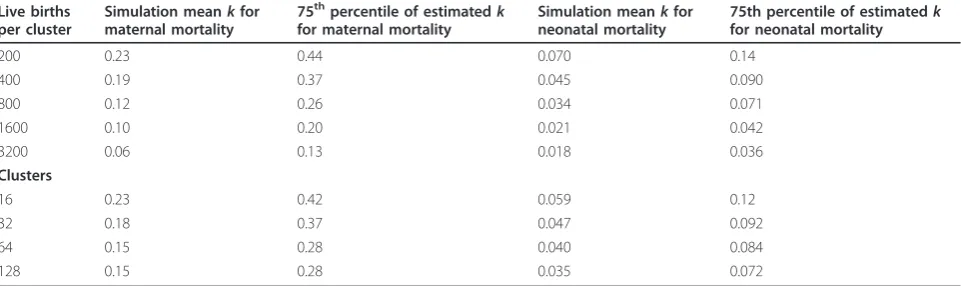
We ran two simulations in order to explore the impact of different numbers of live births per cluster (simulation 1) and of the number of clusters (simulation 2) on esti-matedkfor maternal and neonatal mortality. Results are shown in table 3 and summarised forkin figures 2 and 3. In simulation 1 the MMR was fixed at 300, the NMR at 40 and the number of clusters at 32. We performed sets of 500 simulation runs, each set of runs corresponding to different numbers of live births per cluster, and calcu-lated the mean and 75th percentile of the estimatedkfor
[image:9.595.58.539.112.255.2]maternal and neonatal death. In simulation 2 the number of clusters was varied. The MMR was fixed at 300, the NMR at 40 and the number of births per cluster at 400. Since the true value ofkwas zero, the results help us to understand the impact of cluster size and number of clusters on the reliability and stability of our measured point estimates for both maternal and neonatal mortality. Figures 2 and 3 show that estimates ofkare much less reliable when the number of births per cluster is less than 500 for both maternal and neonatal outcomes. The number of clusters was less important in determining the reliability of estimates ofk for neonatal mortality, but for maternal mortality fewer than 60 clusters led to less reliable estimates of k. Across all simulations, Table 3 Simulation results showing the impact of number of live births per cluster and number of clusters on k estimates for rare outcomes
Live births per cluster
Simulation meankfor maternal mortality
75thpercentile of estimatedk for maternal mortality
Simulation meankfor neonatal mortality
75th percentile of estimatedk for neonatal mortality
200 0.23 0.44 0.070 0.14
400 0.19 0.37 0.045 0.090
800 0.12 0.26 0.034 0.071
1600 0.10 0.20 0.021 0.042
3200 0.06 0.13 0.018 0.036
Clusters
16 0.23 0.42 0.059 0.12
32 0.18 0.37 0.047 0.092
64 0.15 0.28 0.040 0.084
128 0.15 0.28 0.035 0.072
[image:9.595.56.292.462.619.2]Mean estimated coefficient of variation k
Figure 2Simulated impact of number of live births per cluster on estimated coefficient of variation (k) for maternal and neonatal mortality. These simulations were run assuming that all birth outcomes were independent, i.e. the true coefficient of variation was set to zero. As the number of births per cluster increases, the estimated coefficient of variation falls closer to zero indicating that more births per cluster lead to greater reliability in estimates of the coefficient of variation. Throughout, the estimated coefficient of variation is higher for maternal mortality than for neonatal mortality.
Mean estimated coefficient of variation k
estimates of k for maternal mortality were much less reliable than for neonatal mortality. Considering the 75thpercentile of estimates in table 3, 25% of simulation runs for maternal mortality resulted in high estimates of k(> 0.25), even with 800 births per cluster in simulation 1 and across all numbers of clusters in simulation 2. Estimates of k for neonatal mortality had a smaller range throughout.
Discussion
Data from our trials accord with the rare published ICCs for perinatal outcomes from other community-based stu-dies. A recent systematic review of community-based interventions to reduce maternal mortality found five cluster-randomised controlled trials seeking to improve perinatal survival [29]. None of these adjusted for cluster effect on maternal mortality and the ICC for maternal mortality was estimated to be close to 0.
For neonatal mortality, the Newhints trial in Ghana reported a baseline ICC of 0.0007256 (with a baseline neonatal mortality rate of 31 per 1000 livebirths) [30], and the Makwanpur Nepal cRCT an ICC of 0.00644 (95% CI 0.00004-0.0128) [5]. By contrast, estimates from our community-based samples were generally lower than those reported in an analysis of ICCs for perinatal outcomes in hospitals conducted as part of the 2005 WHO Survey on Maternal and Perinatal Health using data from over 90 000 births in 120 facilities across eight Latin American countries. Although the compar-ability of data from the WHO survey and ours is com-promised by differences in data collection and outcome ascertainment methods, it is worth noting that the med-ian ICC for neonatal death at hospital discharge or 7 days after delivery was 0.005, and the median ICC for maternal death was 0.003 in the WHO study, while our one-way analysis of variance ICC estimates range from 0.00034 to 0.00247 for neonatal death and from 0 to 0.00051 for maternal death. The higher ICCs found in the WHO study may reflect greater similarities in out-comes and practices among women who deliver in insti-tutions, as well as differences inherent to the Latin American context.
Previous studies have suggested that the research set-ting (for example, primary or secondary care) and the type of variable (process or outcome) are key determi-nants of ICCs, but that the effects of outcome preva-lence and cluster size are less straightforward [31]. Our study confirms the first two findings, but also suggests, as simulation work shows, that cluster size and the number of clusters also affect estimates of ICCs (or k). The simulation results highlight the difficulty in inter-preting estimates of intracluster variability for rare out-comes such as maternal mortality. In almost all the simulation runs 25% of estimates of k for maternal
mortality were greater than 0.25. Given that in these simulations there was no intracluster correlation, such estimates would have been misleading if derived from an actual data set. Given the wide range of maternal mortality estimates of kover the sets of 500 simulation runs, we must be cautious in placing too much trust in estimates ofk(or ICC) for maternal mortality from indi-vidual trials, including our estimates given in table 2. However, the simulation experiments show much lower estimates ofk for neonatal mortality with a much nar-rower range, indicating that estimates for NMR from individual trials are likely to be reliable, even with small numbers of clusters or births per cluster.
Limitations
Our study had three main limitations. First, we drew upon heterogeneous trials with different cluster recruit-ment strategies and degrees of stratification. These design features need to be taken into consideration when using our ICCs to calculate sample sizes. For example, increased stratification leads to lower ICCs and kvalues. Second, ICCs could have been influenced by different reporting preferences in different clusters. For example, some cluster-based key informants or inter-viewers might have been more adept at reporting or tracking births and deaths than others. Quality of data collection (in terms of both completeness and accuracy) will strongly influence ICCs and is likely to vary between clusters given differences in fieldworkers, ter-rain and supervision. Finally, we used data from trials with fewer than 40 clusters in their control arms. Don-ner and Klar advise against overestimating the stability of a sample estimate obtained from a trial involving less than about 40 clusters. The small number of clusters selected would also have increased the confidence inter-vals around our ICC estimates. We also note that Fish-er’s method for estimating confidence intervals is unlikely to be strictly valid for the smaller samples used in this study. However, combined, our study offers the largest number of ICCs available to date for perinatal outcomes for community-based samples.
Conclusions
findings from previous methodological studies regarding the key determinants of the intracluster correlation coef-ficient: the size of the ICC is related to the prevalence of the outcome of interest, and point estimates of ICC for rare outcomes such as maternal mortality are not likely to be reliable. When planning future trials, published estimates of ICCs from larger clusters are probably safer to use and a range of possible ICCs should be used for sample size calculations. Finally, as maternal and neona-tal survival increases and research moves to testing inter-ventions seeking to improve care-seeking or process outcomes, the high ICCs found for these will need to be accounted for in study sample sizes.
List of Abbreviations used
cRCT: Cluster randomised controlled trial; DHS: Demographic and health survey; ICC: Intracluster correlation coefficient ICD: International classification of diseases; MMR: Maternal mortality ratio; NFHS: National family health survey; NMR: Neonatal mortality rate; PCP: Perinatal Care Project; SBA: Skilled birth attendant; SNEHA: Society for Nutrition, Education and Health Action; TBA: Traditional birth attendant.
Acknowledgements
We wish to thank principal investigators and colleagues from the Wellcome Trust Strategic Award partnership for the Population Science of Maternal and Child Survival: Prof Dharma Manandhar (MIRA, Nepal), Dr Prasanta Tripathy and Dr Nirmala Nair (Ekjut, India), Dr Wasundhara Joshi and Neena Shah More (SNEHA, India), Dr Charles Mwansambo (MaiMwana, Malawi), Prof Kishwar Azad (Perinatal Care Project, Bangladesh).
Funding: In Bangladesh, the Perinatal Care Project is funded by the UK Community Fund, the UK Department for International Development and the Big Lottery Fund and is registered with trial number ISRCTN54792066. In India, the Ekjut trial was funded by the Health Foundation and the Big Lottery Fund and is registered with trial number ISRCTN21817853. The City Initiative for Newborn Health was funded by the ICICI Centre for Child Health and Nutrition and The Wellcome Trust and is registered with trial number ISRCTN96256793. In Malawi, the MaiMwana project is funded by Saving Newborn Lives (Save the Children USA), Effective Interventions, and the UK Department for International Development and is registered with trial number ISRCTN06477126. MaiKhanda and Tim Colbourn are funded by the Health Foundation and the study is registered as trial number ISRCTN18073903. David Osrin was funded by a Wellcome Trust Career Development Fellowship (081052/Z/06/Z). The funders played no part in the development of the article or the decision to submit it for publication.
Author details 1
Clinical Operational Research Unit, University College London, UK.2UCL Centre for International Health and Development, Institute of Child Health, University College London, UK.3MaiMwana Project, Mchinji, Malawi.4Society for Nutrition, Education and Health Action (SNEHA), Dharavi, Mumbai, India. 5MaiKhanda, Malawi.6Ekjut, Chakradharpur, Jharkhand, India.7Perinatal Care
Project, Diabetic Association of Bangladesh (BADAS), Dhaka, Bangladesh.
Authors’contributions
DO, CP and AP had the original idea for the study. CP wrote the simulation. All authors participated in data gathering, data analysis and interpretation and commented on drafts of the manuscript. AP and CP wrote the first draft and collated subsequent inputs. All authors read and approved the final manuscript.
Competing interests
The authors declare that they have no competing interests.
Received: 15 February 2011 Accepted: 14 June 2011 Published: 14 June 2011
References
1. Hayes R, Moulton LH:Cluster Randomised Controlled Trials.New York: Chapman & Hall/CRC Press; 2009.
2. Grosskurth H, Mosha F, Todd J, Mwijarubi E, Klokke A, Senkoro K, Mayaud P, Changalucha J, Nicoll A, ka-Gina G, Newell J, Mugeye K, Mabey D, Hayes R:
Impact of improved treatment of sexually transmitted diseases on HIV infection in rural Tanzania: randomised controlled trial.The Lancet1995,
346:530-536.
3. Wall M, Hayes R, Moore D, Petticrew M, Clow A, Schmidt , Draper A, Lock K, Lynch R, Renton A:Evaluation of community level interventions to address social and structural determinants of health: a cluster randomised controlled trial.BMC Public Health2009,9:207.
4. Shah More N, Bapat U, Das S, Patil S, Porel M, Vaidya L, Koriya B, Barnett S, Costello A, Fernandez A, Osrin D:Cluster-randomised controlled trial of community mobilisation in Mumbai slums to improve care during pregnancy, delivery, postpartum and for the newborn.Trials2008,9:7. 5. Kerry SM, Bland JM:The intracluster correlation coefficient in cluster
randomisation.BMJ1998,316:1455.
6. Killip S, Mahfoud Z, Pearce K:What is an intracluster correlation coefficient? Crucial concepts for primary care researchers.Annals of family medicine2004,2:204-208.
7. Hayes RJ, Bennett S:Simple sample size calculation for cluster-randomized trials.International Journal of Epidemiology1999,28(2):319-326. 8. Preisser JS, Reboussin BA, Song EY, Wolfson M:The importance and role of
intracluster correlations in planning cluster trials.2007,18:552-560. 9. Donner A, Klar N:Pitfalls and controversies in cluster randomization
trials.Americal Journal of Public Health2004,94:416-422.
10. Chakraborty H, Moore J, Carlo WA, Hartwell TD, Wright LL:A simulation based technique to estimate intracluster correlation for a binary variable.Contemporary clinical trials2009,30:71-80.
11. Turner RM, Prevost AT, Thompson SG:Allowing for imprecision of the intracluster correlation coefficient in the design of cluster randomised trials.Statistics in medicine2004,23:1195-1214.
12. Mathers CD, Loncar D:Projections of Global Mortality and Burden of Disease from 2002 to 2030.PLoS Med2006,3:e442.
13. Baqui AH, El-Arifeen S, Darmstadt GL, Ahmed S, Williams EK,et al:Effect of community-based newborn-care intervention package implemented through two service-delivery strategies in Sylhet district, Bangladesh: a cluster-randomised controlled trial.Lancet2008,371:1936-1944. 14. Kumar V, Mohanty S, Kumar A, Misra R, Santosham M,et al:Effect of
community-based behaviour change management on neonatal mortality in Shivgarh, Uttar Pradesh, India: a cluster-randomised controlled trial.Lancet2008,372:1151-1162.
15. Bhutta ZA, Soofi S:Community-based newborn care: are we there yet?
Lancet2008,372:1124-1126.
16. Nair N, Tripathy P, Prost A, Costello A, Osrin D:Community-based approaches to improve newborn survival in low-income countries.PLoS Med7:e1000246.
17. Taljaard M, Donner A, Villar J, Wojdyla D, Velazco A, Bataglia V, Faundes A, Langer A, Narvaez A, Valladares E,et al:Intracluster correlation coefficients from the 2005 WHO Global Survey on Maternal and Perinatal Health: implications for implementation research.Paediatric and perinatal epidemiology2008,22:117-125.
18. Manandhar DS, Osrin D, Shrestha BP, Mesko N, Morrison J,
Tumbahangphe KM, Tamang S, Thapa S, Shrestha D, Thapa B,et al:Effect of a participatory intervention with women’s groups on birth outcomes in Nepal: cluster-randomised controlled trial.Lancet2004,364:970-979. 19. Campbell MK, Grimshaw JM, Elbourne DA:Intracluster correlation
coefficients in cluster randomised trials: empirical insights into how should they be reported.BMC Medical Research Methodology2004,4:9. 20. Thomson A, Hayes R, Cousens S:Measures of between-cluster variability
in cluster randomized trials with binary outcomes.Statistics in Medicine 2009,28:1739-1751.
21. Barnett S, Nair N, Tripathy PK, Borghi J, Rath S, Costello AM:A prospective key informant surveillance system to measure maternal mortality -findings from indigenous populations in Jharkhand and Orissa, India.
BMC Pregnancy Childbirth2008,8:6.
23. Lewycka S, Mwansambo C, Kazembe P, Phiri T, Mganga A,et al:A cluster randomised controlled trial of the community effectiveness of two interventions in rural Malawi to improve health care and to reduce maternal, newborn and infant mortality.Trials2010,11:88.
24. International Classification of Diseases. Tenth Revision (ICD-10), World Health Organisation, Geneva; 2007.
25. Donner N, Klar N:Design and analysis of cluster randomization trials in health research.London: Arnold; 2000.
26. Ukoumunne OC:A comparison of confidence interval methods for the intraclass correlation coefficient in cluster randomized trials.Statistics in Medicine2002,21:3757-74.
27. National Family Health Survey. 2003 [http://www.nfhsindia.org/], National Final Report [Accessed 02/01/10].
28. Malawi DHS 2004. National Statistical Office Zomba, Malawi and ORC Macro Calverton, Maryland, USA; [http://www.measuredhs.com/pubs/ pub_details.cfm?id=575], Accessed 02/01/10 at:.
29. Kidney E, Winter HR, Khan KS, Metin Gülmezoglu M, Meads CS,et al:
Systematic review of effect of community-level interventions to reduce maternal mortality.BMC Pregnancy Childbirth2009,9:2.
30. Kirkwood BR, Manu A, Tawiah-Agyemang ten Asbroek G, Gyan T, Weobong B, Lewandowski ER, Soremekun S, Danso S, Pitt C, Hanson K, Owusu-Agyei S, Hill Z:NEWHINTS cluster randomised trial to evaluate the impact on neonatal mortality in rural Ghana of routine home visits to provide a package of essential newborn care interventions in the third trimester of pregnancy and the first week of life: trial protocol.Trials 2010,11:58.
31. Campbell MK, Fayers PM, Grimshaw JM:Determinants of the intracluster correlation coefficient in cluster randomised trials: the case of implementation research.Clinical trials (London, England)2005,2:99-107. doi:10.1186/1745-6215-12-151
Cite this article as:Pagelet al.:Intracluster correlation coefficients and coefficients of variation for perinatal outcomes from five cluster-randomised controlled trials in low and middle-income countries: results and methodological implications.Trials201112:151.
Submit your next manuscript to BioMed Central and take full advantage of:
• Convenient online submission
• Thorough peer review
• No space constraints or color figure charges
• Immediate publication on acceptance
• Inclusion in PubMed, CAS, Scopus and Google Scholar
• Research which is freely available for redistribution