2018 3rd International Conference on Computational Modeling, Simulation and Applied Mathematics (CMSAM 2018) ISBN: 978-1-60595-035-8
Research and Improvement about SMAC Protocol for Wireless
Sensor Networks
Min LIU
*and Zhi-min HE
Guiyang University, Guizhou, China 550005
*Corresponding author
Keywords: Improved SMAC, NS2 platform simulation, Performance improved.
Abstract. On the basis of the research and competitive MAC protocol, according to the defects of SMAC protocol, in order to adapt to the dynamic changes of the state of the channel, and to improve the fairness of the node to access the channel, this paper proposed an improved SMAC protocol, and used the NS2 platform to simulate. The simulation parameters set as follows: starting point of energy was 1000J, receive power consumption was 368.2 mw, idle listening on the power consumption was 344.2 mw, sleep was 50 uw, simulation of bandwidth was 20kbps, routing protocol was DSR, Duty ratio was 20%. Finally, from the network throughput, the network energy consumption, energy efficiency, transmission delay, etc. were simulated. The simulation results show that the throughput and energy consumption and energy utilization, the improved SMAC agreement improved compared with the SMAC agreement, in terms of transmission delay the improved protocol can be used for a wide portfolio of scene.
Introduction
In wireless sensor network applications, different application environments require different types of MAC protocols. At present, researchers have designed many MAC protocols, but there is no uniform standard. So, according to their application environments, researchers generally classify MAC protocols into three types: competitive, fixed allocation and hybrid.
Competitive MAC protocol adopts the strategy of occupying channel by competition on demand, but it is prone to collision and low channel utilization. Fixed allocation MAC protocol occupies the channel by allocating the channel usage rights, which reduces the energy consumption and collision probability to a certain extent, but the synchronization requirements between nodes are relatively high. Hybrid MAC protocol combines the advantages of the first two protocols and has a wide range of applications, but it is expensive and uneconomical to research and develop the protocol. Based on the study of SMAC protocol, this paper proposes an improved SMAC protocol, which has obvious advantages.
SMAC Protocol
SMAC is a control protocol(Sensor MAC, SMAC) based on competitive sensor media proposed by Wei Ye in 2002. It has adopted the basic working mechanisms of IEEE 802.11. At the same time, the sleep mode is introduced, which greatly reduces the energy consumption of nodes. And the synchronization mechanism between nodes is proposed.
In order to eliminate the network energy consumption caused by idle interception, crosstalk, collision and retransmission, etc. SMAC adopts RTS/CTS/DATA/ACK transmission mechanism. A virtual cluster, adaptive traffic interception mechanism is proposed.
Virtual Cluster Mechanism
Periodic interception and sleep: Each node independently schedules its work state, periodically turns to sleep state, intercepts the channel state after waking up, and determines whether to send or receive data. Adaptive traffic interception mechanism: In a communication process, the adjacent nodes need to keep intercepting for a period of time after the end of the communication. In this period, if the RTS packet is received, the data will be received immediately to reduce the delay of data packet transmission.
Fragmented Transmission of Information
The long information is divided into small frames, and the RTS / CTS mechanism is used to reserve the time for sending the whole long message at one time. The small frames are transmitted in burst mode, which reduces the overhead of control packets and frame headers.
Theoretical Analysis of SMAC Protocol
In a single cycle, there are two conditions for determining the energy efficiency of the SMAC protocol: Energy consumption for retransmission of data due to transmission failure and continuous competition for channels. Under the assumption of high flow and some ergodic hypothesis, the following energy utilization ratio can be obtained.
SD C D P P P
(1)
SD
P represents the power consumption of the node N during the successful transmission of
packets in a cycle. PCrepresents the power consumption of a node during the failed transmission of
packets for node collision in a cycle. represents the power consumption of a node to transmit packets successfully in a cycle. Set the average number of collisions of the packets in a work cycle as , and the desired value of non-busy slot time caused by nodes' back off in competition as
] [BC
E . ts represents a slot size. D represents the average size of packets. PT represents
transmission power, PR represents received power, PIdle is the consumed power when nodes are
idle [2]. In the PC stage, the duration isTPC , and in the stage, it isTPD. Then there is the
following formula:
C P
T =E[CC](E[BC]ts DDIFS) (2)
D P
T =E[BC]ts DSIFSACK DIFS (3)
D
P = PT D (4)
C
P =PT E[CC] D+PIdle E[CC] (DIFS E[BC] ts) (5)
SD
P =PT D+PIdle(E[BC]ts SIFSDIFS)+PR ACK (6) It can be concluded from formula (1), (4), (5), (6) that in order to achieve high energy efficiency of nodes and network throughput, it is necessary to make packet transmission compact without gaps. Under this circumstances, =0, E[BC]=0, and the energy utilization ratio is:
ACK P DIFS SIFS P D P D P R Idle T T ) (
(7)
A necessary condition for a node to transmit packets in a competitive cycle is that the probability of a node accessing a channel is greater than that of other nodes. This protocol implements a
i
D P
] [CC E
D P
random backoff mechanism, so the backoff counter value determines the probability of node N to obtain the channel in the work cycle.
1 1 ) (
bi trans
C i
P (8)
is the backoff counter of node N .From the formula (8), it shows that :when =0,the node would transmit the packet immediately through the channel, at this time, =1. When = , =0. It can be concluded that: it would effectively increase the energy utilization and throughput of the node to set a smaller backoff counter for the node that will transmit the packet, and then configure a larger backoff counter for the node that has no data packet to transmit at present. Setting up a large backoff counter for the node that occupies the channel for a long time and a smaller for the node that can participate in the competition for a long time but fail, and also need to transmit the data, which can effectively increase the fairness of the node to obtain the channel and reduce the transmission delay of the packet [3].
SMAC Protocol Improvement
Defect of the Backoff Algorithm of SMAC Protocol
In order to adapt to the dynamic changes of channel state and improve the fairness of node to access channel, this paper refers to DCF backoff mechanism of IEEE 802.11, and improves the shortcomings of SMAC.
The properties of BEB algorithm of IEEE 802.11 is as follows: (1) Small initialization window
and maximum window were implemented. (2) When the node transmit
unsuccessfully each time, the node will double the backoff window until . (3) When the node transmit successfully, the node will set the backoff window to the minimum
competition window .
Because BEB algorithm adopts the idea of competition window multiplication to deal with the failure of nodes' competition of channel, the nodes can get rid of the competition zone quickly, and the probability of nodes to access channel will increase at the same time. When the nodes transmit a packet successfully, the competition window will be set to . It leads the nodes won the channel last time to have a smaller competition window all the time, the chances to access the channel of the nodes are far greater than other nodes. The fluctuation of competition window is relatively large, which increases the potential competition probability of nodes, and will inevitably affect the network throughput.
Improvement of Backoff Algorithm of SMAC Protocol
Firstly, three definite values: minimum competition window value , maximum competition
window value and intermediate threshold value are
introduced into the new backoff algorithm.
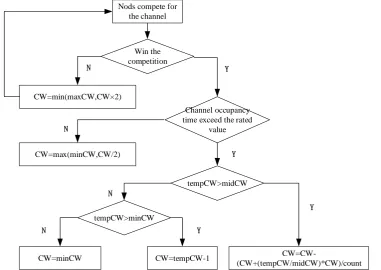
The specific description of the new backoff algorithm is as follows. (1) Channel Competition Failure: If a node fails in the channel competition process, it multiplies the competition window
until the maximum competition window , . (2) Channel
Competition Success: If a node wins the channel competition, it will set the competition window as the optimal initial competition window . In order to improve the fairness of all nodes to access the channel, the initial competition window is dynamically determined by the number of successive channel occupancies. Each time the node successfully occupies the channel, its channel occupy counter value will plus 1. When the channel occupy counter value is less than the threshold of channel occupy times , the competition window will be halved to the lower
limit and the initial competition window is set to . When
the channel occupy counter value is greater, the initial competition window of the node will be kept
i
bi
C i Cbi
) (i Ptrans
bi
C Ptrans(i)
CWMin CWMax
CW CWMax
CW CWMin
CW CWMin
CW
min
CW
max midCW (minCWmaxCW)/2
CW
max CW min(maxCW,CW2)
initCW
Count
thCount CW
within a suitable range to improve the chances of other nodes to access the channel. In this algorithm, recorded the value the halved competition window superadded 2 times the number of
channel occupy as , and then compared with , if is smaller, the
competition window will lie in the small value area at this time. Continued to compare
with , if is less than , set to , otherwise set the initial
competition window to minus 1. If is greater than , the competition
window will lie in the large value area, and the initial backoff window value will be calculated as:
= . (3) Backoff mechanism: If all the active
nodes were intercepting the channel, and the idle slot of the sensing channel is one, the node would
reduce the backoff time of one slot ( ): = .When the value of backoff
counter changes to 0, the node would transfer packets. Channel utilization maximization and energy wastage from backoff reduction would be realized. If there are succession idle slots
during intercepting channel, should meets: = whenever an idle time node
passes through. If is less than , then =0. When a node finds a channel collision or occupancy of the channel by another node, it would hang its own backoff counter and wait until the next competitive cycle begins to execute the unfinished backoff counter value. Backoff window improvement algorithm is as follows.
Nods compete for the channel
CW=min(maxCW,CW×2)
CW=max(minCW,CW/2)
CW=tempCW-1
CW=minCW
CW=CW-(CW+(tempCW/midCW)*CW)/count Win the
competition
Channel occupancy time exceed the rated
value
tempCW>midCW
tempCW>minCW
N
N
N
N
Y
Y Y
[image:4.595.115.497.334.604.2]Y
Figure 1. Backoff window changes algorithm.
Improved SMAC Simulation
NS2 Outline
The NS2 software has a variety of basic communication protocols, including IEEE 802.11, SMAC in MAC protocol and AODV, DSDV in Routing protocol. The software is developed with C++ and OTcl, in which C++ is used to write basic network component objects such as time scheduler, Tcl script is used to write simulation environment code, including link, topology, packet transmitting rate and other settings.
Simulation process of NS2 is divided into three steps: first, add the code that needs the simulation protocol; write the Tcl file after adding the code; finally, analyze the simulation data.
tempCW tempCW midCW tempCW
tempCW
CW
min tempCW minCW initCW minCW
tempCW tempCW midCW
initCW CW (CW(tempCW /midCW)CW)/Count
BT BTnew BTold aSlotTime
1 min
2 CW
new
BT BTnew BTold /2
new
Simulation Parameter Configuration of SMAC
The simulation topology is set up to a chain structure of single hop transmission consisting of 10 nodes. In the topology, the distance between adjacent nodes is set to 200 m, and the wireless transmission distance is 250 m. The node carries out single-cycle and single-hop transmission packets. Implementing different network load protocols and comparing their performance, and using the transmission interval of data stream in the simulator to simulate the real-time load change scenario. Assuming that the interval varies from 1s to 15s, for example, when interval is 10, it means that a node would transmit only one packet outward every 10s. Assuming that the starting point energy of the node is 1000J, a large value is assumed to provide sufficient energy for simulation to prevent simulation interruption due to insufficient energy. The transmission power is 386mw, the receiving power is 368.2mw, the idle interpreting power is 344.2mw, and the sleep power consumption is 50uw. The simulation bandwidth is 20kbps, the routing protocol is DSR, and the duty cycle is 20% [5].
Simulation Property Analysis of SMAC
This paper implements the improved SMAC and the original SMAC protocol to simulate the network communication in the same network simulation environment, then carefully analyzes the simulation results and draws the simulation diagram. A comparison is made among network throughput, energy consumption and energy efficiency.
Network Throughput Analysis
The so-called network average throughput refers to the packet value that the target node successfully receives from the sending node throughout the network communication. It is obvious from Figure.3 that the improved SMAC protocol is always better than the original SMAC in throughput. SMAC implements a single backoff algorithm, it cannot adapt to the complex and changeable network mutation, and the nodes are likely to collide once the network traffic mutation, thereby affecting the transmission process and greatly reducing the throughput. However, the new backoff mechanism of the improved SMAC protocol that can adapt to the change of communication environment, generally reflects the steady change of network throughput in a certain range, and greatly improves the network throughput. As can be seen from Figure.2, when the packet Interval is less than 5s, the throughput of the improved SMAC protocol is nearly 70% higher than the original SMAC protocol.
Analysis of Network Energy Consumption
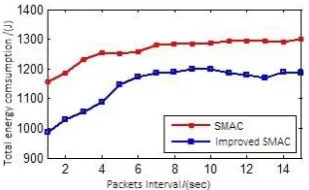
Figure 2. Network end-to-end throughput. Figure 3. Total energy consumption in the network.
Energy Efficiency Analysis
Energy efficiency can evaluate the energy utilization of the protocol. The larger the value, the better the execution rate, the smoother the communication for the whole network, and the better the performance the protocol provides. It is defined the number of packets that can be transmitted per 1J of energy consumption of nods. As can be seen from Figure.4, SMAC protocol wastes a lot of energy due to packet retransmission when network traffic is large, resulting in low energy efficiency. The improved SMAC protocol will dynamically adjust the backoff window according to the number of channels occupied by nodes, which reduces the energy consumption of packet retransmission. And the energy efficiency is relatively high. As can be seen from Figure.5, when the packet interval is less than 6 s, the energy efficiency of the improved SMAC protocol is increased by nearly 55% on average compared with the original SMAC protocol. When the packet interval is more than 6 seconds, the improved SMAC protocol consumes less energy than SMAC protocol, so its energy efficiency is higher than SMAC protocol.
Transmission Delay Analysis
End-to-end transmission delay is the time difference between the generation and reception of the same packet from the source node to the target node. Including packet queuing delay, retransmission delay and propagation delay. In this paper, the definition of average delay of node transmission is defined by literature, namely the average value of end-to-end time delay of all packets from the beginning to the end of the same data stream. As shown in Figure.5, since SMAC has a fixed competition window, when the traffic is large, the nodes will result in time delay due to competition of channel and retransmission. In the improved protocol, the backoff window is dynamically adjusted, which can reduce the chances that most nodes compete for the channel at the same time, thereby reduces the time delay of nods to a certain extent. When the packet interval is less than 7S, time delay of the improved protocol is reduced by about 37.5% compared with the SMAC protocol. Because the improved protocol will adjust the backoff window size according to the number of channel occupied by the node, there will be unnecessary delay caused by the nods due to waiting for the channel competition when the packet interval is large. As can be seen from Figure.6, when the packet interval is greater than 7 s, time delay of the improved protocol has an increase of about 4.8% compared with the original. In a word, the improved protocol is suitable for the environment with large traffic, which can make full use of the performance of the protocol and improve the life cycle of the network.
[image:6.595.336.483.648.739.2] [image:6.595.109.267.649.743.2]
Protocol Simulation Summary
The drawbacks of SMAC protocol's backoff mechanism are analyzed in this paper. It uses multiplicative increase. If the transmission is successful, the backoff window will become minimal immediately. It greatly reduces the flexibility of the backoff window, while reduce the probability of other nodes competing for the channel, resulting in the unfairness of the entire competition process greatly increased.
Because all nodes can access channels at equal probability. So that some nodes who need to transmit packets quickly can send data in a considerable time. At the same time, it guarantees that the probability of competing channels can minimize of the nodes that can't transmit packets in this period, thus reducing the probability of packet collision.
Summary
A new backoff algorithm is adopted to solve the problem of simple binary backoff mechanism in SMAC protocol. In the new backoff algorithm, the conditions for implementing the backoff strategy are very different. Considering the time of channel occupancy, all nodes can occupy the channel with the same probability. The improved SMAC protocol always better than the original SMAC in terms of throughput, energy consumption and energy utilization. Total energy consumption decreased by nearly 100J, energy efficiency is relatively high. Reducing the chances that most nodes compete for the channel at the same time, thereby reducing the time delay of nods to a certain extent. In this paper, the node adaptively adjusts the backoff window size according to the number of channels occupied, so that all nodes can occupy the channel fairly as much as possible. It is better adapted to the dynamic state of channel state and improves the fairness of node to access channels. The improved protocol is suitable for scenarios with large traffic volume in terms of transmission delay. The research on SMAC protocol is of great significance for the construction of large-scale wireless sensor networks.
Acknowledgements
This work was financially supported by the education youth science and technology talent growth project of Guizhou provincial department (QJH KY Certificate [2017]240 and the special fund funding of Guiyang science and technology bureau guiyang college (GYU-KYZ[2018]04).
Liu Min, Associate professor, Mainly engaged in computer application and data mining algorithms.
Reference
[1] Chen Linxing. Wireless sensor network technology and Application [M]. Beijing: Publishing House of Electronics Industry, 2007:100-121.
[2] Wang Shu. Theory and application of Wireless Sensor Networks [M]. Beijing: Beijing University of Aeronautics and Astronautics Press, 2007:197-200.
[3] Peng Jun, Chen Chu. Data error control of train communication network [J]. Computer measurement and control, 2005, 13(2):192-194.
[4] Li Jianzhong, Li Jinbao. Concept, problems and progress of sensor networks and data management [J]. Journal of software, 2003, 14 (10): 1717-1727.