Full Length Research Article
ELECTRO-COAGULATION (EC) PROCESS TO TREAT BASIC DYE
1,*
Manoj. P. Wagh,
2Nana. M. Mulik,
3Nemade, P. D.
1,2
Assistant Professor in Civil Engineering Department , P. D. V. Vikhe Patil College of Engineering Ahmednagar,
Savitribai Phule Pune University, Pune, Maharashtra, India
3
Professor, Department of Civil Engineering, S. B. Patil College of Engineering, Indapur, Dist: Pune-413106,
Savitribai Phule Pune University, Pune, Maharashtra, India
ARTICLE INFO ABSTRACT
In 21st century the world is facing the critical issue of waste water management, textile industry are the top most red industries in the world. Industrial processes create a variety of wastewater pollutants, highly turbid which are difficult and expensive to treat. In this paper (basic dye) camel ink is treated by using electro-coagulation process. Experiment is carried out by using batch mode reactor in a laboratory using aluminum electrodes. UV Spectrophotometer is used to carry absorbance. Experiment is carried out by using aeration with electro coagulation. The study focus on effect of electrolysis duration, current density, and spacing between electrodes. Maximum color removal efficiency was found to be 74.92 % with 16 volts and 180 minutes by using aeration and plain electro coagulation. Maximum color removal efficiency was found to be 86.47 % with 08 volts and 150 minutes by using aeration, electro coagulation and sodium chloride dose.
Copyright©2016, Manoj et al. This is an open access article distributed under the Creative Commons Attribution License, which permits unrestricted use, distribution, and reproduction in any medium, provided the original work is properly cited.
INTRODUCTION
As per the world health organization (W.H.O) use of colored water even approved hygienically, is not acceptable and colored water is generally not prefered by consumers. Color in water is due to aromatic compounds produced from decay of natural herbal substances (Malakootian and Fatehizadeh, 2010). Existence of Color is the major reason for the undesirable taste, odor and disinfections. The quality of water is decided according to color of water and its appearance. Colored water is not preferred by the people. If the people have given the choice, they will select the clean water without any color. Apart from consumer’s, different industries like paper industry, beverage productions, dairy, textile industry, plastic production, and cloth washing demands colorless water as the colored water is not preferable in those industries, this is the reason the color in water is considered to have an adverse effect (Mohammadian Fazli et al., 2010; Manoj Wagh, 2015; Manoj Wagh, 1159).
*Corresponding author: Manoj. P. Wagh,
Assistant Professor in Civil Engineering Department , P. D. V. Vikhe Patil College of Engineering Ahmednagar, Savitribai Phule Pune University, Pune, Maharashtra, India.
Chemical particles present in the water affects the color of water which cannot be separated by the simple process of filtration is called the true color. Suspended and colloidal partials present in the water also affect the water which is called as the manifest color which can be easily removed by filtration process. (Kim et al., 2003). The color of raw water affects the hardness and density of raw water and ultimately scale and sludge will get deposited in inner side of container. Color water increases the environmental load factor. As per green chemistry is concern, environmental load factor should be lower. So it is essential to sustain environmental load factor to minimize the pollution by using fruitful catalysis. Color in water is the because of dissolution express from metals in soil and stone, from organic matter in soil and plants, and occasionally from industrial by-products. When color is present due to metals, it is ordinary due to iron, copper, or manganese ions in the water. Leaf and humate may add very complex phenolic substance, strophanthin, and their by products to the water, resulting in a yellow or brown tinge. Industries can add a variety of chemicals with different colours. Suspended and dissolved particles in water influence color. Suspended material in water bodies may be a result of natural causes and/or human activity.
ISSN: 2230-9926
International Journal of Development Research
Vol. 06, Issue, 05, pp. 7858-7862, May,2016
International Journal of
DEVELOPMENT RESEARCH
Article History:
Received 25th February, 2016
Received in revised form 18th March, 2016
Accepted 17th April, 2016
Published online 31st May, 2016
Key Words:
Electro-Coagulation, Electrolysis, Spectrophotometer, Aluminum Electrodes, Absorbance
Clean water with a low collection of dissolved materials appears blue and point out less yield. Dissolved organic matter, such as humus, peat or decaying plant matter, can produce a yellow or brown color. Some algae or dinoflagellates produce reddish or deep yellow waters. Water rich in flora fauna and other algae usually appears green. Soil runoff produces a variety of yellow, red, brown and gray colours weathered rocks and soils, the land-use activity and the type of trees and plants growing within the watershed will influence the types and amount of dissolved and suspended material found in a lake or stream. Color may also be affected by the concentration of natural dissolved organic acids such as tannins and lignins, which give water a tea color. These are formed when plant material is slowly broken down by organisms into very small particles that are dissolved into water. Tannins that are yellow to black in color are the most abundant kind found in lakes and streams and can have a great influence on water colour. Lakes that are surrounded by coniferous forests (evergreens such as pine, spruce, hemlock and fir trees) are generally brown in color because pine needles that fall to the ground are very slow to degrade. This is also true of lakes surrounded by wetlands, where plants decompose very slowly. Naturally occurring organic compounds such as tannins and lignins, derived from the decomposition of plant and animal matter,
can give surface water and groundwater a tea-like yellow-brown hue, as well as a musty smell, is known for its "root beer" color. Kobya et al., (2016) performed electro coagulation (EC) process in a batch mode to assess the impact of various experimental parameters such as initial pH, current density, electrolysis time, initial phenol concentration, and conductivity on the removal of phenol in aqueous solutions, phenol removal efficiency by using iron electrode was 98.6% and for aluminum electrode 99.2% .Abdul et al., (2016), investigate the effect of pH on EC process; acidic pH is more effective for decolorization. Ville et al., (2008), summarized application of EC process to different industries such as tannery, textile, colored wastewater, pulp and paper industry wastewater; oily wastewater; food industry wastewater. The present study includes the implementation of EC process to decolourization of color dye by using the aeration process and sodium chloride.
MATERIALS AND METHODS
[image:2.595.107.507.356.752.2]Camel ink royal blue basic dye locally available is used as sample to investigate the effect of electro coagulation. Aluminum electrode also called as sacrificed electrode manufactured by J. M. Industry Ahmednagar, Maharashtra State India, of purity 99.9 % are used to treat the basic dye.
Figure b. Variation of Absorbance with time
Figure c. Variation of Absorbance with voltage (EC &Aeration)
[image:3.595.138.468.549.754.2]Magnetic stirrer of Remi made of capacity 5ML plus with 1500 rpm are used. UV Spectrophotometer NV 201 Fisher Scientific made is used to find out percentage color removal.
METHOD
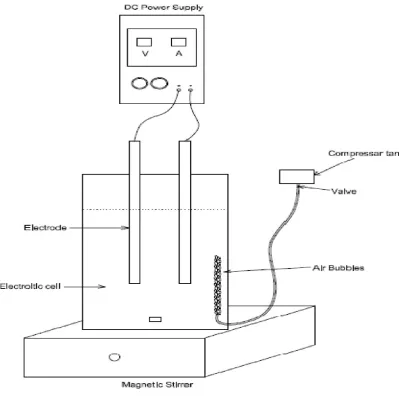
Electro coagulation unit consists of beaker with magnetic stirrer, magnetic bar, two aluminum electrodes, and D.C. power supply system and aeration unit are shown in figure 1. Both aluminum electrodes having submerged area of each electrode are 21 cm2each.Electrodes are placed vertically and dipped in 1000 ml basic dye solution. Electrodes are connected to D.C. power supply & Aeration is carried out.
Camel pen ink of 100 ml is mixed with 1000 ml tap water that is 10 % concentration of basic dye is treated with different voltage such as 8 volts, 12 volts, 16 volts for duration 30, 60, 90, 120, 150 and 180 minutes. Spacing between two electrodes is 1.5 cm; aeration was carried out by using centrifugal pump (small electric motor). In second part, dose of 5 gm of sodium chloride was applied and followed by electro coagulation. In third part, color solution was passed through 10 gm charcoal power allowed to stirrer for half hour. Sample was then sent to electro coagulation. Value of color removal was calculated after 30 minutes interval. Agitation speed for (EC) was 500 rpm. Basic color dye concentration was measured using UV Spectrophotometer at a wavelength corresponding to maximum absorbance of dye. The color removal efficiency is carried out by using this formula
Color removal efficiency (%) = x 100
RESULTS AND DISCUSSION
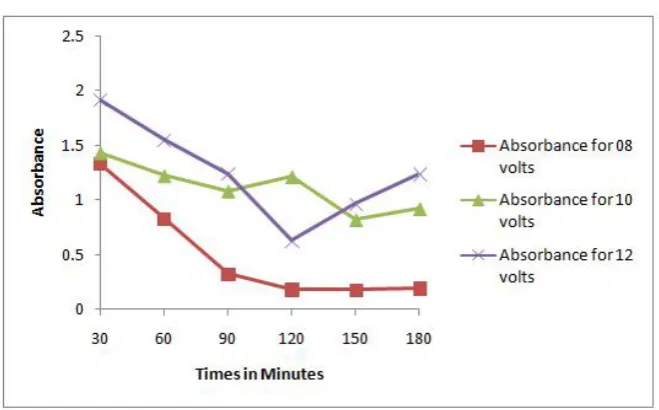
Initially experiment was conducted to study effect of (EC) on absorbance and the duration of time. As the time increase color removal efficiency is increases similar result has been obtained by wagh et al., (2015). First run was carried out by considering aeration and (EC). The aeration increases the rate of oxidation indirectly it enhances the rate of bubble formation on the sacrificial electrode so rate of electro coagulation increases (wagh et al., 2015). Table 1 represents electro coagulation process is vigorously occur in presence of the sodium chloride as sodium chloride accumulates the conductivity rate. Color removal efficiency also increase in presence of sodium chloride as compare to the plan electro coagulation and aeration. Absorption rate is also vary with combination of (EC) aeration and (EC) with sodium chloride as shown in figure 2. pH and time and distance between two electrodes are the main parameter to remove the color of the sample (kobya et al., 2012, Wagh et al., 2015) As per faraday’s law electric conductivity increase with increase in voltage, similar electro coagulation rate has been increases tremendously and sludge is form on a large scale. The samples of treated dye are collected in 30 minute interval. To carry out the final absorbance of each treated sample are pass through whatman paper 40. Maximum absorbance is 0.346 for 16V, 0.423 for 12 V and 1.29 for 8 Voltage respectively are shown in table 2 & 3 respectively. Figure 3 & 4 represents the variation of absorption with time and for different voltage.
Conclusion
[image:4.595.82.521.79.150.2]In this study electro coagulation carried out by using Al-Al electrodes in batch mode operation, and the optimum values of
Table 1. Variation of Absorbance with time at (8 Voltage)
Times in minutes Absorbance (EC & Aeration) Absorbance [(EC) + aeration + dose of sodium chloride]
30 1.743 0.831
60 1.512 0.324
90 1.393 0.185
120 1.381 0.180
150 1.362 0.195
[image:4.595.109.497.185.256.2]180 1.29 0.120
Table 2. Variation of Absorbance with voltage (EC &Aeration)
Times in minutes Absorbance for 8 volts Absorbance for 12 volts Absorbance for 16 volts
30 1.743 1.42 1.38
60 1.512 1.359 1.125
90 1.393 0.847 0.822
120 1.381 0.723 0.712
150 1.362 0.590 0.447
180 1.29 0.423 0.346
Table 3. Variation of Absorbance with voltage [(EC) + aeration + dose of sodium chloride]
Times in minutes Absorbance for 08 volts Absorbance for 10 volts Absorbance for 12 volts
30 1.331 1.427 1.918
60 0.831 1.220 1.551
90 0.324 1.081 1.244
120 0.185 1.211 0.630
150 0.180 0.821 0.965
[image:4.595.116.491.309.378.2]various operating parameters were obtained. The optimum
value of voltage was found to be 16 volts. Maximum color
removal efficiency is found to be 74.92 % without use of sodium chloride at an electrolysis time of 150 minutes.
Maximum removal of color is found to be 86.47% with sodium chloride at electrolysis time of 150 minutes. The nature of pH is found to be almost constant during experiments.
Acknowledgements
The authors would like to express sincere thanks to Dr. H. N. Kudal, Principal, P. D. V. Vikhe Patil College of Engineering Ahmednagar Savitribai Phule Pune University, Pune, Maharashtra, India
REFERENCES
Abdul Raman Abdul Aziz, P. Asaithambi, Wan Mohd Ashri Bin Wan Daud 2016. Combination of electrocoagulation with advanced oxidation processes for the treatment of distillery industrial effluent, Process Safety and Environmental Protection, pp. 227-235.
Bryant, E., Fulton, G. and Budd, G. 1996.- Disinfection alternatives for safe drinking water. Van Nostrand Reinhold. New York.
Kim, S., Park, C., Kim, T., Lee, J. and Kim, S. 2003. COD reduction and decolorization of textile effluent using a combined process. J.biosci. bioeng, 95: 102 - 105.
Kobya Mehmet, Eran Demirbas 2012. Effect of operational parameters on the removal of phenol from aqueous solutions by electro coagulation using Fe and Al electrodes, Desalination and Water Treatment, 46, pp. 366-374.
Kobya. M and Gengecb.E 2012. Decolourization of melanoidins by a electrocoagulation process using aluminium electrodes Environmental Technology,pp 1-10. Malakootian, M, A. Fatehizadeh 2010. Colour removal from
water by coagulation / caustic soda and lime “Iran.
Journal. Environmental Health. Science. Engineering., Vol. 7, No. 3, pp. 267-272
Manoj Wagh , P. D. Nemade, Colour and COD removal of Distillery spent wash by using Electro coagulation ,
“International Journal of Engineering Research and General Science” Volume 3, Issue 3,pp. 1159-1173.
Manoj Waghand P.D.Nemade 2015. Treatment process and Technologies for Decolourization and COD Removal of Distillery Spent Wash: A Review , International Journal of
Innovative Research in Advanced Engineering,Volume 2,
Issue 07 pp. 30-40
Manoj Wagh, Pravin Nemade “Treatment of Distillery Spent Wash by Using Coagulation and Electro – coagulation” (EC), American Journal of Environmental Protection, 2015, Vol. 3, No. 5, 159-163.
Mohammadian Fazli, M., Mesdaghinia, A. R., Naddafi, K., Nasseri, S., Yunesian, M., Mazaheri Assadi, M., Rezaie, S. and Hamzehei, H.D. 2010. Optimization of reactive blue 19 decolorization by ganoderma sp. using response surface methodology. Iran. J. Environ. Health. Sci. Eng., 7(1): 35-42.
Ville Kuokkanen, Toivo Kuokkanen, Jaakko Ramo, Ulla Lassi 2013. Recent Applications of Electrocoagulation in Treatment of Water and Wastewater—A Review, Green
and Sustainable Chemistry, 2013, 3, 89-121.