2988
ENTERPRISE RESOURCE PLANNING IMPLEMENTATION
SUCCESS FACTOR
(A case study in Atma Jaya Catholic University of Indonesia)
1WELI
1Master of Accounting Department, Atma Jaya Catholic University of Indonesia, Jakarta, Indonesia
E-mail: 1[email protected]
ABSTRACT
This research aims to analyze the systems implementation success factors, benefits to users, and satisfaction of users in the implementation of Enterprise Resource Planning(ERP) at Atma Jaya Catholic University of Indonesia, which went live in June 2016. This new system was initiated by Atma Jaya Foundation to improve the preparation of consolidated financial statements, which the previous system could not accommodate. This change was executed despite the contentment with the predating system. A problem occurred at the beginning of the new system implementation, where users were challenged with the new interface and English instruction. To avoid further delays, the work integration between all units was postponed. The Atma Jaya Foundation decided to centralize data processing in two units: Bureau of Accounting and Finance and Bureau of Facilities and Infrastructure Management. This action caused further challenges that deserve an investigation. We employ case study method to obtain description of user responses and how university leaders managed the whole implementation process. Data were collected through interviews with end-users and key system implementers. We find that strong support from leaders, favorable project management, and appropriate change management may anticipate user resistance. Users also felt involved in the implementation project. Our analysis shows that users are quite satisfied with the ERP performance. Problems at the beginning of use were unraveled with assistance from vendor and university leaders. Finally, users believe that ERP can be implemented properly and will benefit them in daily operations. This research contributes to empirical and case studies on ERP system implementation in educational institutions. The findings from this investigation are expected to complement current empirical literature on ERP system implementation success.
Keywords: ERP, Implementation, IS Success Factor, Benefits, Satisfaction
1. INTRODUCTION
An Enterprise Resource Planning (ERP) system integrates all business processes. It comprises multi-module applications, which focuses on functional areas of a business [1]. This integrated information system is expected to create firm value through efficiency and flexibility, related to costs of timely information distribution to respective users for decision-making [1]–[4]. Originally, ERP was designated for data processing in manufacturing industries and large companies. However presently, ERP is utilized in a variety of company sizes and industries. Education organization is one of them. Advancements in higher education technology forces universities to convert from conventional system into an integrated one. Study by [5] reported that in Australian universities employ ERP to boost
efficiency, flexibility, and support decision-making process.
2989 decision-making responsibilities for leaders/management [9].
However, [8] found that ERP implementation in universities is more difficult than those done in other business organizations. In corporations, business processes are easier to reengineer because to achieve cost efficiency, they make reductions in administrative process costs. Meanwhile in universities, efficiency in administration is not a main factor for performance because it rests on their academic reputation. Such difference in organization nature presents an implementation challenge, particularly in customization process.
Even though there have been several studies on ERP system implementation, this topic is still relevant, particularly for industry-specific cases such as educational institutions [1], [10]. Further investigations are also needed for institutions in developing nations because it is still quite rare [11]. In Indonesia, ERP application in universities is becoming more popular like in other countries [13]. However special reports are yet to be written.
To fulfil the need for a lean business process in a contemporary environment, Atma Jaya Catholic University of Indonesia (AJCUI) began implementing ERP for its finance process in June 2016. This implementation was managed by two units: Bureau of Accounting and Finance (BAF) and Bureau of Facilities and Infrastructure Management (BFIM). Our preliminary observation and studies give evidence that there were challenges in ERP implementation within BAF and BFIM, which were primarily caused by the lack of user knowledge and skills. Users were not familiar with the new display and English language instructions. As a result, it took more time to process data at the beginning of ERP use. Data center was also not accessible real-time. Moreover, due to inability to use the online ERP in each respective unit, a centralized system was used instead. This incident added substantial workload to the BAF. This occurrence was intriguing because ERP is supposed to integrate and simplify business processes, which would enhance information flexibility and financial reporting accuracy[2]–[4].
Based on our review, there is a need to further study the ERP implementation in AJCUI: its success factors, benefits experienced, and user satisfaction throughout its more than two-year use. This is necessary because at the beginning of the implementation, there were operational changes because the objective of the implementation, i.e. business process integration, was not achieved. The Atma Jaya Foundation decided to centralize all work load in two units: BAF and BFIM. This action
has to be assessed to determine whether it influenced implementation success and how system users responded to the changes that occurred. Our findings are expected to provide useful input for education institutions that are considering ERP implementation, contribute to information systems education literature, and empirical and case studies on ERP implementation success factors in educational institutions.
Based on our introduction, we formulate the following research question: (i) What factors determine the success of ERP system implementation in educational institution? (ii) How do the users respond to the implementation? Are they satisfied with it? Do they experience benefits from the new system?
2. LITERATURE REVIEW
Our study follows the concept of Critical Success Factors (CSF) by [10]. CSF is a result of meta-analysis which is based on Information Systems Success Model. We also adhere to [11], who document the three layers that we need to approach in determining information systems success: organizational layer, departmental layer, and end-user layer. The organizational layer would be represented by Atma Jaya Foundation’s key people, meanwhile the departmental and end-user layers would be represented by key people in Bureau of Accounting and Finance (BAF) and Bureau of Facilities and Infrastructure Management (BFIM).
2.1 User Satisfaction and ERP System Implementation Success
ERP is implemented by companies to add value; however, many were unsuccessful at it [8], [9], [11], [12]. There are several challenges in ERP implementation process, namely process, people, and culture [8], as well as the university’s unique business process [13]. The other study by [14] also found other implementation challenges:
Costly implementation
Costs which include software purchase and consulting fees.
Inadequate information technology infrastructure
To ensure the ERP can run as designed, the organization would need to provide compatible IT.
Refusal to change
A company may face resistance from system users. Therefore, end-users and key-users have to be supported to adapt from the old to the new system.
2990 The management has to facilitate systems change by providing financial and human resources.
This is why we have to not only assess the satisfaction and benefits of ERP use, but also the causes of implementation failure, such as the level of support from leaders/managers and resistance to change from the users [15]. Both key-users and end-users’ acceptance to change has a crucial role in determining a system’s success. If these users are able to adapt to the new ERP implementation and operate the system, then it will result in performance and productivity improvement [11], [14]. The success of this implementation also requires financial and human resources support, which are provided by the top management team [6], [8], [14].
Determinants of ERP system implementation have been formerly researched. [10] reviewed ERP literature and found that ERP system success is influenced by: commitment and support from the management, project management and evaluation, business process engineering, minimum customization, well-composed ERP team, change management program, proper training and education for the organization, business plan and vision, adequate interunit communication and cooperation, vendor support, organizational culture, software analysis, project champion, careful software choice, capable consultant, legacysystem support’s compatibility with the new system, system quality, and user participation. Therefore, full organizational engagement is necessitated to ensure the success of ERP implementation. Entity (as facility provider), management (as supervisors), and employees (as users) have strategic roles throughout the transition. In organizing the system change, proper planning, coordination, and training would impact users’ acceptance and satisfaction.
A study conducted by [13] in Queensland University of Technology discovered six groups that determine ERP implementation success: ERP adoption decisions, ERP selection, customization procedures, integration aspects, role of consultants, and ERP system evaluation. Later on, [8] gave evidence for the following factors of ERP implementation success in universities: top management commitment and support, change management, project management, business process reengineering and system’s customization, training, ERP team composition, consultant selection and relationship, and communication plan. Ergo, our usage of the Information Systems Success Model in assessing the user satisfaction, which will reflect on the ERP implementation success in AJCUI.
2.2 Assessing the Benefits of ERP System Implementation
A company’s decision to implement the ERP system is triggered by its benefits. We can synthesize from previous findings that use of ERP aids its users; offering advantages for accounting, operations, management, strategy, IT infrastructure, and organization [4], [12], [16]–[18]. Overall, ERP brings efficiency to the business process.
The effectiveness of system use affects its advantages for users [16], [19], [20]. Previous surveys show that ERP system use brings change, specifically in the accounting process, where the
ERP system integrates accounting
applications/software. This brings about to flexibility in information generation and increase in financial reporting quality, which leads to reliable and timely accounting information for decision-making [1], [3], [4], [19].
Our anecdotal evidence gathered from experienced ERP users in Indonesian firms supports the empirical findings that we have reviewed above, such as aiding management in decision-making and increasing operating efficiency and effectiveness due to the integration of business functions. ERP system is capable of handling business process, from customer order management to production process, which also includes materials order system integrated with the finance system. ERP streamlines end-to-end operation because it provides comprehensive and timely information about operations, finance, and sales[12]. Additionally, this speediness augments customer relationship management due to the prompt response from the company. The system is also superior in facilitating warehouse management system. In the matter of Indonesian universities, it has been reported that they benefit greatly from the effective and efficient allocation of human resources and the establishment of a connected accounting system. For this reason, this research will evaluate the advantages of ERP system, focusing on the accounting and administration functions.
3. METHODS
Our study describes the ERP implementation process: the planning stage, system launch, initial system use, and after two-and-a-half years of utilization. We aim to report on the implementation process and advantages of the system experienced by the users and key-people.
2991 interviewed users from the Bureau of Accounting and Finance (BAF) and Bureau of Facilities and Infrastructure Management (BFIM). Prior to the interview, the informants were given details/illustration and brief review of the research. Adhering to the input from the head of BAP, we selected four interviewees: BAP head, accounts payable staff, cashier, and infrastructure supervision and operating support staff. Meanwhile the informant from BFIM was an Asset and Purchasing staff.
During the second stage of data collection, we conducted a follow-up interview with the same informants from the first stage, as well as additional key-people at the time of planning stage up till the system launch. Moreover, we distributed questionnaires to various units to evaluate the benefits/advantages of ERP and user satisfaction after two-and-a-half years of utilization.
3.1 Operationalization of Variables 3.1.1 Implementation success factor
This variable describes factors of system implementation success. The factors in this variable follow the ones developed by [10]:
Support and commitment from leaders
Project management and evaluation
Business process engineering with minimum customization
ERP team composition
Change management program
User training
Vision and business plan
Enterprise-wide communication and cooperation
Organizational culture
Vendor support
Software analysis
Project champion
Way of ERP selection
Consultant employment
Business compatibility and legacy system
System quality
User involvement
3.1.2 Benefits of implementing ERP
This variable evaluates the benefits that are experienced by ERP system users in AJCUI. Our measurement is adopted from previous studies [16], [19], [20]. The benefits are categorized into four: IT infrastructure, Operational, Organizational, and Managerial.
IT Infrastructure
o Gathers data quickly and easily o Generates output quickly and easily o Increases general database maintenance
o Improves document circulation
o Augments Communication between employee and management
Operational benefits
o Shortens accounting closing process time o Shortens financial reporting time o Reduces accounting staff (workload) o Increases reporting quality – payment
order
o Shortens reporting time – payment order o Shortens document entry time
o Shortens year-end account closing process time
o Lowers operational costs o Reorganizes personnel/workforce Organizational benefits
o Increases flexibility of information production
o Increases accounting application integration
o Enhances decision-making process o Augments internal audit
o Improves financial reporting quality Managerial benefits
o Improves control on working capital o Encourages use of ratio analysis o Reduce payroll processing time o Strengthens monitoring of assets o Makes the most of financial resources o Increases flexibility in information
provision
o Augments cash control – liquidity
o Improves decision-making through timely information
o Handles new programs more conveniently o Enhances the effectiveness of internal
control
o Improves the supplier’s service
o Increases the clarity/transparency of financial management
o Supports inter-department integration of functions
3.1.3ERP system user satisfaction
This variable evaluates the satisfaction of ERP Finance users in AJCUI. The measurement is constructed based on the Information Systems Success Model [21], which considers the quality of the system, quality of the generated information, and use of related users.
New system generates precise output, as-needed.
Users are satisfied the information accuracy of the new system
2992
The new system is user-friendly
The new system provides sufficient information
Output is presented in workable format
Information are obtained in a timely manner
Information are clear/coherent/comprehensible
The new system is easily utilized
Informants respond to the nine items above using a scale from one to ten (1 to 10), with 10 being user most satisfied with the ERP and experiences the most advantage/benefit from it.
4. FINDINGS AND DISCUSSION
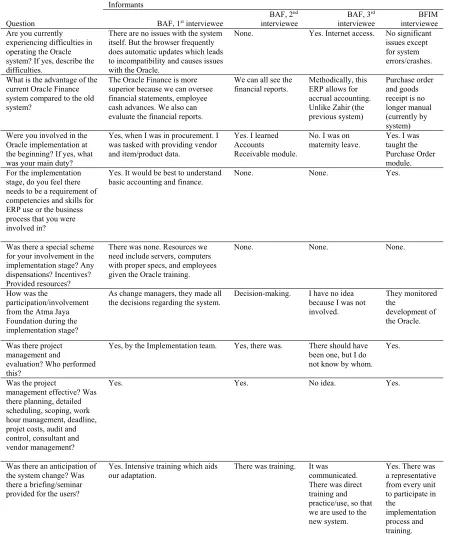
As mentioned in the previous chapter, our data were collected from two Atma Jaya units: The Bureau of Accounting and Finance (BAF, 3 informants) and the Bureau of Facilities and Infrastructure Management (BFIM, 1 informant). We also added one more informant from Atma Jaya Foundation who was aware of the implementation process since the beginning. The BAF manages the financial and accounting system for Atma Jaya Catholic University of Indonesia (AJCUI) and Atma Jaya Hospital. Daily BAF activities include processing input, verifying budgetary requests from other AJCUI units, cash receipt, cash payment, and daily bank reconciliation. Meanwhile the BFIM oversees asset management, procurement, infrastructure management, and operational support. Prior to the ERP implementation, the BAF used Zahir accounting software and the BFIM used Microsoft Excel for processing purchase orders and executing purchasing activities. Table 1 presents a summary of responses from the informants/ interviewees (see appendix):
General Description of the System Implementation
The implementation of ERP Finance was commanded by the Atma Jaya Foundation. They intended for timely and accurate financial information, which the former system could not facilitate. The previous system was not able to present AJCUI’s consolidated financial statement to the Foundation. Financial statement consolidation was completed manually on Microsoft Office because the Zahir software could not enable process; it took plenty of time and generated inaccuracies. For example, balance differences between the general ledger and the statement of financial position (or balance sheet). This problem obstructed the Foundation’s decision-making process, particularly in a developing business environment. Thus, the Foundation’s decision to
change the accounting and finance information system in AJCUI. At the beginning, a Steering Committee was formed. It comprised the head and members of Atma Jaya Foundation, and the head of Bureau of Information Technology System (BITS). Their agenda was to plan the system development in 2012-2013 and carry out ERP vendor selection through beauty contests in 2014-2015.
The ERP Finance implementation was based on a business plan, synergized with the organizational vision and mission of the Atma Jaya Foundation. The Foundation also established a special task force: The Implementation Team, consisting of key people/users which include the Foundation’s Head of Finance, the Head of BAF, the General Manager of Atma Jaya Hospital, Head of Procurement from BFIM, and finance staff from various work units. The members of the Implementation Team also had their own daily responsibilities; following their respective job description. To ensure the implementation adheres to the project timeline, the Implementation Team would periodically meet with consultants to coordinate their duties. And the Steering Committee oversees and evaluates the work of the Implementation Team.
To prevent issues arising from the system change, the vendor held trainings and briefings to prepare and motivate the users’ adaptation, shape the users’ attitude toward change, and decrease the likelihood of probable conflict caused by the implementation. These sessions were held even before the implementation began to explain the need for a new, integrated system. This necessity was further urged by the approaching opening of the third AJCUI campus in Tangerang and the future development plans of the Hospital.
The next phase was the beauty contest between potential vendors, conducted by the Project Team. The contest was subsequently won by the Oracle Database. The key-people and key-users from every work unit were involved to educate and raise awareness about the continuous business process and the importance of functioning independent units, because they would affect one another and the performance of the organization as a whole. This process would indirectly influence the change in the organization’s work culture.
2993 needs of the user. Oracle is able to accommodate the integration of other existing information systems in AJCUI, such as the MyAtma learning management system and the Hospital information system.
User Response
Prior to the ERP system implementation, the BAF had been conveniently using Zahir accounting software for two years. The BAF staff were used to and skillful at it. They neither had issues operating the software nor the desire to substitute it. Whereas the BFIM applauded the system change because they previously completed their work manually.
The ERP system implementation began with training from consultants. The instructors directed every section/department in the two bureaus, especially at the employees who directly dealt with the system. The trainees said that they received technical support and proper materials/modules related to the system use. The training took up to fourteen days (largely a two-day average) during regular working time. The training modules were given progressively and different for every employee, depending on his/her job description. Both BAF and BFIM staff felt that the trainers had skillfully delivered adequate and comprehensible materials throughout the training.
The trainees did not experience any major difficulties during the training. They could easily understand the given materials. However, these were only the basic functions of the system. Once the ERP was actively used in the Bureaus, the system users encountered problems due to difference in work procedures. For example, users from BFIM came across system crashes, variances between manual and system calculations, and unfamiliar system codes. These issues were solved through guidance from the vendors. Additionally, users were not discouraged from using the new system. They felt that such complications were common because it was early stage of implementation. It would take more time to adapt, particularly for older personnel.
The ERP transformed the business procedure; principally the purchasing process. It converted the lengthy and manual procedure into a simpler and faster process. Under the new system, approval of the purchase order is done through the application. This simplifies workflow because the system directly allows users to execute purchases as long as it does not exceed the determined purchase value limit. Unlike the old system where all purchases had to be authorized manually, whatever the amount.
At the introduction of the implementation, users actually experienced better work process. However, there were occurring hindrances in other units related to the finance process within the new application, which led to event delays in AJCUI. Lack of readiness in some departments drove the Atma Jaya foundation to instigate a centralized ERP use in BAF and BFIM. This centralization, on the other hand, inconvenienced both Bureaus because data were pouring in from other units (faculties, departments, and other bureaus) and mounted up workload. As time went by, the implementation progressed in other units, which decluttered the workload.
Initially the BAF staff were not aware of the motivations to convert the system into ERP. Subsequently, they recognized the advantages of the new system. The ERP Finance speeds up business process. Its decentralized work system reduces staff workload, because data input can be done independently in every AJCUI unit. Therefore, the Foundation’s decision to centralize the ERP was counterproductive because it burdened the BAF staff. In response, the Foundation decided to initiate overtime and recruit more human resources like student interns.
Overall, users felt involved and took part in the system change. They contributed by describing the internal business process to Oracle, building designs for the ERP implementation, and coaching other AJCUI employees on how to use new system. Furthermore, the employees appreciated the support, guidance, and commitment given by the university leaders. The tutelage given by the vendors during the first month of implementation was also considered to be very helpful. However, the decision to centralize the system in BAF and BFIM turned out to be complicating staff work. It added workload and user response time. Nevertheless, users felt that the new system implementation was quite successful. It promotes faster financial information generation and consolidation process.
2994 Our interview data analysis finds that critical success factors for ERP implementation in AJCUI corresponds to the findings of previous studies [10]: 1. Support and commitment from AJCUI leaders, measured from their involvement, awareness, participation, support, and funding.
2. Effective project management through planning, detailed scheduling and timetabling, deadline setting, project costs, control mechanisms, and collaborations with consultants and vendors. Project was periodically evaluated throughout the implementation, following the project timeline. This was done because the key-people performed multiple assignments. 3. Process business engineering occurred in
few aspects. There were minor customizations, e.g. integration between the university’s learning management system and the hospital information system. Other business processes received minor procedure tweaks.
4. Members of the ERP implementation team were selected for the competence and their job description (accounting and finance roles in every AJCUI unit). Steering Committee also had a role in overseeing and empowering the work of the implementation team.
5. The Atma Jaya Foundation had developed and directed adequate change management. They prepared for possible conflicts and informed stakeholders about the reason for ERP implementation. Hence, there was no resistance from the users. All employees responded positively to the system change and were ready to operate it accordingly.
6. The trainings were conducted effectively. All trainees satisfactorily reviewed the series of seminars given by the trainers. 7. The Atma Jaya Foundation had assembled
proper business plan and a strong vision for the new system. Project feasibility was done to ensure the congruence of the project and long-term strategy of AJCUI. 8. The Atma Jaya Foundation managed to
communicate the benefits of ERP to the whole organization, therefore encouraging inter-department harmony and collaboration.
9. The AJCUI organizational culture championed the implementation success.
The employees/users displayed a commitment and reception to change. 10. The vendor provided support and line of
communication with the users.
11. Project managers presented strong leadership and commitment for implementation success.
12. Software selection was completed with prudence through beauty contests, while involving stakeholders. The process considered software feasibility and quality, business scope suitability, and the vendor’s appropriateness, i.e. experience, reputation, knowledge, and competence. 13. Enlisted consultants interacted effectively
and helpfully with the users. They assisted with forming the implementation team, assessing their competence.
14. The legacy system was sufficient. The preexisting hardware and software were adequate for supporting the new system. 15. The new system is deemed to be of
quality, flexible, and well-matched to AJCUI strategies.
16. The new system implementation engaged users and their support from all Atma Jaya units/departments.
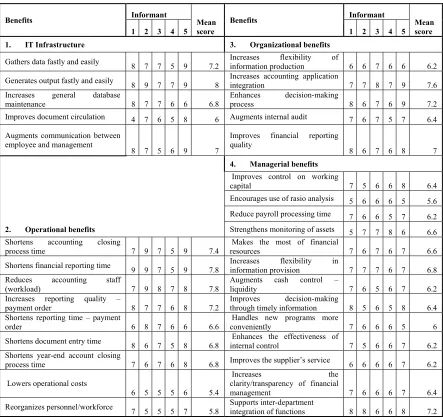
As for the variable of benefits experienced by users during the implementation, we followed a model from previous papers; assessing IT infrastructure, operational benefits, organizational benefits, and managerial benefits [16], [19], [20]. The interview responses for the benefits from ERP system use can be found on Table 2 (see appendix).
Firstly, the benefits associated with IT infrastructure are regarded to be greatest out of all categories, namely the speed and ease of data compilation and output generation, along with improved communication between management and subordinates. Circulation of documents was slightly upgraded from the old system. On the other hand, the new system was considered to be inflexible because documents need to be approved before printing. This would disrupt work flow if authority were not in place.
2995 Thirdly, employees also felt that there were some organizational benefits. The newly implemented system integrated accounting applications, which improved the quality of financial reporting and afterward, the decision-making process. Lastly, managerial benefits were not experienced as greatly as the other benefits, although they commended the integration between units/departments.
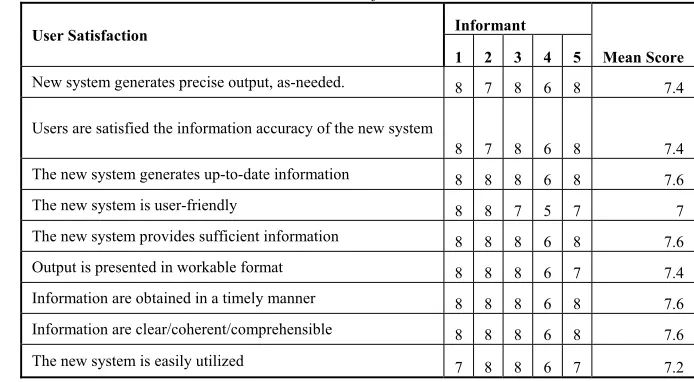
Table 3 (see appendix) presents the users’ satisfaction with the ERP. The user satisfaction assessment using the Information Systems Success Model reveals that users are quite satisfied with the new system in the following ways: providing information, displaying suitable format and report, producing accuracy, and generating current information. The users agreed that the new system was user-friendly, albeit not at the beginning. Moreover, system errors and crashes also occurred. With time, fixes, and adjustments, users deemed the new system as easy-to-use. The users’ approval was mainly attributed to the automation of manual work, such as labor-intensive spreadsheet entry. The quality of work improved due to the ERP system’s financial statement layout. This allowed for a more organized and meticulous data. Every activity/transaction is able to be overseen by units/departments with direct line to the BAF, therefore promoting transparency.
5. CONCLUSION
Based on our research, we can conclude that the implementation of ERP Finance in AJCUI is successful. This was measured using an instrument developed by [10] and following the model of ERP use by [11] which separates the organization into three layers:
1. Organizational layer
a. There was support and commitment from AJCUI leaders.
b. Change management was directed by AJCUI leaders.
c. Atma Jaya Foundation had formulated its business planning and established a clear vision regarding the new system implementation.
d. Feasibility study was done in accordance with AJCUI’s long-term strategy.
e. Atma Jaya Foundation had appropriately communicated the benefits of ERP to future users. f. AJCUI organizational culture enables
implementation success.
g. The legacy system was integrable and hardware was adequate to support implementation.
h. The new system was felt to be of quality, flexible, and compatible with AJCUI strategy.
2. Departmental layer
a. Project management was effective. b. There was a slight business process
engineering
c. Trainings for users were conducted effectively.
d. Team of ERP Implementers were competent and well composed. e. Vendor was communicative and
provided technical support.
f. Project leaders displayed leadership and strong commitment.
g. Software was carefully selected by stakeholders through beauty contest h. There were competent consultants,
who communicated effectively with users.
3. End-user layer
a. There was user involvement
b. Users showed their commitment to change.
The benefits that were experienced by ERP system users mostly correspond with previous research findings [16], [19], [20]. The greatest benefit relates to IT infrastructure, followed by operational, organizational, and managerial benefits. The new system quickly gathers data input and produces output in a rapider manner, which advances communication between employee and management. The system also increases reporting efficiency through accounting staff reduction and accounting software integration. This improves financial reporting quality and decision-making process.
We evaluated user satisfaction using the Information Systems Success Model. We find that the system: (i) gives a reporting and display format which matches the needs of users, and (ii) produces accurate and timely information. However, there was also a centralized work model problem. Initially, this accounting and finance function was supposed to be performed/operated in each respective unit. Such centralization caused workload buildup in BAF and BFIM, which triggered a need for overtime and new employee recruitment. This resulted in higher operational cost.
2996 [21]. We also contrast the findings of [11] where training is not a hindrance to ERP implementation success. Furthermore, we can conclude that the implementation success in AJCUI is heavily influenced by the Foundation’s strategy in managing human resources when the end users were unready for the ERP system. The Foundation was resolute and decisive at the centralization of activities. Even though the centralization process caused higher overtime costs, it was a successful step; users ended up using the system fluidly. This resulted in a properly functioning internal business process. Strong leadership is a determinant of success in managing changes. This can be shown from user satisfaction and statement about the benefits of the new system.
Finally, our research has its limitations. First, data were collected through interviews within BAF and BFIM and finance employees from different units. Second, timing constraints. The implementation is relatively new; thus, we would still need to conduct more reviews in the future across all units which possess accounting and finance function area. During our data collection stage, decentralization tryout for the system was still performed gradually.
REFRENCES:
[1] R. A. Tenkorang and P. Helo, “EnterpriseResourcePlanning(ERP):ARevie w LiteratureReport,” in the World Congress on Engineering and Computer Science 2011, 2011, no. October.
[2] S. Newell, J. C. Huang, R. D. Galliers, and S. L. Pan, “Implementing enterprise resource planning and knowledge management systems in tandem: Fostering
efficiency and innovation
complementarity,” Inf. Organ., vol. 13, no. 1, pp. 25–52, 2003.
[3] C. Spathis and S. Constantinides, “Enterprise resource planning systems’ impact on accounting processes,” Bus. Process Manag. J., vol. 10, no. 2, pp. 234– 247, 2004.
[4] C. Spathis and S. Constantinides, “The usefulness of ERP systems for effective management,” Ind. Manag. Data Syst., vol. 103, no. 8–9, pp. 677–685, 2003.
[5] L. Von Hellens, S. Nielsen, and J. Beekhuyzen, Qualitative case studies on implementation of enterprise wide systems. 2005.
[6] N. Pollock and J. Cornford, “ERP Systems and the University as a ‘Unique’ Organisation,” Inf. Technol. people, vol. 17, no. 1, pp. 31–52, 2004.
[7] C. Somarajan, J. R. Weber, and K. Surendran, “Planning and Implementation of an ERP system in a University in USA : Some Insights and Guidelines,” Proc CONISAR 2008, vol. 1, pp. 1–12, 2008. [8] G. Seo, “Challenges in Implementing
Enterprise Resource Planning (ERP) system in Large Organizations: Similarities and Differences Between Corporate and University Environment,” 2013.
[9] A. Abugabah and L. Sansogni, “Paper_12-The_Phenomenon_of_Enterprise_Systems_ in_Higher_EducationInsights_From_Users, ” vol. 4, no. 12, pp. 79–85, 2013.
[10] S. Dezdar and A. Sulaiman, “Successful enterprise resource planning implementation: Taxonomy of critical factors,” Ind. Manag. Data Syst., vol. 109, no. 8, pp. 1037–1052, 2009.
[11] Z. Ahmer, E. Demir, C. Tofallis, and H. Asad, “Usage of Enterprise Resource Planning Systems in Higher Education Institutions in Pakistan,” Hertfordsh. Bus. Sch. Work. Pap., pp. 1–26, 2016.
[12] Z. Yan, L. Yan, W. Wang, and C. Jian, “An Investigation into Post-Implementation Success of ERP: An Empirical Study of the Chinese Retail Industry,” Proc. Fifteenth AMCIS, San Fr. Calif. August 6th-9th 2009, no. 2001, pp. 1–11, 2009.
[13] A. A. Rabaa’ and G. G. Gable, “ERP Systems in the Higher Education Sector: A Descriptive Case Study,” 20th Aust. Conf. Inf. Syst., pp. 456–470, 2009.
[14] A. N. Al-nafjan and A. S. Al-Mudimigh,
“THE IMPACT OF CHANGE
MANAGEMENT IN ERP SYSTEM: A CASE STUDY OF MADAR,” J. Theor. Appl. Inf. Technol., pp. 91–97, 2011.
[15] A. Thelen, “UNIVERSITY ERP
IMPLEMENTATION IN GERMANY: QUALITATIVE EXPLORATORY CASE STUDY OF ADMINISTRATIVE STAFF EXPERIENCES,” Germany, 2015.
2997 [17] C. Spathis, “Enterprise systems
implementation and accounting benefits,” J. Enterp. Inf. Manag., vol. 19, no. 1, pp. 67– 82, 2006.
[18] C. Spathis and J. Ananiadis, “Assessing the benefits of using an enterprise system in accounting information and management,” J. Enterp. Inf. Manag., vol. 18, no. 2, pp. 195–210, 2005.
[19] C. Spathis, “Enterprise systems implementation and accounting benefits,” J. Enterp. Inf. Manag., vol. 19, no. 1, pp. 67– 82, 2006.
[20] C. Spathis and J. Ananiadis, “Assessing the benefits of using an enterprise system in accounting information and management,” J. Enterp. Inf. Manag., vol. 18, no. 2, pp. 195–210, 2005.
2998 APPENDIX
Table 1: Summary of Interview Responses
Question
Informants
BAF, 1st interviewee BAF, 2 nd
interviewee
BAF, 3rd
interviewee
BFIM interviewee Are you currently
experiencing difficulties in operating the Oracle system? If yes, describe the difficulties.
There are no issues with the system itself. But the browser frequently does automatic updates which leads to incompatibility and causes issues with the Oracle.
None. Yes. Internet access. No significant issues except for system errors/crashes.
What is the advantage of the current Oracle Finance system compared to the old system?
The Oracle Finance is more superior because we can oversee financial statements, employee cash advances. We also can evaluate the financial reports.
We can all see the financial reports.
Methodically, this ERP allows for accrual accounting. Unlike Zahir (the previous system)
Purchase order and goods receipt is no longer manual (currently by system) Were you involved in the
Oracle implementation at the beginning? If yes, what was your main duty?
Yes, when I was in procurement. I was tasked with providing vendor and item/product data.
Yes. I learned Accounts Receivable module.
No. I was on maternity leave.
Yes. I was taught the Purchase Order module. For the implementation
stage, do you feel there needs to be a requirement of competencies and skills for ERP use or the business process that you were involved in?
Yes. It would be best to understand basic accounting and finance.
None. None. Yes.
Was there a special scheme for your involvement in the implementation stage? Any dispensations? Incentives? Provided resources?
There was none. Resources we need include servers, computers with proper specs, and employees given the Oracle training.
None. None. None.
How was the
participation/involvement from the Atma Jaya Foundation during the implementation stage?
As change managers, they made all
the decisions regarding the system. Decision-making. I have no idea because I was not involved.
They monitored the
development of the Oracle.
Was there project management and
evaluation? Who performed this?
Yes, by the Implementation team. Yes, there was. There should have been one, but I do not know by whom.
Yes.
Was the project
management effective? Was there planning, detailed scheduling, scoping, work hour management, deadline, projet costs, audit and control, consultant and vendor management?
Yes. Yes. No idea. Yes.
Was there an anticipation of the system change? Was there a briefing/seminar provided for the users?
Yes. Intensive training which aids our adaptation.
There was training. It was communicated. There was direct training and practice/use, so that we are used to the new system.
Yes. There was a representative from every unit to participate in the
2999 Was there a designed
change management? For instance, change planning and management, conflict management, reason for system change, refusal-to-change management, readiness to change, expectation consistent with the measured objectives?
Yes. Yes. No idea. Yes.
Was there a customization for the Oracle?
Yes. Yes. Namely the
employee cash advances (Kas Bon Sementara, or
KBS), because it was not defined in the ERP.
Yes, accordingly. Yes. It follows the workflow and procedures in AJCUI.
Were the ERP benefits communicated to the whole organization before the implementation?
Yes. Every unit was involved. Yes. Yes. Yes.
Were there any
deliberations regarding the culture and change readiness in the organization? Any applications?
Yes. There were trials (tryouts). We were asked for consent. And there were written manuals.
No. I have no idea, but there should have been one.
Yes.
Was there a suggestion for users to commit to the system and for learning it?
Yes. That we need to change from the old system to the new system.
There was. Yes, there was. Yes.
Was there any support from the vendor: before, during, and after implementation? If yes, what was the form of support?
Yes, with time constraints. There was after-sale support if we encountered system difficulties.
Yes, for one whole month, and during year-end closing process.
Yes, we were attended.
Yes. They aided us when there were errors.
Did you participate in the training (using the new system)? How long and was it sufficient
Yes. It was more than four
sessions. Two weeks. I was on maternity leave. But upon returning, I was given directly briefed by my direct supervisor on how to use it. It was an on-the-job training for me. After some time, there was another traning and I took part in it for two sessions. It did not take long for me to master it. It was not an issue for me to partake in the training, after daily use.
Yes, six months.
Question Interviewee, Atma Jaya Foundation
What was the Foundation’s reason for ERP implementation?
To obtain accurate and timely financial information.
Was the implementation tailored to the vision and business planning of the Foundation?
Yes
3000
Following up, what were the difficulties? It took quite a long time to consolidate them. The generated information might also be inaccurate. For example, the balances displayed in the ledgers are different from ones presented in the balance sheet.
How long was the planning process for the system change?
The planning began in 2012-2013. The implementation commenced in June 2016.
Was there a special task force for the
implementation stage? How many were involved and what were their duties?
Yes, we formed the Implementation Team. It consisted of the Steering Committee and key people (comprising users). The Steering Committee is responsible for the policies related to the implementation, meanwhile the key people is assisted by consultants to prepare the (concept of) accounting system which is needed by the users later on
Were there any considerations for competencies and skills in ERP or business processes in forming the Implementation Team?
The key people comprised of the Foundation’s head of Finance, Head of BAF, Finance Manager of the Atma Jaya Hospital, Head of Procurement from BFIM, and finance staff from various work units.
Was there a special scheme for the Implementation Team? Any dispensation, incentives, provided resources which enable them to focus on the implementation?
There were no dispensations. Key people kept doing their daily responsibilities. However, they regularly met with the consultants at their convenience. Preparation workshops were given for one whole week.
How was the Foundation leaders’ involvement? Their commitment?
Head of Foundation was a member of the Steering Committee.
Was there a project management and evaluation?
Who performed this? Project management ensured the success of the project. The Steering Committee evaluated periodically, as needed.
Was the project management effective? Was there planning, detailed scheduling, scoping, work hour management, deadline, project costs, audit and control, consultant and vendor management?
The key people worked following a timeline that was agreed upon with the consultants. There were milestones and deadlines. Audit was not included.
Was there an anticipation of the system change? What was provided to the users to help them adapt?
Workshops for users were given gradually. It was tailored to the needs of each unit.
Was there a designed change management? Including change planning and management, conflict management, reason for system change, refusal-to-change management, readiness to change, understanding of the need-to-change, change in business objective during the project, and expectation consistent with the measured objective
Change to ERP had been communicated for some time. We needed it because we were establishing our third Campus and expanding our Hospital. Users showed enthusiasm in changing. The change process itself was relatively easy with minimum conflict.
Was there a customization for the Oracle? If yes,
what was the reason for it? Oracle is an open system which we can customize to the needs of the users. The Atma Jaya Foundation has AJCUI and the Atma Jaya Hospital. The University ERP has to be integrated with MyAtma, the learning management system. Whereas for the Hospital, we need to integrate the Oracle with the Hospital information systems.
Were the ERP benefits communicated to the whole organization before the implementation?
Yes, long before the implementation. Vendor selection also involved users from all units.
Were there any deliberations regarding the culture and change readiness in the organization? What was the application like?
The ERP implementation process concerned all units. There needs to be a coordination throughout the organization. If one party fails to perform its functions/duties, then it would implicate others. This forces every unit to perform appropriately. This dynamic directly brings about to a cultural change.
Was there a suggestion for users to commit to the
new system and for learning it? Sure, there was commitment to change. Due to the fact that the implementation commenced mid-year, our staff had to adapt quickly; to map the chart of accounts, input beginning balances, and perform end-of-year reconciliations
Was there any support from the vendor: before, during, and after implementation? If yes, what was the form of support?
The vendor attended the users in-person for one whole month during the implementation.
Before opting for Oracle, did you perform software analysis? What was the process like? What did you base this decision upon?
3001 Would you consider this implementation
successful? Why?
[image:14.612.85.528.161.581.2]Yes, it has been a success. We solved our main problem. We can now obtain relevant and reliable financial information. Consolidating can be done instantly.
Table 2: ERP benefits experienced by users
Benefits Informant Mean
score
Benefits Informant Mean
score
1 2 3 4 5 1 2 3 4 5
1. IT Infrastructure 3. Organizational benefits
Gathers data fastly and easily 8 7 7 5 9 7.2 Increases information production flexibility of 6 6 7 6 6 6.2
Generates output fastly and easily 8 9 7 7 9 8 Increases accounting application integration 7 7 8 7 9 7.6 Increases general database
maintenance 8 7 7 6 6 6.8
Enhances decision-making
process 8 6 7 6 9 7.2 Improves document circulation 4 7 6 5 8 6 Augments internal audit 7 6 7 5 7 6.4
Augments communication between employee and management
8 7 5 6 9 7
Improves financial reporting quality
8 6 7 6 8 7
4. Managerial benefits
Improves control on working
capital 7 5 6 6 8 6.4
Encourages use of rasio analysis 5 6 6 6 5 5.6
Reduce payroll processing time 7 6 6 5 7 6.2
2. Operational benefits Strengthens monitoring of assets 5 7 7 8 6 6.6
Shortens accounting closing
process time 7 9 7 5 9 7.4 Makes the most of financial resources 7 6 7 6 7 6.6
Shortens financial reporting time 9 9 7 5 9 7.8 Increases information provision flexibility in 7 7 7 6 7 6.8 Reduces accounting staff
(workload) 7 9 8 7 8 7.8
Augments cash control –
liquidity 7 6 5 6 7 6.2 Increases reporting quality –
payment order 8 7 7 6 8 7.2 Improves through timely information decision-making 8 5 6 5 8 6.4 Shortens reporting time – payment
order 6 8 7 6 6 6.6
Handles new programs more
conveniently 7 6 6 6 5 6 Shortens document entry time 8 6 7 5 8 6.8 Enhances the effectiveness of internal control 7 5 6 6 7 6.2
Shortens year-end account closing
process time 7 6 7 6 8 6.8 Improves the supplier’s service 6 6 6 6 7 6.2
Lowers operational costs
6 5 5 5 6 5.4
Increases the clarity/transparency of financial
3002
Table 3: End-users’ satisfaction with the ERP
User Satisfaction Informant
Mean Score 1 2 3 4 5
New system generates precise output, as-needed. 8 7 8 6 8 7.4
Users are satisfied the information accuracy of the new system
8 7 8 6 8 7.4 The new system generates up-to-date information 8 8 8 6 8 7.6
The new system is user-friendly 8 8 7 5 7 7
The new system provides sufficient information 8 8 8 6 8 7.6
Output is presented in workable format 8 8 8 6 7 7.4
Information are obtained in a timely manner 8 8 8 6 8 7.6
Information are clear/coherent/comprehensible 8 8 8 6 8 7.6
The new system is easily utilized 7 8 8 6 7 7.2
DELONE,W.H.,&MCLEAN,E.R.(2016).INFORMATION SYSTEMS SUCCESS MEASUREMENT. FOUNDATIONS AND