Full Length Research Article
COMPARATIVE ANALYSIS OF ALKALINE PROTEASE PRODUCTION BY SOLID STATE AND
SUBMERGED FERMENTATION
*
Dr. Nagesh Malik and Vaibhav Shinde
Department of Microbiology, V.E.S College of Arts, Science and Commerce, Chembur, Mumbai-400071, India
ARTICLE INFO ABSTRACT
Enzymes produced from microorganisms that can survive under extreme pH could be particularly useful for commercial applications under high alkaline conditions. In this research project comparative analysis of solid state fermentation and submerged fermentation is carried out, in order to find out which is better of the two. Fungal isolates were screened for alkaline protease production on Skim milk containing agar plates and identified by clear zones of protein hydrolysis around colonies. Totally four fungal isolates were used in primary screening, out of these, one which gave maximum zone, was selected for comparative study of alkaline protease production by solid state and submerged fermentation. Standard media was used for the alkaline protease production and it was observed that solid state fermentation showed almost double the activity than submerged fermentation. This enzyme was found to have optimum activity at pH 10, at pH 11 and pH 12 the enzyme activity was found to decline marginally. Solid state being the cost effective fermentation process with the high activity and high pH range, can be used on the commercial level.
Copyright © 2016 Dr. Nagesh Malik and Vaibhav Shinde.This is an open access article distributed under the Creative Commons Attribution License, which permits unrestricted use, distribution, and reproduction in any medium, provided the original work is properly cited.
INTRODUCTION
Enzymes are large biological molecules responsible for speeding up the biochemical reaction and convert chemicals that sustain life. They are highly selective in nature, greatly accelerating both the rate and specificity of metabolic reactions, from the digestion of food to the synthesis of DNA. Almost all chemical reactions in living cells need enzyme in order to occur at rates sufficient for life. Enzymes are also known as catalysts, by lowering the activation energy enzymes work for a reaction, thus dramatically increasing the rate of the reaction. As a result, products are formed faster and reactions reach their equilibrium state more rapidly.
Protease: Protease also known as proteinase, is any enzyme that conducts proteolysis, that is, begins protein catabolism by hydrolysis of the peptide bonds that link amino acids together in the polypeptide chain forming the protein..
Proteases may be classified on the basis of optimal pH in which they are active in to
*Corresponding author: Dr. Nagesh Malik,
Department of Microbiology. V.E.S College of Arts, Science and Commerce, Chembur, Mumbai-400071, India.
Acid proteases
Neutral proteases- involved in type1 hypersensitivity.
Alkaline proteases (Basic proteases) (Garcia-Carreno, 1991)
Acid Neutral Alkaline
Alkaline proteases: Alkaline proteases (E.C.3.4.21-24,99) from different sources have been viewed for their production , their role in decomposition, downstream processing and commercial applications have been reviewed by Anwar and saleemuddin (1998) and Kumar and Takagi (1999). The proteolytic enzymes hydrolyze the peptide links of proteins to form smaller sub units of amino acids and are produced both extracellularly and intracellularly (Gajju et al., 1996; Kumar et
al; 2002; Potumarthi et al., 2007). They account for about 2/3rd
share of the worldwide detergent enzyme sales. Market analysis reports indicate a steady growth for these enzymes (Enzymes, 2008). Alkaline proteases have either a serine amino acid or a metal ion at the catalytic centre. These enzymes have been reported to operate under harsh physiological conditions of temperature of (20 to 70oC), pH (up to 11) and in presence of organic solvents, detergents etc. Although alkaline proteases are primarily used as detergent additives, they have wide range of applications in the fields of research and industries such as food, leather, textile, recovery
ISSN: 2230-9926
International Journal of Development Research
Vol. 6, Issue, 02, pp. 6972-6976, February,2016
International Journal of
DEVELOPMENT RESEARCH
Article History:
Received 24th November, 2015 Received in revised form 25th December, 2015 Accepted 24th January, 2016 Published online 29th February, 2016
Available online at http://www.journalijdr.com
Key Words:
Alkaline Proteases, Fungal,
of silver from X-ray films, meat tenderization etc (Horikoshi and Akiba, 1982; Dahot 1994; Mala et al., 1998;
Kirk et al., 2002; Kocher et al., 2003; Zambare et al., 2007; Abidi et al., 2008). Alkaline proteases are generally produced by submerged fermentation. In addition solid state fermentation has been exploited to a lesser extent for production of these enzymes (Ganesh Kumar, Hiroshi Takagi, 1999). Hence our focus will be on solid state fermentation. Alkaline protease producing microorganism: Research indicates that alkaline proteases are produced by mammalian tissues, higher animals, plants, fungi, actinomycetes, bacteria etc. However microbial alkaline proteases have gained significance in commercial production due to inherent advantages of microbial systems like short doubling times, less space requirement, easy genetic manipulations etc. Alkaline proteases of neutrophilic as well alkalophilic bacterial, fungal and insect origins are utilized for commercial exploitation (Anwar and Saleemuddin, 1998). Several microbial species are reported to produce alkaline protease. The most extensively studied alkaline protease producing bacteria are the genera of Bacillus (Kalisz 1998; Gupta et al., 2002), Pseudomonas (Bayoudh et al., 2000) and actinomycetes- Streptomyces species (Petinate et al., 1999), among Fungi the genera of Conidiobolus, (Bhosale et al., 1995), Rhizopus (Banerjee and Bhattacharyya, 1993) and Aspergillus, and among Yeasts is the genus Candida. Among all these microorganisms the fungi have been found to be more promising with respect to alkaline protease production. Alkaline proteases reported from both neutral and alkalophilic microorganisms are of commercial importance (Horikoshi 1999a). The most extensively studied alkaline proteases, the subtilisin BPN’ and Carlsberg are produced by neutral strains of Bacillus subtilis (Horikoshi 1999a). Most alkalophilic microorganisms produce alkaline proteases, but only those with substantial production are considered commercially (Kumar and Takagi, 1999). Despite the fact that several microbial species are able to produce alkaline protease, only those organisms which are non-toxic and non-pathogenic with GRAS (Generally Regarded As Safe) status and substantial production are considered.
MATERIALS AND METHODS
Isolation
Being a solid state fermentation, we were interested in isolating fungal organisms from soil; protease is an enzyme which is synthesized by microorganisms to breakdown substrates in a natural environment when no other source of energy is readily available. Environments which are plentiful in substrates that can be easily utilized as energy sources by any organism help in their isolation for their enzymatic properties. Domestic waste water runoff, sewage collection centres marshes where kitchen waste water is let out to serve as ideal sites for isolation of protease producing organisms.
Materials
1) Samples collected from Marshy soil (where domestic waste water is let out)
2) Washing pond slit
Media used: Sterile saline for preparation of dilution, PDB (potato dextrose broth), PDA (potato dextrose agar) for isolation.
Methods: Collection of soil samples in a sterile Erlenmeyer flask. 1g of each of the soil samples were inoculated into 50 ml PDB in separate 250 ml Erlenmeyer flask. The flasks were incubated at 30o C on shaker conditions for 48 hrs.
The broths were serially diluted and 0.1 ml from dilutions 10-2, should be together 10-4 & 10-6 were spread plated on each of sterile PDA. The plates were then incubated at 300C for 96 hrs. Observed Fungal isolates were selected for further screening processes. 4 organisms isolated and maintained/preserved on sterile PDA plates at 40C.
Screening
Primary Screening: The isolates selected for further analysis were subjected to screening for their ability to produce the enzyme of interest. This was done by, selecting an organism which is capable of producing proteolytic enzyme on sterile PDA containing 2% skim milk as a protein source (Mukesh Kumar; 2012, Sankareswaran et al., 2011, Kranthi et al. 2012).Visual observation for zone of clearance was used for detection of enzyme productivity by the isolates. (Jorgensen, 1974; Ten et al., 2005) (Sandhia and Prema, 1998; Verma et
al., 2001; Ellaiah et al., 2003)
Materials: Screening medium used was 2% Skim Milk & 2.4% PDA pH adjusted to 7.4 by using 2N NaOH, reagents used was 5% TCA (trichloroacetic acid)
Method: A loop full of each of the isolates were spot inoculated on the above screening medium. The inoculated plates were incubated at 300C for 72 hrs then the plates were flooded using 5% TCA. After 5 minutes the solution was poured off. The plates were observed for colorless zones around the growth indicating break down of proteins, against an opaque plate as TCA precipitates Skim milk making the plate opaque and leaving areas where protein has been broken down transparent. Organisms which showed promising activity were selected for further study.
Secondary screening: of the 4 isolates screened, isolate which showed promising activity on the screening medium was subjected to secondary screening. The loop full spores were inoculated in a 50ml PDB in 250 ml Erlenmeyer flask and incubated on shaker for 24 hrs. Aliquot from this medium was used as a inoculum. The isolate were used for comparative studies for both solid state fermentation and submerged fermentation.
Production of Alkaline proteases by fermentation:
Fermentation is energy yielding process in which organic compounds acts as electron donor as well as the electron acceptor.
Wheat flour 1g, Coconut oil 1g, 6ml salt solution with 80% total moisture level (6ml Salt solution+2ml inoculum).
Submerged fermentation (SmF): The composition of media used for SmF; Wheat Bran 3g, Soyabean meal 2g, Wheat flour 1g, Coconut oil 1g, Salt solution 50ml being a submerged fermentation.
The above media was autoclaved at 1210 C / 15 minutes, cooled and then inoculated with 2ml of inoculum/ 50 ml of medium and incubated at 300C for 5 days in incubator (in the case of Solid state fermentation), and was incubated on shaker at 180 rpm/300C for 5 days.
DOWN STREAM PROCESSING
A wide range of techniques is available for the variety of product from the fermented substrates and the choice depends on the source, i.e intracellular or extracellular, scale of operation, enzyme stability.
Enzyme extraction: As the enzyme was extracellular, the fermented solids were crumbled and extraction was done in a batch process. Water and Tween 80 were used to leach enzymes. Two hours of soaking time was allowed, then solid media was filtered and passed through muslin cloth to get crude enzyme, volume and pH is recorded. In case of submerged fermentation, centrifugation is carried out at 5000 rpm for 5 Mins; supernatant obtained is the crude enzyme. The crude enzyme obtained from SSF and Smf is further used for enzyme analysis. Production of cost in the crude SSF is low as compared to Smf (Ashok Pandey, Selvakumar, Carlos Soccol and Poonam Nigam, Mitra et al., 1994).
Effect of pH on enzyme production by solid state fermentation: The metabolic activities of microorganisms are sensitive to pH changes. (Kranthietal, 2012; Hadirlazim, Houda Mankaietal, 2009). Changes in pH may cause denaturation of enzyme resulting in the loss of enzymatic activity (Kranthietal, 2012).
Determination of the Total protein content: The total protein content of the sample were determined according to the method described by Lowry’s method, the protein standard used was Bovine Serum Albumin (BSA) (1mg/ml).
RESULTS AND DISCUSSION
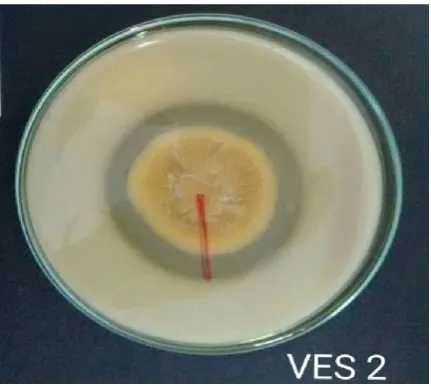
Isolation of alkaline protease producer: Total four morphologically different fungal isolates were appeared on Potato Dextrose Agar. These colonies were designated as VES 1, VES 2, VES 3 & VES 4. Isolate VES 2 showed luxuriant growth with maximum zone of clearance therefore selected for further study (Figure 1).
Production of Alkaline Proteases by SSF & SmF
[image:3.595.326.542.52.245.2]Fungi showing maximum zone of clearance were used for comparative studies, using solid state and submerged fermentation. Solid state fermentation media showed higher activity than submerged fermentation (Table 1) (Fig.2).
Fig. 1. Fungus showing maximum zone of clearance
Mukesh Kumar et al., 2012 noted 84.09 u/ml in submerged fermentation by using Bacillus subtilis. M. Sankareswaranetal, 2014, noted around 90 u/ml activity in submerged fermentation and around 140 u/ml in solid state fermentation
at PH 9 and there was a drastic drop in the enzyme activity at
[image:3.595.311.560.370.587.2]pH more than 9.
Table 1. Comparison of activity by SSF and SmF
Type of Fermentation
Inoc- ulum size
Incubation time/temp
Activity u/ml
SSF 2% 120 hrs / 30oC 200 u/ml SmF 2% 120 hrs / 30oC 80 u/ml
Fig. 2. Enzyme analysis
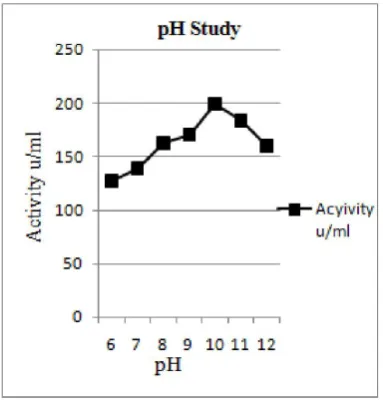
Effect of pH on enzyme production by solid state fermentation: The effect of pH was studied ranging from pH 6.0- pH 12 to find out the optimum pH, at which the enzyme is highly active. It was noted that, enzyme activity was in the increasing order from pH 6.0 to pH 10 and showed the maximum activity at pH 10 and activity declined marginally at pH 11 and pH 12 as shown in Figure 3. Effect of pH on Proteolytic activity was studied by Mukundraj Govindrao Rathod and Anupama Prabhakarrao Pathak., 2014 and it was noted that there was a drastic drop in activity at pH 11 and pH
12 instead of being isolated from alkaline habitat. Krishnaveni, Mukesh kumar, Balakumuran, Ramesh and Kalaichelvan, 2012, also noted drop in enzyme activity as the PH increases.
Sankareswaran et al., 2014 note 140 u/ml of the activity at pH
9 and there was drastic drop in the activity at PH more than 9.
[image:4.595.70.262.109.312.2]Our enzyme is more alkali tolerant, as there is a marginal drop in the activity even at PH 11 and PH 12.
Fig. 3. Effect of pH on enzyme
Determination of the Total protein content: The total protein content of the crude sample (SSF) was determined by Lowry’s Method (Table2).
Table 2. Total protein content in mg/ml
Sample used Dilution O.D Protein conc. mg/ml SSF crude enzyme 1:30 0.527 20mg/ml
Conclusion and Future Prospects: Comparative study of Alkaline protease production using Solid State and Submerged fermentation using fungal strain showed that, solid state fermentation showed higher activity as compared to submerged fermentation and thus it can be concluded that solid state fermentation can be used to get the higher activity alkaline proteases, as alkaline proteases have number of applications in Detergent industry. (Kumar, Savitri, Thakur, Verma and Bhalla, 2008, Phadtare et al., 2007), Leather industry (Choudhary, Jana and Jha 2004, Jathavathu Madhavi
et al., 2011.), Food industry (Mala B. Rao, Aparna M.
Tanksale, Mohini S. Ghatge and Vasanthi V. Deshpande, 1998), Food and feed industry , Photographic industry, silk degumming, Medical usage, Industrial and household waste (Gupta. Beg. Lorenz).
Acknowledgements
The authors thank Dr Aruna Inamdar, Sr Scientist, Chembond Chemicals Ltd, for her support and guidance. The authors also thank Dr J.K Phadnis, Principal, V.E.S College of Arts, Science and Commerce, for her support and encouragement.
REFERENCES
Abidi F., Limam F. and Nejib, M.M. "Production of alkaline protease by Botrytis cinerea using economoc raw materials. Assay as biodetergent." Proc. Biochem 43 (n.d.): 1202-08.
Akiba. J. 1982. "Alkalophilic Microorganisns: A new microbial wolrd." Japan scientific societies press and
berlin. Springer Verlag.
Ashok Pandey, P. Selvakumar, Carlos R. Soccol and Poonam Nigam. "Solid State Fermentation for the production of industrial enzymes." n.d.
Banerjee, R. and Bhattacharyya, B.C. 1992. "Optimization of multiple inducers effect on protease biosynthesis by Rhizopus oryzae." Bioprocess eng 7: 225-28.
Bayoudh, A., Gharsallah, N., Chamkha, M., Dhouib, A., Ammar, S. and Nasir, M. 2000. "Purification and characterization of an alkaline protease from Pseudomonas Aeruginosa MN1." Ind Microbiol biotechnol 24: 291-95. Bhosale, S. H., Rao M. B., Deshpande, V.V., Srinivasan, M.C.
1995. "Thermostability of high activity alkaline protease from Conidiobolus coronatus(NCl 86.8.20)." Enzyme Microb Technol 17: 136-39.
Dahot (Placeholder). U.M. 1994. "Purification and some properties of alkaline protease from Penicillium expansum." J. Islamic Acad.Sci., 7(2) 62: 100-105.
Dr. Prasad A., Wadegaonkar,Ahmed Z.M., Panda B.P., Javed S. and Ali M. "Production of mevastatin by SSF udsing wheat bran as a substrate." Bio process Engineering and technology, n.d.
Ellaiah P., Adinarayana K.,Rajyalaxmi P., and Srinivasulu B. 2003. "Optimization of process parameters for alkaline protease production under solid state fermentation by alkalophilic Bacillus sp." Asian J. Microbiol. Biotechnol.
Environ. Sci 5 : 49-54. 14.
Gajju H., Bhalla T.C. and Agarwal H.O. 1996. "Thermostable alkiline protease from thermophilic Bacillus coagulans PB - 77." Ind. J. Microbiol 36: 153-55.
Gupta R., Beg Q.K. and Lorenz P. 2002. "Bacterial alkaline proteases: molecular approaches and industrial applications." Appl. Microbiol. Biotech. 59: 15-32.
Jatavathu Madhavi, Jathavathu Shrilakshmi M.V., Raghavendra Rao and K. R. S. Sambasiva Rao. 2011. "Efficient leather dehairing by bacterial thermostable protease." International Journal of Bio-science and
biotechonoly 3(4) (Dec).
Kalisz, MH. 1988. "The biological degradation of cellulose derivatives and its regulation to the mechanism of cellular hydrolysis." Adv. Biochem Eng Biotechnol 36 59: 1-65. Kalisz. H.M. 1988. "Microbial proteinases." Adv. Biochem
Eng Biotechnol. 36: 1-65.
Kirk O., borchert T.V. and Fuglsang C.C. 2002. "Industrial enzymea applications." Curr. Opin. Biotechnol 43: 473-81. Kocher A., Choct M., Ross G., Broz J. and Chung T.K. 2003.
"Effect of enzyme combinations on apparent metabolizable energy of corn- soybean meal based diets in boilers." J.
Appl. Poul. Res., 12(3): 275-83.
Kranthi, V.S. Muralidhar Rao, D. and Jaganmohan, P. 2012. "Protease production by Rhizopus stolonifer through solid state fermentation." Central European journal of
Experimental Biology, 1(3) 36 : 113-117.
Krishnaveni, K., Mukesh Kumar, D.J., Balakumaran, M.D., Ramesh, S. and Kalaichelvan, P.T. 2012. "Production and optmization of extracellular Alkaline Protease from Bacillus subtilis from Dairy Effluent." Scholar Research
Kumar C.G. and Takagi H. 1999. "microbial alkaline proteases: from a bio-industrial viewpoint." Biotechnol. Adv. 17: 561-94.
Kumar, D., Savitri N., Thakur, R., Verma, and Bhalla, T. C. 2008. "Microbial protease and Application as laundry detergent additive." Research journal of Microbiology 3: 661-72.
Kumar, D.J.Mukesh, and N.Govindrajan, M.D Balakumaran and P.T.Kalaichelvan Premavathi Venkatchalam. "Production and purification of Alkaline Protease from Bacillus.sp.MPTK 712 isolated from Dairy sludge." IDOSI Publications 51: 433-439.
Limam., Hadeer Lazim. Houda Mankai. Nedra Slama. Insaf Barkallaha. Ferid. 2009. "Production and optimization of Thermophile alkaline protease in solid state fermentation by Stretomyces sp. CN902y." J.Ind.Microbiol. Biotechnol 58 :36: 531-537.
Mala B.R., Tanksale A.M.,Ghatge M.S. and Deshpande V.V. 1998. "Molecular and Biotechnological aspects of microbial protease." Microbiol. Mol. Biol. Rev. 62: 712-16. Malathi R. and Chakraborty, S. 1991. "Production of alkaline
protease by a new Aspergillus flavus isolate under solid substrate fermentation conditions for use as a depilation agent." Appl. Environ. Microbiol 57: 712-16.
Mitra A.L. and Chandra, P. "Solid state fermentation." (Wiley Estern publishers ) n.d.: 134-36.
Mitra, P., Chakraverty, R. and Chandra, A.L. 1994. "Solid state fermentation." J. Sci. Ind. Res. (Wiley Estern) 55 : 134-46,439-42.
Mitra, P., Chakrverty, R. Chandra, A.L. 1994. "Production of proteolytic enzymes by solid state fermentation." J. Sci.
Ind. Res., 55: 55,439-42.
Pathak, Mukundraj Govindrao Rathod and Anupama Prabhakarrao. 2014. "Isolation and identification of Alkaline Protease production from selected Alkaline Habitat." International journal of innovative biological
research Vol 3; Issue 1 12(2): 1-6.
Petinate D.G., R.M. Martins, R.R.R. Coelho, M.N.L. Meirelles, M.H., Branquinha and A.B. Vermelho. 1999. "Influence of growth medium in protease and pigment production by streptomyces cyanens." Mem Inst Oswaldo Cruz , Rio de Jenerio 94 : 173-77.
Phadatare S.U., Deshpande V.V. and Srinivasan M.C. 1993. "High actuvity alkaline protease from Condiobolous coronatus (NCL86.8.20) Enzyme production and compatibility with commercial detergents." Enz. Microbiol. technol. 15: 72-76.
Potumarthi R., Subhakar C. and Jetty A. 2007. "alkaline protease production by submerged fermentation in stirred tank reactor using Bacillus licheniformis NCIM-2042 Effect of aeration and agitation regimes." Biochem.Engg.J. 34: 185-92.
Saleemuddin, Anwar A. 1998. "Alkaline protease:A review."
Biores. Technology 64 (M): 175-83.
Sandhia, P. and Prema, G.S. 1998. "Selection of Optimal growth medium for the synthesis of alkaline proteinase from Bacillus SGP-26." J. Sci. Indus. Res. 57: 629-33. Sankareswaran, M. and Prabhavati s. P. 2014. Anbalagan.
"Optimization of production of an extracellular alkaline protease by soil isolated bacillus sp. using submerged and solid state fermentation with agricultural wastes." African
Journal of Microbiology Research, Vol (8) 4 (Feb):
872-877.
Saurabh, S., Jasmine, I., Pritesh G, G. and Rajendra Kumar,S. 2007*. "Enhanced productivity of Serine Alkaline protease by Bacillus sp. using soyabean as a substrate." Malaysian
Journal of Microbiology, Vol 3(1) 44: 1-6.
Ten L.M., Im W.T., Kim M.K. and Lee S.T. 2005. "A plate assay for simultaneous screening of polysaccharide and protein degrading microorganisms." Lett. App. Microbiol 40: 92-98.
Verma, R., Sil, K., Pandey, A.K. and Rajak, R.C. 2001."Solid state fermentation to produce alkaline protease by Aspergillus Fumigatus B149." Ind.J. Microbiol. 41: 111-14.
Waksman, S.A. 1927. Baltimore William and Wilkins Co. "Principles of soil microbiology.".
Zambare, V.P., Nilegaonkar, S.S. and Kanekar, P.P. 2007. "Production of an alkaline protease and its application in dehairing of baffalo hide." World J. Microbiol
Biotechnology 23: 1569-74.