2544
CLINICAL DECISION SUPPORT SYSTEM FOR DIAGNOSIS
OF ACUTE RESPIRATORY TRACT INFECTIONS (ARI)
1MUHAMMAD SYAUKANI, 2SRI HARTATI, 3HARI KUSNANTO, 4SURYO GURITNO
1Student Doctoral Program in Computer Science Dept. of Computer Science and Electronics, Faculty of Mathematics and Natural Sciences, Universitas
Gadjah Mada, Yogyakarta, Indonesia
2,4Dept. of Computer Science and Electronics, Faculty of Mathematics and Natural Sciences, Universitas Gadjah Mada, Yogyakarta, Indonesia
3Study Program of Publich Health, Interests Health Management Information System, Faculty of Medicine, Universitas Gadjah Mada, Yogyakarta, Indonesia
E-mail: 1[email protected], 2[email protected], 3[email protected], 4[email protected]
ABSTRACT
Acute Respiratory Infection is the disease that sometimes happens to children that can lead mortality. In emergency room there are still some cases of Acute Respiratory Infection that cannot be handled quickly and appropriately, so there should be a model of clinical decision support system as an assisting tool of the doctors to diagnose Acute Respiratory Infection especially pneumonia on children and under-five years children. In clinical decision supporting system, decision maker should provide rating value of alternative working load toward the criteria; the value given is in the form of ordinal data. This paper offers problem solving of ordinal data on clinical decision support systems using Extended TOPSIS. The test used 30 samples of medical records from the hospitals by comparing between TOPSIS method and Extended TOPSIS. Based on test results, it states that Extended TOPSIS method can produce proper diagnostic decision alternatives according to the medical records with sensitivity value of 93%, specificity value of 96%, precision value of 93% and value accuracy of 95%.
Keywords: Clinical Decision Support Systems, TOPSIS, Extended TOPSIS
1. INTRODUCTION
Acute Respiratory Infection (ARI) is the disease that sometimes happens to children that can lead mortality. It happens since their immune system is still fragile and low, so they need early, quick and appropriate treatment since arriving in the Emergency room [3].
Based on the study conducted at Ansari Saleh Banjarmasin Hospital, the treatment of Acute Respiratory Infection especially pneumonia on children and under-five years children still has low service. It is proven by the fact that there are still some cases of Acute Respiratory Infection that cannot be handled quickly and appropriately. It happens since the doctor in charge is not available in the room, and the knowledge of the nurses is
limited. Therefore, there should be a media that can help medical professionals in doing their jobs in health term by using computer based system in making a decision.
Decision making problem is often encountered in many fields; the field of health is also included here. Decision making is a process of finding the best choice of all viable alternatives. Decision-making process is inseparable from the support of several factors, such as human resources and decision-making procedures. These factors are the components in a system. These conditions lead to the decision support system (DSS).
2545 improve the decision-making process of a doctor as a strategy consideration in decision making [9].
This study utilizes models of clinical decision support systems as a tool for the diagnosis of children patients with ARI. In the process of determining the decision alternatives, decision making gives value of match rating between alternatives and criteria. The values given have ordinal data. To resolve the issue of ordinal data in clinical decision support systems, it can use Extended TOPSIS method.
2. LITERATURE REVIEW
There are a lot methods that can be used in developing the model of clinical decision supporting system with Acute Respiratory Infection as its domain similar to the other researches that had previously been done in order to analyze decision supporting system in diagnose Community-Acquired Pneumonia (CAP) by using Evidence Naïve Bayesian. The result of the study shows that Clinical Decision Supporting System can assist medical professionals in decreasing lateness rate in overcoming patient’s diagnosis failure in hospitals [5]. In further, [10] the development of decision supporting system to identify the patients who have Community Acquired Pneumonia (CAP) by using Bayesian Network (BN) and Artificial Neural Network (ANN). The result of the study shows that Decision Supporting System can help medical professionals to do CAP diagnosis. Besides, [2] analyzing decision supporting system by combining Bayesian Network with natural language processing system to have diagnosis of the patients with Community Acquired Pneumonia (CAP). The result of the study shows that the system is able to CAP diagnosis.
Furthermore, the study related to clinical decision supporting system to diagnose Ventilator-Associated Pneumonia (VAP) by using Dynamic Bayesian Network (DBN). The result of the study shows that the system can help doctors in doing clinical diagnosis to the patients suspected from VAP [4]. Moreover, [1] making design as well as implementation of decision supporting system with the regulation based on expert system to diagnose and manage pneumonia in children. The result of expert validation as well as the test based on the data from medical record can help a doctor in diagnose pneumonia.
Based on the study of decision supporting systems that have been conducted, all of those discuss about the function of decision supporting system in diagnose Acute Respiratory Infection. In
the studies, decision supporting systems do not apply multi attribute decision making (MADM) in decision making process. MADM models are mostly applied in overcoming the problem of decision supporting system in several aspects especially MADM model which uses TOPSIS method such as [16] doing modification of TOPSIS method in the stage of counting the distance. If TOPSIS standard uses eucludian distance method, the proposed modification in TOPSIS uses
mahalanobis distance method. The development is conducted to finish dependent attribute problem which is both correlated and uncorrelated.
It is similar [19] to the development by expanding TOPSIS to determine the value of group decision making in which every information of individual decision is presented by matrix in the form of interval numbers. The proposed method is very easy and can be done in computable process.
Moreover, [8] doing development by expanding TOPSIS to overcome the problem in decision making with interval data in which each stage of the formulas uses the value in the form of interval. In further [12] the modification of TOPSIS is in the stage to determine the value of positive ideal solution and negative ideal solution to reach maximum value as cardinal evaluation and minimum value as ordinal preference modification in order to finish cardinal and ordinal problem as well as the result of decision alternative in the form of descending order. [17] Modification of TOPSIS method in the stage of distance calculation uses Correlation Coefficient method to solve the problem of ordinal data scale. The study offers the application of MADM model with developed TOPSIS method (Extended TOPSIS).
3. CLINICAL DECISION MAKING MODEL
Clinical decision-making model for diagnosing respiratory diseases proposed consists of the components of data management, model management, user interface and decision makers.
Data management component in the model of clinical diagnosis decision making on respiratory disease has significant function to manage the data in a database in the form of criteria data, alternative data, and ratings data match which will be used in modeling the decision to diagnose respiratory diseases.
2546 (DM) will give rating match value between alternatives and criteria. The score is based on the expertise of the DM against the match of each criterion against each alternative. The values given are ordinal data with the range score of 0 to 2. Score 0 means that the criteria do not have significant impact (does not have a close match) with an alternative. However, score 2 represents that the criteria are very influential on the alternative. Besides, DM will also give value to each criterion. The value is given by the DM based on their knowledge and their interests and how important these criteria in the decision making.
Extended
TOPSIS method is used to determine
[image:3.612.88.532.245.427.2]alternative decision ranks in decision making. This method is used to solve multiple criteria problems in giving a solution of a number of possible alternatives by comparing each alternative with the best alternative and the worst alternative among the problem alternatives. The result of the process with Extended TOPSIS method is the alternative rank of decision by DM. On the other hand, the user interface is used as a communication medium between users and decision support system. The model in this study was developed by referring to the concept of DSS Turban [12]. The following Figure 1 Model is clinical decision taking method:
Figure 1: Model Is Clinical Decision
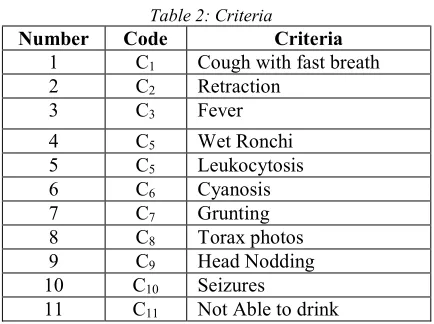
Based on a research at Ansari Saleh Banjarmasin Hospital and interviews with pediatricians, children’s lungs specialist, radiologists and general practitioners as well as some reference guides to the treatment diagnosis ARI disease which is pneumonia in children [15], therefore there are some pneumonia diseases which can be used as an alternative and several symptoms that can be used as a criterion in supporting the creation of the model of clinical decision support systems in diagnosing respiratory disease. The following Table 1 and Table 2 show a list of alternatives and criteria.
Table 1: Alternative
Number Code Alternative
1 A1 Pneumonia
2 A2 Severe Pneumonia
[image:3.612.312.529.458.620.2]3 A3 Non Pneumonia
Table 2: Criteria
Number Code Criteria
1 C1 Cough with fast breath
2 C2 Retraction
3 C3 Fever
4 C5 Wet Ronchi
5 C5 Leukocytosis
6 C6 Cyanosis
7 C7 Grunting
8 C8 Torax photos
9 C9 Head Nodding
10 C10 Seizures
11 C11 Not Able to drink
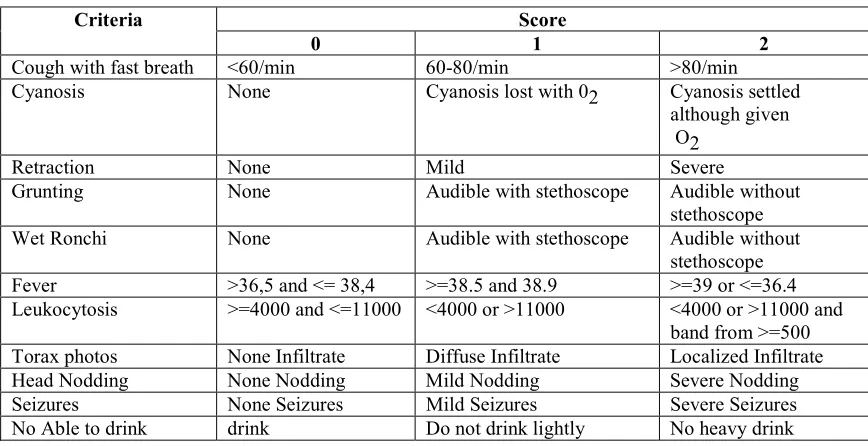
To provide rating match value in a particular alternative against each criterion, the value assigned by the DM refers to Respiratory Distress Scoring (RDS) System [9]. Table 3 shows criteria value of the alternative.
Model Management
- Extended TOPSIS Data Management
- Data Criteria - Data Alternative
User interface
Doctors For Decision Makers Database,
Criteria, Alternative, Data Medical
Record
Alternative rankings (Diseases
2547
Table 3: Criteria Value Of The Alternative
Criteria Score
0 1 2
Cough with fast breath <60/min 60-80/min >80/min
Cyanosis None Cyanosis lost with 02 Cyanosis settled
although given O2
Retraction None Mild Severe
Grunting None Audible with stethoscope Audible without
stethoscope
Wet Ronchi None Audible with stethoscope Audible without
stethoscope Fever >36,5 and <= 38,4 >=38.5 and 38.9 >=39 or <=36.4 Leukocytosis >=4000 and <=11000 <4000 or >11000 <4000 or >11000 and
band from >=500 Torax photos None Infiltrate Diffuse Infiltrate Localized Infiltrate
Head Nodding None Nodding Mild Nodding Severe Nodding
Seizures None Seizures Mild Seizures Severe Seizures
No Able to drink drink Do not drink lightly No heavy drink
4. RESULT AND DISCUSSION
Modeling of clinical decision support systems for the diagnosis of respiratory diseases in children is developed by using Extended TOPSIS method. Extended TOPSIS is used to finish rating match scoring between alternatives and criteria in the form of ordinal data. To resolve the issue, it needs TOPSIS method expansion in step 4 to 6 to produce decision alternatives in accordance with the condition of the reality of the medical records. Here it is the Stages of Extended TOPSIS Algorithm.
In solving decision making process, it is firstly necessary to construct a matrix of performance rating X referring to alternative A = (i = 1,2, ..., m) in which m is the number of alternatives amounted to 3, with the criterion C = (j = 1,2, ..., n), in which n is the number of criteria amounted to 11. Table 4 shows rating performance matrix in general.
Table 4: Rating Performance Matrix In General
Alternative Criteria
C1 C2 .... Cn
A1 X11 X12 .... X1n
A2 X21 X22 .... X2n
... .... .... .... ....
Am Xm1 Xm2 .... Xmn
Based on Table 4, the example is if there is an incidence of clinical cases, for example, a 1-month-old child with symptoms of cough with fast breathing 65 / min, mild retraction, 38.50 fever, wet lungs and 45000 leukocyte can refer to Table 1 that Alternative A1 is pneumonia; A2 is severe pneumonia; and A3 is non pneumonia, and based on Table 2 there are 11 criteria that C1 is Cough and Fast Breathing; C2 is a retraction; C3 is fever; C4 is Wet Ronchi; C5 is leukocytosis; C6 is cyanosis; C7 is Grunting; C8 is Torax photos; C9 is Head Nodding; C10 is Seizures; and C11 is not able to drink, so that Table 5 shows the matrix of alternative rating performance to the criteria.
Table 5: Matrix Of Alternative Rating Performance To The Criteria
Alternative Criteria
Cough with
fast breath
(C1)
Retraction (C2)
.... Not able to drink
(Cn) A1 =
Pneumonia X11 X12 .... X1n
A2=Severe Pneumonia
.... .... .... ....
A2=Non
Pneumonia X31 X32 .... X311
2548 1, Value X12 is the score for pneumonia alternative toward mild retraction criteria, namely: 1. It is similar to what is done for the provision of all grades Xnm based on the condition of the patient's symptoms, thus it obtains matrix of performance rating matrix as it is presented in Table 6.
Table 6: Matrix Of Performance Rating
Alternative Criteria
C1 C2 C3 C4 C5
A1 1 1 1 1 1
A2 1 0 1 1 1
A3 1 0 0 0 0
1. Step One: to calculate the normalized matrix, with the following formula :
(1)
Where :
- rij=normalization value of each alternative from criteria i to j
- xij=rating of alternative performance of i against criteria of j
- m=number of alternatives with 3 as the totals Based on equation 1, normalized matrix will be as follows:
0.5774 1.0000 0.7071 0.7071 0.7071
rij = 0.5774 0.0000 0.7071 0.7071 0.7071 0.5774 0.0000 0.0000 0.0000 0.0000
2. Step two: to calculate the value of normalized weighted matrix, with the following formula:
yij = wi.rij (2)
Where :
- yij = normalized weighted matrix value
- wi = value of criteria weights, the weight values given are 1 = low; 2 = medium; and 3 = high.
- rij = normalized values of each alternative, in which i = 1,2, ..., m where m is the alternatives amounted to 3 and j = 1,2, ..., n where n is a lot of criteria; in this case the criteria used were five criteria.
The value given by DM is based on the knowledge and urgency level criteria and the importance of the criteria in defining alternative. If the criteria is considered as not important, the DM will give low value to the
criteria. If the criteria is considered as important, it can be given higher value to the criteria. For example in this case, cough and rapid breath are criteria which considered as important so that DM gives high value to 3. As well as other criteria value, DM gives value that correspond with the urgency, which 3 for light retraction criteria value, 2 for fever, 1 for rackles, and 1 for leukocytosis therefore criteria value for w1=3; w2=3; w3=2; w4=1; w5=1. Based on equality 2 which is multipled between criteria value and normalization of each alternatives value i with criteria j. Thus will formed normalized matrix as follows:
1.7321 3.0000 1.4142 0.7071 0.7071
yij= 1.7321 0.0000 1.4142 0.7071 0.7071
1.7321 0.0000 0.0000 0.0000 0.0000
3. Step Three: to define ideal positive solution value and ideal negative value, using the formula below:
(3)
(4)
In which :
(5) (6)
Where :
- A+ = ideal positive solution is obtained by taking maximum value from each column j in valued normalized matrix (yij)..
- A- =ideal negative solution is obtained by taking maximum value from each column j in valued normalized matrix (yij)
- = maximum value from each column j in valued normalized matrix (yij)
- = minimum value from each column j in valued normalized matrix (yij)
Based on equality 5 and 6 thus ideal positive solution value (A+) and ideal negative (A-) is as follows:
A+= {1.7321; 3.0000; 1.4142; 0.7071; 0.7071} A-= {1.7321; 0.0000; 0.0000; 0.0000; 0.0000}
2549 and ideal negative solution using Minkowski Distance Method. At this stage, modification is conducted for corresponding the method that is used with the type of variable. Generally, TOPSIS used Euclidean Distance method for quantitative variable. Extended TOPSIS is suggested to use Miskowski Distance which can be used to calculate ordinal variable or quantitative [14][6].
Alternative distance A, toward ideal positive solution, using formula below:
(7)
Alternative distance A, toward ideal negative solution, using formula below:
(8)
Where :
- m = number of alternatives, in this case the number of alternatives is 3
- n = number of criteria, in this case the number of criteria is 5
- di+ = alternative distance toward ideal positive solution
- di-= alternative distance toward ideal negative solution
- yij = alternative value i toward criteria j in valued normalized matrix
- p = integer positive value, if p=1 stated manhattan distance, if p=2 stated euclidean distance and if p=3 stated minkowski distance.
- yj+ = ideal positive solution on criteria n
- yj- = ideal negative solution on criteria n
Based on equality 7 and 8 which has distance calculated of each alternatives toward ideal positive solution value and ideal negative solution, therefore it is resulted value as follow:
d1+= 0.0000 d1-=2.2894
d2+= 2.0801 d2-= 1.4422
d3+= 2.2894 d3-= 0.0000
5. Step Five: to define maximum and minimum value from the result obtained in stage 4, using formula below:
N={max(di-), min(di+)}, i=1,2,..m (9)
Where :
- N = maximum value di- and minimum value di+
- max(di-) = alternative value toward ideal negative solution
- min(di+) =alternative value toward ideal positive solution
- m= the number of alternative is 3
Based on equality 9 it is defined maximum and minimum value, therefore it is resulted value as follow:
N= {2.2894 ; 0.0000}
6. Step Six: to define alternative rank value, from the result which obtained in the stage 4 and 5, using the formula below:
(10)
Where :
- Ri = alternative rank value
- di+ = alternative distance value toward ideal positive solution
- d
i- = alternative distance value toward ideal negative solution
- max(di-) = maximum value
- min(di+) = minimum value
Alternative rank value is calculated using equality 10, therefore the alternative rank value result is as follow:
R1 = 3.2377
R2 = 1.4574
R3 = 0.0000
From the result above, the highest or best alternative value will be used as alternative decision to decide diagnosis result (R1=3.2377 is Pneumonia).
2550
Table 7: The Result Of The Test
Diseases
System
Pneumonia Severe Pneumonia Non Pneumonia
TOPSIS Extended
TOPSIS TOPSIS Extended TOPSIS TOPSIS Extended TOPSIS
R
ea
lit
y
Pneumonia 11 12 2 0 0 1
Severe Pneumonia 0 0 12 12 0 0
Non Pneumonia 1 0 0 1 4 4
From the Table 6 then calculation process is conducted to determine sensitivity, specificity, precision and accuracy value. As well as Table 8
which shows the result of Confusion Matrix calculation.
Table 8: The Result Of Confusion Matrix Calculation
Test Value
Method Sensitivity Specificity Precision Accuracy
TOPSIS 90% 94% 90% 93%
Extended TOPSIS 93% 96% 93% 95%
The result of Confusion Matrix calculation shows that the Extended TOPSIS method shows 93% sensitivity value, 96% specifity value, 93% precision value and 95% accuracy value.
5. CONCLUSION
This paper offers problem solving of ordinal data in determining the model of clinical decision supporting system as an assisting tool to diagnose patient with Acute Respiratory Infection especially pneumonia on babies and children by using Extended TOPSIS. The test used 30 medical record sample from hospital by comparing TOPSIS method and Extended TOPSIS method. Based on the test result, it is known that Extended TOPSIS method can generate alternative diagnosis decision that correspond to medical record data with 93% sensitivity value, 96% specificity value, 93% precision value and 95% accuracy value.
The study needs to be developed in further to the model of clinical group decision supporting system by involving several decision makers in clinical decision making.
REFRENCES:
[1]. Amosa B.M.G., Orisawale B.A., Kawonise K.A., Fabiyi A.O and Fabiyi A.A., “Development of a Web Based Expert System for Diagnosis and Management of Childhood
Pneumonia”, International Journal of Science
and Advanced Technology, 2015, 5(12),
pp.2221-8386.
[2]. Aronsky, D., Fiszman, M., Chapman, W.W., dan Haug, P.J., “Combining Decision Support Methodologies to Diagnose Pneumonia”,
AMIA Symposium, Washington DC,
November 2001, pp. 3-7.
[3]. Balitbangkes, Riset Kesehatan Dasar 2007,
Departemen Kesehatan Republik Indonesia, Jakarta, 2005.
[4]. Charitos, T., van der Gaag, L.C., Visscher, S., Schurink, K. A.M. dan Lucas, P.J.F., “A Dynamic Bayesian Network for Diagnosing Ventilator-Associated Pneumonia in ICU Patients”, Journal: Expert Systems With Applications - ESWA, 2009, 2(36), pp. 1249-1258.
[5]. Clark, S.R., “Decision support systems for the reatment of community-acquired pneumonia”,
Conference Papers And Presented at the Australian Health Informatics Conferences in,
Australia, Oktober,2000, pp. 21-23.
[6]. Han J, Kamber M, Pei J., “Data Mining Concepts and Techniques: Edisi Ke-3”,
Massachusets : Morgan Kaufmann, 2011.
2551 [8]. Jahanshahloo, G.,R., F. Hosseinzadeh Lotfi,
M. Izadikhah, “An algorithmic method to extend TOPSIS for decision-making problems with interval data”, Applied Mathematics and Computation, 2006, 175(1), pp.1375 1384. [9]. Kizito, J. Diagnesia, “a prototype of a decision
support system for anesthetists”, Third International Conference on Broadband Communications, Information Technology & Biomedical Applications, Pretoria, Gauteng, South Africa 2008, pp. 3-26.
[10].Lagor, C., Aronsky, D., Fiszman, M. dan Haug, P.J., “Automatic Identification Of Patients Eligible For A Pneumonia Guideline : Comparing The Diagnostic Accucarcy Of Two Decision Support Models”, Studi Health Technol Inform, 2001, pp. 493-497.
[11].Lahby, M., Cherkaoui, L., Adib, A., “New multi acces selection method base on malahanobis distance”, Applied Mathematical Sciences, 2012, pp. 2745-2760.Li. W,Guanqi Guo. G, Xiaoqiang Zhou. X, “Generalizing and Integrating TOPSIS and Cook-Seiford Method for Multicriteria Group Decision-Making with Both Cardinal and Ordinal Data”, Mathematical Problems in Engineering, 2015, pp. 1-7.
[12].Robert L. Chatburn, Eduardo Mireles-Cabodevila, “Handbook of respiratory care third edition, Jones & Bartlett Learning”,
United Kingdom, 2011.
[13].Turban, E., Sharda. R., Delen. D, “Decision support and expert system: management support system”, fourth edition. Prentice-Hall Inc, 2005.
[14].Tzeng, G.H dan Huang, J.J., “Multiple Attribute Decision Making Methods and Applications”, CRC Press is an imprint of Taylor & Francis Group. USA, 2011.
[15].Vega. A, Aguarón. J, García-Alcaraz. J, Moreno-Jiménez. J.M., “Notes on Dependent Attributes in TOPSIS”, 2nd International Conference on Information Technology and Quantitative Management, ITQM, 2014, pp. 308-317.
[16].Wachowicz, T., “Application of topsis methodology to the scoring of negotiation issues measured on the ordinal scale”, Group Decis Negot. Springer, 2013, pp.101-105. [17].World Health Organization (WHO), “Pocket
book of hospital care for children: guidelines for the management of common childhood illnesses – 2nd ed”, WHO Press, 2013.