2393
MOBILE-BASED EXPERT RELIANT SYSTEM OF
APPLICATION DETERMINING THE ADEQUACY OF COWS
FOR ISLAMIC QURBAN RITUAL USING METHOD OF
FORWARD CHAINING
1ENDAH PURNAMASARI, 2KHAIRA ALMISRI, 3INGGIH PERMANA, 4NURMAINI
DALIMUNTHE 1
Department of Animal Sciences, Faculty of Agriculture and Animal Sciences, Universitas Islam Negeri Sultan Syarif Kasim (UIN SUSKA) Riau 28293, Pekanbaru, Riau, Indonesia
2,3,4
Department of Information Systems, Faculty of Science and Technology, Universitas Islam Negeri Sultan Syarif Kasim (UIN SUSKA) Riau 28293, Pekanbaru, Riau, Indonesia
E-mail: [email protected], [email protected],
3
[email protected], [email protected]
ABSTRACT
The most prevalent livestock used for qurban ritual on Islamic festival of Eid Al Adha is cow. There are a number of criteria must be adhered to before a livestock is deemed elligible for sacrificial slaughter. However, these requirements are often overlooked or ignored by the general public which derives from their inadequate understanding of these criteria. Also, the number of expert who are asked to examine the elligibility of livestocks and socialize the skills required to the public is limited. This study has designed and created a web based system of expert reliant application to determine the adequacy of livestock so as to help the laymen to determine the satisfactoriness of cows. Forward chaining the inference technic used in the research. The study was done in two stages namely the creation of knowledge basis and implementation stage. In the former stage extensive repository of information on the implementation of animal slaughtering is acquired from numerous scholars in their respective fields. These scholars who are consulted include (1) religious scholars; (2) veterinarians; and (3) animal science experts. The acquired information is arranged in the forms of rules that can be converted into a computer program. In the latter stage analysis on the need basis for application functionality, interface design, creating and testing of the application is conducted. The outcomes are arranged categorically which result in 90 rules that determine the adequacy of cows for sacrifice. The three main features revealed from this implementation of expert reliant system of application are: (1) examine the acceptableness of cows; (2) features designed for responses to inquiries; and (3) features designed for presentation of latest facts from inferences. Based on the unit test shown, this application is successful in performing inferences on the knowledge aspect based on the facts correctly entered by users. Moreover, based on the black box test conducted by using 10 different smartphones with various specifications, the test showed 100% success rate on the need basis in the ongoing application functionality. Considering the results demonstrated in the unit test and black box test it can be concluded that this application can be recommended to settle the issue assessing the adequacy of cows for Islamic qurban rituals.
Keywords: Forward Chaining, Adequacy of Animal for Qurban Ritual, Mobile, Cow, Expert Reliant
System
1.
INTRODUCTIONIncreasing awareness of public in general has been resulting in the rising numbers of people offering livestocks for the festive Eid Al Adha celebration of qurban ritual [1]. Participants of this celebration is not only limited to middle class to upper class individuals but also participated in by those who have specifically allocated a portion of
their earnings for particular day. In addition, enhancement in the economy in general has also been instrumental in the increased participation of the public in the sacrifical day
2394 from the numerous mosques sited in Pekanbaru and the vicinity where it is the majority of the animals slaughtered compared with other livestocks such as buffaloes and goats. According to [1] based on the data collected from 2011 to 2014 of the 390 mosques surveyed in the City of Pekanbaru on average the slaughtering of cows showed a continuous increase.
There are a number of considerations involved in the determination of animal of choice. Livestock vendors place emphasis on body weight and price more than other characteristics whereas the consumers make their purchase based on their prepared budgets [2]. Furthermore, [3] also state that other critical factors for people offering animals for sacrifice are age of livestock, general health, and body weight while their body size and particular breed only are not particularly instrumental in their decision making. Islamic Shar’i dictates that there are five types of animal conditions that render animals inelligible for sacrifice as set forth by HR Ibnu Majah of Al-Bara’ ibnu Azib in [4]): (1) blindness in one eye which can be conclusive ascertained; (2) animals in sickness which can be clearly determined; (3) limping animals whose ribs are clearly visible; (4)weak and/or broken legs; and lastly (5) very thin and unable to support itself to stand. Observation showed [5] that a lot of the parties involved in the event such as the caretakers of mosques, animal handlers and organizers of the event themselves had not been given proper training by the local official authorities and the government division solely focusing on and responsible in the issues of animal welfare and the association of veterinarians as well as universities. Both the animal handlers responsible in sacrificing the livestocks and the supporting crews had not been properly educated on the health hazards of zoonosis. In addition they had not been tutored on the correct application of the practices of halal principles and hygienic animal handling for the people working with animals.The absence of governmental participation in this aspect resulted in the inadequate standards of animal sacrifice in this religious observance. There was lack of monitoring from the respective municipal department in charge of issuing approval for sacrificing animals , ante-mortem and post-mortem inspection, assurance of health and hygiene of the people having direct contact with the animals and the welfare of the animals themselves. No direct monitoring on whether the conduct of animal sacrifice was administered according to halal principles was made by officials from the
department of religion and its respective vertical institutions.
There was no control made to ensure cleanliness and hygiene on the sites conducted by the local authorities. Some caretakers of the mosques communicated and exchanged information regarding the administration of the animal sacrifice and some submitted reports of the event to their respective local authorities in the subdistricts.
Lack of control ant awareness of the general public on the importance of constant monitoring on the conduct of animal sacrifice has led to compromised safety level of the meat for consumption as well as the halal, hygiene and wholesome aspects. Improper handling of meats pose risks of contracting animal diseases which may pose health risks to people who consume them.
The regulation issued by the minister of agriculture of the Republic of Indonesia number 144/Dept of Agriculture/PD.410/9/2014 on Requirements for Sacrificial Animals chapter 36 clause 1 states that inspection and monitoring of animal welfare are conducted with the aim of applying the principles of halal, ensuring that the health of people with direct contact with animals and the welfare of animals themselves are well maintained. Chapter 38 clause 1 states that inspection on animals for sacrifice is conducted to prevent any violation to the said regulation [5].
The considerations adhered to by people offering animals for sacrifice when making decision is in actuality very minimal when compared with other numerous criteria that must be taken into consideration in ascertaining the sufficiency of the animals. This is often the case where people’s unawareness of appropriate critieria for livestocks and where these livestocks can be sourced. The fact that the number of experts who can personally and manually examine these livestocks and train people to perform the tasks is also limited. Therefore, it is imperative that a system in which the process of examination is streamlined needs to be devised. This expert reliant system is a computer program which conducts that logical reasoning using knowledge of a number of experts and scholars to settle down this issue (Jackson, 1999 in [6]). This system especially acquire the knowledge of individuals in their respective area of expertise needed to tackle this issue.
2395 global market of mobile technology (Holla and Katti, 2012 in [7]). The number of cellular users in Indonesia is estimated to reach 100 million (Kompas, 2013 in [8]). Mobile applications also allow rapid response to users wherever they are. (Ciuera, 2010 in [9]). In return, this will help bridge the gap between supply of pertinent information on adequacy of animals for sacrifice which eventually help educate and train laymen in this area. Studies on web based expert reliant system has been previously conducted such as: (1) expert reliant system on infants and pregnancy [10]; (2) expert reliant system on general symptoms of common diseases [11]; and (3) expert reliant system on financial planning [12].
This study used forward chaining as the method of inference. Forward chaining is a method that employs available facts to acquire newer facts before the final conclusion is drawn. Previous researchers have taken advantage of forward chaining for various cases for instance (1) detection of human disease [13, 14, 15, 16, 11, 17]; (2) detection of plant diseases [18]; (3) detection of vitamin deficiency [19]; (4) smart house [20]; (5) campus environment [21]; (6) financial planning [12]; (7) pregnant mothers and infants [10].
Based on the previously described background, this research aims to create an expert reliant system on ascertaining the adequacy of cows for sacrifice taking advantage of mobile technology using forward chaining method to enable the general public in examining whether one particular livestock is adequate or not to be an animal for sacrifice.
2.
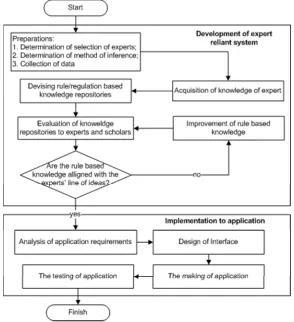
RESEARCH METHODOLOGYIn general, this research is divided into two stages. The first stage is development of expert reliant system and the second one is implementation of application. In the stage of development of this system, the actual scholars who will directly be involved, the method of inference of choice, data collection, acquisition of information of experts’ knowlege, management of information as well as evaluation of knowledge database are determined. In the stage of implementation to application, analysis and design of application, planning of interface, devising and testing of application are performed. The illustration of this particular stage of research can be seen in Figure 1.
2.1 Acquisition of Knowledge of Expert
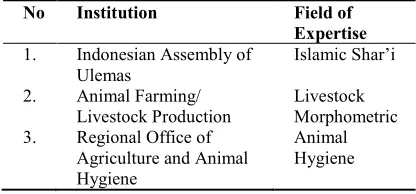
[image:3.612.314.521.207.304.2]The expert involved in the making of this system are those who are especially trained expert in the field of animal science, veterinary, and Islamic Shar’i. Those various experts whose knowledge is acquired in the study can be seen in Table 1.
Table 1: List of Experts Involved in The Development of Expert Reliant Systems
No Institution Field of
Expertise 1. Indonesian Assembly of
Ulemas
Islamic Shar’i
2. Animal Farming/ Livestock Production
Livestock Morphometric 3. Regional Office of
Agriculture and Animal Hygiene
Animal Hygiene
In this phase a series of interviews are conducted on the adequacy of livestocks for sacrifice bibliography research is also conducted concerning references made these experts. After that these repositories of information are converted into rules that can be applied into program coding. These rules represent all the knowledge supplied by the scholars. The rules that have been converted into program coding will be referred back to the experts to ensure the accuracy of decisions produced.
2.2 Acquisition of Knowledge of Expert
The expert involved in the making of this system are those who are especially trained expert in the field of animal science, veterinary, and Islamic Shar’i. Those various experts whose knowledge is acquired in the study can be seen in Table 1.
Table 2: List of Experts Involved in The Development of Expert Reliant Systems
No Institution Field of
Expertise 1. Indonesian Assembly of
Ulemas
Islamic Shar’i
2. Animal Farming/ Livestock Production
Livestock Morphometric 3. Regional Office of
Agriculture and Animal Hygiene
Animal Hygiene
[image:3.612.313.521.566.663.2]2396 repositories of information are converted into rules that can be applied into program coding. These rules represent all the knowledge supplied by the
[image:4.612.159.453.149.471.2]scholars. The rules that have been converted into program coding will be referred back to the experts to ensure the accuracy of decisions produced.
Figure 1: Ilustration of Research Methodology
2.3 Implementation to Application
After the initial phase of experts’ knowledge basis system has been made, the subsequent stage of implementing this to application smartphone is conducted. At this phase object oriented and design approach (OOAD) is adopted. There are five stages involved in the making of this application in this study. The first phase is analysis and design of application and the the second phase is design of interface of application, the third phase is the creation of program coding and final phase is testing of application.
In the first stage analysis and design of the application on the need basis is conducted namely (1) who will use the application; (2) what are the needs of each user; and (3) the work flow of the application. Meanwhile one with diagram modelling taken from unified modelling language
(UML) known as use case diagram together its scenario is used.
The second stage is when designing of interface of application begins. The design of interface is made paying attention to aspects of human interaction with computer (IMK) such as (1) color; (2) size of the buttons; (3) lay out and so on. In designing the userface researchers use the Microsoft Visio 2010 as a platform for the application.
2397 out to ensure that the features designed fulfil the funtional need of application work properly.
3.
ANALYSIS AND DESIGNAt this stage analysis is performed on the knowledge basis, the need for application functionality and userface design. Knowledge basis analysis results in variables and rules which are required in this expert reliant system. Meanwhile, functional need analysis identifies individuals needed and what can they can contribute to expert
system designed. Planning of userface creates the intended userfaces to applied in the application that is in progress.
3.1 Knowledge Basis Analysis
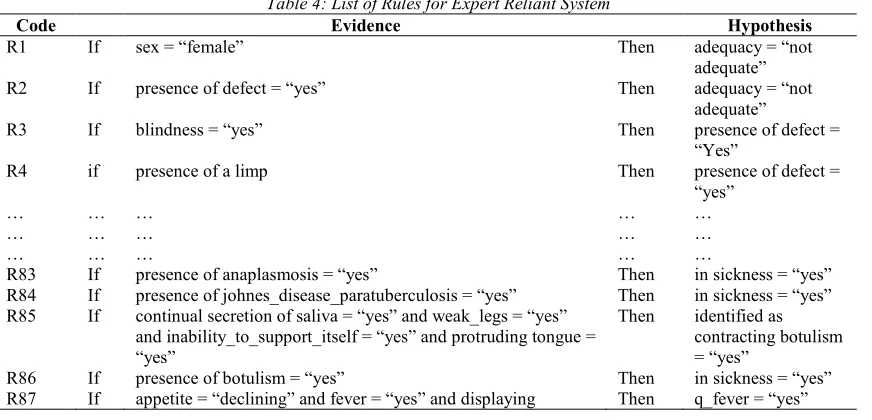
[image:5.612.87.519.260.573.2]Based on the result indicated in analyses, the number of variables needed for this expert reliant system on the adequacy of animals for sacrifice is 107 and 90 pieces for rules. The list of variables can be seen in Table 2 whereas list of rules can be seen in Table 3.
Table 3: List of Variables for Expert Reliant System
No Names of
Variables
Remarks
1 Adequacy This variable contains “Adequate” or “Inadequate”. The initial variable is “Adequate” 2 Sex This variable contains “Male” or “Female”
3 Age This variable contains “Older than or equivalent to 2 years” or “Less than 2 years”. The initial value of the variable is “Older thn or equivalent to 2 years”.
4 Appearance of Permanent Incisors
This variable contains “Yes” or “No”. “Yes” indicates that the permanent incisors have changed or “No” indicates that the permanent incisors have not yet changed. The initial variable of this is “Yes”.
… … …
… … …
… … …
105 Botulism This variable refers to the status of Botulism disease
This variable contains “Yes” or “No”. “Yes” means that a cow has been identified as contracting botulism while “No” means that a cow has not been identified as contracting Botulism disease. The initial variable is “No”.
106 Q fever This variable refers to the status of Q fever disease.
This variabel contains “Yes” or “No”. “Yes” means that a cow has been identified as contracting Q fever. “No” means that a cow has not been identified as contracting Q fever. The initial variable is “No”.
107 Rabbies This variable shows an indication of Rabbies disease.
This variable contains “Yes” or “No”. “Yes” means that a cow has been identified as contracting Rabbies whereas “No” means that a cow has not been identified as contracting Rabbies. The initial variable is “No”.
Table 4: List of Rules for Expert Reliant System
Code Evidence Hypothesis
R1 If sex = “female” Then adequacy = “not
adequate” R2 If presence of defect = “yes” Then adequacy = “not
adequate”
R3 If blindness = “yes” Then presence of defect =
“Yes”
R4 if presence of a limp Then presence of defect = “yes”
… … … … …
… … … … …
… … … … …
R83 If presence of anaplasmosis = “yes” Then in sickness = “yes” R84 If presence of johnes_disease_paratuberculosis = “yes” Then in sickness = “yes” R85 If continual secretion of saliva = “yes” and weak_legs = “yes”
and inability_to_support_itself = “yes” and protruding tongue = “yes”
Then identified as contracting botulism = “yes”
[image:5.612.87.523.528.738.2]2398
respiratory issues = “yes” and showing difficulty in mobility = “yes”
R88 If q_fever = “yes” Then in sickness = “yes”
R89 If presence of paralysis Then being paralytic = “yes”
R90 If having_no_leg(s)_or_missing_ leg(s) Then being paralytic = “yes”
3.2 Analysis on The Need Basis of The
Application Functionality
Based on the results shown in analysis, there are five needs identified in the functionality of the application, namely (1) assessing the adequacy of a cow; (2) references on the requirements of animals for sacrifice; (3) consulting information on the list
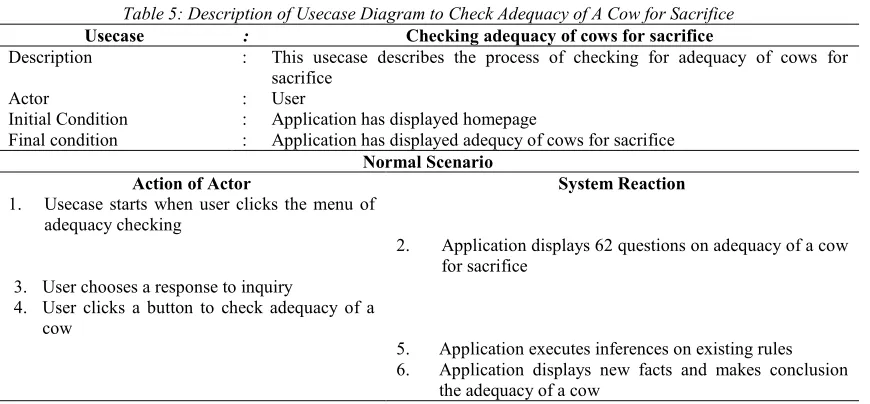
[image:6.612.170.443.299.483.2]of bovine related diseases; (5) evaluating explanations for the questions; and (6) receiving explanation of new facts. The illustration for the need in the functionality of the application can be seen in Figure 2. Meanwhile, scenario for usecase diagram in checking the adequacy of a cow for sacrifce of Figure 2 can be seen in Table 4.
[image:6.612.92.527.514.716.2]Figure 2: Usecase Diagram of Application
Table 5: Description of Usecase Diagram to Check Adequacy of A Cow for Sacrifice
Usecase : Checking adequacy of cows for sacrifice
Description : This usecase describes the process of checking for adequacy of cows for sacrifice
Actor : User
Initial Condition : Application has displayed homepage
Final condition : Application has displayed adequcy of cows for sacrifice Normal Scenario
Action of Actor System Reaction
1. Usecase starts when user clicks the menu of adequacy checking
2. Application displays 62 questions on adequacy of a cow for sacrifice
3. User chooses a response to inquiry
4. User clicks a button to check adequacy of a cow
5. Application executes inferences on existing rules 6. Application displays new facts and makes conclusion
2399
3.3 Designing Interface of Application
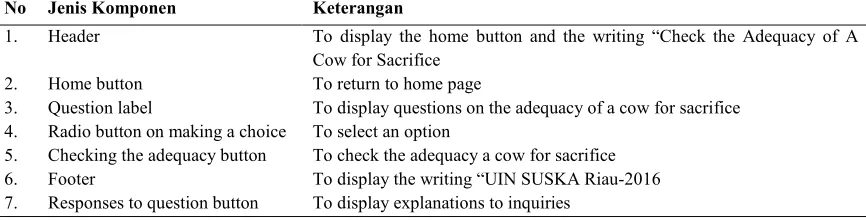
In this application there are seven user interface design in connection with its construction: (1) homepage interface for users; (2) interface of a page to check the adequacy of a cow; (3) interface for result on checking the adequacy of a cow; (4) interface of page on the list of valid list of adequate cow requirements; (5) interface of page for list of existing cow diseases; (6) interface of page on the application; (7) interface on a page on responses to inquiries; and (8) interface of page for descriptions of diseases on the menu checking the adequacy of a cow. Figure 3 is one of the designs of application interface that is constructed. The design of interface itself is on the page checking the adequacy of a cow for sacrifice. The details in Figure 3 can be seen in Table 5.
4.
RESULTS AND DISCUSSIONS4.1 Implementation Results
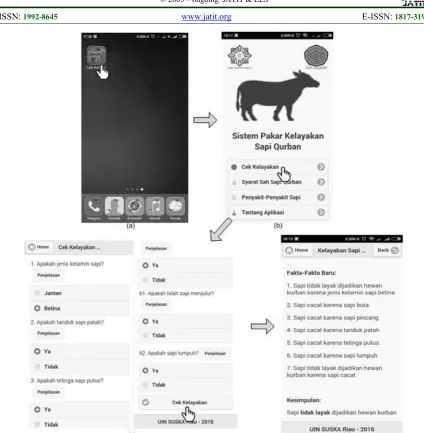
[image:7.612.317.524.192.458.2]This section will describe how the application that has been created can fulfil the needs of functionality of an application. Illustration showing the fulfillment of this functionality can be seen in Figure 4, Figure 5, Figure 6, Figure 6, Figure 7, and Figure 8.
Figure 4 shows the mechanisms for checking the adequacy of a cow for sacrifice on this expert reliant the system of application that has been created. In order for the homepage to appear, a user must first open the application by clicking an
application icon (Figure 4.a). After that the user can click the checking the adequacy (Figure 4.b). After that the application will display 62 questions whose answers will be chosen by the user (Figure 4.c). After being picked, the user clicks the checking the adequacy (Figure 4.c). Finally, the applicatin will display new facts and conclusion (Figure 4.d).
[image:7.612.88.521.509.619.2]Figure 3: Designs of Application Interface to Check Adequacy of a Cow for Sacrifice
Table 6: Descriptions of Interface Page on The Question
No Jenis Komponen Keterangan
1. Header To display the home button and the writing “Check the Adequacy of A Cow for Sacrifice
2. Home button To return to home page
3. Question label To display questions on the adequacy of a cow for sacrifice 4. Radio button on making a choice To select an option
2400
Figure 4: How to Check The Adeqacy of A Cow for Sacrifice in The Application
Figure 5 depicts the process of looking up information on the valid conditions of a cow for sacrifice on this expert reliant system of application devised. First the user click the menu button showing acceptable conditions of a cow for sacrifice on the main page (Figure 5.a). After that the application display information on the requirements that must be met by a cow for sacrifice (Figure 5.b).
2401
Figure 5: How to Consult The List of Valid Conditions of A Cow for Sacrifice
Figure 6: How to Consult The List of Known Cow Diseases
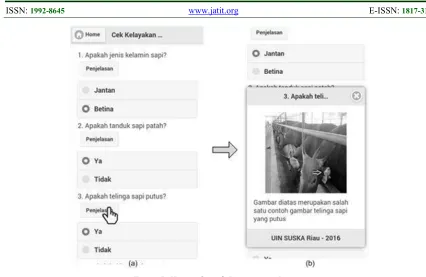
Figure 7 shows how to look up to explanations responding to questions that appear on the page for checking the adequacy of a cow for sacrifice. Firstly, the user click the button leading to
[image:9.612.99.513.351.578.2]2402
Figure 7: How to Consult Responses to Inquiries
Figure 8: How to Consult The Information on New Facts
Figure 8 shows how to consult the information on new facts on the result page displaying the checking the adequacy of a cow for sacrifice. Firstly, the user clicks the button which lays out the descriptions provided in the new facts from
[image:10.612.154.457.366.612.2]2403
4.2 Unit Test
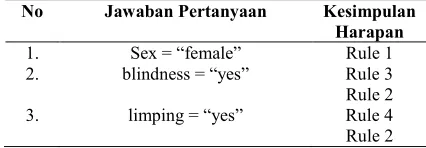
[image:11.612.294.521.73.270.2] [image:11.612.82.295.289.363.2]Unit test observation was conducted by making a table giving several options (Table 6) which has to be made by the user on the questions during the adequacy checking of a cow for sacrifice. This is followed by comparison between conclusions given by the application and the conclusions that should be produced by the application. If these are the same as intended, the application has successfully executed the inferences toward the rules. But if any discrepancies are found, further enhancement are later reinforced on the application. Details of the unit testing observation can be seen in Table 6.
Table 7: The Table Showing Responses to Inquiries
No Jawaban Pertanyaan Kesimpulan
Harapan 1. Sex = “female” Rule 1 2. blindness = “yes” Rule 3
Rule 2 3. limping = “yes” Rule 4
Rule 2
4. broken horn = “yes” Rule 5 Rule 2 5. torn_off ear(s) = “yes” Rule 6
Rule 2 6. cut_off tail = “yes” Rule 7
Rule 2 7. swollen testicle Rule11 Rule41 Rule8 Rule2 … … … … … … … … …
56 being paralytic = “yes” Rule 89 Rule 2 57 missing/cut_off_leg(s) = “yes” Rule 90
Rule 2
4.3 Black Box Test
This test is performed using ten smartphones each containing various specifications. Details of the specifications of the smartphones used can be seen in Table 7. The scenario employed can be seen in Table 8.
Table 8: Details of Specifications of Smartphones Used In The Black Box Test
Brand of Cellular Screen size RAM Version Network Processor
Smartphone 1 Xiaomi redmi 1S 4.7 inches 1 GB Kitkat 4.4.4 HSDPA Quad core
Smartphone 2 Xiaomi redmi 3 5.0 inches 2GB Lollipop 5.1 HSDPA Okta core
Smartphone 3 Galaxy J1 4.5 inches 512 MB Kitkat 4.4.4 HSDPA Dual core
Smartphone 4 Galaxy J2 4.7 inches 1 GB Lollipop 5.1.1 HSDPA Quad core
Smartphone 5 Sony Xperia M 4.0 inches 1 GB Jelly Bean 4.2.2 HSDPA Dual core
Smartphone 6 Zenfone 4 4.0 inches 1 GB Jelly Bean 4.3 HSDPA Dual core
Smartphone 7 Galaxy Ace 3 4.0 inches 1 GB Jelly Bean 4.2 HSDPA Dual core
Smartphone 8 Mito fantasy U A60 5.0 inches 1 GB Kitkat 4.4.2 HSDPA Dual core
Smartphone 9 Andromax c2 4.0 inches 512 MB Jelly Bean 4.2 HSDPA Dual core
Smartphone 10 Infinix hot not 5.5 inches 2GB Kitkat 4.4.2 HSDPA Okta core
Table 9: Scenario of Black Box Test on Smartphone
No Testing Class Testing Item Resulting Outcome
1. Application installation
Installation of application on the gadget
The application is successfully installed
2. Opening application
Clicking the icon of application
The application displays the main page that contains menu showing checking the adequacy feature, valid conditions of adequate cow for sacrifice, list of common cow’s diseases, and feature on the application
2. Checking the adequacy of a cow for sacrifice
Clicking the menu for checking the adequacy
Application displays 62 questions
Selecting a response to questions and clicking a button to check the adequacy
Application shows new facts and conclusions on the adequacy of a cow for sacrifice
4. Consulting the information on the valid conditions of a cow for sacrifice
Clicking the menu on the valid conditions of acceptable cow for sacrifice
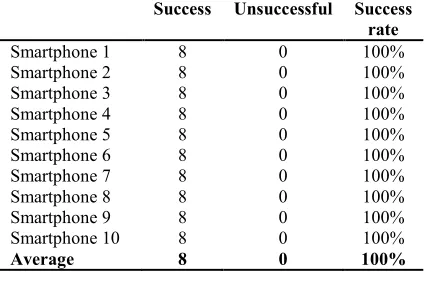
[image:11.612.83.527.388.731.2] [image:11.612.84.526.393.511.2]2404 Table 9 is the summary of black box testing using ten smartphone devices. From the table it can be seen that the functionality of the design of the system checking the adequacy of a cow for sacrifice has run with 100% success rate over the various specifications of the smartphone used in the testing.
Table 10: Results of The Calculation of Black Box Testing on The Expert Reliant System on The Adequacy of a Cow for Sacrifice
Success Unsuccessful Success
rate
Smartphone 1 8 0 100%
Smartphone 2 8 0 100%
Smartphone 3 8 0 100%
Smartphone 4 8 0 100%
Smartphone 5 8 0 100%
Smartphone 6 8 0 100%
Smartphone 7 8 0 100%
Smartphone 8 8 0 100%
Smartphone 9 8 0 100%
Smartphone 10 8 0 100%
Average 8 0 100%
5.
CONCLUSIONBased ont the analyses, designs and devising of the application of expert reliant system that has been conducted, it can be concluded that there must be three main features building this expert reliant system of application namely: (1) checking the adequacy of a cow feature which determines the acceptableness of a cow for sacrifice; (2) feature showing descriptions to inquiries that aims to help user further understand the inquiries from the checking the adequacy feature; (3) the feature showing explanations of new facts resulting from inferences.
Unit test results show that this expert reliant system of application has been successful in than performing the inferences on the basis of knowledge based on facts correctly entered by the user. Other that, balckbox testing carried out on ten different smartphone devices each having different specifications demontstrate that the features made to fulfill the functionality of the application worked successfully at 100% success rate. Based on the results shown in the unit testing examination and blackbox testing it can be concluded that this applicatin can be recommended to assist in the issue of checking the adequacy of a cow for sacrifice.
REFRENCES:
[1] Purnamasari, E. (2015). “Aspects of Qurban Ritual in Pekanbaru”. Akademika Jurnal
Pemikiran Islam, 20(2), 337-359.
[2] Komariah., D.J. Setyono., and Aslimah. (2015). “Karakteristik Kuantitatif dan Kualitatif Kambing dan Domba Sebagai Hewan Qurban di Mitra Tani Farm”. Buletin Peternakan, 39(2), 84-91.
[3] Farlis, J. and Yusuf, J. (2011). “Performa sapi qurban di sumatera barat.Prosiding Seminar Nasional Pengembangan Ternak Kerbau dan Sapi”. FakultasPeternakan UniversitasAndalas. [4] Rasyidi, A. and Kurdi, A. (2007). “Tuntunan
Ringkas Ibadah Kurban”. Tabalong: Lembaga Pengembangan Dakwah Tertulis Tanjung Tabalong.
[5] Purnamasari, E., R. Hanif, A. Firdaus, Zulfikar, J. Handoko, dan W. N.H. Zain. (2017).
“
Sifat Fisik, Kimia dan Mikrobiologik serta Evaluasi terhadap Implementasi Penyembelihan Hewan Qurban pada Masjid di 5. Consultinginformation on the common diseases of cow
Clicking the menu on the list of diseases of a cow
Application displays the list of common diseases of a cow
Clicking one of the names of the cow’s diseases
Application displays the information on the chosen disease
6. Consulting the information on the application
Clicking the menu on the application
The application shows the information on the parties involved in the making of the application
7. Receiving the responses to inquiries
Clicking the button on the descriptions of the questions
The application displays the explanations of the questions
8. Receiving the explanations of new facts
Clicking the button on the descriptions of new facts
[image:12.612.85.299.401.542.2]2405 Kelurahan Simpang Baru Kota Pekanbaru
”
. Research Note. Faculty of Agriculture and Animal Sciences.[6] Sutojo, T., Mulyanto, E., and Suhartono, V. (2011). “Kecerdasan Buatan”. Yogyakarta: Andi Offset.
[7] Suprapto, B. J. “Aplikasi Android Pemeriksa Kesehatan Hewan Qurban Berdasarkan Syariah Islam Dinas Peternakan dan Peikanan Kabupaten Tapin Banjar Masin”. 2014.
[8] Prabowo, I. J. K. G., Setiawan, A., and Prakoso, S. T. (2014). “Pengembangan Sistem Mobile Journal Berbasis Android untuk Referensi Belajar Mahasiswa di Lingkungan Fakultas Ekonomi UNY”. Program Kreativitas
Mahasiswa-Karsa Cipta.
[9] Braska, J.S. “Aplikasi Android Pemeriksa Kesehatan Hewan”. 2014.
[10] Anggraini, R. N. E., Soedjono, A. R., Sianipar, F. Y., and Rochimah, S. (2015, October). “Infant and pregnancy encyclopedia application”. In Advanced Mechatronics,
Intelligent Manufacture, and Industrial
Automation (ICAMIMIA), 2015 International
Conference on (pp. 91-95). IEEE.
[11] Shofi, I. M., Wardhani, L. K., and Anisa, G. (2016, April). “Android application for diagnosing general symptoms of disease using forward chaining method”. In Cyber and IT Service Management, International Conference on (pp. 1-7). IEEE.
[12] Yusof, S. M., and Lokman, S. F. S. S. (2014, April). “Personal financial planner: A mobile application that implementing forward chaining technique for notification mechanism”. In
Computer Applications and Industrial
Electronics (ISCAIE), 2014 IEEE Symposium on (pp. 65-69). IEEE.
[13] Critien, L. V., Khuman, A. S., Carter, J., and Ahmadi, S. (2014, September). “A rule based system for diagnosing and treating chronic heart failure”. In 2014 14th UK Workshop on
Computational Intelligence (UKCI) (pp. 1-6).
IEEE.
[14] Ghahazi, M. A., Zarandi, M. F., Harirchian, M. H., and Damirchi-Darasi, S. R. (2014, June). “Fuzzy rule based expert system for diagnosis of multiple sclerosis”. In Norbert Wiener in the 21st Century (21CW), 2014 IEEE Conference on (pp. 1-5). IEEE.
[15] Ibrahim, F., Ali, J. B., Jaais, A. F., and Taib, M. N. (2001). “Expert system for early diagnosis of eye diseases infecting the Malaysian population”. In TENCON 2001. Proceedings of IEEE Region 10 International Conference on
Electrical and Electronic Technology (Vol. 1,
pp. 430-432). IEEE.
[16] Maharani, S., Dengen, N., Saputra, G. Y., Khairina, D. M., and Hatta, H. R. (2015, October). “Expert system applications for early diagnosis teeth and oral disease in children”. In
2015 2nd International Conference on
Information Technology, Computer, and
Electrical Engineering (ICITACEE) (pp.
87-91). IEEE.
[17] Windriyani, P., Kom, S., Wiharto, S. T., Kom, M., and Sihwi, S. W. (2013, June). “Expert system for detecting mental disorder with forward chaining method”. In ICT for Smart Society (ICISS), 2013 International Conference on (pp. 1-7). IEEE.
[18] Munirah, M. Y., and Rozlini, M. (2013, October). “An Expert System development: Its application on Diagnosing Oyster Mushroom Diseases”. In Control, Automation and Systems (ICCAS), 2013 13th International Conference on (pp. 329-332). IEEE.
[19] Novaliendry, D., Yang, C. H., and Labukti, A. D. G. (2015, October). “The expert system application for diagnosing human vitamin deficiency through forward chaining method”.
In Information and Communication Technology
Convergence (ICTC), 2015 International
Conference on (pp. 53-58). IEEE.
[20] Seebauer, M. (2011, January). “Expert system for optimization of food consumption in Intelligent Home”. In Applied Machine Intelligence and Informatics (SAMI), 2011
IEEE 9th International Symposium on (pp.
255-258). IEEE.
[21] Sumardi., Nurhayati, O. D., Prasetyo, M. N., and Widianto, E. D. (2015, October). “Expert system for campus environment indexing in wireless sensor network”. In 2015 2nd
International Conference on Information
Technology, Computer, and Electrical