UNIVERSITI TUN HUSSEIN ONN MALAYSIA
STATUS CONFIRMATION FOR MASTER'S PROJECT REPORT
QUALITY OF SERVICE PERFORMANCES OF THREE MOBILE AD HOC NETWORK PROTOCOLS
ACADEMIC SESSION: 200912010
I. NABILAH BlNTI A DAM, agree to allow this Master's Project Report to be kept at the Library under the following terms:
I. This Master's Project Report is the property of the Universiti Tun Hussein Onn Malaysia. 2. The library has the right to make copies for educational purposes only.
3. The library is allowed to make copies of this report for educational exchange between higher educational institutions.
4. **Please Mark ( ,/ )
D
D
[Zj]
CONFIDENTIAL RESTRICTED FREE ACCESS (WRITER;S'SIGNA TURE)(Contains information of high security or of great importance to Malaysia as STIPULATED under the OFFICAL SECRET ACT 1972)
(Contains restricted information as determined by the organization/institution where research was conducted.
Approve by,
(SUPERV~S SIGNATURE)
Permanent address:
LOT 12608 KG. GONG DA TOK, MENGABANG TEll POT,
21030 KUALA TERENGGANU, TERENGGANU DARUL IMAN.
Date:
Note:
DR. H.J. ."\vA BIN ABDULLAH
Supervisor's Name
Date:
QUALITY OF SERVICE PERFORMANCES OF THREE MOBILE AD HOC NETWORK PROTOCOLS
NABILAH BINTI ADAM
A project report is submitted as partial fulfilment of the requirement for the award of the
Master's Degree in Electrical Engineering
Faculty of Electrical and Electronic Engineering Universiti Tun Hussein Onn Malaysia
II
"1 hereby declare that 1 havc read this projcct rcport and in my point of\'iew this prpject
is qualified in terms ofscopc and quality for purpose of awarding the Mastcr"s Dcgrcc in Elcctrical Engincering"
Signature
Namc of Supervisor DR. 1-1.1. .JI\VA BIN ABDULLAH
"I declare that this project is the result of my own work except the ideas and references which 1 have clarified their sources."
Signature
... g ...
~~
... .
Name of Author NABILAH BINTI ADAM
Date J I, - 1\ _ ,1'00 q
... ~ ... -...•... -... -.. .
IV
To:
My parents: Tuan Haji Adam b. Haji Ngah and Puan Hajjah Ropinah bt. Haji Abas.
My family:
Mohd Shah Iskandar b. Sidek, Khairul Anuwar b. Adam, Normazani bt.
Ismail, Adib Rahimi b. Adam, Saliza bt. Sazali, Amirah bt. Adam, Mohd
Hazwan b. Mohamed Norli, Mohd Faris b. Khairul Anuwar, Farah
Najibah bt. Khairul Anuwar, Mohd Farhan b. Khairul Anuwar, Farah
v
ACKNOWLEDGEMENT
First of all, all thanks are due to Allah.
] would like to thank my project supervisor, Dr. Hj. Jiwa bin Abdullah for his extraordinary patient and their enduring optimism. I admire his knowledge, intelligence and patience. ] do appreciate his dedicated guidance, suggestion, critical comments and warm supports. ] am blessed and honoured to be his student.
I would like to acknowledge Universiti Malaysia Terengganu (UMT) and the Ministry of Higher Education (MOHE) for sponsoring my master degree study.
Beside that, I would like to thank my parent Mr. Haji Adam bin Haji Ngah and Mss. Hajah Ropinah bt. Haji Abas for all her love and support. They were always there for me to help and provide constant guidance, shining a light upon the completion of this project. My sincere gratitude goes to my family for their loves and support over the years.
\,1
ABSTRACT
Mobile Wireless Ad Hoc Networks (MANETs) is network without infrastructure, where
every node functions as transmitter, router and data sink. Every node must discover its
local neighbours and through them it will communicate to nodes that are out of its
transmission range. The routing mechanisms in MANET are challenged by the
interaction of three fundamental difficulties such as contention, congestion and node
connectivity. Every ad hoc routing protocol has their own advantages based on the
performances in the network. The thesis proposed to evaluate the Quality of Service
(QoS) performances of three types MANET protocols. The protocols included the
Dynamic Source Routing (DSR), Ad Hoc On-demand Distance Vector (AODV) and
Temporally Ordered Routing Algorithm (TORA) protocol. The analysis had been done
theoretically and through simulation using an Optimized Network Engineering Tools
(OPNET) Modeler. Using OPNET Modeler software, these performances had been
analyzed by the following metrics: packet delivery ratio, end-to-end delay, packet
VII
ABSTRA1{
Mobile Wireless Ad Hoc Networks (MANETs) adalah rangkaian tanpa infrastruktur,
iaitu setiap stesen berfungsi sebagai pemancar, penghala dan kumpulan data. Dalam
rangkaian ini, setiap stesen mesti menemui stesen-stesen berada berdekatannya dan
melalui stesen-stesen itu ia akan berhubung untuk stesen yang terkeluar daripada julat
penghantarannya. Mekanisma penghalaan dalan1 MANET dicabar oleh tindak balas tiga
faktor as as seperti pertembungan, kesesakan dan persambungan antara stesen. Setiap
protokol penghalaan ad hoc mempunyai kelebihan berdasarkan keadaan dalam
rangkaian. Tesis ini telah dijalankan bagi menilai pre stasi Quality Service (QoS) bagi
tiga jenis protokol MANET. Protokol tersebut termasuklah Dynamic Source Routing
(DSR), Ad Hoc On-demand Distance Vector (AODV) dan Temporally Ordered Routing
Algorithm (TORA) protokol. Analisis telah dilakukan dari segi teori dan melalui
simulasi menggunakan perisian Optimized Network Engineering Tools (OPNET)
A1odeler. Menggunakan perisian OPNET Modeler, prestasi ini telah dianalisis dari segi
metrik yang berikut: nisbah penyampaian paket, hujung ke hujung kelewatan,
YIII
CONTENTS
CHAPTER ITEM PAGE
TITLE
DECLARA TION ii
DEDICATION iv
ACKNOWLEDGEMNT v
ABSTRACT VI
ABSTRAK vii
CONTENTS viii
LIST OF TABLES x
LIST OF FIGURES XI
LIST OF ABBREVIATIONS xiii
CHAPTER INTRODUCTION 1-5
1.1 Background 1.2 Problem Statement 1.3 Objectives of Project
CHAPTER II
CHAPTER III
CHAPTER IV
CHAPTER V
LITERATURE REVIE\V
2.1 Introduction
2.2 Previous Case Study
2.3 Theoretical Evaluation of Mobile Ad Hoc Network
2.4 Summary
METHODOLOGY
3.1 Introduction 3.2 Methodology
3.3 Performance Metrics 3.4 Experimental Configuration 3.5 OPNET Modeler Software 3.6 Summary
ANALYSIS AND DISCUSSION
4.1 Introduction
4.2 Simulation Results for DSR 4.3 Summary
CONCLUSIONS AND RECOMMENDATIONS
6.1 Introduction 6.2 Conclusions 6.3 Future Studies
x
LIST OF TABLES
TABLES TITLE PAGE
2.1
Overall comparisons of On-Demand versusTable-Driven based.
16
3.1
General simulation parameters for three protocols.25
3.2
Simulation parameters for AODV.26
3.3
Simulation parameters for DSR. 273.4
Simulation parameters for TORA.28
3.5
Hardware Specification.31
4.1
Packet delivery ratio performances for all protocols.46
4.2
Average delay performances for all protocols.48
4.3
Average data dropped performances for all protocols.50
4.4
Average routing load performances for all protocols.51
4.5
Average throughput performances for all protocols.54
5.1
Performances comparison of three kinds of routingXI
LIST OF FIGURES
TABLES
TITLE
PAGE
1.1
A
Mobile Ad Hoc Network.2
2.1
Classification for mobile ad hoc network routingprotocols.
15
3.1
The flow chart of the project development.23
3.2
Node Model required for some MANET networks.35
3.3
The node model for MANET station.37
3.4
The node model for WLAN workstation andWLAN server.
37
3.5
The node model for WLAN ethemet router.38
3.6
The IP dispatch process model.38
3.7
Manet manager process model.39
3.8
The child process for MANET manager process model:(a) dsrJte, (b) aodvJte and (c) manet_tora_imep_mgr.
40
4.1
Packet delivery ratio as a function of number of nodesfor all protocols.
46
4.2
Average delay as a function of number of nodesfor all protocols.
48
4.3
Average data dropped as a function of number of nodes4.4
4.5
5.1
Average routing load as a function of number of nodes
for all protocols.
Throughput as a function of number of nodes for all
protocols.
Graph for performance comparison of three routing
protocols for MANETs.
xii
52
54
MANET -PDA's QoS OPNET DSR AODV TORA DSDV MAC IEEE NS-2 LAN TDMA CAC PANs TCP/IP ZRP RREQ RREP SDLC CBR TTL
LIST OF ABBREVIATIONS
Mobile Ad Hoc Network
Personal Data Assistant
Quality of Service
Optimized Network Engineering Tools
Dynamic Source Routing
Ad Hoc On-Demand Distance Vector
Temporarily Ordered Routing Algorithm
Dynamic Sequence Distance Vector
Media Access Control
Institute of Electrical and Electronics Engineers
Network Simulator-2
Local Area Network
Time Division Multiple Access
Call Admission Control
Personal Area Networks
Transmission Control Protocol and Internet Protocol
Zone Routing Protocol
Route Request Packet
Route Reply Message
Software Development Life Cycle
Constant Bit Rate
Time to Leave
xiv
PC Personal Computer
RAM Random Access Memory
ESD External System Domain
FTP File Transfer Protocol
HTTP Hypertext Transfer Protocol
CHAPTER I
INTRODUCTION
1.1 Background
In general, mobile ad hoc network (MANET) is formed dynamically by
autonomous systems of mobile nodes that are connected via wirelessly without support
of any existing network infrastructure or centralized administration. Without any
wired-infrastructure,
it
is envisaged that MANET could be deployed in applications such assearch and rescue, automated battlefields, disaster recovery and sensor networks.
The nodes that make up a network at any given time communicate with and
through each other. In this way every node can establish a connection to every other
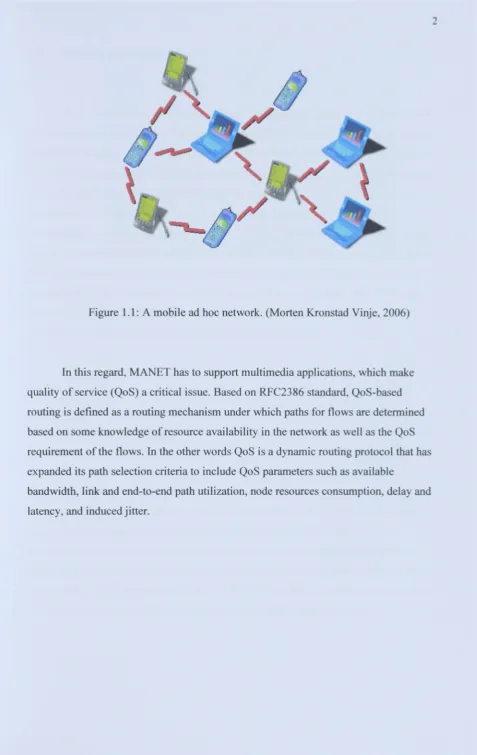
node that is included in the MANET. Typically nodes could be personal devices like
mobile phones, laptops and personal data assistant (rDA ·s). Smaller and simpler
devices also utilized this concept, such as wireless headsets and hands free phone.
Figure 1.1: A mobile ad hoc network. (Morten Kronstad Vinje, 2006)
In this regard, MANET has to support multimedia applications, which make
quality of service (QoS) a critical issue. Based on RFC2386 standard, QoS-based
routing is defined as a routing mechanism under which paths for flows are determined
based on some knowledge of resource availability in the network as well as the QoS
requirement of the flows. In the other words QoS is a dynamic routing protocol that has
expanded its path selection criteria to include QoS parameters such as available
bandwidth, link and end-to-end path utilization, node resources consumption, delay and
latency, and induced jitter.
[image:19.595.61.539.34.790.2]3
1.2 Problem Statement
Each node in the network may be transmitting various types of information with
different levels of importance. Therefore, the available resources in the network must be
distributed in such a way that each user gets different levels of access according to the
level of service required. The dynamic nature of MANET, along with limited resources
that vary with time such as bandwidth, battery power and storage space, makes QoS
provisioning, a challenging problem. The routing mechanisms in MANET are made
complicated due to the interaction of three fundamental issues with regard to network
such as contention, congestion and node connectivity. Every ad hoc routing protocol has
their O\Vll advantages based on their individual performances in the network. By give
the constant values of parameters such as: number of nodes, data rate, packet size and
used constant bit rate (CBR) as a traffic type, this project is done to evaluate the
perfom1ances ofMANET protocols using appropriate metrics.
1.3 Objectives of Project
The objective of this project is to evaluate the QoS routing performances of
three MANET protocols: dynamic source routing (DSR), ad hoc on-demand distance
vector (AODV) and temporally ordered routing algorithm (TORA) protocol. The
analysis had been done theoretically and through simulation using an Optimized
Network Engineering Tools (OPNET) Modeler. Using OPNET Modeler software, these
performances had been analyzed by using the following metrics: packet delivery ratio,
4
1.4 Scope of Project
The scopes of this project is to evaluate three MANET routing protocols through
research and simulation. OPNET Modeler software will be used in this project to
develop these protocols. After that, the performances of three MANET protocols had
been analyzed based on metrics. Then, the results will be compared between the
protocols and results from literatures.
1.5 Thesis Layout
TIle thesis is organized as follows:
Chapter 1: In this chapter will explain an introduction to the QoS performances
for Mobile Ad Hoc Network. The introduction consists of background, problem
statement, objectives of project, scope of project and research methodology.
Chapter 2: This chapter consists of the previous study and the theoretical of the
project. Its will cover the literature research based on routing in Mobile Ad Hoc
Network.
Chapter 3: In order to achieve the objectives of this project, this chapter will
explain the methodology of the project. The simulation parameters and the metrics that
Chapter 4: The results of the studies are presented and compared within this
chapter. With the comparison, some analysis considering different kind of
characteristics that have an effect on the results is provided.
Chapter 5: This chapter summarizes all the results and done the conclusions of
the project and recommendation for future works.
CHAPTER II
LITERATURE REVIEW
2.1 Introduction
Literature survey has been carried out in order to gain enough knowledge
regarding this project. The objective of this chapter is to critically review the existing
research on mobile ad hoc networks (MANETs) protocols. Particular emphasize will be
given to the metrics that had been used to analyzed the performances of three MANETs
protocols: DSR, AODV and TORA. The following reviewed articles were of greatest
significance, providing substantial and authoritative information from the pervious
7
2.2 Previous Case Study
Josh Broch et al. (1998) presents the results of a detailed packet-level simulation
comparing four multi-hop wireless ad hoc network routing protocols that cover a range
of design choices: DSDV, TORA, DSR, and AODV. They have extended the Network
Simulator-2 (ns-2) simulator to accurately model the MAC and physical-layer behavior
of the IEEE 802.11 wireless LAN standard, including a realistic wireless transmission
channel model, and present the results of simulations of networks of 50 mobile nodes.
Each of the protocols studied performs well in some cases yet has certain drawbacks in
others. DSDV performs quite predictably, delivering virtually all data packets when
node mobility rate and movement speed are low, and failing to converge as node
mobility increases. TORA, although the worst performer in our experiments in terms of
routing packet overhead. The performance ofDSR was very good at all mobility rates
and movement speeds, although its use of source routing increases the number of
routing overhead bytes required by the protocol. Finally, AODV performs almost as
well as DSR at all mobility rates and movement speeds and accomplishes its goal of
eliminating source routing overhead, but it still requires the transmission of many
routing overhead packets and at high rates of node mobility is actually more expensive
than DSR.
The actual work consisted of representing and comparing some researches on ad
hoc routing performance had been presented by Sampo Naski (2004). Three studies
were reviewed and their results were compared. The comparison was done with respect
to three major protocols: DSDV, DSR and AODV. The studies compared were based on
simulations. After all the simulations results of the different studies were quite similar.
On the other hand, the special scenarios and simulations runs with larger networks
pointed out that the perfomlance of ad hoc routing protocols may decrease rapidly
especially if there are some bottlenecks in the network. It was also concluded that any