Safety & Instruction Manual
T/C Hawken
™Muzzleloading Rifle
WARNING: Black Powder or an
approved Black Powder substitute
such as Pyrodex
®are the only
propellant powders that are safe to
use in a muzzleloading firearm.
Read the instructions and
warnings in this manual
CAREFULLY BEFORE
using this firearm.
THOMPSON/CENTER ARMS COMPANY, INC.
400 North Main Street
Rochester, New Hampshire 03867
TEL. 1-603-330-5659
WARNING
READ THESE
INSTRUCTIONS AND
WARNINGS CAREFULLY.
BE SURE YOU UNDERSTAND
THESE INSTRUCTIONS AND
WARN-INGS BEFORE USING THIS FIREARM.
FAILURE TO READ THESE
INSTRUC-TIONS AND TO FOLLOW THESE
WARN-INGS MAY RESULT IN SERIOUS INJURY
OR DEATH TO YOU AND OTHERS
AND DAMAGE TO PROPERTY
This SAFETY & INSTRUCTION
MANUAL should always accompany
this firearm and be transferred with it
upon change of ownership or when the
firearm is presented to another person.
Always keep your firearm pointed in a
safe direction. Never point a firearm at
anything you do not intend to shoot.
If you don’t have a manual, printed
copies are available free upon request
by contacting the factory at the address
below. They are also available via
download from the company’s web site
shown below.
THOMPSON/CENTER ARMS CO., INC.
• CUSTOMER SUPPORT •
400 NORTH MAIN STREET
ROCHESTER, New Hampshire 03867
TEL.: 1-603-330-5659
www.tcarms.com
YOUR SAFETY RESPONSIBILITIES . . . 3
SAFE STORAGE & TRANSPORTATION . . . 8
SAFETY RULES FOR THE HAWKEN™ . . . 10
BASIC EQUIPMENT FOR SHOOTING THE HAWKEN™ . . . 13
UNDERSTANDING BLACK POWDER . . . 14
UNDERSTANDING PYRODEX®. . . 15
MODEL & FEATURES IDENTIFICATION . . . 16
PREPARATION FOR FIRING . . . 19
CHARGING THE T/C HAWKEN™ . . . 20
PATCHING THE ROUND BALL . . . 22
PRIMING THE T/C HAWKEN™ CAP LOCK RIFLE . . . 27
PRIMING THE T/C HAWKEN™ FLINT LOCK RIFLE . . . 27
FIRING THE T/C CAP LOCK HAWKEN™ . . . 31
FIRING THE T/C FLINT LOCK HAWKEN™ . . . 32
UNLOADING AND UNCHARGING . . . 34
FIELD CLEANING . . . 36
THOROUGH CLEANING . . . 38
DISASSEMBLY FOR CLEANING . . . 39
RE-ASSEMBLY OF THE T/C HAWKEN™. . . 41
SIGHT ADJUSTMENT . . . 42
THE HAWKEN™ TRIGGER MECHANISM . . . 42
LIMITED LIFETIME WARRANTY. . . 44
CONTACT & SHIPPING FOR SERVICE . . . 45
LOAD COMPONENTS . . . 47
SUGGESTED LOADS FOR T/C HAWKEN™ . . . 47
YOUR SAFETY
RESPONSIBILITIES
SAFETY IS YOUR NUMBER ONE
RESPONSIBILITY!!!!
At home, in the field, at the range, or anywhere, the first concern of every firearm owner should be safety. Apply the following safe-ty rules in every situation, with any kind of firearm. If you feel uncertain about any operational aspects of your firearm, please contact Thompson/Center before proceeding with its operation.
WARNING: YOU MUST FOLLOW ALL OF THESE SAFETY RULES TO ENSURE THE SAFE USE OF YOUR FIREARM. THE FAILURE TO FOLLOW THE INSTRUCTIONS AND WARNINGS IN THIS MANUAL COULD CAUSE SERIOUS PERSONAL INJURY OR DEATH TO YOU OR OTHERS AND DAMAGE TO PROPERTY..
As a gun owner, you accept a demanding responsibility. How seri-ous you take this responsibility can be the difference between life and death. There is no excuse for careless or abusive handling of
YOUR SAFETY RESPONSIBILITIES CONT’D
• ALWAYS KEEP YOUR FIREARM POINTED IN A SAFE DIRECTION.Never point a firearm at anyone or anything you do not intend to shoot whether or not it is loaded. This is particularly important when loading, unloading, or field stripping the gun. ALWAYS control the direction of the firearm.• ALWAYS TREAT EVERY FIREARM AS IF IT IS LOADED AND WILL FIRE. Do not take anyone’s word that the firearm is uncharged or unprimed – always check for yourself. Never pass your firearm to another person until the action is open and/or on safe you visually check that it is uncharged and unprimed. Keep your muzzleloading firearm uncharged and unprimed and safely stored when not in use.
• NEVER PLACE YOUR FINGER INSIDE THE TRIGGER GUARD OR ON THE TRIGGER UNLESS YOU INTEND TO FIRE.Ensure that other objects do not touch the trigger.
• ALWAYS BE SURE OF YOUR TARGET AND WHAT IS BEYOND IT.Always be sure of where the bullet will strike and shoot only where there is a safe back stop free of obstructions, water or other surfaces which can cause ricochets. Be sure your bullet will stop behind your target. Bullets can glance off many surfaces like rocks or the surface of water and travel in unpre-dictable directions with considerable velocity. Do not fire random-ly into the sky.
• NEVER CROSS OBSTACLES SUCH AS FENCES OR STREAMS WITH A CHARGED OR PRIMED MUZZLELOADING FIREARM.Always make certain your muzzleloading firearm is unprimed before crossing a fence, climbing a tree, jumping a ditch or negotiating other obstacles.
• SAFE GUN HANDLING IS YOUR PERSONAL RESPONSIBIL-ITY AT ALL TIMES.Firearms are dangerous and can cause seri-ous injury or death if they are misused or used inappropriately. Safety must be the prime consideration of any one who owns or handles firearms. Accidents are the result of violating the rules of safe gun handling and common sense. Firearm safety training is available. Contact your firearms dealer, law enforcement agency, local sportsman’s club, etc. for availability.
• YOU ARE RESPONSIBLE FOR THE FIREARM AT ALL TIMES.In owning a firearm, you must undertake full-time respon-sibility for your firearm’s safety and security. You must protect yourself and all others against injury or death from misuse of the firearm 24 hours a day.
• FIREARM SECURITY IS YOUR RESPONSIBILITY.You must secure firearms safely from children and/or unauthorized users. Your firearm should always be kept unloaded and locked when not in use. Never assume that the use of this lock is sufficient to safely secure your firearm. You must always evaluate your per-sonal situation and employ the security systems that meet your needs and prevent children and unauthorized users from gaining access to your firearm.
YOUR SAFETY RESPONSIBILITIES CONT’D
• APPROPRIATE USE FOR YOUR FIREARM MEANS USING YOUR FIREARM FOR LEGAL PURPOSES.For example - tar-get shooting, hunting and lawful resistance of deadly criminal force. It is your responsibility to ensure that you are in compli-ance with all applicable laws and ordincompli-ances regarding the use of your firearm.• NEVER RELY ON MECHANICAL FEATURES ALONE.Only your safe gun-handling habits will ensure the safe use of your firearm. This is your responsibility.
• ALWAYS SAFELY STORE AND SECURE YOUR FIREARM.
Safe and secure storage of your firearm is one of your most important responsibilities. It is a full-time responsibility. You must always secure your firearm and ammunition and loading compo-nents separately so that they are not accessible to children and/or other unauthorized persons.
• NEVER KEEP AMMUNITION AND LOADING COMPONENTS IN THE SAME LOCATION AS THE FIREARM. Store each in a separate and secure place.
• ALWAYS WEAR EYE PROTECTION THAT IS SPECIFIED FOR USE WITH FIREARMSevery time you handle your firearm for cleaning and maintenance.
• ALWAYS WEAR EYE AND EAR PROTECTORS THAT ARE SPECIFIED FOR USE WITH FIREARMSevery time you dis-charge your firearm. Make sure others in the vicinity of where you will be shooting do so as well.
• NEVER USE ALCOHOL OR DRUGS BEFORE OR WHILE SHOOTING.Do not use your firearm if you are on any medication which impairs, even slightly, your mental or physical ability.
• ALWAYS HAVE ADEQUATE VENTILATION.Discharging firearms in poorly ventilated areas, cleaning firearms, or handling ammunition and loading components may result in exposure to lead and other substances known to cause birth defects, reproduc-tive harm, and other serious physical injury. Review the warnings and labels for all ammunition and loading components and clean-ing products carefully. Wash hands thoroughly after exposure.
• BEFORE HANDLING ANY FIREARM, UNDERSTAND ITS OPERATION.Not all firearms are the same. Familiarize yourself with the mechanical features of any firearm you intend to use. If you feel uncertain about any operational aspects of your firearm, please contact Thompson/Center before proceeding with its operation.
• NEVER ALLOW A FIREARM TO BE USED BY INDIVIDUALS WHO DO NOT UNDERSTAND ITS SAFE OPERATION OR
YOUR SAFETY RESPONSIBILITIES CONT’D
• ALWAYS USE THE CORRECT COMBINATION OF LOAD COMPONENTS (POWDER, PRIMER AND PROJECTILE) FOR YOUR PARTICULAR MUZZLELOADING FIREARMas detailed in this manual.• BE CERTAIN THE BARREL IS CLEAR OF OBSTRUCTIONS BEFORE SHOOTING.Mud, water, snow or other objects may inadvertently lodge in the barrel bore. A small obstruction can cause a dangerous increase in pressure and may damage your gun and cause injury to yourself and others.
• BE SURE ALL ACCESSORIES, SUCH AS HOLSTERS. GRIPS, SLINGS, SCOPES AND OTHER ACCESSORIES ARE COMPATIBLEwith the firearm and that the accessories do not interfere with safe operation. It is your responsibility to under-stand and follow all of the instructions in this manual,as well as those which may be supplied with your ammunition and loading components and any accessory.
• NEVER DISASSEMBLE YOUR FIREARMbeyond the proce-dures outlined in this manual. Improper disassembly or re-assembly of your firearm may be dangerous and can lead to serious injury or death.
• NEVER MANIPULATE, ADJUST OR CHANGE ANY OF THE INTERNAL COMPONENTS OF YOUR FIREARM UNLESS SPECIFICALLY INSTRUCTED TO DO SO IN THIS MANUAL.
Improper manipulation of any other internal component may affect the safety and reliability of your firearm and may cause serious injury or death.
• NEVER ALLOW ANY ALTERATION OR REPLACEMENT OF PARTS IN YOUR THOMPSON/CENTER FIREARM UNLESS PERFORMED BY A QUALIFIED GUNSMITHusing genuine Thompson/Center parts. If you do otherwise, improper function-ing of your firearm may occur and serious injury or death and damage to property may result.
WARNING: SAFE USE OF A FIREARM IS YOUR PER-SONAL RESPONSIBILITY AND THE FAILURE TO FOL-LOW ALL OF THESE BASIC SAFETY RULES MAY RESULT IN SEVERE PERSONAL INJURY OR DEATH TO YOU OR OTHERS AND DAMAGE TO PROPERTY. YOU ARE THE MOST IMPORTANT SAFETY DEVICE WHEN IT COMES TO THE USE OF YOUR FIREARM AND THOMPSON/CENTER AND ITS PARENT COMPANY WILL NOT BE RESPONSIBLE FOR ANY PERSONAL INJURY, DEATH OR PROPERTY DAM-AGE THAT RESULTS FROM: (1) THE CRIMINAL OR NEGLI-GENT USE OF THIS FIREARM; (2) A DISREGARD OF THESE SAFETY INSTRUCTIONS AND WARNINGS; (3) IMPROPER OR CARELESS HANDLING OF THIS FIREARM; (4) THE USE OF NON-STANDARD, DEFECTIVE, IMPROPER LOAD COM-PONENTS OR (5) IMPROPER OR NEGLIGENT MODIFICA-TIONS OR REPAIRS TO THE FIREARM.
YOUR SAFETY RESPONSIBILITIES CONT’D
• NEVER CLIMB TO OR DESCEND FROM A TREE STAND WITH A PRIMED MUZZLELOADING FIREARM. NEVER RAISE OR LOWER A PRIMED MUZZLELOADING FIREARM TO OR FROM A TREE STAND.Tree stands are potentially hazardous. If you feel that you must use a tree stand, purchase a top-quality brand only and follow the manufacturer’s instructions to the letter. Failure to follow this rule may cause serious injury and/or death to the shooter or bystanders and damage to property.
• NEVER LEAN A CHARGED AND PRIMED RIFLE AGAINST A TREE, WALL OR ANY SURFACE. Once the rifle has been charged it is your responsibility to guard it against accidental bumps.
• USE THOMPSON/CENTER SCOPE MOUNTS ONLY. The current product catalog lists a series of scopes and mounts which are designed specifically for use with our firearms. These mounts make use of existing screw holes. Those who desire a scope sight should make use of Thompson/Center mounts. Do not drill additional holes in the barrel as this could weaken the barrel structure leading to a rupture. A ruptured barrel can cause serious injury and/or death to the shooter or bystanders and damage to property.
• NEVER MODIFY ANY OF THE PARTS IN YOUR FIREARM.
Do not add or replace any of the parts in your firearm unless they are genuine Thompson/Center parts and you follow the instructions supplied by Thompson/Center. If you do otherwise, improper functioning may occur and serious injury or death may result. In addition to the dangers presented, the use of non-facto-ry parts, including but not limited to, barrels and springs, voids all warranties.
WARNING: NEVER RELY ON MECHANICAL SAFETY FEATURES OF THE GUN ALONE. ONLY YOUR SAFE GUN HANDLING WILL ENSURE THE SAFE USE OF YOUR FIREARM. THIS IS YOUR RESPONSIBILITY.
SAFE STORAGE &
TRANSPORTATION
WARNING: ALWAYS POINT THE MUZZLE IN A SAFE DIRECTION.
WARNING: FIREARMS ARE DANGEROUS WHEN USED AND STORED IMPROPERLY. THEY POSE A RISK OF SERIOUS OR FATAL INJURIES. FIREARMS CAN BE ESPECIALLY DANGEROUS TO CHILDREN WHEN THEY ARE STORED IN AN IRRESPONSIBLE AND UNSAFE MANNER. FOR YOUR SAFETY AND THE SAFETY OF OTH-ERS, IT IS IMPERATIVE THAT YOU KEEP YOUR FIREARM LOCKED AND UNLOADED IN A SECURE PLACE. THE AMMUNITION AND LOADING COMPONENTS SHOULD BE STORED IN A SEPARATE, SECURE LOCATION WHEN IT IS NOT IN USE. SAFE AND SECURE STORAGE OF YOUR FIREARM IS ONE OF THE MOST IMPORTANT RULES OF FIREARM SAFETY. YOUR FAILURE TO FOLLOW THESE RULES MAY RESULT IN SERIOUS INJURY OR DEATH TO YOU OR OTHERS.
• ALWAYS SECURE YOUR FIREARM IN A MANNER THAT WILL PREVENT UNAUTHORIZED ACCESS.Whenever your firearm is not in use, keep it unloaded and locked. Your safety and the safety of others requires that you always secure and store your firearm in a manner that will prevent unauthorized access. Never leave a firearm unattended unless it is locked, unloaded and secured.
WARNING: NEVER LOCK A LOADED FIREARM AND NEVER LOAD A LOCKED FIREARM!
• ALWAYS STORE YOUR FIREARM AND AMMUNITION AND LOADING COMPONENTS SEPARATELYso that they are not accessible to children or other unauthorized persons. Safe and secure storage of your firearm and ammunition and loading com-ponents are your responsibility. It is a full-time responsibility.
• NEVER ASSUME THAT A “HIDING” PLACE IS A SECURE STORAGE METHOD.Others may be aware of your storage loca-tion or come upon it by chance. It is your personal responsibility to use common sense when storing your firearm and ammunition and loading components and to always make sure they are not accessible to children or other unauthorized persons.
• NEVER TRANSPORT A CHARGED OR PRIMED MUZZLE-LOADING FIREARM.When transporting your firearm, be sure it is uncharged, unprimed and securely locked. Safe and secure transportation of your firearm is your responsibility.
SAFE STORAGE & TRANSPORTATION CONT’D
• ALWAYS FOLLOW THE LAW!Many jurisdictions have laws that make it a crime to keep a firearm unlocked and in an area accessible to children or others. Keeping a firearm locked and unloaded when not in use is not only common sense safety prac-tice... IT IS THE LAW. You must be familiar with all local, state, and federal laws regarding the safe storage and transportation of your firearm. Failure to know and follow the law may result in unauthorized access or use of your firearm by another. Obey all laws relating to the storage and transportation of firearms. Your local police department or gun shop can furnish you with avail-able information on storing and/or transporting a firearm safely and legally.• YOUR FIREARM IS YOUR RESPONSIBILITY.You must pre-vent your firearm from being stolen or from being used by untrained or unqualified individuals. Keep it locked, uncharged, unprimed and secured when not in use.
SAFETY RULES
FOR THE HAWKEN
™
In addition to the Safety Responsibilities covered so far in this manual, there are several guidelines specific to black powder muzzleloading guns that must be adhered to at all times to ensure the safety of the shooter and others.
• NEVER USE SMOKELESS POWDER OF ANY TYPE OR IN ANY QUANTITY IN A MUZZLELOADING FIREARM, AND NEVER MIx POWDERS.The use of any smokeless powder could result in a detonation or explosion which could cause injury and/or death to the shooter or bystanders and damage to property.
• USE ONLY BLACK POWDER OR AN APPROVED BLACK POWDER SUBSTITUTE SUCH AS PYRODEx® TO LOAD YOUR MUZZLELOADING FIREARM. Never use even small amounts of smokeless powder, even if it is black in color. The use of any other propellant may cause injury or death to the shooter or bystanders and damage to property.
• NEVER SMOKE WHILE USING YOUR MUZZLELOADER. The spark from a lighted cigarette, cigar or pipe can ignite Black Powder or a Black Powder substitute such as Pyrodex®, Percussion Caps or Primers. Smoking around a charged and/or primed muzzleloader, percussion caps, primers, priming powder or supply of powder may cause premature firing of the gun or an explosion of the powder can, horn or flask causing serious injury and/or death to the shooter or bystanders and damage to property.
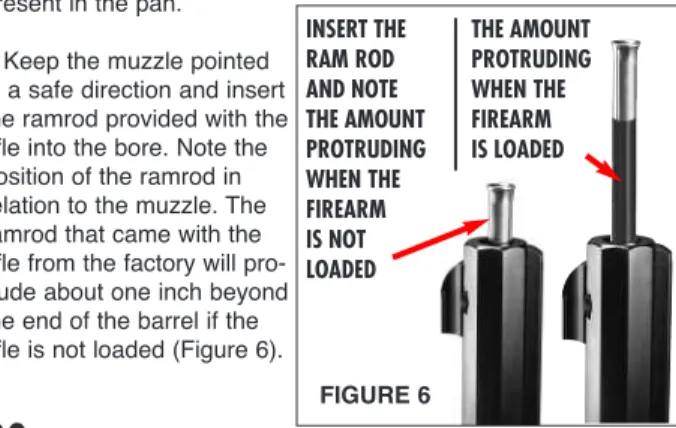
• BEFORE LOADING, MAKE SURE THE MUZZLELOADING FIREARM IS NOT ALREADY CHARGED.To make sure it is uncharged, keep the muzzle pointed in a safe direction and insert the ramrod provided with the rifle into the bore. Note the position of the ramrod in relation to the muzzle. It will be about one inch beyond the end of the barrel if the rifle is not loaded.
• NEVER ExCEED THE RECOMMENDED MAxIMUM CHARGE LISTED IN THIS BOOK.To do so could result in injury or death to the shooter or bystanders.
• WHEN LOADING, BE CERTAIN THAT THE PROJECTILE IS LOADED IN THE PROPER SEQUENCE AND THAT IT IS SEATED PROPERLY.Serious personal injury or death can result if the projectile is not seated properly. To provide a reference mark for future loadings, mark the ramrod at the muzzle once a projectile has been loaded to the proper depth. NOTE: Be sure to recheck the ramrod mark if you change loading components or alter the ramrod.
MUZZLELOADER SAFETY RULES CONT’D
• NEVER POUND ON THE RAMROD.Black Powder and approved Black Powder substitutes such as Pyrodex® are poten-tially sensitive to impact and could ignite from impact. Always keep the muzzle directed away from your face or body when loading.• BLACK POWDER AND BLACK POWDER SUBSTITUTES SUCH AS PYRODEx® LEAVE CORROSIVE RESIDUES IN THE BORE AND ON THE GUN.A thorough cleaning is absolute-ly necessary before storage for any amount of time to keep the firearm functioning correctly and in safe condition.
• UNDERSTAND THE TERMINOLOGY“Charge” or “Charged” which applies to the presence of a propellant powder charge and projectile in the bore of the muzzleloading firearm.
•“Uncharge” or “Uncharged” refers to the opposite condition to
“Charged” and indicates that the powder charge and projectile have been either fired or removed and that the bore is complete-ly clear.
• “Prime” or “Primed” applies to the act of placing a primer, cap
or priming powder in or on a muzzleloader.
•“Unprime” or “Unprimed” refers to the opposite condition of
“Primed” and indicates that the primer, cap or priming powder has been removed from the firearm or is not in place.
• NEVER PRIME YOUR MUZZLELOADING GUN UNTIL YOU ARE READY TO FIRE IT.Your muzzleloader should remain unprimed until the instant before firing. After you prime the firearm, your full concentration should be on the target and the act of firing.
WARNING: KEEP PEOPLE AND FLAMMABLE MATERIAL AWAY FROM THE TOUCHHOLE AREA. WHEN FIRING ANY FLINT LOCK MUZZLELOADER, THE “FLASH” FROM THE TOUCHHOLE HAS THE POTENTIAL TO CAUSE INJURY.
• A SHARP OR HEAVY BLOW TO THE ExTERNAL HAMMER CAN FRACTURE PARTS AND CAUSE A MALFUNCTION OR DISCHARGE OF THE FIREARM. An accidental discharge may cause serious injury and/or death to the shooter or bystanders and damage to property.
• NEVER HAND A CHARGED MUZZLELOADING FIREARM TO ANOTHER PERSON.Once charged, a muzzleloading firearm requires your complete attention. Never charge the firearm and then hand it to another shooter. Equally, you should never shoot a muzzleloading firearm that has been charged by someone else. Only the person doing the loading knows whether the
MUZZLELOADER SAFETY RULES CONT’D
• DO NOT CHARGE YOUR MUZZLELOADER DIRECTLY FROM A CAN, HORN OR FLASK.A spark from a previous firing may ignite the stream of powder being poured into the gun and cause the container to explode. The explosion of a powder can, horn or flask can cause serious injury and/or death to the shooter or bystanders and damage to property. Use a separate pre-cali-brated measuring device containing small quantities of powder to charge your gun. Keep the muzzle directed away from your face and body when loading.• ALWAYS KEEP SUPPLIES OF POWDER AND PRIMERS WELL AWAY FROM A FIRING POSITION OR SHOOTING BENCH.A powder horn, flask, can of powder, or quantity of primers can ignite with deadly force if exposed to sparks or intense heat. Follow the manufacturer’s instructions for safe han-dling and storage of powder and primers. Keep unused powder and primers well away from firearms that are being discharged. Sparks from the discharge of a muzzleloading firearm may cause an unused supply of powder or primers to ignite causing serious injury and/or death to the shooter or bystanders and damage to property.
• You must follow these procedures every time a firearm leaves your hand, is cleaned, handed to you or another person, trans-ported or stored.
WARNING: NEVER RELY ON MECHANICAL FEA-TURES ALONE. ONLY YOUR SAFE GUN HANDLING WILL ENSURE THE SAFE USE OF YOUR FIREARM. THIS IS YOUR RESPONSIBILITY.
WARNING: NEVER DRY-FIRE YOUR FLINT LOCK WHEN THE BARREL IS CHARGED. A SPARK FROM DRY-FIRING COULD RESULT IN AN ACCIDENTAL DISCHARGE.
BASIC EQUIPMENT
FOR SHOOTING THE
T/C HAWKEN
™
In order to shoot your Thompson/Center Hawken™ muzzle-loader, the min i mum ac ces so ries or equipment from the following list will be necessary.
WARNING: DO NOT ATTEMPT TO SHOOT YOUR MUZ-ZLELOADING FIRE ARM UNTIL YOU HAVE READ THIS MANUAL IN ITS EN TIRE TY AND UNDERSTAND IT FULLY. FAILURE TO READ AND FOL LOW THESE IN STRUC -TIONS COULD RESULT IN JU RY AND/OR DEATH TO THE SHOOT ER OR BY STAND ERS AND DAMAGE TO PROP ER TY. IF YOU ARE UN ABLE TO UN DER STAND ANY OR ALL OF THIS MA TE RI AL, CALL THE CUS TOM ER SER VICE DE PART -MENT AT THOMP SON/CEN TER.
1. Proper eye protection - specified for use with firearms. 2. Proper ear protection - specified for use with firearms.. 3. Black Powder or an approved Black Powder substitute such as
Pyrodex®, in the appropriate gran u la tion for your par tic u lar
firearm.
4. Number 11 percussion caps for cap lock models. FFFG Black Powder for priming flint lock models.
5. A Powder Measure.
6. Projectiles: Appropriate for your firearm. 7. Bore cleaning patches.
8. A Jag to hold cleaning patches
9. An appropriate bore cleaner (Like Thompson/Center’s Number
13®Bore Cleaner).
10. An appropriate oil or rust inhibiting lubricant (Like T/C’s Natural Lube 1000 Plus™ Bore Butter™.
UNDERSTANDING
BLACK POWDER
Shooting muzzleloading firearms requires the shoot-er to be both a reloadshoot-er and a rifleman at the same time. It requires strict adherence to the instructions set forth in this booklet. Failure to follow these instructions may cause damage to the firearm and injury and/or death to the shooter or bystanders and damage to property.
NOTE: Black Powder is manufactured in four specific types or granu-lations for use in firearms. Generally speaking, it is the granule size which determines the appropriate use of Black Powder. The largest granulations are naturally the slowest burning and, therefore, work best in large caliber rifles and shotguns. Pistols or smaller caliber rifles require a finer or faster burning powder. The priming powder used in the pan of a flint lock is extremely fine and fast burning for positive ignition of the main charge.
FG (commonly called Single “F”)
The muzzleloading enthusiast finds little use for this very coarse black powder. It’s use is restricted to the large bore (10, 8, 4 gauge) shotguns of yesteryear.
FFG (commonly called Double “F”)
This is a very popular powder for .45 caliber to .58 caliber rifles. It is also used for 12, 16, and 20 gauge muzzleloading shotguns. While it is not considered a pistol powder, it is sometimes used in very large caliber single shot pistols. It is recommended for use in most T/C muzzleloaders.
FFFG (commonly called Triple “F”)
Due to its wide range of uses, Triple “F” is the black powder that is most commonly found on a dealer’s shelf. It is used in all per-cussion revolvers, most single shot pistols, and most of the smaller (under .45 caliber) rifles. In a pinch, it can also be used to prime a flint lock.
FFFFG (commonly called Four “F”)
The finest of all currently available black powders, Four “F” is best used for priming flint locks. Due to its limited use, it is some-times difficult to obtain.
When purchasing Black Powder be certain that it is in the original manufacturer’s container and that its granulation or type is clear-ly marked on the label. Follow the storage and handling precau-tions which are on the label. If you have any quesprecau-tions concern-ing the safe handlconcern-ing or storage of Black Powder, write to the manufacturer of the powder. Additional information on powder storage is available from the National Fire Protection Association, P.O. Box 9146, Quincy, Mass. 02269. Or call 1-800-344-3555. Ask for pamphlet #495.
UNDERSTANDING
PYRODEX
®
Pyrodex®is a propellant powder designed for use in
muzzleloading cap lock rifles, pistols and shotguns.
Pyrodex®is not Black Powder. In accordance with the
manufacturer’s instructions, Pyrodex relates closely to Black Powder on a volume to volume basis (not weight of charge). In other words, a black powder measure that is set to dispense 70 grains of black powder will, in fact, dispense approximately 52 grains of Pyrodex (by weight). This lighter charge of Pyrodex will provide a charge which is ballistically similar to 70 grains of Black Powder. For all practical purposes, knowing the actual weight of a charge of Pyrodex may be informative, but not necessary. Your black powder measure will dictate the proper amount by its graduations according to volume. If you want to know the actual comparative weight of a Pyrodex charge, con-tact the manufacturer, Hodgdon Powder Co. Inc., 6231 Robinson, Shawnee Mission, KS 66202-1332.
Pyrodex does not ignite as easily as Black Powder and, conse-quently, it is not recommended for use in flint lock firearms. Flint locks require strong, positive ignition and should be charged and primed with Black Powder of the appropriate granulation only.
PYRODEx®CTG - FOR BLACK POWDER CARTRIDGES.
This powder was designed to be used in early model breech load-ing cartridge firearms (rifles, pistols & shotguns) which were intend-ed for use with Black Powder only. It has no application in Thompson/Center muzzleloading firearms. It is listed here simply for identification purposes.
PYRODEx®RS (or PYRODEx SELECT “RS”) RIFLE &
SHOT-GUN POWDER.Designed for use in all calibers of percussion muz-zleloading rifles and shotguns, this powder has a wide application. It may be used with all Thompson/Center muzzleloading rifles and shotguns. Pyrodex Select (RS) may also be used in these applications.
PYRODEx®P - PISTOL POWDER.Designed for use in most
per-cussion muzzleloading pistols and cap and ball revolvers, this pow-der has application in the Thompson/Center Patriot™ Pistol. The reader should bear in mind that Thompson/Center does not manu-facture or sell powder of any type. If there is ever a question as to the proper application of a particular powder or the safety of a given charge, write to the manufacturer of the powder. Adhere to the safe handling and storage precautions printed on the manufacturer’s con-tainer and never purchase or use powders which have been removed from their original container. USE OF THE WRONG PROPELLANT may cause injury and/or death to the shooter or bystanders and dam-age to property. For information on Pyrodex write to Hodgdon Powder Co., Inc., 6231 Robinson, Shawnee Mission, KS 66202-1332.
MODEL & FEATURES
IDENTIFICATION
BUTT PLATE LOCK PLATE MUZZLE STOCK NIPPLE HAMMER REAR SIGHT FRONT SIGHT BARREL ESCUTCHEON-WITH WEDGE PIN FOREND TRIGGER GUARD TRIGGERS FIGURE 1 RAMROD THIMBLE PATCH BOX RAM ROD RETAINER SPRING NOSE CAP TRIGGER GUARD TANGCAP LOCK
MODEL
SHOWN
MODEL & FEATURES I.D. CONT’D
Frizzen Flint Leather Flint Cushion Hammer Lock Plate Frizzen Spring Jaws Pan
DETAILS OF A FLINT LOCK ASSEMBLY
WARNING: NEVER DRY-FIRE YOUR HAWKEN™. DAMAGE COULD RESULT OR A SPARK FROM DRY-FIR-ING COULD RESULT IN AN ACCIDENTAL DISCHARGE.
FOR ASSEMBLY & DISASSEMBLY. THE BARREL MUST BE LIFTED AS SHOWN
TO UNLOCK THE HOOKED BREECH PLUG FROM THE TANG .
DETAIL SHOWING HOOKED BREECH
Double-Set Trigger Details
Firing Trigger Set Trigger (adjustable)
FIGURE 4 HAMMER MUST BE IN HALF-COCK POSITION WHEN ASSEMBLING OR DIS-ASSEMBLING FIGURE 3a FIGURE 2 FIG. 3b
Trigger Adjustment Screw - controls the amount of “set trigger” engagement
MODEL & FEATURES I.D. CONT’D
CALIBER DESIGNATION ON BARREL
PROPELLANT MARKING ON BARREL
SERIAL NUMBER MARKING ON BARREL GUN MODEL DESIGNATION ON BARREL FIGURE 5a FIGURE 5b FIGURE 5c FIGURE 5d
PREPARATION FOR
FIRING
WARNING:THE FAILURE TO FOLLOW THESE FIREARM SAFETY REQUIREMENTS WILL CAUSE SERIOUS PER-SONAL INJURY OR DEATH TO YOU OR OTHERS.
• ALWAYS TREAT ALL FIREARMS AS IF THEY ARE LOADED.
• ALWAYS WEAR PROPER CLOTHING WHEN FIRING A MUZZLELOADERwearing long sleeves is recommended to protect arms from debris that may be ejected during firing. • NEVER SMOKE WHILE SHOOTING OR HANDLING A
MUZ-ZLELOADING FIREARM.
• ALWAYS KEEP LOADING COMPONENTS AND LOADING RESERVES WELL AWAY FROM THE MUZZLELOADER WHEN FIRING.
• ALWAYS WEAR ADEQUATE AND PROPER EAR PROTEC-TORS SPECIFIED FOR FIREARM USEto prevent permanent damage to your hearing. Make sure others who are nearby are wearing ear protection as well.
• ALWAYS WEAR SAFETY GLASSES SPECIFIED FOR FIREARM
USE,whether indoors or out. Safety glasses should protect your
eyes from the firing flash and particles associated with the discharge of a muzzleloading firearm. Failure to do so creates a risk of person-al injury from particles or debris spitting or from a ricochet. • ALWAYS BE ALERT AND ALWAYS FOLLOW THE SAFETY
INSTRUCTIONS OF THE RANGE OFFICER.Never shoot if you are tired, cold or impaired in any way.
• ALWAYS BE AWARE OF OTHER PEOPLEso that persons do not accidentally walk into the line of fire.
• THE SHOOTER (AND ALL OTHERS IN THE SHOOTING AREA) MUST ALWAYS BE IN A POSITION THAT IS OUT OF THE LINE OF FIREand are not within an area where they may be struck by a ricochet or particles spitting from a firearm, or by ejected cases from some types of firearms.
• NEVER SHOOT AT SURFACES THAT MAY CAUSE A RICOCHET.
Always select a place to shoot that has a safe backstop, is free from obstructions and has no surfaces which may cause a ricochet. • NEVER FIRE RANDOMLY INTO THE SKY.Always select a
place to shoot that has a safe backstop.
• NEVER USE ALCOHOL OR DRUGS BEFORE OR WHILE SHOOTING OR HANDLING ANY FIREARM.
CHARGING THE
T/C HAWKEN
™
WARNING: ALWAYS POINT THE MUZZLE IN A SAFE DIRECTION.
NOTE: The loading data found in the back of this manual was
compiled using Pyrodex®or Black Powder as a propellant. With
any other approved Black Powder substitute, follow the instruc-tions supplied by the manufacturer and heed all warnings and instructions as they apply to loading and usage of that product. • Inspect the bore for obstructions and oil or grease (and clean if necessary). This is true with the rifle as it comes from the facto-ry, as it has been treated with anti-rust compound that needs to cleared before use.
• Do not load the muzzleloading firearm until you have read and fully understand this manual.
• Do not load or prime the muzzleloading firearm until you are ready to use it. Keep your finger off the trigger and outside the trigger guard until you are ready to fire.
• Read this manual in its entirety before at tempt ing to load your muzzleloading firearm. Improper loading and use of your fire arm can cause injury and/or death to the shoot er or by stand ers and damage to property.
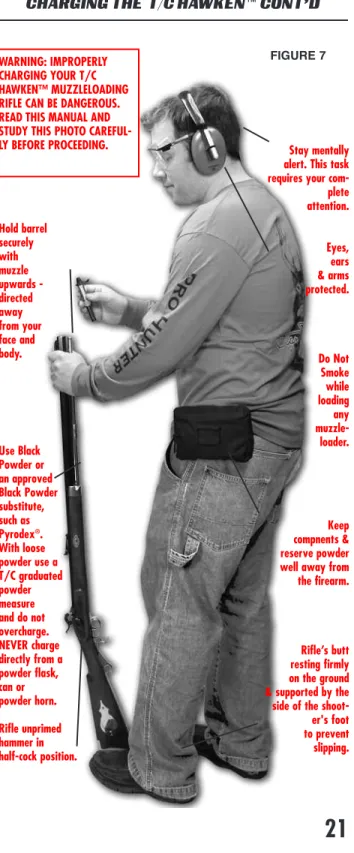
• Study the photo on page 21 carefully and read all the captions be fore you charge your muzzleloading rifle.The photo shows a shooter in the process of loading a Hawken™ muzzleloader. • Make sure it is unprimed and uncharged.
• With a cap lock, place the hammer in the half-cock position and ensure that no percussion cap is present on the nipple. • With a flint lock, place the hammer in the half-cock position, open the frizzen and remove any priming charge that may be present in the pan.
• Keep the muzzle pointed in a safe direction and insert the ramrod provided with the rifle into the bore. Note the position of the ramrod in relation to the muzzle. The ramrod that came with the rifle from the factory will pro-trude about one inch beyond the end of the barrel if the rifle is not loaded (Figure 6).
FIGURE 6 INSERT THE RAM ROD AND NOTE THE AMOUNT PROTRUDING WHEN THE FIREARM IS NOT LOADED THE AMOUNT PROTRUDING WHEN THE FIREARM IS LOADED
CHARGING THE T/C HAWKEN
™CONT’D
Stay mentally alert. This task requires your com-plete attention.
Eyes, ears & arms pro tect ed.
Do Not Smoke while loading any muzzle-loader. Keep com p nents & reserve powder well away from the firearm.
Rifle’s butt resting firmly on the ground & supported by the
side of the shoot-er's foot to prevent slipping.
FIGURE 7
WARNING: IMPROPERLY CHARG ING YOUR T/C HAWKEN™ MUZZLELOADING RI FLE CAN BE DAN GER OUS. READ THIS MANUAL AND STUDY THIS PHO TO CARE FUL -LY BEFORE PROCEEDING. Hold barrel securely with muzzle upwards - directed away from your face and body. Use Black Powder or an approved Black Powder substitute, such as Pyrodex®. With loose powder use a T/C graduated powder measure and do not over charge. NEVER charge directly from a powder flask, can or powder horn. Rifle unprimed hammer in half-cock position.
CHARGING THE T/C HAWKEN
™CONT’D
WARNING: NEVER DRY-FIRE YOUR HAWKEN™AS DAMAGE TO THE FIREARM COULD RESULT.• Commit this exercise to memory and practice it every time that you handle the Hawken™ muzzleloader. Before you attempt to load it - before you store it away - before you hand it to a friend or leave it unattended, always check to ensure that the muzzle-loading firearm is unprimed and uncharged.
• Wipe the bore free of all oil before loading. Be me tic u lous with your cleaning - for the presence of any amount of oil in the barrel or cham ber can dampen the powder charge and cause the rifle to misfire or hangfire (see section on “Cleaning”).
PATCHING THE
ROUND BALL
WARNING: TO SHOOT PROPERLY, THE ROUND BALL MUST BE TIGHTLY PATCHED. IF THE ROUND BALL IS NOT TIGHTLY PATCHED, IT MAY, BY MOVEMENT OF THE FIREARM, WORK ITS WAY OFF THE POW DER CHARGE AND UP THE BORE. UNDER SUCH A CON DI -TION THE BALL WILL ACT AS A BARREL OBSTRUC-TION AND FIRING CAN CAUSE INJURY AND/OR DEATH TO THE SHOOT ER OR BY STAND ERS AND DAM AGE TO PROPERTY.
• It is the job of the lubricated cloth patch to hold the ball tightly against the powder charge until firing and to securely grip both the ball and the rifling so as to transfer the spin of the rifling to the pro jec tile it self. If the patch fits too loose ly, the ball will not spin and its flight will be unstable (Figure 8).
The patch must be thick enough to fill the rifling grooves. Ball diameter must make
allowances for added thickness of the patch at the lands.
When a perfectly patched round ball is driven through the barrel, it will show cloth marks around the circumference of the ball. It will be heavily engraved where it bore on the lands and lightly engraved in the groove area.
Ball Dia.
Ball Dia.
PATCHING THE ROUND BALL CONT’D
• When shooting a muzzleloading firearm, recover a few of the fired patches and check their condition. Fired patches can usual-ly be found usual-ly ing on the ground about 10 yards in front of the muzzle. The fol low ing il lus tra tion will help you to determine whether your patch and/or lu bri cant is do ing its job (Figure 9). • Lubricant is required to ease loading and prevent the patch material from burn ing. Thompson/Center recommends the use of patches lubricated with Natural Lube 1000 Plus Bore Butter™.
WARNING: DO NOT USE ANY TYPE OF PLASTIC PATCH OR SABOT WITH A ROUND BALL IN ANY THOMP SON/CENTER FIREARM. WHEN SUCH PATCH-ES OR SAB OTS ARE USED, IT IS POS SI BLE, EVEN UNDER OPTIMUM TOLERANCE CON DI TIONS, FOR THE BALL AND PATCH OR SABOT TO DISENGAGE THEM SELVES FROM EACH OTHER. THIS RESULTS IN THE BALL MOVING FOR -WARD (LEAVING AIR SPACE BETWEEN THE PATCH OR SABOT AND THE BALL). UN DER SUCH CON DI TIONS, THE BALL WILL ACT AS A BAR REL OB STRUC TION AND FIRING CAN RESULT IN IN JU RY AND/OR DEATH TO THE SHOOT ER OR BYSTANDERS AND DAMAGE TO PROPERTY.
TO LOAD A ROUND BALL WITH A CLOTH PATCH:
• Lay a lubricated cloth patch over the muzzle and place the round ball in the center of the patch.
• Place the stubby end of the bul-let starter on the top of the ball, as shown in Figure 10, and apply pressure until the ball starts into the barrel. A tight ly patched ball will require a good deal of pres-sure and it starts suddenly. A tight fitting combination will load with some difficulty. Never attempt to start the ball with the ramrod. Used improperly the ramrod could
Efficient Patch
A patch which is working correctly can be found intact. The area behind the ball which is exposed to burning powder will be blackened .
Burned Out Patch
If the patch material is too thin, frail, or not properly lubricated, it may burn through upon firing. The patch shown here illustrates this condition.
FIGURE 9
PATCHING THE ROUND BALL CONT’D
• Once the ball is started into the barrel, reverse the bullet starter as shown (Figure 11), and place the rod end on the top of the ball. With a sharp blow of the hand, drive the ball down about four inches into the barrel. The ball and patch have now been formed to the rifling and will (if the bore is not fouled) load eas i ly the rest of the way down the bore until it rests firmly on the powder charge.
• Using the ramrod, push the ball the remainder of the way down the bar rel until it firmly contacts the powder charge (Figure 12). Seat the ball firm-ly against the pow der charge (Figure 13) but do not pound on it. Pounding on the ramrod will deform the ball. A de -formed ball will not shoot accurately. Try to load and seat each patched lead ball with the same amount of pres sure, shot after shot.
NOTE: With successive shots, foul-ing in the bore may build up in suffi-cient quan ti ty to make load ing more dif fi cult, or even im pos si ble. If, for any reason you ex pe ri ence pro gres
-sive ly more dif fi cult loading due to build up of foul ing, you must clean the bore, or safe load ing will become im pos si ble. See the sec tion on “Cleaning”.
• Use the ramrod to push the ball down the barrel and to seat it against the charge. • Once the patched round ball has been loaded, carefully mark your ram rod at the muzzle. A reference mark on the ramrod will allow you to en sure that all the future projectiles are seated to the same depth (Figure 14).
• Remove the ramrod from the bore and return it to the thimbles.
FIGURE 11 FIGURE 12 The Patched Round Ball Must Be Seated Firmly On The Powder Charge FIGURE 14 FIGURE 13
CHARGING THE T/C HAWKEN
™CONT’D
Loading Conical Bullets or Sabots When Using Loose (granular) Black Powder or granular Pyrodex®
• Adjust the powder measure to dispense the desired charge and fill it with Black Pow der or an approved Black Powder substi-tute, such as Pyrodex. To achieve accuracy, consistency in the pow -der charge is a must.
• With the hammer in the half-cock position and the firearm unprimed, set the rifle on its butt and hold the muz zle away from your face and body as pic tured on page 21.
• Pour the mea sured charge down the barrel and strike the side of the barrel sev er al sharp raps with the heel of your hand. This will settle the pow der into the cham ber area of the bar rel.
• Start the projectile into the bore using a short starter (Figure 15).
• Use the ramrod to seat the projectile firm-ly on top of the powder (Figure 16 & 17). Do not pound on the ramrod or beat the projectile with excessive force, so as to crush the powder or distort the bullet. • Mark your ramrod at the muzzle, ensur-ing that each time you seat a bullet on the powder the projectile is seated to this same depth (Figure 18).
• Re-mark the ramrod each time you adjust the powder charge or change pro-jectiles.
• If you are loading an all-lead conical
bul-let like T/C’s Maxi-Ball™or Maxi-Hunter® do
not use any kind of cloth patch with these projectiles. They should be lubricated prior to loading, and are designed to be shot as
cast (not sized further). T/C Maxi-Balls®and Maxi-Hunters™come
from the factory pre-lubricated. However, if you find some
unlu-Seat the projectile firmly against the powder charge FIGURE 17 FIG. 18 FIGURE 15 FIGURE 16
CHARGING THE T/C HAWKEN
™CONT’D
• When loading a Maxi-Ball™or Maxi-Hunter®bullet into the
muz-zle, you will note how only the forward most bearing band grooves to the rifling when loading. The base of the bullet upsets (increases in diameter) upon firing, causing it to fill the grooves, thus stabilizing the projectile and aiding accuracy.
• Remove the ramrod from the bore and return it to the thimbles.
WARNING: NEVER FIRE A MUZZLELOADER UNLESS THE PROJECTILE IS FIRMLY SEAT ED AGAINST THE POWDER CHARGE AND THE RAMROD HAS BEEN REMOVED FROM THE BORE. IF A PROJECTILE DOES NOT FIT TIGHTLY, THEN JARRING OR MOVEMENT OF THE FIREARM CAN CAUSE THE PROJECTILE TO MOVE FOR -WARD, OFF THE POWDER CHARGE. IF THE FIRE ARM IS FIRED WHEN A PRO JEC TILE IS OFF THE POWDER CHARGE, OR THE RAMROD IS STILL IN THE BORE, THEN THE PRO JEC TILE OR RAM ROD CAN ACT AS A BORE OBSTRUCTION. THIS CAN RESULT IN A RUP TURED BAR-REL, CAUSING INJURY AND/OR DEATH TO THE SHOOT ER OR BY STAND ERS AND DAM AGE TO PROP ER TY.
IF, DUE TO FOULING, A BUL LET OR BALL BE COMES LODGED PART WAY DOWN THE BARREL, THE FIREARM MUST BE DIS AS SEM BLED AND THE CHARGE RE MOVED. SEE SECTIONS ON “DISASSEMBLY AND CLEANING”.
PRIMING THE T/C
HAWKEN
™
CAP LOCK
RIFLE
WARNING: ALWAYS KEEP THE MUZZLE POINTED IN A SAFE DIRECTION.
WHEN YOU ARE READY TO FIRE YOUR CAP LOCK, PRIME IT AS SHOWN (Figure 19).
• Hold the cap lock rifle firmly with the muzzle pointed in a safe di rec tion and pull the hammer back to “cocked” position. Press the No. 11 Per cus sion Cap down tightly onto the nipple and the rifle is ready to fire.
• The rifle is now ready to fire and will fire if the trigger is pulled.
PRIMING THE T/C
HAWKEN
™
FLINT LOCK
RIFLE
WARNING: ALWAYS KEEP THE MUZZLE POINTED IN A SAFE DIRECTION.
WARNING: DO NOT PRIME THE FIREARM UNTIL YOU ARE ACTUALLY READY TO FIRE AND YOU HAVE DOU -BLE CHECKED TO ENSURE THAT THE RAMROD HAS BEEN REMOVED FROM THE BORE. THOMP SON/CENTER DOES NOT RECOMMEND PRIMING THE FIREARM UNTIL THE INSTANT BE FORE FIRING. CARRYING A CHARGED, PRIMED HAWKEN™
CAN BE DAN GER OUS. AC CI DEN TAL DIS CHARGE IS A CON-STANT HAZARD WHICH, IF IT OC CURS, CAN CAUSE IN JU RY AND/OR DEATH TO THE SHOOTER OR BY STAND ERS AND DAM -AGE TO PROPERTY. THE ONLY SAFE WAY TO GUARD AGAINST AN AC CI DEN TAL DIS CHARGE IS TO CARRY YOUR
PRIMING THE HAWKEN
™FLINT LOCK CONT’D
NOTE: Priming the pan of your flint lock correctly is as important as getting good sparks from your flint. The two go hand-in-hand with regards to reliable ignition. The following steps should be taken to ensure reliable ignition.
• Make sure the flint is aligned in the jaws squarely, so that the edge of the flint is horizontal across the face of the frizzen (Figure 20). This will ensure maximum contact of the entire flint edge along the face of the frizzen for maximum spark generation.
• Ensure that the flint is well secured in the jaws, with the bevel down (Figure 21) to get maxi-mum surface contact with the frizzen when the flint strikes the face of the frizzen. The higher the initial contact, the more surface area of the frizzen is used to create
sparks. The more sparks there are, the more predictable the igni-tion of the main charge will be.
Top View Of Flint in Jaws
Flint should be at 900 angle to the
frizzen and should have between 1/16" & 1/8" clearance with hammer in half-cock position. Frizzen 900 Flint Jaw Trim Leather FIGURE 20
With the hammer on half-cock and the frizzen closed, clamp the flint securely. Leading edge of flint should be square with and 1/16" away from the face of the frizzen. Trim Away Excess Leather
Jaws - Top View
Hammer on half-cock After the flint is securely locked
in place, use a razor blade to trim off all excess leather. Trim around both the top and bottom jaws.
1/16" Frizzen Closed 900 Frizzen Flint FIGURE 22
Bevel
Down
Maximum Contact Area FIGURE 21PRIMING THE HAWKEN
™FLINT LOCK CONT’D
• After the flint is securely locked in place, trim off the excess leather around both the top and bottom jaws of the lock (Fig 22). • Make sure the surfaces of the frizzen, the pan, and the flint are free of any oil or lubricant, and as dry as possible. Never wipe down these parts with any type of lubricant. If, in the process of cleaning your rifle, lubricant comes in contact with one or all of these parts, use a good degreaser to remove this oil. A dry igni-tion area is the key to good igniigni-tion with a flint lock.
• Sharp flints are a must for quick, positive ignition. Keep the front of the flint sharp by knapping if necessary.
• Always wear eye protection and hearing protection that is approved for use with firearms. Protect your arms from flying par-ticles as well as by wearing a shirt with long sleeves. Those wearing long hair or beards should use extra caution when firing a flint lock. The flash from a flint lock can torch hair.
PRIMING THE HAWKEN
™FLINT LOCK CONT’D
• Open the frizzen and proceed as follows. • Use your
touch-hole pick before loading initially and after each subsequent shot. Insert the pick into the touchhole and move it in and out to ensure
that the full diameter of the touch hole is clear (Figure 24). You will probably notice after firing your flint lock, that a crust of pow-der residue builds up in the ignition channel, partially blocking it. This crust must be removed, and the channel cleared out to the full diameter, before re-loading, in order to get reliable ignition. • When pouring your priming powder, start by pouring the black powder (FFFFG granulation) into the touchhole, then fill the pan approximately
one-half full (Figures 25 and 26). By giving the stock a few light “taps” with the heel of your hand, you help settle some of the priming powder further into the igni-tion channel. This also helps to improve the ignition reliability.
WARNING: NEVER DRY-FIRE YOUR FLINT LOCK WHEN THE BARREL IS CHARGED. A SPARK FROM DRY-FIRING COULD RESULT IN AN ACCIDENTAL DISCHARGE.
If you decide not to fire; make sure the gun is pointed in a safe direction, open the frizzen and remove the priming charge from the pan and touchhole.
Use TouchHole Pick
after each shot
to help assure
reliable ignition.
FIGURE 24
Fill the pan approximately one-half full
FIGURE 26
Start by pouring the black powder
(FFFFG granulation) into the
touchhole
FIRING THE
CAP LOCK HAWKEN
™
WARNING: ALWAYS KEEP THE MUZZLE POINTED IN A SAFE DIRECTION.
WARNING: WEAR EYE AND EAR PROTECTION SPECI-FIED FOR FIREARM USE EVERY TIME YOU DISCHARGE YOUR FIREARM. MAKE SURE OTHERS IN THE VICINITY OF WHERE YOU WILL BE SHOOTING DO SO AS WELL.
WARNING: ALWAYS HAVE ADEQUATE VENTILATION. CLEANING FIREARMS IN POORLY VENTILATED AREAS, DISCHARGING FIREARMS, OR HANDLING AMMUNITION AND LOADING COMPONENTS MAY RESULT IN ExPOSURE TO LEAD AND OTHER SUBSTANCES KNOWN TO CAUSE BIRTH DEFECTS, REPRODUCTIVE HARM AND OTHER SERIOUS PHYSICAL INJURY. WASH HANDS THOROUGHLY AFTER ExPOSURE.
WARNING: NEVER RELY ON MECHANICAL FEATURES ALONE. ONLY YOUR SAFE GUN HANDLING WILL ENSURE THE SAFE USE OF YOUR FIREARM. THIS IS YOUR RESPONSIBILITY.
WARNING: WHEN FIRING ANY FIREARM, HOLD IT FIRMLY, AL LOW ING YOUR BODY WEIGHT TO ABSORB AND BUFFER THE FORCE OF THE RECOIL. AN IMPROPERLY HELD FIREARM CAN CAUSE POSSIBLE INJURY AND/OR BRUISING.
• Grasp firearm with one hand on the forend and other hand on the wrist of the stock with the trigger finger resting along and outside of the trigger guard. • Draw the hammer back fully rearward to the “FULL-COCK” position (FIG. 28). • Place a No.11 percussion cap on the nipple.
• The rifle will now fire when pressure is applied to the trigger.
• Raise firearm and pull buttstock firmly into shoulder.
• Place your finger on trigger and squeeze until the rifle fires. • To reload, see the Section on
CAP LOCK HAMMER IN “HALF-COCK” POSITION
CAP LOCK HAMMER IN “COCKED” POSITION
CAP LOCK HAMMER IN “FIRED” POSITION RESTING ON NIPPLE
FIG. 27
FIRING THE CAP LOCK HAWKEN
™CONT’D
• If you decide not to fire, remove the cap from the nipple. Use a suit able decapping tool like T/C's Decapper. Hold your thumb on the hammer so that it can not drop free ly and pull the trig ger. Al low the ham mer to move for ward slow ly un til it rests on the nip -ple. Re turn the ham mer to half-cock position.
WARNING: IF THE FIREARM IS NO LONGER GOING TO BE USED, UNCHARGE IT BY FIRING IT INTO A SUIT ABLE BACK STOP OR PULL THE CHARGE BEFORE RETURNING IT TO YOUR VE HI CLE, CAMP OR HOME (SEE SECTION ON “UNLOADING”). AN AC CI DEN TAL DIS CHARGE CAN CAUSE INJURY AND/OR DEATH TO THE SHOOT ER OR BY STAND ERS AND DAM AGE TO PROP ER TY.
WARNING: IF YOUR FIREARM GIVES ANY INDICATION THAT IT IS NOT PERFORMING PROPERLY OR THE OPERATION OF YOUR FIREARM HAS CHANGED “THE WAY IT FEELS OR SOUNDS”, STOP FIRING. MAKE SURE THE FIREARM IS POINTED IN A SAFE DIRECTION, UNLOAD THE FIREARM AND HAVE IT INSPECTED BY A FACTORY TECHNI-CIAN. CALL THOMPSON/CENTER CUSTOMER SUPPORT.
FIRING THE
FLINT LOCK HAWKEN
™
WARNING: ALWAYS KEEP THE MUZZLE POINTED IN A SAFE DIRECTION.
WARNING: WEAR EYE AND EAR PROTECTION SPECI-FIED FOR FIREARM USE EVERY TIME YOU DISCHARGE YOUR FIREARM. MAKE SURE OTHERS IN THE VICINITY OF WHERE YOU WILL BE SHOOTING DO SO AS WELL.
WARNING: ALWAYS HAVE ADEQUATE VENTILATION. CLEANING FIREARMS IN POORLY VENTILATED AREAS, DISCHARGING FIREARMS, OR HANDLING AMMUNITION AND LOADING COMPONENTS MAY RESULT IN ExPOSURE TO LEAD AND OTHER SUBSTANCES KNOWN TO CAUSE BIRTH DEFECTS, REPRODUCTIVE HARM AND OTHER SERIOUS PHYSICAL INJURY. WASH HANDS THOROUGHLY AFTER ExPOSURE.
WARNING: NEVER RELY ON MECHANICAL FEATURES ALONE. ONLY YOUR SAFE GUN HANDLING WILL ENSURE THE SAFE USE OF YOUR FIREARM. THIS IS YOUR RESPONSIBILITY.
WARNING: WHEN FIRING ANY FIREARM, HOLD IT FIRMLY, AL LOW ING YOUR BODY WEIGHT TO ABSORB AND BUFFER THE FORCE OF THE RECOIL. AN IMPROPERLY HELD FIREARM CAN CAUSE POSSIBLE INJURY AND/OR BRUISING.
FIRING THE FLINT LOCK HAWKEN
™CONT’D
WARNING: WHEN FIRING ANY FLINT LOCK MUZZLE-LOADER, THE “FLASH” FROM THE TOUCHHOLE HAS THE POTENTIAL TO CAUSEINJURY. KEEP PEOPLE AND FLAMMABLE MATERIAL AWAY.
The instant before firing, you must prime the Hawken™ muzzleloading rifle. With the muzzle pointed in a safe direction and the hammer in the half-cock position, open the frizzen and charge the pan as directed previously in the Priming Section.
• Grasp firearm with one hand on the forend and other hand on the wrist of the stock with the trigger finger resting along and outside of the trigger guard. Raise firearm and pull buttstock firmly into shoulder. • Draw the hammer back fully rear-ward to the “FULL-COCK” position (Figure 31).
• The rifle will now fire when pres-sure is applied to the trigger.
• Place your finger on trigger and squeeze until the rifle fires. • To reload, see the Section on “CHARGING”.
WARNING: IF THE FIREARM IS NO LONGER GOING TO BE USED, UNCHARGE IT BY FIRING IT INTO A SUIT ABLE BACK STOP OR PULL THE CHARGE BEFORE RETURNING IT TO YOUR VE HI CLE, CAMP OR HOME (SEE SECTION ON “UNLOADING”). AN AC CI DEN TAL DIS CHARGE CAN CAUSE INJURY AND/OR DEATH TO THE SHOOT ER OR BY STAND ERS AND DAM AGE TO PROP ER TY.
• If you decide not to fire, open the frizzen and dump the priming charge. Leave the frizzen open. Hold your thumb on the hammer so that it can not drop freely, and pull the trigger. Allow the ham-mer to move slow ly forward until it reach es the “FIRED” position (Figure 32). Return the hammer to half-cock po si tion (Figure 30).
WARNING: IF YOUR FIREARM GIVES ANY INDICA-TION THAT IT IS NOT PERFORMING PROPERLY OR THE OPERATION OF YOUR FIREARM HAS CHANGED “THE WAY IT FEELS OR SOUNDS”, STOP FIRING. MAKE SURE THE FIREARM IS POINTED IN A SAFE DIRECTION, UNLOAD THE FIREARM AND HAVE IT INSPECTED BY A
FLINT LOCK HAMMER IN “HALF-COCK” POSITION - FRIZZEN CLOSED
FLINT LOCK HAMMER IN “COCKED” POSITION - FRIZZEN CLOSED
FLINT LOCK HAMMER IN “FIRED” POSITION FRIZZEN OPEN
FIG. 30
FIG. 31
UNLOADING AND
UNCHARGING
WARNING: ALWAYS KEEP THE MUZZLE POINTED IN A SAFE DIRECTION.
WARNING: NEVER ATTEMPT TO PULL A CHARGE FROM YOUR MUZZLELOADER UNTIL YOU ARE ABSOLUTELY CERTAIN THAT THE FIREARM IS UNPRIMED.
WARNING: DO NOT SMOKE, OR BE NEAR ANYONE ELSE WHO IS SMOKING WHILE IN THE PROCESS OF PULLING THE CHARGE; THE SPARK FROM A LIGHT-ED CIGARETTE, CIGAR, OR PIPE CAN IGNITE BLACK POW-DER, PYRODEx®, OR PRIMERS.
WARNING: AN ExTERNAL SPARK SOURCE CAN IGNITE YOUR POWDER CHARGE, CAUSING AN ACCI-DENTAL DISCHARGE, WHICH COULD RESULT IN INJURY AND/OR DEATH TO THE SHOOTER OR
BYSTANDERS AND DAMAGE TO PROPERTY.
UNLOADING A CHARGE FROM THE THOMPSON/CENTER HAWKEN™MUZZLELOADING RIFLE
• Under normal conditions the Hawken™ muzzleloading rifle is unloaded simply by fir ing it into a suit able and safe backstop. There are, however, some con di tions un der which the fire arm can not be fired and the charge must be removed manually.
SOME OF THE MOST COMMON REASONS FOR MANUALLY REMOVING A CHARGE ARE AS FOL LOWS:
• If the projectile is not seated firmly against the powder charge, stop im me di ate ly! Do not attempt to fire the rifle. You must remove the charge and clean the barrel before firing.
• If the rifle is loaded in a proper manner yet fails to fire after re -peat ed re-priming and clearing of the ignition channel.
• If you are at a location that is unsuitable for discharging the fire arm be fore transporting it.
To remove a charge from your T/C Hawken™muzzleloader it will be necessary to take the following steps:
• Ensure that the gun is unprimed. Remove the cap from the nip-ple on the cap lock or open the frizzen and remove any priming powder that may be present from the flint lock.
• Remove the barrel from the stock - following these steps: • Remove the ramrod - set it aside.
UNLOADING & UNCHARGING CONT’D
• Pull out the wedge pin. It may be necessary to tap it partially out in order to grasp it and pull it the rest of the way out.
• Lift the barrel up and pull it forward - away from the lock assem-bly. Pull the barrel forward, thus pulling the breech plug out of the breech plug slot in the tang.
• Obtain a container that is wide enough to accept the barrel. • Add about 8˝ of water to the container (hot water is best). • Submerge the breech and of the barrel in the water to the render the powder inert.
• Once the breech end of the barrel has been soaked in the hot water for at least 1/2 hour and the powder charge has been ren-dered inert, you should remove the projectile with a bullet puller on the end of the ramrod.
• Once projectile and charge have been removed, clean the bar-rel (and breech plug) in accordance with the instructions in this manual.
• If for any reason you are unable to remove the charge, make sure the charge has been rendered inert with hot water, followed by squirting oil into the breech area through the nipple channel or touchhole, and return the barrel to the Service Department with a letter describing the problem.
FIELD CLEANING
WARNING: ALWAYS KEEP THE MUZZLE POINTED IN A SAFE DIRECTION.
WARNING: NEVER ATTEMPT TO CLEAN A CHARGED OR PRIMED MUZZLELOADING FIREARM. AN AC CI -DEN TAL DIS CHARGE CAN CAUSE IN JU RY AND/OR DEATH TO THE SHOOT ER OR BY STAND ERS AND DAMAGE TO PROP ER TY.
WARNING: ALWAYS HAVE ADEQUATE VENTILATION. CLEANING FIREARMS IN POORLY VENTILATED AREAS, DISCHARGING FIREARMS, OR HANDLING AMMUNITION AND LOADING COMPONENTS MAY RESULT IN ExPOSURE TO LEAD AND OTHER SUBSTANCES KNOWN TO CAUSE BIRTH DEFECTS, REPRODUCTIVE HARM AND OTHER SERIOUS PHYSICAL INJURY. WASH HANDS THOR-OUGHLY AFTER ExPOSURE.
NOTE:Residue from burned black powder and black powder sub-stitutes is very corrosive. The fouling or residue left over after firing your muzzleloading firearm can be destructive to the gun’s parts. Leaving your firearm unclean with this fouling present can lead to a ruined firearm, as parts will rust and oxidize in short order. Also, the build up of fouling from shot to shot can affect accuracy. The lubricant used, the amount of powder in the charge, and the projectile used (sabot, pure-lead conical bullet or patched round-ball) will affect the amount of fouling produced with each shot. Eventually, if not cleaned, the muzzleloading firearm will become impossible to load properly. Driven part way down the bore and blocked by fouling, a projectile may “hang up” and refuse to budge further.
WARNING: A PROJECTILE WHICH IS SEATED ONLY PART WAY DOWN THE BARREL SETS UP A HIGH LY DAN GER OUS CONDITION WHICH MAY CAUSE A BURST BAR REL AND IN JU RY AND/OR DEATH TO THE SHOOTER OR BY STAND ER AND DAM AGE TO PROPERTY. THE PROJECTILE MUST BE SEATED FIRMLY AGAINST THE POW DER CHARGE. IF THE PROJECTILE IS NOT SEATED AGAINST THE POWDER CHARGE THE FIREARM MUST BE DISASSEMBLED AND THE CHARGE REMOVED (SEE SEC TION ON “PULL ING A CHARGE”). NEV ER FIRE A MUZZLELOADING FIREARM UN LESS THE PRO JEC TILE IS FIRMLY SEATED ON THE POW DER CHARGE.
• The Thompson/Center Hawken™ muzzleloading rifle was sup-plied with a clean ing jag (that goes on the end of the ramrod) which is the proper size for cleaning the rifle. Use com mer cial cleaning patches (round or square) or pieces of dis card ed cloth -ing to clean the bore.
FIELD CLEANING CONT’D
• Use the cleaning jag that was pro-vided with the Hawken™, and a cleaning patch saturated with a bore cleaner like
Thompson/Center’s Number 13®
Bore Cleaner (Figure 33). Run the saturated patch up and down the bore a few times - to remove the fouling (Figure 34).
• Number 13®Bore Cleaner is
specifically designed for cleaning
Black Powder or Pyrodex®fouling.
• After removing all the fouling, follow up with a few dry patches to thoroughly dry the bore. • Clean the trigger guard assembly with a soft bristle brush dampened with some bore cleaner When the trigger guard is dry, lightly oil it. Re-assemble and check for proper functioning of the hammer and trigger mechanism.
Bore
Cleaning Jag
The Cleaning Jag threads onto the end of the ramrod.
Position Patch over end of Jag. Patch thickness requires judgement (see text). FIGURE 34 FIGURE 33
THOROUGH
CLEANING
WARNING: ALWAYS KEEP THE MUZZLE POINTED IN A SAFE DIRECTION.
WARNING: NEVER ATTEMPT TO CLEAN A CHARGED OR PRIMED MUZZLELOADING FIREARM. AN AC CI DEN TAL DIS -CHARGE CAN CAUSE IN JU RY AND/OR DEATH TO THE SHOOT ER OR BY STAND ERS AND DAMAGE TO PROP ER TY.
WARNING: WEAR SAFETY GLASSES EVERY TIME YOU ASSEMBLE OR DISASSEMBLE YOUR FIREARM. WARNING: DO NOT ALTER, MODIFY OR REPLACE ANY OF THE PARTS OF YOUR FIREARM UNLESS THIS WORK IS PERFORMED BY A QUALIFIED GUN-SMITH USING GENUINE THOMPSON/CENTER PARTS. IF YOU DO OTHERWISE, IMPROPER FUNCTIONING MAY OCCUR AND SERIOUS INJURY MAY RESULT.
WARNING: ALWAYS HAVE ADEQUATE VENTILATION. CLEANING FIREARMS IN POORLY VENTILATED AREAS, DISCHARGING FIREARMS, OR HANDLING AMMUNITION AND LOADING COMPONENTS MAY RESULT IN ExPOSURE TO LEAD AND OTHER SUBSTANCES KNOWN TO CAUSE BIRTH DEFECTS, REPRODUCTIVE HARM AND OTHER SERIOUS PHYSICAL INJURY. WASH HANDS THOR-OUGHLY AFTER ExPOSURE.
• Cleaning is essential to ensure the proper functioning of your firearm.
• Your firearm is a precision instrument. To ensure reliable function it is necessary to follow a routine maintenance procedure. When you are finished shooting for the day or for the season and plan to store the Hawken™ muzzleloader away, it is rec om mend ed that you clean the fire arm thor ough ly. Follow the instructions that follow for disassembly of the muzzleloader and thorough clean ing:
CAUTION:
Always follow the instructions provided with your gun cleaner and gun lubricant.
CAUTION:
Some cleaners can cause damage to your firearms. You should avoid prolonged solvent immersion and prolonged ultrasonic cleaning of your firearm. Choice of solvent should be restricted to those products specifically developed for firearms mainte-nance. Damage to a firearm’s finish may occur if these cautions are ignored. Ammoniated solvents or other strong alkaline sol-vents, should not be used on any Thompson/Center firearm.
DISASSEMBLY FOR
CLEANING
WARNING: ALWAYS KEEP THE MUZZLE POINTED IN A SAFE DIRECTION.
WARNING: NEVER ATTEMPT TO CLEAN OR DISAS-SEMBLE A CHARGED OR PRIMED MUZZLELOADING FIREARM. AN AC CI DEN TAL DIS CHARGE CAN CAUSE IN JU RY AND/OR DEATH TO THE SHOOT ER OR BY STAND -ERS AND DAMAGE TO PROP ER TY.
WARNING: WEAR SAFETY GLASSES EVERY TIME YOU ASSEMBLE OR DISASSEMBLE YOUR FIREARM.
• NEVER DISASSEMBLE YOUR FIREARMbeyond the proce-dures outlined in this manual. Improper disassembly or re-assem-bly of your firearm may be dangerous and can lead to serious injury or death.
To disassemble the Hawken™ muzzleloading rifle; • Remove the ramrod - set it aside.
• Pull out the wedge pin. It may be necessary to tap it partially out from the other side in order to grasp the pin and pull it the rest of the way out.
• Lift the barrel up as shown (Figure 35) and pull it forward -away from the lock assembly. Pull the barrel forward, thus pulling the breech plug out of the breech plug slot in the tang.
• Next in the cleaning process; fill a pan with hot soapy water. Submerge the muzzle end of the bar rel in the wa ter and push a wet patch down the bar rel (from the breech end) on the end of your ramrod with a jag in stalled. Pump the ramrod and patch up and down in the bar rel. This will draw water into the bar rel and flush out the fouling. When the bar rel is clean - allow it to dry.
DISASSEMBLY FOR CLEANING CONT’D
• Thoroughly wipe any pow der res i due from the hammer/trigger assembly and receiver. Dry the parts thor ough ly.
• Remove the nipple on the cap lock model (or the touchhole bushing on the flint lock) and clean it and the corresponding threads in the barrel. Dry the parts thor ough ly and reassemble the bushing into the barrel.
• After clean ing your Hawken™ muzzleloading ri fle, it is rec om -mend ed that you light ly lubricate the metal surfaces of the ri fle to prevent rust and corrosion. Do not use heavy grease or oil, as during cold weather, lubricant may con geal and slow or stop the hammer fall when the trig ger is pulled.
• With the barrel completely dry, lightly lubricate the bore with a qual i ty gun lubricant. Re-install the breech plug, making sure that you have lubricated all of the threads with an anti-seize lu bri cant like T/C's Super Lube.
• Remove any fouling on the exterior parts with an cloth
damp-ened with T/C’s Number 13®Bore Cleaner - followed by drying
and a light application of oil suitable for firearms.
• If other service is required, con tact the Thompson/Center Customer Service Department.
• This photograph shows the extent to which the Hawken™ should be disassembled (Figure 36).