Squibs and Discussions
Decoding Complexity in Word-Replacement
Translation Models
K e v i n K n i g h t *
University of Southern California
Statistical machine translation is a relatively new approach to the long-standing problem of trans- lating human languages by computer. Current statistical techniques uncover translation rules from bilingual training texts and use those rules to translate new texts. The general architecture is the source-channel model: an English string is statistically generated (source), then statistically transformed into French (channel). In order to translate (or "decode") a French string, we look for the most likely English source. We show that for the simplest form of statistical models, this problem is NP-complete, i.e., probably exponential in the length of the observed sentence. We trace this complexity to factors not present in other decoding problems.
1. I n t r o d u c t i o n
Statistical models are widely used in attacking natural language problems. The s o u r c e -
c h a n n e l framework is especially popular, finding applications in part-of-speech tag-
ging, accent restoration, transliteration, speech recognition, and many other areas. In this framework, we build an underspecified model of how certain structures (such as strings) are generated and transformed. We then instantiate the model through training on a database of sample structures and transformations.
Recently, Brown et al. (1993) built a source-channel model of translation between English and French. They assumed that English strings are produced according to some stochastic process (source model) and transformed stochastically into French strings (channel model). To translate French to English, it is necessary to find an English source string that is likely according to the models. With a nod to its cryptographic antecedents, this kind of translation is called decoding. This paper looks at decoding complexity.
2. P a r t - o f - S p e e c h T a g g i n g
The prototype source-channel application in natural language is part-of-speech tagging (Church 1988). We review it here for purposes of comparison with machine translation. Source strings comprise sequences of part-of-speech tags like noun, verb, etc. A simple source model assigns a probability to a tag sequence tl .. •tm based on the prob- abilities of the tag pairs inside it. Target strings are English sentences, e.g., wl ... win. The channel model assumes each tag is probabilistically replaced by a word (e.g., noun by dog) without considering context. More concretely, we have:
• v total tags
• A bigram source model with v 2 parameters of the form b(t]t), where P ( t l . . . tin) "" b(tllboundary) • b(t2]tl) . . . b(tn]tm-1) " b(boundary]tm)
• A substitution channel model with parameters of the form s(w]t), where P(wl ... Wmlh... tm) ~ S(Wllh)" S(W21t2)" ..." S(Wraltm)
• an m-word text annotated with correct tags
• an m-word unannotated text
We can assign parts-of-speech to a previously unseen word sequence w l . . . Wm by finding the sequence t l . . . tm that maximizes P ( h . . . tmlWl... Wm). By Bayes' rule, we can equivalently maximize P(h ... tm)'P(wl.., wmlh.., tin), which we can calculate directly from the b and s tables above.
Three interesting complexity problems in the source-channel framework are:
• Can parameter values be induced from annotated text efficiently?
• Can optimal decodings be produced efficiently?
• Can parameter values be induced from unannotated text efficiently?
The first problem is solved in O(m) time for part-of-speech tagging--we simply count tag pairs and w o r d / t a g pairs, then normalize. The second problem seems to require enumerating all O(v m) potential source sequences to find the best, but can actually be solved in O(mv 2) time with dynamic programming. We turn to the third problem in the context of another application: cryptanalysis.
3. S u b s t i t u t i o n C i p h e r s
In a substitution cipher, a plaintext message like HELLO WORLD is transformed into a ciphertext message like EOPPX YXAPF via a fixed letter-substitution table. As with tagging, we can assume an alphabet of v source tokens, a bigram source model, a substitution channel model, and an m-token coded text.
If the coded text is annotated with corresponding English, then building source and channel models is trivially O(m). Comparing the situation to part-of-speech tag- ging:
• (Bad news.) Cryptanalysts rarely get such c o d e d / d e c o d e d text pairs and must employ "ciphertext-only" attacks using unannotated training data.
• (Good news.) It is easy to train a source model separately, on raw unannotated English text that is unconnected to the ciphertext.
Knight Decoding Complexity
Given coded text f of length m, a plaintext vocabulary of v tokens, and a source model b:
1. set the s0Cle) table initially to be uniform 2. for several iterations do:
a , b. C.
d.
set up a count table c0CI e) with zero entries P(f) = 0
for all possible source texts e l . . . em (el drawn from vocabulary) compute P(e) = b(ell boundary), b(boundary
lem). [Ii~=2 b(eilei_l)
m compute P(fle) = I~j=l
s(fjleJ)
P(f) + = P(e). P(fle)
for all source texts e of length m compute P(elf ) = P(e)'P(fle)
P(f) for j = 1 to m
c0~lej) += P(e~)
normalize c0Ci e) table to create a revised s0CI e)
Figure 1
A naive application of the EM algorithm to break a substitution cipher. It runs in O(mv m) time.
4. Machine Translation
In o u r discussion of substitution ciphers, w e w e r e o n relatively sure g r o u n d the channel m o d e l w e a s s u m e d in d e c o d i n g is actually the same one u s e d b y the cipher writer for encoding. That is, w e k n o w that plaintext is c o n v e r t e d to ciphertext, letter b y letter, according to some table. We h a v e no such clear c o n c e p t i o n a b o u t h o w English gets c o n v e r t e d to French, a l t h o u g h m a n y theories exist. B r o w n et al. (1993) recently cast some simple theories into a source-channel f r a m e w o r k , using the bilingual C a n a d i a n p a r l i a m e n t p r o c e e d i n g s as training data. We m a y assume:
• v total English words.
• A b i g r a m source m o d e l with V 2 parameters.
• Various s u b s t i t u t i o n / p e r m u t a t i o n channel models.
• A collection of bilingual sentence pairs (sentence lengths < m).
• A collection of m o n o l i n g u a l French sentences (sentence lengths < m).
Bilingual texts seem to exhibit English w o r d s getting substituted w i t h French ones, t h o u g h not one-for-one a n d not w i t h o u t changing their order. These are i m p o r t a n t d e p a r t u r e s from the t w o applications discussed earlier.
In the m a i n channel m o d e l of B r o w n et al. (1993), each English w o r d t o k e n
ei
in a source sentence is assigned a "fertility" @, w h i c h dictates h o w m a n y French w o r d s it will p r o d u c e . These assignments are m a d e stochastically according to a table n(~le ). T h e n actual French w o r d s are p r o d u c e d according to s(fie ) a n d p e r m u t e d into n e w positions according to a distortion table d(jli, m, 1). Here, j a n d i are absolute tar- g e t / s o u r c e w o r d positions w i t h i n a sentence, a n d m a n d I are t a r g e t / s o u r c e sentence lengths.
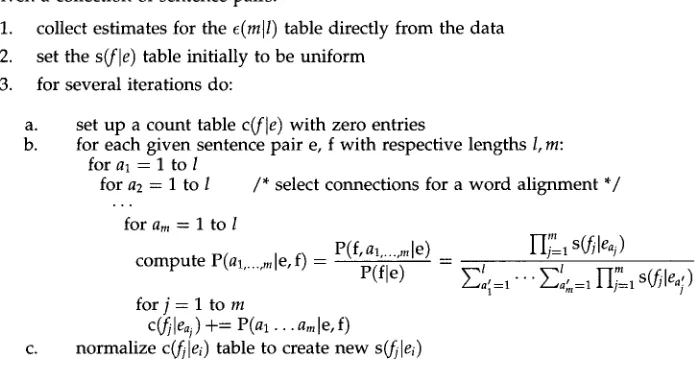
Given a collection of sentence pairs:
1. collect estimates for the ~(m]l) table directly from the data 2. set the s0e]e) table initially to be uniform
3. for several iterations do:
a . b.
C.
set up a count table c(f]e) with zero entries
for each given sentence pair e, f with respective lengths I, m: f o r a l = l t o l
f o r a2 = 1 to 1 /* select connections for a word alignment */
for am = 1 to l
compute P(al ... ]e, f) - p(f' al ... ]e) P(f]e)
for j = 1 to m
c0~l%) + = P(al... amle, f)
normalize c0~]ei ) table to create new s(fi]ei)
m
1-Ij=, s~l%)
[image:4.468.59.407.61.255.2]G'o; =, " • ~,,-=, ' I-[j=, m s~le,;)
Figure 2
Naive EM training for the Model 1 channel model.
Word-aligned data is usually n o t available, b u t large sets of u n a l i g n e d bilin- gual sentence pairs do s o m e t i m e s exist. A single sentence pair will h a v e
[m
possible a l i g n m e n t s - - f o r each French w o r d position 1 . . . m, there is a choice of I English po- sitions to connect to. A n a i v e EM i m p l e m e n t a t i o n will collect n, s, a n d d counts b y considering each alignment, b u t this is expensive. (By contrast, part-of-speech tagging involves a single alignment, leading to O(m) training). Lacking a p o l y n o m i a l refor- mulation, B r o w n et al. (1993) d e c i d e d to collect counts o n l y o v e r a subset of likely alignments. To bootstrap, they r e q u i r e d some initial idea of w h a t alignments are rea- sonable, so they b e g a n w i t h several iterations of a simpler channel m o d e l (called M o d e l 1) that has nicer c o m p u t a t i o n a l properties.In the following description of M o d e l 1, w e r e p r e s e n t an a l i g m n e n t formally as a vector al . . . am, with values
aj
r a n g i n g o v e r English w o r d positions 1 . . . I.M o d e l 1 C h a n n e l
Parameters:
c(mll )
a n d s(f[e).G i v e n a source sentence e of length I:
1. choose a target sentence length m according to
¢(mll )
2. for j = 1 to m, choose an English w o r d position
aj
according to the u n i f o r m distribution o v e r 1 . . . l3. for j = 1 to m, choose a French w o r d j~ according to s ~ ] % ) 4. read off fl ...fro as the target sentence
Because the same e m a y p r o d u c e the same f b y m e a n s of m a n y different align- ments, w e m u s t s u m over all of t h e m to obtain P(fle):
1 l 1 l m
P(fl e) = c(mll) T~ Y~al=l ~a2=l """ Y~am=l I]j=l
s(fjleai)
Knight Decoding Complexity
More efficient
O(lm)
training was devised b y B r o w n et al. (1993). Instead of pro- cessing each alignment separately, they modified the algorithm in Figure 2 as follows:b. for each given sentence pair e, f of respective lengths l, m: for j = 1 to m
sum = 0
for i = 1 to I
sum
+=s(fjlei)
for i = 1 to I
c(fjlei )
+=s(fjlei ) / sum
This w o r k s because of the algebraic trick that the p o r t i o n of P(fle) w e originally w r o t e
1 1 m e m
as ~ a l = , " "" Y~am=l
1-Ij=l S(J~[
aj)
can be rewrittenas YIj=I Y~I=I
s(fjlei)"
We next consider decoding. We seek a string e that maximizes P(elf), or equiva- lently maximizes P(e) • P(fle). A naive algorithm w o u l d evaluate all possible source strings, w h o s e lengths are potentially u n b o u n d e d . If w e limit o u r search to strings at m o s t twice the length m of o u r o b s e r v e d French, t h e n w e h a v e a
naive
O(m2v 2m)
method:G i v e n a string f of length m
1. for all source strings e of length I _ 2m:
a. c o m p u t e P(e) = b(el I b o u n d a r y ) - b ( b o u n d a r y Iet) " I-lli=2
b(eilei-1)
m
b. c o m p u t e P(fle) =
c(mll ) ~ l-[j=1 ~1i=1 s(fjlei)
c. c o m p u t e P(elf) ,-~ P(e) • P(fle)d. if P(elf ) is the best so far, r e m e m b e r it 2. p r i n t best e
We m a y n o w h o p e to find a w a y of reorganizing this c o m p u t a t i o n , using tricks like the ones above. Unfortunately, w e are unlikely to succeed, as w e n o w show. For p r o o f purposes, w e define o u r optimization p r o b l e m w i t h an associated
yes-no
decision problem:Definition: M1-OPTIMIZE
G i v e n a string f of length m a n d a set of p a r a m e t e r tables (b, e, s), r e t u r n a string e of length I < 2m that maximizes P(elf), or equivalently maximizes
1
P(e) - P(fle) = b(el I b o u n d a r y ) - b ( b o u n d a r y I el ) • 1 - [ i = 2
b(eilei-1)
• c ( m l l ) ± v i m x-,! l m l l j = l / ' i = 1 s(fjlei)
Definition: M1-DECIDE
G i v e n a string f of length m, a set of p a r a m e t e r tables (b, e, s), a n d a real n u m b e r k, does there exist a string e of length l < 2m such that P(e) • P(fle) > k?
Theorem
M1-DECIDE is NP-complete.
To show inclusion in NP, we need only nondeterministically choose e for a n y problem instance a n d verify that it has the requisite P(e) • P(fle) in O(m 2) time. Next we give separate polynomial-time reductions from two NP-complete problems. Each reduction highlights a different source of complexity.
4.1 Reduction 1 (from Hamilton Circuit Problem)
The H a m i l t o n Circuit Problem asks: given a directed g r a p h G w i t h vertices labeled 0 , . . . , n , does G have a p a t h that visits each vertex exactly once a n d returns to its starting point? We transform a n y H a m i l t o n Circuit instance into an M1-DECIDE in- stance as follows. First, w e create a French vocabulary fl . . . fn, associating w o r d fi with vertex i in the graph. We create a slightly larger English vocabulary e0 . . . en,
w i t h e0 serving as the " b o u n d a r y " w o r d for source m o d e l scoring. Ultimately, we will ask M1-DECIDE to decode the string f l . . . f n .
We create channel m o d e l tables as follows:
s~.lei) = {10 i f i = j otherwise
¢(mll) = {10 i f l = m otherwise
These tables ensure that a n y decoding e off1 ...fn will contain the n w o r d s el . . . . , en
(in some order). We n o w create a source model. For every pair (i,j) such that 0 G i,j G n:
= ~ l / n if graph G contains an edge from vertex i to vertex j
b(ej[ei)
to
otherwiseFinally, we set k to zero. To solve a H a m i l t o n Circuit Problem, we transform it as above (in quadratic time), then invoke M1-DECIDE w i t h inputs b, c, s, k, a n d f l . . . f m . If M1-DECIDE returns yes, then there m u s t be some string e w i t h both P(e) a n d P(fle) nonzero. The channel m o d e l lets us conclude that if P(f[e) is nonzero, then e contains the n words e l , . . . , en in some order. If P(e) is nonzero, then every bigram in e (including the two b o u n d a r y bigrams involving e0) has nonzero probability. Because each English w o r d in e corresponds to a unique vertex, we can use the order of w o r d s in e to produce an ordering of vertices in G. We a p p e n d vertex 0 to the beginning a n d e n d of this list to produce a H a m i l t o n Circuit. The source model construction guarantees an edge between each vertex a n d the next.
If M1-DECIDE returns no, then w e k n o w that every string e includes at least one zero value in the computation of either P(e) or P(fle). From a n y proposed H a m i l t o n Circuit--i.e., some ordering of vertices in G - - w e can construct a string e using the same ordering. This e will have P(f]e) = 1 according to the channel model. Therefore, P(e) = 0. By the source model, this can only h a p p e n if the proposed "circuit" is actually broken somewhere. So no H a m i l t o n Circuit exists.
Knight Decoding Complexity
my
b°uid~N
~ r ~ ' / ~ ~
falls
Thursday
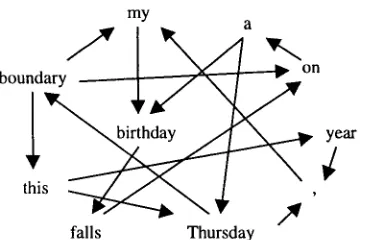
Figure 3
Selecting a good source word order is like solving the Hamilton Circuit Problem. If we assume that the channel model offers deterministic, word-for-word translations, then the bigram source model takes responsibility for ordering them. Some word pairs in the source language may be illegal. In that case, finding a legal word ordering is like finding a complete circuit in a graph. (In the graph shown above, a sample circuit is b o u n d a r y --, this ---* year ~ comma ~ m y
--* birthday --~ falls --~ on ---* a --+ T h u r s d a y ~ boundary). If word pairs have probabilities attached
to them, then word ordering resembles the finding the least-cost circuit, also known as the Traveling Salesman Problem.
Salesman Problem. It introduces edge costs dq a n d seeks a m i n i m u m - c o s t circuit. By v i e w i n g e d g e costs as log probabilities, w e can cast the Traveling Salesman P r o b l e m as one of optimizing P(e), that is, of finding the best source w o r d o r d e r in M o d e l 1 decoding.
4.2 Reduction 2 (from M i n i m u m Set Cover Problem)
The M i n i m u m Set C o v e r P r o b l e m asks: g i v e n a collection C of subsets of finite set S, a n d integer n, does C contain a cover for S of size ~ n, i.e., a subcollection w h o s e u n i o n is S? We n o w t r a n s f o r m a n y instance of M i n i m u m Set C o v e r into an instance of M1-DECIDE, using p o l y n o m i a l time. This time, w e a s s u m e a rather neutral source m o d e l in w h i c h all strings of a given length are equally likely, b u t w e construct a m o r e c o m p l e x channel.
We first create a source w o r d ei for each subset in C, a n d let gi be the size of that subset. We create a table b ( e i l e j ) with values set u n i f o r m l y to the reciprocal of the source v o c a b u l a r y size (i.e., the n u m b e r of subsets in C).
A s s u m i n g S has m elements, w e next create target w o r d s fl . . . f m c o r r e s p o n d i n g to each of those elements, a n d set u p channel m o d e l tables as follows:
if the e l e m e n t in S c o r r e s p o n d i n g to j~ is also in the subset c o r r e s p o n d i n g to ei
otherwise
¢(mll) = {10 i f l ~ n
otherwise
f l i f l > n
~(m
otherwise
[image:7.468.36.221.52.172.2]obtained
m~
however
)
ted
J . . . ~d
left left the meal
Figure 4
Selecting a concise set of source words is like solving the Minimum Set Cover Problem. A channel model with overlapping, one-to-many dictionary entries will typically license many decodings. The source model may prefer short decodings over long ones. Searching for a decoding of length _< n is difficult, resembling the problem of covering a finite set with a small collection of subsets. In the example shown above, the smallest acceptable set of source words is {and, cooked, however, left, comma, period}.
If M1-DECIDE r e t u r n s yes, t h e n s o m e d e c o d i n g e w i t h P(e) • P(f]e) > 0 m u s t exist. We k n o w that e m u s t contain n or f e w e r w o r d s - - o t h e r w i s e P(f[e) = 0 b y the c table. F u r t h e r m o r e , the s table tells us that e v e r y w o r d fj is c o v e r e d b y at least o n e English w o r d in e. T h r o u g h the one-to-one c o r r e s p o n d e n c e b e t w e e n e l e m e n t s of e a n d C, w e p r o d u c e a set c o v e r of size G n for S.
Likewise, if M 1 - D E C I D E r e t u r n s no, t h e n all d e c o d i n g s h a v e P(e) • P(f[e) = 0. Because there are no zeroes in the source table b, e v e r y e h a s P(f[e) = 0. Therefore either (1) the length of e exceeds n, or (2) s o m e f j is left t m c o v e r e d b y the w o r d s in e. Because source w o r d s c o v e r target w o r d s in exactly the s a m e fashion as e l e m e n t s of C c o v e r S, w e c o n c l u d e that there is n o set c o v e r of size < n for S. Figure 4 illustrates the intuitive c o r r e s p o n d e n c e b e t w e e n source w o r d selection a n d m i n i m u m set covering.
5. D i s c u s s i o n
The t w o p r o o f s p o i n t u p s e p a r a t e factors in M T d e c o d i n g complexity. O n e is w o r d - o r d e r selection. But e v e n if a n y w o r d o r d e r will do, there is still the p r o b l e m of p i c k i n g a concise d e c o d i n g in the face of o v e r l a p p i n g bilingual d i c t i o n a r y entries. T h e f o r m e r is m o r e closely tied to the source m o d e l , a n d the latter to the c h a n n e l m o d e l , t h o u g h the c o m p l e x i t y arises f r o m the interaction of the two.
[image:8.468.52.260.56.243.2]Knight Decoding Complexity
The proofs we presented are based on a worst-case analysis. Real s, e, and b ta- bles may have properties that permit faster optimal decoding than the artificial tables constructed above. It is also possible to devise approximation algorithms like those de- vised for other NP-complete problems. To the extent that word ordering is like solving the Traveling Salesman Problem, it is encouraging substantial progress continues to be made on Traveling Salesman algorithms. For example, it is often possible to get within two percent of the optimal tour in practice, and some researchers have demonstrated an optimal tour of over 13,000 U.S. cities. (The latter experiment relied on things like distance symmetry and the triangle inequality constraint, however, which do not hold in word ordering.) So far, statistical translation research has either opted for heuristic beam-search algorithms or different channel models. For example, some researchers avoid bag generation by preprocessing bilingual texts to remove word-order differ- ences, while others adopt channels that eliminate syntactically unlikely alignments.
Finally, expensive decoding also suggests expensive training from unannotated (monolingual) texts, which presents a challenging bottleneck for extending statistical machine translation to language pairs and domains where large bilingual corpora do not exist.
References
Brew, Chris. 1992. Letting the cat out of the bag: Generation for shake-and-bake MT. In Proceedings of the 14th International Conference on Computational Linguistics (COLING), pages 610-616, Nantes, France, August.
Brown, Peter, Stephen Della-Pietra, Vincent Della-Pietra, and Robert Mercer. 1993. The
mathematics of statistical machine translation: Parameter estimation. Computational Linguistics, 19(2):263-311. Church, Kenneth. 1988. A stochastic parts