IOT based Solar Powered Automatic Irrigation
System
Namrata Kataki1, Pranjit Das 2, Manjay Chetri 3, Nihashree Sarma4, Dipamani Pathak 5 1, 2, 3, 4, 5
Department of ECE,Girijananda Chowdhury Institute of Management and Technology (GIMT), Guwahati
Abstract: An automated irrigation system was developed to optimize the use of water for agricultural crops. Nowadays, farmers in the agriculture field are facing a lot of problems in pouring the water into their field to keep their crops healthy especially in summer season. So we are trying to tackle this problem through this project. This proposed system keeps the information about the level of moisture in the soil and keeps moisture to acceptable limits. The level of moisture can be measured using a sensor namely moisture sensor. According to the level of measured moisture, the water pump is switched ON or OFF. As sun is an unlimited source of power, solar panels are used in this project to fulfil the required need of power.
Keywords: IOT, Arduino, Thing Speak, solar panel, sensor
I. INTRODUCTION
[image:1.612.142.467.579.714.2]Agriculture uses 85% of available freshwater resources worldwide, and this percentage will continue to be dominant in water consumption because of population growth and increased food demand [1]. As our country is an agriculture-oriented country and the rate at which water resources are depleting is a dangerous threat to the mankind. Hence there is a need of efficient way of irrigation. This project is designed to develop an automatic irrigation system which controls the watering in the fields depending on moisture content of the soil. The main advantage of this project is to reduce human intervention and still ensure proper irrigation. The main aim of this project was to provide water to the plants or paddy fields automatically using microcontroller (Arduino Uno). There are many timer based devices available in the market which waters the soil on a set interval. But they do not sense the soil moisture and the ambient temperature to know if the soil actually needs watering or not [2]. The control unit of the system receives the signal of varying moisture condition of the soil through the sensing arrangement. The system has a network of soil-moisture sensor, and a humidity sensor and temperature sensor. These sensors outputs are fed to the microcontroller which will trigger the water pump whenever necessary. Moreover implementing IOT in the system allows the user to control and monitor the scenario remotely. The interconnected objects referred as Internet of Things (IoT) is continuing to evolve offering more control over our living environment and allowing more ease in doing things. Many consider this as the next big horizon in the evolution of the Internet [3]. IOT has the capability of collecting, storing, analyzing and distributing data among diverse interfaces, apps and devices. The freedom for real-time application of data and data-driven insights has become easier than ever before [4]. The status of the soil as well as the values of all the sensors will be transmitted over the internet and displayed on a web page which will help the user to globally access the values by any digital device like mobile phones. The smart sensors placed in the agriculture fields are also capable of real time notification about the moisture level in lands and can prevent wastage of water. This capability can be further used if the real time sensor data can trigger the water pump by switching it off or on depending on moisture content of the soil [5]. The system is powered by photovoltaic panels and has a wireless communication link with the control unit.
II. HARDWAREDESIGN
[image:2.612.73.546.217.662.2]The Automated Irrigation system based on soil moisture using Arduino is quite familiar in modern days. The system is comprised of Arduino UNO Board, LCD, DHT11 Sensor, pH sensor, Soil Moisture Sensor, Pump and Solar Panel. The probe of the soil Moisture Sensor will sense the moisture content of the soil and data will be sent directly to the microcontroller. The Arduino acts as the base controller of the system. The DHT11 sensor is used to measure the temperature and humidity of the root zone of the plants in dynamic (dry and wet) conditions and is connected to the Arduino board. The analog sensor readings are connected to the ADC pin of the controller, which will convert the analog signals into digital format. The microcontroller will display the values of moisture content along with the other readings from DHT11 sensor i.e. the temperature and humidity on the LCD screen. A 12V water pump is used with the control unit for automatic plant watering system. The whole system is powered through solar cell so that inefficient supply of electricity cannot be a problem in watering the crops in rural area.
Fig 2: Circuit Diagram of the system
The ESP8266 module is a low-cost Wi-Fi microchip module with full TCP/IP stack and microcontroller capability. This small
module allows microcontrollers to connect to a Wi-Fi network and make simple TCP/IP connections using Hayes-style commands.
Fig 4: Soil moisture data from ThingSpeak in excel view
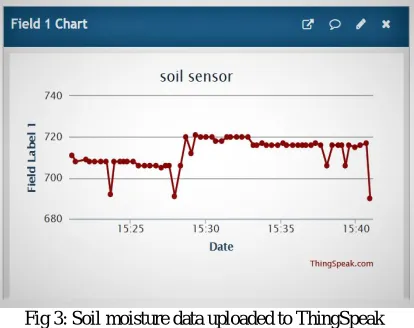
The ThingSpeak is an IOT analytics platform service that allows us to aggregate, visualize and analyse live data streams in the cloud.
The cloud holds the output data and send to the web pages created by the users. So, now the whole system can be controlled remotely with the help of internet.
III.SOFTWAREIMPLEMENTATION
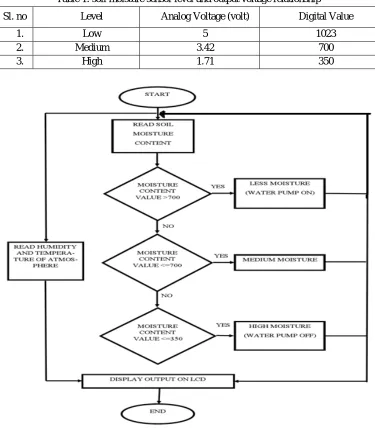
The Arduino Board is programmed using the Arduino IDE software [9]. The function of the moisture sensor is to sense the water content present in the soil i.e., the moisture level in the soil. However to classify the readings of the soil moisture sensor for different moisture level of the soil, the analog output value should be converted to digital value which will be displayed on the LCD screen.
A. Calculations For 1scale/Saturation Level
An analog to digital converter (ADC) is a very useful feature that converts an analog voltage on a pin to a digital number. Relating ADC value to voltage:
1) Less Moisture Condition a) For analog voltage measured=5V
b) ADC reading= (Resolution of the ADC × analog voltage measured)/System voltage
c) ADC reading= (1023 × 5)/5 = 1023
2) Medium Moisture Condition a) For analog voltage measured= 3.42V
b) ADC reading= (Resolution of the ADC × analog voltage measured)/System voltage
c) ADC reading= (1023 × 3.42)/5 = 700
[image:3.612.202.409.285.449.2]3) High Moisture Condition
a) For analog voltage measured= 1.71V
b) ADC reading= (Resolution of the ADC × analog voltage measured)/System voltage
[image:4.612.118.493.145.573.2]c) ADC reading= (1023 × 1.71)/5 = 350
Table 1: soil moisture sensor level and output voltage relationship
Sl. no Level Analog Voltage (volt) Digital Value
1. Low 5 1023
2. Medium 3.42 700
3. High 1.71 350
Fig 5: Flow Chart of the controller part of the system
B. Selection of Low Level
When the moisture of soil is low that is soil is dry the water pump is on and if moisture is high that is soil is wet the water pump is off [6]. The control unit is programmed in such a way that the pump will automatically turn ON if it satisfies the less moisture condition. For high moisture condition or after fulfilling the required amount of moisture in the soil the pump will turn OFF automatically.
IV.RESULTS
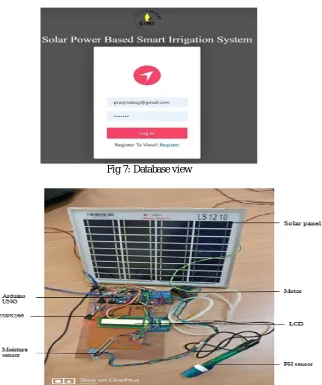
[image:5.612.167.412.167.305.2]The system was tested in the field conditions and result revealed that, system would be a best option for medium size agriculture field. Because of this automated system water wastage in the field could be reduced by 50% of normal irrigation wastage. Beside human involvement was reduced due to automation. Irrigation becomes easy, accurate and practice with the impression above shared and can be executed in agriculture fields in future to endorse agriculture to next level. The output from moisture sensor and level system plays wide role in producing the output.
[image:5.612.157.479.331.716.2]Fig 6: model of the automatic irrigation system
Fig 7: Database view
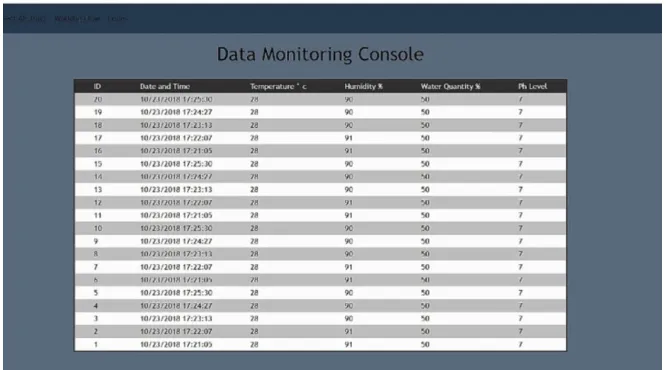
Fig 9: data monitoring console
V. CONCLUSIONS
The automated irrigation system developed was found to be feasible, sensitive and cost effective for optimizing water resources in agricultural production. This irrigation system allows cultivation in places with water scarcity and thereby improving sustainability. The use of solar power in this irrigation system is significantly important for organic crops and other agricultural products that are geographically isolated, where the investment in electric power supply would be expensive. In agriculture lands with severe shortage of rainfall, this model can be effectively applied to attain great result with most type of soil.
VI.FUTURESCOPE
The project can be extended to greenhouse to create completely automated garden and farmlands. In future, rain water harvesting can be done and this harvested water can be used to moisten fields. Hooters can be used so that it gives siren at various occasions such as interruption detection, flood etc. Using IR sensors any object passing into fields can be detected and warned.
REFERENCES
[1] W. A. Jury and H. J. Vaux, “The emerging global water crisis: Managing scarcity and conflict between water users,” Adv. Agronomy, vol. 95, pp. 1–76, Sep. 2007.
[2] J. Gutiérrez, J. F. Villa-Medina, A. Nieto-Garibay, and M. Á. Porta-Gándara, “Automated Irrigation System Using a Wireless Sensor Network and GPRS Module”, IEEE Transactions On Instrumentation And Measurement, 0018-9456 © 2013 IEEE.
[3] M. Gogoi, “Automatic Irrigation System Using INTERNET OF THINGS”, International Journal for Research in Engineering Application & Management (IJREAM) ISSN : 2454-9150 Vol-04, Issue-02, May 2018.
[4] M. Young, S. V. Devika, Sk. Khamuruddeen, Sk. Khamurunnisa, Jayanth Thota, Khalesha Shaik, “Arduino Based Automatic Plant Watering System”, International Journal of Advanced Research in Computer Science and Software Engineering , Volume 4, Issue 10,October - 2014, pp. 449- 456. [
[5] T. K Kumar, L. Jayaraman , Rajkanna “a survey to design and develop automatic irrigation system”, vol 4, issue 5, 2016.
[6] D. D. Adhikari, D. Goorahoo, D. Zoldoske, and E. Norum, “Standardized testing of soil moisture sensors used in "smart controller" irrigation systems”. Paper presented at the 4th World Congress on Computers in Agriculture and Natural Resources, July 24, 2006 - July 26, 98-103.
[7] M. N. Rajkumar, S. Abinaya and V. V. Kumar, "Intelligent irrigation system — An IOT based approach," 2017 International Conference on Innovations in Green Energy and Healthcare Technologies (IGEHT), Coimbatore, 2017, pp. 1-5.
[8] S. B. Saraf and D. H. Gawali, "IoT based smart irrigation monitoring and controlling system," 2017 2nd IEEE International Conference on Recent Trends in Electronics, Information & Communication Technology (RTEICT), Bangalore, 2017, pp. 815-819
[9] A. Kumar and S. Magesh, “Automated irrigation system based on soil moisture using arduino”, International Journal of Pure and Applied Mathematics, Volume 116, No. 21, 2017, pp 319-323.
[10] http://www.slideshare.net/stk25/ppt-for-automatic-plant-irrigation-system