Approach to Coreference Resolution
Emili Sapena
∗Universitat Polit`ecnica de Catalunya
Llu´ıs Padr ´o
∗∗Universitat Polit`ecnica de Catalunya
Jordi Turmo
†Universitat Polit`ecnica de Catalunya
This work is focused on research in machine learning for coreference resolution. Coreference resolution is a natural language processing task that consists of determining the expressions in a discourse that refer to the same entity.
The main contributions of this article are (i) a new approach to coreference resolution based on constraint satisfaction, using a hypergraph to represent the problem and solving it by relaxation labeling; and (ii) research towards improving coreference resolution performance using world knowledge extracted from Wikipedia.
The developed approach is able to use an entity-mention classification model with more expressiveness than the pair-based ones, and overcome the weaknesses of previous approaches in the state of the art such as linking contradictions, classifications without context, and lack of information evaluating pairs. Furthermore, the approach allows the incorporation of new information by adding constraints, and research has been done in order to use world knowledge to improve performances.
RelaxCor, the implementation of the approach, achieved results at the state-of-the-art level, and participated in international competitions: SemEval-2010 and CoNLL-2011. RelaxCor
achieved second place in CoNLL-2011.
1. Introduction
Coreference resolution is anatural language processing (NLP) task that consists of determining which mentions in a discourse refer to the same entity or event. A men-tion is a referring expression that has an entity or event as a referent. By referring expressionwe mean noun phrases (NP), named entities (NEs), embedded nouns, and pronouns (all but pleonastic and interrogative ones) whose meaning as a whole is a
∗TALP Research Center, Universitat Polit`ecnica de Catalunya. E-mail:[email protected]. ∗∗TALP Research Center, Universitat Polit`ecnica de Catalunya. E-mail:[email protected].
†TALP Research Center, Universitat Polit`ecnica de Catalunya. E-mail:[email protected]. Submission received: 12 March 2012; revised submission received: 14 September 2012; accepted for publication: 13 November 2012.
[[FC Barcelona]0president Joan Laporta]1has warned [Chelsea]2off [star striker Lionel
Messi]3.
Aware of [[Chelsea]2owner Roman Abramovich]4’s interest in [the young Argentine]3, [Laporta]1said last night: “[I]1will answer as always, [Messi]3is not for sale and [we]0 do not want to let [him]3go.”
Figure 1
Example of coreference resolution. All the mentions are annotated with a subscript indicating their coreference chain.Boldfacedmentions refer to the entity Lionel Messi.
reference to an entity or event in the real world, which is what we call referent. In this article, we do not deal with coreference involving events, and focus only on entity correference.
Coreference chains or entitiesare groups of referring expressions that have the same referent. Thus, a coreference chain is formed by all mentions in a discourse that refer to the same real entity. Given an arbitrary text as input, the goal of a coreference resolution system is to find all the coreference chains. A partial entity is a set of mentions considered coreferential during resolution.
Figure 1 shows the mentions of a newspaper article and their corresponding coref-erence chains. Note that the difficulty of corefcoref-erence resolution lies in the variety of necessary knowledge sources. For instance, morphological and syntactic analysis is needed to detect mentions, and semantic/world knowledge to know that Messiis a
star strikerand ayoung Argentine.
Coreference resolution is a mandatory step in order to understand natural language. In this sense, dealing with such a problem becomes important for tasks in which the higher their comprehension of the discourse, the better such systems will perform— tasks such as machine translation (Peral, Palomar, and Ferr´andez 1999), question an-swering (Morton 2000), summarization (Azzam, Humphreys, and Gaizauskas 1999), and information extraction.
One of the possible directions to follow in coreference resolution research is the incorporation of new information such as world knowledge and discourse co-herence. In some cases, this information cannot be expressed in terms of pairs of mentions—that is, it is information that involves either several mentions at once or partial entities. Furthermore, an experimental approach in this field should over-come the weaknesses of previous state-of-the-art approaches, such as linking contra-dictions, classifications without context, and a lack of information when evaluating pairs.
This article presents an approach for coreference resolution based on constraint satisfaction that represents the problem in a hypergraph and solves it by relaxation labeling. One of the main goals of developing such an approach is the incorporation of world knowledge and discourse coherence in order to improve performance while addressing the problems mentioned previously.
2. Coreference Resolution: State of the Art
In this section we summarize the main machine-learning–based approaches to corefer-ence resolution. For a wider study, we refer the reader to Mitkov (2002).
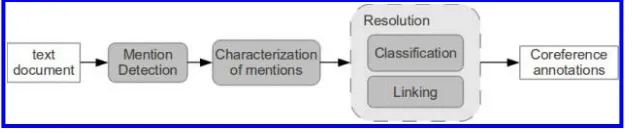
A coreference resolution system receives plain text as input, and returns the same text with coreference annotations as output. Most existing coreference resolution sys-tems can be considered instances of this general process, which consists of three main steps: mention detection, characterization of mentions, and resolution (see Figure 2).
The first step is the detection of mentions, where text processing is needed in order to find the boundaries of the mentions in the input text. Next, in the second step, the identified mentions are characterized by gathering all the available knowledge about them and their possible compatibility. Typically, machine learning systems introduce all the knowledge by means of feature functions. Finally, the resolution itself is performed in the third step. A generalization of the inner architecture of the resolution step is difficult given the diversity of approaches and algorithms used for resolution. Even so, the diverse approaches in current systems have at least two main processes in the resolution:classificationandlinking.
r
Classification.This process evaluates the compatibility of elements in order to corefer. The elements can be mentions or partial entities. A typical implementation is a binary classifier that assigns class CO (coreferential) or NC (not coreferential) to a pair of mentions. It is also very typical to use confidence values or probabilities associated with the class. Classifiers can also use rankers and constraints.r
Linking.The linking process links mentions and partial entities in order to form the final entities. This process may range from a simple heuristic, such as single-link, to an elaborate algorithm such as clustering or graph partitioning. The input of the linking process includes the output of the classification process: classes and probabilities.2.1 Classification Models
The models found in the state of the art for the classification process are: mention pairs, rankers, and entity-mention.
[image:3.486.50.366.571.638.2]Mention pairs. Classifiers based on the mention-pair model determine whether two mentions corefer or not. To do so, a feature vector is generated for a pair of mentions using a set of features. Given these features as input, the classifier returns a class: CO (coreferent), or NC (not coreferent). In many cases, the classifier also returns a confidence value about the decision taken. The class and the confidence value of each
Figure 2
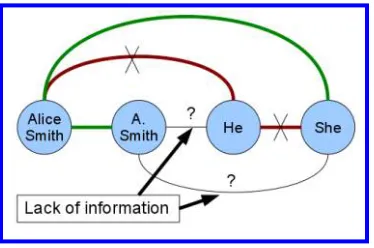
Figure 3
A pairwise classifier does not have enough information to classify pairs (A. Smith,he) and (A. Smith,she).
evaluated pair of mentions will be taken into account by the linking process to obtain the final result.
The mention-pair model has two main weaknesses: a lack of contextual infor-mation and contradictions in classifications. Figure 3 shows an example of lack of information. The figure is a representation of a document with four mentions (Alice Smith, A. Smith, he, she). The edges between mentions represent the classification in a mention-pair model; green means that the classifier returns the CO class, and red (also marked with an X) returns the NC class. In this case, the lack of information is due to the impossibility of determining the gender ofA. Smith. Next, Figure 4 shows a possible scenario with contradictions. In this scenario, the classifier has determined that the pairs (A. Smith, he) and (A. Smith, she) corefer, which causes contradictions when generating the final coreference chains given that the pairs (Alice Smith,he) and (he,she) do not corefer.
Rankers.The rankers model overcomes the lack of contextual information found using mention-pairs. Instead of directly considering whethermiandmjcorefer, more perspec-tive can be achieved by looking for the best candidate from a group of mentions to corefer with an active mention. Rankers can still fall in contradictions, however, and need to rely on the linking process to solve that.
[image:4.486.53.227.527.616.2]Entity-mention.The entity-mention model classifies a partial entity and a mention, or two partial entities, as coreferent or not. In some models, a partial entity even has its
Figure 4
own properties or features defined in the model in order to be compared with the mentions. Due to the information that a partial entity gives to the classifier, in most cases this model overcomes the lack of information and contradiction problems of the mention-based models. For example, a partial entity may include the mentionsAlice SmithandA. Smith, whose genders are “female” and “unknown” respectively. In this case, the partial entity is more likely to be linked with the subsequent mentionshethan withhe(Figures 3 and 4). The features used for entity-mention models are almost the same as those used for mention-based models. The only difference is that the value of an entity feature is determined by considering the particular values of the mentions belonging to it.
2.2 Resolution
The coreference resolution engines in the state of the art can be classified into three paradigms depending on their resolution process (i.e., combinations of classification and linking processes):
r
Backward searchapproaches classify mentions with previous ones, looking for the best antecedents. In this case, the linking step is typically an heuristic that links mention pairs classified as positive (single-link).r
Two-stepapproaches perform the resolution in two separate steps. Thefirst step is to classify all of the elements, and then the second step is a linking process using algorithms such as graph partitioning or clustering to optimize the results given the classification output.
r
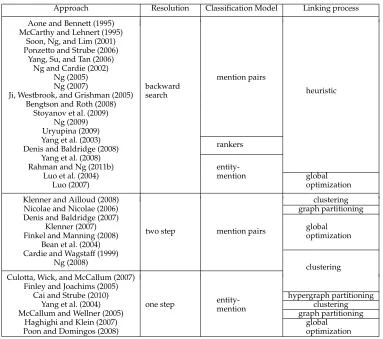
One-stepapproaches directly run the linking process while classification is performed on-line. In this manner, mention-group and entity-mention models can be easily incorporated.Figure 5 summarizes the classification of several systems in the state of the art, up to 2011. Recently, the CoNLL-2012 shared task (Pradhan et al. 2012) offered an evaluation framework similar to that of CoNLL-2011. The second column specifies which resolution step is used. The third column shows the classification model used by the system, and the fourth column identifies the algorithm followed in the linking process.
More details about supervised machine learning systems can be found in Ng (2010).
3. A Constraint-Based Hypergraph Partitioning Approach to Coreference Resolution
Approach Resolution Classification Model Linking process Aone and Bennett (1995)
backward search
mention pairs
heuristic McCarthy and Lehnert (1995)
Soon, Ng, and Lim (2001) Ponzetto and Strube (2006)
Yang, Su, and Tan (2006) Ng and Cardie (2002)
Ng (2005) Ng (2007)
Ji, Westbrook, and Grishman (2005) Bengtson and Roth (2008)
Stoyanov et al. (2009) Ng (2009) Uryupina (2009) Yang et al. (2003)
rankers Denis and Baldridge (2008)
Yang et al. (2008)
entity-mention Rahman and Ng (2011b)
Luo et al. (2004) global
optimization Luo (2007)
Klenner and Ailloud (2008)
two step mention pairs
clustering
Nicolae and Nicolae (2006) graph partitioning
Denis and Baldridge (2007)
global optimization Klenner (2007)
Finkel and Manning (2008) Bean et al. (2004) Cardie and Wagstaff (1999)
clustering Ng (2008)
Culotta, Wick, and McCallum (2007)
one step entity-mention Finley and Joachims (2005)
Cai and Strube (2010) hypergraph partitioning
Yang et al. (2004) clustering
McCallum and Wellner (2005) graph partitioning
Haghighi and Klein (2007) global
[image:6.486.48.431.60.399.2]optimization Poon and Domingos (2008)
Figure 5
A classification of coreference resolution approaches in state-of-the-art machine-learning systems.
Given these prerequisites, we define an approach based on constraint satisfaction that represents the problem in a hypergraph and solves it by relaxation labeling, re-ducing coreference resolution to a hypergraph partitioning problem with a given set of constraints. The main strengths of this system are:
r
Modeling the problem in terms ofhypergraph partitioningavoids linking contradictions and errors caused by a lack of information or context.r
Constraintsare compatible with the mention-pair and entity-mentionmodels, which let us incorporate new information. Moreover, constraints can be both automatically learned and manually written.
r
Relaxation labelingis an iterative algorithm that performs function optimization based on local information. It first determines the entities of the mentions in which it has more confidence, mainly solving the problem of lack of information for some pairs and the lack of context. The iterative resolution facilitates the use of the entity-mention model.knowledge is represented as a set of constraints, and Section 3.3 explains how attach-inginfluence rules to the constraints means that the approach incorporates the entity-mention model. Finally, Section 3.4 describes the relaxation labeling algorithm used for resolution.
3.1 Graph and Hypergraph Representations
The coreference resolution problem consists of a set of mentions that have to be mapped to a minimal collection of individual entities. By representing the problem in a hypergraph, we are reducing coreference resolution to a hypergraph partitioning problem. Each partition obtained in the resolution process is finally considered an entity.
The document mentions are represented as vertices in a hypergraph. Each of these vertices is connected by hyperedges to other vertices. Hyperedges are assigned a weight that indicates the confidence that adjacent mentions corefer. The larger the hyperedge weight in absolute terms, the more reliable the hyperedge. In the case of the mention-pair model, the problem is represented as a graph where edges connect pairs of vertices.
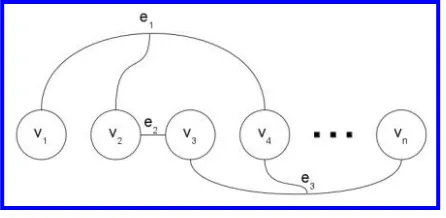
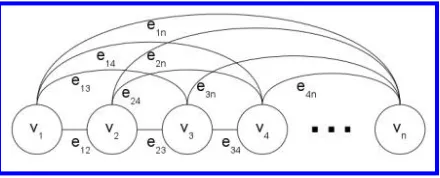
LetG=G(V,E) be an undirected hypergraph, whereVis a set of vertices andEis a set of hyperedges. Letm=(m1,. . .,mn) be the set of mentions of a document withn mentions to resolve. Each mentionmiin the document is represented as a vertexvi∈V. A hyperedgeeg∈Eis added to the hypergraph for each group (g) of vertices (v0,. . .,vN) affected by a constraint, as shown in Figure 6. The subset of hyperedges that incide on
viisE(vi).
A subset of constraintsCg ⊆Crestricts the compatibility of a group of mentions.Cg is used to compute the weight value of the hyperedgeeg. Letw(eg)∈Wbe the weight of the hyperedgeeg:
w(eg)=
k∈Cg
λk (1)
whereλkis the weight associated with constraintk. The graph representing the mention-pair model is a subcase of the hypergraph where|g|=2. Figure 7 illustrates a graph. For simplicity, in the case of the mention-pair model, an edge betweenmiandmjis called
[image:7.486.51.274.520.629.2]eij. In addition, sometimeswijis used instead ofw(eij).
Figure 6
Figure 7
Example of graph representing the mentions of a document connected by edges (mention-pair model).
DIST SEN 1(0,1)&GENDER YES(0,1)&¬FIRST(0)& MAXIMALNP(0)&MAXIMALNP(1)&
SRL ARG 0(0)&SRL ARG 0(1)& TYPE P(0)&TYPE P(1)
Figure 8
Example of a mention-pair constraint (N=2).
DIST SEN 1(0,1)&DIST SEN 1(1,2)& AGREEMENT YES(0,1,2)&ALIAS YES(0,2)& SRL ARG 0(0)&SRL ARG 0(1)&SRL ARG 0(2)& TYPE E(0)&TYPE S(1)&TYPE E(2)
Figure 9
Example of a mention-group constraint (N=3).
3.2 Constraints as Knowledge Representation
In this approach, knowledge is a set of weighted constraints where each constraint contributes a piece of information that helps to determine the coreferential relations between mentions. A constraint is a conjunction of feature-value pairs that are evaluated over all the pairs or groups of mentions in a document. When a constraint applies to a set of mentions, a corresponding hyperedge is added to the hypergraph, generating the representation of the problem explained in Section 3.1 (Figure 6).
LetNbe the order of a constraint, that is, the number of mentions expected by the constraint (|g|). Apair constrainthas orderN=2, and agroup constrainthasN>2. The mentions evaluated by a constraint are numbered from 0 toN−1 in the order they are found in the document.
Figures 8 and 9 show examples of constraints for N=2 and N=3, respectively. The constraint in Figure 8 requires that: The distance between the mentions is just one sentence, their genders match, m0 is not the first mention of its sentence, m0 is
a maximal NP (the next parent node in the syntactic tree is the sentence itself), m1
also is a maximal NP, both mentions are ARG0 in semantic role labeling, and both mentions are pronouns.1 The constraint in Figure 9 applies to three mentions and requires that: The distance between consecutive mentions is one sentence, all three mentions agree in both gender and number,m0 and m2 are aliases, all three mentions
are ARG0 in their respective sentences, and m0 and m2 are named entities and m1 is
a common NP.2 There are many examples of negativeconstraints, that is, constraints that restrict mentions from being in the same entity. For instance GENDER NO(0,1) & TYPE P(0) & TYPE P(1) expresses thatm1 and m0 are pronouns and do not match
in gender.
Each constraint has aweightthat determines the hyperedge weight of the hyper-graph (see Equation (1)). A constraint weight is a value that, in absolute terms, reflects the confidence of the constraint. Moreover, this weight is signed, and the sign indicates whether the adjacent mentions corefer (positive) or not (negative). The use of negative information is not very extensive in state-of-the-art systems, but given the hypergraph representation of the problem, where most of the mentions are interconnected, the negative weights contribute information that cannot be obtained using only positive weights. Moreover, in our experiments, the use of negative weights accelerates the convergence of the resolution algorithm. The training process that determines the weight of each constraint is explained in Section 4.3.
3.3 Entity-Mention Model Using Influence Rules
We have explained how groups of mentions satisfying a constraint are connected by hyperedges in the hypergraph. This section explains how the entity-mention model is definitively incorporated to our constraint-based hypergraph approach. The entity-mention model takes advantage of the concept of an entity during the resolution pro-cess. This means that each mention belongs to an entity during resolution, and this information can be used to make new decisions.
In order to incorporate the entity-mention model into our approach, we define the influence rule, which is attached to a constraint. Aninfluence rule expresses the conditions that the mentions must meet during resolution before the influence of the constraint takes effect.
An influence rule consists of two parts: condition and action.
r
Theconditionof an influence rule is a conjunction of coreference relations that the mentions must satisfy before the constraint has influence. This condition is specified by joining mentions into groups, where each group represents a partial entity specified by a subscript. For instance, (0, 1)A, (2)Bmeans that mentions 0 and 1 belong to entityAand mention 2 belongs to entityB(A=B).r
Theactionof an influence rule defines the desired coreference relation and determines which mentions are influenced. It is expressed in the same terms as the condition, specifying the mentions that are influenced and the entity to which they should belong. For instance, an action can be (3)B. This action indicates that mention 3 is influenced in order to belong to entityB.Figure 10 shows an example of anN=4 constraint with an influence rule attached. The constraint specifies the feature functions that the involved mentions must meet, such as semantic role arguments, sentence distances, and agreements. The influence rule then determines that when mentions 0 and 2 belong to the same entity, and mention 1
Constraint:
SRL ARG 0(0)&SRL ARG 1(1)&SRL ARG 0(2)&SRL ARG 1(3)&
DIST SEN 0(0,1)&DIST SEN 1(1,2)&DIST SEN 0(2,3)&
AGREEMENT YES(0,2)&AGREEMENT YES(1,3)
Influence rule: (0, 2)A, (1)B⇒(3)B Example:
Charlie0calledBob1.
[image:10.486.50.317.62.149.2]He2invitedhim3to the party.
Figure 10
Artificial example of an entity-mention constraint. It takes advantage of the partial entities during resolution. If mentions 0 and 2 tend to corefer, the structure indicates that mentions 1 and 3 may corefer in a different entity.
belongs to a different entity, mention 3 is influenced in order to belong to the same entity as mention 1. This figure also contains some text to help understand why this kind of constraint may be useful. A mention-pair approach could easily make the mistake of classifying mentions 2 and 3 as coreferent. This is an example of introducing information about discourse coherence using an entity-mention model.
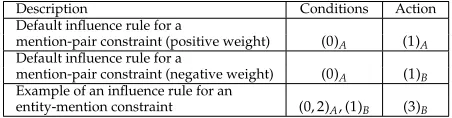
In order to retain consistency with the mention-pair model, all the constraints used in this approach are assigned a default influence rule that depends on the sign of the edge weight. In the case that the weight is positive, the last mention is influenced to belong to the same entity as the first mention, and a negative weight causes the opposite. Figure 11 shows the default influence rules for mention-pair constraints with both positive and negative weights.
Note that when influence rules are used, a hyperedge is added for each subset of constraints that applies to the same group of mentions and has the same influence rule. In the case that some constraints apply to the same group of mentions but have different influence rules, a hyperedge is added to the graph for each influence rule. Therefore, in Equation (1),Cg⊆Crefers to the constraints that apply to the group and share the same influence rule.
3.4 Relaxation Labeling
Relaxation is a generic name for a family of iterative algorithms that perform function optimization based on local information. They are closely related to neural nets and gradient steps. Relaxation labeling has been successfully used in engineering fields to solve systems of equations, in Artificial Intelligence for computer vision (Rosenfeld, Hummel, and Zucker 1976), and in many other AI problems. The algorithm has also been widely used to solve NLP problems such as part-of-speech tagging (Padr ´o 1998), chunking, knowledge integration, semantic parsing (Atserias 2006), and opinion mining (Popescu and Etzioni 2005).
Description Conditions Action
Default influence rule for a
mention-pair constraint (positive weight) (0)A (1)A
Default influence rule for a
mention-pair constraint (negative weight) (0)A (1)B
Example of an influence rule for an
entity-mention constraint (0, 2)A, (1)B (3)B
Figure 11
[image:10.486.48.274.571.630.2]Figure 12
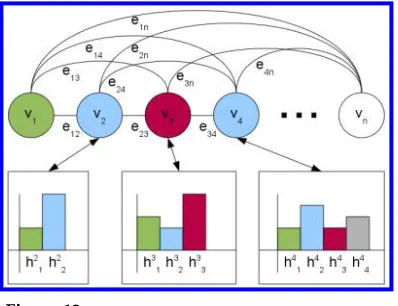
Representation of Relax solving a graph. The vertices representing mentions are connected by weighted edgeseij. Each vertex has a vectorhiof probabilities to belong to different partitions.
The figure showsh2,h3, andh4.
Relaxation labeling (Relax) solves our weighted constraint-based hypergraph par-titioning problem by dealing with (hyper)edge weights ascompatibility coefficients.3 In
this manner, each vertex is assigned to a partition satisfying as many constraints as possible. In each step, the algorithm updates the probability of each vertex belonging to a partition. This update is performed by transferring the probabilities of adjacent vertices proportional to the edge weights.
LetV={v1,v2,. . .,vn}be a set of variables. In our approach, each vertex (vi) in the
hypergraph is a variable in the algorithm. LetLibe the number of different labels that are possible forvi. The possible labels of each variable are the partitions that the vertex can be assigned. Note that the number of partitions (entities) in a document is a priori unknown, but it is at most the number of vertices (mentions) because, in an extreme case, each mention in a document could refer to a different entity. Therefore, a vertex with indexican be in the firstipartitions (i.e.,Li=i).
The aim of the algorithm is to find a weighted labeling such that global consistency is maximized. A weighted labeling is a weight assignment for each possible label of each variable:H=(h1,h2,. . .,hn), where each hi is a vector containing a weight for each possible label ofvi; that is,hi=(hi1,hi2,. . .,hiLi). As relaxation is an iterative process,
these weights (of between 0 and 1) vary in time. We denote the probability for labellof variableviat time steptashil(t), or simplyhilwhen the time step is not relevant. Note that the label assigned to a variable at the end of the process is the one with the highest weight (max(hi)). Figure 12 shows an example.
Maximizing global consistency is defined as maximizing the average support for each variable, which is defined as the weighted sum of the support received by each of its possible labels—that is,Li
l=1hil×Sil, whereSilis the support received by that pair from the context.
The support for a variable-label pair (Sil) expresses the compatibility of the as-signment of labellto variable vi compared with the labels of neighboring variables, according to the edge weights. Although several support functions may be used (Torras
1989), we chose the following (Equation (2)), which defines the support as the sum of the influences of the incident edges.
Sil=
e∈E(vi)
Inf(e) (2)
where Inf(e) is the influence of edge e. The influence of an edge is defined by its weight and theinfluence rulesattached to the constraints involved with this edge (see Section 3.3). An influence rule determines how the current probabilities for the same label of adjacent vertices (hjl) are combined.
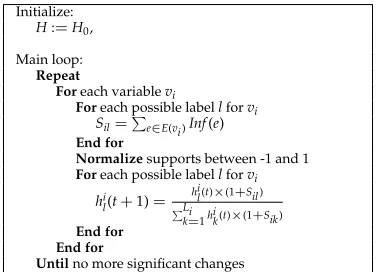
The pseudo-code for the relaxation algorithm can be found in Figure 13. It consists of the following steps:
1. Start with a random labeling, or with a better-informed initial state. 2. For each variable, compute the support that each label receives from the
current weights of adjacent variable labels following Equation 2. 3. Normalize support values between−1 and 1. Supports are divided by a
ScaleFactor. In case that after that a support is higher than 1 or−1 then its value is cutted to 1 or−1, respectively. Given that constraint weights are between 1 and−1 and a group of mentions is not generally affected by more than 10 constraints,ScaleFactoris empirically set to 8 in our experiments.
4. Update the weight of each variable label according to the support obtained by each of them (that is, increase weight for labels with high support [greater than zero], and decrease weight for those with low support [less than zero]) according to the update function:
hil(t+1)= h
i
l(t)×(1+Sil)
Li
k=1hik(t)×(1+Sik)
(3)
Initialize:
H:=H0,
Main loop: Repeat
Foreach variablevi
Foreach possible labellforvi
Sil=
e∈E(vi)Inf(e)
End for
Normalizesupports between -1 and 1 Foreach possible labellforvi
hi l(t+1)=
hil(t)×(1+Sil) Li
k=1hik(t)×(1+Sik)
End for End for
[image:12.486.48.236.493.629.2]Untilno more significant changes
Figure 13
There are many functions that can be used to calculate the support (Torras 1989). The one we chose was also used by Padr ´o (1998) and M`arquez, Padr ´o, and Rodr´ıguez (2000).
5. Iterate the process until the convergence criterion is met. The usual criterion is to wait for no more changes in an iteration, or a maximum change below some epsilon parameter (Equation (4)). But there is also a maximum number of iterations where the process is stopped. This number is a constant and does not depend on the size of the document.
max(hil(t+1)−hil(t))≤ || ∀i,l (4)
Each combination of labels for the graph vertices is a partitioning (Ω). The resolution process searches the partitioningΩ∗which optimizes the goodness functionF(Ω,W), which depends on the edge weights W. In this manner,Ω∗is optimal if:
F(Ω∗,W)≥F(Ω,W),∀Ω (5)
A partitioning Ω is directly obtained from the weighted labelingH assigning to each variable the label with maximum probability. The supports and the weighted labeling depend on the edge weights (Equation (2)). To satisfy Equation (6) is equivalent to satisfying Equation (5). Many studies have been done towards the demonstration of the consistency, convergence, and cost reduction advantages of the relaxation algorithm (Rosenfeld, Hummel, and Zucker 1976; Hummel and Zucker 1983; Pelillo 1997). For instance, Hummel and Zucker (1983) prove that maximizing average consistency (left-hand-side term of Equation (6) produces labelings satisfying Equation (5) when only binary constraints are used. Although there is no formal proof for higher order constraints, the presented algorithm (that forces a stop after a number of iterations) has proven useful for practical purposes in our case.
Li
l=1
h∗li×Sil≥ Li
l=1
hil×Sil ∀h,∀i (6)
Note that because the weight update for each label is independent of the others, the algorithm can be straightforward parallelized. In the following, there are some examples of the Relax implementation of the edge influences (Inf(e)) given the influence rules attached to the constraints.
The simplest example is when mention m0 has a direct influence over mention m1. The influence rule attached to the constraint is (0)A⇒(1)A. This is determined by Equation (7) and is the kind of influence used in the mention-pair model.
Inf(e)=w(e)×h0l (7)
The next example requires that mentionm0and mentionm1tend to corefer during
the resolution in order to influence mentionm2. The influence rule is (0, 1)A⇒(2)A.
In this case, the influence of the edge representing this influence rule is given by Equation (8). Mentionsm0 andm1 are tending to corefer (belong to the same entity:l)
when their values for labellare tending to 1 (and the other labels are tending to 0). In this case, multiplyingh0
Figure 14
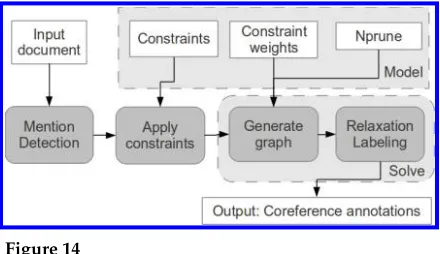
RELAXCORresolution process.
the weight of the edge. In other cases when the coreference betweenm0 andm1 is not
clear (or they are clearly not coreferent), at least one of the values of h0l and h1l is not close to 1 and the value of their product rapidly decreases, so the influence of the edge also decreases.
Inf(e)=w(e)×h0l ×h1l (8)
Following the previous example, now suppose that in order form0to influencem2
it is required thatm1does not belong to the same entity asm0. In this case,h1l is negated using its complementary value (1−h0
l), as is shown in Equation (9). The corresponding influence rule is (0)A, (1)B⇒(2)A.
Inf(e)=w(e)×h0l ×(1−h1l) (9)
The complexity of the influence rules can be increased arbitrarily and, theoretically, any number of mentions and entities can be involved. This last example (Equation (10)) shows how to represent (0, 2)A, (1)B⇒(3)B, an influence rule requiringm0 andm2 to
belong to the same entity, whilem1belongs to a different one in order to influencem3.
Inf(e)=w(e)×hl1×(1−h0l ×h2l) (10)
4. RelaxCor
RELAXCORis the coreference resolution system implemented in this work to perform experiments and test the approach explained in Section 3. This section explains the implementation and training methods, before the experiments and error analysis are presented in the following sections. RELAXCORis programmed in Perl and C++, is open
source, and is available for download from our research group’s Web site.4
The resolution process of RELAXCOR is shown in Figure 14. First, the mention detection system determines the mentions of the input document and their boundaries. The mention detection system is explained in Section 4.1. Alternatively, true mentions can be used when available, allowing this step to be skipped. Next, for each pair or group of mentions (depending on the model), the set of feature functions calculate their values, and the set of model constraints is applied. The set of feature functions used
by RELAXCORand its knowledge sources are explained in Section 4.2. A (hyper)graph is then generated using the applied constraints and their weights. Finally, relaxation labeling is executed to find the partitioning that maximizes constraint satisfaction.
The training and development processes used in this work are described in Sec-tions 4.3 and 4.4. The former explains the method for training the mention-pair model, and the latter concerns the entity-mention model.
4.1 Mention Detection
RELAXCORincludes a mention detection system that uses part-of-speech and syntactic
information. Syntactic information may be obtained from dependency parsing or con-stituent parsing. The system extracts one candidate mention for every:
r
Noun phrase (NP).r
Pronoun.r
Named Entity.r
Capitalized common noun or proper name that appear two or more times in the document. For instance, the NPan Internet businessis a mention, but alsoInternetis added in the case that the word is found once again in the document.The head of every candidate mention is then determined using part-of-speech tags and a set of rules from Collins (1999) when constituent parsing is used, or using dependency information otherwise. In case some NPs share the same head, the larger NP is selected and the rest are discarded. Also, mention repetitions with exactly the same boundaries are discarded. Note that a mention detection system in pipeline configuration with the resolution process acts as a filter and the main objective at this point is to achieve as much recall as possible.
4.2 Knowledge Sources and Features
The system gathers knowledge using a set of feature functions that interpret and evalu-ate the input information according to some criteria. Given a set of mentions numbered from 0 to N−1 following the order found in the document, each feature function evaluates their compatibility in a specific aspect. RELAXCOR includes features from
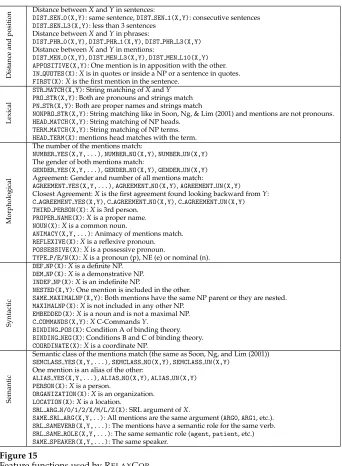
all linguistic layers: lexical, syntactic, morphological, and semantic. Moreover, some structural features of the discourse have also been used, such as distances, quotes, and sentential positions. A feature function with only one argument indicates that it offers information about only one mention. For example,REFLEXIVE(0)indicates that mention 0 is a reflexive pronoun. Figure 15 shows an exhaustive list of the features used and a brief description of each one.
Distance
and
p
osition
Distance betweenXandYin sentences:
DIST SEN 0(X,Y): same sentence,DIST SEN 1(X,Y): consecutive sentences
DIST SEN L3(X,Y): less than 3 sentences Distance betweenXandYin phrases:
DIST PHR 0(X,Y),DIST PHR 1(X,Y),DIST PHR L3(X,Y)
Distance betweenXandYin mentions:
DIST MEN 0(X,Y),DIST MEN L3(X,Y),DIST MEN L10(X,Y) APPOSITIVE(X,Y): One mention is in apposition with the other.
IN QUOTES(X):Xis in quotes or inside a NP or a sentence in quotes.
FIRST(X):Xis the first mention in the sentence.
Lexical
STR MATCH(X,Y): String matching ofXandY
PRO STR(X,Y): Both are pronouns and strings match
PN STR(X,Y): Both are proper names and strings match
NONPRO STR(X,Y): String matching like in Soon, Ng, & Lim (2001) and mentions are not pronouns.
HEAD MATCH(X,Y): String matching of NP heads.
TERM MATCH(X,Y): String matching of NP terms.
HEAD TERM(X): mentions head matches with the term.
Morphological
The number of the mentions match:
NUMBER YES(X,Y,...),NUMBER NO(X,Y),NUMBER UN(X,Y)
The gender of both mentions match:
GENDER YES(X,Y,...),GENDER NO(X,Y),GENDER UN(X,Y)
Agreement: Gender and number of all mentions match:
AGREEMENT YES(X,Y,...),AGREEMENT NO(X,Y),AGREEMENT UN(X,Y)
Closest Agreement:Xis the first agreement found looking backward fromY:
C AGREEMENT YES(X,Y),C AGREEMENT NO(X,Y),C AGREEMENT UN(X,Y) THIRD PERSON(X):Xis 3rd person.
PROPER NAME(X):Xis a proper name.
NOUN(X):Xis a common noun.
ANIMACY(X,Y,...): Animacy of mentions match.
REFLEXIVE(X):Xis a reflexive pronoun.
POSSESSIVE(X):Xis a possessive pronoun.
TYPE P/E/N(X):Xis a pronoun (p), NE (e) or nominal (n).
Syntactic
DEF NP(X):Xis a definite NP.
DEM NP(X):Xis a demonstrative NP.
INDEF NP(X):Xis an indefinite NP.
NESTED(X,Y): One mention is included in the other.
SAME MAXIMALNP(X,Y): Both mentions have the same NP parent or they are nested.
MAXIMALNP(X):Xis not included in any other NP.
EMBEDDED(X):Xis a noun and is not a maximal NP.
C COMMANDS(X,Y):XC-CommandsY.
BINDING POS(X): Condition A of binding theory.
BINDING NEG(X): Conditions B and C of binding theory.
COORDINATE(X):Xis a coordinate NP.
Semantic
Semantic class of the mentions match (the same as Soon, Ng, and Lim (2001))
SEMCLASS YES(X,Y,...),SEMCLASS NO(X,Y),SEMCLASS UN(X,Y)
One mention is an alias of the other:
ALIAS YES(X,Y,...),ALIAS NO(X,Y),ALIAS UN(X,Y) PERSON(X):Xis a person.
ORGANIZATION(X):Xis an organization.
LOCATION(X):Xis a location.
SRL ARG N/0/1/2/X/M/L/Z(X): SRL argument ofX.
SAME SRL ARG(X,Y,..): All mentions are the same argument (ARG0,ARG1, etc.).
SRL SAMEVERB(X,Y,...): The mentions have a semantic role for the same verb.
SRL SAME ROLE(X,Y,...): The same semantic role (agent,patient, etc.)
[image:16.486.50.392.58.524.2]SAME SPEAKER(X,Y,...): The same speaker.
Figure 15
Feature functions used by RELAXCOR.
4.3 Training and Development for the Mention-Pair Model
This section describes the training and development process for the implementation of RELAXCORusing the mention-pair model and the graph representation. The training process applies a machine learning algorithm over the training data to obtain a set of constraints. A weight is then assigned to each constraint, taking into account the precision of the constraint finding coreferent mentions.
Figure 16
RELAXCORtraining process.
however, given that it takes a group of linguistic experts many hours devoted to this task. An alternative option is to use constraints from other coreference resolution systems, such as the ones used in Lee et al. (2011). Our experiments are based on automatically learned constraints.
Figure 16 shows the training process. First, a data selection process unbalances the training data set and then a machine learning process obtains the constraints. The learned constraints are then applied to the training data set and their precision is evaluated. The precision of each constraint determines its weight. The develop-ment process optimizes two parameters—balanceandNprune—in order to achieve max-imum performance given a measure for the task. Figure 17 shows the development process.
4.3.1 Data Selection.Generating an example for each possible pair of mentions in the training data produces an unbalanced data set in which more than 99% of the examples are negative (not coreferent). This bias towards negative examples makes the task of the machine learning algorithms difficult. Many classifiers simply learn to classify every example as negative, which achieves an accuracy of 99% but is not at all useful. In the case of decision trees and rule induction, this imbalance is also counterproductive. In addition, some corpora have more examples than the maximum affordable by the learning algorithm, given our computational resources. In this case, it is necessary to reduce the number of examples.
In order to reduce the amount of negative examples, a data selection process similar to clustering is run using the positive examples as the centroids. We define the distance between two examples as the number of features with different values. A negative example is then discarded if the distance to all the positive examples is always greater than a threshold,D. The value ofDis empirically chosen depending on the corpora and the computational resources available.
Figure 17
[image:17.486.52.271.520.643.2]4.3.2 Learning Constraints.Constraints are automatically generated by learning a deci-sion tree and then extractingrulesfrom its leaves using C4.5 software (Quinlan 1993). The algorithm generates a set ofrulesfor each path from the learned tree, then checks whether therulescan be generalized by dropping conditions. Theserulesbecome our set of constraints. Other studies have successfully used similar processes to extract
rulesfrom a decision tree that are useful in constraint satisfaction algorithms (M`arquez, Padr ´o, and Rodr´ıguez 2000).
The weight assigned to a constraint (λk) is its precision over the training data (Pk), but shifted by abalancevalue:
λk=Pk−balance (11)
The precision here refers to the positive class, that is, the ratio between the number of positive examples and the number of examples where the constraint applies. Note that the data selection process (Section 4.3.1) discards some negative examples to learn the constraints, but the weight of the constraints is calculated with the precision of the constraint over the whole training data.
[image:18.486.48.315.410.628.2]The balanceparameter adjusts the constraint weights to improve the balance be-tween precision and recall. On the one hand, a high balancevalue causes most of the constraints to have a negative weight, with only the most precise having a positive weight. In this case, the system is precise but the recall is low, given that many rela-tions are not detected. On the other hand, a low value forbalance causes many low-precision constraints to have a positive weight, which increases recall but also decreases precision (see Figure 18). The correct value forbalanceis thus a compromise solution found in the development process, optimizing performance for a specific evaluation measure.
Figure 18
4.3.3 Pruning.As explained in Section 3.2, when a constraint applies to a set of mentions, a corresponding hyperedge is added to the hypergraph. In the case of the mention-pair model with automatically learned constraints, the most typical case is that each pair of mentions satisfy at least one constraint, which produces an edge for each pair of mentions. There are three main issues to take into account when the problem is represented by an all-connected graph:
r
The weight of an edge depends on the weights assigned to the constraints according to Equation (1). Note that the calculation of edge weights is independent of the graph adjacency. This implies that the larger the number of adjacencies, the smaller the influence of a constraint. Consequently, resolution has different results for large and small documents.r
Regarding the second issue, it is notable that some kinds of mention pairs are very weakly informative—for example, pairs such as (pronoun, pronoun). Many stories or discourses have a few main characters (entities) that monopolize the pronouns in the document. This produces many positive training examples for pairs of pronouns matching in gender and person, which may lead the algorithm to produce large coreferential chains joining all these mentions, even for stories where there are many different characters.r
Finally, the computational cost of solving an all-connected graph by relaxation labeling isO(n3). This cost is easily deduced by examining the algorithm in Figure 13. First, there is a loop for each variablevi, and the number of variables is the number of mentions:n. Inside this, there is another loop for each labellofvi, and the number of labels forviisLi=i. The cost for these two loops isO(n22). Inside the second loop, the support
is calculated. The calculation of the supportSilfor a vertexviand labell is an iteration over the incident edgesE(vi), which is equal tonin an all-connected graph. Thus, the adjacency of the vertices depends on the size of the document. Therefore, the final computation cost of the algorithm isO(n3
2 ), orO(n3) taking out the constant value.
The pruning process turns E(vi) into a constant value Nprune. For each vertex’s incidence listE(vi), only a maximum ofNpruneedges remain and the others are pruned. In particular, the process keeps theNprune/2 edges with the largest positive weight and theNprune/2 with the largest negative weight. The value ofNpruneis chosen empirically by maximizing performance over the development data. After pruning, (i) the contribu-tion of the edge weights does not depend on the size of the document; (ii) most edges of the less informative pairs are discarded, avoiding further confusion without limitation on distance or other restrictions that cause a loss of recall; and (iii) computational costs are reduced fromO(n3) toO(n2), given that the innermost loop has a constant number
of iterations (Nprune).
of possible labels. Moreover, an error in the first variables has more influence on the performance than an error in later ones. It is reasonable to expect that placing named entities at the beginning is helpful for the algorithm, given that named entities are usually the most informative mentions.
Reordering only affects the number of possible labels of the variables. The chrono-logical order of the document is taken into account by the constraints, regardless of the graph representation. Our experiments (Sapena, Padr ´o, and Turmo 2010a) confirm that placing named entity mentions first, then nominal mentions, and finally the pronouns, increases the precision considerably. Inside each of these groups, the order is the same as in the document.
4.4 Training and Development for the Entity-Mention Model
The training process for the entity-mention model is, in theory, exactly the same as for the mention-pair model, but with predefined influence rules and groups ofNmentions instead of pairs. For each combination of influence rule andN, the training process has the same steps as explained in previous sections: Learn constraints, apply them to the training data, calculate the weights, and perform the development process to find the optimal balance value. The positive examples are those that satisfy the final condition of the influence rule, and the rest are negative examples. A machine-learning process to discover group constraints has a considerable cost, however, if all the training data need to be evaluated. The number of combinations increases exponentially as the number of implied mentions increases. Moreover, the ratio of positive to negative examples is extremely low, and a data selection process like the one used for pair constraints (Section 4.3.1) has a high computational cost.
For these reasons, the group constraints of our experiments are obtained using only the examples that the mention-pair model could not solve. Thus, after training and running RELAXCOR over an annotated data set using just pair constraints, its errors are now used as examples for training the entity-mention model. The type of errors are those in which three mentions (N=3) corefer (0, 1, 2)A, but the mention-pair model has determined that just two of them corefer and discarded the third one (for example: (0, 1)A, (2)B). Each time an error like this is found, the three mentions correspond to a positive example (corefer) and all other combinations of three men-tions between menmen-tions 0 and 2 are considered negative examples. The influence rules for the constraints learned this way are (0, 1)A⇒(2)A, (0, 2)A⇒(1)A, and (1, 2)A⇒ (0)A, depending on which mention was wrongly classified by the mention-pair model.
Note that when an entity-mention model has been trained this way, the resolution system is executed using both the mention-pair and entity-mention models at the same time.
Alternatively, constraints for the entity-mention model can be added manually by writing them. Figure 19 shows an example of a manually written entity-mention constraint (i.e., a group constraint with an influence rule). This kind of constraint has great potential to take advantage of the structure of discourses. The example shows how the algorithm can benefit from knowing that nested mentions have some kind of relation. In the case that two coreferring mentions are related with two other mentions with the potential to corefer, the entity-mention model can use this information to find more coreference relations.
The Technical University of Catalonia, sometimes called UPC-Barcelona Tech, is the largest engineering university in Catalonia, Spain. The objectives of the UPC are based on internationalization, as it is[[Spain]0’s technical university with the
highest number of international PhD students]1and[[Spain]2’s university with
the highest number of international master’s degree students]3...
Constraint:PN STR(0,2)&HEAD MATCH(1,3)&NESTED(0,1)&NESTED(2,3)
[image:21.486.52.393.64.160.2]Influence rule: (0, 2)A, (1)B⇒(3)B
Figure 19
Example of a manually written group constraint using an influence rule to take advantage of the entity-mention model. The constraint expects four mentions where: two of them are proper names and match in their complete strings, the other two match in their heads, mention 0 is inside mention 1, and mention 2 is inside mention 3. The influence rule says that when mentions 0 and 2 belong to the same entity (A) but mention 1 belongs to another one (B), then mention 3 should belong to entity B in order to corefer with mention 1. (Text source: Wikipedia.
Annotations were manually done for this example.)
evaluating their precision over the training data, and thebalancevalue is determined by a development process. In our experiments, however, the number of group constraints is typically lower than the number of pairwise ones, so there is no need for pruning.
4.5 Related Work
In Section 2, we introduced an overview of many approaches, with their classification models and resolution processes (see Figure 5). Our approach can be classified simi-larly as a one-step resolution that uses the entity-mention model for classification and conducts hypergraph partitioning for the linking process. This classification matches that of the COPAsystem described in Cai and Strube (2010). Both approaches represent the problem in a hypergraph, where each mention is a vertex, and use hypergraph partitioning in order to find the entities. The differences between these two approaches are substantial, however. The most significant differences are as follows:
r
Hypergraph generation. RELAXCORadds hyperedges to the hypergraph for each group of mentions that satisfy aconstraint, whereas COPAaddsa hyperedge for each group of mentions that satisfy afeature. Note that the addition of hyperedge weights representing features cannot take advantage of the nonlinear combinations offered by constraints. Actually, in order to incorporate some nonlinearity, COPAneeds combined features to introduce information such as mention type (pronoun, proper name, etc.) or distances.
r
Resolution algorithm. RELAXCORuses relaxation labeling in order to satisfy as many constraints as possible. In fact, the hypergraph is just a representation of the problem. COPAusesrecursive 2-way partitioning, a hypergraph partitioning algorithm. COPA’s main contribution is not the resolution algorithm, but the hypergraph representation of the problem.r
Computational costs. RELAXCORneeds to train a decision tree in order touse constraints, which reduces the computational cost of the training process. On the other hand, the cost of the resolution algorithm isO(n3) for COPA whereas it isO(n2) in RELAXCORthanks to the pruning process.
5. Experiments and Results
Several experiments have been performed on coreference resolution in order to test our approach. This section includes a short explanation and result analysis of the most significant experiments. First, there is an explanation of a set of experiments to evaluate the performance of coreference resolution and mention detection. The scores are compared with the state of the art in diverse corpora, measures, and languages. Next, our participation in Semeval-2010 and CoNLL-2011 shared tasks is explained in detail with performance, comparisons, and error analysis. Finally, a set of experiments using the entity-mention model are described.
The framework used in our experiments consists of widely used corpora and mea-sures to facilitate replication and comparison. Corpora used are ACE 2002 (NIST 2003), the same portion of OntoNotes v2.0 used in Semeval-2010 (Recasens et al. 2010), and the same portion of OntoNotes v4.0 used in CoNLL Shared Task 2011 (Pradhan et al. 2011). Regarding the measures, we used MUC (Vilain et al. 1995), B3 (Bagga and Baldwin
1998), and two variants of CEAF (Luo 2005): mention-based (CEAFm) and entity-based (CEAFe).
5.1 Mention Detection
The performance of the mention detection system achieves a good recall, higher than 90%, but a low precision, as published in Sapena, Padr ´o, and Turmo (2011) and repro-duced in Table 1. The OntoNotes corpora have been used for this experiment, as they were used in CoNLL-2011. Given that the mention detection in a pipeline combination acts as a filter, recall should be kept high, as a loss of recall at the beginning would result in a loss of performance in the rest of the process. At this point, however, the precision is not a priority as long as it remains reasonable, given that the coreference resolution pro-cess is able to determine that many mentions are singletons. Moreover, the evaluation of precision on the OntoNotes corpora only take into account mentions included in a coreference chain, not singletons. The RELAXCORoutput, however, includes singletons. This means that the precision value is not really evaluating the precision of the mention detection system. A fair evaluation of mention detection should be performed in a corpus with annotations of every referring expression, but such a corpus is not available as far as we know.
[image:22.486.48.439.617.665.2]The most typical error made by the system is to include extracted NPs that are not referential (e.g., predicative and appositive phrases) and mentions with incorrect boundaries. The incorrect boundaries are mainly due to errors in the predicted syntactic
Table 1
Mention detection results on OntoNotes (Corpus: CoNLL-2011 Shared Task).
OntoNotes Recall Precision F1
Development 92.45 27.34 42.20
Table 2
Results on ACE-phase02.
bnews npaper nwire Global
Metric: CEAF CEAF B3
Model F1 F1 F1 F1 P R F1
RELAXCOR 69.5 67.3 72.1 69.7 85.3 66.8 74.9
MaxEnt+ILP (Denis 2007) – – – 66.2 81.4 65.6 72.7
Rankers (Denis 2007) 65.7 65.3 68.1 67.0 79.8 66.8 72.7
column and some mention annotation discrepancies. Furthermore, the coreference an-notation of OntoNotes used in CoNLL-2011 included verbs as anaphors of some verbal nominalizations. But verbs are not detected by our mention detection system, so most of the missing mentions are verbs. The methodology of the mention detection system is explained in Section 4.1.
5.2 State-of-the-Art Comparison
RELAXCORperformance has been compared several times with other published results from state-of-the-art systems. We claimed Sapena, Padr ´o, and Turmo (2010a) to have the best performance for the ACE-phase02 corpus, using true mentions in the input and evaluating with the CEAF andB3measures. The table comparing scores with the best results found at that moment is reproduced as Table 2.
The approach is also compared with the state of the art in two competitions: SemEval-2010 (Sapena, Padr ´o, and Turmo 2010b) and CoNLL-2011 (Sapena, Padr ´o, and Turmo 2011). RELAXCORachieved one of the best performances in SemEval-2010, but contradictory results across measures prevented the organization from determining a
Figure 20
[image:23.486.52.417.436.639.2]Table 3
Results of RELAXCORon development data (SemEval-2010).
– CEAF MUC B3
language R P F1 R P F1 R P F1
ca 69.7 69.7 69.7 27.4 77.9 40.6 67.9 96.1 79.6 es 70.8 70.8 70.8 30.3 76.2 43.4 68.9 95.0 79.8 en-closed 74.8 74.8 74.8 21.4 67.8 32.6 74.1 96.0 83.7 en-open 75.0 75.0 75.0 22.0 66.6 33.0 74.2 95.9 83.7
winner. In addition, RELAXCORachieved second position in the CoNLL-2011 Shared Task; Figure 20 reproduces the official table of results. Following sections describe the shared tasks in detail.
Finally, the performance of RELAXCORis again compared with two other state-of-the-art systems in M`arquez, Recasens, and Sapena (2012).
5.2.1 SemEval-2010.The goal of SemEval-2010 task 1 (Recasens et al. 2010) was to eval-uate and compare automatic coreference resolution systems for six different languages in four evaluation settings and using four different evaluation measures. This complex scenario aimed at providing insight into several aspects of coreference resolution, in-cluding portability across languages, relevance of linguistic information at different levels, and behavior of alternative scoring measures. The task attracted considerable attention from a number of researchers, but only six teams submitted results. Moreover, participating systems did not run their systems for all the languages and evaluation settings, thus making direct comparisons among all the involved dimensions very difficult.
RELAXCOR participated in the SemEval task for English, Catalan, and Spanish
[image:24.486.49.441.562.665.2](Sapena, Padr ´o, and Turmo 2010b). At the time, the system was not ready to detect mentions. Thus, participation was restricted to the gold-standard evaluation, which included the manual annotated information and also provided the mention boundaries. RELAXCORresults for development and test data sets are shown in Tables 3 and 4, respectively. The version of RELAXCOR used in SemEval had a balance value fixed to 0.5, which proved to be an inadequate value. Thus, the results have high precision but a very low recall. This situation produced high scores with the CEAF andB3measures, due in part to the annotated singletons. The system was penalized by measures based on pair-linkage, however, particularly MUC. Although RELAXCOR had the highest
Table 4
Results of RELAXCORon test data (SemEval-2010).
– CEAF MUC B3 BLANC
language R P F1 R P F1 R P F1 R P BLANC
Information: closed Annotation: gold
ca 70.5 70.5 70.5 29.3 77.3 42.5 68.6 95.8 79.9 56.0 81.8 59.7 es 66.6 66.6 66.6 14.8 73.8 24.7 65.3 97.5 78.2 53.4 81.8 55.6 en 75.6 75.6 75.6 21.9 72.4 33.7 74.8 97.0 84.5 57.0 83.4 61.3 Information: open Annotation: gold
precision scores (even with MUC), the recall was low enough to finally obtain low scores forF1.
Regarding the test scores of the comparison with other participants (Recasens et al. 2010), RELAXCOR obtained the best performance for Catalan (CEAF andB3), English
(closed: CEAF andB3; open:B3), and Spanish (B3). Moreover, RELAXCORwas the most
precise system under all metrics in all languages, except for CEAF in English-open and Spanish. This confirms the robustness of the results of RELAXCOR, but also highlights the necessity of searching for a balance value other than 0.5 to increase the recall of the system without losing much by way of precision. Indeed, the idea of using development (Section 4.3) to adapt the balance value occurred after these results were obtained.
The incorporation of WordNet to the English run of RELAXCOR was the only difference between our implementation in the English-open and English-closed tasks. The scores were slightly higher when using WordNet, but not significantly so (75.8% vs. 75.6% for CEAF and 34.2% vs. 33.7% for MUC). Analyzing the MUC scores, note that the recall improves (from 21.9% to 22.6%), while the precision decreases a little (from 74.4% to 70.5%), which corresponds to the information and noise that WordNet typically provides.
More recent results of RELAXCORon the same corpora are published in M`arquez, Recasens, and Sapena (2012).
5.2.2 CoNLL-2011.The CoNLL-2011 Shared Task was based on the English portion of the OntoNotes 4.0 data5(Pradhan et al. 2011). As is customary for CoNLL tasks, there
was aclosedand anopentrack. For the closed track, systems were limited to using the distributed resources, in order to allow a fair comparison of algorithm performance, whereas the open track allowed for almost unrestricted use of external resources in addition to the provided data. About 65 different groups demonstrated interest in the shared task by registering on the task Web page. Of these, 23 groups submitted system outputs on the test set during the evaluation week. Eighteen groups submitted only closed track results, three groups only open track results, and two groups submitted both closed and open track results.
RELAXCORparticipated in the closed track CoNLL task (Sapena, Padr ´o, and Turmo 2011). All the knowledge required by the feature functions was obtained from the annotations of the corpus, and no external resources were used with the exception of WordNet, gender and number information, and sense inventories. All of these were allowed by the task organization and are available on their Web site.
The results obtained by RELAXCOR can be found in Tables 5 and 6. Due to the
lack of annotated singletons, mention-based metricsB3and CEAF produce lower scores
(near 60% and 50%, respectively) than typically achieved with different annotations and mapping policies (usually near 80% and 70%). Moreover, the requirement that systems use automatic preprocessing and do their own mention detection increases the difficulty of the task, which obviously decreases the scores in general. The official ranking score was the arithmetic mean of the F-scores of MUC,B3, and CEAFe.
The MUC measure is link-based and does not take singletons into account, anyway. Thus, it is the only one comparable with the state of the art at this point. The results obtained with the MUC scorer show an improvement in RELAXCOR’s recall, a feature that needed improvement given the remarkably low SemEval-2010 results with MUC. Note that these improvements in MUC scores, specially in recall, are mainly due to
Table 5
RELAXCORresults on the development data set (CoNLL-2011).
Measure Recall Precision F1
Mention detection 92.45 27.34 42.20 mention-based CEAF 55.27 55.27 55.27 entity-based CEAF 47.20 40.01 43.31
MUC 54.53 62.25 58.13
B3 63.72 73.83 68.40
[image:26.486.49.433.242.340.2](CEAFe+MUC+B3)/3 – – 56.61
Table 6
RELAXCORofficial test results (CoNLL-2011).
Measure Recall Precision F1
Mention detection 92.39 28.19 43.20 mention-based CEAF 53.51 53.51 53.51 entity-based CEAF 44.75 38.38 41.32
MUC 56.32 63.16 59.55
B3 62.16 72.08 67.09
BLANC 69.50 73.07 71.10
(CEAFe+MUC+B3)/3 – – 55.99
the introduction of the balance value in the development process but also to many other refinements done in the whole process such as new feature functions and bug fixing.
RELAXCORachieved second position in the official closed track results, as shown in Figure 20. The final column shows the official ranking score. The difference from the system in first place is 1.8 points, which is statistically significant, whereas the difference to third position is just 0.03 points and is not significant. The winning system—Stanford (Lee et al. 2011)—does not use machine learning but combines many heuristics to join mentions and partial entities, starting with the most precise ones. It is thought that the difference between RELAXCOR and Stanford’s system is mainly due to their use of sophisticated handwritten heuristics instead of our auto-matically learned constraints. Note that Lee et al. (2011) solve coreferences by applying first the most precise constraints. RELAXCOR also solves first the most precise con-straints given that these ones have the highest weights and are the most influencing ones.
5.3 Languages
Table 7
Comparison of RELAXCORresults using just the mention-pair model (N=2) with those also using the entity-mention model (N=3) (Corpus: SemEval-2010).
Measure Precision Recall F1
N
=
2 CEAFm 81.73 81.73 81.73
MUC 72.92 54.17 62.17
B3 91.87 82.87 87.14
CEAFe 81.95 90.47 86.00
N
=
3 CEAFm 82.02 82.02 82.02
MUC 73.01 54.28 62.27
B3 91.59 83.12 87.15
CEAFe 82.10 90.63 86.15
5.4 Experiments with the Entity-Mention Model
Constraints for the entity-mention model are automatically obtained using the training data examples that the mention-pair model could not solve, with predefined influence rules and limited toN=3. The training process is explained in Section 4.4. Experiments with the entity-mention model are conducted using both models at the same time. The goal of the experiments is to improve the performance of the mention-pair model itself. Table 7 shows the experimental results using the SemEval-2010 English corpus. The table compares the entity-mention results (RELAXCOR using N=3 constraints with influence rules, including the whole set ofN=2 constraints) with those using mention-pairs (RELAXCORusing justN=2 constraints). The entity-mention model outperforms the mention-pair model. The number of really useful examples (i.e., mentions wrongly classified by the mention-pair model but correctly classified by the entity-mention model), however, is low. Consequently, the difference in their scores is not significant. TheN=3 constraints have a good precision and also an acceptable recall, although most of the mentions affected by these constraints were already affected and correctly solved by the mention-pair model. Further research is needed in order to find more useful constraints, either by writing more elaborate group constraints or finding a better system that automatically finds them.
These results may be somewhat justified, because the entity-mention model uses the same feature functions and, consequently, the same information as the mention-pair model. In fact, only the new information is that information already included in the conditions of the influence rules, which take into account the entities assigned to each mention during resolution. In addition, group constraints can also include, in an implicit way, information about the structure of the discourse. It seems clear, however, that this new information is either minimal or not relevant enough. Figure 21 shows an example of a learned entity-mention constraint.
Constraint: GENDER NO (0,1) = 0 & STR MATCH(0,1) = 0 & ORGANIZA-TION(0)= 0 &POSSESSIVE(1)&NUMBER NO(1,2)= 0 &NUMBER UN(1,2)
= 0 &DIST SEN L3(0,1)&DIST SEN L3(0,2)
Influence rule: (0, 2)A⇒(1)A
Figure 21