Structured Parallel Programs on
x86-64
Multicores
Kevin Hammond, Christopher Brown, and Susmit Sarkar
School of Computer Science, University of St Andrews, Scotland, UK.
{kevin.hammond,susmit.sarkar,cmb21}@st-andrews.ac.uk
Abstract. This paper determines correctness and timing properties for
structured parallel programs on x86-64 multicores. Multicore architec-tures are increasingly common, but real architecarchitec-tures have unpredictable timing properties, and commonly used relaxed-memory concurrency mod-els mean that even functional correctness is not obvious. This paper takes a rigorous approach to correctness and timing properties, examining com-mon locking protocols from first principles, and extending this through queues to structured parallel constructs. We prove functional correctness and derive simple timing models, extending these for the first time from low-level machine operations to high-level parallel patterns. Our derived high-level timing models for structured parallel programs allow us to
accurately predict upper bounds on program execution times onx86-64
multicores.
Keywords: Multicore, relaxed-memory concurrency, functional correct-ness, algorithmic skeletons, operational semantics, timing models.
1
Introduction
Multicore architectures are increasingly common, providing excellent trade-offs between performance and energy consumption. However, the actual execution behaviour of parallel programs on real multicores is still often difficult to under-stand. Arguing about the correctness of parallel programs is non-trivial in the presence of real-world relaxed-memory consistency models. Moreover, predicting the execution time of parallel programs is hard. Both issues derive from the same problem: there is no well-understood correspondence between the high-level par-allel primitives that programmers use and the low-level implementations of those primitives that are actually executed. We address this problem by directly con-sidering correctness and timing properties from basic machine-level operations all the way to high-level parallelism structures.
i n t x = 0 , y = 0 ; extern i n t x, y;
. . . .
{ // thread 1 { // thread 2
x = 1 ; y = 2 ;
return y; return x;
[image:2.595.131.486.118.191.2]} }
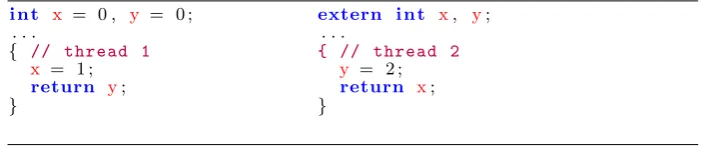
Fig. 1. Under the x86-TSO relaxed-memory consistency model, both threads could return 0. This is not possible under SC.
The main advantages to us are:
1. The programmer can think in terms of patterns of parallelism, rather than e.g. low-level memory operations;
2. Certain complex parallel conditions, such as race conditions and deadlocks, are eliminatedby design, so dramatically simplifying design, implementation and testing of parallel programs; and
3. Simple, but effective, performance models are possible.
This paper exploits these advantages to produce strong and principled cost mod-els for two fundamental parallel programming structures:task farmsandparallel pipelines. Danelutto et al. [3] have shown that many common parallelism pat-terns can be expressed in terms of these two primitives. Our work thus extends straightforwardly to many other high-level patterns of parallelism.
Memory Consistency. Standard correctness proofs of parallel programs usu-ally assume memory accesses to be interleaved, so-calledSequential Consistency
(SC) [4]. However,x86-64 multicores, and many other recent architectures (e.g. ARM and IBM Power), do not comply with this assumption, making such rea-soning invalid. Consider, for example, the program fragment in Figure1. Under theTotal Store Order relaxed-memory consistency model that is used byx86-64
multicores (x86-TSO), both threads could return 0, a result that is impossible using the simpler SC model.
Novel Contributions. While there has been significant previous work on algo-rithmic skeletons, this paper represents the first attempt, of which we are aware, to establish cost models from first principles for widely-used multicore hardware. In addition, this paper makes the following specific novel contributions:
1. It describes an operational semantics for structured parallel programs, that is used to derive, from first principles, a compositional cost model for any combination of the farm and pipeline algorithmic skeletons;
t8
…
…
…
f
t9 t10 t11 t12
f t4 f t5 f t6
g (f t1) g (f t2)
f t3 f t7
g (f t0)
[image:3.595.133.474.130.267.2]g
Fig. 2.Two-Stage Parallel Pipeline:f |g
free from deadlock, both singly and in any combination, when implemented by queues using that locking protocol; and
3. It validates the cost model against some example parallel programs, giving accurate predictions of lower-bound speedups; our predictions are typically within 7% and in all cases within 30% of the actual speedup.
A key aspect of our approach is that we model the actual relaxed-memory model used by realx86-64 multicore systems, exploiting recent work on thex86-TSO
model [5,6], which gives a precise account of the observable behaviour ofx86-64
multiprocessors in terms of an idealised abstract machine. We are thus able, for the first time, to provide realistic cost models for programs that are executed in parallel on such architectures. The spin-lock protocol that we use has been shown to be the most efficient protocol for implementing simple locks onx86-64
architectures [5]. It is widely used to implement real parallel programs. Our cor-rectness proof is the first direct operational proof that this protocol is correctly implemented by the underlying hardware through its relaxed-memory access pro-tocol. Finally, the queue protocol shown here has many uses beyond algorithmic skeletons, and is representative of many widely-used higher-level synchronisation protocols. The correctness proof shown here is likewise the first proof that such a protocol is correctly implemented by the underlying multicore hardware.
2
Pipeline and Farm Skeletons
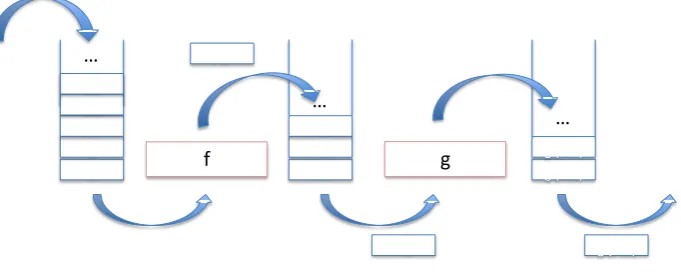
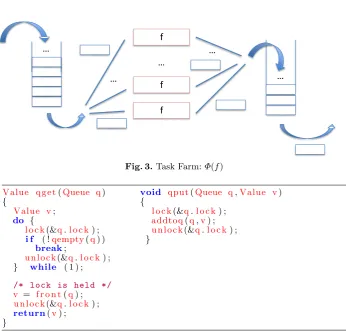
In this paper, we consider two fundamental skeletons: 2-stagepipelines(Figure2) andtask farms(Figure3). We use a streaming implementation that links skele-tons using (unbounded) queues. This allows skeleskele-tons to be easily composed, and also allows arbitrarily nested parallel structures to be built from the basic skeletons. Parallel pipelines (f |g) represent the composition of two operations
t8
…
… f
t9 t10 t11 t12
f t0 f t4
f t1
f
f …
f t2
…
…
f t3
f t6 t5
[image:4.595.133.480.106.437.2]t7
Fig. 3.Task Farm:Φ(f)
Value q g e t(Queue q) void qput(Queue q,Value v)
{ {
Value v; l o c k(&q.l o c k) ;
do { addtoq(q,v) ;
l o c k(&q.l o c k) ; u n l o c k(&q.l o c k) ;
i f ( !qempty(q) ) }
break;
u n l o c k(&q.l o c k) ;
} while ( 1 ) ;
/* lock is held */ v = f r o n t(q) ; u n l o c k(&q.l o c k) ;
return(v) ;
}
Fig. 4.Simple queue implementation in C.
Multi-stage pipelines can be built by composing multiple two-stage pipelines and then merging the input/output queues.Task farms (Φ(f)) apply the same op-erationf to each of the inputs in a stream. A fixed number of worker instances is created, which each applyf in parallel to a subset of the inputs. The result of applying a farm to a stream of inputs t0, t1, . . . is then thebag {f t0, f t1, . . .}, where the results may be produced in an arbitrary order. Thisnon-deterministic
2.1 Simple Queue Implementation using Locks
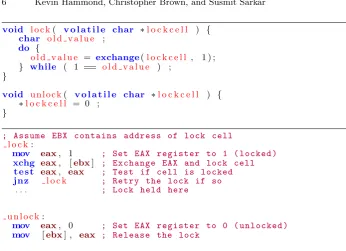
The pipeline and farm skeletons use queues to manage the input/output streams. Figure 4shows how queues can be implemented using lockand unlock primi-tives, plus operations to remove the first element from the queue (front), add a new element to the queue (addtoq), and check whether the queue is empty (qempty). Queues are implemented using the abstract type Queue, containing values of type Value. The qget operation returns the first element from the queue, spinning if the queue is empty. This implements a blocking read opera-tion. The corresponding qput operation adds a value to the end of the queue, locking and unlocking as necessary. When used as a pair,qget/qputimplement a synchronisation operation between two parallel threads. Figure5gives a spin-lock implementation of lock/unlock in C andx86-64 assembler, assuming an atomic exchange primitive,exchange. Spin-locks are widely used in parallel sys-tems where there are low contention rates, since they are simple to implement and the costs of acquiring and releasing the locks are very low. In fact, until recently, the Linux kernel used almost identical code. For fairness reasons, it now uses a slightly modified version (ticketed spin-locks). Here, lockcellis a variable that contains the lock. If it has the value 1, then the lock has been acquired by some thread; if it has the value0, then no thread has acquired the lock. Acquiring the lock using the lock routine involves reading the value of lockcell, and exchanging it with the locked value, 1. If the lock has already been acquired by another thread, the process is repeated until the lock can be acquired (i.e. the previous value of lockcell was0). Releasing the lock using theunlockroutine simply involves settinglockcellto0. Note that the unlock need not be an atomic memory operation.
3
Key Hardware Characteristics
In what follows, we will consider memory accesses to be classified intoReads from and Writes to specific memory locations, plus Fences and atomic Exchanges. Intel’s x86-64 instruction set also provides some refined versions of these ba-sic operations [7]. Sequential consistency (SC) memory models [4] ensure that memory accesses from multiple threads are carried out in an order that is con-sistent with some valid set of memory accesses by a fully sequential processor. That is, memory accesses from different threads are interleaved so that there is effectively a single thread of memory accesses. Recall the simple example from Figure1. Here, depending on the exact timing ofReadsandWrites onx andy, thread 1 could return either 1 or 0 and thread 2 could return either 2 or 0. It is not possible for both threads to return 0, however, since one of the twoWrites
void l o c k( v o l a t i l e char ∗l o c k c e l l ) {
char o l d v a l u e ;
do {
o l d v a l u e = exchange(l o c k c e l l , 1 ) ;
} while ( 1 == o l d v a l u e ) ;
}
void u n l o c k( v o l a t i l e char ∗l o c k c e l l ) { ∗l o c k c e l l = 0 ;
}
; Assume EBX contains address of lock cell l o c k:
mov eax, 1 ; Set EAX register to 1 ( locked )
xchg eax, [ebx] ; Exchange EAX and lock cell
t e s t eax, eax ; Test if cell is locked
jnz l o c k ; Retry the lock if so
. . . ; Lock held here
u n l o c k:
mov eax, 0 ; Set EAX register to 0 ( unlocked )
[image:6.595.133.480.96.347.2]mov [ebx] , eax ; Release the lock
Fig. 5.Above, simple spin-lock implementation in pseudo-C using an atomicexchange operation on the lockcell memory location; 1 indicates the lock is acquired; 0 is used to release the lock. Below, correspondingx86-64 instructions (ignoring function prelude/postlude). Thexchginstruction in lockacquires the lock, which is released in in unlock using a normal memory write. Note that onx86-64, a xchg implicitly behaves as a full memory barrier.
consistency models that offer higher performance. Modern x86-64-class micro-processors use Total Store Ordering (x86-TSO) [6,5].x86-TSO guarantees that the order in which Write instructions for a given processor appear in (shared) memory is identical to the sequence in which the processor issued the Writes.
x86-TSO can be implemented by providing each hardware thread of execution with a private FIFO write-buffer. This is an abstract machine implementation: a more realistic hardware implementation is discussed further below.Writesare stored temporarily in this buffer prior to being actioned by the main memory.
Reads from the local processor (only) can access this write buffer, if necessary, as an intermediate step between reading from the private and shared caches.
Writesrecorded in the write buffer will be used in preference to any correspond-ing values in the shared cache. After an unpredictable, but finite, time, each
This provides strong local temporal guarantees: all local accesses that appeared in the instruction stream prior to a Fence/Exchange will be executed before
any accesses that appeared after the Fence/Exchange. It also provides strong global memory guarantees: all memory locations (and any cached copies) will be consistent with the memory state immediately following theFence/Exchange.
Definition 1. Thread. A Thread is an ordered sequence of memory accesses,
where memory accesses comprise Reads,Writes,Fencesand Exchanges to spe-cific memory locations. ARead takes a memory location and returns a value. A
Write takes a memory location and a value and has no result. A Fence has no parameters or result. An Exchange is treated as a simultaneous and indivisible
Read,Writeand Fence. It takes a memory location and a value and returns a (possibly different) value.
Definition 2. Write buffer. AWrite bufferis associated with each thread, and
contains an ordered sequence of Writes, each associating a value with an ad-dress. Each Writeis recorded in the corresponding write buffer immediately it is executed by any Thread.
Definition 3. Memory. AMemory maps addresses to values.
Definition 4. Core. ACorecomprises a set of Threads.
Definition 5. Multicore. A Multicore comprises a set of Cores plus a single
shared Memory1.
Definition 6. Execution Order. The execution order is a linear trace of
tran-sitions made by the labelled transition system called the x86-TSO machine [6].
Hardware Correspondence The abstract model above talks about “threads”
of execution. In current multiprocessor implementations, these are grouped to-gether in various ways, each of which has varying implications for scheduling and timing. Firstly, user-level threads are mapped by the runtime system to
hardware-level threads. In this paper, we ignore this scheduling cost. That is, we consider only a non-preemptive model with no explicit thread yields to other threads or the runtime system. Taking such yields into account would introduce interference with other processes and threads running on the system. The model above speaks of such hardware threads when mentioning a thread of execution. Secondly, each hardware thread is mapped to specific hardware resources on a core. The mapping may be one-to-one, or many-to-one (hyperthreading, also known assimultaneous multi-threading). Each hyperthread generally has exclu-sive use of registers and a load-store reordering buffer. The load-store reordering buffer maintains metadata to ensure observable FIFO buffering for the stores, and also to ensure that loads appear ordered to the programmer, even though
1
aggressive implementations can and do perform out-of-order operations, e.g. sat-isfaction of read requests. Third, a set of cores (typically 2 to 4) are collected in one CPU. Typically, the first levels of cache (L1 and L2 on the Intel Core-i7) are private to the core, while higher levels (L3 on the Intel Core-i7) are shared between all the cores on one CPU. Finally, multiple CPUs may be connected in one system, all sharing a common memory. The caches communicate with each other and with memory to maintain “cache coherence”, that is, a clear notion of order of update operations (stores) to a location. This is generally managed at the cache-line granularity (64 on the Intel Core-i7). To be clear, the functional model above speaks of store buffers. These are implemented by so-called Memory Ordering Buffers (MOBs), which internally do out-of-order actions. The flushing of buffers then corresponds to the point when non-local threads (on the same core or otherwise) can see those stores. Further buffering occurs between various levels of the cache. However, in all cases the cache maintains a coherent view, so that if the store is visible to at least one hardware thread other than the one executing the store, then it is visible to all of them.
x86-64 Cache Protocol. Both the Intel and AMD implementations of thex86
cache protocol are variations of the classic MESI protocol [8]. Conceptually, there can be four states for each location in a cache (managed on a cache-line granularity): Modified (this cache holds an exclusive copy and memory has a stale copy), Exclusive (this cache holds an exclusive copy, the memory copy is also valid),Shared (this cache holds a copy, but other caches possibly hold copies as well), and Invalid (this cache does not hold a current copy for this location). While the cache behaviour does not directly impact the functional correctness proof, it does have implications for the cost models we develop.
4
Correctness and Progress Properties
This section considers the functional correctness of the spin-lock, queue and pipeline/task farm implementations described above, working from first princi-ples in terms of the basicx86-64 memory operations and x86-TSO consistency model. We first consider a key ordering relation, coherence order, then sketch soundness proofs for the spin-lock and queue implementations, and finally build on these to sketch soundness proofs for the skeleton implementations.
4.1 Coherence Order
A derived relation called coherence order naturally emerges from thex86-TSO
memory consistency model described above. Coherence order is a total, linear ordering of Writes to a given memory location, organised in the order that the
Definition 7. Coherence Order. Given a set of write buffers, WBi containing
tuplesht, m, vi, wheretis the time that the Writeis flushed from WBi,mis the
memory location, and v is the new value to be written to that location, then the
coherence order for some memory locationmis defined to be the sequence
CO(m)linear order over {htj, m, vji | htj, m, vji ∈ n
[
i=1
WBi}
s.t. ∀j, k.htj, mj, vji<CO(m)htk, mk, vki=⇒tk > tj.
Note that under this definition, it is not possible for two Writes to the same memory location to occur at the same time.Writesto different memory locations may, however, occur at the same time. This is consistent with the restrictions of physical memory. It is easy to show from this definition that noThread can read values out of coherence order.
Lemma 1. Read Coherence Order. No Thread can read values out of coherence
order.
Proof Sketch: Suppose that twoReads r1andr2 in the sameThread,T, from
the same memory location, m, occur in order, but that they return different values. Let us call the corresponding Writes w1 and w2 (w1 6= w2). We do a case analysis depending on whetherw2 is read byr2 from the local write buffer or from memory. Suppose that w2 is in the write buffer. Then w2 cannot have been the last write in the write buffer at the time of the read r1, and thus w2 must be flushed at some later time, and definitely later thanw1. Suppose that, instead, w2 is taken from memory. Then the local write buffer must be empty for that location. Now, eitherr1readw1from the write buffer, and thereforew1 must have been flushed (beforew2), or it read it from memory, and againw2 is
in Coherence order beforew1. ut
4.2 Functional Correctness of the Spin-Lock Implementation
The spin-lock implementation needs to enforce two key properties: i) that at most one thread at a time possesses the lock; and ii) that all Writes that are made while the lock is held are always visible to any subsequent thread that acquires the lock. We show this by using the memory properties defined in the previous section, together with the code for the spin-lock implementation oflock andunlockthat was given in Figure5.
Lock acquisition and release. We assume that the only Reads/Writes to
Theorem 1. Lock acquisition and release. Under the assumptions of the previ-ous paragraph,
– following a call to lock, the calling Thread will possess the lock, and no other Thread will possess the lock; and
– following a call tounlock, the calling Threadwill no longer possess the lock until it has successfully calledlockagain.
Proof Sketch: Both of the above parts can be proved simultaneously by
induc-tion on the lock and unlock calls in an execution trace, and by case analysis of the write buffer state at every lock. The key operation is thelock function, which is called when acquiring the lock. We return from this function exactly when the internal loop exits, that is whenold value is not1. This means that old value is 0, or in other words, that lockcell held 0 in the final iteration of the loop and is now1. Since the only way to updatelockcellwith a locked (1) value is via an Exchange, this will always appear directly in memory, and never stay in the write buffer. In contrast, an unlocked (0) value can stay in the buffers, since this is done by a simple Write. Since only the Thread that has successfully acquired the lock ever calls the unlock function, and since it does this precisely once for each lock acquisition, there will only ever be at most one unlock value (0) for lockcell in any of the write buffers. There are now two cases to consider.
Case 1: Consider first the case when no write buffer contains an unlock value. If lockcell holds 1, then the lock is already held. No lock acquisition can succeed until lockcell becomes 0. Conversely, if lockcell holds 0, the lock is free. Any isolated lock acquisition will successfully acquire the lock, but because of the atomic nature of theExchange, if there are multiple simultaneous acquisition attempts then only one of these can succeed. Furthermore, because of coherence on lockcell, no subset of threads can disagree on which lock acquisition succeeded.
Case 2:The second case occurs when someThread T’s write buffer contains an unlock value. It follows that lockcell must still be locked, and therefore noThread can acquire the lock. However, thread T has released the lock. Now either the unlock value must eventually flush by itself, and we will then be in Case 1 above, or T can attempt to re-acquire the lock, in which case the first action of theExchange will be to flush the write buffer. ut
Synchronisation. We now turn to the second key property, that the lock acqui-sition and release operations collectively provide synchronisation. More precisely, following the acquisition of a lock, a thread should have an identical view of the shared memory to that of the unlocking thread at the immediately preceding lock release. This is not an immediate result, since the two threads may be dif-ferent, and the view of the shared memory is mediated by the write buffers of the cores that are involved.
Theorem 2. Synchronisation. Assuming shared-memory accesses are only
per-formed by threads holding a lock, all Writesmade by aThreadbetween a success-ful call tolock and the following call to unlock are visible to the next Thread
that acquires the lock.
Proof Sketch: We observe that each write buffer is emptied in a FIFO
man-ner, and that each Thread has its own write buffer.Writes to shared memory locations within the critical section controlled by the lock are initially buffered in the write buffer for theThreadthat acquired the lock. The lock release is itself aWrite, that is placed in the bufferafter all theseWrites. We proved above that a new lock is only acquired when the unlockingWrite is flushed from the buffer. Since the write buffer is FIFO, this implies that all the precedingWrites in the critical section must have already been flushed to theMemory. Now turning to the lock acquisition, since a lock acquisition involves an Exchange, which com-pletely flushes aThread’s write buffer, anyRead to the shared locations (in case of multiple accesses to one location, the first such) by the acquiringThread must read its value from memory. It follows that synchronisation is obtained. ut
4.3 Progress of the Spin-Lock Implementation
4.4 Functional Correctness of the Queue Implementation
Recall that the pseudo-code for the queue implementation was shown in Figure4. We will assume that the queue is only touched by the qgetandqputfunctions that are defined here, and the underlying lock location is not directly accessed by other code. We first verify that the queue implementation validates the as-sumptions made in the proof of the spin-lock implementation. First, since the only code that affectslockcellare the calls to thelockandunlockfunctions, it is easy to see no other code toucheslockcell. Furthermore, on every control flow path, theunlockfunction is only called after having acquired the lock, it is not called more than once, and it is definitely called before eitherqgetor qput returns. Moreover, any access to the queue and its fields occurs in program-order between a lock and anunlock from the same thread. Now we argue that the queue properties are ensured by the operations. There are three key properties:
1. The qget operation returns with a value that was previously placed in the queue.
2. A value that is placed once in the queue is never removed twice. 3. FIFOorder is maintained for the queue.
For 1), the loop in theqgetfunction can only be exited by thebreakstatement. This means that when the loop exits, we know that the queue is non-empty, and furthermore, that the Thread that called qget holds the lock. Thus no other thread can remove elements from the queue, and it follows that thefront operation will be able to find and remove at least one value. For 2), since the frontoperation completes before the lock is released, a value cannot be removed more than once. For 3), since only one thread can execute eitherqget or qput at a time, the queue follows sequential semantics. Therefore values are removed in the order that they were put into the queue.
4.5 Progress of the Queue Implementation
4.6 Functional Correctness of the Farm/Pipeline Skeletons
As defined here, the pipeline and farm skeletons are both streaming operations, with workers applying functional operations to inputs to produce some out-put. The requirement is that all inputs that are placed in the input streams are processed to produce a corresponding output. Moreover, each input in a stream is processed precisely once. Each worker is associated with an input queue Qi = x1, x2, . . . , xn and an output queue Qo, containing tasks and re-sults, respectively. Each queue is guarded by its own lock, and is shared with one or more other workers. A worker obtains an input task from its input queue, applies its functional operation, and then places the result of the task on the output queue. It is easy to see that the assumptions that we need to ensure the correctness of the queue implementation (the queue is touched only by the qget and qput methods) are valid for both of the queues. Furthermore, any communication between workers occurs only through these queues.
Let us consider a parallel pipeline f|g. From the queue properties, by in-duction on the initial sequence in the input queuex1, x2, . . . , xn, and assuming that f is finite, we can see that worker f will produce results in the sequence
f(x1), f(x2), . . . , f(xn), and that all inputs will produce a corresponding out-put. Again, by the queue properties and by induction on this sequence, the next stage will produce the sequence g(f(x1)), g(f(x2)), . . . , g(f(xn)). That is,
∀j,0< j≤n.Qo[j] =g(f Qi[j]), and so the output queuesQo represents a map ofg.f over the elements in the input queuesQi.
Now let us consider a task farmΦ(f). Suppose that the initial sequence in the input queue isx1, x2, . . . , xn. By the queue properties, each element is removed exactly once, and assuming that f is finite, all workers will complete and put results f(xi) on the output queue. However, without further limitations, the order of the results in the output queue will now depend on the scheduling of each of the worker threads. Unlike the strong ordering for the pipeline, here we can only say that the output queue will containf(x1), f(x2), . . . , f(xn) in some permutation. It is not possible to make a strong statement about result ordering without further knowledge of the thread scheduler.
4.7 Progress of the Farm and Pipeline Skeletons
5
Timing Models for
x86-64
Multicores
Our overall objective is to obtain good timing predictions for parallel code run-ning onx86-64 multicores, based on a rigorous understanding of the underlying relaxed memory model. As mentioned in the hardware correspondence section, we consider a non-preemptive model. This means that our timing models directly apply when parallelism is less than or equal to the number of cores. Alternatively, if parallelism is greater than the number of cores, stronger fairness assumptions on the scheduler will have to be made to extend our timing models. In order to construct our timing cost models, we will usetraces to describe the operation of each thread in the system, and then abstract over these to determine the over-all timing behaviour of the system. A trace describes an actual execution of a thread in terms of the observable primitive operations that it performs. Since we are not interested in the values that our system produces, but only in the time that it takes to execute, we abstract over the actual computations that a thread performs between each memory access, using the abstractCompute operation to capture the time taken by actual computations. This paper considers only the costs associated with memory accesses. In the actual hardware, memory access costs depend on a variety of factors such as the presence or absence of a location in cache, the interconnect topology, the relative speeds of the various cache levels of the cache, etc. There are, thus, varying levels of realism that can be included in the cost model. We begin with a relatively na¨ıve model, which just considers buffer sizes. As we will see, even a simple model like this already captures most of the important timing effects that we are interested in.
5.1 Simple Average Timing Model
Our first timing model estimates execution costs by assigning an average time to each kind of access. Our parameters are:
TRead the (average) time to read a location
TWrite the (average) time to write a location
TExchangethe (average) time to exchange a location
We build up our model in stages, starting with the spin-lock implementation from Figure 5, then considering the queue implementation from Figure4, and finally extending our model to the high-level farm and pipeline skeletons.
Spin-lock Timings. The cost of anunlockoperation is justTWrite, while that of
alockoperation isN·TExchange, whereN is the number of times that a thread
spins before acquiring the lock. Since each lock can only be held by one thread at a time, if a thread attempts to acquire a lock while it is held by another thread, it will spin uselessly. Once the lock is released, iftthreads are all trying to acquire the lock, only one will succeed. Assuming that the hardware allows precisely one thread to exchange successfully, it follows that it will taket·TExchangetime
Queue Timings. Suppose that there are n threads accessing the queue. In the worst case, they will all contend with each other. By the argument above, aqput operation therefore succeeds in time:Tqput=n·TExchange+TWrite+TWrite, i.e.,
n·TExchangefor the lock; oneTWritewhen adding to the queue; and anotherTWrite
for the unlock. Similarly,provided that the queue is not empty, aqgetoperation succeeds in timeTqget=n·TExchange+TRead+ 2TWritei.e.,n·TExchangefor the
lock; one TRead when reading the head of the queue; and two TWrite, one for
writing the queue head and one for the unlock.
Farm and Pipeline Skeleton Timings. For thefarm skeleton, suppose there are
n worker threads. The work done by each thread is a qget followed by the actual computation and finally aqputoperation. Each of the queue operations has contention n+ 1. Thus, each thread takes time Tqget+Tf +Tqput which
simplifies to 2·(n+ 1)·TExchange+ 4·TWrite+TRead+Tf. For the two-stage
pipeline skeleton, there are two cases depending on which of the two stages dominates the time taken (the other being idle). If the first stage dominates (qualitatively, the second stage has insufficient work), then the first queue has contention|f|+ 1, the middle queue has contention|f|+ 1, and the second queue has contention 1. The first stage thus takes timeTqget+Tf+Tqputwhich simplifies
to 2·(|f|+ 1)·TExchange+ 5·TWrite+Tf. while the second stage takes timeTg. The total time is the sum of the times for the two stages 2·(|f|+ 1)·TExchange+
5·TWrite+Tf+Tg. Conversely, if the second stage dominates (qualitatively, the second stage is saturated), then the first queue has contention|f|+ 1, the middle queue has contention|f|+|g|+ 1, and the second queue has contention 1. The first stage takes timeTf, and the second takesTqget+Tg+Tqputwhich simplifies
to (2· |g|+|f|+ 1)·TExchange+ 5·TWrite+Tg Again, the total time is the sum of the times for the two stagesTf+ (2· |g|+|f|+ 1)·TExchange+ 5·TWrite+Tg.
5.2 Including Store Buffer Flushing
A more realistic model would take into account that an exchange operation has two components: i) flushing the local store buffer, TFl; and ii) the actual
ex-change operationTJustX. Naturally, the first component depends on the number
of entries in the local buffer that are waiting to be flushed, b. It follows that
TExchange=b·TFl+TJustX.
Spin-lock Timings. Notice that the exchange operation is only used in the con-text of a tight loop in the lock operation. The first time, the store buffer must be flushed, but each successive time, the store buffer is already empty. The price of a flush is thus paid only once. Assuming thattthreads contend for a lock as before, and with the same assumption as before that a single exchange succeeds, then the cost of alock operation is b·TFl+t·TJustX. Here,b is the (average)
number of writes waiting in the buffers, which is between 0 and the size of the store buffer,B. Theunlockoperation has the same cost as in our first model.
Queue Timings. Theqputoperation now takes time:b·n·TFl+n·TJustX+TWrite+
Farm and Pipeline Skeleton Timings. A one-stage farm takes: 2·(n+ 1)·b·TFl+
(n+ 1)·TJustX+ 4TWrite+TRead+Tf. For a two-stage pipeline, the same analysis as before applies. If the first-stage dominates, the time is: 2·(|f|+ 1)·b·TFl+
(2· |f|+|g|+ 1)·TJustX+ 5·TWrite+Tf and if the second-stage dominates, the time is: (2· |g|+|f|+ 1)·b·TFl+ (2· |f|+|g|+ 1)·TJustX+ 5·TWrite+Tg.
5.3 Predicted Speedups
Speedup for Farms. We now use the cost model above to predict execution speedups for some example skeletons. First consider a simple one-stage farm with
n threads uniformly doingTf work. The computation takes timen·Tf, which we can consider to be constant when calculating speedup. The total cost is as calculated for farms in §5.2. Assuming thatTf is sufficiently large to dominate the time of a single Read, Write, or pure Exchange, the predicted speedup is approximately: SpeedupΦ ' n·W
1+c·n2, where W is a constant that depends on
the total cost of computation, andc is a constant that depends on the number of times that the lock is taken. Both these constants can be determined by instrumenting the code when it is run sequentially on just one core.
Speedup for Two-Stage Pipelines. Now consider a two-stage pipeline withf first-stage workers andgsecond-stage workers, each uniformly doing workTf andTg, respectively. Since the total work is constant, if the first stage is fully occupied then the predicted speedup will be: Speedupf|g' f·W1
1+c1·f (eqn.1), whereW1is a
constant that depends on the total cost of computation done in stage one (and can be approximated by the cost of a single thread in the first and a single thread in the second stages), andc1is a constant that depends on the number of times that the lock on the first queue is taken. If the second stage is saturated, then the predicted speedup will be: Speedupf|g' f·W2
1+c2·(f+g) (eqn.2), where againW2 is
a constant depending on the total cost of computation, andc2 is a constant de-pending on the number of times the lock on the second queue is taken. Constant
W2 will beTg/Tf times the constantW1above (and thus constant for a partic-ular application). The stage that dominates depends precisely on which of the values from eqn. (1) or (2) is lower, i.e. precisely when the second stage becomes
saturated. The final speedup is thus: Speedupf|g'min f·W1
1+c1·f,
f·W2
1+c2·(f+g)
1 2 4 6 8 10 12 14 16 18 20 22 24 1 2 4 6 8 10 12 14 16 18 20
No.Φ2Workers
Sp
eed
up
1024×1024 (titanic)
Φ1= 1 Φ1= 2 Φ1= 4 Φ1= 8
1 2 4 6 8 10 12 14 16 18 20 22 24 1 2 4 6 8 10 12 14 16 18 20
No.Φ2Workers 2048×2048 (titanic)
Φ1= 1 Φ1= 2 Φ1= 4 Φ1= 8
1 4 8 12 16 20 24 28 32 36 40 44 48 52 56 60 64 1 4 6 8 10 12 14 16 18 20 22 24 26 28 30 32
No.Φ2Workers 2048×2048 (lovelace)
[image:17.595.143.461.119.416.2]Φ1= 1 Φ1= 2 Φ1= 4 Φ1= 8 Φ1= 16
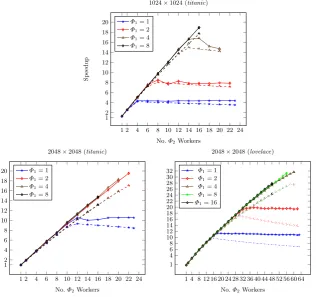
Fig. 6.Image Convolution (Φ1(r)|Φ2(p)) ontitanicandlovelace. Dashed/lighter lines are predictions. Note that the number ofΦ1+Φ2 workers≤total hardware threads (24 fortitanic/64 forlovelace).
6
Experimental Validation
6.1 Image Convolution
Image convolution is widely used in image processing applications such as blur-ring, smoothing or edge detection. The convolution algorithm is a composition of two functionsr◦p, whererreads in an image from a file andpprocesses the image by applying a filter. This process is typically applied to a stream of input images, and produces a stream of output images. For each pixel in the input image, the filtering stage consists of computing the scalar product of the filter and the window surrounding the pixel:
output pixel(i, j) =X m
X
n
input pixel(i−n, j−m)×filter weight(n, m)
For our benchmark tests, we parallelise the convolution using a two-stage pipeline, where each stage is a farm:Φ1(r)|Φ2(p). Speedup results for two different image sizes on the 24-coretitanicmachine are shown on the left and centre of Figure6, with each worker in either farm allocated to its own core. Speedups are recorded against the sequential version of the algorithm. The solid lines show the actual execution speedups and the dashed lines show the speedup predictions. The x
axis is the number of Φ2 workers and each line corresponds to a fixed number ofΦ1 workers. In all cases, the predicted speedups closely match the actual re-sults, giving a correct lower bound prediction of the actual speedup. For the 1024×1024 images, the best speedup is 18.90 for Φ1= 8 andΦ2= 16 workers. Our cost model predicts a speedup of 17.65 (within 7% of the actual value). We observe threeknees in the graph, where the speedups flatten out: forΦ1= 1 and
Φ2= 4; orΦ1= 2 andΦ2= 6; and atΦ1= 8 andΦ2= 14. In all cases, our cost models correctly predict both the knee and the speedup. For the 2048×2048 images, the best speedup is 19.53 forΦ2= 22 andΦ1= 2, where our cost model predicts a speedup of 16.98 (within 14% of the actual value). We observe one
knee, at Φ1= 1 andΦ2= 12, which our cost model also correctly predicts. The right-hand graph in Figure 6investigates the scalability of our approach, show-ing speedup results for 2048×2048 images on the 64-corelovelacemachine. The best speedup that we obtain, atΦ1= 4 andΦ2= 60, is 31.6, versus a predicted speedup of 27.48 (that is, within 14% of the actual value). Speedup predictions for the remaining number ofΦ1workers (4,8 and 10) are consistent with the ac-tual speedups, showing that the cost model correctly predicts identical speedup in all three cases.
6.2 Cholesky Decomposition
Cholesky Decomposition is used in linear algebra, comprising the decomposition of a Hermitian, positive-definite matrix into the product of a lower triangular matrix and its conjugate transpose. Our implementation uses a task farm, Φ1, to model the decomposition stage. Speedup results for a 1024×1024 matrix are shown in Figure 7. The top set of results shows speedups for the 24-core
1 2 4 6 8 10 12 14 16 18 20 22 24 1
2 4 6 8 10 12 14 16 18
No. Workers
Sp
e
edup
titanic
1024×1024 MM 2048×2048 MM QuickSort Cholesky
1 2 4 6 8 10 12 14 16
1 2 4 6 8 10 12 14 16
No.ΦWorkers
ladybank
1024∗1024 MM 2028∗2048 MM QuickSort Cholesky
1 4 8 12 16 20 24 28 32 36 40 44 48 52 56 60 64 1
2 4 6 8 10 12
No.ΦWorkers
lovelace
[image:19.595.150.470.118.425.2]2048∗2048 MM 3000∗3000 MM QuickSort Cholesky
Fig. 7.Speedups for Cholesky Decomposition, Matrix Multiplication and QuickSort, using single task farms, ontitanic,ladybank andlovelace. Dashed lines are predictions.
6.3 Matrix Multiplication
The product of two matrices,AandB is defined as:
(AB)i,j= m
X
k=1
Aik.Bkj
As for Cholesky decomposition, this can also be implemented using a task farm. with Figure 7giving speedup results for 1024×1024 and 2048×2048 matrices on both titanic and ladybank. For ladybank, the 1024×1024 example gives a speedup of 7.55 on 10 cores, versus a prediction of 6.33. Once again, the cost model correctly predicts lower bounds on speedup, predicting, for example, a speedup of 5.98 on 16 cores versus an actual speedup of 6.12. For the 2048×2048 execution, the best speedup is 3.54 on 14 cores, versus a predicted speedup of 3.04. For titanic, the 1024×1024 example gives a best speedup of 16.7 on 24 cores versus a predicted speedup of 15.65. Likewise, for the 2048×2048 example, we obtain a best speedup of 14.19 versus a predicted speedup of 11.46. In both cases, overall speedups are better for smaller matrices. This is due to lower communication costs. As with the Cholesky example, in all cases our cost models correctly predict a lower bound on speedup. In the best case, the prediction is within 3% of the actual speedup.
6.4 QuickSort
1 2 4 6 8 10 12 14 16 18 20 22 24 1
2 4 6 8 10
No.ΦWorkers
Sp
eed
up
titanic
NQ 19 NQ 17
1 2 4 6 8 10 12 14 16
1 2 4 6 8 10 11 12
No.ΦWorkers ladybank
NQ 19 NQ 17
1 4 8 12 16 20 24 28 32 36 40 44 48 52 56 60 64 1
2 4 6 8 10
No.ΦWorkers lovelace
[image:21.595.153.463.125.404.2]NQ 17 NQ 19
Fig. 8. Speedups for NQueens (g | Φ(s)) on ladybank and titanic. Dashed lines are predictions.
6.5 NQueens
NQueens involves placing n queens on an n∗n chessboard, so that no two queens may attack each other, according to the usual rules of chess. The solution requires that no two queens occupy the same row, column or diagonal. In our implementation, we have modelled the NQueens problem as a two-stage pipeline,
g | Φ(s), where g is the stage that generates all positions of the queens, and s
1
1 4 6 8 10 12 14 16 18 20 22 24 1 2 4 6 8 10 12 14 16 18 20
No.Φ2Workers
Sp
ee
dup
FastFlow
Φ1= 1
Φ1= 2
Φ1= 4
Φ1= 8
1
1 4 6 8 10 12 14 16 18 20 22 24 1 2 4 6 8 10 12 14 16 18 20
No.Φ2Workers OpenMP
Φ1= 1
Φ1= 2
Φ1= 4
[image:22.595.149.469.124.261.2]Φ1= 8
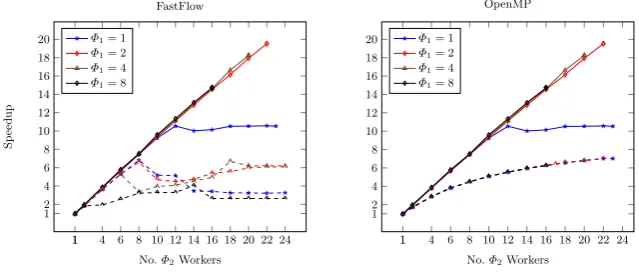
Fig. 9.Speedups for our implementation (solid lines) versus FastFlow (above, dashed lines), and OpenMP (below, dashed lines); Convolution of 500 images, size 2048×2048 (titanic). The baseline sequential performance is identical in each case.
6.6 Comparison with other Techniques
7
Related Work
Timing issues are critically important for parallel and concurrent execution, and they have therefore been widely studied in the literature. However, despite their prevalence in real hardware, very little work considers relaxed memory models. This paper represents the first attempt of which we are aware to consider the precise impact of relaxed memory models on functional correctness, deadlock and timing. Correctness of the spin-lock protocol on x86-TSO has been previously proved using a semantic criterion (triangular-race freedom [11]) derived from thex86-TSO model used here [6,5]. In contrast, our new proof proves functional correctness and deadlock freedom directly over the operational model of the actualx86-64 instructions [6,5]. Our proof has been composed with a proof for queues and thence skeletons, and furthermore clearly isolates necessary hardware assumptions for progress. We also consider, for the first time, the crucial issue of execution time. Burckhardt et al [12] verify spin-locks on TSO by adapting a modified version of linearisability, and thus implicitly obtain compositionality. However, they ignore the progress and fairness constraints that we uncover, and also do not treat execution time.
The C/C++11/C++14 standards provide atomic operations that support various kinds of weak memory models [19,20]. They could be used to implement the Fence and Exchange operations, but do not support higher-level parallel structures, such as the structured algorithmic skeletons that we have used here. Boehm and Adve [21] consider the foundations of this concurrency model. Adve and Boehm [22] give a useful survey of weak memory models as of 2010.
8
Conclusions
This paper has developed new proofs of functional correctness forx86-64 mul-ticores and used these to derive cost models for structured parallel programs. For the first time, we have direct operational proofs of functional correctness and deadlock freedom for standard locking and queuing algorithms under the relaxed memory model used by commonx86-64 multicores. We have used these to build accurate cost models for parallel programs that are structured using common algorithmic skeletons. Our predictions match very closely to actual results: in most cases predicting a lower-bound to within 7% accuracy.
8.1 Limitations/Further Work
There are a number of obvious limitations to the work described here that would repay further work. Firstly, the queues that we have used here are unbounded. Extending our work to consider bounded queues should not be technically dif-ficult, but would add some complexity to the queue definitions and would also require us to consider how “back-pressure” [23] from the demand on one queue impacts the production of values that feed that queue. Secondly, although it is very commonly used in practice, the locking mechanism that we have used here carries some, possibly significant, cost: by definition, when a processor is executing a spin-lock, it is wasting energy and not doing any useful work. More efficient notification or “lock-free”2techniques would obviate this at the cost of a significantly more complex proof and rather more complex cost model. We have therefore chosen not to do this here. Thirdly, and more seriously, as with most work on algorithmic skeletons, we have not considered any form of feedback, as in FastFlow’s “farm/pipeline-with-feedback” skeletons [10]. Incorporating skele-tons with feedback would allow the construction of more complex parallel pro-grams, but would require us to determine fixed-points in the skeletons and to solve the resulting timing recurrence relations. Fourthly, we have ignored some hardware effects. In particular, while we have accounted for the behaviour of the cache and associated hardware when determining functional correctness and deadlock properties, we have not attempted to precisely model memory access behaviour in determining execution times, but have assumed that the sequential cost model properly accounts for such costs. We have also not modelled the pro-cessor instruction pipeline. Neither issue will affect functional correctness, but could, obviously, impact low-level timing accuracy.
2 In the sense that locks are not visible to the programmer, rather than they are not
Acknowledgements
This work has been partially supported by the EU Horizon 2020 grant “RePhrase: Refactoring Parallel Heterogeneous Resource-Aware Applications – a Software Engineering Approach” (ICT-644235), by COST Action IC1202 (TACLe), sup-ported by COST (European Cooperation in Science and Technology), and by EPSRC grant EP/M027317/1 “C3: Scalable & Verified Shared Memory via Consistency-directed Cache Coherence”.
References
1. Cole, M.I.: Algorithmic skeletons: structured management of parallel computation. MIT Press, Cambridge, MA, USA (1991)
2. Gonz´alez-V´elez, H., Leyton, M.: A survey of algorithmic skeleton frameworks: high-level structured parallel programming enablers. Software: Practice & Experience 40(12) (2010) 1135–1160
3. Danelutto, M., Torquati, M.: A RISC Building Block Set for Structured Paral-lel Programming. In: Proc. 21st Euromicro International Conference on ParalParal-lel, Distributed, and Network-Based Processing (PDP ’13). (2013) 46–50
4. Lamport, L.: How to Make a Multiprocessor Computer That Correctly Executes Multiprocess Programs. IEEE Transactions on Computers C-28(9) (September 1979) 690–691
5. Sewell, P., Sarkar, S., Owens, S., Zappa Nardelli, F., Myreen, M.O.: x86-TSO: A Rigorous and Usable Programmer’s Model for x86 Multiprocessors. CACM53(7) (July 2010) 89–97
6. Owens, S., Sarkar, S., Sewell, P.: A Better x86 Memory Model: x86-TSO. In: Proc. TPHOLs ’09: Intl. Conf. on Theorem Proving in Higher-Order Logics, Springer LNCS 5674 (August 2009) 391–407
7. Intel: Intel 64 and IA-32 Architectures Software Developer’s Manual Volume 3A: System Programming Guide, Part 1,§8.2.2. Intel (2013)
8. Papamarcos, M.S., Patel, J.H.: A Low-overhead Coherence Solution for Multipro-cessors with Private Cache Memories. In: Proc. ISCA ’84: 11th Annual Interna-tional Symposium on Computer Architecture, ACM (1984) 348–354
9. Chapman, B., Jost, G., Pas, R.v.d.: Using OpenMP: Portable Shared Memory Parallel Programming (Scientific and Engineering Computation). The MIT Press (2007)
10. Aldinucci, M., Danelutto, M., Kilpatrick, P., Torquati, M.: Fastflow: High-level and Efficient Streaming on Multi-core. In: Programming Multi-core and Many-core Computing Systems, ser. Parallel and Distributed Computing. (2012) 11. Owens, S.: Reasoning about the Implementation of Concurrency Abstractions
on x86-TSO. In: Proc. ECOOP ’10: European Conference on Object-Oriented Programming, Springer (June 2010) 478–503
12. Burckhardt, S., Gotsman, A., Musuvathi, M., Yang, H.: Concurrent Library Cor-rectness on the TSO Memory Model. In: Proc. ESOP ’12: 21st European Confer-ence on Programming Languages and Systems. (2012) 87–107
13. Hamdan, M.M.: A Survey of Cost Models for Algorithmic Skeletons. Technical report, Heriot-Watt University (1999)
15. Skillicorn, D.B.: A Cost Calculus for Parallel Functional Programming. Journal of Parallel and Distributed Computing28(1995)
16. Valiant, L.G.: A Bridging Model for Parallel Computation. Communications of the ACM (CACM)33(8) (August 1990) 103–111
17. Lisper, B.: Towards Parallel Programming Models for Predictability. In: Proc. WCET ’12: 12th International Workshop on Worst-Case Execution Time Analysis. Volume 23 of OpenAccess Series in Informatics (OASIcs). (2012) 48–58
18. Blelloch, G.E., Greiner, J.: A Provable Time and Space Efficient Implementation of NESL. In: Proc. ICFP ’96: ACM SIGPLAN International Conference on Functional Programming. (1996) 213–225
19. Becker, P., ed.: Programming Languages — C++. ISO/IEC (2011)
20. Williams, A.: C++ Concurrency in Action: Practical Multithreading. Manning Publications (2012)
21. Boehm, H.J., Adve, S.V.: Foundations of the C++ concurrency memory model. In: Proc. PLDI ’08: 29th ACM SIGPLAN Conference on Programming Language Design and Implementation. (2008) 68–78
22. Adve, S.V., Boehm, H.J.: Memory Models: A Case for Rethinking Parallel Lan-guages and Hardware. Communications of the ACM (CACM)53(8) (2010) 90–101 23. Collins, R.L., Carloni, L.P.: Flexible filters: load balancing through backpressure for stream programs. In: Proc. EMSOFT ’09: ACM SIGBED International Conference on Embedded Software. (2009) 205–214