1 Presence of an audience and consistent inter-individual differences affect archerfish shooting 1
behaviour 2
Nick A.R. Jonesa*, Mike Webstera, Christopher N. Templetonb, Stefan Schusterc, Luke 3
Rendella 4
a Centre for Social Learning and Cognitive Evolution, School of Biology, University of 5
St Andrews, St Andrews, U.K. 6
b Department of Biology, Pacific University, Forest Grove, OR, U.S.A. 7
c Department of Animal Physiology, University of Bayreuth, Bayreuth, Germany 8
9
*Correspondence: N.A.R. Jones, School of Biology, University of St Andrews, Sir Harold 10
Mitchell Building, St Andrews, Fife KY16 9TH, U.K. 11
E-mail: [email protected]
12
Abstract 13
The social environment can play an important role in shaping the foraging behaviour of 14
animals. In this study we investigated whether archerfish, Toxotes jaculatrix, display any 15
behavioural changes in response to the presence of an audience while using their specialized 16
foraging tactic of shooting, spitting precisely aimed jets of water, at prey targets. As any prey 17
items shot down are potentially available to competitors, we hypothesized that shooting fish 18
would be sensitive to the presence of potential competitors, especially given the suggestion 19
that, in the wild, this species shows intraspecific kleptoparasitism and faces interspecific 20
competition. We found that in the presence of another fish, archerfish took longer to shoot, 21
made more orientations (aiming events) per shot, and tended to be closer to the target at the 22
2 to shoot, and these differences were consistent across contexts, with and without an audience. 24
Our results show that archerfish are sensitive to, and adjust their shooting behaviour in 25
response to, the presence of an audience and highlight the importance of social context in this 26
fish species. We also suggest that inter-individual differences may play an important role in 27
archerfish shooting behaviour. This study highlights the importance of social effects and 28
competition on foraging behaviour and decision making. Further work in this species could 29
explore whether differences in competitive foraging ability are linked to sensitivity to the 30
presence of an audience. 31
Keywords 32
archerfish; consistent individual differences; foraging; kleptoparasitism; producer–scrounger; 33
social foraging; 34
Introduction 35
An animal’s social environment can influence its behaviour in many ways, and social effects 36
on behaviour are frequently studied within the context of foraging. Social cues can be used by 37
an individual to determine, for example, when, where and what to eat (Galef & Giraldeau, 38
2001). Rates of foraging success and related foraging efficiency at the individual level may 39
increase with social foraging, through for example processes of social enhancement (Baird, 40
Ryer, & Olla, 1991) or indirect benefits of social living such as reduced need for predator 41
vigilance in groups (Lima, 1995). However, rates of foraging can also be negatively affected 42
by the presence of others through within-group competition (Cresswell, 1997; Goss-Custard, 43
2002) and effects of social inhibition as observed in social hierarchies (Baker, Belcher, 44
Deutsch, Sherman, & Thompson, 1981). 45
One of the more subtle ways in which social context can affect the behaviour of an individual 46
3 1969). In foraging contexts it is well documented that the presence of an ‘audience’ of one or 48
more individuals can affect the behaviour and decision making of an individual forager 49
(Giraldeau & Caraco, 2000). For example, individuals may shift from one foraging site to 50
another to avoid competition (Alatalo, 1981). Individual foragers can suffer reduced foraging 51
rates through what is known as indirect or passive interference competition (Cresswell, 1997; 52
Maniscalco, Ostrand, Suryan, & Irons, 2001; Shealer & Burger, 1993), also called cryptic 53
interference (Bijleveld, Folmer, & Piersma, 2012). This and other forms of competition are 54
considered to be especially important in situations where behaviour may make resources 55
publicly available to others, such as in the caching behaviour of ravens, Corvus corax 56
(Heinrich & Pepper, 1998) and/or where the cost of competition can be particularly high, 57
where competitors can engage in physical attack or where the likelihood of kleptoparasitism 58
is high (Ward & Webster, 2016). In such competitive situations timing and positioning may 59
be important, and it has been suggested that animals can adjust the timing of certain 60
behaviours in ways that mitigate intraspecific foraging competition (Alanärä, Burns, & 61
Metcalfe, 2001; Carothers & Jaksić, 1984). 62
Fish have been shown to actively manage the competing demands of vigilance and 63
competition in a group (Ryer & Olla, 1996), use social information to develop more efficient 64
foraging techniques (Reid, Seebacher, & Ward, 2010) and adjust the level of cooperative 65
foraging (Pinto, Oates, Grutter, & Bshary, 2011). There have also been studies of 66
kleptoparasitism and producer–scrounger systems in fish species showing that the costs and 67
benefits of the producer and scrounger roles are affected by group size, and suggesting that 68
individual fish may be able to use social cues to adjust their role (Hamilton & Dill, 2003). 69
Fish in general have long been considered good laboratory models for understanding foraging 70
competition (Ashley, Ward, Webster, & Hart, 2006) as they are typically more tractable 71
4 as an experimental fish system as they can be relatively easily trained to shoot at targets for 73
food rewards (Newport, Wallis, & Siebeck, 2015; Schuster, 2007; Timmermans, 2000). 74
Archerfish, Toxotes spp., are a particularly interesting group in which to study social effects 75
on foraging decisions. When foraging, archerfish spit water to down prey such as insects in 76
vegetation overhanging the water. While their shooting ability allows them to target prey 77
mostly unavailable to other fish, it also has the potential disadvantage of being an inherently 78
conspicuous behaviour. It provides a clearly visible cue to competitors for the imminent 79
arrival of food at the water’s surface. When shooting at a potential prey item, archerfish tend 80
to hold position in a stereotypical alignment, ‘aiming’ or orienting towards the target (Bekoff 81
& Dorr, 1976; Timmermans & Souren, 2004) with their gaze fixated at that target (Ben-82
Simon, Ben-Shahar, & Segev, 2009). The orientation and posture of a hunting archerfish may 83
therefore act as inadvertent cues, providing information about where and when a shot is likely 84
to be made to any potential competitor. Other fish may be able to take advantage of the 85
impending arrival of a food item such that a shooting archerfish becomes an obvious resource 86
provider, and other fish, acting on this information, can act as scroungers or kleptoparasites. 87
Thus, archerfish provide an example of a foraging system with inherently public resource 88
provision in a producer–scrounger system. This, combined with the intense competition 89
archerfish are exposed to in the wild (Rischawy, Blum, & Schuster, 2015) suggests that 90
archerfish should be selected to pay attention to social conditions and associated competitive 91
risk while foraging. 92
Many other aspects of archerfish shooting behaviour have been studied, from how they shape 93
and control their shots, learn to hit moving targets and discriminate between targets 94
(Dewenter, Gerullis, Hecker, & Schuster, 2017; Gerullis & Schuster, 2014; Karoubi, 95
Leibovich, & Segev, 2017; Newport et al., 2015; Newport, Wallis, Temple, & Siebeck, 2013; 96
5 responses to differing social contexts. Given the potential for competition and
98
kleptoparasitism, archerfish are likely to be sensitive to the presence of an audience and this 99
may result in a change in their behaviour. Indeed, archerfish perform rapid but directed bursts 100
of speed (‘c-starts’) that enable them to quickly reach downed prey, and there is some 101
evidence that the latency to perform c-starts decreases in groups (Schlegel & Schuster, 2008). 102
Similarly, juvenile archerfish were shown to jump more frequently for food, a tactic with 103
lower kleptoparasitism risk, as group size increased (Davis & Dill, 2012). 104
While jumping may reduce the threat of kleptoparasitism, it only works for prey that are close 105
to the water surface as archerfish are unable to jump as high as they can effectively shoot 106
(Shih, Mendelson, & Techet, 2017). In situations where an archerfish must shoot, nearby 107
conspecifics are likely to affect the decision making of the shooting fish. Given the 108
importance that related factors of distance, speed and time are likely to play in competing for 109
a shot-down prey, where scroungers may be able to get closer to the prey than the shooter in 110
social foraging situations, we expected that orientation and distance between fish and the 111
target may be important parameters governing shooting behaviour strategies. We aimed to 112
determine whether latency to shoot changed when a fish was exposed to a visual audience in 113
the form of a size-matched conspecific. We also anticipated that archerfish would react to the 114
presence of a conspecific by changing their positioning or other aspects of their shooting 115
behaviour. As any single foraging decision can be affected by many factors, but notably 116
levels of satiation (Morgan, 1988; Riddell & Webster, 2017), we used a repeated measures 117
6 Methods
119
Subjects and animal husbandry 120
Eight archerfish of unknown sex (archerfish are monomorphic) and age (the archerfish were 121
wild caught) participated in this experiment. At the time of the experiment, the fish were 122
estimated to be 8–16 months old and were 8–10 cm long. They were sourced from an 123
accredited ornamental fish retailer. The fish were housed in the St Andrews fish laboratory as 124
a single group in a glass tank (180 × 45 cm and 35 cm deep) and under a 12:12 h light:dark 125
cycle, with water temperatures between 24.5 and 25 oC. Water quality parameters (pH, nitrite, 126
ammonia and nitrate concentrations) were measured weekly, and levels were kept within a 127
range appropriate for archerfish as per Newport et al. (2013). The fish were fed daily with an 128
alternating mixture of commercial fish food (Tetra Cichlid Sticks) and freeze-dried 129
bloodworms. 130
Experimental set-up 131
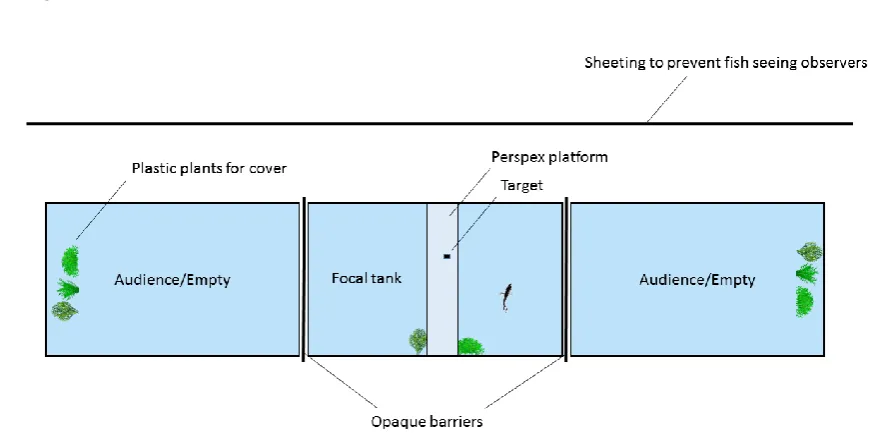
Three tanks of equal dimensions (55 x 55 cm and 45 cm deep) were set up side by side with a 132
0.5 cm gap between them (Fig. 1). A 3 mm thick black opaque plastic barrier was inserted 133
between each tank which could be easily slid in or out to block or allow vision between tanks. 134
These barriers were used to create three different experimental conditions (hereafter 135
‘treatments’, see below), by controlling the visibility of the side tanks, and thus audience fish, 136
during trials. Each tank had an immersion heater to ensure temperatures were kept at 24.5 ± 137
0.5 oC and a small internal filter (Eheim 305), a 1 cm deep gravel bottom, and plastic plants 138
positioned to provide structure and refuge but allow a clear view of neighbouring tanks. The 139
water in all three tanks was maintained at the same level (± 1 cm). 140
The middle tank was used for the focal fish and had three plastic plants (to provide cover) 141
positioned at the rear of the tank. For all trials a clear Plexiglas ‘target platform’ 10 cm wide 142
7 each side of the focal tank were designated as audience tanks; each was identical to the focal 144
tank but the three plastic plants were positioned at the side of the tank furthest from the focal 145
tank, to provide a clear view between tanks, and there was no target platform. A camera 146
(ELP 2 Megapixel USB webcam) was positioned 0.7 m above the tank set-up such that all 147
three tanks could be remotely observed from a top down perspective. 148
Experimental Procedure 149
The size of each fish was estimated at time of capture from the stock tank using a ruler while 150
holding the fish in the net against the side of the tank. Fish were then size matched as closely 151
as possible (differences in length no larger than 0.5 cm total length) and tested in pairs. For 152
each pair, one fish was randomly assigned as the focal fish and the other as the audience fish. 153
The audience fish was randomly assigned to one of the side tanks, and the two fish were 154
transferred to the experimental tanks and left for 24 h to acclimatize before the experiment 155
started. Audience fish were always fed with the barriers in place to ensure that the focal fish 156
never observed them eating. The experiment consisted of two phases: training and testing. To 157
avoid potential stress and disruption to the focal fish the audience fish remained in their 158
respective tank throughout both training and test phases for the focal fish. 159
For the initial 24 h, the barriers were removed, and the focal fish was able to see both the 160
empty tank and the tank with the conspecific (hereafter ‘audience tank’) except during 161
feeding. Both the focal and audience fish received daily food rations after all trials for each 162
day were complete to maximize hunger levels immediately prior to training or testing. 163
During the training phase each focal fish was trained to shoot a novel target (black square 164
shape) within 3 min of presentation. This was to ensure that the fish had properly 165
acclimatized to the tank set-up and had reliably learnt to shoot the target to gain a food 166
8 done without an audience. There were two training stages, each consisting of three sessions 168
with up to 10 trials per day. Each trial consisted of an opportunity for the fish to shoot at a 169
target placed on the Perspex platform. Trials began as soon as the target was placed on the 170
platform and ended when a shot hit the target or after a maximum trial duration if one was 171
imposed (see below). A food reward was delivered after each successful shot and successive 172
trials were begun between 30 and 45 s after the previous trial had ended. Shots could easily 173
be seen, as water jets hit the platform and left a water splash. During training, fish were only 174
rewarded for shots where the splash hit the Perspex within 5 mm of the target. Fish were 175
never rewarded for jumping, nor for shooting anything except the presented target. 176
Training stage 1 177
Initially, the focal fish was presented with a known food item, a large pellet, as a target on the 178
platform for each trial. Three sessions were conducted for each fish per day. Each session 179
lasted until the fish had successfully completed 10 trials, or for 1 h if the fish did not achieve 180
this. Once a fish had shot at the pellet 10 times in three consecutive sessions, it was 181
considered ready for the second training phase. 182
Training stage 2 183
The fish was presented with a novel square black plastic shape (10 × 10 mm and 2 mm thick), 184
and once each fish had shot at this target consistently (shooting at least 10 times in a single 1 185
h session) a maximum trial time of 180 s was imposed. If a fish failed to shoot within the 186
180 s, the trial was terminated, and a new trial was begun after 30 s. Once a fish had shot the 187
target within 180 s per trial in at least eight of 10 trials per session in three consecutive 188
sessions in a single day, it was considered trained. After fish had achieved this second 189
9 ensure the fish was shooting consistently, and experimental sessions were started the
191
following day. 192
Trial phase 193
(1) After achieving training criterion, each fish entered the trial phase in which experimental 194
treatments were introduced. Here visible access to neighbouring tanks was manipulated 195
using barriers to create one of three treatments: Baseline: both barriers were in place such 196
that neither of the neighbouring tanks were visible to the focal fish as per training 197
conditions. 198
(2) No Audience control: one barrier was removed so that an empty tank was visible 199
(3) With Audience: one barrier was removed such that the tank with a conspecific fish was 200
visible 201
The baseline condition was included as well as the no audience condition to account for any 202
potential differences in behaviour of the focal fish in response to potential distraction due to a 203
changed environment that could occur in the no audience condition. 204
Each fish received 90 experimental trials, with testing run for 3 days for each fish, and three 205
sessions per day. Each session consisted of 10 trials and was randomly assigned to a 206
treatment, such that each subject was exposed to one session of each treatment per day. 207
Sessions were set within consistent time periods to account for diel variation in hunger or 208
shooting motivation. Morning sessions were begun between 0900 and 1000 hours, with a 209
minimum of 3 h between successive sessions. Test trials lasted until a fish shot or until 360 s 210
had elapsed without any shot being made. At no point did any of the audience fish ever 211
attempt a shot at the target, given the position of the platform and the dimensions of the target 212
it is unlikely they could see the target, and any shot would have been obstructed by the glass 213
10 Measurement of variables
215
Each session was recorded with the video camera from above. Variables were scored during 216
video playback using the Solomon software package (Péter, 2017), version 17.03.22. Latency 217
(s) to shoot was recorded for each trial, where a trial started as soon as the target had been 218
placed on the platform and ended once the fish had shot at the target (or the trial time limit 219
was reached), with the water jet hitting the platform. 220
In addition to latency to shoot we recorded the frequency of orientation (aiming) events per 221
trial and distance between target and fish at the time of each shot. This behaviour was defined 222
and categorized based on descriptions of orientation during shooting behaviour given in 223
previous studies (Bekoff & Dorr, 1976; Ben-Simon et al., 2009). Fish were considered to be 224
orienting towards the target when they positioned themselves such that the target was directly 225
ahead of them and they maintained this orientation while swimming slowly or remaining 226
motionless for at least 2 s. The distance between the target and the fish at the time of each 227
shot was measured as the number of body lengths apart, which was split into two categories: 228
close, where fish shot from a position directly under or within a single body length of the 229
target, or far, more than one body length between fish and target. Latency to shoot per trial 230
was recorded for all eight fish in all trials; however, for one fish (fish 7) the other variables 231
were not included in the analysis. This was due to a technical issue affecting the camera that 232
meant that we were unable to clearly view movements of the fish in some parts of the tank, 233
although shots hitting the shooting platform were still clearly visible and are included in the 234
analyses for latency to shoot. 235
To assess the reliability of the data we extracted from the videos, 25% of the videos were 236
rescored by a hypothesis-naïve observer. To estimate interobserver agreement an inter-rater 237
reliability test was run to compare principal (N.J.) and secondary scorer, for the latency to 238
11 agreement was found with an interclass correlation between observers of 0.98–0.99, with a 240
mean of 0.986; F139,140 = 141, P <0.001). Similarly, scores for frequency of aiming events 241
and distance at time of shot had high interobserver agreement, with interclass correlation 242
between observers of 0.913–0.954 (mean of 0.937; F139,140 = 30.8, P <0.001) and of 0.830– 243
0.909 (mean of 0.875; F139,140 = 30.8, P <0.001), respectively. 244
Data Analysis 245
Only data from trials in which a shot was made were included in analysis, but this was the 246
case for most of the 90 trials per fish. Those trials where the 180 s cut-off was reached were 247
not included in the analysis as the lack of a shooting attempt could not be attributed to any 248
single cause. However, the time limit was reached in only 8.5% of the 720 trials, and the 249
occurrences were spread evenly across the treatments (baseline: N=16; no audience: N= 23; 250
with audience: N = 26). 251
Latency to shoot 252
All statistical analyses were performed using R Studio 1.0.136/R version 3.2.3 (R Core Team, 253
2017) using a mixed model approach. Before any models were interpreted we checked that 254
the model assumptions of normality and homoscedasticity of residuals was met, as 255
determined by visual inspection of diagnostic plots. We set latency to shoot at a presented 256
target (latency) as the response variable, and log transformed it to reduce skew. We then 257
fitted a linear mixed-effects model (Bates, Mächler, Bolker, & Walker, 2015) to test whether 258
the latency to shoot varied with treatment. Thus, treatment was a fixed factor, and as this was 259
a repeated-measures design we included the subject identity (FishID) as a random factor to 260
account for within-subject variation. To account for any variation that occurred across days 261
and within days across sessions we included day and session as random factors. As trials 262
were consecutive for each session and trial order might be expected to account for some 263
12 specifically trial nested within session within day to account for potential correlations within 265
sessions and days. Thus, the full model built using the ‘lmer’ function (in R lme4 package) 266
was: 267
lmer (logLatency~ Treatment + (1|FishID) + (1| Day) +(1| Day:Session) + 268
(1|Day:Session:Trial)) 269
To test for the significance of each random factor included in the model, we built a reduced 270
model without that random factor and ran a likelihood ratio test (LRT) where we compared 271
the full model with the reduced model using the ‘anova’ function in the R ‘stats’ package 272
(Quinn and Keough, 2002). If these two models were not significantly different we assumed 273
that the random effects were not important; only random factors that were significant in the 274
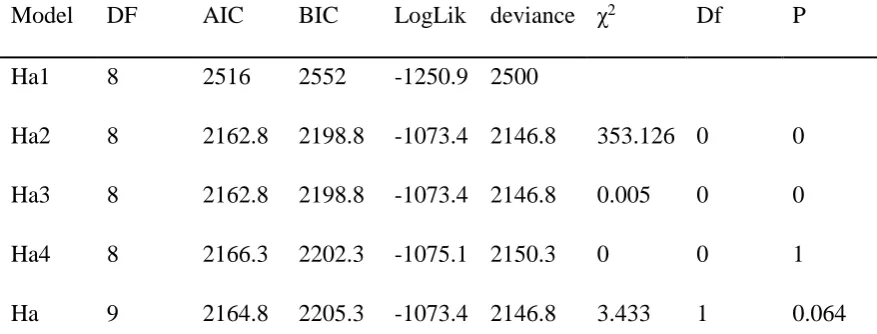
model were retained. (See the Supplementary material for tables of null models.) For the 275
main fixed effect of treatment, we ran an LRT to calculate the significance of the fixed 276
factors. For these, and all other, models, where appropriate, we conducted post hoc pairwise 277
comparisons using the ‘lsmeans’ function in the R lsmeans package (Lenth, 2016) with P 278
values adjusted for multiple comparisons (Tukey method), using the default Satterthwaite 279
method to estimate degrees of freedom. As some focal fish were used as an audience prior to 280
being tested as a focal fish there might have been an effect of experience on latency to shoot. 281
We included an order term in the model to account for this. We used a two-level categorical 282
factor based on whether the focal fish been an audience member before being a focal fish or 283
not. This term did not significantly improve model fit (Table 1) and was not included in the 284
final model. This lack of an experience effect was not unexpected as each focal fish required 285
significant training time and this appeared independent of experience as an audience. 286
13 Individual differences in latency to shoot
288
While not an initial aim of this study, the repeated-measures approach afforded us the chance 289
to examine whether archerfish showed any consistent individual differences across 290
experimental contexts. Consistent individual differences have been shown for many species, 291
expressed in a variety of different measures of behaviour, and can have strong effects on 292
speed and accuracy of foraging decisions (Wang, Brennan, Lachlan, & Chittka, 2015), and 293
these differences may also affect or be affected by social context (Jolles, Taylor, & Manica, 294
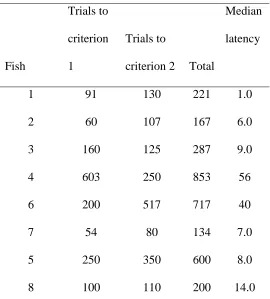
2016). The training periods for the fish suggested that individuals might exhibit consistent 295
differences in time to reach training criterion and tendency to shoot (Appendix Table A1) As 296
such, although we had no a priori hypothesis, we attempted to quantify whether these 297
observed tendencies to shoot at the individual level were evidence of consistent individual 298
differences. The formal method of quantifying whether a behavioural trait is influenced by 299
consistent inter-individual differences is to analyse the behaviour for repeatability. A 300
behaviour is repeatable where individuals behave consistently through time and or different 301
contexts and when individuals behave differently from each other within those contexts (Bell, 302
Hankison, & Laskowski, 2009). To test this and assess whether the individual differences in 303
latency to shoot are repeatable in archerfish, we compared latency to shoot across the three 304
treatment contexts. We used the approach described by Biro et al. ( 2010) where a random 305
intercept model describes the extent to which the rank order of individual scores is 306
maintained across contexts. We compared the full model we used to quantify the effect of 307
treatment on latency (as above), where fish identity was specified as a random effect, with a 308
null model, where the individual identity was removed, using an LRT with the ‘anova’ 309
function. A significant difference between the two models indicates that there are consistent 310
differences in behaviour at the individual level across the three treatments. To explore and 311
14 was calculated as has been used in similar analysis of repeatability of behaviour (Krause, 313
Krüger, & Schielzeth, 2017) using the ‘rptR’ package in R. This package builds on the 314
functions developed for mixed-model analysis with the addition of parametric bootstrapping 315
to provides reliable estimates for ‘R’ and the uncertainty surrounding these estimates (Stoffel, 316
Nakagawa, & Schielzeth, 2017). 317
Orientation frequency 318
A generalized linear mixed model was fitted to compare the frequency of orientation events 319
per shot across treatments. We compared the frequency of orientations between treatments 320
using a Poisson family model. The model used was: 321
glmer (Orient~ Treatment + (1|FishID) + (1| Day) +(1| Day:Session) + 322
(1|Day:Session:Trial), family ="poisson") 323
After fitting this model, we ran the dispersion_glmer function in the lmer package (as per 324
Bates et al, 2015) to ensure there was no overdispersion in the model fit. 325
Distance from target 326
To investigate whether the audience had an effect on the distance between the shooting fish 327
and target at the time of the shot we categorized the distance between fish and target as either 328
close (within one body length) or far (fish more than one body length from the target). We 329
used body length as the unit of measurement to standardize between fish with different 330
lengths. To analyse these data, we fitted a mixed-effects model to estimate the probability of 331
shooting from further than one body length (Far). The model was fitted as a binomial glmm 332
model: 333
glmer (Orient~ Treatment + (1|FishID) + (1|Day) + (1|Session) +(1| Day:Session) + 334
15 Ethical Note
336
This research was approved by the University of St Andrews Animal Welfare and Ethics 337
Committee (AWEC). No procedures required U.K. Home Office licensing. All tanks were 338
enriched with gravel and plastic plants for cover. All fish were retained in the laboratory after 339
the study period to be used in future projects. Handling was kept to a minimum, and when 340
fish had to be moved between tanks they were caught using two large hand nets to reduce the 341
likelihood of extended capture periods. In the experimental tanks fish were kept singly in a 342
volume of at least 125 litres. Archerfish are not considered a social species. There are no 343
published studies on the effects or preference for any social context and or isolation in this 344
species, but multiple previous studies have maintained archerfish in isolation with no 345
reported ill effects or perceived likelihood of stress. During our study we closely monitored 346
each fish, specifically for signs of reduced feeding rate, responsiveness, stereotypic behaviour 347
and colour changes. We observed few instances of these signs, only post transfer between 348
tanks, and all effects were temporary. 349
Results 350
Training 351
All fish achieved both training criteria but required a lot of time to reach them. The number 352
of trials required to achieve criterion differed markedly across fish (Appendix Table A1). 353
There appeared to be a positive relationship between time to criterion and latency to shoot in 354
baseline settings, and this may relate to a general sensitivity to risk but we did not formally 355
quantify this given the small number of fish (Appendix Table A1). 356
Latency to shoot 357
Focal fish took longer to shoot when exposed to a visible audience than when exposed to an 358
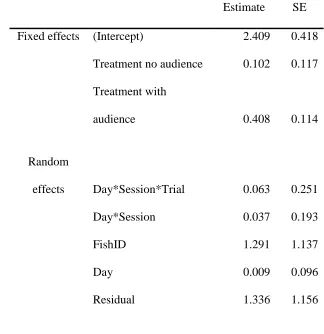
16 influenced by audience treatment (LRT: χ2
2 = 13.642, P = 0.001; Table 2). The differences in 360
latency were due to the audience: post hoc contrasts between the treatments with and without 361
an audience when the barrier was removed were statistically significant (lsmean: t536.92 = -362
2.641, P = 0.023). There was no statistically significant difference between the baseline and 363
no audience treatments (lsmean: t456.99 = -0.875, P = 0.066). 364
Inter-individual differences 365
The fish identity term within the model accounted for up to 47% of the variance explained by 366
the random effects, indicating that there was important variation between individual fish. 367
Indeed, during both training and testing, individual fish displayed notable differences in 368
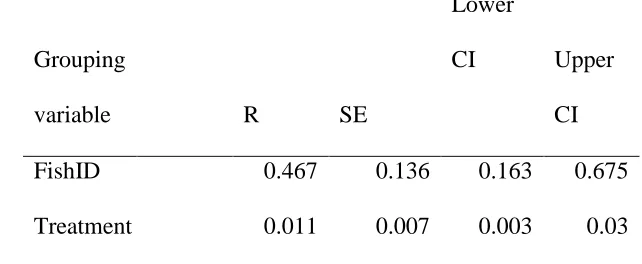
latency to shoot. Across the three treatments individual repeatability ‘R’ in mean latency to 369
shoot was high (P < 0.001; Table 3), with lower repeatability at the level of treatment. 370
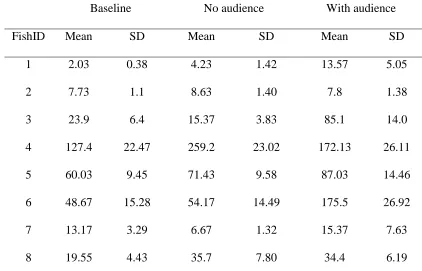
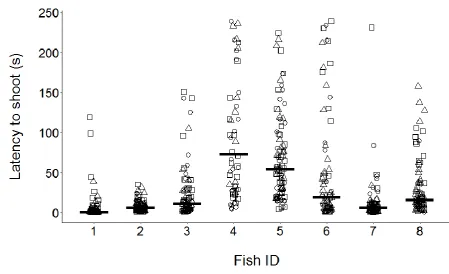
Similarly, median (Fig. 3) and mean (Table 4) latencies to shoot for each fish across all trials 371
show that individual archerfish had relatively consistent latencies to shoot that persisted 372
across contexts. Median latency to shoot varied between individuals by a factor of eight or 373
more from under 10 s to over 70 s. 374
Orientation 375
Fish did not always shoot even after orienting or ‘aiming’ at a target, and would sometimes 376
disengage and switch to other behaviours, or reposition before reorienting at the target. The 377
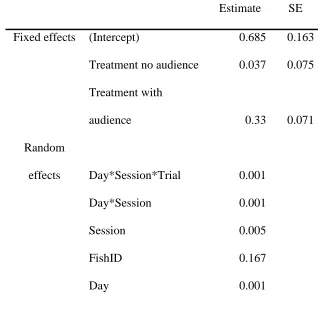
mean number of orientation events per shot increased in the presence of an audience (LRT: 378
χ2
2 =26.674, P < 0.001; Fig.4, Table 5). There were significant differences in the frequency of 379
orientation events between the audience and no audience conditions (lsmean: z = -4.173, P < 380
0.001). Fish did not show different frequencies of orientation in the baseline and no audience 381
17 Distance from target
383
Treatment had an overall effect on where fish shot from (close/far; LRT: χ2
2 = 8.614, P 384
=0.013; Table 6), and fish were less likely to shoot from further away when there was an 385
audience than in the no audience control (lsmean: z = 2.873, P = 0.011; Fig. 5). 386
Discussion 387
Archerfish increased their latency to shoot a target for a food reward when observed by an 388
audience member in a neighbouring tank, which suggests that, when shooting, archerfish are 389
sensitive to the visual presence of other fish and modify their behaviour in response to that 390
presence. Moreover, given the change in other aspects of their behaviour when exposed to a 391
conspecific, with the increase in mean number of aiming events per trial and the tendency to 392
make fewer shots from further distances from the target, our results are consistent with 393
archerfish modifying their behaviour to reduce the potential risk of kleptoparasitism. This 394
interpretation is especially likely given that Davis and Dill (2012) observed behavioural 395
changes in the context of high kleptoparasitism rates in groups of juvenile archerfish. Being 396
aware of, monitoring and reacting to potential competitors with behavioural tactics to reduce 397
the chances of kleptoparasitism have been reported for a variety of animals with some classic 398
examples from corvids (Heinrich & Pepper, 1998) and kelp gulls, Larus dominicanus 399
(Hockey & Steele, 1990). Although the actual time difference between treatments was small 400
it was functionally significant given how fast archerfish make foraging decisions when 401
shooting and intercepting prey, with fish capable of making complex decisions in as little as 402
0.04s (Schlegel & Schuster, 2008). Even small increases in latency can be important in such 403
systems. 404
Foraging events with long handling times can lead to higher rates of kleptoparasitism (Steele 405
& Hockey, 1995). Given that shooting represents an investment of time in a specific prey 406
18 kleptoparasitism by shooting more quickly, reducing this ‘handling’ time, when exposed to a 408
potential competitor. Our results fit the theory that in systems where there is very aggressive 409
competition and/or high rates of kleptoparasitism, animals will attempt to avoid or mitigate 410
such competition. The change in position and the increased frequency of orientation events 411
we describe may represent such avoidance techniques, similar to the evasive behaviour when 412
caching displayed by grey squirrels, Sciuruscarolinensis (Leaver, Hopewell, Caldwell, & 413
Mallarky, 2007), ravens (Heinrich & Pepper, 1998) and blue gouramis, Trichopodus 414
trichopterus (Hollis, Langworthy-Lam, Blouin, & Romano, 2004). Our results may also be 415
partly due to the conditions of the experiment: with a consistent food cue a single audience 416
member may represent a ‘manageable’ threat, so positioning and timing are enough to reduce 417
the threat of kleptoparasitism. It is likely that archerfish would respond differently if less 418
predictable food cues were used and/or if there was more than one potential competitor. 419
Animals that forage in groups may experience multiple types of interspecific competition. 420
Broadly, three types of competition are possible: interference, scramble and contest (Ward et 421
al., 2006). A single competitor may represent a form of interference competition which, as 422
shown in studies of blackbirds, Turdus merula, suggests competitive foraging can reduce 423
foraging efficiency (Cresswell, 1997). Even in systems where direct kleptoparasitism is low, 424
interference competition, such as that observed in blackbirds, can have a powerful effect on 425
foraging behaviour, reducing foraging efficiency, as monitoring of intraspecific competitors 426
may reduce any benefits, at the individual level, of group foraging (Cresswell, 1997). Our 427
results underline the importance of interference competition, where the threat of 428
kleptoparasitism acts as a powerful driver of behaviour. 429
While not the primary aim of this study, our results also suggest that individual differences 430
may play a role in responses to an audience. Such individual differences are a central and 431
19 1986; Réale, Reader, Sol, McDougall, & Dingemanse, 2007). They can play a major role in 433
numerous aspects of animal behaviour including collective behaviour (Jolles, Boogert, 434
Sridhar, Couzin, & Manica, 2017) and foraging performance (Bergvall, Schäpers, Kjellander, 435
& Weiss, 2011). Individual behavioural differences can often be correlated with different 436
strategies of coping with risk; for example, more ‘proactive’ animals show less sensitivity to 437
risk (Ioannou & Dall, 2016), including levels of competition risk. Archerfish shooting 438
behaviour is inherently risky, with the threats of kleptoparasitism and predation, as the fish 439
may be exposed to both aerial and aquatic predators while positioning and aiming their shots. 440
Although somewhat speculative at this point, given the individual differences observed in our 441
study, archerfish may have different sensitivities to competition at the individual level and 442
this may result in different levels of response to the presence of others; however, this will 443
need to be examined by further studies specifically designed to test this effect. 444
Measured individual differences in behaviour may also be attributed to ecological niches 445
within a population, size or developmental differences. Studies of similar producer–scrounger 446
systems with intense competition have shown that individual differences can play a role in 447
the development and use of foraging tactics such as kleptoparasitism and related scrounging 448
behaviours (Beauchamp, 2001; Morand-Ferron, Giraldeau, & Lefebvre, 2007). At the 449
ecological level there is some interest in the interconnected effects of individual differences 450
and foraging ecology (Bolnick et al., 2003; Toscano, Gownaris, Heerhartz, & Monaco, 2016). 451
Theoretical work has explored the effects of different roles in a producer–scrounger game, 452
specifically categorizing some individuals as more or less resistant to kleptoparasitism 453
(Grundman, Komárková, & Rychtář, 2009). Empirical work has shown that individual 454
differences can affect competitive foraging behaviour and competitive ability in a number of 455
ways, for example dietary wariness (McMahon, Conboy, O’Byrne-White, Thomas, & 456
20 consistencies we have shown in latency to shoot in the presence of an audience, we expect 458
that further work on this system may contribute to the understanding of the connections 459
between individual differences, sensitivity to social context and ecological roles or foraging 460
tactics employed within producer–scrounger systems. 461
Further studies on social context on archerfish shooting behaviour are likely to reveal 462
different social factors that affect shooting behaviour and responses to the presence of others. 463
Dominance and social rank can have a large impact on the use of alternative foraging tactics 464
and may also be related to individual differences and shape the competitive effects on 465
behaviour (Modlmeier, Keiser, Watters, Sih, & Pruitt, 2014). While there are no direct 466
studies of dominance in archerfish, it has been described in captivity (Davis & Dill, 2012) 467
and dominance and social hierarchies can have strong effects on kleptoparasitic systems 468
(Baker et al., 1981; Barta & Giraldeau, 1998; Hollis, Langworthy-Lam, Blouin, & Romano, 469
2004b; LeSchack & Hepp, 1995). Similarly, the number, size and density of competitors are 470
likely to strongly impact behaviours of a shooting fish. Density is known to affect animal 471
behaviour in competitive contests and has been shown to affect food resource defence and 472
competition in fish species such as the swordtail, Xiphophorus sp. (Kaiser et al., 2013). More 473
subtle factors may also be worthy of investigation; for example, levels of familiarity may also 474
affect rates of kleptoparasitism (Webster & Hart, 2007). 475
Overall, our results add to the body of evidence showing that animals can be sensitive to their 476
social environment when making foraging decisions and respond in a manner that 477
presumably increases their individual success. We have shown that archerfish are sensitive to, 478
and respond to, an audience while foraging. Our results also suggest that there may be 479
consistent individual differences in levels of sensitivity to, or strategies to cope with, an 480
21 this effect. Such studies could also examine the effects of dominance hierarchies on inter-482
individual differences in archerfish shooting behaviour. 483
484
Acknowledgments 485
We thank Helen Spence-Jones for acting as a secondary video scorer, as well as Tania 486
Mendo, Barbara Klump and two anonymous reviewers who contributed valuable comments 487
and suggestions that improved the manuscript. This study was funded by the Fisheries 488
Society of the British Isles (studentship to N.A.R.J.). 489
490
491
492
493
494
References 495
Alanärä, A., Burns, M. D., & Metcalfe, N. B. (2001). Intraspecific resource partitioning in 496
brown trout: the temporal distribution of foraging is determined by social rank. 497
Journal of Animal Ecology, 70(6), 980–986. https://doi.org/10.1046/j.0021-498
8790.2001.00550.x 499
Alatalo, R. V. (1981). Interspecific competition in tits Parus spp. and the goldcrest Regulus 500
regulus: foraging shifts in multispecific flocks. Oikos, 37(3), 335–344. 501
https://doi.org/10.2307/3544125 502
Baird, T. A., Ryer, C. H., & Olla, B. L. (1991). Social enhancement of foraging on an 503
22 Environmental Biology of Fishes, 31(3), 307–311.
505
https://doi.org/10.1007/BF00000697 506
Baker, M. C., Belcher, C. S., Deutsch, L. C., Sherman, G. L., & Thompson, D. B. (1981). 507
Foraging success in junco flocks and the effects of social hierarchy. Animal 508
Behaviour, 29(1), 137–142. https://doi.org/10.1016/S0003-3472(81)80160-1 509
Barta, Z., & Giraldeau, L.-A. (1998). The effect of dominance hierarchy on the use of 510
alternative foraging tactics: a phenotype-limited producing-scrounging game. 511
Behavioral Ecology and Sociobiology, 42(3), 217–223. 512
https://doi.org/10.1007/s002650050433 513
Bates, D., Mächler, M., Bolker, B., & Walker, S. (2015). Fitting Linear Mixed-Effects 514
Models Using lme4. Journal of Statistical Software, 67(1), 1–48. 515
https://doi.org/doi:10.18637/jss.v067.i01 516
Beauchamp, G. (2001). Consistency and flexibility in the scrounging behaviour of zebra 517
finches. Canadian Journal of Zoology, 79(3), 540–544. https://doi.org/10.1139/z01-518
008 519
Bekoff, M., & Dorr, R. (1976). Predation by “shooting” in archer fish, Toxotesjaculatrix: 520
Accuracy and sequences. Bulletin of the Psychonomic Society, 7(2), 167–168. 521
https://doi.org/10.3758/BF03337154 522
Bell, A. M., Hankison, S. J., & Laskowski, K. L. (2009). The repeatability of behaviour: a 523
meta-analysis. Animal Behaviour, 77(4), 771–783. 524
https://doi.org/doi.org/10.1016/j.anbehav.2008.12.022 525
Ben-Simon, A., Ben-Shahar, O., & Segev, R. (2009). Measuring and tracking eye movements 526
of a behaving archer fish by real-time stereo vision. Journal of Neuroscience 527
23 Bergvall, U. A., Schäpers, A., Kjellander, P., & Weiss, A. (2011). Personality and foraging 529
decisions in fallow deer, Damadama. Animal Behaviour, 81(1), 101–112. 530
https://doi.org/10.1016/j.anbehav.2010.09.018 531
Bijleveld, A. I., Folmer, E. O., & Piersma, T. (2012). Experimental evidence for cryptic 532
interference among socially foraging shorebirds. Behavioral Ecology, 23(4), 806–814. 533
https://doi.org/10.1093/beheco/ars034 534
Biro, P. A., Beckmann, C., & Stamps, J. A. (2010). Small within-day increases in 535
temperature affects boldness and alters personality in coral reef fish. Proceedings of 536
the Royal Society of London B: Biological Sciences, 277(1678), 71–77. 537
https://doi.org/10.1098/rspb.2009.1346 538
Bolnick, D. I., Svanbäck, R., Fordyce, J. A., Yang, L. H., Davis, J. M., Hulsey, C. D., & 539
Forister, M. L. (2003). The Ecology of Individuals: Incidence and Implications of 540
Individual Specialization. The American Naturalist, 161(1), 1–28. 541
https://doi.org/10.1086/343878 542
Carothers, J. H., & Jaksić, F. M. (1984). Time as a niche difference: the role of interference 543
competition. Oikos, 42(3), 403–406. https://doi.org/10.2307/3544413 544
Cresswell, W. (1997). Interference competition at low competitor densities in blackbirds 545
Turdusmerula. Journal of Animal Ecology, 66(4), 461–471. 546
https://doi.org/10.2307/5941 547
Dall, S. R. X., Bell, A. M., Bolnick, D. I., & Ratnieks, F. L. W. (2012). An evolutionary 548
ecology of individual differences. Ecology Letters, 15(10), 1189–1198. 549
https://doi.org/10.1111/j.1461-0248.2012.01846.x 550
Davis, B. D., & Dill, L. M. (2012). Intraspecific kleptoparasitism and counter-tactics in the 551
archerfish (Toxoteschatareus). Behaviour, 149(13–14), 1367–1394. 552
24 Dewenter, J., Gerullis, P., Hecker, A., & Schuster, S. (2017). Archerfish use their shooting 554
technique to produce adaptive underwater jets. Journal of Experimental Biology, 555
jeb.146936. https://doi.org/10.1242/jeb.146936 556
Galef Jr, B. G., & Giraldeau, L.-A. (2001). Social influences on foraging in vertebrates: 557
causal mechanisms and adaptive functions. Animal Behaviour, 61(1), 3–15. 558
https://doi.org/10.1006/anbe.2000.1557 559
Gamer, M., Lemon, J., Fellows, I., & Singh, P. (2012). irr: Various Coefficients of Interrater 560
Reliability and Agreement. Retrieved from https://CRAN.R-project.org/package=irr 561
Gerullis, P., & Schuster, S. (2014). Archerfish Actively Control the Hydrodynamics of Their 562
Jets. Current Biology, 24(18), 2156–2160. https://doi.org/10.1016/j.cub.2014.07.059 563
Giraldeau, L.-A., & Caraco, T. (2000). Social Foraging Theory. Princeton, NJ: Princeton 564
University Press. 565
Goss-Custard, J. D. (2002). Competition for food and interference among waders. Ardea, 38– 566
90, 31–52. https://doi.org/10.5253/arde.v68.p31 567
Grundman, S., Komárková, L., & Rychtář, J. (2009). A Hawk-Dove game in finite 568
kleptoparasitic populations. Journal of Interdisciplinary Mathematics, 12(2), 181– 569
201. https://doi.org/10.1080/09720502.2009.10700621 570
Hamilton, I. M., & Dill, L. M. (2003). Group foraging by a kleptoparasitic fish: A strong 571
inference test of social foraging models. Ecology, 84(12), 3349–3359. 572
https://doi.org/10.1890/02-0227 573
Heinrich, B., & Pepper, J. W. (1998). Influence of competitors on caching behaviour in the 574
common raven,Corvuscorax. Animal Behaviour, 56(5), 1083–1090. 575
https://doi.org/10.1006/anbe.1998.0906 576
Hockey, P. A. R., & Steele, W. K. (1990). Intraspecific kleptoparasitism and foraging 577
25 Behavioural Mechanisms of Food Selection (pp. 679–706). Berlin, Germany:
579
Springer. https://doi.org/10.1007/978-3-642-75118-9_33 580
Hollis, K. L., Langworthy-Lam, K. S., Blouin, L. A., & Romano, M. C. (2004). Novel 581
strategies of subordinate fish competing for food: learning when to fold. Animal 582
Behaviour, 68(5), 1155–1164. https://doi.org/10.1016/j.anbehav.2003.11.022 583
Ioannou, C. C., & Dall, S. R. X. (2016). Individuals that are consistent in risk-taking benefit 584
during collective foraging. Scientific Reports, 6, 33991. 585
https://doi.org/10.1038/srep33991 586
Jolles, J. W., Aaron Taylor, B., & Manica, A. (2016). Recent social conditions affect 587
boldness repeatability in individual sticklebacks. Animal Behaviour, 112, 139–145. 588
https://doi.org/10.1016/j.anbehav.2015.12.010 589
Jolles, J. W., Boogert, N. J., Sridhar, V. H., Couzin, I. D., & Manica, A. (2017). Consistent 590
individual differences drive collective behavior and group functioning of schooling 591
fish. Current Biology, 27(18), 2862–2868.e7. 592
https://doi.org/10.1016/j.cub.2017.08.004 593
Kaiser, H., Orford, R., Thornycroft, R., Naylor, M., Field, R., Sheppard, J., & Magellan, K. 594
(2013). The effects of competitor density on aggressive behaviour and resource 595
defence in a Poeciliid fish. Journal of Applied Ichthyology, 29(6), 1264–1268. 596
https://doi.org/10.1111/jai.12293 597
Karoubi, N., Leibovich, T., & Segev, R. (2017). Symbol-value association and discrimination 598
in the archerfish. PLOS ONE, 12(4), e0174044. 599
https://doi.org/10.1371/journal.pone.0174044 600
Krause, E. T., Krüger, O., & Schielzeth, H. (2017). Long-term effects of early nutrition and 601
environmental matching on developmental and personality traits in zebra finches. 602
26 Leaver, L. A., Hopewell, L., Caldwell, C., & Mallarky, L. (2007). Audience effects on food 604
caching in grey squirrels (Sciuruscarolinensis): evidence for pilferage avoidance 605
strategies. Animal Cognition, 10(1), 23–27. https://doi.org/10.1007/s10071-006-0026-606
7 607
Lenth, R. V. (2016). Least-Squares Means: The R Package lsmeans. Journal of Statistical 608
Software, 69(1), 1–33. https://doi.org/doi:10.18637/jss.v069.i01 609
LeSchack, C. R., & Hepp, G. R. (1995). Kleptoparasitism of American Coots by Gadwalls 610
and Its Relationship to Social Dominance and Food Abundance. The Auk, 112(2), 611
429–435. https://doi.org/10.2307/4088730 612
Lima, S. L. (1995). Back to the basics of anti-predatory vigilance: the group-size effect. 613
Animal Behaviour, 49(1), 11–20. https://doi.org/10.1016/0003-3472(95)80149-9 614
Magurran, A. E. (1986). Individual differences in fish behaviour. In T. J. Pitcher (Ed.), The 615
Behaviour of Teleost Fishes (pp. 338–365). New York, NY: Springer US. 616
https://doi.org/10.1007/978-1-4684-8261-4_13 617
Maniscalco, J. M., Ostrand, W. D., Suryan, R. M., & Irons, D. B. (2001). Passive interference 618
competition by glaucous-winged gulls on black-legged kittiwakes: A cost of feeding 619
in flocks. The Condor, 103(3), 616–619. 620
McMahon, K., Conboy, A., O’Byrne-White, E., Thomas, R. J., & Marples, N. M. (2014). 621
Dietary wariness influences the response of foraging birds to competitors. Animal 622
Behaviour, 89, 63–69. https://doi.org/10.1016/j.anbehav.2013.12.025 623
Modlmeier, A. P., Keiser, C. N., Watters, J. V., Sih, A., & Pruitt, J. N. (2014). The keystone 624
individual concept: an ecological and evolutionary overview. Animal Behaviour, 89, 625
27 Morand-Ferron, J., Giraldeau, L.-A., & Lefebvre, L. (2007). Wild Carib grackles play a 627
producer–scrounger game. Behavioral Ecology, 18(5), 916–921. 628
https://doi.org/10.1093/beheco/arm058 629
Morgan, M. J. (1988). The influence of hunger, shoal size and predator presence on foraging 630
in bluntnose minnows. Animal Behaviour, 36(5), 1317–1322. 631
https://doi.org/10.1016/S0003-3472(88)80200-8 632
Newport, C., Wallis, G., & Siebeck, U. E. (2015). Same/different abstract concept learning 633
by archerfish (Toxoteschatareus). PLoS ONE, 10(11). 634
https://doi.org/10.1371/journal.pone.0143401 635
Newport, C., Wallis, G., Temple, S. E., & Siebeck, U. E. (2013). Complex, context-636
dependent decision strategies of archerfish, Toxoteschatareus. Animal Behaviour, 637
86(6), 1265–1274. https://doi.org/10.1016/j.anbehav.2013.09.031 638
Péter, A. (2017). Solomon Coder: A simple solution for behavior coding. (Version 639
beta17.03.22). Retrieved from http://solomoncoder.com 640
Pinto, A., Oates, J., Grutter, A., & Bshary, R. (2011). Cleaner wrasses Labroidesdimidiatus 641
are more cooperative in the presence of an audience. Current Biology, 21(13), 1140– 642
1144. https://doi.org/10.1016/j.cub.2011.05.021 643
R Core Team. (2017). R: A language and environment for statistical computing. Vienna, 644
Austria: R Foundation for Statistical Computing. Retrieved from https://www.r-645
project.org/ 646
Réale, D., Reader, S. M., Sol, D., McDougall, P. T., & Dingemanse, N. J. (2007). Integrating 647
animal temperament within ecology and evolution. Biological Reviews, 82(2), 291– 648
28 Reid, A. L., Seebacher, F., & Ward, A. J. W. (2010). Learning to hunt: the role of experience 650
in predator success. Behaviour, 147(2), 223–233. 651
https://doi.org/10.1163/000579509X12512871386137 652
Riddell, J., & Webster, M. M. (2017). How does hunger affect convergence on prey patches 653
in a social forager? Ethology, 123(11), 811–817. https://doi.org/10.1111/eth.12653 654
Rischawy, I., Blum, M., & Schuster, S. (2015). Competition drives sophisticated hunting 655
skills of archerfish in the wild. Current Biology, 25(14), R595–R597. 656
https://doi.org/10.1016/j.cub.2015.06.005 657
Ryer, C. H., & Olla, B. L. (1996). Social behavior of juvenile chum salmon, Oncorhynchus 658
keta, under risk of predation: the influence of food distribution. Environmental 659
Biology of Fishes, 45(1), 75–83. https://doi.org/10.1007/BF00000629 660
Schlegel, T., & Schuster, S. (2008). Small circuits for large tasks: High-speed decision-661
making in archerfish. Science, 319(5859), 104–106. 662
https://doi.org/10.1126/science.1149265 663
Schuster, S. (2007). Archerfish. Current Biology, 17(13), R494–R495. 664
https://doi.org/10.1016/j.cub.2007.04.014 665
Shealer, D. A., & Burger, J. (1993). Effects of interference competition on the foraging 666
activity of tropical roseate terns. The Condor, 95(2), 322–329. 667
https://doi.org/10.2307/1369355 668
Shih, A. M., Mendelson, L., & Techet, A. H. (2017). Archer fish jumping prey capture: 669
kinematics and hydrodynamics. Journal of Experimental Biology, 220(8), 1411–1422. 670
https://doi.org/10.1242/jeb.145623 671
Steele, W. K., & Hockey, P. A. R. (1995). Factors influencing rate and success of 672
intraspecific kleptoparasitism among kelp gulls (Larusdominicanus). The Auk, 673
29 Stoffel, M. A., Nakagawa, S., & Schielzeth, H. (2017). rptR: repeatability estimation and 675
variance decomposition by generalized linear mixed-effects models. Methods in 676
Ecology and Evolution, 8(11), 1639–1644. https://doi.org/10.1111/2041-210X.12797 677
Timmermans, P. J. A. (2000). Prey catching in the archerfish: Marksmanship, and endurance 678
of squirting at an aerial target. Netherlands Journal of Zoology, 50(4), 411–423. 679
https://doi.org/10.1163/156854200X00162 680
Timmermans, P. J. A., & Souren, P. M. (2004). Prey catching in archer fish: the role of 681
posture and morphology in aiming behavior. Physiology & Behavior, 81(1), 101–110. 682
https://doi.org/10.1016/j.physbeh.2004.01.010 683
Toscano, B. J., Gownaris, N. J., Heerhartz, S. M., & Monaco, C. J. (2016). Personality, 684
foraging behavior and specialization: integrating behavioral and food web ecology at 685
the individual level. Oecologia, 182(1), 55–69. https://doi.org/10.1007/s00442-016-686
3648-8 687
Wang, M.-Y., Brennan, C. H., Lachlan, R. F., & Chittka, L. (2015). Speed–accuracy trade-688
offs and individually consistent decision making by individuals and dyads of 689
zebrafish in a colour discrimination task. Animal Behaviour, 103, 277–283. 690
https://doi.org/10.1016/j.anbehav.2015.01.022 691
Ward, A. J. W., & Webster, M. M. (2016). Sociality: The behaviour of group living animals. 692
Cham, Switzerland: Springer. 693
Ward, A. J. W., Webster, M. M., & Hart, P. J. B. (2006). Intraspecific food competition in 694
fishes. Fish and Fisheries, 7(4), 231–261. https://doi.org/10.1111/j.1467-695
2979.2006.00224.x 696
Webster, M. M., & Hart, P. J. B. (2007). Prior association reduces kleptoparasitic prey 697
competition in shoals of three-spined sticklebacks. Animal Behaviour, 74(2), 253– 698
30 Wöhl, S., & Schuster, S. (2007). The predictive start of hunting archer fish: a flexible and 700
precise motor pattern performed with the kinematics of an escape C-start. Journal of 701
Experimental Biology, 210(2), 311–324. https://doi.org/10.1242/jeb.02646 702
Zajonc, R. B., Heingartner, A., & Herman, E. M. (1969). Social enhancement and impairment 703
of performance in the cockroach. Journal of Personality and Social Psychology, 704
13(2), 83–92. https://doi.org/10.1037/h0028063 705
706
Appendix 707
Training criterion data 708
31 710
Tables 711
Table 1. Results from the likelihood ratio test for effect of test order on the model fit 712
df AIC BIC LogLik Deviance χ21 P
Without order term 8 2163.2 2199.2 1073.6 2147.2
With order term 9 2163.9 2204.4 1072.9 2145.9 1.334 0.248
The order term relates to whether the fish was an audience or focal fish first. AIC: Akaike information criterion; BIC: Bayesian information 713
criterion. 714
32 Table 2. Summary of results for the mixed-model analyses of latency to shoot
716
Estimate SE
Fixed effects (Intercept) 2.409 0.418
Treatment no audience 0.102 0.117
Treatment with
audience 0.408 0.114
Random
effects Day*Session*Trial 0.063 0.251
Day*Session 0.037 0.193
FishID 1.291 1.137
Day 0.009 0.096
Residual 1.336 1.156
717
33 Table 3. Summary of results for the repeatability ‘R’ analyses in latency to shoot, using 1000 bootstraps
719
Grouping
variable R SE
Lower
CI Upper
CI
FishID 0.467 0.136 0.163 0.675
Treatment 0.011 0.007 0.003 0.03
CI: confidence interval. 720
34 Table 4. Mean and SD latency to shoot per fish per treatment
722
Baseline No audience With audience
FishID Mean SD Mean SD Mean SD
1 2.03 0.38 4.23 1.42 13.57 5.05
2 7.73 1.1 8.63 1.40 7.8 1.38
3 23.9 6.4 15.37 3.83 85.1 14.0
4 127.4 22.47 259.2 23.02 172.13 26.11
5 60.03 9.45 71.43 9.58 87.03 14.46
6 48.67 15.28 54.17 14.49 175.5 26.92
7 13.17 3.29 6.67 1.32 15.37 7.63
8 19.55 4.43 35.7 7.80 34.4 6.19
35 Table 5. Summary of results for the mixed-model analyses of frequency of orientation per trial
724
Estimate SE
Fixed effects (Intercept) 0.685 0.163
Treatment no audience 0.037 0.075
Treatment with
audience 0.33 0.071
Random
effects Day*Session*Trial 0.001
Day*Session 0.001
Session 0.005
FishID 0.167
Day 0.001
725
36 Table 6. Summary of results for the mixed-model analyses of distance at time of shot
727
Estimate SE
Fixed effects (Intercept) -0.486 0.357
Treatment no audience 0.381 0.249
Treatment with
audience -0.371 0.275
Random
effects Day*Session*Trial 0.318
Day*Session 0.0001
Session 0.14
FishID 0.767
Day 0.027
37 Table A1. Number of training trials required to achieve criterion for each fish and respective median latency to shoot in the baseline treatment 729
Number of trials to achieve
training milestones
Fish
Trials to
criterion
1
Trials to
criterion 2 Total
Median
latency
1 91 130 221 1.0
2 60 107 167 6.0
3 160 125 287 9.0
4 603 250 853 56
6 200 517 717 40
7 54 80 134 7.0
5 250 350 600 8.0
8 100 110 200 14.0
Also see Table 4, which presents mean values. 730
38 732
Figures 733
734
Figure 1. Experimental set-up, top down view, as recorded by the camera above the tank. The 735
focal fish (N = 8) was always tested in the middle tank; the side tanks were randomly 736
assigned to house either an audience fish (with audience) or remain empty (no audience) for 737
39 739
Figure 2. Latency to shoot for focal fish with three levels of conspecific audience as per 740
experimental treatment (N = 8). The box plots show the median, 25th and 75th percentiles, 741
and the whiskers extend to the data point that is no more than 1.5 times the length of the box 742
as per the Tukey method (R package ggplot2). Points represent values outside of these limits. 743
40 745
Figure 3. Repeatability of latency to shoot with observed latencies for each fish in each of 746
the treatments (shown as differently shaped points). Median latency to shoot across all 747
41 749
Figure.4. Frequency of orientation (aiming) events made per shot for all focal fish across the 750
three treatments (N = 7). The box plots show the median, 25th and 75th percentiles, and the 751
whiskers extend to the data point that is no more than 1.5 times the length of the box as per 752
the Tukey method (R package ggplot2). Points represent values outside of these limits. 753
42 755
Figure.5. Mean (± SE) proportion of shots made from distances categorized as ‘far’ in each 756
treatment (i.e. when the focal fish was more than one body length from the target). *P<0.05; 757
post hoc multiple pairwise comparisons (with Tukey adjustment). 758
43 Supplementary material
766
S.1 A video file of a trial is included. 767
S. 2 Data will be uploaded on Dryad after acceptance (they require publication before 768
44 S. 3 Additional analysis details
770
Below is a list of the alternate null models for the analysis of latency data, these models 771
differed according to the inclusion of different random variables and a comparison was run to 772
ensure the selected model included the appropriate random variables see Table S.1 for 773
[image:44.595.72.511.243.410.2]comparison of anova comparison. 774
Table S. 1. Comparison of alternate null models for the analysis of latency data 775
Model DF AIC BIC LogLik deviance χ2 Df P
Ha1 8 2516 2552 -1250.9 2500
Ha2 8 2162.8 2198.8 -1073.4 2146.8 353.126 0 0
Ha3 8 2162.8 2198.8 -1073.4 2146.8 0.005 0 0
Ha4 8 2166.3 2202.3 -1075.1 2150.3 0 0 1
Ha 9 2164.8 2205.3 -1073.4 2146.8 3.433 1 0.064
Similarly we have included a list of alternate models that were considered and compared for 776
the analysis of orientation frequency and output from an anova comparison see Table S. 2. 777
null1 =glmer(Orient~ (1|FishID) + (1| Day) + (1| Day:Session) + (1|Day:Session:Trial),
data = PosData, family ="poisson")
null2 =glmer(Orient~ (1|FishID) + (1|Session) +(1| Day:Session) + (1|Day:Session:Trial),
data = PosData, family ="poisson")
null3 =glmer(Orient~ (1|FishID) +(1| Day) + (1|Session) + (1|Day:Session:Trial), data =
PosData, family ="poisson")
null4 =glmer(Orient~ (1|FishID) +(1| Day) + (1|Session) +(1| Day:Session) , data =
PosData, family ="poisson")
Table S. 2. Comparison of alternate null models for the analysis of orientation frequency per 778
45
Model DF AIC BIC LogLik deviance χ2 Df P
null1 5 2048.4 2070.2 -1019.2 2038.4
null2 5 2047.8 2069.6 -1018.9 2037.8 0.599 0 0
null3 5 2047.8 2069.6 -1018.9 2037.8 0 0 1
null4 5 2051.5 2073.3 -1020.7 2041.5 0 0 1
mod1 8 2027.2 2062 -1005.6 2011.2 30.334 3 0
780
List of null models, with different random variables excluded, that we considered for analysis 781
of distance from target at time of shot. Table S.3 shows output of the anova comparison. 782
3.null = glmer(Far~ Treatment + (1|FishID) + (1|Session) +(1| Day:Session) +
(1|Day:Session:Trial) , data=PosData,family="binomial")
4.null = glmer(Far~ Treatment +(1|FishID) + (1|Session) + (1| Day) +(1| Day:Session) ,
data=PosData,family="binomial")
5.null = glmer(Far~ Treatment + (1|FishID) + (1| Day) +(1| Day:Session) +
(1|Day:Session:Trial) , data=PosData,family="binomial")
6.null = glmer(Far~ Treatment + (1|FishID) + (1|Session) + (1| Day) +
(1|Day:Session:Trial) , data=PosData,family="binomial")
7.null = glmer(Far~ Treatment + (1|FishID) +(1| Day:Session) + (1|Day:Session:Trial) ,
data=PosData,family="binomial")
46 Table S. 3. Comparison of alternate null models for the analysis of distance from target at 788
time of shot 789
Model DF AIC BIC LogLik deviance χ2 Df P
7null 6 624.12 649.35 -306.06 612.12
6null 7 626.1 655.35 -306.05 612.1 0.022 1 0.882
3null 7 626.1 655.35 -306.05 612.1 0 0 1
4null 7 626.55 655.98 -306.28 612.55 0 0 1
5null 7 626.12 655.55 -306.06 612.12 0.43 0 0
47 791
Table S.4. Full output from repeatability estimate via bootstrap in Rptr 792
Repeatability estimation using the lmm method 793
Call = rpt(formula = logLatency ~ Treatment + (1 | FishID) + (1 | Day) + (1 | Day:Session) + 794
(1 | Day:Session:Trial), grname = c("FishID", "Fixed"), data = data1, datatype = "Gaussian", 795
nboot = 1000, npermut = 0, adjusted = FALSE) 796
797
Data: 665 observations 798
--- 799
FishID (8 groups) 800
Repeatability estimation overview: 801
R SE 2.5% 97.5% P_permut LRT_P 802
0.467 0.136 0.163 0.675 NA 0 803
804
Bootstrapping and Permutation test: 805
N Mean Median 2.5% 97.5% 806
boot 1000 0.441 0.446 0.163 0.675 807
permut 1 NA NA NA NA 808
Likelihood ratio test: 809
logLik full model = -1076.22 810
logLik red. model = -1252.916 811
D = 353, df = 1, P = 3.87e-79 812
--- 813