ISSN Online: 1947-394X ISSN Print: 1947-3931
DOI: 10.4236/eng.2019.116023 Jun. 28, 2019 320 Engineering
Development of Technology for Producing a Fat
Composition Based on Ester for Fattening
Leather
Makhbuba Shamsieva
1, Tulkin Kodirov
1, Abror Xomidjonov
21Tashkent Institute of Textile and Light Industry, Tashkent, Uzbekistan
2Namangan Institute of Engineering and Technology, Namangan, Uzbekistan
Abstract
An ester based on the secondary and by-products of oil and fat and alcohol hydrolysis is obtained for fattening the skin. Distilled fatty acids are used as a secondary product for the preparation of the ester, and fusel oil as a by-product. The main physicochemical properties of the ester obtained were determined. An ester-based formulation has been developed to fatten clothing skins from fine raw materials. The recommended is technological scheme of obtaining a composition for fattening leather.
Keywords
Ester, Esterification, Cotton Soapstock, Distilled Fatty Acids, Fusel Oil, Fattening Materials
1. Analysis of the Fattening Process and Used Fatty
Substances
One of the main factors of production of competitive products is the use of high-quality chemical materials and technologies, having a complex of useful technological properties that reduce the cost of production, solving the envi-ronmental problem, as well as improving the quality parameters of leather mate-rials.
Technical requirements for products used as greasing materials for the skin, are divided into initial requirements, allowing to select from a large number of products, which it is advisable to then be subject to further tests for suitability to meet the requirements of the leather-technological nature, allowing to evaluate the products in the composition in terms of the possibility and conditions of How to cite this paper: Shamsieva, M.,
Kodirov, T. and Xomidjonov, A. (2019) Development of Technology for Producing a Fat Composition Based on Ester for Fat-tening Leather. Engineering, 11, 320-325.
https://doi.org/10.4236/eng.2019.116023
Received: April 20, 2019 Accepted: June 25, 2019 Published: June 28, 2019
Copyright © 2019 by author(s) and Scientific Research Publishing Inc. This work is licensed under the Creative Commons Attribution International License (CC BY 4.0).
http://creativecommons.org/licenses/by/4.0/
DOI: 10.4236/eng.2019.116023 321 Engineering their specific technological use in the production of different types of skin.
Fat substances used in the leather industry can be divided into three groups: natural fats and oils, products of modification of natural fats and oils, petroleum products and synthetic fat substances.
High requirements to consumer properties of natural leather, and the General shortage of fattening materials were the basis for the development of new drugs with multifunctional properties.
Obtaining skins with the necessary performance properties is largely provided by the choice of greasing materials, and the conditions of the greasing process. Therefore, it is always important to study new materials for their further use in leather production.
Due to the reduction of natural fish oil resources for the production of greas-ing materials, it became necessary to replace it with affordable products and semi-products of petrochemical, chemical and other industries [1].
High requirements to consumer properties of natural leathers, and the overall deficit fat liquoring materials were the basis for the development of new drugs with multifunctional properties. The authors of [2] [3] the search were aimed at the creation of fattening materials using more affordable and cheap synthetic raw materials. In accordance with the task of the study, the analysis of products of the organic synthesis industry showed that the basis for the production of greasing materials can serve as: individual maps (technical and distilled) and synthetic acid fractions C17-C20 and C21-C25.
And also, the use of synthetic fat materials based on the sulfa chlorinated hy-drocarbons and their combinations with natural fat substances provides an even distribution of fats in the layers of the skin and their strong binding to collagen eliminates the migration of fat during storage and drying and has a positive ef-fect on the process of finishing. As a result of researches it is established that at interaction of fat of polymer with functional groups of collagen mainly hydrogen bonds are formed.
In [4], paraffin is used as a fattening component. It is determined that
de-pending on the required elasticity it is necessary to regulate the content of paraf-fin in the fattening composition.
The aim of the study was to expand the field of application of by-products of oil and hydrolysis industries, and synthesis of ester and obtaining a new fat composition based on them, which has improved fat properties, and their use instead of imported, scarce and expensive natural fats.
2. Method
For the study, complex ether obtained by the esterification reaction of fatty acids of cottonseed oil with alcohol was selected.
DOI: 10.4236/eng.2019.116023 322 Engineering amount, i.e. 30 mass.%.
To create more effective fattening agents and to develop significantly im-proved technological processes, it is advisable to use new esters in the process of skin fattening, which ensures an even distribution of fat on the skin structure.
To obtain the ester, a secondary product of oil production, distilled fatty acid of cotton soapstock, was used as an acid. The study of the composition and structure of distilled fatty acids revealed the presence of essential, fatty acid, hy-droxyl functional groups in it, which play a significant role in the interaction with the collagen of the dermis.
To obtain the ester, a secondary product of oil production, distilled fatty acid of cotton soapstock, was used as an acid. The study of the composition and structure of distilled fatty acids revealed the presence of essential, fatty acid, hy-droxyl functional groups in it, which play a significant role in the interaction with the collagen of the dermis.
As the alcohol used fusel oil, obtained from the hydrolysis alcohol plant “bio-chemistry plant stock company” (the city of Yangiyul, Tashkent region). Fusel oil is a byproduct of alcohol production, its average composition: 10% ethanol, 13% propanol, 15% Isobutanol, 51% ISO amyl alcohol, 11% mixed alcohols and water. Its main component is ISO amyl alcohol, which can form compounds of ester.
3. Result
The reaction of obtaining the ester was carried out on a reactor heated with a thermometer, a dispenser, an attached trap and a reverse refrigerator. The trap was used to collect condensate, which is formed during the reaction [5].
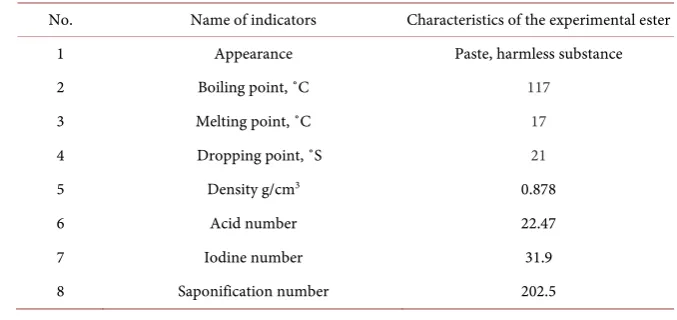
Heating was carried out through the jacket of the reactor. The end of the reac-tion was determined by the amount of water released from the reacreac-tion zone. The basic physical and chemical properties of the obtained ester were deter-mined (Table 1).
[image:3.595.201.540.569.729.2]The resulting product can be used for preparing fatliquoring compositions for fattening leathers.
Table 1. Physicochemical characteristics of the resulting ester.
No. Name of indicators Characteristics of the experimental ester
1 Appearance Paste, harmless substance
2 Boiling point, ˚C 117
3 Melting point, ˚C 17
4 Dropping point, ˚S 21
5 Density g/cm3 0.878
6 Acid number 22.47
7 Iodine number 31.9
DOI: 10.4236/eng.2019.116023 323 Engineering The introduction of the ester into the fat composition allows to obtain a ho-mogeneous fat mixture [6], which increases the viscosity of the fat mixture, and allows the components to bind more firmly to the fibers of the dermis and allows to obtain skins with high strength properties.
On this basis, developed the composition for fattening skin using essential oils in combination with other fat liquoring materials provided that the bunches of fat, imported, expensive, fattening substances (Table 2).
4. Discussion
For experimental study used control and experimental parcels of lamb skins for producing garment leather. The fatliquoring process was carried out in suspen-sion drums.
For the control parcel, a pre-prepared fat mixture with a temperature of 55˚C, pH = 5.5 - 6 was poured through the drum hatch. The processing time of 1.0 - 1.5 h, drum speed of 4 rpm. Consumption of fats was 7.0% by weight of the pressed semi-finished product.
The process of fattening of experimental and control batches of skins was normal. All processes before and after fattening were carried out according to the traditional method.
There were no difficulties in carrying out them. Further processing of the semi-finished product was carried out according to the traditional method.
When using experimental greasing compounds in all cases, there was a dee-pening of color and the absence of plaque on the skin, which significantly in-creases the consumer properties of finished skins.
The test results showed that the use of synthesized ester—as fat components leads to a more uniform distribution of fat in the dermis of the skin and pro-motes uniform staining and filling of the skin.
5. References
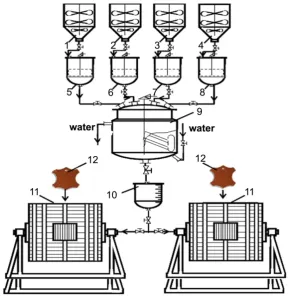
The recommended principal technological scheme of obtaining a composition for fattening of leather-based ester is shown in Figure 1.
Table 2. The components for fatliquoring agents.
No. Name of components
Options, mass.%
Experimental Control test
1 2 3
1 Synthetic oil 45 50 55 60
2 Fish oil 35 25 10 10
3 Ester based on distilled fatty acids with fusel oil 20 25 30 -
4 Synthetic ester of fatty acids based on sebacic acid with ethyl alcohol or ethylene glycol - - - 30
DOI: 10.4236/eng.2019.116023 324 Engineering Figure 1. The basic technological scheme of obtaining a composition for fattening of skins on the basis of ester. 1 - 4 mixers for greasing materials; 5 - 8 measuring instru-ments for greasing materials; 9 reactor for greasing composition; 10 measuring device for fat liquoring composition; 11 drums; 12 semi-finished leather.
Significant changes in technology of fattening of the skin on the basis of the ester increases the role of the process of fattening, with the introduction of fatli-quoring components inside the dermis, with subsequent distribution between the fibers. This helps to reduce friction between them and gives them special properties: elasticity, softness, hydrophobicity and reduces moisture capacity, water permeability, etc.
6. Conclusions
Thus, on the basis of the conducted tests it is established: - a new ester based on by-products was synthesized;
- the basic physical and chemical properties of the obtained ester were deter-mined;
- the use of ester in the fat composition leads to a more uniform process of fat-tening;
- a basic technological scheme for obtaining a composition for the fattening of the skin on the basis of the ester was developed.
DOI: 10.4236/eng.2019.116023 325 Engineering
Acknowledgements
The authors would like to acknowledge Chief Technologist of the “Osiyo- Charm-Fayz” Hoshym Begaliyev for his assistance and support.
Conflicts of Interest
The authors declare no conflicts of interest regarding the publication of this pa-per.
References
[1] Kodirov, T.J., Koshmuratova, I.M., Ruziev, R. and Umarova M.B. (2002) A Study of the Process of Fattening in the Presence of Naphthenic Acids. Scientific Symposium of Young Scientists on “Chemistry and Physics of High-Molecular Compounds”, Tashkent, 30 May 2002, 120-121.
[2] Maksakova, M.A. and Suburban, L.V. (1997) Obtaining Greasing Materials on the Basis of Ethanolamines. Leather-Shoe Industry, No. 4, 40.
[3] Klenovskaya, N. In: Rniikp. M., Ed., New Chemical Materials in the Production of Natural Leather. A Collection of Scientific Research, Invest 2003, 20-22.
[4] Shamsieva, M.B., Kadirov, T.J. and Toshev, A.Yu. (2011) Investigation of the Process of Fattening and the Evaluation of the Properties of Leather for Shoe Soles Solid Hydrocarbon. The Problem of Textiles, No. 2, 60-63
[5] Shamsieva, M.B., Kodirov, T.J., Toshev, A.Y. and Sadikov, N. (2016) New Fatli-quoring Material and the Method of Fattening Leathers Chrome Tanning. Scientif-ic-Technical Journal, No. 2, 45-49.