“
EVALUATION OF PHARMACOPOEIAL STANDARDS
WITH HPTLC PROFILE OF AN IMPORTANT UNANI
FORMULATION - QURS-E-GULNAR”
Asma Sattar Khan*, Farah Ahmed1, Shoeb Ahmed Ansari2, Kiran Negi3
Anas Iqbal Alvi4 and Asma Mirza5
*,1,3,4 and 5Drug Standardization Research Unit, Janakpuri, New Delhi-110058.
2
Drug Standardization Research Institute, Kamla Nehru Nagar Ghaziabad-201002.
ABSTRACT
The preparation of classical Unani formulations is based on traditional methods in accordance with the procedures described in classical texts. Lack of modern pharmacopoeial standards for preparation of these formulations results in batch to batch variations and low quality finished products. The increase in the demand for herbal drugs has led to the need for quality standardization of these drugs. The Drug Standardisation Research Unit under the Central Council of Research in Unani medicine, New Delhi is engaged in developing the standards of classical Unani formulations. The Unani polyherbal formulation, Qurs-e-Gulnar known to be effective in the treatment of chronic diarrhoea, has been standardized at the Unit by following modern scientific quality control procedures. The formulation was subjected to various quality control parameters such as organoleptic evaluations (color, odor, taste, and consistency), physicochemical evaluations (loss on drying, total ash, acid insoluble ash, pH of 1 and 10% solution, water soluble matter and alcohol-soluble matter) and HPTLC analysis. The evaluation of contaminants such as heavy metals, aflatoxins, pesticide residues, and microbial contamination was also carried out in the formulation.
KEYWORDS: SOP, Microscopy, pharmacopoeial parameters, HPTLC, Qurs-e-Gulnar, Quality control.
Volume 8, Issue 10, 1718-1730. Research Article ISSN 2277– 7105
Article Received on 19 July 2019,
Revised on 09 August 2019, Accepted on 29 August 2019,
DOI: 10.20959/wjpr201910-15792
*Corresponding Author
Asma Sattar Khan
Drug Standardization
Research Unit, Janakpuri,
INTRODUCTION
Qurs-e-Gulnar is a Unani poly-herbal formulation categorized under Aqras (tablets) in the National Formulary of Unani Medicine, Part -1.[1] Qurs-e-Gulnar is said to possess Habis (haemostatic) and Qabiz (astringent) action and is used in the treatment of Is’hal-e-Muzmin (chronic diarrhea), Is’hal-e-Damwi (bloody diarrhea) and Nafs-ud-Dam (haemoptysis) (Kabeeruddin). These properties can be attributed to the presence of ingredients like Gulnar (Punica granatum L.), Gil-e-Armani (Aluminium silicate), Samagh-e-Arabi(Acacia nilotica
L. Wild ex. Del), Gul-e-Surkh(Rosa damascena Mill), Aqaqia (Acacia nilotica L. Wild ex. Del) and Kateera (Cochlospermum religosum (L) Alston).
Gulnar, the sterile flowers of Punica granatum, are used in Unani medicine for treatment of dysentery, hematemesis, epistaxis etc.[2] Gil-e-Armani is a mineral origin drug used in Unani medicine for its Qabiz(astringent) and Mujaffif (dessicant) properties in the treatment of bleeding disorders and diarrhea.[3] Samagh-e-Arabi, which is the gum of Acacia nilotica L. Wild ex. Del contributes to astringent property of the formulation and also acts as a binding agent for the tablet.[4]
The present study was aimed to standardize this important Unani drug in order to ensure its authenticity, quality and efficacy. The drug was prepared at laboratory scale at DSRU, New Delhi. According to the formulation composition of the drug, Qurs-e-Gulnar is composed of 6 ingredients (Table 1) in which 5 ingredients are of plant origin and one is mineral origin as described in NFUM-I.[1]
Table 1: Formulation composition.
S.No. Ingredients Botanical Name/English Name Part used Form
1. Gulnar Punica granatum L. Flower Powder 2. Gil-e-Armani Aluminium silicate powder Powder 3. Samagh-e-Arabi Acacia nilotica L. Wild ex. Del Gum Powder 4. Gul-e-Surkh Rosa damascene Mill Flower Powder 5. Aqaqia Acacia nilotica L. Wild ex. Del Extract of pods Powder 6. Kateera Cochlospermum religosum (L) Alston Gum Powder 7. Aab-e-Gulnar Punica granatum L. Infusion Liquid
parameters, HPTLC, heavy metal estimation, aflatoxins, microbial load and pesticide estimation not reported so far to prove the scientific validation of the drug Qurs-e-Gulnar.
MATERIALS AND METHODS
Preparation of drugs
All the ingredients were procured from local raw drug dealer and were identified botanically[6,7] using pharmacognostical methods. The ingredients were further validated by comparing with the monographs available in UPI (Part I), Vol. III & IV.[8]
All the ingredients were taken of pharmacopoeial quality. The ingredients were cleaned and dried under shade to remove the moisture if any. The ingredients (S.No. 1 to 6, Table 1), were crushed separately in an iron mortar to obtain a coarse powder. The coarse powder was further ground in a mixer grinder to get the fine form. The fine powder was mixed thoroughly and sieved through mesh no. 80. Aab-e-Gulnar was added to the mixture and again mixed thoroughly to obtain the lubdi (mass). The Qurs were prepared from the lubdi (mass) and dried under shade. The prepared Qurs were stored in tightly closed glass container free from moisture and kept in a cool and dry place.
Microscopy
5gm of the powdered drug was taken and stirred gently with hot water in a beaker. The supernatant was discarded and the residue was washed with the distilled water. A little residue was stained with iodine solution and mounted in 50% glycerin. Some of the residue was heated in chloral hydrate solution and mounted in 50% glycerin and a little residue was boiled in 2% potassium hydroxide solution, washed with distilled water and mounted in 50% glycerin.[6,7,9]
Physico-chemical Analysis
The physico-chemical parameters of Qurs-e-Gulnar such as removal of foreign matters, moisture contents, extractive values (solubility in water, ethanol and hexane), ash values (total ash and acid insoluble ash), pH values (1% and 10% aqueous solution) and volatile oil estimation were analyzed by standard methods.[10, 11]
Quality control Analysis
estimation was carried out as per the guidelines.[12] Heavy metal analysis was done by atomic absorption spectrophotometer.[13] Analysis of aflatoxins was performed by TLC method.[12] Pesticide residues were analyzed using GC-MS Agilent instrument equipped with mass selective detector as per the methods of AOAC (2005)[13] and (Anonymous, 2000).[12, 14]
HPTLC Analysis
The prepared drug was extracted separately with chloroform and ethanol under refluxing conditions on a water bath for about 30 minutes and then filtered. The extracts were concentrated and made up to 10ml in a volumetric flask separately. These solutions were used for the HPTLC finger print analysis by employing CAMAG Linomat IV sample applicator on aluminum TLC plate pre-coated with silica gel 60 F245 (E. Merck). The plate
was developed up to the distance of 8cm in the chamber (10x10), using 10ml of the developing system Toluene; ethylacetate (9:1) as mobile phase. The plate was dried at room temperature, observed and scanned under UV 254nm and UV 366nm. Further the plate was dipped in 1% vanillin-sulphuric acid reagent and heated at 105o C till colored spots appeared.[5, 16, 17]
OBSERVATIONS
[image:4.595.201.393.503.693.2]Qurs-e-Gulnar is a reddish brown tablet with mild pleasant odor and mucilaginous taste. The drug did not show any filth, fungus or objectionable matter while the sample was spread in a petri dish. (Fig.1).
Fig. 1: Qurs-e-Gulnar.
On examination under microspcope, following cells/tissues/cell contents were observed:
1. Abundant glandular trichomes consisting of uniseriate stalk and a globular head. Very occasionally, there is no stalk and the gland is sessile.
2. Fragmentof calyx in surface view consisting of thick walled parenchyma cells with glandular trichomes.
3. Fragment of epidermal cells of the petals in surface view consisting of slightly thick walled, parenchymal cells with slightly sinuous outline (Fig 2a,b,c).
Fig. 2(a): X40 Trichomes of Gulnar.
Fig. 2(b): X40 Fragment of sepal of Gulnar with Trichomes.
[image:5.595.185.413.208.366.2] [image:5.595.189.408.408.553.2] [image:5.595.191.406.595.744.2]Gul-e-Surkh, Rosa damascena Mill (flower)
1. Fragment of epidermal cells of the petals in surface view appear rectangular or somewhat elongated, moderately thick walled with sinuous outline.
2. Fragment of sepals consisting of polygonal to oval parenchymal cells slightly thick walled having elongated trichomes.
3. Numerous long, unicellular, unseptate, non-glandular trichomes(Fig 2d,e,f).
Fig. 2(d): X40 Epidermal cells of Gul-e-Surkh petal.
Fig. 2(e): X40 Fragment of Gul-e-Surkh sepal showing trichomes.
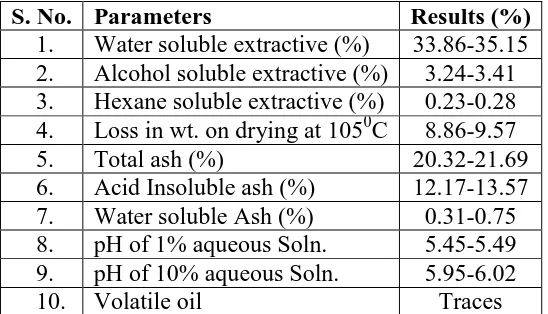
[image:6.595.192.404.210.360.2] [image:6.595.191.405.400.550.2] [image:6.595.188.408.591.742.2]The results observed for the physico-chemical data, microbial load, aflatoxins, pesticideresidues, heavy metals and HPTLC profile are shown in Table 2, 3,4,5,6 & 7 respectively.
Table 2: Physico-chemical Parameters.
S. No. Parameters Results (%)
1. Water soluble extractive (%) 33.86-35.15 2. Alcohol soluble extractive (%) 3.24-3.41 3. Hexane soluble extractive (%) 0.23-0.28 4. Loss in wt. on drying at 1050C 8.86-9.57 5. Total ash (%) 20.32-21.69 6. Acid Insoluble ash (%) 12.17-13.57 7. Water soluble Ash (%) 0.31-0.75 8. pH of 1% aqueous Soln. 5.45-5.49 9. pH of 10% aqueous Soln. 5.95-6.02 10. Volatile oil Traces
Table 3: Microbial load.
S. No. Parameter Analyzed Results Permissible limit as per WHO
1. Total Bacterial count 1 x10² cfu / gm 105 cfu / gm
2. Enterobacteriaceae Absent Nil
3. Salmonella spp. Absent Nil
4. Escherichia coli Absent Nil
5. Staphylococcus aureus Absent Nil
6. Pseudomonas aeruginosa Absent Nil
7. Total Fungal count Less than 1 cfu/gm 103 cfu / gm
Table 4: Aflatoxins level.
S. No. Parameter Analyzed Results Permissible limit as per WHO
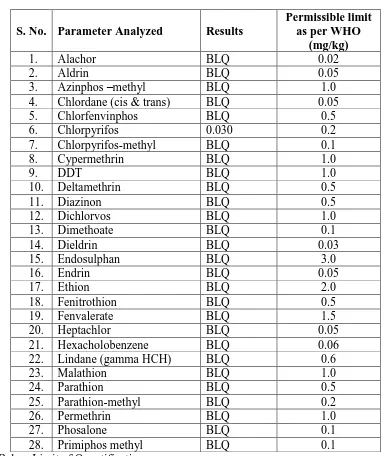
Table 5: Pesticide residue.
S. No. Parameter Analyzed Results
Permissible limit as per WHO
(mg/kg)
1. Alachor BLQ 0.02
2. Aldrin BLQ 0.05
3. Azinphos –methyl BLQ 1.0 4. Chlordane (cis & trans) BLQ 0.05 5. Chlorfenvinphos BLQ 0.5 6. Chlorpyrifos 0.030 0.2 7. Chlorpyrifos-methyl BLQ 0.1 8. Cypermethrin BLQ 1.0
9. DDT BLQ 1.0
10. Deltamethrin BLQ 0.5 11. Diazinon BLQ 0.5 12. Dichlorvos BLQ 1.0 13. Dimethoate BLQ 0.1 14. Dieldrin BLQ 0.03 15. Endosulphan BLQ 3.0 16. Endrin BLQ 0.05 17. Ethion BLQ 2.0 18. Fenitrothion BLQ 0.5 19. Fenvalerate BLQ 1.5 20. Heptachlor BLQ 0.05 21. Hexacholobenzene BLQ 0.06 22. Lindane (gamma HCH) BLQ 0.6 23. Malathion BLQ 1.0 24. Parathion BLQ 0.5 25. Parathion-methyl BLQ 0.2 26. Permethrin BLQ 1.0 27. Phosalone BLQ 0.1 28. Primiphos methyl BLQ 0.1 BLQ-Below Limit of Quantification
Table 6: Heavy Metals.
S. No. Parameter Analyzed Results Permissible limit as per WHO (ppm)
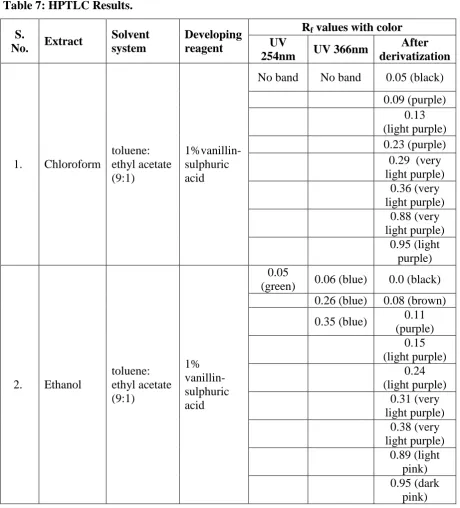
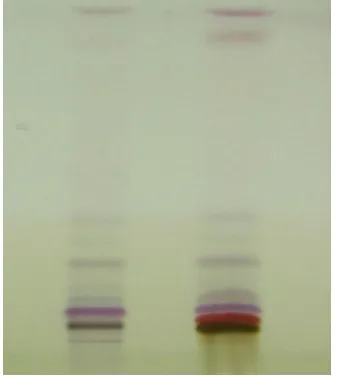
Table 7: HPTLC Results.
S.
No. Extract
Solvent system
Developing reagent
Rf values with color UV
254nm UV 366nm
After derivatization 1. Chloroform toluene: ethyl acetate (9:1) 1%vanillin-sulphuric acid
No band No band 0.05 (black) 0.09 (purple)
0.13 (light purple) 0.23 (purple) 0.29 (very light purple) 0.36 (very light purple) 0.88 (very light purple) 0.95 (light purple) 2. Ethanol toluene: ethyl acetate (9:1) 1% vanillin-sulphuric acid 0.05
(green) 0.06 (blue) 0.0 (black) 0.26 (blue) 0.08 (brown) 0.35 (blue) 0.11
Chloroform ext. Ethanol ext. Chloroform ext. Ethanol ext.
UV 254nm UV 366nm
Fig. 3(a) Fig. 3(b)
Chloroform ext. Ethanol ext.
After Derivatization
Fig. 3(c)
RESULTS AND DISCUSSION
Physico-chemical Analysis
[image:10.595.340.508.73.245.2] [image:10.595.90.252.74.249.2] [image:10.595.214.383.330.519.2]value is low (0.31-0.75%). The aqueous extract of the drug was slightly acidic as pH of aqueous solution falls in the range of 5-6. The volatile oil is in traces only.
Quality Control Analysis
Microbialload
Microbial content of the drug is given in Table 3. The estimation gives the tentative idea to assess the quality and safety of the drug prepared. The assessment is done for estimating the total viable count of bacteria, total fungus count, count of bacteria belonging to the
Enterobacteriaceae family, count of pathogens like E. coli, Staphylococcus aureus and
Salmonella spp. The results indicate the microbial load to be within the permissible limit prescribed by WHO indicating that the drug is safe for internal use for the treatment of prescribed aliments.
Aflatoxins
The results of aflatoxins in the drug are given in Table 4. Aflatoxins are toxic metabolites produced by a variety of molds such as Aspergillus flavus, A. parasiticus and A. nomius. The results do not show any evidence for the presence of any of the aflatoxin contents (B1, B2, G1, and G2).
Pesticidalresidues
The results of pesticidal residues are given in table 5. Production of herbal drugs according to good agricultural practices with no pesticides is very difficult due to several factors. Estimation of pesticides in the samples became a major task and the drug was analyzed using GC-MS (detection limit up to 0.01ppm). The results indicated the drug to be free of pesticide residues and safe for use.
HeavymetalAnalysis
HPTLCProfile
The results of HPTLC Profile are given in Table 7. HPTLC Profiling is very reliable and convenient for identification of crude drugs as well as compound formulations as plant species produces a distinct chromatogram. HPTLC photograph of Qurs-e-Gulnar with both solvent system was observed under UV 254nm, UV 366nm and after derivatization. The chromatogram of chloroform extract shows no band under UV 254nm and UV 366nm and shows 8spots after derivatization. The chromatogram of ethanol extract shows 1 spotunder UV 254nm, 3 spots under UV 366nm and 9 spots after derivatization. (Fig.3a,3b&3c).
CONCLUSION
It can be concluded that organoleptic parameters are not much reliable in identification of herbal drug as the ingredients are powdered and mixed together for preparing compound formulation. The present study therefore holds high significance as the microscopic features; various physico-chemical parameters, HPTLC profile etc. provide criteria for easy identification of the drug Qurs- e-Gulnar and quality control analysis ensure the authenticity, quality and efficacy of the medicine.
ACKNOWLEDGEMENT
The authors are extremely thankful to Director General, CCRUM, New Delhi for his constant encouragement and valuable guidance. We are also thankful to DSRU, Chennai and DSRI, Ghaziabad for providing necessary assistance. A special thanks to my team, DSRU, New Delhi for their support.
REFERENCES
1. Anonymous. National formulary of Unani medicine, Part-1, C.C.R.U.M., Ministry of Health and Family Welfare, Govt. of India, New Delhi, 2006: 41.
2. Kabiruddin, Makhzanul-Mufradat, Principal, Tibbiya College, Delhi: pp 55, 74, 75, 112, 145, 546, 590, 591.
3. Quasmi IA. Kitabul Mufradat. Aligarh: Universal Book House, 2001; 36-37. 4. Kabiruddin M. Makhzanul Mufradat. New Delhi: Idara Litabus Shifa, 2007; 354.
5. Ali SS. Unani Advia Mufarada. New Delhi: Quami Council Barai Farog Urdu Zaban, 1979; 46-47.
6. Wallis TE. Textbook of Pharmacognosy, 3rd ed. J & A Churchill Ltd., London, 1967; 493, 494, 578.
8. Unani Pharmacopoeia of India, Part 1, Vol. III, & VI, Ministry of Health and Family Welfare, Govt. of India, pp 33(vol. III) & 33,66 (vol. VI).
9. Johansen DA. Plant microtechniques, Mc-Graw Hill book company Inc. New York and London: 1940; 65-105.
10.Anonymous. Physico-chemical standards of Unani formulations, Part-III. CCRUM, Govt. of India, New Delhi: 1991; 158-159.
11.WHO. Quality control methods for herbal materials, World Health Organization, Geneva, 2011; 29-32.
12.WHO. WHO Guidelines for assessing the quality of herbal medicines with reference to contaminants and residues, World Health Organization, Geneva: 2007; 27-28, 55-68. 13.AOAC. Official Methods of Analysis of AOAC International, Horwitz W. Latiner G W
Ed., 18th edition. AOAC International Maryland, Chapter, 2005; 10: 17-23.
14.Anonymous. Official Methods of Analysis Association of Official Analytical Chemist (AUAC), 17th ed. Arlington, USA: 2000; 38-60.
15.Wagner H, Bladt S. Plant Drug Analysis – A Thin Layer Chromatography Atlas, 2nd ed., Springer Verlag, Germany: 1996; 1-3: 293-303.
16.Sethi PD. High Performance Thin Layer Chromatography, 1st ed., Vol. X, CBS Publishers and Distributors, New Delhi: 1996; 4-20.