Technology impacts on future urban change in Egypt :
Implications for developing countries.
ABOUKORIN, Antar Abdelall.
Available from Sheffield Hallam University Research Archive (SHURA) at:
http://shura.shu.ac.uk/19192/
This document is the author deposited version. You are advised to consult the
publisher's version if you wish to cite from it.
Published version
ABOUKORIN, Antar Abdelall. (2004). Technology impacts on future urban change in
Egypt : Implications for developing countries. Doctoral, Sheffield Hallam University
(United Kingdom)..
Copyright and re-use policy
See http://shura.shu.ac.uk/information.html
Sheffield Hallam University Research Archive
Fines are charged at 50p per hour
i y y ^ r
22
ilJf; 20os
SpjT*
1
AUG
2008'CprZ'i
ProQuest Number: 10694072
All rights reserved
INFORMATION TO ALL USERS
The quality of this reproduction is dependent upon the quality of the copy submitted.
In the unlikely event that the author did not send a com plete manuscript and there are missing pages, these will be noted. Also, if material had to be removed,
a note will indicate the deletion.
uest
ProQuest 10694072
Published by ProQuest LLC(2017). Copyright of the Dissertation is held by the Author.
All rights reserved.
This work is protected against unauthorized copying under Title 17, United States C ode Microform Edition © ProQuest LLC.
ProQuest LLC.
789 East Eisenhower Parkway P.O. Box 1346
TECHNOLOGY IMPACTS ON FUTURE URBAN
CHANGE IN EGYPT: IMPLICATIONS FOR
DEVELOPING COUNTRIES
A thesis submitted in partial fulfilment of the requirements of
Sheffield Hallam University
for the degree of Doctor of Philosophy
Antar Abdelall Aboukorin
I declare that no portion of the work referred to in this thesis has been submitted in support of an application for another degree or qualification of this or any other university or other institution of learning.
ABSTRACT
TECHNOLOGY IMPACTS ON FUTURE URBAN CHANGE IN EGYPT: IMPLICATIONS FOR DEVELOPING COUNTRIES
Ph.D. Thesis
By: Antar Abdel-All Abou-Korin
September 2004
Since the Industrial Revolution, technology achievements, especially in transportation, have introduced significant changes to city structures and urban systems in both the developed and developing countries. Technology advancements of the Post-Industrial era, especially in telecommunications, are expected to introduce a new substantial wave of urban change. This research examines the future urban impacts of technology in developing countries and aims, in the light of these expected changes, to define the necessary approaches for managing the urban future in these countries.
Based on the theoretical examination of the relationship between technology and urban change, the urban impacts of different technology forces, the analysis of patterns and problems of urban change in Africa and in Egypt, and the analysis of the main problems of the increasing primacy of Greater Cairo Region, the thesis proposes three necessary approaches for managing the urban future in developing countries. These approaches are: urban decentralisation, small-size settlements, and the incremental planning and development of urban activities.
Although the review of current literature demonstrates that these approaches would be effective in managing the urban future in developing countries, and in a further step to confirm the validity of these approaches, the research carried out a forecasting survey of both technology and urban development experts’ opinions and expectations. The statistical analysis of the survey results has revealed that the future impacts of technology on developing countries are expected to be substantial and confirmed that the proposed approaches are valid. Also, this analysis has revealed that existing cities, especially large ones, are expected to face considerable changes regarding their future size and function.
DEDICATION
To
My mother and my father and
ACKNOWLEDGEMENTS
All praise and thanks are due to Allah, my Lord and the Lord of all that exists.
I am grateful to all members of my supervisory panel. I am particularly indebted to Professor Paul Syms, director of studies. His extensive research experience, stimulating suggestions, help and encouragement, in addition to his decent personality have significantly helped me during all the stages of this research. I am also thankful to Mr. Gordon Dabinett for his very useful discussions and critical comments. I am indebted to Dr. Paula Meth, who gave my lots of her time and support. Suggestions made by Gordon and Paula in relation to the direction and the content of the research have significantly helped to maintain its focus and rigour.
I would like to express my gratitude to all technology and urban development experts who participated in my forecasting survey. Their help is invaluable and significantly contributed to this study. I also thank all the academic and administrative members at the Centre for the Built Environment, Sheffield Hallam University for their continuous help and support. Special thanks are due to the librarians at the Adsetts Centre who have offered an efficient and timely service. I am also indebted to all my friends and colleagues at the Department of Architecture, Minia University, Egypt, for their appreciated help in collecting data about urban change in Egypt.
TABLE OF CONTENTS
Abstract... Ill
List of Tables... XII List of Figures...XV Abbreviations...XVIII
CHAPTER ONE
INTRODUCTION: RESEARCH PROBLEM, HYPOTHESIS AND METHODOLOGY...1
1.1 STATEMENT OF THE PROBLEM... 1
1.2 RESEARCH OBJECTIVES...4
1.3 SCOPE OF THE RESEARCH...5
1.4 RESEARCH HYPOTHESIS...7
1.5 RESEARCH METHODOLOGY AND ORGANISATION... 9
CHAPTER TWO AN INVESTIGATION OF THE RELATIONSHIP BETWEEN TECHNOLOGY AND URBAN CHANGE... 16
INTRODUCTION:...16
2.1 TECHNOLOGY - URBAN CHANGE PROCESS...16
2.1.1 Technology and Urbanisation Definitions...16
2.1.1 Technology and Factors Affecting Urbanisation Process...18
2.2 TECHNOLOGY, SOCIAL CHANGE AND URBANISATION...20
2.2.1 Technology Impacts on Society through History...20
2.2.2 Technology and Social Change Theories...22
2.2.2.1 Theories about Technology’s Role in Social Change...24
2.2.2.2 Perceptions about the Future Role o f Technology in Human Development...29
2.2.3 Social Change and Urbanisation:... 32
2.3 TECHNOLOGY, ECONOMIC GROWTH AND URBAN CHANGE...34
2.3.1 Technology and Economic Growth... 34
2.3.2 Economic Growth and Urban Change...35
2.4 TECHNOLOGICAL FORCES AFFECTING URBAN CHANGE... 39
2.5 TECHNOLOGY, GLOBALISATION AND URBAN CHANGE... 40
2.5.1 Technology and Globalisation...40
2.5.2 Globalisation and Urban Change... 41
2.5.2.1 Economic Globalisation and Urban Change...44
2.5.2.2 Cultural Globalisation and Urban Change...46
2.5.2.3 Political Globalisation and Urban Change...47
2.5.2.4 Globalisation and Urbanisation in Developing Countries...47
2.5.3 Globalisation and Technology Transfer to Developing Countries...49
CONCLUSION:... 50
CHAPTER THREE AN ASSESSMENT OF THE URBAN IMPACTS OF THE MAIN TECHNOLOGICAL FORCES...52
INTRODUCTION:...52
3.1 TRANSPORTATION TECHNOLOGIES...53
3.1.1 Transportation as a Tool for Increasing Mobility and Improving Accessibility... 53
3.1.2 Transportation: Increasing Diffusion and Falling Costs...54
3.1.3 Transportation and Space-Time Convergence...55
3.2 TELECOMMUNICATIONS TECHNOLOGIES... 60
3.2.1 Diffusion of Telecommunication Technologies... 60
3.2.2 Growing Reach and Falling Costs... 61
3.2.3 Socio-economic Impacts of Telecommunications...62
3.2.3.1 Emergence and Growth o f Telecommuting Activities:...62
3.2.3.2 Telecommuting and Travel: Main Arguments...63
3.2.3.3 Tele-shopping and E-Commerce:...65
3.2.3.4 Changes to Workplace:...65
3.2.3.5 Changes to Home Environment...66
3.2.4 Telecommunications and Urban Change: Main Debates... 67
3.2.4.1 Cities and Telecommunications Determinism...69
3.2.4.2 Telecommunications: Death o f Distance ’ and Death o f Cities ’...70
3.3 RENEWABLE ENERGY TECHNOLOGIES...74
3.3.1 Advantages of Renewable Energy:... 74
3.3.3 Renewable Energy and Urban Future...78
3.4 URBAN UTILITIES...80
3.4.1 Water Supply Technologies...80
3.4.2 Sanitation Technologies... 82
3.4.3 New Urban Utilities and the Urban Future...83
CONCLUSION:...83
CHAPTER FOUR TECHNOLOGY AND PATTERNS URBAN CHANGE IN DEVELOPING COUNTRIES... 86
INTRODUCTION:...86
4.1 TECHNOLOGY AND PATTERNS OF URBAN CHANGE: THEORETICAL ANALYSIS... 86
4.1.1 Changes in the Size of Urban Settlements...87
4.1.2 Spatial Changes in Urban systems...88
4.2 TECHNOLOGY LEVEL AND PATTERNS OF URBAN CHANGE: INTERNATIONAL DIFFERENCES 92 4.3 PATTERNS OF URBAN CHANGE IN DEVELOPING COUNTRIES: THE CASE OF AFRICA... 100
4.3.1 Patterns of Urban Change in Africa...100
4.3.1.1 Rapid Urbanisation:...100
4.3.1.2 Urban Primacy and Concentration o f Urban Population:...102
4.3.2 Is there a link between economic and urban growth in Africa?... 105
4.3.2.1 Economic Growth and Urbanisation Level in Africa....105
4.3.2.2 Economic Growth and Urban Concentration in Africa...106
4.3.3 Globalization and Urban Change in Africa...107
4.3.4 African Large Cities in the Global Urban System... 108
4.3.5 Urbanisation and the Quality of Life in Large African Cities... 108
4.3.5.1 Urban Poverty and Unemployment:...109
4.3.5.2 Environmental Problems...110
CONCLUSION:... I ll CHAPTER FIVE AN ANALYSIS OF URBAN CHANGE PATTERNS AND PROBLEMS IN EGYPT...113
INTRODUCTION:... 113
5.1 EGYPT: DEVELOPMENT HISTORY AND TECHNOLOGY STATUS...113
5.1.1 Geographic Settings:...113
5.1.2 Development History...114
5.2 PATTERNS AND PROBLEMS OF URBAN CHANGE IN EGYPT...118
5.2.1 Urban Concentration...120
5.2.1.1 Migration from South to North and the Canal Zone...121
5.2.1.2 Migration from the hinterland to Cairo and Alexandria...121
5.2.1.3 Migration Streams: Origin and Destination...122
5.2.1.4 New Towns and Urban Concentration:...125
5.2.2 Differential Growth of Different Settlement Sizes... 126
5.3 PROBLEMS OF URBAN PRIMACY: THE CASE OF CAIRO, EGYPT...129
5.3.1 Primacy Factors in Greater Cairo Region...129
5.3.1.1 Demographic Factors:...129
5.3.1.2 Economic Factors:...131
5.3.1.3 Political Factors:...132
5.3.2 Problems of Urban Primacy in Greater Cairo Region...134
5.3.2.1 Urban Poverty: Social Problems, Housing Shortage, and Slum Growth in GCR... 134
5.3.2.2 Transportation and infrastructure...143
5.3.2.3 Environmental Problems o f GCR's Urban Primacy...145
CONCLUSION:... 147
CHAPTER SIX PROPOSED APPROACHES FOR MANAGING THE URBAN FUTURE IN DEVELOPING COUNTRIES...148
INTRODUCTION:... 148
6.1 URBAN DECENTRALISATION...148
6.1.1 Arguments for Urban Decentralisation... 149
6.1.1.1 Advantages o f Urban Decentralisation for Developing Countries...151
6.1.2 Arguments Against Urban Decentralisation...153
6.1.3 Technology as an Enabler for Urban Decentralisation ...154
6.1.4 An Appraisal of Urban Decentralisation in Egypt... 158
6.1.5 Urban Decentralisation: Approach Assessment...159
6.2 SMALL-SIZE URBAN SETTLEMENT...160
6.2.1 Arguments for Small-Size Urban Settlements...160
6.2.2 Declining Attractiveness of Large Urban Settlements...165
6.2.2.1 Agglomeration Economies Old Arguments...165
6.2.2.2 Environmental Costs o f Large Urban Concentrations...167
6.2.2.3 The Social Costs o f Urban Scale...168
6.2.2.4 Large Cities and the Natural and Human-made Disasters...169
6.2.3 Will Technological Achievements Facilitate the Adoption of Small-Size Settlement Approach?...170
6.2.4 An Appraisal of the Application of Small-Settlements Approach in Egypt...170
6.2.5 Small-Size Urban Settlement: Approach Assessment... 171
6.3 INCREMENTAL PLANNING AND DEVELOPMENT OF URBAN SETTLEMENTS...173
6.3.1 Analysis of Incremental Planning...174
6.3.2 An Appraisal of the Application of Incremental Planning Approach in Egypt...176
6.3.3 Incremental Planning: Approach Assessment...177
CONCLUSION:... 178
CHAPTER SEVEN AN APPLICATION OF FUTURE RESEARCH IN URBAN STUDIES... 179
7.1 ARGUMENTS FOR AND AGAINST FORECASTING STUDIES... 179
7.1.1 Expansion of Urban forecasting Studies:...181
7.2 FORECASTING SURVEY METHODOLOGY...182
7.2.1 Selection of Forecasting Method... 182
7.2.1.1 Anticipatory and Exploratory Approaches...182
7.2.1.2 Judgmental and Statistical Approaches...183
7.2.1.3 Delphi technique:...184
7.2.2 Setting the forecasting time-horizon... 186
7.3 SURVEY DESIGN, SAMPLE SELECTION AND DATA COLLECTION... 188
7.3.1 Questionnaire I - to Science & Technology Experts:...189
7.3.1.1 Questionnaire Design:...189
7.3.1.2 Sample Selection and Data Collection:...189
7.3.2 Questionnaire II - to Science & Technology Experts:...190
7.3.2.1 Questionnaire Design:...190
7.3.2.2 Sample Selection and Data Collection:...191
7.3.3 Questionnaire III - to Urban Development Experts:...191
7.3.3.1 Questionnaire Design:...191
7.2.3.2 Sample Selection and Data Collection:...192
7.4 SURVEY SCORING AND DATA EVALUATION... 194
CONCLUSION:... 195
CHAPTER EIGHT FORECASTING SURVEY: RESULTS ANALYSIS AND DISCUSSION... 197
INTRODUCTION:...197
8.1 QUESTIONNAIRE I: RESULTS ANALYSIS AND DISCUSSION... 198
8.1.1 Characteristics of Experts Group: Area of Interest and Degree of Relevance...198
Question 1:...198
Question 2:...199
8.1.2 Extent and Nature of Expected Technological Change... 200
Question 3:...200
Question 4:...201
8.2 QUESTIONNAIRE II: RESULTS ANALYSIS AND DISCUSSION...202
8.2.1 Experts Relevance to Main Areas of Technology...202
Question 1:...202
Question 2:...203
8.2.2 Expected Impacts of Technology... 204
Question 3:...204
Question 4:...205
Question 5:...207
Question 6:...209
Question 7:...211
Question 8:...213
Question 9:...215
8.2.3 Technology Transfer and its Impacts in Developing Countries...217
Question 10:...217
Question 11:... 218
8.3 QUESTIONNAIRE III: RESULTS ANALYSIS AND DISCUSSION...220
Question 1:...220
8.3.2 Expected Urban Impacts of Main Technological Forces... 221
Question 2:...221
Question 3:...222
Question 4:...223
Question 5:...226
Question 6:...229
Question 7:...231
Question 8:...232
Question 9:...235
8.3.3 Technology and Future New Settlements...237
Question 10:...237
Question 11:...238
Question 12:...240
Question 13:...241
Question 14:...243
8.3.4 Technology and Existing Settlements...245
Question 15:...245
Question 16:...246
8.4 RECEIVED COMMENTS...248
CONCLUSION:...248
CHAPTER NINE FORECASTING SURVEY: AN APPRAISAL OF THE PROPOSED APPROACHES...249
INTRODUCTION:... 249
9.1 EXTENT AND NATURE OF FUTURE TECHNOLOGICAL IMPACTS... 249
Findings:...252
9.2 URBAN DECENTRALISATION APPROACH...253
Findings:...255
9.3 SMALL-SIZE URBAN SETTLEMENTS APPROACH...256
Findings:...259
9.4 INCREMENTAL PLANNING APPROACH...260
Findings:...260
9.5 TECHNOLOGY AND THE FUTURE OF EXISTING SETTLEMENTS... 261
Findings:...262
CONCLUSION:...262
CHAPTER TEN RESEARCH SUMMARY AND CONCLUSIONS...264
10.1 SUMMARY OF FINDINGS...264
10.1.1 Technology and urban change...264
- Technology, Social Change, and Urbanisation:...265
- Technology, economic Growth, and Urban Change:...265
- Technology, Globalisation, and Urban Change:...265
- Urban Impacts o f Main technological Forces:...266
- Technology and Urban Change: Forecasting Survey Results...268
10.1.2 Patterns and Problems of Urban Change in Developing Countries... 269
10.1.3 Proposed Approaches for Managing Urban Future in Developing Countries... 271
10.3 AN APPRAISAL OF THE PROPOSED APPROACHES...272
10.3.1 Urban Decentralisation Approach...272
A-Indications from the Literature Review:...273
B-Indications from the Forecasting Survey:...277
10.3.2 Small-Size Urban Settlements Approach... 278
A-Indications from the Literature Review:...278
B-Indications from the Forecasting Survey:...281
10.3.3 Incremental Planning Approach...283
A-Indications from the Literature Review:...283
B-Indications from the Forecasting Survey:...285
10.4 TECHNOLOGY AND THE FUTURE OF EXISTING SETTLEMENTS...286
10.5 CRITIQUE OF METHODS...287
10.6 CONTRIBUTION TO KNOWLEDGE... 287
10.7 POTENTIALS FOR FUTURE RESEARCH... 289
BIBLIOGRAPHY...291
APPENDIX 1 QUESTIONNAIRE I: FORM AND LIST OF PARTICIPATING EXPERTS...316
Questionnaire I: Form...316
Questionnaire I: List of Participating Experts...318
APPENDIX 2 QUESTIONNAIRE II: FORM AND LIST OF PARTICIPATING EXPERTS...319
Questionnaire II: Form...319
Questionnaire II: List of Participating Experts...322
APPENDIX 3 QUESTIONNAIRE III: FORM AND LIST OF PARTICIPATING EXPERTS... 323
Questionnaire III: Form... 323
Questionnaire III: List of Participating Experts...327
APPENDIX 4 FREQUENCY DISTRIBUTION OF RESPONSES TO QUESTIONNAIRES II AND III...329
A4.1 Frequency Distribution of Responses to Questionnaire II... 329
LIST OF TABLES
Table 2.1: Technological Characteristics of Agricultural, Industrial, and Information Societies21
Table 2.2: Dominant Theories of Socio-Economic Impacts of Technology...24
Table 2.3: Summary of major technological stages and corresponding economical and urban development cycles during 1800-2000... 35
Table 3.1. Growth in passenger-kilometres travelled...54
Table 3.2: Transport technology and urbanisation changes on the local and regional levels 59 Table 4.1: Change in the average size of different size-categories of cities in Africa 1975-2015 (1000)... 103
Table 5.1: Migration movement on the govemorates and regional levels, 1986-1996... 124
Table 5.2: The targeted and percentage occupancy of new cities around Cairo, 1996... 125
Table 5.3: The Number and the Population Change of Different Urban Settlements’ Sizes in Egypt Since 1976... 127
Table 7.1: Main Characteristics of Different Group Communication Techniques... 186
Table 8.1: Frequency distribution of technology experts’ areas of expertise... 198
Table 8.2: Frequency distribution of technology experts’ field of specialisation... 199
Table 8.3: Frequency distribution of technology experts’ areas of expertise...200
Table 8.4: Frequency distribution and descriptive statistics of technology experts’ responses about the main technological achievements expected to influence the future of urban development in the next 30-40 years?... 201
Table 8.5: Frequency distribution of technology experts’ relevance to main areas of technology 202 Table 8.6: Frequency distribution of technology experts’ work relevance...203
Table 8.7: Descriptive statistics of responses to the extent to which current operation and production systems expected to changed in the next Thirty to forty years...205
Table 8.8: Descriptive statistics of responses to the expected influence of technological achievements on urban life during the next 30-40 years...206
Table 8.9: Descriptive statistics of technology experts’ responses to the expected impacts of advancements in urban transport technologies...208
Table 8.10: Descriptive statistics of technology experts’ responses to the expected impacts of renewable energy technologies (solar, wind,, etc) on some urban aspects...210
Table 8.11: Descriptive statistics of technology experts’ responses to the expected change in urban utilities technologies... 211
Table 8.12: Descriptive statistics of technology experts’ responses to the expected impacts of telecommunication and information technologies... 213
Table 8.13: Descriptive statistics of technology experts’ responses to the expected impacts of overall technological achievements on urban patterns...215
Table 8.14: Frequency distribution of technology experts’ responses about how the rate of technology transfer is expected to affect urban life in progressive developing countries in the next 30-40 years...217
Table 8.17: Descriptive statistics of urban experts’ responses to the expected influence of technological achievements on urban life aspects during the next 30-40 years 224 Table 8.18: Descriptive statistics of urban experts’ responses to the expected impacts of urban
transport technologies in developing countries...226 Table 8.19: Descriptive statistics of urban experts’ responses to the expected impacts of
advancements in renewable energy sources in developing countries... 229 Table 8.20: Descriptive statistics of urban experts’ responses to the expected impacts of
technological advancements in urban utilities in developing countries...231 Table 8.21: Descriptive statistics of urban experts’ responses about impacts of
telecommunication & information technology in developing countries during the next 30-40 years... 233 Table 8.22: Descriptive statistics of urban experts’ responses about the expected impacts of
technology on the movement of urban population in developing countries...235 Table 8.23: Descriptive statistics of urban experts’ responses about the expected function of
future urban settlement...237 Table 8.24: Descriptive statistics of urban experts’ responses about the probable ways for the
provision of services in future new urban settlements... 239 Table 8.25: Frequency distribution of urban experts’ responses about the location of future new urban settlements...241 Table 8.26: Frequency distribution of urban experts’ responses about the size of the future new
urban settlements...241 Table 8.27: Frequency distribution of urban experts’ responses about the development of the
future new urban settlements in the next 30-40 years...244 Table 8.28: Frequency distribution of urban experts’ responses about the size of existing urban
settlements in the next 30-40 years...245 Table 8.29: Frequency distribution of urban experts’ responses about the future function of
existing urban settlements in the next 30-40 years... 246 Table A4.1: Frequency distribution of responses to the expected influence of technological
achievements on urban life during the next 30-40 years...329 Table A4.2: Frequency distribution of responses to the expected impacts of advancements in
urban transport technologies... 329 Table A4.3: Frequency distribution of technology experts’ responses to the expected impacts of renewable energy technologies (solar, wind,, etc)... 329 Table A4.4: Frequency distribution of technology experts’ responses to the expected change in
urban utilities technologies... 330 Table A4.5: Frequency distribution of technology experts’ responses to the expected impacts of telecommunication and information technologies... 330 Table A4.6: Frequency distribution of technology experts’ responses to the expected impacts of overall technological achievements on urban patterns...330 Table A4.7: Frequency distribution of the technology experts’ responses about technology
transfer to developing countries... 331 Table A4.8: Frequency distribution of urban experts’ responses to the expected influence of
technological achievements on urban life during the next 30-40 years... 332 Table A4.9: Frequency distribution of urban experts’ responses to the expected impacts of
Table A4.11: Frequency distribution of urban experts’ responses to the expected impacts of technological advancements in urban utilities in developing countries...333 Table A4.12: Frequency distribution of urban experts’ responses about the expected impacts of
telecommunication & information technology in developing countries during the next 30-40 years...333 Table A4.13: Frequency distribution of urban experts’ responses about the expected impacts of technology on the movement of urban population in developing countries 333 Table A4.14: Frequency distribution of urban experts’ responses about the expected function of future urban settlement... 334 Table A4.15: Frequency distribution of urban experts’ responses about the probable ways for
the provision of services in future new urban settlements... 334 Table A4.16: Frequency distribution of urban experts’ responses about the size of the future
new urban settlements... 334 Table A4.17: Frequency distribution of urban experts’ responses about the development of the
future new urban settlements in the next 30-40 years...335 Table A4.18: Frequency distribution of urban experts’ responses about the size of existing urban
settlements in the next 30-40 years... 335 Table A4.19: Frequency distribution of urban experts’ responses about the future function of
LIST OF FIGURES
Figure 1.1: Conceptual Analysis of Research Approaches and Methods...11
Figure 1.2: Research Methodology and Organisation... 13
Figure 2.1: Ways in which technology affects urbanisation... 19
Figure 2.2: Mutual relationships between technology and human development...30
Figure 2.4: The association between nations’ per capita incomes and their levels of urbanization ... 36
Figure 2.5 Structural-Model of Technological on Urban Change Process... 38
Figure 2.4 Main Circuits of Information Economy Flow Among Regional 'World Cities' 43 Figure 2.2: Growth of technology transfer payments and foreign direct investments inflows to developing countries during 1976-1995...50
Figure 3.1: Urban transport and changes in urban patterns...57
Figure 3.2 Impacts of Information Technology on Urban System Components...68
Figure 3.3: Technology as an Enabler for Social Decisions- i.e. the decision to move... 70
Figure 4.1: Historical changes to the physical form of settlements...87
Figure 4.2: Generalised Stages of Differential Urbanisation...88
Figure 4.3: Conceptual Phases of Urban Change Process... 90
Figure 4.4: Urban population shares of urban settlements of more than 10 million inhabitants 93 Figure 4.5: The average size of urban settlements of more than 10 million inhabitants... 94
Figure 4.6: Urban population shares of urban settlements of 5-10 million inhabitants...95
Figure 4.7: The average size of urban settlements of 5-10 million inhabitants... 95
Figure 4.8: Urban population shares of urban settlements of 1-5 million inhabitants...96
Figure 4.9: The average size of urban settlements of 1-5 million inhabitants... 97
Figure 4.10: Urban population shares of urban settlements of 500,000-1 million inhabitants... 98
Figure 4.11: The average size of urban settlements of 500,000-1 million inhabitants... 98
Figure 4.12: Urban population shares of urban settlements of less than 500,000 inhabitants.... 99
Figure 4.13: Growth of urban and rural populations in Africa during 1950-2030... 101
Figure 4.14: Growth of urban population percentage in Egypt and South Africa during 1950-2030... 102
Figure 4.15: Change in the percentage of urban population in different size-categories of cities in Africa 1975-2015... 103
Figure 5.1: Geographic Settings of Egypt...114
Figure 5.2: Egypt’s Temporal Urban and Total Population Growth... 118
Figure 5.3: Egypt’s urban and total population growth during the last two centuries... 119
Figure 5.4: Geographic distribution of the Egyptian govemorates and Planning Regions 122 Figure 5.5: Urban/Rural Migration by Type of Movement, Egypt, 1976-1996... 123
Figure 5.7: Percentage of net urban migration at the regional level, 1996... 124
Figure 5.8: New cities, satellite towns, and new settlements around Greater Cairo Region...126
Figure 5.9: The Greater Cairo Region (GCR)...130
Figure 5.10: Types and Scale of Urban Poverty in Egypt...135
Figure 6.1: Technology and the Spatial Dimensions of Urban development... 156
Figure 7.1: Characteristics of Forecasting Methods and Their Relationships... 184
Figure 7.2: Stages of conducting the forecasting Survey...188
Figure 8.1: Frequency distribution of technology experts’ areas of expertise... 199
Figure 8.2: Frequency distribution of technology experts’ areas of expertise...200
Figure 8.3: Expected influence of different technological sectors on the future of urban development in the next 30-40 years...201
Figure 8.4: Frequency distribution of technology experts’ relevance to main areas of technology ... 203
Figure 8.5: Frequency distribution of technology experts’ work relevance...204
Figure 8.6: Frequency distribution of responses to the expected influence of technological achievements on urban life during the next 30-40 years... 207
Figure 8.7: Frequency distribution of responses to the expected impacts of advancements in urban transport technologies... 209
Figure 8.8: Frequency distribution of technology experts’ responses to the expected impacts of renewable energy technologies (solar, wind,, etc)...211
Figure 8.9: Frequency distribution of technology experts’ responses to the expected change in urban utilities technologies...212
Figure 8.10: Frequency distribution of technology experts’ responses to the expected impacts of telecommunication and information technologies...214
Figure 8.11: Frequency distribution of technology experts’ responses to the expected impacts of overall technological achievements on urban patterns...216
Figure 8.12: Frequency distribution of the technology experts’ responses about technology transfer to developing countries... 219
Figure 8.13: Frequency distribution of responses about experts’ relevance to the main areas of expertise... 221
Figure 8.14: Frequency distribution of responses about the expected technology impacts on urban development in developing countries...222
Figure 8.15: Frequency distribution of urban experts’ responses about the expected influence of different technology sectors on urban development future... 223
Figure 8.16: Frequency distribution of urban experts’ responses to the expected influence of technological achievements on urban life during the next 30-40 years...225
Figure 8.18: Frequency distribution of urban experts’ responses to the expected impacts of advancements in renewable energy sources in developing countries...230 Figure 8.19: Frequency distribution of urban experts’ responses to the expected impacts of
technological advancements in urban utilities in developing countries...232 Figure 8.20: Frequency distribution of urban experts’ responses about the expected impacts of
telecommunication & information technology in developing countries... 234 Figure 8.21: Frequency distribution of urban experts’ responses about the expected impacts of
technology on the movement of urban population in developing countries... 236 Figure 8.22: Frequency distribution of urban experts’ responses about the expected function of
future urban settlement...238 Figure 8.23: Frequency distribution of urban experts’ responses about the probable ways for the provision of services in future new urban settlements... 240 Figure 8.24: Frequency distribution of urban experts’ responses about the size of the future new urban settlements... 243 Figure 8.25: Frequency distribution of urban experts’ responses about the development of the
future new urban settlements in the next 30-40 years... 244 Figure 8.26: Frequency distribution of urban experts’ responses about the size of existing urban settlements in the next 30-40 years...246 Figure 8.27: Frequency distribution of urban experts’ responses about the future function of
ABBREVIATIONS
CAPMAS...Central Agency for Public Mobilisation and Statistics, Egypt D GE... Directorate-General for Energy, European Commission DTI... Department of Trade and Industry, UK
EIA... Energy Information Administration, USA FD I... Foreign Direct Investments
GCR... Greater Cairo Region GLC... Greater London Council
GOPP... General Organisation for Physical Planning, Egypt ICTs... Information and Communications Technologies IMF... International Monetary Fund
InfoDev...The Information for Development Program, World Bank Group ITU... International Telecommunication Union
kWh... kilowatthour. An SI unit of energy measurement, 1 kW for 1 hour LDCs... less-developed countries
MENA Report Middle East and North Africa, Business Report
MHNCU...Ministry of Housing, New Communities and Utilities, Egypt M oH... Ministry of Housing, Egypt
M W ... Megawatt. An SI unit of power measurement (1,000 kW) NICs... Newly Industrialized Countries
NUPS... National Urban Policy Study, Egypt PV... Photovoltaic
PWV... Pretoria-Witwatersrand-Vereeniging metropolitan region, Johannesburg RCP... Rational Comprehensive Planning
R ES... Renewable Energy Sources
RO Units...Reverse Osmosis Water Filtering Units For Safe Drinking Water SAPs... Structural Adjustment Programmes
SFD... Social Fund for Development, Egypt
SIDA... Swedish International Development Cooperation Agency SIS... State Information Service, Egypt
SPECTRE...Spatial Planning & Emerging Communication Technology in the Regions of Europe SPSS... Statistical Package for the Social Sciences
SSA... Sub-Saharan Africa SSA... Sub-Saharan Africa
TETC... Transit and External Traffics Committee, Egypt TIW ... Telesystem International Wireless
TNCs... Transnational Corporations TTP... Technology Transfer Payments
UK- DFID...UK Government Department for International Development UN, DESA...United Nations, Department of Economic and Social Affairs UNCHS...United Nations Centre for Human Settlements, Habitat UNCTAD...United Nations Conference on Trade and Development UNDP... United Nations Development Program
UNESCO...United Nations Educational, Scientific, and Cultural Organisation
UNPD... United Nations Population Division, Department of Economic and Social Affairs US DOT, BTS United States Department of Transportation, Bureau of Transportation Statistics. US, CIA...United States, Central Intelligence Agency
Chapter One
INTRODUCTION: RESEARCH PROBLEM, HYPOTHESIS AND
M ETHODOLOGY
1.1 STATEMENT OF THE PROBLEM
Throughout history, since the Stone Age through the Industrial Revolution and into the Post-Industrial era, civilisations have been characterised by the type of technology they use. In all civilizations, technology has played a significant role in shaping the city, both physically and socially. Technology has been, and is expected to continue being, a powerful dynamic force of change in city structure and urban systems (Mumford 1961; Morris 1972; Fathy 1991). The structural analysis of any old city clearly reveals the impact of the subsequent technological statuses on the city structure. Also, technology has significantly altered the city function within its regional settings. Although gathering people in cities was the best way for defending them during the pre-industrial era, this situation has completely reversed after the proliferation of mass-destruction weapons of the Industrial and Post-Industrial eras.
In Greco-Roman cities, improvements in basic infrastructure such as the introduction of sewerage systems and water supply networks greatly altered building arrangements and the urban environments of these cities. For the industrial city, the generation of electrical power and the motorcar brought about dramatic changes. Electricity has led to the creation new machinery and manufacturing techniques for mass production in large factories. It also led to the creation of new modes of transportation - the tramway, which dispersed social activities into wider areas. Motorcar radically altered accessibility between residents, materials, and markets. It broke down the existing pedestrian network patterns (Mumford 1961). The motorcar was the prime factor in the emergence and development of suburbs, satellite towns, and residential expansion at the growing edges of most metropolitan areas (Clawson 1971; Fathy 1991).
Due to these rapid and impressive changes, almost all cities are currently suffering serious problems. Cities such as Cairo, Delhi, Tehran, which were very effective in meeting their population needs hundred years ago are now suffering very serious physical, socio-economic, and environmental problems on the local and regional levels. Moreover, some of Ebenezer Howard’s planned garden cities in England; such as Letchworth built in 1903 and Welwyn built in 1920, are suffering serious problems nowadays. In addition, serious problems of urban concentration, as a result of acute regional imbalances in the distribution of urban population, are evident in almost all developing countries.
Although technological achievements of the 20th century was very rapid and impressive, future technological achievements, especially in the area of information technology, transportation, and infrastructure, are expected to be faster and more influential in shaping the urban future. Despite this, many new towns under construction in developing countries, such as Egypt, are planned according to the prevailing technical, economic, and social conditions without taking into account the impact of the future technological achievements.
Technology transfer to developing countries, especially in the areas of information technology and telecommunications, is very rapid. Despite its short age, Internet is widely spread in some of the developing countries at a rate that is higher than that it reached in some developed countries only five years ago. In areas of satellite channels and the cellular phone, the situation is not an exception. The TV, telephone, and car ownership rate in some of the developing countries such as Egypt is higher than that of some developed countries only ten years ago (CAPMAS 2000).
addition, Egypt constructed the Cairo underground metro to be the first in Africa and the Middle East. The first metro line was opened to service in 1987. This 42 km line is currently carrying about one million passengers every day. The second metro line, about 20 km long, was opened to service in 1999 and designed to carry some 4 million passengers every day. These few indicators show how much technological achievements have influenced urban development in developing countries (section 5.1.3).
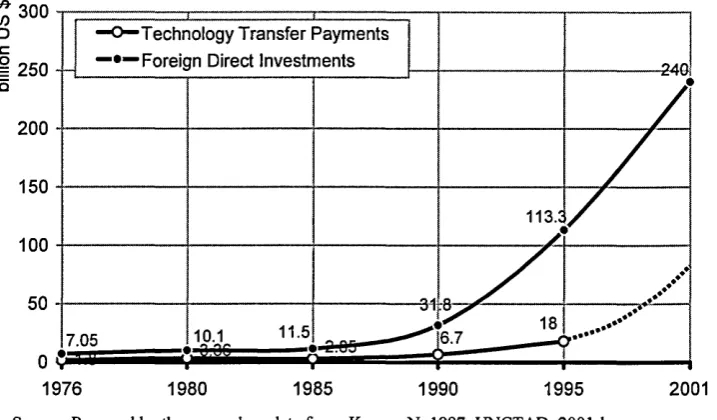
Such trend of increasing technological capabilities of developing countries is expected to continue growing rapidly as technology transfer activities are considerably increasing (Kumar, N. 1997; UNCTAD, 2001-a). This is mainly because technology transfer is of mutual benefit for both the developed and developing countries. For developed countries, it offers good opportunities to open new markets, and for developing countries, it is a necessity to produce competitive products and exploit natural resources. Investments of technology producing companies in developing countries, especially through joint ventures, have increased in the last decades. Therefore, technology products and achievements of developed countries, especially in areas of information technologies, telecommunication, and transportation, transfer very quickly to developing countries (section 2.5).
The main problem here is that developing countries are not well prepared to deal with the expected substantial social and economic impacts of these technologies. These impacts are expected to be of considerable influence in shaping the urban future in these countries.
growth of the different settlement sizes as large cities are usually growing faster than smaller ones, which usually lose their population in favour of larger cities. In 2003, 51% of the country’s urban population were in only 2 large cities of over a million people in size: Greater Cairo 38 percent, and Alexandria 13 percent.
These mounting problems clearly demonstrate that developing countries are facing serious urban problems that are expected to be further aggravated if alternative approaches to urban development, that take into account the current and the future socio-economic and urban impacts of technology advancements, are not appropriately developed and applied.
1.2 RESEARCH OBJECTIVES
The main objective of this thesis is to find out how technology will influence the future of urban development in developing countries and to define the necessary approaches needed manage the urban future in these countries. But, it is not the objective of the thesis to forecast how the urban future in developing countries will be, but rather how it should be. In that context, the thesis has three objectives:
1. To investigate the relationship between technology and urban change and to explore the urban impacts of technological achievements in the areas of transportation, telecommunication, and infrastructure. Investigating such relationship is of considerable importance for the development of urban development approaches necessary to manage the urban future in developing countries.
2. To examine the nature and extent of the main urban change problems in developing countries and how they are different from those in more developed countries. Defining these problems is of considerable importance in devising and developing the necessary urban development approaches that could utilise future technological achievements in addressing these problems.
Taking into account the fact that managing the development of new urban settlements is not enough to achieve a more balanced and more sustainable urban development process, the thesis aims to define the expected impacts of future technological achievements on existing cities and to define the most appropriate future function and size of these settlements.
1.3 SCOPE OF THE RESEARCH
Because the scope of the thesis is mainly about technology and urban change, it is important to explain how the thesis views the role of technology in society. Although there are many schools of thought on this subject, the thesis does not view technology as an autonomous or deterministic factor, but rather as a tool for human development that enables people to increase their incomes, improve their living standards, and participate more in their communities. In addition, and concerning urban analysis, considering technology as the prime cause for urban change seriously underestimates the social and political factors in this process (section 3.2.4.1).
The thesis focuses on developing countries, and mainly those experiencing increasing technological capabilities and improving economic and social conditions. This is mainly because these countries are facing or are expected to face increasing social and economic impacts of technologies and having a good opportunity to manage their urban future. The thesis focuses on Egypt, as an example of these countries, in defining the main urban problems in developing countries. Focusing on Egypt is mainly because the country represents a good example of developing countries experiencing increasing technological capabilities and mounting urban problems and because the researcher is of good experience about urban problems in Egypt. Despite focusing on developing countries, the thesis recommendations may be valid, to some extent, for some of the developed countries as well.
expected to be of considerable importance in shaping future urban development in developing countries.
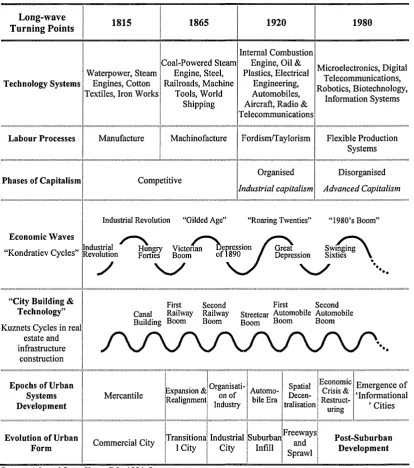
For the time horizon of this study, and because of focusing on urban future in developing countries, a time horizon of about 30-40 years is seen to be more appropriate for the purpose of this study. Taking into account the history of socio economic change, the proposed 30-40 years time-horizon goes well with both the short- and the long-wave economic cycles of Kuznets and Kondratieff (Knox, P.L. 1994, 9). It is the double of Kuznets short-wave cycle (15-20 years) and slightly less than a single long-wave Kondratieff cycle (50 years). However, this time horizon can be regarded as the first phase in a continuous forecasting process to ensure the continuous evaluation and revision of the planning process (section 7.1.2).
Rationale o f Studying the Future Urban Impacts o f Technology in Developing Countries:
Some may argue that studying the future urban impacts of technology in developing countries is unrealistic or irrelevant, as many of these countries have limited technological capabilities when compared to developed countries. Although this argument may seem sound, it neglects the fact that the rate of technological change in developing countries is very high (see 2.5). For developing countries, the utilisation of new technologies is the most economic alternative to overcome the majority of its socio-economic problems mainly in areas of food production, health, energy, and education. This demonstrates the increasing need for technology and consequently its mounting future impacts in developing countries. Moreover, while developed countries are better equipped to utilise and manage its technological change, the sudden and accelerating rate of technological change in progressive developing countries makes the management of future technology impacts in these countries of considerable importance.
technological achievements. The utilisation of these achievements is expected to reduce the costs of their urban programs, especially concerning urban infrastructure.
Although there are many studies that have investigated the future urban impacts of technology in developed countries, this issue is poorly examined in the case of developing countries. This research aims to fill some of this gap through providing a rational assessment of these impacts and defining the necessary approaches for managing future urban changes in these countries.
1.4 RESEARCH HYPOTHESIS
Before formulating the thesis hypotheses, the relevant literature has extensively examined. According to many studies, hypotheses are tentative predication about the nature of the relationship between two or more variables (Gass, 2000; Dixon et al. 1987; Christensen 2004-a). Hypotheses could simply be stated in if-then sentences, that can be categorized in certain logical forms, such as no difference (null hypothesis), associated difference, directionality of difference, and magnitude of difference (Bryman, 2001; O'Connor, 2002, Janda 2001). Blaxter et al. (2001) and Christensen (2004-b) argue that hypotheses should be tested through subjecting them to some sort of empirical scrutiny methods that should be defined in advance.
Accordingly, and based on the review of literature about the nature and extent of technology impacts on urban change the thesis came to the following hypothesis:
That the future technological achievements of the 21st century will have considerable impacts on shaping the urban future in many of the developing countries, as the prevailing economic and social forces and institutions will undergo significant changes.
Based on this hypothesis, and taking into account that while technology has created some urban problems it has opened up new possibilities for urban management, the thesis proposes three complementary approaches, that could be highly facilitated by future technological achievements, for managing the urban future in Egypt:
of work, education, and entertainment, and consequently would facilitate the adoption of such an approach (section 6.1);
Second, Small-size urban settlement is seen as a necessary approach to avoid the problems of current large-scale urban centres and to implement the proposed urban decentralization approach. The thesis argues that small-scale urban settlements approach is more effective and more flexible in meeting the future technological changes and their associated socio-economic impacts. In addition, it argues that this approach ensures, to a reasonable extent, the wise use of investments as it enables the flexibility to build according to actual needs and changing socio-economic and technological conditions. Although there are some constraints on the application of such an approach; mainly concerning accessibility and the provision of infrastructure and basic services; future technological achievements especially in transportation, renewable energy, utilities, and telecommunication are expected to offer reasonable solutions to these constraints and facilitate the adoption of such an approach (section 6.2);
Third, the incremental planning and development of the future urban settlements is a necessary approach to deal with uncertainties that will always exist regarding the nature and extent of future technological change and its urban impacts, especially in developing countries suffering the lack of reliable and systematically organized data. The low occupancy rate in almost all the new towns of Egypt that have been built 25 years ago (section 5.2.1.4) clearly demonstrates that the incremental development could have been a more appropriate approach for the development of such cities. Therefore, the thesis argues that this approach provides better chances for the optimal use of financial and environmental resources as it continuously evaluates the socio-economic, technological, and environmental changes in the society. In addition, the thesis argues that this approach ensures the gradual transition from the existing to the targeted situations and consequently protects societies from the unexpected socio economic impacts of sudden changes (section 6.3).
technology specialist and urban development experts. Through this four-stage process, it is expected that the proposed approaches have been properly developed and assessed.
1.5 RESEARCH METHODOLOGY AND ORGANISATION
If we knew what it was we were doing, it would not be called research, would it?1
Albert Einstein (1879-1955) Before defining the appropriate methodology of this research, it is useful to start by exploring the main advantages and disadvantages of dominant social research types, approaches and methods.
For types of social research, two dimensions are particularly important in classifying types of research (Hakim, 1997; Borgatti, 2000). First: 'Applied' versus 'Basic' research. Applied research is research designed to solve a particular problem in a particular circumstance. Basic research is designed to understand the underlying principles behind human behaviour. Second: 'Exploratory' versus 'Confirmatory' research. Exploratory research is research into a relatively unknown area. Confirmatory research is research into a subject we have a good idea about it. That is when we have a theory (or several theories), and the objective of the research is to find out if the theory is supported by the facts.
For social research approaches to understand the relationship between theory and research, many writers on methodological issues, such as Alan Bryman, (2001) and Oppenheim (1992), classify these approaches into either 'deductive' or 'inductive' approaches. Deductive research usually moves from general ideas/theories to specific particular & situations: the particular is deduced from the general, e.g. broad theories. In such approach, the researcher, and on the basis of what is known about a particular domain and of theoretical considerations in relation to that domain, deduces a hypothesis that must then be subjected to empirical scrutiny. Inductive research moves from particular situations to make or infer broad general ideas/theories. In such approach, the researcher infers research findings for the theory that prompted the whole exercise. The findings are fed back into the stock of theory and the research findings associated with a certain domain of enquiry. However, Bryman, (2001) argues that it is useful to think of the relationship between theory and research in terms of deductive and inductive strategies. He also argues that it is possibly better, to a large extent, to think of deductive and inductive strategies as tendencies rather than as a hard-and-fast distinction.
For social research methods, many writers on methodological issues classify social research methods to either 'quantitative' or 'qualitative' methods (Bryman, 2001; Gephart, 1988; and Oppenheim, 1992). Bryman (2001) argues that the status of the distinction between the two is ambiguous because it is almost simultaneously regarded by some writers as a fundamental contrast and by others as no longer useful or even simply as 'false' (Layder, 1993, 110). However, Bryman (2001) has identified a number of differences between quantitative and qualitative research. Quantitative research emphasizes quantification in the collection and analysis of data. Also, it embodies the view of social reality as an external, objective reality. By contrast, qualitative research emphasizes words rather than quantification in collection and analysis of data. It embodies a view of social reality as a constantly shifting emergent property of individual's creation. Generally (with many exceptions), confirmatory studies tend to be quantitative, while exploratory studies tend to be qualitative.
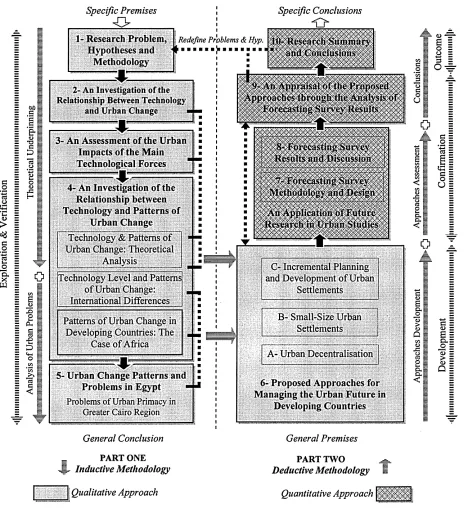
eo
S -l
C5
U
£
ax W
Research Conclusion and Recommendations Formulation of
Research Hypothesis
Theoretical Analysis of T echnology-Urban Change Relationship
Survey of Technology & Urban Development
Experts' Opinions
Technology & Urban Change
Proposed Alternative Urban Development
Approaches
A
e ,©
03
E cc© y
Figure 1.1: Conceptual Analysis of Research Approaches and Methods
The complexity of the construct and research questions of this study necessitated the use of a triangulation approach (multiple methods). Some researchers experienced in using a combination of qualitative and quantitative methods reported that blending and integrating methods and data in studying the same phenomena can "...capture a more complete, holistic and contextual portrayal" of the subject under study, by eliciting data leading to new hypotheses or conclusions, for which single methods would be blind (Pedersen, 1992). Many studies have pointed out the hidden assumption of triangulation: that the weaknesses and limitations of each individual method will be counterbalanced by the other method, exploiting the assets, and neutralizing, rather that compounding, the liabilities (Hilton, 2002; Jick, 1983, Van Maanen, J. 1983).
Regarding the research design, this research can be classified as an exploratory and confirmatory study. Although the thesis started by exploring the relationship between technology and urban change and the possible ways in which technology forces could affect urbanisation in developing countries, it then tries to confirm the role of the proposed approaches for managing the urban future in Egypt by surveying the opinions of both technology and urban development experts about these approaches.
technology and then it examines the urban impacts of the main technology forces.
Then, it tries to examine the relationship between the levels of technology and the different patterns of urban change prevailing in different societies. In doing so, the
thesis presents an analysis of different urban change patterns in the more, less, and least developed countries. Also, Part One presents a detailed investigation of urban change patterns in Africa as a group sample of developing countries, giving more emphasis for patterns of urban change in Egypt and South Africa as they are of the largest urban populations in Africa and having the first two 'Mega Cities' in the continent (UN, DESA, 2002). Finally, Part One presents an extensive analysis of urban change patterns in Egypt and the problems of urban primacy, taking Greater Cairo Region as an example.
PS
u
£(5
>
•oc
O z <u §§
a .2 %->r3 Ui ”Ex w O Specific Premises - o ...
1- Research Problem, Hypotheses and
Methodology
2- An Investigation of the Relationship Between Technology
and Urban Change
3- An Assessment of the Urban Impacts of the Main Technological Forces
S S T T
4- An Investigation of theRelationship between Technology and Patterns of
Urban Change Technology & Patterns of Urban Change: Theoretical
Analysis
Specific Conclusions
Redefine Problems
Technology Level and Patterns of Urban Change: International Differences Patterns of Urban Change in
Developing Countries: The Case of Africa
5- Urban Change Patterns and Problems in Egypt ■
Problems of Urban Primacy in Greater Cairo Region
General Conclusion
C- Incremental Planning and Development of Urban
Settlements
B- Small-Size Urban Settlements
A- Urban Decentralisation
6- Proposed Approaches for Managing the Urban Future in
Developing Countries
General Premises
c = u =
6 1 Q< = O g "3 > = m
<D =
Q |
Vi<D = =
45 = O =
03 = P =
Q . =
< I C = <L> = 6 = £X = O = 13 = > =
PART ONE
Inductive Methodology Deductive MethodologyPART TWO
[image:34.612.63.530.81.613.2]Qualitative Approach Quantitative Approach
Organising the thesis in two parts relates to the combined deductive-inductive method of reasoning to research. The use of the combined method of reasoning is underpinned by a subjective research theory that is based on an ontological assumption of nominalism1; an epistemological assumption of anti-positivism2; and an assumption of voluntarism concerning man-environment relationship3 (Cohen and Manion, 1989). Such methodology usually starts inductively from observations or specific premises in a particular context to form the hypotheses and then deductively from these hypotheses to its application and implications, assessing its validity against the givens of such context. Accordingly, Part One follows an inductive methodology and tries to provide the theoretical and analytical underpinnings of technology and urban change relationship in developing countries. Part Two adopts a deductive methodology that utilises the conclusions of Part One as a basis for proposing alternative urban development approaches for developing countries and to assess the validity of such approaches. Generally, the thesis methodology and organisation can be summarized in the following four points:
First to investigate the theoretical foundations of the relationship between technology and urban change, the current literature on the different schools of thought about technological change and its impacts on the socio-economic and environmental conditions of societies is examined in Chapter Two. Then, a comprehensive review of the expected role of ICTs, transportation, renewable energy, and utilities technologies in shaping the urban future is presented in Chapter Three.
Second, to provide the analytical basis of the research hypothesis, a detailed investigation of the relationship between technology and patterns of urban change is presented in Chapter Four. In this chapter, the thesis empirically examines the main differences in patterns and problems of urban change in countries of different technological statuses (developed, less, and least developing countries) (section 4.2). Finally, the thesis examines the main characteristics and factors affecting urban change patterns and problems in Africa, as a group sample of developing countries (section 4.3). Then, the thesis extensively examines urban change patterns and problems and the technological status of Egypt, as an example of the progressive developing countries (Chapter 5). It also examines the problems of urban primacy in Greater Cairo Region (section 5.3). Through this analysis, the thesis demonstrates two main points: (1) that developing countries are experiencing increasing technological capabilities in all areas of technologies concerned in this
1 Such assumption argues that social reality is a product of personal interpretation - not of independent existence. 2 The epistemological assumption of anti-positivism stresses that knowledge of reality is based on personal
experience and insight - not universally acquired and neutrally transmitted.
research, (2) that these countries suffer some serious urban change problems, regarding the size and the spatial distribution of urban settlements. The thesis argues that these problems could be better managed through urban development approaches that could better address the future impacts of technological achievements.
Third: based on the theoretical underpinning of the future relationship between technology and urban change and on the analysis of ongoing urban change patterns and problems in Africa and in Egypt as an example of developing countries, the thesis proposes three urban development approaches for managing future urban change in developing countries: (1) urban decentralisation, (2) small-size settlements, and (3) incremental planning and development of urban settlements. In developing these approaches, the thesis theoretically investigates the main advantages and drawbacks of each of the proposed approaches and presents an appraisal of their application in Egypt’s case and the role technology achievements in implementing them (Chapter 6).
Fourth, although the proposed approaches have been developed based on an extensive review of literature about technology and urban change and on a detailed examination of urban change patterns and problems in developing countries, the thesis tries to assess the effectiveness and applicability of these approaches in the light of the expected high rate of technological change. In doing so, the thesis employs the Delphi technique to survey the expectations of both technology specialists and urban development experts. The methodology adopted in performing this forecasting study is presented in the survey section in Chapter Seven. The statistical analysis and the discussion of the survey results are presented in Chapter Eight. Based on this analysis and discussion, the thesis presents in Chapter Nine an appraisal of the research hypothesis and the proposed approaches through formulating a synthetic evidence for the validity of each of them from the results of different questions in the three questionnaires of the forecasting survey. It also includes an analysis of the prospects of and constraints on applying the proposed approaches in Egypt.
CHAPTER TWO
AN INVESTIGATION OF THE RELATIONSHIP BETWEEN TECHNOLOGY AND URBAN CHANGE
Introduction:
In order to investigate the relationship between technology and urban change, this chapter starts by a theoretical examination of the technology-urban change process and how technology affects the characterising aspects of urbanisation. The thesis has identified three possible ways through which technology could affect urbanisation: (1) social change, (2) economic growth and (3) technological forces of direct impacts on the physical environment. In addition, and because of the increasing awareness about future impacts of globalisation, the thesis examines how technology affects globalisation and discusses its urban impacts, especially in developing countries.
2.1 TECHNOLOGY - URBAN CHANGE PROCESS
In investigative how technology affects urban change process, the thesis adopted two complementary approaches. First, is to define the characterising features of urbanisation that differentiate between urban and rural communities and then to examine how technology affects these features. Second, is to define the main factors affecting urbanisation process and then to discuss how technology affects each of these factors.
2.1.1 Technology and Urbanisation Definitions
In exploring the relationship between technology and urbanisation, it is important to investigate the impacts of technology on the defining characteristics of urbanisation such as the population size, the economic base, and the lifestyle characteristics of communities. Therefore, the thesis tries here to discuss the different views of how these characteristics are used to differentiate between urban and rural communities and how technology could interfere and change each of these characteristics.
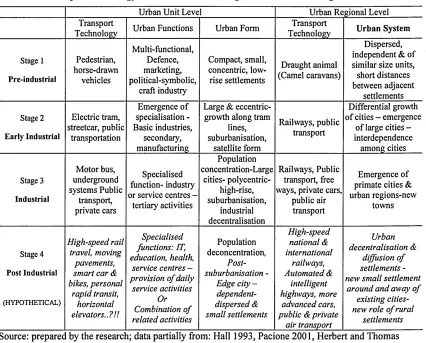
Canada, but 2,500 is the minimum for the USA. Many countries impose much higher thresholds, such as Greece, with 10,000 and Japan with 30,000 (Herbert and Thomas 1997). In Egypt, although the administrative and economic functions are more important than the population size in defining the urban settlement, the size of smallest urban settlement is about 50,000 inhabitants. This diversity is initially confusing, but has some logic if considered with its societal context. Concerning the role of technology in defining settlement size, numerous studies proved that people usually concentrate in centres of better economic and employment opportunities. No doubt that technology is one the main driving forces for economic growth and job creation. The growth of industrial cities during Industrial Revolution era proves the effective role of technology in promoting urbanisation. On the other hand, technology - especially transportation and infrastructure technologies - has considerably facilitated the growth of large cities as it has highly facilitated the rural-urban migration and the emergence of suburbs (Hall 1993; Pacione 2001; Herbert and Thomas 1997; Hart 2001).
Regarding the functions and activities of communities, urban places have at least two kinds of activities that distinguish them from rural settlements. First they are non-agricultural, and second, they are primarily concerned with the exchange rather than with the production of goods. Such criterion, combined with population-size, is employed in India, where a threshold of 75 percent of the adult male population is used (Herbert and Thomas 1997). In this regard, the nature and level of technology available to societies are decisive factors in determining the nature of functions and activities prevailing in different communities. The current classification of countries as developed and developing, which is usually parallel to being industrial or agricultural countries, demonstrates the important role of technology in determining the nature of the main activities prevailing in societies. Moreover, technology is currently introducing many new function