www.wjpr.net Vol 4, Issue 1, 2015. 889
VALIDATION AND ESTIMATION OF ETOPOSIDE IN BULK AND
INJECTABLE DOSAGE FORMS USING RP-HPLC
Deepak Tripathi*1, Mr. Ravinder Mohanty2, Dr. Devender Pathak2,
Hemant Bhardwaj3, Jatin Jaiswal3
1
V.H.B Mediscience Limited Sidcul Rudrapur Uttarakhand. 2
Rajiv Academy for pharmacy, Mathura U.P India. 3
Rakshpal Bahadur College of Pharmacy, Bareilly, U.P. India.
ABSTRACT
A simple, sensitive precise and specified reverse phase high performance liquid chromatographic method was developed and validated for determination of Etoposide in bulk and injectable dosages form. It is found that the excipient in the formulation does not interfere in the quantification of active drug by proposed method. The HPLC separation was carried out by reverse phase chromatography on NH2-(250mm×4.6mm) 5 μm with mobile phase composed of 0.030 M Sodium acetate Buffer pH 4.0: Acetonitrile (70:30) in isocratic mode at flow rate of 1.2 ml/min. The detection was monitored at 254 nm at ambient temperature. The calibration curve of Etoposide is linear from 100 ppm to 300 ppm. The accuracy (recovery 98-102.4%) and reproducibility is satisfactory.
KEYWORDS: Etoposide, RP-HPLC Method, Acetonitrile, Validation.
INTRODUCTION
Etoposide 4-demethyl epipodophyllotoxin 9 (4,6-oethylidine –β-D-glucopyranoside) is a very active drug having pharmacological property to inhibit DNA synthesis and active against cell in G2 phase. And cause DNA break by affecting DNA topoisomerase II function. It is the semi-synthetic derivative of podophyllotoxin with molecular formula: C29H32O13. [1-3]
Article Received on 25 October 2014,
Revised on 15 Nov 2014, Accepted on 07 Dec 2014
Volume 4, Issue 01, 889-894. Research Article ISSN 2277– 7105
*Correspondence for
Author
Deepak Tripathi
www.wjpr.net Vol 4, Issue 1, 2015. 890
OH
OCH3
O
O HO
HO
O O
CH3
H
H3CO
O O
O
[image:2.595.191.408.72.280.2]O
Fig 1: Semi-synthetic derivative of podophyllotoxin
The proposed RP-HPLC method was simple precise and accurate method for determination of Etoposide in bulk and its pharmaceutical dosages form (injection).
MATERIAL AND METHODS
Chemicals and Reagents: Working standard and sample was obtained from V.H.B. Medi
Sciences Rudrapur, Uttarakhand, India. Acetonitrile and water of HPLC Grade were used and other reagents used in study were of analytical reagent grade.
Instrumentation: The determination was carried out on Waters HPLC model 2695 equipped
www.wjpr.net Vol 4, Issue 1, 2015. 891 Table 1-Chromatographic condition
Parameter Optimized Condition
Chromatograph Waters HPLC model 2695 equipped with 2489 UV Visible detector
Column Zorbex NH2 (250mm×4.6mm) 5µm Mobile phase 0.030 M Sodium acetate buffer pH
4.0: Acetonitrile (70:30) isocratic.
Flow rate 1.2 ml/min
Detection 254 nm
Injection volume 20µl
Column temperature Ambient
Preparation of Solutions
Standard Solution: 2000 ppm solution of working standard was prepared in Acetonitrile and
further diluted with mobile phase to prepare 200 ppm standard solution.
Sample Solution: Each vial of sample contains 100mg/5ml of Etoposide. Take 5 ml of sample solution and diluted with mobile phase to prepare solution of 200 ppm with diluent.
Method Validation: Once the method was developed, it is validated according to the I.C.H
guidelines (ICH Guidelines; 2006).[5-6]
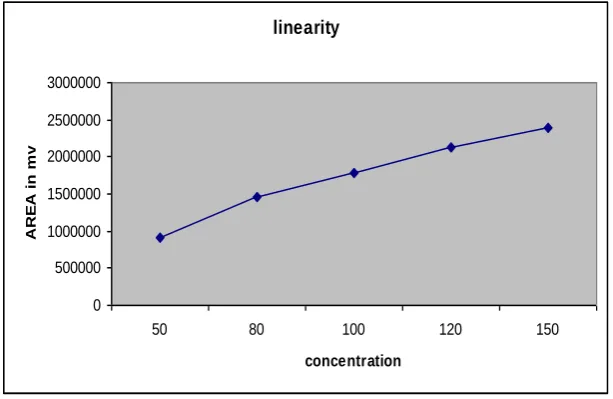
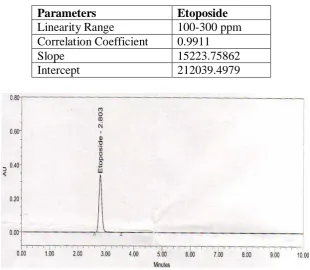
Linearity: The linearity was evaluated by different concentration of standard solution. The concentration was found 100-300 ppm. The calibration curve was plotted between the average area of peak against concentration. The correlation coefficient, slope and intercept found to be 0.9911, 15223.75862, and 212039.4979.[5-6]
Fig. no. 2.0 linearity
0 500000 1000000 1500000 2000000 2500000 3000000
50 80 100 120 150
concentration
A
R
E
A
i
n
m
[image:3.595.152.459.526.725.2]www.wjpr.net Vol 4, Issue 1, 2015. 892 Table -2 Etoposide linearity parameter
Fig. No. 3.0 Chromatogram of Etoposide
System suitability parameter
To check the system suitability standard solution was injected and the tailing factor and theoretical plates were checked.
Precision
Precision was evaluated by carrying out independent sample preparation of a single lot of formulation. The sample was prepared in a same manner. The percentage relative standard deviation was found to be less than 0.5% within a day and day to day variation and cumulative RSD of 18 injections not more than 2.0%.[5-6]
Table-3 Precision of etoposide ppma-part per million
Conc.(ppm) Area Day-1 Area Day-2 Area Day-3
200
1838778.0 1864458-0 1826840.0 1847082.0 1870474.5 1837540.0 1841897.5 1869419.0 1834624.9 1845867.0 1867015.5 1839778.2 1846959.0 1874755.5 1824988.0 1842149.0 1869459.5 1835837.3
%RSD 0.16 0.16 0.29
Parameters Etoposide
Linearity Range 100-300 ppm Correlation Coefficient 0.9911
Slope 15223.75862
www.wjpr.net Vol 4, Issue 1, 2015. 893 Accuracy and Recovery
To study the suitability and method accuracy recovery were carried out. A known quantity of pure drug add to the pre analyzed sample formulation at 50%, 100%, 150% and further diluted to make 100-300 ppm solution and recovery solution was prepared as same but treated with placebo and then check the assay of the recovery solution.[5-6]
Table-4 Recovery studies
Level % Recovery %RSD
50% 101.2 0.23
100% 98.1 0.01
150% 102.3 0.17
Limit of Detection and Limit of Quantification
The LOD is the smallest concentration of analyte that give a measurable response (signal to noise ratio 3.3). The LOD of Etoposide found to be 2 ppm. The LOQ is the smallest concentration of analyte (signal to noise ratio 10.1). The LOQ was 6 ppm. It was concluded that the developed method is sensitive. [5-6]
Ruggedness and Robustness
The ruggedness of the method was determined by performing the method in different instrument like waters HPLC model 2695 equipped with 2489 UV Visible detector (Dual λ absorbance detector) and waters HPLC model 2695 equipped with 2998 photo diode array detector using the empower software by different column and different operators. So the % RSD values between the two different instrument, analyst, and column were 0.18, 0.18, and 0.31 respectively.
Robustness was determined by making slightly changes in the chromatographic conditions such as change in mobile phase, flow rate, column temperature. It obtained that no change in chromatogram. So that method is having good system suitability and precision under set condition and acceptance criteria not more than 2%. [5-6]
RESULT AND DISCUSSION
www.wjpr.net Vol 4, Issue 1, 2015. 894 performed at 50%, 100%, 150% found 101.2%, 98.1%, 102.3%. The stability at ambient temperature found that standard is stable up to 12 hr and sample is stable up to 24 hr at ambient temperature. Thus the method is simple accurate and rapid can employed for routine analysis.
Table-5 System suitability Parameter
Parameter Etoposide
Calibration Range 100-300 ppm Theoritical plates 3623.55 Tailing Factor 1.16
LOD 2 ppm
LOQ 6 ppm
REFERENCES
1. The Department of health social services and public safety. British pharmacopoeia. Vol.1, London; British pharmacopoeia commission office: 2004, pp. 787-791.
2. Tripathi KD. Essential of medical pharmacology. 5th ed., Delhi; Jaypee Brothers Medical Publishers: 2004, pp.775.
3. United States Pharmacopoeial Convention. The united state pharmacopoeia. Board of Trustees: 2004, pp.772-774.
4. Sedek CP. Trouble shooting HPLC system. Delhi; John Wiley and Sons: 2000, pp.71-79. 5. International Conference on Harmonization steering committee (1996) ‘Validation of
analytical procedure: methodology’, pp.1-10.