Recognizing Implied Predicate-Argument Relationships
in Textual Inference
Asher Stern
Computer Science Department Bar-Ilan University
Ido Dagan
Computer Science Department Bar-Ilan University
Abstract
We investigate recognizing implied predicate-argument relationships which are not explicitly expressed in syntactic structure. While prior works addressed such relationships as an extension to se-mantic role labeling, our work investigates them in the context of textual inference scenarios. Such scenarios provide prior information, which substantially eases the task. We provide a large and freely available evaluation dataset for our task setting, and propose methods to cope with it, while obtaining promising results in empirical evaluations.
1 Motivation and Task
This paper addresses a typical sub-task in tex-tual inference scenarios, of recognizing implied predicate-argument relationships which are not expressed explicitly through syntactic structure. Consider the following example:
(i)
The crucial role Vioxx plays in Merck’s port-folio was apparent last week when Merck’s shares plunged 27 percent to 33 dollars after the withdrawal announcement.
While a human reader understands that the withdrawal refers to Vioxx, and hence an im-plied predicate-argument relationship holds be-tween them, this relationship is not expressed in the syntactic structure, and will be missed by syn-tactic parsers or standard semantic role labelers.
This paper targets such types of implied rela-tionships in textual inference scenarios. Partic-ularly, we investigate the setting of Recognizing Textual Entailment (RTE)as a typical scenario of textual inference. We suggest, however, that the same challenge, as well as the solutions proposed in our work, are applicable, with proper adap-tations, to other textual-inference scenarios, like
Question Answering, and Information Extraction (see Section 6).
An RTE problem instance is composed of two text fragments, termedTextandHypothesis, as in-put. The task is to recognize whether a human reading the Text would infer that the Hypothesis is most likely true (Dagan et al., 2006). For our problem, consider a positive Text Hypothesis pair, where the Text is example (i) above and the Hy-pothesis is:
(ii) Merck withdrew Vioxx.
A common approach for recognizing textual en-tailment is to verify that all the textual elements of the Hypothesis arecovered, oraligned, by el-ements of the Text. These elel-ements typically in-clude lexical terms as well as relationships be-tween them. In our example, the Hypothesis lexi-cal terms (“Merck”, “withdrew” and “Vioxx”) are indeed covered by the Text. Yet, the predicate-argument relationships (e.g., “withdrawal-Vioxx”) are not expressed in the text explicitly. In such a case, an RTE system has to verify that the predicate-argument relationships which are ex-plicitly expressed in the Hypothesis, are implied from the Text discourse. Such cases are quite fre-quent (∼17%) in the settings of our dataset, de-scribed in Section 3.
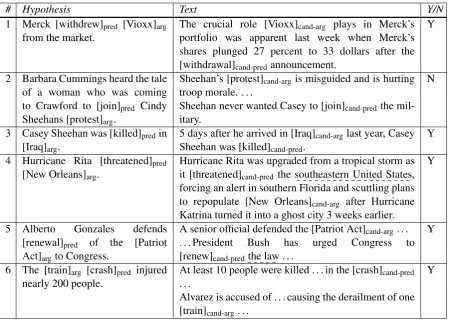
Consequently, we define the task of recognizing implied predicate-argument relationships, with il-lustrating examples in Table 1, as follows. The input includes aTextand aHypothesis. Two terms in the Hypothesis, predicate and argument, are marked, where a predicate-argument relationship between them is explicit in the Hypothesis syntac-tic structure. Two terms in the Text, candidate-predicateandcandidate-argument, aligned to the Hypothesis predicate and argument, are marked as well. However, no predicate-argument rela-tionship between them is expressed syntactically. The task is to recognize whether the
# Hypothesis Text Y/N 1 Merck [withdrew]pred [Vioxx]arg
[image:2.595.73.526.60.384.2]from the market. The crucial role [Vioxx]portfolio was apparent last week when Merck’scand-arg plays in Merck’s shares plunged 27 percent to 33 dollars after the [withdrawal]cand-predannouncement.
Y
2 Barbara Cummings heard the tale of a woman who was coming to Crawford to [join]pred Cindy
Sheehans [protest]arg.
Sheehan’s [protest]cand-argis misguided and is hurting
troop morale. . . .
Sheehan never wanted Casey to [join]cand-predthe
mil-itary.
N
3 Casey Sheehan was [killed]predin
[Iraq]arg.
5 days after he arrived in [Iraq]cand-arglast year, Casey
Sheehan was [killed]cand-pred.
Y
4 Hurricane Rita [threatened]pred
[New Orleans]arg.
Hurricane Rita was upgraded from a tropical storm as it [threatened]cand-pred the southeastern United States,
forcing an alert in southern Florida and scuttling plans to repopulate [New Orleans]cand-arg after Hurricane
Katrina turned it into a ghost city 3 weeks earlier.
Y
5 Alberto Gonzales defends
[renewal]pred of the [Patriot
Act]argto Congress.
A senior official defended the [Patriot Act]cand-arg. . .
. . . President Bush has urged Congress to
[renew]cand-predthe law . . .
Y
6 The [train]arg [crash]pred injured
nearly 200 people. At least 10 people were killed . . . in the [crash]. . . cand-pred Alvarez is accused of . . . causing the derailment of one [train]cand-arg. . .
Y
Table 1: Example task instances from our dataset. The last column specifies the Yes/No annotation, indicating whether the sought predicate-argument relationship is implied in the Text. For illustration, a dashed line indicates an explicit argument that is related to the candidate argument through some kind of discourse reference. Pred, arg and cand abbreviate predicate, argument and candidate respectively.
argument relationship, as expressed in the Hypoth-esis, holds implicitly also in the Text.
To address this task, we provide a large and freely available annotated dataset, and propose methods for coping with it. A related task, de-scribed in the next section, deals with such implied predicate-argument relationships as an extension toSemantic Role Labeling. While the results re-ported so far on that annotation task were rela-tively low, we suggest that the task itself may be more complicated than what is actually required in textual inference scenarios. On the other hand, the results obtained for our task, which does fit textual inference scenarios, are promising, and en-courage utilizing algorithms for this task in actual inference systems.
2 Prior Work
The most notable work targeting implied predicate-argument relationships is the 2010 SemEval task of Linking Events and Their Par-ticipants in Discourse(Ruppenhofer et al., 2009).
This task extendsSemantic Role Labelingto cases in which a core argument of a predicate is missing in the syntactic structure but a filler for the corresponding semantic role appears elsewhere and can be inferred from discourse. For example, in the following sentence the semantic rolegoalis unfilled:
(iii) He arrived (0Goal) at 8pm.
Yet, we can expect to find an implied filler for goalelsewhere in the document.
The SemEval task, termed henceforth as Im-plied SRL, involves three major sub-tasks. First, for each predicate, the unfilled roles, termedNull Instantiations (NI), should be detected. Second, each NI should be classified asDefinite NI (DNI), meaning that the role filler must exist in the dis-course, orIndefinite NIotherwise. Third, the DNI fillers should be found (DNI linking).
auto-matic dataset generation methods and features which capture discourse phenomena. Their high-est result was 12% F1-score. Another work is the probabilistic model of Laparra and Rigau (2012), which is trained by properties captured not only from implicit arguments but also from explicit ones, resulting in 19% F1-score. Another notable work is (Gerber and Chai, 2012), which was lim-ited to ten carefully selected nominal predicates.
2.1 Annotations vs. Recognition
Comparing to the implied SRL task, our task may better fit the needs of textual inference. First, some relatively complex steps of the implied SRL task are avoided in our setting, while on the other hand it covers more relevant cases.
More concretely, in textual inference the can-didate predicate and argument are typically iden-tified, as they are aligned by the RTE system to a predicate and an argument of the Hypothesis. Thus, the only remaining challenge is to verify that the sought relationship is implied in the text. Therefore, the sub-tasks of identifying and classi-fying DNIs can be avoided.
On the other hand, in some cases the candi-date argument is not a DNI, but is still required in textual inference. One type of such cases are non-core arguments, which cannot beDefinite NIs. However, textual inference deals with non-core ar-guments as well (see example 3 in Table 1).
Another case is when an implied predicate-argument relationship holds even though the cor-responding role is already filled by another argu-ment, hence not an NI. Consider example 4 of Ta-ble 1. While the object of “threatened” is filled (in the Text) by “southeastern United States”, a hu-man reader also infers the “threatened-New Or-leans” relationship. Such cases might follow a meronymy relation between the filler (“southeast-ern United States”) and the candidate argument (“New Orleans”), or certain types of discourse (co-)references (e.g., example 5 in Table 1), or some other linguistic phenomena. Either way, they are crucial for textual inference, while not being NIs.
3 Dataset
This section describes a semi-automatic method for extracting candidate instances of implied predicate-argument relationship from an RTE dataset. This extraction process directly follows our task formalization. Given a Text
Hypothe-sis pair, we locate a predicate-argument relation-ship in the Hypothesis, where both the predicate and the argument appear also in the Text, while the relationship between them is not expressed in its syntactic structure. This process is performed automatically, based on syntactic parsing (see be-low). Then, a human reader annotates each in-stance as “Yes” – meaning that the implied rela-tionship indeed holds in the Text, or “No” other-wise. Example instances, constructed by this pro-cess, are shown in Table 1.
In this work we used lemma-level lexical matching, as well as nominalization matching, to align the Text predicates and arguments to the Hy-pothesis. We note that more advanced match-ing, e.g., by utilizing knowledge resources (like WordNet), can be performed as well. To identify explicit predicate-argument relationships we uti-lized dependency parsing by the Easy-First parser (Goldberg and Elhadad, 2010). Nominalization matching (e.g., example 1 of Table 1) was per-formed with Nomlex (Macleod et al., 1998).
By applying this method on the RTE-6 dataset (Bentivogli et al., 2010), we constructed a dataset of 4022 instances, where 2271 (56%) are annotated as positive instances, and 1751 as negative ones. This dataset is significantly larger than prior datasets for the implied SRL task. To calculate inter-annotator agreement, the first author also annotated 185 randomly-selected instances. We have reached high agreement score of 0.80 Kappa. The dataset is freely available at www.cs.biu.ac.il/˜nlp/resources/
downloads/implied-relationships.
4 Recognition Algorithm
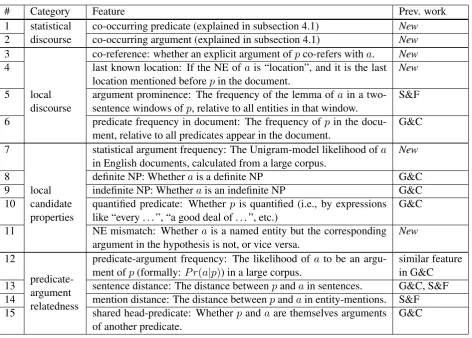
We defined 15 features, summarized in Table 2, which capture local and discourse phenomena. These features do not depend on manually built resources, and hence are portable to resource-poor languages. Some features were proposed in prior works, and are marked by G&C (Gerber and Chai, 2012) or S&F (Silberer and Frank, 2012). Our best results were obtained with the Random Forests learning algorithm (Breiman, 2001). The first two features are described in the next subsection, while the others are explained in the table itself.
4.1 Statistical discourse features
# Category Feature Prev. work
1 co-occurring predicate (explained in subsection 4.1) New
2 statisticaldiscourse co-occurring argument (explained in subsection 4.1) New
3 co-reference: whether an explicit argument ofpco-refers witha. New
4 last known location: If the NE ofais “location”, and it is the last
location mentioned beforepin the document. New
5 argument prominence: The frequency of the lemma ofain a
two-sentence windows ofp, relative to all entities in that window. S&F 6
local discourse
predicate frequency in document: The frequency ofpin the
docu-ment, relative to all predicates appear in the document. G&C
7 statistical argument frequency: The Unigram-model likelihood ofa
in English documents, calculated from a large corpus. New
8 definite NP: Whetherais a definite NP G&C
9 indefinite NP: Whetherais an indefinite NP G&C
10 quantified predicate: Whetherp is quantified (i.e., by expressions
like “every . . . ”, “a good deal of . . . ”, etc.) G&C
11
local candidate properties
NE mismatch: Whetherais a named entity but the corresponding
argument in the hypothesis is not, or vice versa. New
12 predicate-argument frequency: The likelihood of ato be an
argu-ment ofp(formally:P r(a|p)) in a large corpus. similar featurein G&C
13 sentence distance: The distance betweenpandain sentences. G&C, S&F
14 mention distance: The distance betweenpandain entity-mentions. S&F 15
predicate-argument
relatedness shared head-predicate: Whetherp andaare themselves arguments
[image:4.595.74.547.58.396.2]of another predicate. G&C
Table 2: Algorithmic features.pandadenote the candidate predicate and argument respectively.
argument, like selectional preferences, lexical similarities, etc. On the contrary, our statis-tical features follow the intuition that explicit predicate-argument relationships in the discourse provide plausible indication that an implied relationship holds as well. In our experiments we collected the statistics from Reuters corpus
RCV1 (trec.nist.gov/data/reuters/
reuters.html), which contains more than
806,000 documents.
We defined two features: Co-occurring predi-cateandCo-occurring argument. Letp andabe the candidate predicate and the argument in the text. While they are not connected syntactically, each of them often has an explicit relationships withotherterms in the text, that might support the sought (implied) relationship betweenaandp.
More concretely,ais often anexplicitargument of another predicatep0. For example, example 6 in Table 1 includes the explicit relationship “derail-ment of train”, which might indicate the implied relationship “crash of train”. Hence p=“crash”,
a=“train” andp0=“derailment”. TheCo-occurring predicate feature estimates the probability that a
document would contain aas an argument of p, given that a appears elsewhere in that document as an argument ofp0, based on explicit predicate-argument relationships in a large corpus.
Similarly, the Co-occurring argument feature captures cases wherephas another explicit argu-ment, a0. This is exemplified in example 5 of Table 1, where p=“renew”, a=“Patriot Act” and
a0=“law”. Accordingly, the feature quantifies the probability that a document including the relation-shipp-a0would also include the relationshipp-a.
More details about these features can be found in the first author’s Ph.D. thesis atwww.cs.biu. ac.il/˜nlp/publications/theses/
5 Results
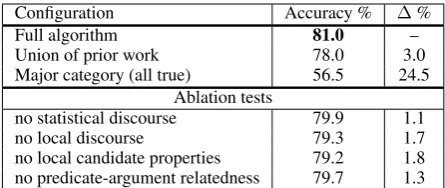
Configuration Accuracy % ∆%
Full algorithm 81.0 –
Union of prior work 78.0 3.0
Major category (all true) 56.5 24.5 Ablation tests
no statistical discourse 79.9 1.1
no local discourse 79.3 1.7
[image:5.595.71.294.62.156.2]no local candidate properties 79.2 1.8 no predicate-argument relatedness 79.7 1.3
Table 3: Accuracy of our method, followed by baselines and ablation tests.
Configuration (input) Recall Precision F1 %
Explicit only 44.6 44.3 44.4
Human annotations 50.9 43.4 46.8
Algorithm recognition 48.5 42.3 45.2
Table 4: RTE-6 Experiment
comparison shows that the contribution of our new features (3%) is meaningful, which is also statis-tically significant withp < 0.01using Bootstrap Resampling test (Koehn, 2004). The high results show that this task is feasible, and its solutions can be adopted as a component in textual infer-ence systems. The positive contribution of each feature category is shown in ablation tests.
An additional experiment tests the contribution of recognizing implied predicate-argument rela-tionships for overall RTE, specifically on the RTE-6 dataset. For the scope of this experiment we de-veloped a simple RTE system, which uses the F1 optimized logistic regression classifier of Jansche (2005) with two features: lexical coverage and predicate-argument relationships coverage. We ran three configurations for the second feature, where in the first only syntactically expressed re-lationships are used, in the second all the implied relationships, as detected by a human annotator, are added, and in the third only the implied rela-tionships detected by our algorithm are added.
The results, presented in Table 4, first demon-strate the full potential of the implied relation-ship recognition task to improve textual entail-ment recognition (Human annotation vs. Explicit only). One third of this potential improvement is achieved by our algorithm1. Note that all these
re-sults are higher than the median result in the RTE-6 challenge (3RTE-6.14%). While the delta in the F1 score is small in absolute terms, such magnitudes
1Following the relatively modest size of the RTE dataset, the Algorithm vs. Explicit result is not statistically significant (p ' 0.1). However, the Human annotation vs. Explicit result is statistically significant withp <0.01.
are typical in RTE for most resources and tools (see (Bentivogli et al., 2010)).
6 Discussion and Conclusions
We formulated the task of recognizing implied predicate-argument relationships within textual in-ference scenarios. We compared this task to the labeling task of SemEval 2010, where no prior in-formation about candidate arguments in the text is available. We point out that in textual inference scenarios the candidate predicate and argument are given by the Hypothesis, while the challenge is only to verify that a predicate-argument rela-tionship between these candidates is implied from the given Text. Accordingly, some complex steps necessitated in the SemEval task can be avoided, while additional relevant cases are covered.
Moreover, we have shown that this simpler task is more feasibly solvable, where our 15 features achieved more than 80% accuracy.
While our dataset and algorithm were presented in the context of RTE, the same challenge and methods are applicable to other textual inference tasks as well. Consider, for example, the Ques-tion Answering (QA) task. Typically QA sys-tems detect a candidate predicate that matches the question’s predicate. Similarly, candidate argu-ments, which match either the expected answer type or other arguments in the question are de-tected too. Consequently, our methods which ex-ploit the availability of the candidate predicate and argument can be adapted to this scenario as well.
Similarly, a typical approach forEvent Extrac-tion (a sub task of Information Extraction) is to start by applying an entity extractor, which identi-fies argument candidates. Accordingly, candidate predicate and arguments are detected in this sce-nario too, while the remaining challenge is to as-sess the likelihood that a predicate-argument rela-tionship holds between them.
Following this observation, we propose future work of applying our methods to other tasks. An additional direction for future work is to further develop new methods for our task, possibly by incorporating SRL resources and/or linguistically oriented rules, in order to improve the results we achieved so far.
Acknowledgments
References
Luisa Bentivogli, Peter Clark, Ido Dagan, Hoa Trang Dang, and Danilo Giampiccolo. 2010. The sixth pascal recognizing textual entailment challenge. In
Proccidings of TAC.
Leo Breiman. 2001. Random forests. Machine
Learn-ing, 45(1).
Ido Dagan, Oren Glickman, and Bernardo Magnini. 2006. The pascal recognising textual entailment
challenge. Machine Learning Challenges.
Evaluat-ing Predictive Uncertainty, Visual Object Classifi-cation, and Recognising Tectual Entailment, pages 177–190.
Marie-Catherine de Marneffe and Christopher D. Man-ning. 2008. The stanford typed dependencies
rep-resentation. Inproceedings of COLING 2008
Work-shop on Cross-framework and Cross-domain Parser Evaluation.
Jenny Rose Finkel, Trond Grenager, and Christopher Manning. 2005. Incorporating non-local informa-tion into informainforma-tion extracinforma-tion systems by gibbs
sampling. InProceedings of ACL.
Matthew Gerber and Joyce Y. Chai. 2012. Seman-tic role labeling of implicit arguments for nominal predicates. Computational Linguistics.
Yoav Goldberg and Michael Elhadad. 2010. An effi-cient algorithm for easy-first non-directional
depen-dency parsing. InProceedings of NAACL.
Aria Haghighi and Dan Klein. 2009. Simple coref-erence resolution with rich syntactic and semantic
features. InProceedings of EMNLP.
Mark Hall, Eibe Frank, Geoffrey Holmes, Bernhard Pfahringer, Peter Reutemann, and Ian H. Witten. 2009. The weka data mining software: An update.
SIGKDD Explorations, 11(1).
Martin Jansche. 2005. Maximum expected f-measure training of logistic regression models. In Proceed-ings of EMNLP.
Philipp Koehn. 2004. Statistical significance tests for
machine translation evaluation. In Proceedings of
EMNLP.
Egoitz Laparra and German Rigau. 2012. Exploiting explicit annotations and semantic types for implicit
argument resolution. InProceedings of IEEE-ICSC.
Catherine Macleod, Ralph Grishman, Adam Meyers, Leslie Barrett, and Ruth Reeves. 1998. Nomlex: A
lexicon of nominalizations. InProceedings of
EU-RALEX.
Michael Roth and Anette Frank. 2013. Automatically identifying implicit arguments to improve argument
linking and coherence modeling. InProceedings of
*SEM.
Josef Ruppenhofer, Caroline Sporleder, Roser Morante, Collin Baker, and Martha Palmer. 2009. Semeval-2010 task 10: Linking events and their
participants in discourse. In The NAACL-HLT
2009 Workshop on Semantic Evaluations: Recent Achievements and Future Directions (SEW-09). Josef Ruppenhofer, Caroline Sporleder, Roser
Morante, Collin Baker, and Martha Palmer. 2010. Semeval-2010 task 10: Linking events and their participants in discourse. InProceedings of the 5th International Workshop on Semantic Evaluation. Carina Silberer and Anette Frank. 2012. Casting
im-plicit role linking as an anaphora resolution task. In
Proceedings of *SEM.