Examining the Role of Linguistic Knowledge Sources in the Automatic
Identification and Classification of Reviews
Vincent Ng and Sajib Dasgupta and S. M. Niaz Arifin
Human Language Technology Research Institute University of Texas at Dallas
Richardson, TX 75083-0688
{vince,sajib,arif}@hlt.utdallas.edu
Abstract
This paper examines two problems in document-level sentiment analysis: (1) de-termining whether a given document is a review or not, and (2) classifying the po-larity of a review as positive or negative. We first demonstrate that review identifi-cation can be performed with high accu-racy using only unigrams as features. We then examine the role of four types of sim-ple linguistic knowledge sources in a po-larity classification system.
1 Introduction
Sentiment analysis involves the identification of positive and negative opinions from a text seg-ment. The task has recently received a lot of attention, with applications ranging from multi-perspective question-answering (e.g., Cardie et al. (2004)) to opinion-oriented information extraction (e.g., Riloff et al. (2005)) and summarization (e.g., Hu and Liu (2004)). Research in sentiment analy-sis has generally proceeded at three levels, aim-ing to identify and classify opinions from doc-uments, sentences, and phrases. This paper ex-amines two problems in document-level sentiment analysis, focusing on analyzing a particular type of opinionated documents:reviews.
The first problem, polarity classification, has the goal of determining a review’s polarity — pos-itive(“thumbs up”) ornegative(“thumbs down”). Recent work has expanded the polarity classifi-cation task to additionally handle documents ex-pressing a neutral sentiment. Although studied fairly extensively, polarity classification remains a challenge to natural language processing systems. We will focus on an important linguistic aspect of polarity classification: examining the role of a
variety of simple, yet under-investigated, linguis-tic knowledge sources in a learning-based polarity classification system. Specifically, we will show how to build a high-performing polarity classifier by exploiting information provided by (1) high or-dern-grams, (2) a lexicon composed of adjectives
manually annotated with their polarity information (e.g.,happyis annotated as positive andterribleas negative), (3) dependency relations derived from dependency parses, and (4) objective terms and phrases extracted fromneutraldocuments.
As mentioned above, the majority of work on document-level sentiment analysis to date has fo-cused on polarity classification, assuming as in-put a set of reviews to be classified. A relevant question is: what if we don’t know that an input document is a review in the first place? The sec-ond task we will examine in this paper —review identification— attempts to address this question. Specifically, review identification seeks to deter-mine whether a given document is a review or not. We view both review identification and polar-ity classification as a classification task. For re-view identification, we train a classifier to dis-tinguish movie reviews and movie-related non-reviews (e.g., movie ads, plot summaries) using only unigrams as features, obtaining an accuracy of over 99% via 10-fold cross-validation. Simi-lar experiments using documents from the book domain also yield an accuracy as high as 97%. An analysis of the results reveals that the high ac-curacy can be attributed to the difference in the vocabulary employed in reviews and non-reviews: while reviews can be composed of a mixture of subjective and objective language, our non-review documents rarely contain subjective expressions.
Next, we learn our polarity classifier using pos-itive and negative reviews taken from two movie
review datasets, one assembled by Pang and Lee (2004) and the other by ourselves. The result-ing classifier, when trained on a feature set de-rived from the four types of linguistic knowl-edge sources mentioned above, achieves a 10-fold cross-validation accuracy of 90.5% and 86.1% on Pang et al.’s dataset and ours, respectively. To our knowledge, our result on Pang et al.’s dataset is one of the best reported to date. Perhaps more im-portantly, an analysis of these results show that the various types of features interact in an interesting manner, allowing us to draw conclusions that pro-vide new insights into polarity classification.
2 Related Work
2.1 Review Identification
As noted in the introduction, while a review can contain both subjective and objective phrases, our non-reviews are essentially factual documents in which subjective expressions can rarely be found. Hence, review identification can be viewed as an instance of the broader task of classifying whether a document is mostly factual/objective or mostly opinionated/subjective. There have been attempts on tackling this so-called document-level subjec-tivity classification task, with very encouraging results (see Yu and Hatzivassiloglou (2003) and Wiebe et al. (2004) for details).
2.2 Polarity Classification
There is a large body of work on classifying the polarity of a document (e.g., Pang et al. (2002), Turney (2002)), a sentence (e.g., Liu et al. (2003), Yu and Hatzivassiloglou (2003), Kim and Hovy (2004), Gamon et al. (2005)), a phrase (e.g., Wil-son et al. (2005)), and a specific object (such as a product) mentioned in a document (e.g., Morinaga et al. (2002), Yi et al. (2003), Popescu and Etzioni (2005)). Below we will center our discussion of related work around the four types of features we will explore for polarity classification.
Higher-order n-grams. While n-grams offer a simple way of capturing context, previous work has rarely explored the use of n-grams as
fea-tures in a polarity classification system beyond un-igrams. Two notable exceptions are the work of Dave et al. (2003) and Pang et al. (2002). Interest-ingly, while Dave et al. report good performance on classifying reviews using bigrams or trigrams alone, Pang et al. show that bigrams are not use-ful features for the task, whether they are used in
isolation or in conjunction with unigrams. This motivates us to take a closer look at the utility of higher-ordern-grams in polarity classification. Manually-tagged term polarity. Much work has
been performed on learning to identify and clas-sify polarity terms (i.e., terms expressing a pos-itive sentiment (e.g., happy) or a negative senti-ment (e.g., terrible)) and exploiting them to do polarity classification (e.g., Hatzivassiloglou and McKeown (1997), Turney (2002), Kim and Hovy (2004), Whitelaw et al. (2005), Esuli and Se-bastiani (2005)). Though reasonably successful, these (semi-)automatic techniques often yield lex-icons that have either high coverage/low precision or low coverage/high precision. While manually constructed positive and negative word lists exist (e.g., General Inquirer1), they too suffer from the
problem of having low coverage. This prompts us to manually construct our own polarity word lists2
and study their use in polarity classification.
Dependency relations. There have been several
attempts at extracting features for polarity classi-fication from dependency parses, but most focus on extracting specific types of information such as adjective-noun relations (e.g., Dave et al. (2003), Yi et al. (2003)) ornounsthat enjoy a dependency relation with a polarity term (e.g., Popescu and Et-zioni (2005)). Wilson et al. (2005) extract a larger variety of features from dependency parses, but unlike us, their goal is to determine the polarity of aphrase, not a document. In comparison to previ-ous work, we investigate the use of a larger set of dependency relations for classifying reviews.
Objective information. The objective portions
of a review do not contain the author’s opinion; hence features extracted from objective sentences and phrases are irrelevant with respect to the po-larity classification task and their presence may complicate the learning task. Indeed, recent work has shown that benefits can be made by first sepa-ratingfactsfromopinionsin a document (e.g, Yu and Hatzivassiloglou (2003)) and classifying the polarity based solely on the subjective portions of the document (e.g., Pang and Lee (2004)). Moti-vated by the work of Koppel and Schler (2005), we identify and extract objective material from non-reviewsand show how to exploit such information in polarity classification.
1http://www.wjh.harvard.edu/∼inquirer/
spreadsheet guid.htm
Finally, previous work has also investigated fea-tures that do not fall into any of the above cate-gories. For instance, instead of representing the polarity of a term using a binary value, Mullen and Collier (2004) use Turney’s (2002) method to assign a real value to represent term polarity and introduce a variety of numerical features that are aggregate measures of the polarity values of terms selected from the document under consideration.
3 Review Identification
Recall that the goal of review identification is to determine whether a given document is a re-view or not. Given this definition, two immediate questions come to mind. First, should this prob-lem be addressed in a specific or domain-independent manner? In other words, should a re-view identification system take as input documents coming from the same domain or not?
Apparently this is a design question with no definite answer, but our decision is to perform domain-specific review identification. The reason is that the primary motivation of review identifi-cation is the need to identify reviews for further analysis by a polarity classification system. Since polarity classification has almost exclusively been addressed in a domain-specific fashion, it seems natural that its immediate upstream component — review identification — should also assume do-main specificity. Note, however, that assuming domain specificity is not a self-imposed limita-tion. In fact, we envision that the review identifica-tion system will have as its upstream component a text classification system, which will classify doc-uments by topic and pass to the review identifier only those documents that fall within its domain.
Given our choice of domain specificity, the next question is: which documents are non-reviews? Here, we adopt a simple and natural definition: a non-review is any document that belongs to the given domain but is not a review.
Dataset. Now, recall from the introduction that
we cast review identification as a classification task. To train and test our review identifier, we use 2000 reviews and 2000 non-reviews from the movie domain. The 2000 reviews are taken from Pang et al.’s polarity dataset (version 2.0)3, which
consists of an equal number of positive and neg-ative reviews. We collect the non-reviews for the 3Available from http://www.cs.cornell.edu/
people/pabo/movie-review-data.
movie domain from the Internet Movie Database website4, randomly selecting any documents from
this site that are on the movie topic but are not re-views themselves. With this criterion in mind, the 2000 non-review documents we end up with are either movie ads or plot summaries.
Training and testing the review identifier. We
perform 10-fold cross-validation (CV) experi-ments on the above dataset, using Joachims’ (1999) SVMlightpackage5 to train an SVM
clas-sifier for distinguishing reviews and non-reviews. All learning parameters are set to their default values.6 Each document is first tokenized and
downcased, and then represented as a vector of unigrams with length normalization.7 Following
Pang et al. (2002), we use frequency as presence. In other words, the ith element of the document
vector is 1 if the corresponding unigram is present in the document and 0 otherwise. The resulting classifier achieves an accuracy of 99.8%.
Classifying neutral reviews and non-reviews.
Admittedly, the high accuracy achieved using such a simple set of features is somewhat surpris-ing, although it is consistent with previous re-sults on document-level subjectivity classification in which accuracies of 94-97% were obtained (Yu and Hatzivassiloglou, 2003; Wiebe et al., 2004). Before concluding that review classification is an easy task, we conduct an additional experiment: we train a review identifier on a new dataset where we keep the same 2000 non-reviews but replace the positive/negative reviews with 2000neutral re-views (i.e., rere-views with a mediocre rating). In-tuitively, a neutral review contains fewer terms with strong polarity than a positive/negative re-view. Hence, this additional experiment would al-low us to investigate whether the lack of strong polarized terms in neutral reviews would increase the difficulty of the learning task.
Our neutral reviews are randomly chosen from Pang et al.’s pool of 27886 unprocessed movie re-views8that have either a rating of 2 (on a 4-point
scale) or 2.5 (on a 5-point scale). Each review then undergoes a semi-automatic preprocessing stage
4Seehttp://www.imdb.com.
5Available fromsvmlight.joachims.org. 6We tried polynomial and RBF kernels, but none yields better performance than the default linear kernel.
7We observed that not performing length normalization hurts performance slightly.
where (1) HTML tags and any header and trailer information (such as date and author identity) are removed; (2) the document is tokenized and down-cased; (3) the rating information extracted by reg-ular expressions is removed; and (4) the document is manually checked to ensure that the rating infor-mation is successfully removed. When trained on this new dataset, the review identifier also achieves an accuracy of 99.8%, suggesting that this learning task isn’t any harder in comparison to the previous one.
Discussion. We hypothesized that the high
accu-racies are attributable to the different vocabulary used in reviews and non-reviews. As part of our verification of this hypothesis, we plot the learn-ing curve for each of the above experiments.9 We
observe that a 99% accuracy was achieved in all cases even when only 200 training instances are used to acquire the review identifier. The abil-ity to separate the two classes with such a small amount of training data seems to imply that fea-tures strongly indicative of one or both classes are present. To test this hypothesis, we examine the “informative” features for both classes. To get these informative features, we rank the features by their weighted log-likelihood ratio (WLLR)10:
P(wt|cj) log P(wt|cj)
P(wt|¬cj) ,
wherewtandcj denote thetth word in the
vocab-ulary and the jth class, respectively. Informally,
a feature (in our case a unigram) w will have a
high rank with respect to a classcif it appears
fre-quently incand infrequently in other classes. This
correlates reasonably well with what we think an informative feature should be. A closer examina-tion of the feature lists sorted by WLLR confirms our hypothesis that each of the two classes has its own set of distinguishing features.
Experiments with the book domain. To
under-stand whether these good review identification re-sults only hold true for the movie domain, we conduct similar experiments with book reviews and non-reviews. Specifically, we collect 1000 book reviews (consisting of a mixture of positive, negative, and neutral reviews) from the Barnes
9The curves are not shown due to space limitations. 10Nigam et al. (2000) show that this metric is effec-tive at selecting good features for text classification. Other commonly-used feature selection metrics are discussed in Yang and Pedersen (1997).
and Noble website11, and 1000 non-reviews that
are on the book topic (mostly book summaries) from Amazon.12 We then perform 10-fold CV
ex-periments using these 2000 documents as before, achieving a high accuracy of 96.8%. These results seem to suggest that automatic review identifica-tion can be achieved with high accuracy.
4 Polarity Classification
Compared to review identification, polarity classi-fication appears to be a much harder task. This section examines the role of various linguistic knowledge sources in our learning-based polarity classification system.
4.1 Experimental Setup
Like several previous work (e.g., Mullen and Col-lier (2004), Pang and Lee (2004), Whitelaw et al. (2005)), we view polarity classification as a super-vised learning task. As in review identification, we use SVMlight with default parameter settings
to train polarity classifiers13, reporting all results
as 10-fold CV accuracy.
We evaluate our polarity classifiers on two movie review datasets, each of which consists of 1000 positive reviews and 1000 negative reviews. The first one, which we will refer to as Dataset A, is the Pang et al. polarity dataset (version 2.0). The second one (Dataset B) was created by us, with the sole purpose of providing additional experimental results. Reviews in Dataset B were randomly cho-sen from Pang et al.’s pool of 27886 unprocessed movie reviews (see Section 3) that have either a positive or a negative rating. We followed exactly Pang et al.’s guideline when determining whether a review is positive or negative.14 Also, we took
care to ensure that reviews included in Dataset B do not appear in Dataset A. We applied to these re-views the same four pre-processing steps that we did to the neutral reviews in the previous section.
4.2 Results
The baseline classifier. We can now train our
baseline polarity classifier on each of the two 11www.barnesandnoble.com
12www.amazon.com
13We also experimented with polynomial and RBF kernels when training polarity classifiers, but neither yields better re-sults than linear kernels.
14The guidelines come with their polarity dataset. Briefly, a positive review has a rating of≥3.5 (out of 5) or≥3 (out
of 4), whereas a negative review has a rating of≤2 (out of 5)
System Variation Dataset A Dataset B
Baseline 87.1 82.7
Adding bigrams 89.2 84.7 and trigrams
Adding dependency 89.0 84.5 relations
Adding polarity 90.4 86.2
info of adjectives
Discarding objective 90.5 86.1
[image:5.595.76.290.62.201.2]materials
Table 1: Polarity classification accuracies.
datasets. Our baseline classifier employs as fea-tures thek highest-ranking unigrams according to
WLLR, withk/2 features selected from each class.
Results withk= 10000 are shown in row 1 of
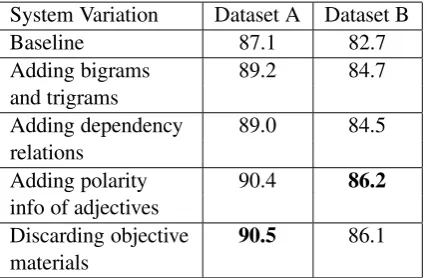
Ta-ble 1.15 As we can see, the baseline achieves an
accuracy of 87.1% and 82.7% on Datasets A and B, respectively. Note that our result on Dataset A is as strong as that obtained by Pang and Lee (2004) via their subjectivity summarization algo-rithm, which retains only the subjective portions of a document.
As a sanity check, we duplicated Pang et al.’s (2002) baseline in which all unigrams that appear four or more times in the training documents are used as features. The resulting classifier achieves an accuracy of 87.2% and 82.7% for Datasets A and B, respectively. Neither of these results are significantly different from our baseline results.16
Adding higher-order n-grams. The negative
results that Pang et al. (2002) obtained when us-ing bigrams as features for their polarity classi-fier seem to suggest that high-order n-grams are
not useful for polarity classification. However, re-cent research in the related (but arguably simpler) task of text classification shows that a bigram-based text classifier outperforms its unigram-based counterpart (Peng et al., 2003). This prompts us to re-examine the utility of high-order
n-grams in polarity classification.
In our experiments we consider adding bigrams and trigrams to our baseline feature set. However, since these higher-ordern-grams significantly
out-number the unigrams, adding all of them to the feature set will dramatically increase the dimen-15We experimented with several values ofkand obtained the best result withk= 10000.
16We use two-tailed pairedt-tests when performing signif-icance testing, withpset to 0.05 unless otherwise stated.
sionality of the feature space and may undermine the impact of the unigrams in the resulting clas-sifier. To avoid this potential problem, we keep the number of unigrams and higher-ordern-grams
equal. Specifically, we augment the baseline fea-ture set (consisting of 10000 unigrams) with 5000 bigrams and 5000 trigrams. The bigrams and tri-grams are selected based on their WLLR com-puted over the positive reviews and negative re-views in the training set for each CV run.
Results using this augmented feature set are shown in row 2 of Table 1. We see that accu-racy rises significantly from 87.1% to 89.2% for Dataset A and from 82.7% to 84.7% for Dataset B. This provides evidence that polarity classification can indeed benefit from higher-ordern-grams.
Adding dependency relations. While bigrams
and trigrams are good at capturing local dependen-cies, dependency relations can be used to capture non-local dependencies among the constituents of a sentence. Hence, we hypothesized that our n
-gram-based polarity classifier would benefit from the addition of dependency-based features.
Unlike most previous work on polarity classi-fication, which has largely focused on exploiting adjective-noun (AN) relations (e.g., Dave et al. (2003), Popescu and Etzioni (2005)), we hypothe-sized that subject-verb (SV) and verb-object (VO) relations would also be useful for the task. The following (one-sentence) review illustrates why.
While I really like the actors, the plot is rather uninteresting.
A unigram-based polarity classifier could be con-fused by the simultaneous presence of the posi-tive termlike and the negative termuninteresting when classifying this review. However, incorpo-rating the VO relation (like, actors) as a feature may allow the learner to learn that the author likes the actors and not necessarily the movie.
In our experiments, the SV, VO and AN re-lations are extracted from each document by the MINIPAR dependency parser (Lin, 1998). As withn-grams, instead of using all the SV, VO and
AN relations as features, we select among them the best 5000 according to their WLLR and re-train the polarity classifier with ourn-gram-based
Incorporating manually tagged term polarity.
Next, we consider incorporating a set of features that are computed based on the polarity of adjec-tives. As noted before, we desire a high-precision, high-coverage lexicon. So, instead of exploiting a learned lexicon, we manually develop one.
To construct the lexicon, we take Pang et al.’s pool of unprocessed documents (see Section 3), remove those that appear in either Dataset A or Dataset B17, and compile a list of adjectives from
the remaining documents. Then, based on heuris-tics proposed in psycholinguisheuris-tics18, we
hand-annotate each adjective with itsprior polarity(i.e., polarity in the absence of context). Out of the 45592 adjectives we collected, 3599 were labeled as positive, 3204 as negative, and 38789 as neu-tral. A closer look at these adjectives reveals that they are by no means domain-dependent despite the fact that they were taken from movie reviews.
Now let us consider a simple procedure P for
deriving a feature set that incorporates information from our lexicon: (1) collect all the bigrams from the training set; (2) for each bigram that contains at least one adjective labeled as positive or negative according to our lexicon, create a new feature that is identical to the bigram except that each adjec-tive is replaced with its polarity label19; (3) merge
the list of newly generated features with the list of bigrams20and select the top 5000 features from
the merged list according to their WLLR.
We then repeat procedure P for the trigrams
and also the dependency features, resulting in a total of 15000 features. Our new feature set com-prises these 15000 features as well as the 10000 unigrams we used in the previous experiments.
Results of the polarity classifier that incorpo-rates term polarity information are encouraging (see row 4 of Table 1). In comparison to the classi-fier that uses onlyn-grams and dependency-based
features (row 3), accuracy increases significantly (p= .1) from 89.2% to 90.4% for Dataset A, and
from 84.7% to 86.2% for Dataset B. These results suggest that the classifier has benefited from the
17We treat the test documents as unseen data that should not be accessed for any purpose during system development. 18http://www.sci.sdsu.edu/CAL/wordlist 19Neutral adjectives are not replaced.
20A newly generated feature could be misleading for the learner if thecontextual polarity(i.e., polarity in the presence of context) of the adjective involved differs from its prior po-larity (see Wilson et al. (2005)). The motivation behind merg-ing with the bigrams is to create a feature set that is more robust in the face of potentially misleading generalizations.
use of features that are less sparse thann-grams. Using objective information. Some of the
25000 features we generated above correspond to
n-grams or dependency relations that do not
con-tain subjective information. We hypothesized that not employing these “objective” features in the feature set would improve system performance. More specifically, our goal is to use procedure P
again to generate 25000 “subjective” features by ensuring that the objective ones are not selected for incorporation into our feature set.
To achieve this goal, we first use the following rote-learning procedure to identify objective ma-terial: (1) extract all unigrams that appear in ob-jective documents, which in our case are the 2000 non-reviews used in review identification [see Sec-tion 3]; (2) from these “objective” unigrams, we take the best 20000 according to their WLLR com-puted over the non-reviews and the reviews in the training set for each CV run; (3) repeat steps 1 and 2 separately for bigrams, trigrams and dependency relations; (4) merge these four lists to create our 80000-element list of objective material.
Now, we can employ procedureP to get a list of
25000 “subjective” features by ensuring that those that appear in our 80000-element list are not se-lected for incorporation into our feature set.
Results of our classifier trained using these sub-jective features are shown in row 5 of Table 1. Somewhat surprisingly, in comparison to row 4, we see that our method for filtering objective fea-tures does not help improve performance on the two datasets. We will examine the reasons in the following subsection.
4.3 Discussion and Further Analysis
Using the four types of knowledge sources pre-viously described, our polarity classifier signifi-cantly outperforms a unigram-based baseline clas-sifier. In this subsection, we analyze some of these results and conduct additional experiments in an attempt to gain further insight into the polarity classification task. Due to space limitations, we will simply present results on Dataset A below, and show results on Dataset B only in cases where a different trend is observed.
The role of feature selection. In all of our
ex-periments we used the bestkfeatures obtained via
experiments. First, we train a polarity classifier us-ing all unigrams from the trainus-ing set. Second, we train another polarity classifier using all unigrams, bigrams, and trigrams. We obtain an accuracy of 87.2% and 79.5% for the first and second experi-ments, respectively.
In comparison to our baseline classifier, which achieves an accuracy of 87.1%, we can see that using all unigrams does not hurt performance, but performance drops abruptly with the addition of all bigrams and trigrams. These results suggest that feature selection is critical when bigrams and trigrams are used in conjunction with unigrams for training a polarity classifier.
The role of bigrams and trigrams. So far we
have seen that training a polarity classifier using only unigrams gives us reasonably good, though not outstanding, results. Our question, then, is: would bigrams alone do a better job at capturing the sentiment of a document than unigrams? To answer this question, we train a classifier using all bigrams (without feature selection) and obtain an accuracy of 83.6%, which is significantly worse than that of a unigram-only classifier. Similar re-sults were also obtained by Pang et al. (2002).
It is possible that the worse result is due to the presence of a large number of irrelevant bigrams. To test this hypothesis, we repeat the above exper-iment except that we only use the best 10000 bi-grams selected according to WLLR. Interestingly, the resulting classifier gives us a lower accuracy of 82.3%, suggesting that the poor accuracy is not due to the presence of irrelevant bigrams.
To understand why using bigrams alone does not yield a good classification model, we examine a number of test documents and find that the fea-ture vectors corresponding to some of these docu-ments (particularly the short ones) have all zeroes in them. In other words, none of the bigrams from the training set appears in these reviews. This sug-gests that the main problem with the bigram model is likely to be data sparseness. Additional experi-ments show that the trigram-only classifier yields even worse results than the bigram-only classifier, probably because of the same reason.
Nevertheless, these higher-ordern-grams play a
non-trivial role in polarity classification: we have shown that the addition of bigrams and trigrams selected via WLLR to a unigram-based classifier significantly improves its performance.
The role of dependency relations. In the
previ-ous subsection we see that dependency relations do not contribute to overall performance on top of bigrams and trigrams. There are two plausi-ble reasons. First, dependency relations are simply not useful for polarity classification. Second, the higher-order n-grams and the dependency-based
features capture essentially the same information and so using either of them would be sufficient.
To test the first hypothesis, we train a clas-sifier using only 10000 unigrams and 10000 dependency-based features (both selected accord-ing to WLLR). For Dataset A, the classifier achieves an accuracy of 87.1%, which is statis-tically indistinguishable from our baseline result. On the other hand, the accuracy for Dataset B is 83.5%, which is significantly better than the cor-responding baseline (82.7%) at the p = .1 level.
These results indicate that dependency informa-tion is somewhat useful for the task when bigrams and trigrams are not used. So the first hypothesis is not entirely true.
So, it seems to be the case that the dependency relations do not provide useful knowledge for po-larity classification only in the presence of bigrams and trigrams. This is somewhat surprising, since thesen-grams do not capture the non-local
depen-dencies (such as those that may be present in cer-tain SV or VO relations) that should intuitively be useful for polarity classification.
To better understand this issue, we again exam-ine a number of test documents. Our initial in-vestigation suggests that the problem might have stemmed from the fact that MINIPAR returns de-pendency relations in which all the verb inflections are removed. For instance, given the sentenceMy cousin Paul really likes this long movie, MINIPAR will return the VO relation (like,movie). To see
why this can be a problem, consider another sen-tence I like this long movie. From this sentence, MINIPAR will also extract the VO relation (like, movie). Hence, this same VO relation is
The role of objective information. Results
from the previous subsection suggest that our method for extracting objective materials and re-moving them from the reviews is not effective in terms of improving performance. To determine the reason, we examine the n-grams and the
depen-dency relations that are extracted from the non-reviews. We find that only in a few cases do these extracted objective materials appear in our set of 25000 features obtained in Section 4.2. This ex-plains why our method is not as effective as we originally thought. We conjecture that more so-phisticated methods would be needed in order to take advantage of objective information in polar-ity classification (e.g., Koppel and Schler (2005)).
5 Conclusions
We have examined two problems in document-level sentiment analysis, namely, review identifi-cation and polarity classifiidentifi-cation. We first found that review identification can be achieved with very high accuracies (97-99%) simply by training an SVM classifier using unigrams as features. We then examined the role of several linguistic knowl-edge sources in polarity classification. Our re-sults suggested that bigrams and trigrams selected according to the weighted log-likelihood ratio as well as manually tagged term polarity informa-tion are very useful features for the task. On the other hand, no further performance gains are ob-tained by incorporating dependency-based infor-mation or filtering objective materials from the re-views using our proposed method. Nevertheless, the resulting polarity classifier compares favorably to state-of-the-art sentiment classification systems.
References
C. Cardie, J. Wiebe, T. Wilson, and D. Litman. 2004. Low-level annotations and summary representations of opin-ions for multi-perspective question answering. InNew Di-rections in Question Answering. AAAI Press/MIT Press. K. Dave, S. Lawrence, and D. M. Pennock. 2003. Mining the peanut gallery: Opinion extraction and semantic clas-sification of product reviews. InProc. of WWW, pages 519–528.
A. Esuli and F. Sebastiani. 2005. Determining the semantic orientation of terms through gloss classification. InProc. of CIKM, pages 617–624.
M. Gamon, A. Aue, S. Corston-Oliver, and E. K. Ringger. 2005. Pulse: Mining customer opinions from free text. InProc. of the 6th International Symposium on Intelligent Data Analysis, pages 121–132.
V. Hatzivassiloglou and K. McKeown. 1997. Predicting the semantic orientation of adjectives. In Proc. of the ACL/EACL, pages 174–181.
M. Hu and B. Liu. 2004. Mining and summarizing customer reviews. InProc. of KDD, pages 168–177.
T. Joachims. 1999. Making large-scale SVM learning prac-tical. InAdvances in Kernel Methods - Support Vector Learning, pages 44–56. MIT Press.
S.-M. Kim and E. Hovy. 2004. Determining the sentiment of opinions. InProc. of COLING, pages 1367–1373. M. Koppel and J. Schler. 2005. Using neutral examples for
learning polarity. InProc. of IJCAI (poster).
D. Lin. 1998. Dependency-based evaluation of MINIPAR. InProc. of the LREC Workshop on the Evaluation of Pars-ing Systems, pages 48–56.
H. Liu, H. Lieberman, and T. Selker. 2003. A model of tex-tual affect sensing using real-world knowledge. InProc. of Intelligent User Interfaces (IUI), pages 125–132. S. Morinaga, K. Yamanishi, K. Tateishi, and T. Fukushima.
2002. Mining product reputations on the web. InProc. of KDD, pages 341–349.
T. Mullen and N. Collier. 2004. Sentiment analysis using support vector machines with diverse information sources. InProc. of EMNLP, pages 412–418.
K. Nigam, A. McCallum, S. Thrun, and T. Mitchell. 2000. Text classification from labeled and unlabeled documents using EM.Machine Learning, 39(2/3):103–134.
B. Pang and L. Lee. 2004. A sentimental education: Senti-ment analysis using subjectivity summarization based on minimum cuts. InProc. of the ACL, pages 271–278. B. Pang, L. Lee, and S. Vaithyanathan. 2002. Thumbs
up? Sentiment classification using machine learning tech-niques. InProc. of EMNLP, pages 79–86.
F. Peng, D. Schuurmans, and S. Wang. 2003. Language and task independent text categorization with simple language models. InHLT/NAACL: Main Proc., pages 189–196. A.-M. Popescu and O. Etzioni. 2005. Extracting product
features and opinions from reviews. InProc. of HLT-EMNLP, pages 339–346.
E. Riloff, J. Wiebe, and W. Phillips. 2005. Exploiting sub-jectivity classification to improve information extraction. InProc. of AAAI, pages 1106–1111.
P. Turney. 2002. Thumbs up or thumbs down? Semantic ori-entation applied to unsupervised classification of reviews. InProc. of the ACL, pages 417–424.
C. Whitelaw, N. Garg, and S. Argamon. 2005. Using ap-praisal groups for sentiment analysis. InProc. of CIKM, pages 625–631.
J. M. Wiebe, T. Wilson, R. Bruce, M. Bell, and M. Martin. 2004. Learning subjective language. Computational Lin-guistics, 30(3):277–308.
T. Wilson, J. M. Wiebe, and P. Hoffmann. 2005. Recogniz-ing contextual polarity in phrase-level sentiment analysis. InProc. of EMNLP, pages 347–354.
Y. Yang and J. O. Pedersen. 1997. A comparative study on feature selection in text categorization. InProc. of ICML, pages 412–420.
J. Yi, T. Nasukawa, R. Bunescu, and W. Niblack. 2003. Sentiment analyzer: Extracting sentiments about a given topic using natural language processing techniques. In Proc. of the IEEE International Conference on Data Min-ing (ICDM).