With 2 text-figures Printed in Great Britain
CONTROL OF THE CIRCADIAN RHYTHM OF ACTIVITY
IN THE COCKROACH
III. A POSSIBLE ROLE OF THE BLOOD-ELECTROLYTES
BY JOHN BRADY*
Zoological Laboratory, Dotordng Street, Cambridge
{Received 24 January 1968)
INTRODUCTION
The physiology of the circadian rhythm of locomotor activity in the cockroach has been the subject of investigations by Harker (e.g. 1964), Roberts (e.g. 1966) and Brady (e.g. 1967a), but many questions remain unanswered. It appears probable that the rhythm is controlled at some level by blood-borne factors, but it is not clear whether these are hormonal or not.
Control of the activity rhythm in the cockroach requires that locomotor movements be suppressed during daylight, released at dusk and maintained in the released state for the first few hours of darkness. The rhythm is truly circadian, since it is maintained at circa 24 hr. under constant environmental conditions. There must therefore be a ' clock' timing the suppression and release of activity in the absence of environmental cues. This timing mechanism appears to be physiologically distinct from the suppres-sion-release mechanism since it can be shown that covert periodicity is maintain^ in an animal which shows no overt activity rhythm (Harker, 1964; Brady, 1967a). On the assumption that the two problems may therefore be studied independently this paper is concerned with an investigation into the suppression-release mechanism only. Two clues were suggested by the literature. First, the work of Hoyle (1954) and Ellis & Hoyle (1954) indicates that the activity level of the locust may be controlled by the concentration of potassium in its blood. Secondly, a brief report by Pichon & Boistel (1963) contains suggestive evidence that peak activity (i.e. the rhythmically expressed part of activity) in the cockroach locomotor cycle is eliminated by a high-potassium diet.
Hoyle (1954) states that tonus is maintained in Locusta by a background of impulses from the 'slow' fibres, and that occasional 'fast' fibre impulses are responsible for reflex and spontaneous movements. He argues that high blood potassium concentra-tions, by lowering the resting and action potentials, must lower the muscles' capacity for contraction, leading to reduced proprioceptive feed-back to the central nervous system, and hence to decreased tonus and spontaneous activity. High blood potassium levels occur in the feeding locust whose spontaneous activity is thereby reduced thus tending to keep the animal on its food plant; the converse applies in the starving locust which has a low potassium concentration tending to raise its level of spontaneous movements thereby helping it to find new food.
40 JOHN BRADY
If cockroach neuromuscular physiology functions similarly it is possible that the same principles may be effective in regulating its activity cycle. If a fall in blood potassium occurs at dusk, Hoyle's argument would indicate that an increase in spon-taneous activity might result and that the circadian activity peak might thus be triggered off.
METHODS
The Periplaneta americana used in this study were reared in a large tank at about 25° C. and provided with whole crushed oats, apple and water ad libitum. A 12 hr. light: 12 hr. dark regime (LD 12:12) was maintained in the tank with the change from light to dark (LD transition) occurring at 12.00 hr. G.M.T.
Four batches of twenty to thirty healthy, young, male cockroaches were selected for experiment. Each batch was placed in a large glass jar (c. 4 litres capacity) and kept in an incubator at constant temperature (+ 0-5° C.) under the same LD cycle as before. After placing a batch in an incubator at least 2 weeks were allowed to elapse before blood samples were taken. It is known that virtually all Periplaneta respond to LD 12 :12 by showing a clear 24 hr. rhythm in their activity (Brady, 19676), but for confirmation cockroaches were frequently sampled from each batch and their rhythmicity tested in actographs (Brady, 1967a).
For ion analysis a blood sample of about 5 (A. was collected into a micro-pipette from the meta-coxal membrane of a hand-held cockroach. Collection of blood from a time-sample of five cockroaches was completed in less than 10 min. When samples were taken during the dark-phase of the LD cycle the individuals were removed from their incubator in the dark, but the light was switched on briefly during the time necessary to collect the blood. When pairs of blood samples were taken from a single individual, for matched haemocyte counts and ion analysis, the procedure described earlier (Brady, 1967 d) was followed.
Blood for ion analysis was expelled from the micro-pipette into 10 ml. of distilled water. Determinations were performed on a Unicam SP 900 flame-photometer against standard solutions of KC1 and NaCl, to an estimated accuracy of ± 0-3 mM K+/1. and + 5-0 mM Na+/1. Details of the techniques and precautions followed have been described elsewhere (Brady, 1967d).
RESULTS
Eight series of samples were analysed from the four batches of cockroaches, making a total of 166 individual blood samples. The animals in batch A were sampled four times and in batch B twice. In each series cockroaches were selected from the batch in groups of 3-6 animals (most groups were of 4 or 5) to make up 4-6 time-samples spanning the period from 3 hr. before the LD transition to 7 hr. after it. Peak activity in Periplaneta normally begins during the first hour of darkness and lasts for 1-3 hr. The range of times selected should therefore have covered all the likely physiological changes immediately associated with the onset, expression and decline of activity.
Series no.
I 2 3 4 5 6 7 8
Table I. Potassium concentration in the blood of Periplaneta sampled at dzgeerent times of day Time span of samples, G.M.T. (hr.) No. of
,
c,
A > Over-all qa Date animals 09.05 09.55 10.40 11.25 12.35 13.15 13.50 16.00 18.30 mean K+ Batch sampled sampled -09.45 -10.25 -I 1.20 -I 1.55 -13.10 -13.45 -14.15 -16.15 -19.15 concentration 10 Sept. 25 12.3 - - 10.9 8.1 11.3 - - 10.1 10.6 - - - -3
19 Oct. I5 10.6 10.1 7'4 8.2 - 9' 1 zg Oct. I 6 - - 11.6 - - -&
-{;:;
8.4 9.7.,
g Nov. I7 - 10.4 - - - - 9'4 9'4 9'7 9'7 - - -s
3 Nov.* 26 15.1 11.3 12.6 13'9 15.8 11.3 - - 13'5 15 Nov.~ 23 10.9 9.3 9.6 10.31 - 11.7 10.4 10.4s-
h42 JOHN BRADY
the different batches. In particular, each of the six series of samples taken from batches A and B show a small drop of some 2 mM/1. during the first hour or so of darkness. Batches C and D, which were taken to confirm this observation, did not show such a trend, however.
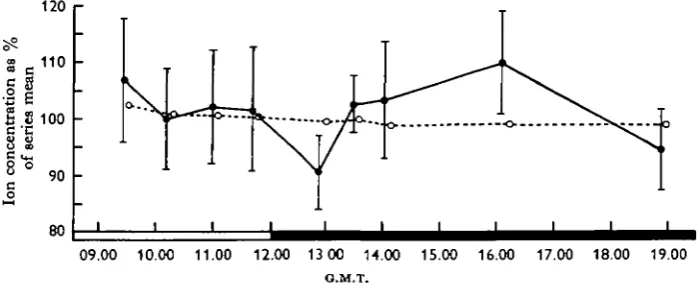
Because of the different potassium levels of the different batches calculation of mean concentrations for the columns of Table i is largely meaningless. The individual values were therefore transformed to percentages of the mean potassium concentration of their respective series. The 166 percentages were then treated as a single set of data and means calculated for the nine columns; these values are illustrated in Fig. i.
120 r
110
£ s 100
c 'C
8 8
c «_,
8 ° 9o
80
09.00 10.00 11.00 12.00 13 00 14.00 15.00 16.00 17.00 18.00 19.00
[image:4.451.50.400.203.347.2]O.M.T.
Fig. i. Changes in the whole-blood potassium and sodium concentration of Periplaneta during the period of LD transition and peak locomotor activity. Results are expressed as a percentage of the series mean with the points plotted centrally in the time-span of the samples (see Table i). Dots and solid line = mean values for potassium concentration (bars = 2 xs.B.); circles and broken line = values for sodium. Abscissa is in hours G.M.T. with the LD transition occurring at 12 noon.
The 12.35-13.10 hr. mean at the onset of darkness shows a fall of about 10% below the values for the preceding hours in the light phase. This fall coincides with the onset of activity, but is not maintained for its duration since the 13.15-13.45 hr. mean shows a reversion to the pre-LD transition level. The 12.35-13.10 hr. value is the only one of the nine which differs significantly from 100% (P < o-oi); it is also significantly less than the 09.05-09.45 hr., 13.15-13.45 hr., 16.00-16.15 hr. means and the aggre-gated mean of 10.40-11.55 hr. (P < o-oi in each case).
The sodium concentration in the blood of the same animals shows no such drop after the LD transition (broken line in Fig. 1), though a steady fall in concentration from 09.00 to 19.00 hr. was observed. The combined means from 09.05 to 11.20 hr. are highly significantly different from the combined means from 13.15 to 16.15 hr. (P = o-ooi).
Orcadian rhythm in cockroach. Ill 43
though for the difference in series 2, 5 and 8 at 12.35-13.10 hr. and 13.50-14.15 hr. the 5 % level of probability is not quite reached (t= 197 for 24 degrees of freedom, the 5% level being 2-06).
If there is a neuro-physiological effect produced by the apparent drop in potassium concentration, then the timing of the change suggests that it relates to the onset of activity and not to its maintenance. Periplaneta kept under strict LD 12:12 show con-siderable individual variation in the precise phase relationship of their activity to the environmental cycle. There is a range of at least an hour in the exact time of com-mencement of activity after the onset of darkness, though the timing of a given indi-vidual is usually accurate within + 5 min. from day to day. Population sampling to measure any physiological change at this time will therefore blur the exact dimensions
160 r
1 2 3 4 5 6 Successive blood counts
Fig. 2. The effect on the haemocyte count and plasma potassium of taking a series of 6 con-secutive blood samples from ten individual Periplaneta over a period of 3 weeks. Results are expressed as a % of the individual's mean. Dots and solid line = haemocyte count; circles and broken line = plasma potassium concentration (see tort); bars = 2 x s.E.
of the change. If, for example, the drop in potassium at the onset of activity is a transi-tory phenomenon such a population study will indicate a smaller change than actually occurs in a given individual. An attempt was therefore made to overcome this diffi-culty by taking series of consecutive samples from single cockroaches whose locomotor activity was being simultaneously monitored in aerographs.
It proved possible to take up to five consecutive samples in 10 hr. from a cockroach if it was in good condition. The result of taking the first sample was to raise the haemo-cyte count dramatically, however, and consequently to cause a rise in the whole-blood potassium concentration (Brady, 1967d). This obscured any change in potassium level that might have occurred over the LD transition. To avoid this further difficulty individual animals were sampled at different times every 3rd or 4th day.
44 JOHN BRADY
when 4 days were allowed to elapse between samples (Fig. 2). However, if the counts were used to correct the whole-blood potassium analyses, on the basis that 10,000 haemocytes//il. of blood represent 0-83 mM K+/1. (Brady, 1967 d), then no change in the plasma concentration was detected for up to six successive samples (Fig. 2). This suggests that successive sampling from single individuals is a legitimate procedure, provided samples are spaced at intervals of a few days, and provided suitable correc-tions are made to allow for the change in haemocyte density. To avoid any other additive effects the sequence of samples from an individual did not follow the logical course of time across the LD transition but was randomized.
The potassium analyses from the ten Periplaneta thus sampled are summarized in Table 2. It is quite clear that no change was detectable in the potassium concentration of either whole-blood or plasma. Similarly, no change was detected in the sodium level. There were no significant differences in the haemocyte counts either, but in view of the results indicated in Fig. 2 this is not entirely surprising.
Table 2. Summary of potassium levels in successive blood samples taken from
ten individual Periplaneta
(Mean K+ concentration expressed as a % of the individual animal's mean (±s.E.).)
Time of samples in relation to activity record
4 to 1 hr. During 1st
before hr. of After activity activity activity Whole-blood (haemocytes included) iO2±3 100 ± 3 99±3 Plasma (haemocytes subtracted) I O I ± 3 99±3 9 9 ± 4
Each of the ten cockroaches was maintained in an actograph and sampled 6 times over a period of 3 weeks. The numbers of analyses are roughly equally divided between the 3 columns. The bottom row is estimated on the basis that 10,000 haemocytes//*!. represent 0-83 mM K+/1. of blood (Brady, ig6-jd).
DISCUSSION
When the cockroaches in batch A were sampled a small fall in the whole-blood potassium concentration was detected coincident with the onset of locomotor activity. A less clearly defined fall was observed in batch B, which was starved before sampling. On the other hand, neither batch C nor D revealed any such change, nor was a change detected by successive sampling from individual animals. The evidence for the exist-ence of a decrease in potassium concentration at the onset of locomotor activity is therefore not entirely clear. However, it is relevant to draw attention to several points which are probably significant.
(1) All four times batch A was analysed a drop in the mean potassium concentration was observed. Though the drop in series 3 occurred in samples collected 10 min. later than the others, this is of no great importance because of the imprecise phase relation-ships of cockroach activity discussed above. Taking the analyses of batch A alone, the
Circadian rhythm in cockroach. HI 45
(2) No drop immediately after the LD transition was apparent in the sodium con-centration. It therefore appears unlikely that the change in potassium was caused by drinking or feeding at the onset of activity.
(3) It is known that cockroaches respond to the stress of handling, or blood sampling, by showing marked changes in their locomotor pattern, the collection of a blood sample generally resulting in the loss of much of the next activity peak (Brady, 1967 a). More-over, these responses are manifest in a form which suggests humoral mediation, so that blood ion changes could possibly be involved, or occur in parallel. If this is so, then the shock of handling may override any subtle circadian changes in the blood of more sensitive individuals.
(4) Batches A and B were cockroaches taken from a stock which derived from
Periplaneta americana' wild-caught' at the gardens of the Zoological Society of London
16 months previously, but which had since been kept by the author under controlled conditions in the laboratory. Batch C came from another stock maintained at the Zoological Laboratory, Cambridge, but of indeterminate origin and age. Batch D, and the animals used for successive sampling, came from the London Zoo 18 months after those of batch A. There is no obvious reason for any physiological differences between the two sets of London animals, but they both showed morphological signs of being rather variable hybrids with P. australasiae, so there may have been differences in genetic strain. Although it seems improbable that there should be strain differences with respect to anything as fundamental as circadian control, it is not impossible that there might be genetic differences in sensitivity to handling.
(5) Theoretically the successive sampling should have detected any change that the population studies might have obscured. Unfortunately the batch A stock was exhausted by the time these observations were made, and cockroaches from the batch D stock had to be used instead, notwithstanding that these had earlier revealed no blood changes. Furthermore, the handling involved in the successive sampling was considerably more severe than had been used in the population study: it lasted three times longer, included pinioning the animal on its back, and necessitated the collection of two samples of blood (Brady, 19670"). If there is any effect of handling and genetic strain it is therefore likely to have been greatest on the successively sampled animals so that the lack of blood ion changes detected by these observations may not be as significant as it appears.
(6) Whereas it is theoretically possible that the fall in potassium could have been caused by a change in the haemocyte density, the data imply that this is unlikely. A mean decrease of some 25,000 cells//il. in the circulating blood would be required to produce the drop of about 2 mM K+/1. observed in batch A. Since the mean haemo-cyte density is about 32,000 cells//tl. (Brady, 1967c) this seems rather improbable. No change in the haemocytes was observed in the successive samples.
46 JOHN BRADY
by Treherne (1967), the intact central nervous system of the insect exhibits a high degree of ionic regulation so that the observed changes in blood ions would not be expected to cause any immediate axon potential changes centrally. Hoyle's model, however, refers to peripheral phenomena, and there is at present no evidence indi-cating a comparable level of ionic regulation in insect muscles. There is therefore room to speculate that potassium changes of the order observed in batch A may have a significant peripheral neuro-physiological effect.
CONCLUSION
The initial proposition was that a form of Hoyle's potassium model for the control of locust activity might function in the cockroach as part of the switching mechanism releasing the circadian locomotor peak. No doubt this was a hopeful simplification of a complex physiological system involving many different processes, and in the event only rather uncertain evidence was collected to implicate a potassium-regulated mechanism. Although it would therefore be inappropriate to draw firm conclusions on this point, there does appear to be sufficient evidence to suggest that cockroach blood is a changing ionic environment throughout the day; very clear daily changes in the concentration of both potassium and sodium were detected in some instances. Whether Hoyle's model applies in this case or not, the coincidence of the potassium change with the onset of peak activity appears to be prima facie evidence for the exist-ence of some form of ionic regulation in the locomotor rhythm.
SUMMARY
1. A study was made of the concentration of potassium and sodium in the blood of
Periplaneta americana to determine whether daily fluctuations occur which might
imply ionic control of the circadian locomotor activity rhythm.
2. Analyses were carried out on 166 blood samples taken at different times of day. A fall of about 10% occurred in the potassium concentration during the first hour of darkness; there was also a gradual decline of 2% in the sodium concentration.
3. However, series of six successive blood samples taken over a period of 3 weeks from ten individual cockroaches revealed no daily change in the level of potassium, sodium or haemocyte density.
4. No conclusions are drawn on the activity control aspect, but the results do suggest that daily changes may occur in cockroach blood ions.
Orcadian rhythm in cockroach. Ill /\rj
REFERENCES
BRADY, J. (1967a). Control of the circadian rhythm of activity in the cockroach. I. The role of the corpora cardiaca, brain and stress. J. exp. Biol. 47, 153—63.
BRADY, J. (19676). Control of the circadian rhythm of activity in the cockroach. II. The role of the sub-oesophageal ganglion and ventral nerve cord. J. exp. Biol. 47, 165-78.
BRADY, J. (1967c). Haemocytes and the measurement of potassium in insect blood. Nature, Land, a i s , 96-7.
BRADY, J. (1967d). The relationship between blood ions and blood-cell density in insects. J. exp. Biol. 47. 313-26.
E m s , P. E. &HOYLB, G.(i954). A physiological interpretation of the marching of hoppers of the African migratory locust (Locusta imgratoria rmgratorioides R. & F.). J. exp. Biol. 31, 271-9.
HARKER, J. E. (1964). The Physiology of Diurnal Rhythms. Cambridge University Press.
HOYLE, G. (1954). Changes in the blood potassium concentration of the African migratory locust
{Locusta tmgratoria rmgratorioides R. & F.) during food deprivation, and the effect on neuromuscular
activity. J. exp. Biol. 31, 260-70.
PICHON, Y. & BOISTEL, J. (1963). Modifications of the ionic content of the haemolymph and of the activity of Periplaneta americana in relation to diet. J. Insect Physiol. 9, 887-91.
ROBERTS, S. K. DE F. (1966). Circadian activity rhythms in cockroaches. III. The role of endocrine and neural factors. J. cell. Physiol. 67, 473-86.
TREHERNE, J. E. (1967). Axonal function and ionic regulation in insect central nervous tissues. In
Insects and Physiology, pp. 175-88. Eds. J. W. L. Beament and J. E. Treherne. Edinburgh and
London: Oliver and Boyd.