June 2014, Volume 58, Issue 7. http://www.jstatsoft.org/
conting: An
R
Package for Bayesian Analysis of
Complete and Incomplete Contingency Tables
Antony M. Overstall
University of St Andrews
Ruth King
University of St Andrews
Abstract
The aim of this paper is to demonstrate theRpackagecontingfor the Bayesian analysis of complete and incomplete contingency tables using hierarchical log-linear models. This package allows a user to identify interactions between categorical factors (via complete contingency tables) and to estimate closed population sizes using capture-recapture studies (via incomplete contingency tables). The models are fitted using Markov chain Monte Carlo methods. In particular, implementations of the Metropolis-Hastings and reversible jump algorithms appropriate for log-linear models are employed. Thecontingpackage is demonstrated on four real examples.
Keywords: contingency tables, capture-recapture studies, reversible jump, log-linear models.
1. Introduction
the cell counts are misclassified or are only partially observed due to non-response from units of the population, see, e.g.,Gelman, Carlin, Stern, and Rubin (2004, Sections 21.5 and 21.6) andTan, Tian, and Ng(2010, Chapter 4).
Log-linear models are typically used to model the observed cell counts, where the log of the expected cell count is proportional to a linear combination involving unknown model parameters. Each interaction term between two or more factors is associated with a set of model parameters and if these model parameters are non-zero it indicates that there exists an association between these factors. Every unique combination of interactions defines its own log-linear model. Therefore identifying interactions is a model determination problem.
Log-linear models are a special case of generalized linear models (GLMs; e.g., McCullagh and Nelder 1989). Therefore, within R(R Core Team 2014), log-linear models can be fitted via classical maximum likelihood using theglm()function. Model determination can then be achieved using, for example, differences in deviance or the Akaike information criterion (AIC). Still under the classical approach, theloglm()function in theMASS package (Venables and Ripley 2002) provides an alternative approach to fitting log-linear models. Note thatloglm()
is a user-friendly wrapper to theloglin()function in the statspackage (RCore Team 2014). In this paper and inconting(Overstall 2014), the Bayesian approach is used. For a review of the Bayesian approach to contingency tables with log-linear models, see, e.g.,Forster (2010). The Bayesian approach involves evaluating the posterior distribution of model parameters and model indicators. Typically, the posterior is analytically intractable and requires approx-imation. The standard approach is to use Markov chain Monte Carlo (MCMC) methods to generate a sample from the posterior.
The R package conting facilitates the Bayesian analysis of complete and incomplete contin-gency tables using log-linear models. This is accomplished with the use of MCMC meth-ods that are particularly suitable for log-linear models. This paper demonstrates conting
and is structured as follows. In Section 2 we describe log-linear models for the analy-sis of contingency tables. In Section 3 we describe suitable MCMC computational algo-rithms that are required to generate posterior samples. We also describe how these methods are implemented in conting. We conclude with an extensive examples section (Section 4) that fully exhibits the capabilities of conting for complete and incomplete contingency ta-bles. Note that contingis available from the Comprehensive RArchive Network (CRAN) at
http://CRAN.R-project.org/package=conting.
2. Log-linear models
In this section we set-up our notation and define the concept of a log-linear model under a Bayesian approach in the presence of model uncertainty. This set-up closely follows that of Overstall and King(2014).
Suppose there are a total of F factors (and/or sources) such that the jth factor, for j = 1, . . . , F, has lj levels. The corresponding contingency table has n=QFj=1lj cells. Lety be then×1 vector of cell counts where each element ofy is denoted byyi with i= (i1, . . . , iF) identifying the combination of factor levels that cross-classify this cell. LetS denote the set of allncross-classifications and thus the set of all cells in the table. LetN =P
For example, consider the alcohol, obesity and hypertension (AOH) data given byKnuiman and Speed (1988) and included as an example dataset in conting. Here, 491 people from Western Australia are cross-classified according to the followingF = 3 factors: alcohol intake (l1 = 4 levels); obesity (l2 = 3 levels) and hypertension (l3 = 2 levels). Therefore, there are
n=l1×l2×l3= 24 cells in the corresponding contingency table and the total population size
is N = 491. See Section 4.1 for the associated Bayesian analysis of this table usingconting, which identifies interactions between the factors.
For a log-linear model it is assumed that
yi ∼Poisson (µi), (1)
independently, for i ∈ S, where logµi is written as a linear combination of the intercept, main effect and interaction parameters (see, e.g., Overstall and King 2014). However for identifiability, these parameters are constrained using, for example, sum-to-zero or corner-point constraints. In this paper and in conting, we use sum-to-zero constraints. The log of the expectation, µi, of yi can then be written as
logµi=ηi=φ+x>i θ, (2)
where ηi is referred to as the linear predictor, φ ∈ R is the unknown intercept parameter,
θ ∈Rp is thep×1 vector of unknown regression parameters andxi is thep×1 design vector that identifies which elements of θ are applicable to cell i ∈ S. Let β = φ,θ>> be the (p+ 1)×1 vector of log-linear parameters. We can write (2) in matrix form as
logµ=η=φ1n+Xθ= (1n,X)β, (3)
where µ and η are n×1 vectors with elements given byµi and ηi, 1n is an n×1 vector of ones,X is the n×pdesign matrix with rows given by xi and log(·) is applied element-wise.
The specification given by (2), and equivalently by (3), assumes that we know which inter-actions are present in the model. This will not be the case in practice, so we introduce an unknown model indicator, m, which denotes a combination of interactions. We now write the log-linear model as
logµi=ηi =φ+x>m,iθm, (4)
where θm is thepm×1 vector of regression parameters for model m and xm,i is thepm×1 design vector that identifies which elements of θm are applicable to cell i ∈ S for model m. Let βm = φ,θ>m> denote the vector of log-linear parameters for model m. In matrix form this model is
logµ=η=φ1n+Xmθm = (1n,Xm)βm, (5)
where Xm is the n×pm matrix with rows given by xm,i.
all factors but no interactions. We also now define the concept of the maximal model, i.e., the most complex model we wish to consider. This is usually accomplished by specifying the highest-order interaction terms that we will consider. The saturated model, for a complete contingency table, is the one that contains theF-way interaction between all factors.
To complete the model specification under the Bayesian approach, we specify a joint prior distribution forφ,θmandmwhich is denoted byπ(φ,θm, m). We decompose this distribution as follows
π(φ,θm, m) =π(φ,θm|m)π(m),
where π(φ,θm|m) is the joint prior distribution ofφ and θm conditional on model m ∈ M and π(m) is the prior model probability of model m∈ M, such thatP
m∈Mπ(m) = 1.
In this paper, and inconting, we assume a position of having weak prior information and wish to specify prior distributions that reflect this position. However due to Lindley’s paradox (see, e.g., O’Hagan and Forster 2004, pp. 77–79) care must be taken when specifying prior distributions that reflect weak prior information since the posterior model probabilities will be sensitive to the scale of the prior variance.
One approach from the literature is to use a “default” prior distribution (Kass and Wasser-man 1996). For examples of such prior distributions which are directly applicable to log-linear models, seeDellaportas and Forster(1999),Ntzoufras, Dellaportas, and Forster(2003), Saban´es-Bov´e and Held(2011) andOverstall and King(2014). We use the generalized hyper-g prior proposed bySaban´es-Bov´e and Held(2011) where for a log-linear model, we decompose the joint prior distribution of φand θm as
π(φ,θm|m) =π(φ)π(θm|m),
with π(φ)∝1 and
θm|σ2, m∼N
0, σ2n
X>mXm
−1
,
with σ2 > 0 an unknown hyperparameter with a hyper-prior distribution given by σ2 ∼ IG a2,b2
, where a and b are specified hyperparameters. The Saban´es-Bov´e and Held prior distribution is a generalization to GLMs of the Zellner g-prior (Zellner 1986) for linear models. It can be interpreted as being the posterior distribution from a locally uniform prior and an imaginary sample where 1/σ2 indicates the size of this “prior sample” (Dellaportas and Forster 1999). Ifσ2= 1, then theSaban´es-Bov´e and Heldprior distribution provides the same
information as a prior sample of one observation and the prior reduces to the unit information prior (Ntzoufras et al.2003).
Both theSaban´es-Bov´e and Heldand unit information priors are implemented inconting. The user can specify the value of the hyperparametersaand b, under theSaban´es-Bov´e and Held prior. They have default values ofa=b= 10−3 and we use these default values whenever we employ theSaban´es-Bov´e and Heldprior for the examples in Sections4.3 and4.4.
For the prior model probabilities we assume a uniform prior over the model space, i.e.,π(m) = |M|−1 where|M|denotes the number of models in M.
Note that, as an alternative to the model specification given in (1), we can assume that
where the elements ofρ are given by
ρi=
µi
P
i∈Sµi
. (6)
Under the multinomial specification, the intercept,φ, is unnecessary since it will cancel in the numerator and denominator of (6). For complete contingency tables, Forster (2010) shows that the joint posterior distribution of θm and m are identical under both the Poisson and multinomial models, if the joint prior distribution forφ andθm is specified asπ(φ,θm|m) =
π(θm|m), i.e., as is true for the Saban´es-Bov´e and Heldand unit information priors.
Overstall, King, Bird, Hutchinson, and Hay (2014) extend this result to incomplete contin-gency tables and show that the joint posterior distribution of θm, m and the missing cell counts are identical under the Poisson and multinomial models if we adopt the same prior structure as above forφandθm, and the prior distribution for the unknown total population size, N, under the multinomial model is of the form π(N) ∝ N−1, i.e., the Jeffreys prior (Madigan and York 1997).
It follows that the MCMC methods detailed in Section3 allow us to evaluate the posterior distribution under either the Poisson or multinomial model formulations.
Under theSaban´es-Bov´e and Held, and unit information prior distributions described above, the posterior distribution is analytically intractable necessitating the use of the MCMC meth-ods, detailed in Section3, to estimate, for example, the posterior model probabilities. Under the subset of decomposable models and the multinomial model formulation,Dawid and Lau-ritzen (1993) show that by using a hyper-Dirichlet prior distribution the posterior model probabilities are available in closed form. Madigan and York (1997) used this result to es-timate closed population sizes from incomplete contingency tables. However, as noted by Dellaportas and Forster (1999), we should not restrict ourselves to the less flexible class of decomposable models for solely computational reasons. Hence we consider the much richer class of hierarchical models and use the prior distributions described above.
3. Methods and implementations
3.1. Posterior distributions
In the case of complete contingency tables we evaluate the joint posterior distribution of φ, θm,σ2 (if unknown) andm given by
π(φ,θm, σ2, m|y)∝π(y|φ,θm, m)π(θm|σ2, m)π(σ2)π(m), (7)
where π(y|φ,θm, m) is the likelihood function under model m ∈ M. This distribution is analytically intractable so we generate a sample from it using MCMC methods. In partic-ular we use the reversible jump algorithm (Green 1995). We briefly describe a particular implementation of this algorithm, suitable for log-linear models, in Section3.2.
For incomplete contingency tables, lety= y(O),y(U)wherey(O) andy(U) are the observed and unobserved cell counts, respectively. Furthermore, letOandU denote the sets of observed and unobserved cells, respectively, so thatO ∩ U =∅ and O ∪ U =S. We evaluate the joint posterior distribution ofy(U),φ,θm,σ2, and m, i.e.,
where π(y(O),y(U)|φ,θm, m) = π(y|φ,θm, m) is the complete-data likelihood function. We generate a sample from this posterior distribution using a data-augmentation MCMC algo-rithm (King and Brooks 2001). This algorithm is briefly described in Section 3.2.
In some cases, for incomplete contingency tables, one of the sources may observe individuals who are not members of the target population. An example of this is from the capture-recapture studies that have been used to estimate the number of people who inject drugs (PWID) in Scotland in the years 2003, 2006 and 2009 (see, King, Bird, Brooks, Hutchin-son, and Hay 2005;King, Bird, Hutchinson, and Hay 2009; King, Bird, Overstall, Hay, and Hutchinson 2013, respectively). Here there are four sources who observe PWID. One of the sources is the Hepatitis C virus (HCV) database. This database does not actually observe PWID, but instead people who are newly diagnosed with the HCV and have injecting drug use as a historical risk factor. Assuming that these people are PWID results in over-estimation of the total population size of PWID in Scotland (see King et al. 2009 and Overstall et al. 2014). A modeling approach was adopted byOverstallet al.(2014) whereby people observed by the HCV databaseand another source are regarded as PWID, however the true number of PWID observed by just the HCV database is unknown but bounded from above by the count in this cell, i.e., the cell count is left censored. Lety(O),y(U) andy(C)be the observed,
unobserved and censored cell counts. Let z(C) be the observed cell counts of the censored cells, i.e., the upper bound on the true cell counts,y(C), for the censored cells. Furthermore, letC denote the set of all censored cells, so that all pairwise intersections of O,U and C are the empty set andO ∪ U ∪ C=S. We evaluate the joint posterior distribution ofy(U),y(C),
φ,θm,σ2 and m, given by
π(y(U),y(C), φ,θm, σ2, m|y(O),z(C))∝
π(y(O),y(U),y(C)|φ,θm, m)π(z(C)|y(C))π(θm|σ2, m)π(σ2)π(m), (9)
where π(y(O),y(U),y(C)|φ,θm, m) = π(y|φ,θm, m) is the complete-data likelihood function and π(z(C)|y(C)) gives the distribution of z(C) conditional on y(C). Overstall et al. (2014) specified
zi(C)|yi(C)∼U[yi(C),∞),
fori∈ C, i.e., uninformative censoring. The data-augmentation algorithm used to generate a sample from the posterior distribution given by (9) is described in Section3.2.
The posterior distributions given by (7), (8) and (9) are all joint distributions of the model parameters, missing cell counts (in the case of (8) and (9) for incomplete contingency tables) and the model indicator. The model defined by such a joint distribution (i.e., including the model indicator) is known as the encompassing model (O’Hagan and Forster 2004, p. 164).
3.2. Computation
The general data-augmentation algorithm cycles through the following steps.
1. Given the current values of φ, θm, σ2, m and y(C), generate new values of the un-observed cell counts, y(U), from the full conditional distribution which is denoted by
π(y(U)|φ,θm, σ2, m,y(C),y(O),z(C)).
2. Given the current values of φ, θm, σ2, m and y(U), generate new values of the cen-sored cell counts, y(C), from the full conditional distribution which is denoted by
π(y(C)|φ,θm, σ2, m,y(U),y(O),z(C)).
3. Given the current values ofy(C) andy(U), generate new values of the model parameters and model indicator, φ, θm, σ2 and m, from the full conditional distribution which is denoted by π(φ,θm, σ2, m|y(C),y(U),y(O),z(C)).
We will shortly describe how we can generate values from the full conditional distributions given in Steps 1, 2 and 3. The above algorithm is implemented in conting by the functions
bict() andbictu(), which act as wrapper functions forbict.fit()which is the workhorse.
For incomplete contingency tables, with no censored cell counts, we can skip Step 2. This algorithm is also implemented by bict() and bictu(). For complete contingency tables, we can skip Steps 1 and 2. This algorithm is implemented in conting by the functions bcct()
and bcctu(), which again act as wrapper functions for bcct.fit().
We now briefly describe how the simulation in each of the above three steps can be achieved. We do not describe the methods in detail but outline the algorithms involved and point the appropriate references out to the reader.
The simulation in Step 1 is trivial. The full conditional distribution can be written as
π(y(U)|φ,θm, σ2, m,y(C),y(O),z(C))∝π(y(U)|φ,θm, m),
and each element ofy(U) can be generated as follows
yi|φ,θm, m∼Poisson (µi),
for logµi =φ+x>m,iθm and i∈ U.
Similarly in Step 2, the full conditional distribution can be written as
π(y(C)|φ,θm, σ2, m,y(U),y(O),z(C))∝π(y(C)|φ,θm, m)π(z(C)|y(C)),
and each element ofy(C) can be generated as follows
yi|φ,θm, zi, m∼Trunc-Poisson (µi, zi),
fori ∈ C, where zi is the element of z(C) corresponding to yi and Trunc-Poisson(µ, z) is the truncated Poisson(µ) distribution bounded from above byz.
In Step3, the univariate full conditional distribution of σ2 is
σ2|θm, m∼IG
a+pm
2 ,
b+n1θ>mX>mXmθm 2
!
.
The full conditional distribution ofφ,θm and mcan be written as
and can be generated from using the reversible jump algorithm. The reversible jump algorithm works as follows. Suppose the current model ism with current log-linear parametersβm = (φ,θ>m)>. We propose a move to modelkwith probability πm,k. Innovation variables (Green
2003), which are denoted by um, are generated from some proposal distribution and then a mapping function is applied to βm and um to produce the proposed log-linear parameters
βk = (φ,θ>k)>. We accept this proposed move with an associated acceptance probability. The key is the joint specification of the mapping function and the proposal distribution with different implementations resulting from different specifications. We use the specification for GLMs proposed by Forster, Gill, and Overstall (2012). For details on this specification for log-linear models, seeOverstallet al. (2014). This method is implemented in contingby the functionRJ_update().
Note that πm,m, the probability of proposing a move to the current model (called a null move), can be positive. In this case, we generate new values for the log-linear parameters, βm, conditional on the model, m. We use the Metropolis-Hastings algorithm, in particular, the iterated weighted least squares implementation for GLMs proposed byGamerman(1997). For details on this method applied to log-linear models, see Overstall et al. (2014). This method is implemented in conting by the function iwls_mh().
The values of πm,k are specified such that only local moves are proposed, i.e., πm,k are only non-zero for modelskthat can be derived from mby adding or dropping a single interaction term (both subject to the principle of marginality). The moves of adding or dropping a term are referred to as birth or death moves, respectively, by Forster et al. (2012). Suppose our current model is m, and we can propose a birth or death move to Tm models, then we set
πm,k = (1−πm,m)Tm−1 for k 6= m. In conting, the user may specify the probability, πm,m, of the null move as an optional argument to the functions bcct() and bict(), with default value 0.5.
3.3. Assessing model adequacy
In this section we briefly review the method of assessing model adequacy, under the Bayesian approach, which is implemented inconting. This method uses predictions from the model of the observed cell counts. The idea is to compare these predicted cell counts to the observed cell counts. If they are inconsistent, then we can conclude that the model is inadequate. For more details on other approaches to assessing model adequacy, under the Bayesian approach, seeGelmanet al. (2004, Chapter 6).
The comparison of predicted and observed cell counts can be made using the Bayesian (or posterior predictive)p value. In general, letyrep and ψ denote the predicted cell counts and the vector of all of the model parameters. DefineT(Y,ψ) to be a discrepancy statistic that can depend on both the cell counts, Y, and the parameters, ψ. The Bayesian p value is defined as
pB=P(T(yrep,ψ)≥T(y,ψ)|y),
where the probability is with respect to the joint posterior distribution ofyrep and ψ. If the model is inadequate, the distribution of T(yrep,ψ) will be inconsistent with the distribution
of T(y,ψ), therefore the Bayesianp value will be close to zero or one.
The Bayesian p value differs from the classical p value in that for a classical p value the discrepancy statistic only depends on the cell counts. The probability that defines the classical
hypothesis or an estimated value). Under the Bayesian approach, the discrepancy statistic can depend on ψ, over which we integrate out uncertainty with respect to the posterior distribution.
We can easily estimate the Bayesian p value using the MCMC sample generated from the posterior distribution. In the case of log-linear models applied to contingency tables, ψ = (φ,θm, m), and let φ(j), θ(mj)(j) and m
(j) be the jth value of φ, θ
m and m from the MCMC chain. We generate a predicted response vector,y(j), using
yi(j)|φ(j),θ(j)
m(j), m
(j)∼Poissonµ(j) i
,
where logµ(ij)=φ(j)+x>m(j),iθ
(j)
m(j), fori∈ O. Therefore for an MCMC sample of size M, we will haveM sampled values,y(1), . . . ,y(M) from the posterior predictive distribution of yrep. Let
TO(j) = T(y,µ(j)),
TP(j) = T(y(j),µ(j)),
and we estimate the Bayesianp value to be the proportion of TP(j) ≥TO(j), forj= 1, . . . , M.
Examples of discrepancy statistics which are appropriate for contingency table data are the
χ2, deviance and Freeman-Tukey statistics, given by
χ2 : T(y,µ) = P
i∈O(yi−µi)2/µi, Deviance : T(y,µ) = −2P
i∈O(yilogµi−µi−logyi!), FreemanTukey : T(y,µ) = P
i∈O √
yi− √
µi
2
.
Each of these statistics can be used within conting to assess model adequacy using the
bayespval() function (see Section 3.4). This function estimates the Bayesian p value also
and allows the user access to the sampled valuesTP(j) and TO(j), forj = 1, . . . , M.
3.4. Functions of conting
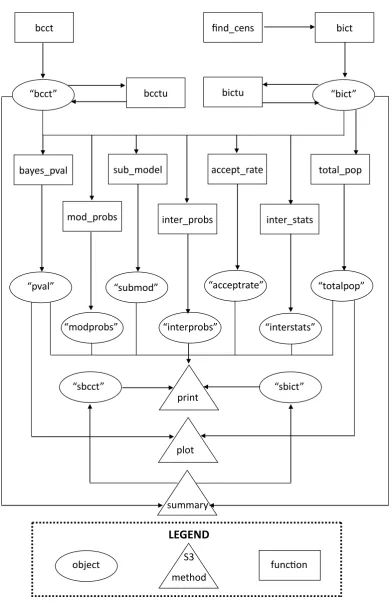
Figure1 shows all of the functions of contingthat the user will typically call. The main two functions are bcct() and bict() that implement the MCMC algorithm in Section 3.2, for complete and incomplete contingency tables, respectively. Mandatory arguments to bcct()
and bict() will be the form of the maximal model (in terms of a ‘formula’ object) and
the number of MCMC iterations to perform in the first instance. The data are introduced to
bcct()andbict()using thedataargument, where the data must be either a ‘data.frame’ or
‘table’ object. Otherwise, the variables in the maximal model are taken from the environment
from which bcct() orbict() is called. Once the data-augmentation algorithm has finished the requested number of iterations, then additional iterations can be requested usingbcctu()
andbictu(), forbcct() and bict(), respectively.
bayes_pval
mod_probs
bcct find_cens bict
“bcct” bcctu bictu “bict”
accept_rate
inter_probs sub_model
inter_stats
total_pop
“pval”
“modprobs”
“submod” “totalpop”
summary
“sbcct” “sbict”
“acceptrate”
“interprobs” “interstats”
plot
function
object S3
method
[image:10.595.106.499.108.711.2]LEGEND
Name of Description Produces an S3 methods
function object of that can be
class applied to this class
accept_rate() Calculates the acceptance rates ‘acceptrate’ print
of the reversible jump and Metropolis-Hastings algorithms which can be used to assess MCMC performance (see
Brooks, Giudici, and Roberts 2003).
bayespval() Performs assessments of model ‘pval’ print
adequacy by predicting from the plot
model to calculate the Bayesian
p value
inter_probs() Calculates the posterior ‘interprob’ print
probability of each term in the maximal model.
inter_stats() Calculates the posterior ‘interstat’ print
probability, mean, variance, and highest posterior density interval (HPDI) of each log-linear
parameter of the maximal model.
mod_probs() Calculates the posterior ‘modprobs’ print
model probabilities.
sub_model() Conditional on a user-specified ‘submod’ print
model of interest, calculates the posterior mean, variance and HPDI for the log-linear parameters, as well as assessments of model
adequacy and estimates of the total population size.
total_pop() Derives an MCMC sample from ‘totpop’ print
the posterior distribution of the plot
total population size. Can only be applied to ‘bict’
[image:11.595.91.514.107.615.2]objects.
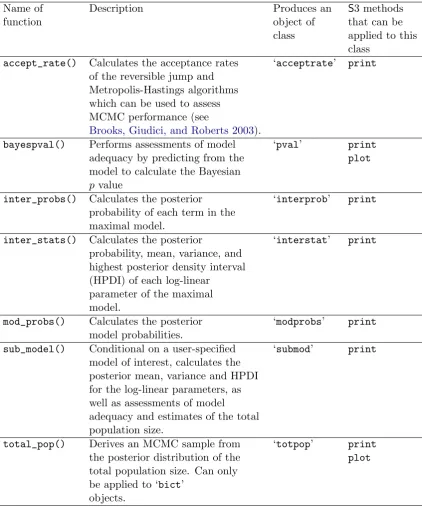
Table 1: The seven specific functions that can be used for ‘bcct’ and ‘bict’ objects.
There are also seven specific functions that can be used for ‘bcct’ and ‘bict’ objects and these are summarized in Table1. The functions shown in Table1(except forinter_probs(),
accept_rate()and sub_model()) are used to construct the output given by the summary()
4. Examples
In this section we use four examples to demonstrate conting. The first two examples involve complete contingency tables and the latter two involve incomplete contingency tables. The data for the four examples are included in conting. In each example, we have specified the seed using theset.seed()function, so that all of the examples are fully reproducible.
4.1. Alcohol, obesity and hypertension
In Section 2, we introduced the AOH data as an example of a complete contingency table. We now conduct a Bayesian analysis of this table using thebcct() and bcctu()functions.
The mandatory arguments to bcct() are the form of the maximal model and the number of MCMC iterations. We specify that the maximal model be the saturated model which includes the three-way interaction. We initially request 1000 MCMC iterations. Optional arguments tobcct()involve specifying the starting values of the MCMC algorithm, the prior (Saban´es-Bov´e and Held, or unit information), the value of πm,m and details for saving the MCMC output to external files. Additionally, we can also specify the hyperparameters for the Saban´es-Bov´e and Heldprior (aand bfrom Section2) and request a progress bar to monitor the iterations. We assume the unit information prior distribution but allow the remaining arguments to take their default values so that the algorithm starts from the posterior mode of the maximal model, πm,m= 0.5, the output is not saved to external files, and no progress bar is displayed. Once the initial 1000 MCMC iterations are complete we request a further 9000 iterations (making a total of 10000) using the bcctu() function. We then print out the resulting ‘bcct’ object which gives a very simple summary which essentially informs the user of the analysis performed.
R> set.seed(1)
R> data("AOH", package = "conting")
R> aoh_ex <- bcct(formula = y ~ alc * hyp * obe, data = AOH, + n.sample = 1000, prior = "UIP")
R> aoh_ex <- bcctu(object = aoh_ex, n.sample = 9000) R> aoh_ex
Number of cells in table = 24
Maximal model = y ~ alc * hyp * obe
Number of log-linear parameters in maximal model = 24
Number of MCMC iterations = 10000
Computer time for MCMC = 00:01:06
Prior distribution for log-linear parameters = UIP
Iteration number
Intercept par
ameter
0 2000 4000 6000 8000 10000
2.70
2.75
2.80
2.85
2.90
2.95
3.00
[image:13.595.162.428.108.349.2]3.05
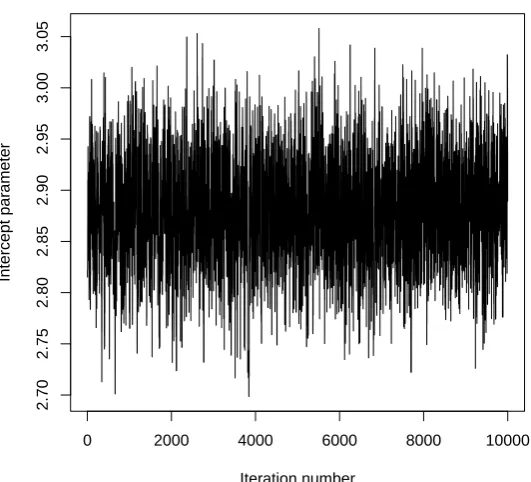
Figure 2: Trace plot for the intercept parameter,φ, in the alcohol, obesity and hypertension example.
2004, p. 426) by inspecting trace plots of the sampled values. For example we can produce a trace plot of the intercept parameter,φ, using the following line of code.
R> ts.plot(aoh_ex$BETA[, 1], ylab = "Intercept parameter", + xlab = "Iteration number")
The resultant plot is shown in Figure 2. We see that convergence occurs very quickly. For a detailed summary of the analysis performed, including posterior summary statistics, use the generic S3 method summary(). This function has optional arguments which control how the MCMC output is used. These are the number of burn-in iterations (n.burnin), the amount of thinning (thin), the cutoff of the posterior probability for presenting results on the log-linear parameters (cutoff), the discrepancy statistic (statistic), values to control which posterior model probabilities to present (best and scale), and the target probability (prob.level) for the highest posterior density intervals (HPDIs). We use a conservative burn-in phase of 5000 iterations, present posterior summary statistics only for log-linear parameters with probability greater than 0.05 and present the posterior model probabilities of the four models with the highest values for these probabilities. We use the χ2 discrepancy statistic and no thinning which are the default values of the argumentsstatistic and thin.
R> aoh_ex_summ <- summary(aoh_ex, n.burnin = 5000, cutoff = 0.05, best = 4) R> aoh_ex_summ
Posterior summary statistics of log-linear parameters:
post_prob post_mean post_var lower_lim upper_lim
alc1 1.0000 -0.05246 0.007552 -0.22109 0.12462
alc2 1.0000 -0.06679 0.006965 -0.22473 0.10549
alc3 1.0000 0.09071 0.006147 -0.05021 0.24773
hyp1 1.0000 -0.51223 0.002758 -0.61998 -0.41760
obe1 1.0000 -0.03502 0.006740 -0.20669 0.11304
obe2 1.0000 -0.01829 0.004804 -0.15216 0.11661
hyp1:obe1 0.4556 -0.19692 0.005621 -0.33686 -0.05046
hyp1:obe2 0.4556 -0.03208 0.005590 -0.19581 0.09921
NB: lower_lim and upper_lim refer to the lower and upper values of the 95 % highest posterior density intervals, respectively
Posterior model probabilities:
prob model_formula
1 0.5344 ~alc + hyp + obe
2 0.4492 ~alc + hyp + obe + hyp:obe 3 0.0100 ~alc + hyp + obe + alc:hyp
4 0.0064 ~alc + hyp + obe + alc:hyp + hyp:obe
Total number of models visited = 4
Under the X2 statistic
Summary statistics for T_pred
Min. 1st Qu. Median Mean 3rd Qu. Max.
6.183 18.810 23.250 23.950 28.080 61.940
Summary statistics for T_obs
Min. 1st Qu. Median Mean 3rd Qu. Max.
13.26 25.45 32.28 31.55 36.35 60.93
Bayesian p-value = 0.2246
First, under the χ2 discrepancy statistic, the Bayesian p value of 0.22 does not indicate an inadequate model meaning that predictions of the cell counts are consistent with the observed cell counts. The posterior modal model is the independence model and the model with the sec-ond largest posterior model probability only contains the hypertension and obesity interaction
(hyp:obe). These two models are estimated to account for approximately 98% of the
pos-terior probability. This shows there are no strong interactions between the factors although there is some evidence for interaction between hypertension and obesity. From inspecting the posterior means of the log-linear parameters associated with the hypertension and obe-sity interaction, it indicates that as obeobe-sity level moves from low to high, the probability of hypertension increases.
Now suppose we were interested in inference solely based on the model with the second highest posterior model probability, i.e., the model withformula = y ~ alc + hyp + obe
+ hyp:obe. We can produce posterior summary statistics similar to those given bysummary(),
but which are conditional on a model of interest. This is accomplished using thesub_model()
a formula, or by the ranking of the model with respect to its posterior model probability
(order). We demonstrate with the latter, i.e., setorder = 2.
R> sub_model(object = aoh_ex, order = 2, n.burnin = 5000)
Posterior model probability = 0.4492
Posterior summary statistics of log-linear parameters: post_mean post_var lower_lim upper_lim
(Intercept) 2.86613 0.002993 2.76755 2.97230
alc1 -0.04840 0.007238 -0.21232 0.11952
alc2 -0.06900 0.006670 -0.24143 0.07961
alc3 0.09178 0.006074 -0.04605 0.24327
hyp1 -0.51954 0.002843 -0.61771 -0.41347
obe1 -0.08635 0.005781 -0.23917 0.05344
obe2 -0.02019 0.005841 -0.16255 0.13261
hyp1:obe1 -0.19665 0.005563 -0.33610 -0.05114
hyp1:obe2 -0.03199 0.005572 -0.19581 0.09921
NB: lower_lim and upper_lim refer to the lower and upper values of the 95 % highest posterior density intervals, respectively
Under the X2 statistic
Summary statistics for T_pred
Min. 1st Qu. Median Mean 3rd Qu. Max.
7.662 18.730 23.330 23.950 28.350 63.310
Summary statistics for T_obs
Min. 1st Qu. Median Mean 3rd Qu. Max.
17.23 22.15 25.00 25.80 28.17 48.01
Bayesian p-value = 0.4114
Note that if the MCMC algorithm has not visited the specified model (given by formulaor
order) thensub_model() will return an informative error.
4.2. Risk factors for coronary heart disease
R> set.seed(1)
R> data("heart", package = "conting")
R> heart_ex <- bcct(formula = y ~ (A + B + C + D + E + F)^6, data = heart, + n.sample = 50000, start.formula = y ~ (A + B + C + D + E + F)^2, + save = 1000, prior = "UIP")
R> list.files()
[1] "BETA.txt" "MHACC.txt" "MODEL.txt" "RJACC.txt" "SIG.txt"
The last line of code above, shows the MCMC output files in the working directory. We calculate the acceptance rates of the MCMC algorithms used.
R> accept_rate(heart_ex)
Acceptance rate of reversible jump proposals = 14.9384 %
Acceptance rate of Metropolis-Hastings proposals = 75.8558 %
Convergence of the MCMC iterations was assessed informally using trace plots (not shown) similar to Section 4.1. We now summarize the analysis. We use a burn-in phase of 10000 iterations, the deviance discrepancy statistic, and request 99% probability intervals for the log-linear parameters. We only present the posterior model probabilities for the models with the four highest probabilities. We could achieve this by using thesummary() function. However, we instead calculate the Bayesian p value using the bayespval() function, the posterior summary statistics for the log-linear parameters using theinter_stats() function, and the posterior model probabilities using themod_probs() function. Thus we demonstrate the use of these dedicated functions.
R> heart_ex_bp <- bayespval(heart_ex, n.burnin = 10000, + statistic = "deviance")
R> heart_ex_bp
Under the deviance statistic
Summary statistics for T_pred
Min. 1st Qu. Median Mean 3rd Qu. Max.
312.0 344.7 352.0 352.6 359.9 416.1
Summary statistics for T_obs
Min. 1st Qu. Median Mean 3rd Qu. Max.
346.8 361.8 365.5 366.2 369.7 401.0
Bayesian p-value = 0.1502
R> inter_stats(heart_ex, n.burnin = 10000, prob.level = 0.99)
post_prob post_mean post_var lower_lim upper_lim
(Intercept) 1.0000 2.69922 0.0015485 2.59372 2.79933
A1 1.0000 -0.03725 0.0007013 -0.10644 0.03646
B1 1.0000 -0.22973 0.0016583 -0.32235 -0.11395
C1 1.0000 -0.16069 0.0010445 -0.24495 -0.07997
D1 1.0000 -0.13602 0.0006591 -0.20335 -0.06653
E1 1.0000 -0.12742 0.0009243 -0.19963 -0.03890
F1 1.0000 -0.89965 0.0011254 -0.98633 -0.81541
A1:C1 1.0000 0.13400 0.0005913 0.07056 0.19688
A1:D1 0.9671 -0.08805 0.0005665 -0.14956 -0.02815
A1:E1 0.9992 0.11984 0.0006039 0.05499 0.18183
B1:C1 1.0000 -0.69960 0.0009270 -0.77933 -0.62331
D1:E1 0.9859 0.09479 0.0005992 0.03273 0.15784
NB: lower_lim and upper_lim refer to the lower and upper values of the 99 % highest posterior density intervals, respectively
R> mod_probs(heart_ex, n.burnin = 10000, best = 4)
Posterior model probabilities: prob
1 0.19462 2 0.12968 3 0.07010 4 0.06705
model_formula
1 ~A + B + C + D + E + F + A:C + A:D + A:E + B:C + C:E + D:E 2 ~A + B + C + D + E + F + A:C + A:D + A:E + B:C + B:E + D:E
3 ~A + B + C + D + E + F + A:C + A:D + A:E + B:C + B:E + C:E + D:E 4 ~A + B + C + D + E + F + A:C + A:D + A:E + B:C + B:F + C:E + D:E
Total number of models visited = 394
Under the deviance discrepancy statistic, the Bayesian p value of 0.15 does not suggest an inadequate model. The models with the four highest posterior model probabilities are the same as identified byDellaportas and Forster (1999) andForster et al. (2012). With regards to the log-linear parameters we used the default value for cutoff so we are only presented with results for parameters with posterior probability greater than 0.75. This suggests there are strong interactions between smoking and strenuous physical work (A:C), systolic blood pressure (A:D) and the ratio of α and β lipoproteins (A:E), as well as for the interactions between strenuous mental and physical work (B:C) and between systolic blood pressure and the ratio ofα and β lipoproteins (D:E).
4.3. Spina Bifida
medical rehabilitation records (S3). Additionally, these people are cross-classified according to ethnicity (eth) which has three levels: Caucasian, Afro-American and Other. These data can be used to estimate the total population size of people born with Spina Bifida by estimating the missing cell counts of people not observed by any of the three sources.
Below we print out the data. It can be seen that the three cell counts corresponding to people not observed by any of the three sources (one for each classification of ethnicity) areNA. This tellsbict() that these cell counts are missing.
R> data("spina", package = "conting") R> spina
y S1 S2 S3 eth
1 NA un un un caucasian
2 45 un obs un caucasian
3 230 obs un un caucasian
4 134 obs obs un caucasian
5 52 un un obs caucasian
6 3 un obs obs caucasian
7 107 obs un obs caucasian
8 12 obs obs obs caucasian
9 NA un un un afro-american
10 3 un obs un afro-american
11 13 obs un un afro-american
12 8 obs obs un afro-american
13 8 un un obs afro-american
14 1 un obs obs afro-american
15 3 obs un obs afro-american
16 0 obs obs obs afro-american
17 NA un un un other
18 0 un obs un other
19 1 obs un un other
20 0 obs obs un other
21 0 un un obs other
22 0 un obs obs other
23 1 obs un obs other
24 0 obs obs obs other
We begin by considering the independence model only, i.e., we do not consider model un-certainty. Single model inference can be achieved using bict() (and bcct() for complete contingency tables) by specifying the model of interest as the maximal model and then setting
πm,m= 1 (i.e.,null.move.prob = 1). Note that single model inference can also be achieved, having already fitted the encompassing model (Section 3), by using the sub_model() func-tion as demonstrated in Secfunc-tion4.1. We use 25000 iterations under the defaultSaban´es-Bov´e and Held prior. When the MCMC algorithm has finished, we summarize the analysis after discarding the first 5000 iterations as burn-in and use the defaultχ2 discrepancy statistic.
R> set.seed(1)
R> summary(spina_ex_ind, n.burnin = 5000)
Posterior summary statistics of log-linear parameters:
post_prob post_mean post_var lower_lim upper_lim
(Intercept) 1 1.37569 0.053109 0.8693 1.7748
S11 1 -0.35986 0.003265 -0.4731 -0.2501
S21 1 0.49110 0.002028 0.4047 0.5798
S31 1 0.55756 0.002120 0.4693 0.6495
eth1 1 2.77890 0.052561 2.3624 3.2639
eth2 1 -0.01643 0.057632 -0.4700 0.4627
NB: lower_lim and upper_lim refer to the lower and upper values of the 95 % highest posterior density intervals, respectively
Posterior model probabilities: prob model_formula
1 1 ~S1 + S2 + S3 + eth
Total number of models visited = 1
Posterior mean of total population size = 757.4334
95 % highest posterior density interval for total population size = ( 717 797 )
Under the X2 statistic
Summary statistics for T_pred
Min. 1st Qu. Median Mean 3rd Qu. Max.
3.517 14.480 19.050 20.970 24.940 246.800
Summary statistics for T_obs
Min. 1st Qu. Median Mean 3rd Qu. Max.
61.21 68.07 71.92 73.22 76.75 110.60
Bayesian p-value = 0.003
The Bayesianpvalue is very close to zero which suggests that the predicted cell counts from the model are inconsistent with the observed cell counts indicating that the model is inadequate. We elaborate the model by including model uncertainty and fitting the encompassing model. We set the maximal model as the model with all two-way interactions and request 25000 iterations.
R> set.seed(1)
R> spina_ex <- bict(formula = y ~ (S1 + S2 + S3 + eth)^2, data = spina, + n.sample = 25000)
Posterior summary statistics of log-linear parameters:
post_prob post_mean post_var lower_lim upper_lim
(Intercept) 1 1.13984 0.065807 0.6276 1.57305
S11 1 -0.42069 0.032310 -0.6791 0.05947
S21 1 0.75397 0.008459 0.5912 0.91438
S31 1 0.77893 0.007449 0.6151 0.94123
eth1 1 2.75560 0.062992 2.2954 3.21856
eth2 1 0.01322 0.077752 -0.4928 0.52171
S21:S31 1 -0.43865 0.004804 -0.5808 -0.30623
NB: lower_lim and upper_lim refer to the lower and upper values of the 95 % highest posterior density intervals, respectively
Posterior model probabilities:
prob model_formula
1 0.40965 ~S1 + S2 + S3 + eth + S2:S3
2 0.14595 ~S1 + S2 + S3 + eth + S1:S2 + S2:S3 3 0.13730 ~S1 + S2 + S3 + eth + S1:S3 + S2:S3 4 0.11350 ~S1 + S2 + S3 + eth + S1:eth + S2:S3
5 0.06110 ~S1 + S2 + S3 + eth + S1:S2 + S1:eth + S2:S3 6 0.05505 ~S1 + S2 + S3 + eth + S1:S3 + S1:eth + S2:S3
Total number of models visited = 24
Posterior mean of total population size = 725.8932
95 % highest posterior density interval for total population size = ( 676 781 )
Under the X2 statistic
Summary statistics for T_pred
Min. 1st Qu. Median Mean 3rd Qu. Max.
3.509 13.970 18.240 20.930 24.190 745.100
Summary statistics for T_obs
Min. 1st Qu. Median Mean 3rd Qu. Max.
7.308 18.490 22.190 22.850 26.480 57.180
Bayesian p-value = 0.3622
total_pop() function. The total_pop() function will return an object of class ‘totalpop’ which is a list including a component calledTOT, which is the required MCMC sample. Below, as an example, we use this sample to produce the point estimate that minimizes the relative squared error loss function, i.e., the point estimate is given by ˆN =E(N−1|y(O))/E(N−2|y(O)), (Madigan and York 1997).
R> spina_tot <- total_pop(spina_ex, n.burnin = 5000)
R> round(mean(1/spina_tot$TOT) / mean(1/(spina_tot$TOT^2)), 0)
[1] 724
Madigan and York (1997) found a point estimate of 731, under the same loss function, with a 95% probability interval of (689, 794). Note that they collapsed the Afro-American and Other levels of the ethnicity factor to one level: Afro-American and Other.
4.4. Estimating the number of people who inject drugs in Scotland
In this section we consider a 27 incomplete contingency table which is given by King et al.
(2013). These data relate to estimating the number of PWID in Scotland in 2006. There are four sources: social inquiry reports (S1); hospital records (S2); Scottish Drug Misuse Database (S3); HCV database (S4), and three additional factors: age (age;<35 years, 35+ years), gender (gender), and region (region; Greater Glasgow & Clyde, Rest of Scotland). A total of 5670 PWID are observed by the four sources. As discussed in Section 3.1, the cell counts corresponding to only being observed by the HCV database (S4) are subject to censoring. We need to identify which cells are subject to censoring. This can be done via the
find_cens()function.
R> data("ScotPWID", package = "conting")
R> cens <- find_cens(sources = ~ S1 + S2 + S3 + S4, cens_source = ~ S4, + data = ScotPWID)
R> ScotPWID[cens, ]
y S1 S2 S3 S4 Region Gender Age
9 122 un un un obs GGC Male Young
25 135 un un un obs GGC Male Old
41 48 un un un obs GGC Female Young
57 38 un un un obs GGC Female Old
73 134 un un un obs Rest Male Young
89 104 un un un obs Rest Male Old
105 78 un un un obs Rest Female Young
121 25 un un un obs Rest Female Old
We set the maximal model to include all two-way interactions and specify the defaultSaban´ es-Bov´e and Held prior distribution. We request 2 million iterations of the MCMC algorithm and save the MCMC output to external files every 1000 iterations. We also tell the function
bict()that we have some censored cells using thecens argument. The default value for this
R> set.seed(1) R> scot_ex <- bict(
+ formula = y ~ (S1 + S2 + S3 + S4 + Age + Gender + Region)^2, + data = ScotPWID, cens = cens, n.sample = 2000000, save = 1000)
Throughout our summary of the above analysis we use a burn-in phase of 200000 iterations (i.e., we discard the first 10% of the iterations) and due to the size of the MCMC output we base our inference only on every 5th iteration by settingthin = 5. FollowingGelman et al.
(2004, p. 295) we only recommend using thinning when there are problems with computer memory due to large numbers of parameters and/or MCMC iterations. To assess model adequacy we use the Freeman-Tukey discrepancy statistic.
R> scot_ex_bp <- bayespval(scot_ex, n.burnin = 200000, thin = 5, + statistic = "FreemanTukey")
R> scot_ex_bp
Under the Freeman-Tukey statistic
Summary statistics for T_pred
Min. 1st Qu. Median Mean 3rd Qu. Max.
16.23 28.49 31.30 31.54 34.32 54.88
Summary statistics for T_obs
Min. 1st Qu. Median Mean 3rd Qu. Max.
27.13 33.00 34.24 34.44 35.67 50.62
Bayesian p-value = 0.26
The Bayesian p value is 0.26 which indicates that there is no evidence of an inadequate model. We now calculate the posterior probabilities of the log-linear parameters using the
inter_probs() function and only present those with probability greater than 0.70.
R> inter_probs(scot_ex, n.burnin = 200000, thin = 5, cutoff = 0.70)
Posterior probabilities of log-linear parameters: post_prob
(Intercept) 1.0000
S1 1.0000
S2 1.0000
S3 1.0000
S4 1.0000
Age 1.0000
Gender 1.0000
Region 1.0000
S1:S3 0.9442
S1:Age 0.9991
S2:Age 0.9865
S2:Gender 0.9999
S3:Age 1.0000
S3:Region 1.0000
Age:Gender 1.0000
Age:Region 1.0000
The posterior probabilities of the log-linear parameters are consistent with those found by Overstallet al. (2014). Finally we derive an MCMC sample from the posterior distribution of the total population size and find its posterior mean and 95% HPDI using the tot_pop()
function.
R> scot_ex_tot <- total_pop(scot_ex, n.burnin = 200000, thin = 5) R> scot_ex_tot
Posterior mean of total population size = 22856.24
95 % highest posterior density interval for total population size = ( 16427 27097 )
The posterior mean of the total population size of PWID in Scotland in 2006 is 22900 (to nearest 100). This value is consistent with that found by Overstall et al. (2014). Applying theS3 genericplot() to an object of class ‘totpop’ will produce a histogram of the MCMC sample from the posterior distribution of the total population size.
R> plot(scot_ex_tot)
The resultant histogram is shown in Figure3. Note that the bimodal nature of the posterior distribution of the total population size was also found by Overstall et al. (2014). This bimodality is caused by the presence, or absence, of the interaction between the social inquiry and Scottish Drug Misuse Database sources (S1:S3). The posterior mean for this interaction is positive so that the upper mode corresponds to the presence of the interaction, and the lower mode to absence.
5. Concluding remarks
This paper demonstrates the use of theRpackage conting, for the Bayesian analysis of com-plete and incomcom-plete contingency tables. The conting package allows a user to identify in-teractions between factors and to estimate closed populations using incomplete contingency tables from capture-recapture studies. The capabilities ofconting are demonstrated via four examples.
A novice user need only supply the data, the form of the maximal model (in the usual Rway of using a formula), and the number of MCMC iterations. The S3 method for summary()
will then provide all of the relevant information.
However a more experienced user can also access the sampled values of the model param-eters and missing cell counts (for an incomplete table). For example, from Section 4.4,
scot_ex$BETA is the 2 million by 29 matrix containing the sampled values of the β
Total Population
P
oster
ior probability
15000 20000 25000 30000
0.00000
0.00005
0.00010
0.00015
[image:24.595.161.419.114.345.2]0.00020
Figure 3: Histogram of the posterior distribution of the total population size of PWID in Scotland in 2006.
unobserved and censored cell counts. Furthermore, if the argument save is not NULL, then
bcct()and bict() will save the MCMC output to external files; see Section4.2. These files
can be read into R and manipulated however the user wishes. Possible applications of this output include more extensive assessments of MCMC convergence and model adequacy, and the calculation of posterior summaries relevant to a specific research question.
Future work will involve updating conting to fit Bayesian models to contingency tables in-volving structural zeros, misclassified cell counts and ordinal factor levels.
Acknowledgments
The authors thank the reviewers for their constructive comments and suggestions, which have greatly improved the article and package. Both authors were partly funded by the MRC-funded addictions cluster, NIQUAD (Grant No. G1000021).
References
Agresti A (2007). An Introduction to Categorical Data Analysis. 2nd edition. John Wiley & Sons.
Brooks SP, Giudici P, Roberts GO (2003). “Efficient Construction of Reversible Jump Markov Chain Monte Carlo Proposal Distributions.” Journal of the Royal Statistical Society B,
Dawid AP, Lauritzen SL (1993). “Hyper Markov Laws in the Statistical Analysis of De-composable Graphical Models for Contingency Tables.” The Annals of Statistics, 21(3), 1272–1317.
Dellaportas P, Forster JJ (1999). “Markov Chain Monte Carlo Model Determination for Hierarchical and Graphical Log-Linear Models.”Biometrika,86(3), 615–633.
Edwards D, Havr´anek T (1985). “A Fast Procedure for Model Search in Multidimensional Contingency Tables.”Biometrika,72(2), 339–351.
Fienberg SE (1972). “The Multiple Recapture Census for Closed Populations and Incomplete 2k Contingency Tables.” Biometrika,59(3), 591–603.
Forster JJ (2010). “Bayesian Inference for Poisson and Multinomial Log-Linear Models.” Statistical Methodology,7(3), 210–224.
Forster JJ, Gill RC, Overstall AM (2012). “Reversible Jump Methods for Generalised Linear Models and Generalised Linear Mixed Models.”Statistics and Computing,22(1), 107–120.
Fox J (2002). AnR and S-PLUS Companion to Applied Regression. Sage.
Gamerman D (1997). “Sampling from the Posterior Distribution in Generalised Linear Mixed Models.”Statistics and Computing,7(1), 57–68.
Gelman A, Carlin JB, Stern HS, Rubin DB (2004). Bayesian Data Analysis. Chapman and Hall.
Green PJ (1995). “Reversible Jump Markov Chain Monte Carlo Computation and Bayesian Model Determination.”Biometrika,82(4), 711–732.
Green PJ (2003). “Trans-Dimensional Markov Chain Monte Carlo.” In PJ Green, NL Hjort, S Richardson (eds.), Highly Structured Stochastic Systems. Oxford University Press.
Kass RE, Wasserman L (1996). “The Selection of Prior Distributions by Formal Rules.” Journal of the American Statistical Association,91(435), 1343–1370.
King R, Bird SM, Brooks SP, Hutchinson SJ, Hay G (2005). “Prior Information in Behavioural Capture-Recapture Methods: Demography Influences Injectors’ Propensity to Be Listed on Data-Sources and their Drugs-Related Mortality.” American Journal of Epidemiology,
162(7), 694–703.
King R, Bird SM, Hutchinson SJ, Hay G (2009). “Estimating Current Injectors in Scotland and Their Drug-Related Death Rate by Sex, Region and Age-Group via Bayesian Capture-Recapture Methods.”Statistical Methods in Medical Research,18(4), 341–359.
King R, Bird SM, Overstall AM, Hay G, Hutchinson SJ (2013). “Injecting Drug Users in Scot-land, 2006: Number, Demography, and Opiate-Related Death-Rates.” Addiction Research and Theory,21(3), 235–246.
Knuiman MW, Speed TP (1988). “Incorporating Prior Information into the Analysis of Contingency Tables.”Biometrics,44(4), 1061–1071.
Madigan D, York Y (1997). “Bayesian Methods for Estimation of the Size of a Closed Popu-lation.”Biometrika,84(1), 19–31.
Mantel N (1970). “Incomplete Contingency Tables.”Biometrics,26(2), 291–304.
McCullagh P, Nelder JA (1989). Generalized Linear Models. 2nd edition. Chapman and Hall.
Ntzoufras I, Dellaportas P, Forster JJ (2003). “Bayesian Variable and Link Determination for Generalised Linear Models.” Journal of Statistical Planning and Inference, 111(1–2), 165–180.
O’Hagan A, Forster JJ (2004). Kendall’s Advanced Theory of Statistics, volume 2B: Bayesian Inference. 2nd edition. John Wiley & Sons.
Overstall AM (2014). conting: Bayesian Analysis of Contingency Tables. R package ver-sion 1.3, URLhttp://CRAN.R-project.org/package=conting.
Overstall AM, King R (2014). “A Default Prior Distribution for Contingency Tables with Dependent Factor Levels.”Statistical Methodology,16, 90–99.
Overstall AM, King R, Bird SM, Hutchinson SJ, Hay G (2014). “Incomplete Contingency Tables with Censored Cells with Application to Estimating the Number of People who Inject Drugs in Scotland.”Statistics in Medicine,33(9), 1564–1579.
RCore Team (2014). R: A Language and Environment for Statistical Computing. R Founda-tion for Statistical Computing, Vienna, Austria. URLhttp://www.R-project.org/.
Saban´es-Bov´e D, Held L (2011). “Hyper-g Priors for Generalized Linear Models.” Bayesian Analysis,6(3), 387–410.
Tan M, Tian GL, Ng KW (2010). Bayesian Missing Data Problems. Chapman & Hall/CRC.
Venables WN, Ripley BD (2002). Modern Applied Statistics with S. 4th edition. Springer-Verlag, New York. URLhttp://www.stats.ox.ac.uk/pub/MASS4/.
Zellner A (1986). “On Assessing Prior Distributions and Bayesian Regression Analysis with
g-Prior Distributions.” In PK Goel, A Zellner (eds.), Bayesian Inference and Decision Techniques: Essays in Honor of Bruno de Finetti. North-Holland/Elsevier.
Affiliation:
Antony M. Overstall
St Andrews United Kingdom
E-mail: [email protected]
Journal of Statistical Software
http://www.jstatsoft.org/published by the American Statistical Association http://www.amstat.org/
Volume 58, Issue 7 Submitted: 2012-12-12