arXiv:1202.0161v1 [astro-ph.SR] 1 Feb 2012
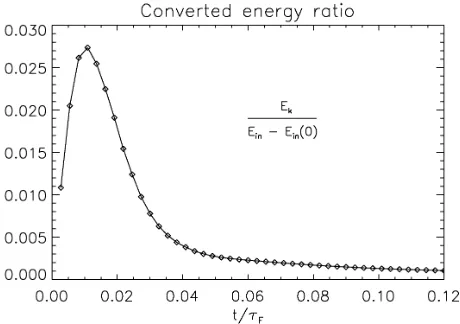
during the initial diffusion phase, and what is the nature of the outward transmission of information and energy. The resistivity rapidly diffuses the current at the null point. The presence of a plasma pressure allows the vast majority of the free energy to be transferred into internal energy. Most of the converted energy is used in direct heating of the surrounding plasma, and only about 3% is converted into kinetic energy, causing a perturbation in the magnetic field and the plasma which propagates away from the null at the local fast magnetoacoustic speed. The propagating pulses show a complex structure due to the highly non-uniform initial state. It is shown that this perturbation carries no net current as it propagates away from the null. The fact that, under the assumptions taken in this paper, most of the magnetic energy released in the reconnection converts internal energy of the plasma, may be highly important for the chromospheric and coronal heating problem.
I. INTRODUCTION
Magnetic reconnection is likely to play an important role in the coronal heating problem, but the relative importance of re-connection and wave heating models in the different regions of the corona is still unclear1–3. Magnetic null points are impor-tant locations for magnetic reconnection. Their relevance in coronal studies has been stated by numerous authors4–6, and,
in two-dimensions, they are the only locations where nection can occur. Two big questions about magnetic recon-nection at null points are: into what forms of energy is the stored magnetic energy converted, and where does this energy conversion take place. It is well known that magnetic energy is transferred into internal, kinetic and fast particle energy, but the question of the proportions in each is still unsettled.
At two-dimensional magnetic X-points in particular, the an-swers to all these questions, as well as the source of the re-quired magnetic energy for reconnection, have been a subject of study for decades. In many situations in the solar corona, the continuous slow photospheric motions of the magnetic footpoints feed energy to the magnetic field. This energy may be stored in the form of many current density layers7,8.
Lo-cally within these current layers, the properties of the plasma may at some point reach some appropriate conditions for which reconnection becomes important. For instance, current layers may undergo current induced microinstabilities creat-ing an anomalous resistivity9–11, which then permits the
dissi-pation of the current via reconnection. In this process, part of the magnetic energy is transferred into kinetic and/or internal energy of the plasma (plus particle acceleration in kinematic models). This is likely to be the case in many examples of so-lar fso-lares12,13, and is a possible mechanism for coronal heating
via myriads of small-scale nano-flares14. The onset of these
instabilities, as well as the energy partitioning, are still not
well understood.
In this paper, we consider the case where a current layer has been slowly formed in a non-force-free scenario, using a mag-netohydrodynamic (MHD) model. We apply a local enhance-ment in resistivity in the current layer to mimic the sudden on-set of an anomalous resistivity causing spontaneous magnetic reconnection (without the presence of any external flow15,16).
This approach fixes the amount of available magnetic energy in the process, and is completely different to steady state re-connection models such as the fast rere-connection regimes17–19, where the rate with which the reconnection is being driven is the same as the actual rate with which the flux is reconnected. A recent study which considered the source and nature of the energy conversion associated with 2D spontaneous re-connection has been carried out in Longcope and Priest20
(from now on referred to in the paper as LP07). In this pa-per, they make an analytical study of the fast magnetosonic (FMS) wave launched by reconnection in a current sheet af-ter a sudden increase in the resistivity. By conducting a one-dimensional analysis in which they investigate the leading or-der term only, which they assume to be m = 0, they found that a propagating sheath of current which travels out from the null at the local Alfv´en speed, converting the magnetic en-ergy into kinetic enen-ergy as it moves through the volume. They start from an ideal Green’s current sheet21, where the field is potential everywhere except in an infinitesimally thin, but fi-nite length, current sheet with an infifi-nite current density. The dissipation of the current is then modelled by introducing a uniform diffusivity,η, everywhere in the domain, which is big enough for their dynamics to be approximated by the linear re-sistive MHD equations. An important assumption is that they neglect the plasma pressure, and hence, treat the problem as purely magnetic.
described by a diffusion equation and the second by a propa-gating wave equation. As soon as the resistivity is enhanced, diffusion expands the current rapidly (at a rate much quicker than any wave travel time), and the current expansion then slows down to the point where the speed of expansion couples to the local FMS mode. From that point on, a propagating fast wave expands outwards from the edge of the diffusion region, carrying most of the energy converted in the diffusion process. The coupling between diffusion and FMS waves after a sud-den enhanced resistivity was first studied22for an infinite
cur-rent sheet embedded in a uniform external field. The work of LP07 is a generalization from the uniform magnetic field to a more complex X-point scenario.
In their derivations, several assumptions are made, which we summarise here:
1) their analytical study is conducted within a linear regime, where the natural dissipation length scale (lη∼η1/2) is much larger than the size of their current sheet;
2) they neglect the effects of plasma pressure, for simplicity; 3) they assume that the most significant changes in the mag-netic field are in the m=0 term. Hence, the perturbation has cylindrical symmetry, with a circular expanding sheath.
The overall results they find are:
1) after the initial diffusive phase, the magnetic energy is con-verted almost entirely into kinetic energy;
2) their outward propagating wave carries a net positive cur-rent, due to the diminished current left behind by the recon-nection;
3) a persistent peak of current density remains at the location of the X-point, where a small amount of energy dissipation continues, driven by a velocity inflow set off after the out-going FMS wave has past. Thus, within the diffusion region around the X-point, a steady flow consistent with reconnec-tion is left behind: outwards parallel to the axis of the current sheet and inwards perpendicular to it;
4) in addition to the outwards propagation of the wave, to the right and left of the null the flow field encroaches slowly in-wards as the pulse expands;
5) the m = 0 component of the FMS wave is a concentric sheath of current that propagates outwards and is narrow but not infinitesimal. Its width is proportional to the radius, and it carries a net current with it, so that, once the FMS wave has passed by, the field inside the sheath has less current and is much closer to potential.
In the present paper, we conduct numerical experiments to consider the same questions as in the analytical treatment of LP07. However, we cannot start our numerical experiments from the same initial condition. The main reason for not us-ing a Green-type initial current sheet in our numerical exper-iments is that, with a finite grid (of any resolution) the width of the current sheet becomes finite, and the current layer is no longer in equilibrium. Also, inside the current sheet, where the magnetic field reverses sign, the magnetic pressure varies across the current sheet, creating an unbalanced magnetic pressure force. To analyse the problem of spontaneous recon-nection and the nature of any waves launched, it is essential that our experiments start from a genuine non-force-free mag-netohydrostatic (MHS) equilibrium, where the Lorentz forces
of the central current layer are entirely balanced by plasma pressure gradients.
We use full 2D MHD numerical simulations, starting with an initial equilibrium X-point that contains a main elongated current layer at the location of the null, which has a high, but not infinite peak. The current also extends faintly along the four separatrices of the system, such that the current structures are able to contain non-zero plasma pressure gradients. This initial state is given by Fuentes-Fern´andez et al.23(which will be referred to as FF11), as a numerical solution to the non-resistive collapse of a squashed potential X-point, achieved by viscous relaxation. This state is a “quasi-static” equilibrium in which force balance is achieved throughout the domain, ex-cept locally at the null and along the separatrices. At these locations, a very slow asymptotic regime towards an infinite time singularity remains and is numerically and physically un-avoidable.
For further details of work done regarding current sheet for-mation around 2D X-points for both force-free and non-force-free solutions, see FF11. In the first paper of that series24,
the authors studied the role of plasma pressure effects in sim-ple hydromagnetic scenarios. Starting from the non-force-free “quasi-equilibrium” from FF11, we study the impulsive re-connection due to an anomalous localised resistivity in a nar-row diffusion region at the location of the null. We aim to compare our numerical results with the simplified analytical study of LP07.
The paper is structured as follows. In Sec. II, we define the equations governing the dynamical evolution. In Sec. III, we present the initial equilibrium state to start our numerical experiment, mentioning its properties, its relevance, and its origin. The main results are shown in Sec. IV, followed by a general discussion in Sec. V.
II. RESISTIVE MHD EQUATIONS
For the numerical experiments studied in this paper, we have used Lare2D25, a staggered Lagrangian-remap code with user controlled viscosity and resistivity, that solves the full MHD equations. The numerical code uses the normalised MHD equations, where the normalised magnetic field, den-sity and lengths,
x=L ˆx, y=Lˆy, B=BnBˆ , ρ=ρnρ ,ˆ
imply that the normalising constants for pressure, internal en-ergy, current density and plasma velocity are,
pn =
B2n
µ , ǫn=
B2n
µρn
, jn=
Bn
µL and vn=
Bn
√µρ
n .
The subscripts n indicate the normalising constants, and the
hat quantities are the dimensionless variables with which the
code works. The expression for the plasma beta can be ob-tained from this normalization as
β=2 ˆp
ˆ
FIG. 1: Two-dimensional contour plots of (a) electric current density and (b) plasma pressure for the initial equilibrium state. Solid white lines are the magnetic field lines, drawn as contours of the flux function, Az, where Az <0 outside the cusp (top and bottom), Az >0 inside the cusp (left and right) and Az =0 at the null and on the separatrices. This state is taken from the final equilibrium obtained after the dynamical non-resistive relaxation of FF11.
In this paper, we will work with normalised quantities, but the
hat is removed from the equations for simplicity.
The (normalised) equations governing our MHD processes are,
∂ρ
∂t +∇·(ρv) = 0, (1)
ρ∂v
∂t +ρ(v·∇)v = −∇p+(∇×B)×B+Fν, (2)
∂p
∂t +v·∇p = −γp∇·v+Hν+
j2
σ , (3) ∂B
∂t = ∇×(v×B)+η∇
2B, (4)
whereηis the magnetic diffusivity (which, in the normalised equations, equals the resistivity), Fνand Hνare the terms for the viscous force and viscous heating, and j2/σis the ohmic
dissipation. The internal energy,ǫ, is given by the ideal gas law, p=ρǫ(γ−1), withγ=5/3.
Finally, the time unit used in our numerical results is the FMS crossing time,τF, i.e. the time for a FMS wave to travel from the null (y=0) to the top (y=0.35) or bottom boundary. This time is calculated as
τF =
Z y=0.35
y=0
dy
cF(y)
, (5)
where cF(y)=
q
v2
A+c2sis the local fast magnetosonic speed, and it matches the time for the initial perturbation to reach the top boundary.
III. INITIAL STATE
The starting point for our numerical experiments is of ex-treme importance. This state should ideally be in a perfect non-force-free equilibrium, in order to be able to compare
our results with LP07. The form of such a non-force-free state has been sought by some authors in the past26–29, but a consistent analytical expression has still not been found. The latest attempt has been made by FF11, through the vis-cous, non-resistive, dynamical relaxation of a squashed po-tential X-point (starting from a homogeneous current density in the whole domain). The final state from this numerical re-laxation is the starting point for the numerical experiments in the present paper.
The initial state was achieved numerically after a MHD evolution, consistent with energy transfer between magnetic, kinetic and internal energies. The non-zero plasma pressure makes it possible to achieve a realistic state in which the current is not located at an ideal infinitesimally thin current sheet, such as the family of solutions studied by Bungey and Priest30. Instead, the current accumulates in a finitely thick
layer which also extends along the four separatrices. The fact that this state is not in a perfect equilibrium is unavoidable, simply because of the infinite-time nature of the current sin-gularity. Nevertheless, the time evolution of such an asymp-totic regime does not cause any complications for the resistive experiments that are studied in this paper, since its time-scale is much slower than those of the processes discussed here.
The final state of the numerical relaxation found in FF11 is described as a “quasi-static” equilibrium in which the Lorentz and the pressure forces balance each other throughout the do-main, save at the current layer. As a MHS equilibrium, this state must obey the Grad-Shafranov equation, which, for 2D symmetries, relates the plasma pressure, flux function and cur-rent density, as follows
dp(Az) dAz
=−jz(Az). (6)
FIG. 2: Current density surface within the initial diffusion region, in a close up of the null point. Magnetic field separatrices are shown as black lines. Note, the current extended along the separatrices is only just over jcrit=6.
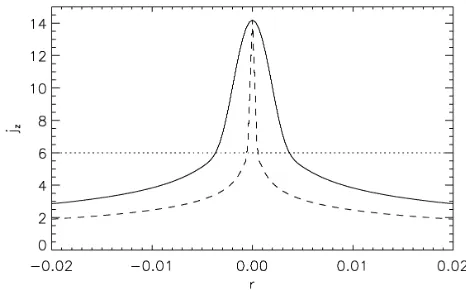
FIG. 3: Cuts of current density in the x-direction (solid) and y-direction (dashed) across the central current layer. The radial co-ordinate r corresponds to x for the solid line, and y for the dashed line. The dotted horizontal line marks the level of jcrit.
FF11.
Fig. 1 shows the final state from FF11 which is the start-ing point for our numerical experiments. The current density (Fig. 1a) is localised within a small region about the null and faintly extends along the four separatrices. The plasma pres-sure (Fig. 1b) has a positive gradient in the regions inside the cusp (left and right), and a negative gradient outside the cusp (top and bottom). The initial background values of the current density and the plasma pressure for this particular experiment are j0 =1.04 and p0 = 0.375, and the viscosity is isotropic
and has a value ofν=0.0001. The resolution of the numerical grid is 3072×3072, which uniformly covers the domain ex-tending from−0.5 to 0.5 in the x-direction and−0.35 to 0.35 in the y-direction. Magnetic field lines are line-tied at the four boundaries and all components of the velocity are set to zero on the boundaries. The other quantities have their derivatives perpendicular to each of the boundaries set to zero. Both
to-tal energy and toto-tal mass are conserved in the experiments, to within numerical error.
Starting with the FF11 set-up (Fig. 1), we apply an anoma-lous (non uniform) resistivity that vanishes below a critical value of the current density, jcrit, and is constant above it,
η= (
0 if jz<jcrit, η0 if jz≥jcrit.
(7)
This approach allows diffusion only about the null, where the current density is large. This is known to be a crucial parame-ter for fast reconnection regimes and solar flares31–34, but also
for coronal heating from small-scale sources35,36. Here, we have chosen jcrit=6 andη0 =0.0008. The estimated
numer-ical diffusivity, due to the finite grid resolution, is 0.0001. In the absence of an enhanced diffusivity,η0, the current layer
would keep evolving slowly in time becoming shorter and thinner (as seen in Fig. 9 in FF11).
[image:4.612.59.292.290.435.2]It is worth noting that the initial structure of the current den-sity extends along the separatrices very faintly, as shown in Fig. 2, but the main concentration of current is still at the cen-tral current layer. In Fig. 3, we show horizontal and vertical cuts through the null point, of the initial current density distri-bution. Note, how the central current layer is elongated in the
x-direction, but is much thinner in the y-direction.
IV. RESULTS
A. Diffusive phase
Following the approach of LP07, we first look at the initial phase where the current density peak is diffused by the resis-tive terms, to the point where it reaches the value of jcrit. This diffusive phase occurs within the first few time-steps of the simulation and contains all the energy conversion due to the ohmic dissipation itself.
In Fig. 4, we show the changes in magnetic, internal and kinetic energies, normalised to the value of the initial internal energy. The kinetic energy is zero in the initial state. From these plots, we can see the sudden decrease of magnetic en-ergy (Fig. 4a), due to the magnetic reconnection occurring at the null, which is directly transferred into both internal (Fig. 4b), and kinetic energy (Fig. 4c). The relative changes of energy are very small. This is due to the very narrow initial diffusion region (see Fig. 2 and 3), which only allows a small amount of magnetic flux to be reconnected. The energies re-main constant after the time t/tF shown in the plots.
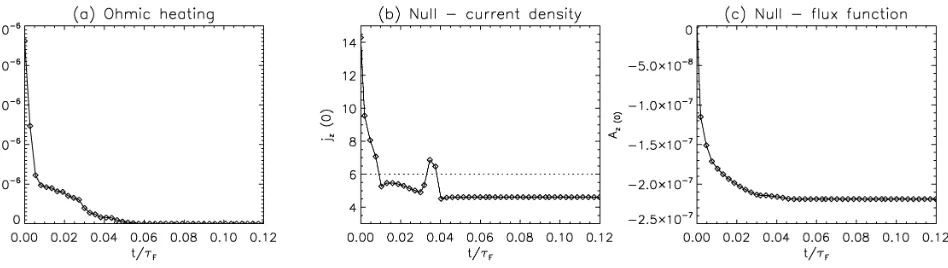
In Fig. 5, we show the ohmic heating integrated over the whole domain, together with the behaviour of the current den-sity, jz, and the flux function, Az, at the location of the null. The ohmic heating (Fig. 5a), which is proportional to the absolute change of j2
Ini-FIG. 4: Time evolution of a) magnetic, b) internal and c) kinetic energy, integrated over the whole domain, for the first time-steps of the simulation. The first two have been normalised to the relative change from their non-zero initial values. The initial values of the magnetic and internal energies are, respectively, 0.09 and 0.40.
FIG. 5: Time evolution of a) the ohmic heating integrated over the domain, b) the current density at the location of the null (the dotted line indicates the value of jcrit) and c) the flux function at the location of the null, for the same time interval as in Fig. 4.
tially, the current at the null decreases rapidly until jz < jcrit (at t ∼0.01τF). Note that, this occurs just before the kinetic energy reaches its maximum, and just before the ohmic heat-ing flattens. This current density overshoot (the current go-ing well below the level of jcrit) may be a consequence of the small scale advection, outwards from the null, within the ex-panded diffusion region, right after the sudden decrease of the peak current density, which spreads out the current density lowering it below jcrit. At time t ∼ 0.03τF, the null current density increases significantly (even above the value of jcrit) and it then quickly goes back down. A possible cause for this effect is discussed below. Soon after, it stabilises to a value of
jz∼4.5, at roughly the time when the ohmic heating stops. In Fig. 5c, we show the time evolution of the flux function at the null point (initially zero for convenience), normalised to the value of Az at the middle (x= 0) of the upper bound-ary (i.e. to the range of Azavailable to reconnect, that is 0.5). The change of the flux function is negative, because the recon-nected field lines have a negative Az. The rate of change of Az decreases at t ∼ 0.03τF, in agreement with the null current density rise, and then stops at the time when ohmic heating ceases, so Azremains fixed here-after.
We now investigate further the time evolution of the ener-gies of the system, to determine the nature of the energy into which the majority of the transferred magnetic energy is
con-verted. Fig. 6 shows the ratio of the change in kinetic energy to the change in internal energy. It is clear that the vast major-ity of the converted magnetic energy during the reconnection process goes directly into internal energy, while the energy that is transferred into kinetic is minimal. This is the first main result that differs dramatically from LP07. Our initial state is not a potential equilibrium with a current sheet, but is a non-force free state in which there exists a background non-zero current density everywhere, together with a plasma pressure gradient which is large compared to the magnitude of the effects driven by the reconnection process. This contrasts with the zero-beta treatment of LP07 which did not include internal energy.
The consequences of this result are that the amplitude of the propagating wave is extremely small. Changes in cur-rent density and pressure are no more than about 10−6 times
their initial values. Thus, for the analysis of the propagating wave, we have had to consider the differences of quantities from their initial non-uniform distributions, rather than their absolute magnitudes.
[image:5.612.81.555.246.380.2]cur-FIG. 6: Time evolution of the ratio of the change in kinetic energy to the change in internal energy, for the same time interval as in Fig. 4.
rent density has been decreased to a level below jcrit (i.e. at
t ∼0.03τF). During this period, a small amount of magnetic energy is converted into internal energy via ohmic heating, and a tiny amount of it is converted into kinetic energy, ac-celerating the plasma within the diffusion region. By the end of this diffusive phase, a fast magnetosonic wave is launched from the edge of the diffusion region. But instead of a sin-gle pulse outwards from the null, as described in LP07, a pair of FMS pulses of opposite sign, directed outwards from the diffusion region edge and inwards towards the null point, is launched. The closest distance between the edge of the diff u-sion region and the null appears in a vertical cut through the null point (see Fig. 2). This width is approximately 0.00055. Also, the speed of the FMS wave in the region near the null can be approximated as the sound speed of the plasma in that region (since the magnitude of the magnetic field is negligible near the null), which in our experiment is cs∼0.9. This gives a time for a magnetosonic pulse to travel from the closest edge of the diffusion region to the null of t∼0.02τF. Added to the time when the current density falls to the value of jcrit, gives a value of t∼0.03τF, which is the time of the observed current density bump.
In other words, if a pair of fast waves is launched from the edge of the diffusion region in opposite directions at the mo-ment when the diffusion stops, i.e. when jz < jcrit, then, one of these pulses would reach the null, causing an increase in the current density, and acting against reconnection for that short period of time. This effect can be seen clearly in Fig. 5b and causes a minor perturbation in the flux function at the null, as seen in Fig. 5c. Of course, the same thing would happen from the below edges of the diffusion region, and hence, these two pulses would travel through and follow the opposite partners outwards from the null.
Now that the initial diffusive phase has been described, we analyse the subsequent phase where a FMS wave is launched radially from the null point. The signature of this wave is seen as a small perturbation to the current density, the plasma pressure and the plasma flow velocity.
B. Wave initiation
Immediately after the short diffusive phase in which the current is reduced to below the level of jcrit, a FMS wave is launched in all directions, in accordance with LP07. As already discussed, due to the small amplitude of our pertur-bation, from now on we show all quantities subtracted from the initial distributions. Fig. 7 shows the current density and plasma pressure perturbations, and the velocity vector field, for a time shortly after the initiation of the wave (t=0.06τF). An important fact to note is that the dominant mode in the magnetic field perturbation is m=4, as seen from the current density map (Fig. 7a). We first focus on the velocity vector field (Fig. 7c) and the plasma pressure pulse (Fig. 7b).
The velocity field pattern (inflow above and below the null, and outflow to the left and right) is caused by the passage of the FMS wave communicating the occurrence of the sudden reconnection that has occurred at the thin diffusion region. The plasma inflows leave a pressure deficit behind, while the plasma outflows cause a pressure enhancement in front. This explains the different signs of the plasma pressure perturba-tion (Fig. 7b). A pair of positive semi-circular pulses travel outwards from the left and right edges of the diffusion region, and a pair of negative planar pulses (remember we are deal-ing with differences here, not with absolute quantities) travel above and below the null. The positive pressure pulses corre-spond to plasma outflows, while the negative pressure pulses are associated with plasma inflows. Also, the shapes of the positive and negative pulses are defined by the initial shape of the diffusion region at the time where the FMS wave is launched. This is about 5 times longer than wider, and its short and faint extensions along the 4 separatrices are one order of magnitude smaller than in the central region (see Fig. 2) and so, their contribution may be completely neglected. Hence, the negative plasma pressure pulse is initiated in a planar way, while the positive pulses are initiated at the left and right edges of the diffusion region, showing a circular propagation cen-tered at those vertices.
[image:6.612.63.293.53.215.2]velocity field, for t=0.06τF. Solid black lines show the magnetic field lines withAz=0, i.e. the separatrices for the initial state (hence, a sign for reconnection to have occurred). In (c), red arrows show the direction of the flow at each point.
FIG. 8: Sketch of the different forces that are carried by the mag-netic and plasma perturbations, at any moment before the pulse has left the diffusion region well behind. The dashed thick line is the propagating wave front. Here, we show the current density vector corresponding to each of the pulses (positive current points outside of the 2D plane), the direction of the background magnetic field vec-tor, and the directions of the plasma and Lorentz forces, Fpand FL
respectively.
C. Wave propagation
As the FMS wave escapes further from the central diffusion region, it leaves behind a region of magnetic field and plasma that has returned to the initial equilibrium state. This is shown in Fig. 9. Here, we see the current density and plasma pres-sure perturbations, and the velocity vector field, for a time when the propagating wave is far from the region close to the null (t = 0.49τF). The m = 4 mode is again clearly seen in the current density perturbation (Fig. 9a), and the same structure described above remains during the propagation of the wave. Note, the propagating current density pulse always carries both a negative and a positive current.
As for the plasma pressure pulse (Fig. 9b), we can see the propagation of two faint negative pulses travelling vertically at the top and bottom, and the two curved positive fronts to the right and left of the null. When the positive pulse leaves the region about the null, a pressure deficit appears following
behind. By looking at the velocity vector field (Fig. 9c), we see that this corresponds to a slow encroachment towards the origin, and is the result of advection from the wave interacting with diffusion (see LP07 for more details).
The waves observed in the previous plots expand with the local fast speed. However, due to the asymmetry of our domain, the pulse is not perfectly concentric, but expands slightly faster in the vertical direction.
The physical perturbation that the FMS wave causes in the magnetic field and the plasma is sketched in Fig. 10, for the same three regions as described in Fig. 8. In region (I), the FMS wave compresses both the plasma and the magnetic field (the following decompression of the plasma due to the flow encroachment is not shown in the Figure for simplicity). In region (II), it causes the opposite behaviour, expanding both the plasma and the magnetic field. And in region (III), the FMS wave bends the magnetic fields towards the direction of the reconnection flow, and compresses the plasma.
Over all, what Figures 7 to 10 show is that the nature of the wave propagation in each region is different, according to how the forces act in each of them. What is more, the reconnection does not produce one single pulse, but four (two quasi-planar pulses at the top and bottom of the layer, and two semicircular pulses at the right and left edges). Thus a dominating m =
0 radial mode for the magnetic field perturbation could not exist, because the magnetic field is not radially symmetric, and neither are the forces caused by the reconnection.
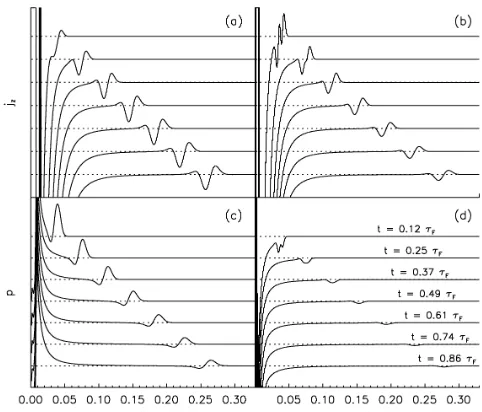
In order to have a closer look at the propagation of the wave, we look at its profile in different cuts at various times dur-ing the numerical simulation. Fig. 11 shows horizontal and vertical cuts in the domain, from the null point to the bound-aries, of both the current density and the plasma pressure, for seven times throughout the numerical experiment, before the pulse reaches the upper and lower boundary (t=τF). In the horizontal cut of current density (Fig. 11a) we can see that the pulse decreases in amplitude and broadens only slightly in time. In contrast, the decrease in amplitude and broaden-ing are very apparent in the vertical cut of the current density (Fig. 11b). Besides, in the first steps of the vertical propaga-tion, there are two pulses that finally become one after about
[image:7.612.60.294.236.395.2]FIG. 9: Two-dimensional contour plots of (a) electric current density perturbation (b) plasma pressure perturbation and (c) magnitude of the velocity field, for t=0.49τF. Solid black lines are the magnetic field lines. In (c), red arrows show the direction of the flow at each point.
FIG. 10: Sketch of the magnetic field perturbation and the leading pressure front perturbation for the three same regions as in Fig. 8. The background plasma pressure gradient is indicated for each re-gion.
explain the additional bump in Fig. 5b. According to our hypothesis, after the diffusive phase, a pair of FMS pulses is launched from the edge of the diffusion region in opposite di-rections, outwards from and inwards to the null point. When the inward pulses reach the null, they travel through it and fol-low behind the opposite outwards propagating pulses, until the second pulse catches up with the first and then they eventually merge into one.
The same cuts are shown for the plasma pressure (Fig. 11c and d). In the horizontal cut, we see the main positive pulse, followed by a negative blob which accounts for the inward encroachment of the flow. The pulse in the vertical cut shows the same two-pulse merging observed in the current density.
To finish our analysis, the last question is, does the pulse as a whole carry a net current with it? In order to evaluate this, we define the quantity C(r,t) as the integrated perturbed
current inside a circle of radius r at a time t,
C(r,t)=
Z 2π
0
Z r
0
∆jz(r, θ,t) rdrdθ , (8)
where∆jz represents the perturbation in current density, i.e. after subtracting the initial state. This quantity is equivalent
to C(r,t) in LP07 except that here we integrate over the
az-imuthal direction instead of assuming one-dimensionality of the problem, and we consider the perturbation,∆jz ,as op-posed to the absolute value, jz.
This function depends on one spatial coordinate and on time. Fig. 12 shows plots of C(r) for the same seven times as considered in Fig. 11. For a given time, the function C(r) represents the total current contained in circles of increasing radius r.
The most central regions are extremely negative. This is be-cause we are dealing here with differences in current density, and this region corresponds to the initial high current density peak. Then, there is a layer of positive current that broadens. This corresponds to the 8-petal flower in Fig. 9a, where the positive (red) petals dominate on the inside while the negative (blue) petals dominate outside. However, C(r) vanishes after this layer, and hence, the whole structure has no net current. It can be seen from the plots that both before and after cross-ing the propagatcross-ing pulse, the value of C(r) is identically zero. This shows that the propagating wave carries no net current. The consequences of this result are very important, if we take into account the following:
In a closed system where the boundaries are in an unper-turbed equilibrium, the integrated current within the system must remain constant, because
d dt
I
C
B·dl= d
dt
Z
S
∇×B·ds= d
dt
Z
S
j·ds=0. (9)
Here, C represents the closed boundary of the system, whose length element is dl, and S represents the domain enclosed by
C, whose surface element is ds. The first part of Eq. (9) is
zero because the boundaries of the system are in equilibrium. Therefore, at least while the propagating wave has not reached the boundaries, the integrated current within our domain must remain constant (this has been verified numerically).
[image:8.612.77.274.226.386.2]FIG. 11: One-dimensional plots of current density (above) and plasma pressure (below) in a horizontal (left) and vertical (right) cut in the middle of the box, through the null, for seven different times during the propagating wave phase. Curves are displaced in the y-axis, and the dotted lines mark the zero for each of them. The times for all cuts are given on (d).
FIG. 12: Plot of the quantity C(r), from Eq. (8), at the same times as in Fig. 11, as a function of radius. Curves are displaced in the y-axis, and the dotted lines mark the zero for each of them.
V. DISCUSSION
Many analytical models for potential and force-free two-dimensional current sheets30 are available as starting points for reconnection studies in the vicinity of a magnetic X-point. Only in the last few years have a few authors attempted to give a description of the non-force-free solution to the relax-ation of magnetic environments under the effect of a plasma pressure23,27–29, but none of these cases have studied the sub-sequent current dissipation due to the sudden onset of mag-netic reconnection in a finite diffusion region, i.e. what hap-pens when the reconnection is not driven but occurs
sponta-rent density is greatly enhanced near the null, but also extends along the four separatrices. The form of the resistivity is such that it is only non-zero above a certain value of the current density, namely jcrit. Hence, diffusion will occur only until the current density drops below that level. Due to the fact that the initial diffusion region (where jz> jcrit) is very small, the perturbation in the field and the plasma caused by the recon-nection is very small, compared to the initial distribution of both the Lorentz forces and plasma pressure gradients.
The evolution of the system is divided into a diffusive phase and a propagating wave phase. During the first phase, the maximum current (at the null) is rapidly decreased below the level of jcrit. Within this short time, some magnetic energy is converted into both internal and kinetic energy. The over-all energetics of our numerical experiments are very different from LP07. In their experiment, most of their magnetic energy is directly converted into kinetic energy in the form of a prop-agating FMS wave, since their model has vanishing plasma beta. In the end the net current in the initial current sheet is almost entirely redistributed by this process, and the free magnetic energy drops by a significant fraction. According to their model, later on in the evolution of the field, this FMS wave would damp its energy far from the diffusion region.
A new scenario is presented in which pairs of oppositely directed planar pulses are launched from the top and bottom edges of the expanded diffusion region, towards the null and outwards from the null. The pulses travelling towards the null quickly pass through it and follow their opposite outward part-ner until merging with it. At the same time, two semicircular pulses are launched from the left and right vertices of the dif-fusion region.
[image:9.612.66.302.358.504.2]from the outset (even though the system is not actually radial). In our numerical experiment, our current sheet is elongated (although still short) and the obvious non-radial symmetry of the X-type magnetic field comes into play. Secondly, in our numerical experiments, we find four different pulses emanat-ing from the diffusion region and then expanding throughout the non-homogeneous medium. This suggests that a domi-nating m=0 radial mode for the magnetic field perturbation could never exist, and rather we obtain a m=4 mode, which arises naturally from the geometry of the magnetic field and from the reconnection flow pattern.
Also, the current perturbation carries no net current with it, which differs from LP07 due to our different assumptions about the magnetic diffusivity (namely, that it vanishes below a critical current density). This result, added to the fact that, while the perturbation does no reach the boundaries, the in-tegrated current within the domain must remain constant, as stated in Eq. (9), indicates that the decrease in magnetic en-ergy occurs purely through a redistribution of the central cur-rent in the region about the null, rather than through a decrease in the total current.
An interesting feature of LP07 is that after the FMS wave has escaped the central current sheet, a persistent X-point electric field continues flux transfer, with little energy dissi-pation. This feature is not present in our experiments, since we switch reconnection offwhen the current density is small. For comparison, an experiment with uniform resistivity was also run. The results from such an experiment are different from both the main experiments in this paper and the analyt-ical work of LP07, in two ways. Firtly, there is no clear and (near to) concentric wave expansion, because of the additional diffusion of the enhanced current along the four separatrices and the background current; Secondly, the system eventually reaches the potential configuration, i.e. a simple hyperbolic X-point.
In the numerical experiments presented in this paper, the amplitude of the initial current layer is small, and the diffusion region is short and thin. Hence, the amount of available mag-netic energy is tiny. This fact makes the propagating pulses al-most negligible. In a more realistic situation, we would expect to see viscous damping of the perturbations, causing a further
heating of the plasma away from the diffusion region. This cannot be seen in our experiments because, both the ampli-tude of the perturbations and the viscosity are tiny, the viscous damping does not occur before the pulses reach the boundary of our system.
In addition, the initial internal energy is about 4 times larger than the initial magnetic energy, and the plasma beta in our do-main is large. Therefore, the characteristic speeds of the slow and fast modes are very similar. This feature has the disadvan-tage of not allowing us to distinguish between fast and slow modes, but has the advantage of making the propagation of the pulses quasi-circular, facilitating calculations such as the net propagation of current density.
In a further paper, we will investigate the same reconnec-tion process in a low beta scenario where the initial current density at the null is about two orders of magnitude larger, and the initial current layer is thinner and longer. In these fur-ther experiments, the fast and slow magnetosonic speeds will be significantly different so we hope to be able to distinguish between these two wave modes. Also, we will look for en-ergy conversion far from the diffusion region, due to viscous damping of the waves, and we will evaluate if the portioning of energies depends on the initial choice of plasma parame-ters.
The consequences of the present study are of potential im-portance for the chromospheric and coronal heating problem. Under the assumptions taken in this paper, the spontaneous reconnection of a current layer through the relaxation of mag-netic fields driven, for example, by slow footpoint motions, may act as a source for direct plasma heating in non-zero beta environments. Similar experiments for three-dimensional magnetic null point reconnection are to be carried out as a nat-ural continuation of the present study.
Acknowledgements
The authors would like to thank Dr. I. De Moortel for useful discussions. Computations were carried out on the UKMHD consortium cluster funded by STFC and SRIF.
∗ Electronic address: [email protected] 1 R. W. Walsh and J. Ireland, A&A Rev. 12, 1-41 (2003). 2 J. A. Klimchuk, Sol. Phys. 234, 41-77 (2006).
3 A. W. Hood, in Lecture Notes in Physics, Berlin Springer Verlag
793, 109 (2010).
4 I. Ugarte, H. P. Warren and A. R. Winebarger, Astrophys. J. 662,
1293-1301 (2007).
5 D. W. Longcope and C. E. Parnell, Sol. Phys. 254, 51-75 (2007). 6 S. Masson, E. Pariat, G. Aulanier and C. J. Schrijver, Astrophys.
J. 700, 559-578 (2009).
7 E. N. Parker, Astrophys. J. 174, 499 (1972). 8 van Ballegooijen, Astrophys. J. 298, 421-430 (1985).
9 A. A. Galeev and R. Z. Sagdeev, in Handbook of Plasma Physics
(edited by A. A. Galeev and R. N. Sudan, 1984) 2, 271-303.
10 M. A. Raadu and J. J. Rasmussen, Astrophys. Space Sci. 144,
43-71 (1988).
11 M. Yamada, H. Ji, S. Hsu, T. Carter, R. M. Kulsrud, N. Bretz,
F. Jobes, Y. Ono and F. W. Perkins, Phys. Plasmas 4, 1937-1944 (1997).
12 S. K. Antiochos and P. A. Sturrock, Astrophys. J. 254, 343-348
(1982).
13 M. B´arta, J. B¨uchner, M. Karlick´y and J. Sk´ala, Astrophys. J. 737,
24 (2011).
14 K. Galsgaard and Å. Nordlund, J. Geophys. Res. 101,
13445-13460 (1996).
15 D. W. Longcope and H. R. Strauss, Astrophys. J. 426, 742-757
(1994).
16 I. J. D. Craig and S. M. Henton, Astrophys. J. 434, 192-199
(1994).
A90 (2010).
25 T. D. Arber, A. W. Longbottom, C. L. Gerrard and, A. M. Milne,
Computational Phys. 171, 151-181 (2001).
26 J. M. Fontenla, Astrophys J. 419, 837-854 (1993).
(2002).
36 V. Krasnoselskikh, O. Podladchikova, B. Lefebvre and N. Vilmer,