Differentiating the effects of negative state on optimism
and the implicit perception of everyday injury risk
MORGAN, James I and GARTHWAITE, Joe
Available from Sheffield Hallam University Research Archive (SHURA) at:
http://shura.shu.ac.uk/5454/
This document is the author deposited version. You are advised to consult the
publisher's version if you wish to cite from it.
Published version
MORGAN, James I and GARTHWAITE, Joe (2012). Differentiating the effects of
negative state on optimism and the implicit perception of everyday injury risk. In:
ANDERSON, Martin, (ed.) Contemporary Ergonomics and Human Factors 2012 :
Proceedings of the international conference on Ergonomics and Human Factors
2012, Blackpool, UK, 16-19 April 2012. CRC Press, 181-188.
Copyright and re-use policy
See
http://shura.shu.ac.uk/information.html
DIFFERENTIATING THE EFFECTS OF NEGATIVE STATE
ON OPTIMISM AND THE IMPLICIT PERCEPTION OF
EVERYDAY INJURY RISK
James I. Morgan & Joe Garthwaite
Psychology Group, Sheffield Hallam University, UK
To date no research has examined the effects of negative state on the perception of everyday injury risk. Instead, studies have focussed more broadly on the relationship between mood and self-reported optimism. The present study had two aims. Firstly, to assess the effect of incidental anxiety on implicit injury risk perception using a modified Implicit Association Test (IAT). Secondly, it sought to compare any effect with that on a conventional measure of risk perception (optimism). In line with previous research, anxious participants perceived more risk (were less optimistic). In contrast, there was no significant correlation between anxiety and the implicit perception of everyday injury risk. Theoretical and practical implications are discussed.
Introduction
According to the UK Health and Safety Executive (HSE) 09/10 statistics, fatal accident rates at work have shown a downward trend in recent years. Despite this, according to the same statistics, non-fatal injuries remain a frequent occurrence. Accident and emergency data reveal that these injuries are not confined to the workplace. There is a need to examine the factors associated with the occurrence of everyday injuries in all settings.
Explanations for these, and similar risk appraisals, point to the role of individual differences such as age (e.g. Deery, 1999), gender (e.g. Baker, Lamb, Grabowski, Rebok, & Li, 2001), and prior hazard experience (e.g. Wiegmann, Goh, & O’Hare, 2002). In many risk situations, including the aviation example above, the associated risks are widely known and therefore one or more of these individual difference variables, paired with changes in attitudes and feelings towards the risk, will be the most likely predictors (see Pauley, O’Hare, Mullen, & Wiggins, 2008).
In situations where the actual risks are less clear, for instance injury risk in everyday situations, it is more likely that perceptions are guided by emotional state (see Hockey, Maule, Clough, & Bdzola, 2000). A large body of theoretical literature suggests that quite apart from a person’s feelings in reaction to a particular risk or hazard (i.e. anticipatory emotions), incidental emotional states can impact on risk appraisals (see Loewenstein & Lerner, 2003 for a review). For example, Lerner and Keltner (2001) report a series of studies in which they examined the effect of specific, experimentally induced, and naturally occurring moods on risk perception (estimates of optimism about future events). Their most noteworthy finding concerned the effects of the negative states anger and anxiety (or fear). Whereas angry participants exhibited optimistic risk estimates (perceived less risk), anxious individuals were more pessimistic (perceived more risk).
These findings are theoretically important but there is some doubt as to whether they can inform research on injury risk perception. This is due to the questionable validity of the measures and methods adopted. For example, in the research mentioned above, Lerner & Keltner (2001) did not use a risk perception measure per se, but an adapted version of Weinstein’s (1980) measure of optimism about the occurrence of positive or negative future events. The reliance on self-report measures of risk appraisal in the majority of mood-risk research is also problematic. Self-report methods provide an indication of a respondent’s perceptions via their explicit attitudes, rather than measuring those perceptions directly. This is problematic because explicit attitudes are considered to be within conscious control, while the effect of mood on risk appraisal is thought to be an automatic, rather than a deliberative process (Loewenstein, Weber, Hsee, & Welch, 2001).
are interpreted as being more strongly associated in memory than more difficult or incompatible pairings, which elicit slower responses. A full description of the IAT procedure appears in the method section below.
The present study is the first to use an IAT to measure implicit perceptions of everyday injury risk and as such it was somewhat exploratory. In light of the theoretical and applied research findings outlined above there were two aims. Firstly, to assess the effect of incidental state anxiety on implicit everyday injury risk perception, and secondly, to compare any effect with that on a conventional self-report measure of explicit risk perception (optimism).
Method
Design
The study adopted a correlational design. The variables included were negative state scores (anxiety), implicit risk perception scores on the IAT (D), optimism scores for negative events, optimism scores for positive events, and total optimism scores.
Participants
A total of 31 Sheffield Hallam University students volunteered to participate in the study in return for course credits. The sample comprised 18 females and 13 males, aged between 20 and 27 (M = 23.3, SD = 2.17).
Materials and Apparatus
Incidental state anxiety was assessed using the first 20 items of the State-Trait Anxiety Inventory (STAI: Spielberger, 1983). Participants were asked to determine to what extent they were currently experiencing a range of anxious feelings such as nervousness and indecisiveness as well as more positive feelings using a 4-point scale, ranging from (1) ‘not at all’ to (4) ‘very much so’. After reverse scoring responses for the positive items the scale was deemed reliable (α
= .86).
In accordance with previous theoretical work (e.g. Lerner & Keltner, 2001), an adapted version of Weinstein's (1980) measure of optimism was used as an explicit measure of risk perception. This consisted of 25 items portraying hypothetical future life events. 12 of the events were positive such as 'you graduate in the top third of your class', and 13 of the events were negative (and reverse scored), such as 'you develop gum problems'. Participants were asked to estimate, on a scale from (-4) “very much less likely” to (4) “very much more likely”, the chances of each hypothetical event happening to them compared to another student of the same sex and studying at the same university. Estimates for positive and negative events were summed separately to form 2 subscales of optimism (α = .71 and α = .81, respectively) and also combined to form a
A computerised Implicit Association Test (IAT) was used to measure implicit everyday injury risk perception. Specifically, the IAT was constructed in order to record participants’ implicit associations between depictions of high injury probability (HIP) scenarios and low injury probability (LIP) scenarios and sets of words meaning risky (danger, threatened, harm, lethal, and hazard) and safe (protected, secure, home, reliable, and sure). These words were the same as those used by Pauley et al. (2008). Ten colour images, five showing HIP scenarios and five showing LIP scenarios, were also used. Appropriate images were selected from a google image search based on Cox and Tait’s (1991) definition of risk perception. HIP images depicted visible hazards that may cause physical harm such as faulty wiring in a household electricity circuit. LIP images, depicted neutral scenes with no visible dangers, in locations such as the home and the office. The face-validity of the chosen images was tested in a brief pilot study. Seventeen student participants rated all ten images on a 5-point Likert-type scale ranging from 0 ‘not at all risky’ to 5 ‘very risky’. Mean ratings for each of the five LIP images on the riskiness scale were between 1 and 2, with a combined mean rating of 1.19 (SD = .21). The mean ratings for each of the five HIP images ranged from between 3 to 4, with an overall mean rating of 3.81 (SD = .20). A t-test revealed a significant difference between overall riskiness ratings of HIP and LIP, t(16) = 20.04, p < .0001.
Table 1: Description of the IAT procedure. Block
1 2 3 4 5
Task description Initial target-concept discrimination Associated attribute discrimination Initial combined task Reversed target-concept discrimination Reversed combined task Task instructions
• LIP HIP •
• Safe Risky •
• LIP HIP • • Safe Risky •
LIP • • HIP
LIP • • HIP • Safe Risky •
Note. LIP = low injury probability; HIP = high injury probability. The position of the black dots represents whether the response is made with the participants left or right hand.
To ensure that any differences in reaction times for the incompatible and compatible blocks could not be attributed to order effects, block presentation was counterbalanced. Approximately half of the participants completed the compatible pairings first as described above (block order = 1, 2, 3, 4, 5), while the other half of the participants completed the incompatible pairings first (block order = 4, 1, 5, 2, 3).
The IAT was constructed and presented using the Inquisit 3.0.4.0 program by Millisecond Software (Inquisit 3.0.4.0, 2010). Participants completed the IAT on a 15.4inch flat screen mobile PC.
Procedure
Having consented to take part, participants completed the state anxiety measure. Participants were then asked to complete the explicit risk perception (optimism) and the implicit everyday injury risk perception (IAT) measure. The presentation order was counterbalanced, so that approximately half of the participants completed the IAT measure first and the other half completed the optimism measure. The negative state and optimism measures were previewed with their own participant instructions, and were completed by hand. A laptop computer was used to present the IAT instructions and the IAT test blocks. Following data collection each participant was thanked for their involvement and was debriefed.
Results
Data Screening
Data that were not normally distributed were normalized using log10
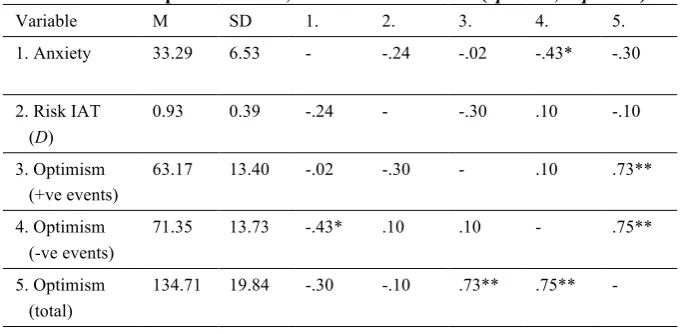
raw or transformed data, whereas all descriptive statistics (means, standard deviations) are from raw data. There were no outliers. Table 2 shows the means, standard deviations, and intercorrelations between all variables.
IAT Effects
The calculation of the IAT effect followed the revised scoring algorithm described by Greenwald, Nosek, and Banaji (2003), whereby implicit associations are measured using a difference score (D), which in the present study was calculated as (mean reaction time incompatible - mean reaction time compatible)/standard deviation of all latencies. Therefore, positive D scores indicated stronger associations for compatible pairings (e.g. risky words with HIP images), whereas a D score of 0 indicated no difference in associations, and negative D scores indicated inaccurate risk perceptions (stronger associations of incompatible pairings). D scores can range from -2 to +2.
The D scores ranged from –0.13 to 1.40 (M = 0.93, SD = 0.39). The mean reaction times to the compatible pairings of HIP/risky and LIP/safe were significantly faster (M = 944.99 ms, SD = 261.43 ms) than the incompatible pairings of HIP/safe and LIP/risky (M = 1646.70 ms, SD = 531.92 ms), t(30) = 7.90, p < .0001.
Optimism (Explicit Risk Perception) and Implicit Risk Perception
Optimism scores for negative events were not significantly related to optimism scores for positive events, r(31) = .10, p = .60. In line with the procedure adopted by Lerner and Keltner (2001), both subscales were included in the analysis, along with a total optimism score for each participant. High scores represent greater optimism and hence less risk perception. None of the three optimism scales were significantly correlated with IAT D scores (all p’s ≥ .18).
Negative State and Optimism
There was a significant correlation between state anxiety and optimism for negative events (r(31) = -.43, p = .02). This means that the more anxious participants were the less optimistic they were in their estimates of the likely occurrence of negative events.
Negative State and Implicit Risk Perception
Table 2: Descriptive statistics, and intercorrelations (*p < .05, **p < .01)
Variable M SD 1. 2. 3. 4. 5.
1. Anxiety 33.29 6.53 - -.24 -.02 -.43* -.30
2. Risk IAT (D)
0.93 0.39 -.24 - -.30 .10 -.10
3. Optimism (+ve events)
63.17 13.40 -.02 -.30 - .10 .73**
4. Optimism (-ve events)
71.35 13.73 -.43* .10 .10 - .75**
5. Optimism (total)
134.71 19.84 -.30 -.10 .73** .75** -
Discussion
The results showed that, in line with previous research (e.g. Lerner & Keltner, 2001), anxious participants perceived a greater risk of future negative event occurence (were less optimistic). In contrast, incidental anxiety was not significantly correlated with the implicit perception of everyday injury risk on the IAT.
As this is the first study of its kind, the implications are discussed with some caution. The finding regarding the anxiety-optimism relationship adds support to previous theoretical research, which suggests anxious people are more pessimistic in their estimates of the probability of future events, especially negative ones. What remains uncertain is whether this effect can be replicated when the risk in question is more ambiguous, and where a less deliberative form of information processing is necessary.
Our findings suggest not. There was no significant correlation between anxiety and the implicit perception of everyday injury risk. However, it would be unwise to suggest that this is a result that can be generalised beyond the small study sample. It is a possibility that incidental state can influence injury risk perception but that the current design, and the measures used, did not facilitate this.
the current IAT and further explore the role of emotional state in injury risk perception. In addition, there may be some merit in using the current IAT to assess the effect of other influences on injury risk perception, and also the potential for IAT scores to predict actual risk behaviour.
In terms of practical implications, there may be some value in assessing the effect of organisational aspects as well as individual differences on injury risk perception in applied settings where personal injury rates may be high, or in safety-critical environments where the consequences of inaccurate risk perception, and risky behaviour may be more severe.
Statement of relevance:
This paper is relevant for those interested in the measurement of implicit everyday injury risk perception, and the effect of individual differences such as mood state on those perceptions.
References
Baker, S., Lamb, M. W., Grabowski, J. G., Rebok, G., and Li, G. 2001, Characteristics of general aviation crashes involving mature male and female pilots, Aviation, Space, and Environmental Medicine, 72,447–452. Cox, S. and Tait, R. 1991, Reliability, safety, and the human factor
(Butterworth-Heinemann, Stoneham, MA).
Deery, H. A. 1999, Hazard and risk perception among young novice drivers,
Journal of Safety Research, 30,225–236.
Goh, J. and Wiegmann, D. 2002, Human factors analysis of accidents involving visual flight rules flight into adverse weather, Aviation, Space, and Environmental Medicine, 73, 817–822.
Greenwald, A. G. and Banaji, M. R. 1995, Implicit social cognition: Attitudes, self-esteem, and stereotypes, Psychological Review, 102,4–27.
Greenwald, A. G., McGhee, D. E., and Schwartz, J. L. K. 1998, Measuring individual differences in implicit cognition: The Implicit Association Test,
Journal of Personality and Social Psychology, 74,1464–1480.
Greenwald, A. G., Nosek, B. A., and Banaji, M. R. 2003, Understanding and using the Implicit Association Test: I. An improved scoring algorithm,
Journal of Personality and Social Psychology, 85, 197–216.
Health and Safety Executive Statistics 2009/2010.
http://www.hse.gov.uk/statistics/overall/hssh0910.pdf (August 2011, date last accessed).
Hockey, G. R. J., Maule, A. J., Clough, P. J., & Bdzola, L. 2000, Effects of negative mood states on risk in everyday decision making, Cognition & Emotion, 14, 823-855.
Hunter, D. R. 2006, Risk perception among general aviation pilots, International Journal of Aviation Psychology, 16,135–144.
Lerner, J. S. and Keltner, D. 2001, Fear, anger, and risk, Journal of Personality and Social Psychology, 81, 146-159.
Loewenstein, G. F. and Lerner, J. S. 2003, The role of affect in decision making. In R. J. Davidson, H. H. Goldsmith, & K. R. Scherer (eds.), Handbook of Affective Sciences (Oxford: University Press, New York), 619-642.
Loewenstein, G. F., Weber, E. U., Hsee, C. K., and Welch, N. 2001, Risk as feelings, Psychological Bulletin, 127,267–286.
Mearns, K. and Flin, R. 1995, Risk perception and attitudes to safety by personnel in the offshore oil and gas industry: A review. Journal of Loss Prevention in the Process Industries, 8, 299-305.
O’Hare, D. and Wiegmann, D. A. 2003, Continued VFR flight into IMC: Situational awareness or risky decision making? (Federal Aviation Administration, Washington, DC).
Pauley, K. A., O'Hare, D., Mullen, N. W., and Wiggins, M. 2008, Implicit perceptions of risk and anxiety and pilot involvement in hazardous events,
Human Factors, 50(5), 723-733.
Rundmo, T. 1996, Associations between risk perception and safety, Safety Science, 24(3), 197-209.
Spielberger, C. D. 1983, Manual for the State-Trait Anxiety Inventory
(Consulting Psychologists Press, Palo Alto).
Weinstein, N. D. 1980, Unrealistic optimism about future life events, Journal of Personality and Social Psychology, 39(5), 806-820.