Corpus Building for Low Resource Languages in the DARPA
LORELEI Program
Jennifer Tracey, Stephanie Strassel, Ann Bies, Zhiyi Song, Michael Arrigo, Kira Griffitt,
Dana Delgado, Dave Graff, Seth Kulick, Justin Mott and Neil Kuster
Linguistic Data Consortium
3600 Market Street, Suite 810
Philadelphia, PA 19104
{garjen|strassel|bies|zhiyi|marrigo|kiragrif|
danafore|graff|kulick|jmott|[email protected]}
Abstract
We describe corpora for the LORELEI (Low Resource Languages for Emergent Incidents) Program, whose goal is to build human language technologies to provide situational awareness during emergent incidents, with a particular fo-cus on low resource languages. Incident Language packs are used for system de-velopment and testing in machine transla-tion, entity disambiguation and linking, and the “situation frame” task, which re-quires aggregation of information about the emergent incident. Incident lan-guages, as well as the incidents them-selves, remain unknown until the evalua-tion begins, and no labeled training data is provided; systems developers must rapidly adapt technology for the incident language and return initial results within 24 hours. Given this surprise language evaluation scenario, Representative Lan-guage packs are designed to support re-search into cross-language projection and language universals rather than to pro-vide training data. They contain large volumes of monolingual and parallel text, basic annotations, lexical resources and simple NLP tools for 23 languages se-lected for typological diversity and cov-erage. We discuss the creation of the LORELEI language packs with a special focus on resources for machine transla-tion, as well as techniques for maintain-ing consistency across the language packs.
©
2019 The authors. This article is licensed under a Crea-tive Commons 4.0 license, no derivaCrea-tive works, attribution, CCBY-ND.1
Introduction
The DARPA (Defense Advanced Research Pro-jects Agency) LORELEI Program aims to im-prove the performance of human language tech-nologies capable of providing situational aware-ness in the context of a specific natural disaster or other emergent incident, with a particular fo-cus on low resource languages for which existing natural language processing (NLP) technology including machine translation is insufficient to support the use case. Systems are required to process information about topics, entities, rela-tions and sentiment, where both the incident lan-guage(s) and the incident type(s) remain un-known until the evaluation starts, and where ini-tial system output is due in just 24 hours.
Specialized data is crucial to achieving these ambitious goals. Linguistic Data Consortium (LDC) has created two types of linguistic re-sources to support training, development and evaluation of machine translation (MT) and other language technologies for LORELEI: Incident Language (IL) packs and Representative Lan-guage (RL) packs. Incident LanLan-guage packs are designed for LORELEI system development and testing. Systems are evaluated against a human gold standard reference for three tasks: machine translation, entity disambiguation and linking, and “situation frame”, which requires aggrega-tion of basic informaaggrega-tion about the needs and issues resulting from the emergent incident. MT output is also subject to human assessment to gauge its utility for of the situation frame task.
the final LORELEI program evaluation in sum-mer 2019. The IL languages appear in Table 1.
Kinyarwanda Uyghur
Oromo Uzbek
[image:2.595.88.279.109.185.2]Sinhala IL11 (undisclosed) Tigrinya IL12 (undisclosed) Ukrainian
Table 1: LORELEI Incident Languages
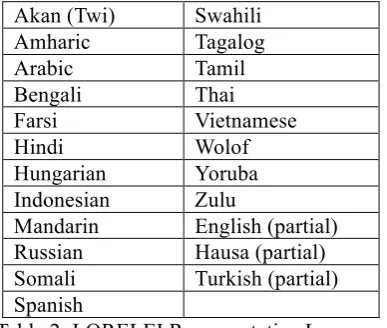
[image:2.595.86.280.555.719.2]Representative Language packs contain re-sources in 20 languages that have been selected to provide broad typological coverage, with lan-guages ranging from higher resourced (Spanish) to very low resourced (Akan). Partial language packs exist for three additional languages. Be-cause evaluation languages remain unknown to system developers until the start of the test peri-od, RL packs are designed to support research into utilization of language universals and pro-jection from related-language resources, rather than serving as training data tailored to particular evaluation tasks in a pre-specified language. Each RL pack contains large volumes of mono-lingual and parallel text, along with smaller amounts of manual entity annotation and linking, light semantic role labeling, document-level la-beling of situational needs and issues, as well as a lexicon and basic tools such as tokenizers and sentence segmenters, plus a grammatical sketch for the language. Some RL packs include sup-plemental morphological or syntactic resources. Every RL pack also shares a common set of Eng-lish documents translated into the RL; when this set is combined across all RLs it comprises a 21-way parallel corpus. The RL languages appear in Table 2.
Akan (Twi) Swahili
Amharic Tagalog
Arabic Tamil
Bengali Thai
Farsi Vietnamese
Hindi Wolof
Hungarian Yoruba
Indonesian Zulu
Mandarin English (partial) Russian Hausa (partial) Somali Turkish (partial) Spanish
Table 2: LORELEI Representative Languages
In the sections that follow we discuss the pro-cess used to create the LORELEI language
packs, with a particular focus on resources to support machine translation research. We also discuss strategies for maintaining compatibility and consistency in data collection, translation and annotation efforts across all LORELEI lan-guages.
2
Monolingual Test, Parallel Text and
Lexicons
LORELEI RL and IL language packs contain a number of components specifically designed to support machine translation research, including large volumes of monolingual and parallel or comparable text as well as rich lexical resources.
2.1 Monolingual Text
Both Representative and Incident Language Packs contain large volumes of monolingual text, primarily focusing on data in the LORELEI do-main of emergent situations like natural disasters, and spanning a range of genres from formal news to informal social media, blogs and discussion forums to reference materials like Wikipedia. The minimum target for monolingual text in the RLs was 2 million words; actual data yields ranged from over 1.25 billion words on the high end (Russian) to 600,000 words on the low end (Wolof, the only language to fall below the min-imum target). IL minmin-imum targets were lower, and final data volumes ranged from 3 million words (Oromo) to 27 million words (Uyghur). Reaching the minimum data volume targets for ILs proved to be a particular challenge, especial-ly for some genres; this was exacerbated by the need for the IL test sets to be primarily com-prised of documents about the particular test in-cident(s). We relied heavily on IL native speakers to use creative search techniques to find test in-cident data, and often needed to stretch the boundaries of traditional genre definitions to sat-isfy minimum IL data volume targets.
har-vested using an extension of LDC’s web collec-tion infrastructure first developed in the DARPA BOLT Program (Garland et. al. 2012). Harvested text was tokenized and sentence-segmented using LORELEI tools designed for cross-language consistency, supplemented with existing open source tools where necessary, and encoding was standardized to UTF-8. The Google CLD2 lan-guage detector was used to filter out harvested text not in the target language. CLD2 perfor-mance varied considerably by language and gen-re; moreover, data for many languages contained some degree of code switching and orthographic variation. Therefore, automatic language ID was intended to locate pervasive problems with a data source, rather than detect every case of non-target text in the corpus. Given this, documents subject to manual translation and annotation re-ceived an additional manual audit pass to verify language, content and domain relevance.
All collected sources were also reviewed for Intellectual Property Rights issues prior to distri-bution, and where necessary language packs in-clude pointers to the original data rather than downloaded/processed data. Language packs include utilities for corpus users to download and process such data, to ensure that they end up with the same versions of the data LDC used through-out our data pipeline.
2.2 Parallel and Comparable Text
Representative Language packs contain a mini-mum of 1 million words of parallel text: 900,000 words of RL source data translated into English, and a common set of 100,000 words translated from English into every RL. The 900,000 word set was drawn from the monolingual text collec-tion for each language, and was designed to con-tain roughly equal proportions of data from for-mal news sources and from inforfor-mal genres like blogs and social media, though the actual distri-bution varied by language. The common set of 100,000 English words translated into every RL contained four components: approximately 50% general English news documents, 25% LORE-LEI-domain English news documents, with the remaining 25% consisting of a phrasebook and elicitation corpus originally developed for the REFLEX (Research on English and Foreign Language Exploitation) Program and subse-quently updated for LORELEI (Alvarez et al., 2006). Because the same 100,000-word English set was translated into all 20 RLs, the result is a 21-way parallel corpus spanning a broad range of language families and typologies.
We used three methods to produce parallel text for the Representative Languages: 1) scraping parallel text from the web; 2) obtaining transla-tions through crowdsourcing; and 3) obtaining translations from translation vendors. This com-bination of methods resulted in translations of varying quality and quantity across languages, but the goal was always the same: to produce sentence-aligned content-accurate translations.
Wherever possible translation targets were met by scraping existing parallel text from the web. In addition to harvesting parallel text sources identified by native speakers, we used BITS (Ma and Liberman, 1999) to locate additional sources of parallel text from the web. BITS scans a list of potential parallel websites, downloads content from those websites and uses translation lexicons constructed for LORELEI to perform language ID on the individual webpages and identify any that are translations of one another. The docu-ment pairs are then sentence aligned using Champollion (Ma, 2006), which calculates simi-larity scores between tokenized segments from both languages to reach the optimal alignment.
When found parallel text was insufficient to meet data volume targets, we turned to crowdsourcing, using two platforms: Amazon Mechanical Turk (https://www.mturk.com/) and CrowdTrans (https://crowdtrans.com/), a plat-form first developed under LORELEI. Initial crowdsourcing efforts focused on translation of English news sources into RLs, with good yields for Spanish, Russian and Arabic. Subsequent ef-forts were limited to languages with very large pools of crowd workers, namely Hindi and Benglai, and focused on RL-into-English data. Translation proceeded one segment at a time in order to maintain accurate sentence alignment across languages. Segments resulting in at least 3 crowd translations were also subject to a crowdsourced best-to-worst ranking task for ad-ditional quality control. Within the CrowdTrans platform we also used native speaker Community Managers to vet workers before translation to improve the overall quality.
par-allel text on the web and where there were too few workers to make crowdsourcing viable.
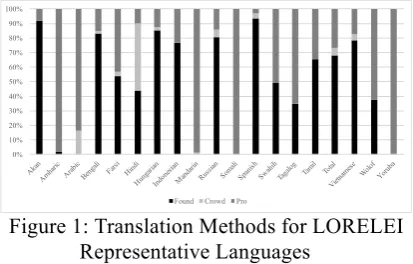
[image:4.595.84.291.249.381.2]Taken together, the LORELEI Representative Language packs provide nearly 42 million words of parallel text, of which 68% came from found data, 5% from crowdsourcing and 27% from translation vendors. Figure 1 shows the relative use of each method across the Representative Languages. Note that for some languages like Chinese and Arabic, existing high quality vendor translations were already available from prior DARPA language programs, so very little new translation was produced using any method.
Figure 1: Translation Methods for LORELEI Representative Languages
Incident Language packs include up to 75,000 words of IL data with high quality (one-way, two-way or four-way) manual English transla-tions for system evaluation. They were designed to include an additional 300,000 words of found parallel text for rapid system adaptation into the IL; ideally at least some of this adaptation data is relevant to the evaluation incident or at least rel-evant to the LORELEI domain. When compared with the Representative Languages, LORELEI ILs are very low resource, and in many cases sufficient volumes of parallel text simply do not exist on the web to satisfy the 300,000 word tar-get. In these cases we provided much larger vol-umes of comparable text instead. To produce IL comparable text we harvested large volumes of data in both the IL and English, including multi-lingual data from the same website where possi-ble. We created multilingual clusters following Kutuzov et al. (2016), with document vectors obtained using the method described in Arora et al (2017). The resulting clusters were then aug-mented by assigning individual Incident Lan-guage documents to English-only clusters whose centroid was maximally similar to the IL docu-ment. Native speakers reviewed the results to prune, merge and split clusters as needed to im-prove the overall quality.
2.3 Lexicons
Each Representative Language pack includes a lexicon encompassing an inventory of at least 10,000 headwords/lemmas with part-of-speech, English gloss, and optionally (where appropriate and available) morphological information. The lexicon is comprised of found resources like existing online dictionaries, etc., with some manual effort by native speakers to create new entries as needed to ensure adequate coverage, focusing effort on high frequency tokens missing from the found resources.
For several languages, extensive morphologi-cal information is included in a separate word-forms table indexed to the entries in the lexicon. For Arabic, morphological information comes from the Penn Arabic TreeBank (Kulick, et al., 2010); for Amharic, Farsi, Hungarian, Russian, Somali, Spanish and Yoruba, morphological in-formation comes from the Unimorph Project (Ki-rov, et al., 2018).
For Incident Languages, a custom lexicon is not created, but pointers to available online mon-olingual and bilingual dictionaries are provided, and where terms of use permit redistribution, the dictionaries are included in the corpus. ILs also include other found grammatical resources like gazetteers, grammars and primers.
3
Annotation Resources
In addition to monolingual and parallel text, LORELEI Language Packs contain several types of manual annotation.
3.1 Entity Annotation
LORELEI Language Packs include three kinds of entity annotation resources: Simple Named Entity, Full Entity, and Entity Linking. In Simple Named Entity (SNE) annotation, text is labeled for names of persons, organizations, locations/ facilities, and geopolitical entities. Full Entity (FE) annotation adds nominal and pronominal mentions of the same types, as well as titles for person entities (such as job titles); it also adds document-level entity coreference. In Entity Linking, named entity mentions are linked to a reference knowledge base developed for LORELEI based on existing external resources. A total of 75,000 words per representative language was labeled for SNE, while an additional 25,000 words was labeled for FE and Entity Linking. Incident Language Pack test sets were also labeled for SNE and EDL.
0% 10% 20% 30% 40% 50% 60% 70% 80% 90% 100%
3.2 Semantic Annotation
Representative Language Packs contain two semantic annotation types developed to support LORELEI research and evaluation: Simple Semantic Annotation (SSA) and Situation Frame (SF). Both SSA and SF label basic information relevant to humanitarian aid and disaster relief scenarios. Situation Frame annotation directly corresponds to the LORELEI SF evaluation task, with a focus on the kind of information that monolingual English-speaking mission planners might require in order to direct a response to an incident as it unfolds. For each document annotators identify the kinds of needs that exist in each location, as well as issues such as civil unrest that might affect the provision of humanitarian assistance, along with the entities involved in the incident. Annotations are at the document level and do not involve extracting specific text extents to justify each Situation Frame. Each annotated frame also includes information about the status, scope, and severity of the needs and issues, as well as sentiment or emotion expressed toward them. SSA represents a more general approach to semantic annotation, labeling basic information about physical events and disaster-relevant situations, their participants, and their locations, with annotations tied to specific text extents in the data. SF appears in both RL and IL packs, while SSA appears only in RL packs.
3.3 Morphosyntactic Annotation
Two types of morphological and syntactic an-notation appear in the Representative Language Packs. A 10,000-word subset of the data labeled for both Full Entity and Simple Semantic Anno-tation is further annotated to identify maximal, non-overlapping Noun Phrases (NPs). Annota-tors follow surface syntactic structure, applying constituency tests to determine where to mark NPs. After the first 10 RLs were created, a pro-grammatic decision was made to put more anno-tation effort toward entity and Situation Frame annotation, and so NP annotation was not added to the remaining RLs.
Morphological segmentation was also per-formed for nine languages; these languages were selected to include a variety of morphological features including robust case marking systems and noun class systems, the use of infixes, cir-cumfixes, reduplication, etc. The nine languages selected were Akan, Hindi, Hungarian, Indone-sian, RusIndone-sian, Spanish, Swahili, Tagalog, and
Tamil. For each of these languages, 2000 tokens were segmented at morpheme boundaries, along with markup to indicate substitution (as in
give/gave in English).
3.4 Parallel Annotation Set
As noted above, all Representative Language packs share a common set of documents translat-ed from English into the RL. From this common set, a smaller 2000-word set was selected for parallel annotation in both the original English and the RL translation. This means that the same translated-from-English document set has been annotated in English and in each of 20 RLs, for all of the following tasks: Simple Named Entity, Full Entity, Entity Linking, Simple Semantic An-notation, and Situation Frame. This data has also been labeled for Noun Phrase Chunking in the 10 RL languages where that task was completed.
4
Grammatical Sketches and Tools
tokenizers. Sentence segmentation is performed using an implementation of the Punkt algorithm based on the version found in NLTK (Kiss et. al. 2006). The named entity tagger is a custom conditional random field-based named entity tagger for each RL, trained on the named entity annotations described above.
5
Evaluation Resources for Machine
Translation
The primary machine translation evaluation for LORELEI relies on one-way, two-way or four-way gold standard manual translation of an incident-focused test set for each IL. This test data is supplemented by two additional MT evaluation resources: Assessment and HyTER.
5.1 Assessment of MT Output for the Situa-tion Frame Task
Although manual annotation of Situation Frames did not involve selecting a segment of text to justify each frame, LORELEI systems were required to output a single segment that justified both the frame type (e.g. need for food) and its place (e.g. Hela). These justification segments were subject to manual assessment for both the quality of the MT output and the utility of the selected segment for providing situational awareness within the context of the Situation Frame task. For all cases where the LORELEI system produced a Situation Frame that matched a gold standard reference Situation Frame on the same document, assessors reviewed that frame’s justification segment across several dimensions. First, assessors were asked whether the MT for the selected justification segment was sufficiently intelligible to make subsequent assessment decisions, or if additional document context and/or the manual translation was required. The assessor then determined whether the situation frame type was justified by this segment, and if so, whether the place was also justified. If the segment was insufficient to justify either type or place, the assessor was shown the human translation for the segment and asked the same questions. A justification segment like “People starving in Hela” would be judged as being sufficiently intelligible and as justifying both the type and the place; while a justification segment like “Food supply it run short” would be assessed as intelligible and as justifying need but not place.
5.2 HyTER Annotation
To provide additional resources for diagnostic MT scoring in LORELEI, LDC produced a set of data annotated for HyTER. HyTER (Hybrid Translation Edit Rate) is an annotation approach that results in an exponential number of possible translations for a given sentence, thus producing large reference networks for translation evalua-tion (Dreyer and Marcu, 2012). We produced HyTER annotation for 645 English gold standard reference translation segments selected from the Uyghur Incident Language test set. One of the four available references was selected as the pri-mary input reference for each segment. For each primary segment we performed two independent HyTER annotation passes, followed by a quality control pass on each segment. This effort yielded nearly 1.2x10¹⁵ unique meaning equivalents from
the original 645 reference segments, with a me-dian of 350,000 meaning equivalents per seg-ment.
6
Maintaining Cross-Language
Con-sistency
The research that underlies LORELEI system development relies in part on cross-lingual trans-fer approaches, as well as exploitation of lan-guage universals. As such, it is important for the RL language packs to be uniform and consistent in their design and implementation. At the same time, the RLs were selected specifically for their typological diversity. To achieve maximum com-patibility across language packs while respecting the specific properties of each individual lan-guage, we adopted a number of strategies.
At the most basic level, the structure and core components for all language packs are the same, with consistent documentation and file formats across all corpora. All data collection and annota-tion efforts utilized a central database, enabling consistent handling of the data pipeline. We also used the same tools across all languages for data pre-processing wherever possible. For instance, all whitespace-delimited languages share a single tokenizer, whose rules were intentionally kept simple and were largely punctuation-based in order to increase uniformity across languages. While language-specific extensions to the rule set were possible, they were kept to the bare min-imum.
al. (2012), and all languages share the same enti-ty and situation frame enti-types and enti-type definitions. Concepts shared across different annotation tasks utilized shared definitions and approaches. For instance, several LORELEI annotation tasks rely on annotators marking the extent of some phe-nomenon (like a named entity), so rules for se-lecting extents were defined in a uniform way across tasks and languages. All annotation is ken-based rather than character-based; since to-kens are defined using shared rules across all languages, this further reducing language-specific variation resulting from low-level anno-tation decisions.
To further enhance consistency in annotation, we developed template-based language-independent annotation guidelines which were then customized for each of the RL and IL lan-guages as needed. We used the same policies across all languages for how to make decisions in the case of necessary language-specific exten-sions to the default approach. To achieve this, we first identified key questions about language fea-tures that could influence annotation, for in-stance, whether a language has possessive com-pound noun construction (e.g. Arabic idafa). Grammatical sketches for every language de-scribed whether the language possessed any of these annotation-relevant features, and if so how the phenomenon was realized in that language. The annotation guidelines template then provided a “menu” of options for how to localize the guidelines: if language has feature A, invoke tion 3.6; if language has feature B, invoke sec-tion 4.8, and so on. This approach ensured con-sistency across languages within a task since lan-guages with the same features get the same anno-tation treatment. It also ensured consistency in annotation approaches across tasks. Grammatical sketches themselves also follow the same tem-plate for all languages.
Finally, prior to data distribution, all language packs – both Representative and Incident – were subject to independent quality review by an ex-ternal team including native speaker linguists. Among other factors, the independent QC team reviewed data for conformity to the pre-established language universal annotation poli-cies and template-based guidelines.
7
Conclusion
Taken as a whole, the LORELEI Representative and Incident Language Packs represent a rich new resource for machine translation and natural
language technology development in a low resource language setting. The Representative Language packs provide coverage of 23 typologically diverse languages, including some very low resource languages for which existing corpora are scarce. Beyond providing new data for these particular languages, the breadth of data and annotation types and the consistency of data components, corpus creation methods and annotation/translation approaches across the language packs is designed to support new research directions in the use of language universals and cross-language transfer. For MT research in particular the 23-way parallel text corpus represents a valuable new resource. The Incident Language Packs provide carefully curated test sets with gold standard translations and annotations for system development and testing. To date we have distributed representative language packs in 20 languages, as well as partial Representative Language Packs in three additional languages, to LORELEI performers. We have created seven Incident Language Packs; two additional Incident Language Packs are in progress to support the final LORELEI evaluation in 2019. LORELEI Representative and Incident Language Packs for all languages will begin to appear in the LDC Catalog in Fall 2019, making these resources broadly available to the research community at large.
8
Acknowledgements
This material is based upon work supported by the Defense Advanced Research Projects Agency (DARPA) under Contract No. HR0011-15-C-0123. Any opinions, findings and conclusions or recommendations expressed in this material are those of the author(s) and do not necessarily re-flect the views of DARPA. The authors gratefully acknowledge Lori Levin, Chris Callison-Burch, Neville Ryant, Jonathan Wright, Brian Gainor, Christopher Caruso, Alex Shelmire, and the hun-dreds of LORELEI native speaker annotators for their contributions to this research.
References
Alvarez, Alison, Lori Levin, Robert Frederking, Si-mon Fung, Donna Gates, Jeff Good. 2006. The MILE Corpus for Less Commonly Taught Lan-guages, In Proceedings of the Human Language Technology Conference of the NAACL, Companion
Volume: Short Papers. Association for
Arora, Sanjeev, Yingyu Liang, and Tengyu Ma. 2017. A simple but tough to beat baseline for sentence embeddings. 2017. In International Conference on Learning Representations (ICLR 2017)
Compact Language Detector 2. [Online]. Available: https: //code.google.com/p/cld2/
DARPA LORELEI website, retrieved May 24, 2019. https://www.darpa.mil/program/low-resource-languages-for-emergent-incidents
Dreyer, Markus and Daniel Marcu. 2012. HyTER: Meaning-Equivalent Semantics for Translation Evaluation. Conference of the North American Chapter of the Association for Computational
Lin-guistics: Human Language Technologies,
Montre-al, Canada 162–171.
Garland, Jennifer, Stephanie Strassel, Safa Ismael, Zhiyi Song, Haejoong Lee. 2012. Linguistic Re-sources for Genre-Independent Language Technol-ogies: User-Generated Content in BOLT. LREC 2012: 8th International Conference on Language
Resources and Evaluation, Istanbul, Turkey.
Kirov, Christo, Ryan Cotterell, John Sylak-Glassman, Géraldine Walther, Ekaterina Vylomova, Patrick Xia, Manaal Faruqui, Sebastian Mielke, Arya D. McCarthy, Sandra Kübler, David Yarowsky, Jason Eisner and Mans Hulden. 2018. UniMorph 2.0: Universal Morphology. LREC 2018: 11th Interna-tional Conference on Language Resources and
Evaluation, Miyazaki, Japan
Kiss, Tibor, Jan Strunkt. 2006. Unsupervised multi-lingual sentence boundary detection.
Computation-al Linguistics 32: 455-525.
Kulick, Seth, Ann Bies, Mohamed Maamouri. 2010. Consistent and Flexible Integration of Morphologi-cal Annotation in the Arabic Treebank. LREC 2010: 7th International Conference on Language
Resources and Evaluation Valletta, Malta.
Kutuzov, Andrey, Mikhail Kopotev, Tatyana Sviriden-ko, Lyubov Ivanova. 2016. Clustering Comparable Corpora of Russian and Ukrainian Academic Texts: Word Embeddings and Semantic Fingerprints. Pro-ceedings of the Ninth Workshop on Building and
Using Comparable Corpora, Portorož, Slovenia
Ma, Xiaoyi. 2006. Champollion: A Robust Parallel Text Sentence Aligner. LREC 2006: 5th Interna-tional Conference on Language Resources and
Evaluation, Genoa, Italy
Ma, Xiaoyi, Mark Liberman. 1999. BITS: A Method for Bilingual Text Search over the Web. Machine
Translation Summit VII: Singapore, September
13-17
Petrov, Slav, Dipanjan Das, and Ryan McDonald. 2012. A universal part-of-speech tagset. LREC
2012: 8th International Conference on Language