Original Article
Revealing pathway dynamics in burn
injury by analyzing multiple differential modules
Lei Jiang1*, Wu Sui2*, Jing Chu3, Wenlei Zhao4, Peng Wang1
1Department of Aesthetic, Plastic and Burn Surgery, Yuhuangding Hospital, #20 Yuhuangding East Road, Yantai, 264000, Shandong, P.R. China; 2Department of General and Pediatric Surgery, Yuhuangding Hospital, #20 Yuhuangding East Road, Yantai, 264000, Shandong, P.R. China; 3Department of ICU, Yuhuangding Hospital, #20 Yuhuangding East Road, Yantai, 264000, Shandong, P.R. China; 4Department of Radiology, Yuhuangding Hospital, #20 Yuhuangding East Road, Yantai, 264000, Shandong, P.R. China. *Equal contributors.
Received January 27, 2016; Accepted May 24, 2016; Epub August 15, 2016; Published August 30, 2016
Abstract: Recent advances in systems biology have revealed that variety in the frame structure and activity of gene network play an important role in burn injury progression. One biological data set E-GEOD-19743 was derived to construct differential co-expression networks (DCNs). There were 35 normal pediatric controls and 26 pediatric burn injury samples, 28 adult controls and 26 adult burn injury patients in total with different post-burn periods. The inference of multiple differential modules (iMDM) algorithm was applied to identify both unique and shared gene modules across multiple DCNs, termed M-DMs (multiple differential modules). One M-module in child group and
one M-module in adult group were detected with significant dynamic scores. Dramatic differences are observed in
genes and modules between post burn children and adults. As the burn injury progresses, multiple interactions in
these modules are significantly changed, with P<0.01 between the two stages. Module analysis can lead to further insights and investigations of therapeutic options targeting specific age groups and disease stages.
Keywords: Multiple differential modules, burn injury, pathway dynamics
Introduction
Recent advances in systems biology have revealed that variety in the frame structure and scope of gene network play an important role in the disease progression [1]. Severe burn injury is a disease involving multiple molecular path-ways. Burn injury is commonly followed by hypermetabolic responses that persist long time [2]. Patients have multi-organ dysfunction and increased inflammatory cytokines and acute phase proteins leading to irreparable damage and death [3, 4]. Zhou et al. [5] report-ed that burn injury invokreport-ed a genome-wide response over the early and middle stages (up to 49 days) post injury, 21% of the genes per-turbed by injury are age-dependent and enriched on specific pathways of metabolism and inflammation.
In the recent years, the dynamics of pathways and its relationship to diseases were hot spot to reveal molecular mechanism [6]. Ando et al.
[7] reported that a systematic analysis for iden-tifying key genes involved in neural differentia-tion by detecting their dynamical behaviors. The concept of gene network has been used to ana-lyze various diseases, including ovarian cancer [8], inflammatory bowel disease [9], colon can -cer [10] and heart failure [11, 12].
We applied a novel framework, inference of multiple differential modules (iMDM) that enables simultaneous analysis of multiple dif-ferential co-expression networks (DCNs) to identify multiple differential modules (M-DMs) [1]. It provides a systematic analytical frame-work for identifying differentially expressed gene modules that are either unique or shared among DCNs. To capture dynamic changes in gene modules across different status, the algo-rithm quantifies changes in both gene activity and connectivity.
factors such as age. Yet little is known regard-ing the dynamic changes in the gene network during burn injury progression. We have a facto-rial study with age group (child/adult) and post-burn period (the early/middle stage) in iMDM method to detect M-DMs.
Material and methods
Datasets and construction of DCNs
One biological data set E-GEOD-19743 was derived from the Gene Expression Omnibus (GEO) database (http://www.ncbi.nlm.nih.gov/ geo/) [5]. There were 35 normal pediatric con-trols and 26 pediatric burn injury samples, 28 adult controls and 26 adult burn injury patients in total. The platform is A-AFFY-44 - Affymetrix GeneChip Human Genome U133 Plus 2.0. For each patient, two time-point measurements were considered: the early stage (0-10 days) and the middle stage (11-49 days) post burn. The Linear Models for Microarray Data (LIMMA) was then used to preprocess data. After data normalization performing by robust multi-array average (RMA) [13], 20544 genes were obtained.
The human protein-protein interaction network (PPIN) was collected from the Retrieval of Interacting Genes (STRING; v 9.0) [14], includ-ing 787896 PPI sets and 16730 genes. Then we constructed a PPI subnet after getting inter-section with expression profiles and the PPIN, which contained 725216 PPI sets and 15130 genes.
Construction of a binary co-expression network and edge weight assignment based on differen-tial gene expression between the burn injury and controls were developed to shape DCNs [1, 15]. Only edges whose correlations are greater than the threshold δ are chosen, which was set at 0.9.
Identification of M-DMs
M-module algorithm was adapted to identify M-DMs [16], which consisted of three steps: seed prioritization, module search by seed
expansion and refinement of candidate mo-dules.
The function was constructed to denote the importance of vertex i in the corresponding net-work as
ijk
g(i)=/j N (i)! k A' g(j)
(1)
where Nk(i) denotes the set of neighbors of i in
Gk; A’k denotes the degree normalized weighted adjacency matrix which is computed as A’k = D-1/2A
kD1/2where D is diagonal matrix with
ele-ment Dii=/jAijk. The top 5% were selected as the seed genes.
For a given seed v ∈ V, we treat it as a M-module
C= {v} [16]. For each vertex u in its neighbor-hood in all networks, we define N (v) =UiNi(v)
where Ni(v) is the neighbor set in Gi as the candidate for C. We calculate the entropy changes
H(C',C) H(C) H(C')=
-O
(2) ΔH(C’,C)>0 means the addition of u improves the connectivity of the former M-module C. The
u whose addition maximizes ΔH is added to C. Summing over all vertices in C and network k, we use H Ck
^ h
=/i C! H(C )i . The graph entropyfor C is k
H(C) k 1H (C)/C M
=/ = (3) The constraints indicate that each gene can belong to one or more modules and each mod-ule has to contain at least one gene.
Inthe refinement of M-modules, sizes of them < 5 are removed. If two M-modules have a Jaccard index of 0.5, they are merged [16].
Statistical significance of candidate M-DMs
Each network is completely randomized 100 times by degree-preserved edge shuffling. To obtain module scores for the null distribution, we performed module search on the random-ized networks with method of Benjamini-Hochberg adjusting [1, 17].
Quantification of connectivity dynamics of shared M-DMs
[image:2.612.90.287.97.137.2]The Module Connectivity Dynamic Score (MCDS) was used to quantify the change in the connectivity of component modules [1].
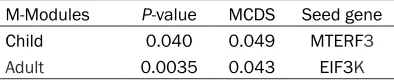
Table 1. Two significantly dynamic M-modules in burn injury patients
(A )C A /M 1
i,i 1 C i,i 1 M 1
=
O
-C / +- + (4)
An adjusted P≤0.05 is considered as sig-nificant.
Results
Construction of DCNs
We used the expression profile data to con -struct two DCNs for the child and adult group, respectively. There are 1062 genes, 5432 edges in child DCN and 618 genes, 3378 edges in adult DCN.
Identification of M-DMs
The top 5% of genes in the DCN were selected as seeds. We obtained 53 seed genes in child group and 30 seeds in adult group. Then 26 modules in child group and 4 modules in adult group were searched by seed expansion and entropy minimization.
Quantification of connectivity dynamics of shared M-DMs
The statistical significance of M-modules is computed based on the null score distribution of M-modules generated using randomized net-works. A total of 13289 modules in child group and 7823 modules in adult group were obtained
to perform Benjamini-Hochberg adjusting. We found all of 26 modules in child group and 2 of adult group were significantly different modules (P≤0.05).
At a MCDS p-value cut off of 0.05, we found one M-module in child group and one M-module in adult group with significant dynamic scores (Table 1). As a result, the two M-modules in the
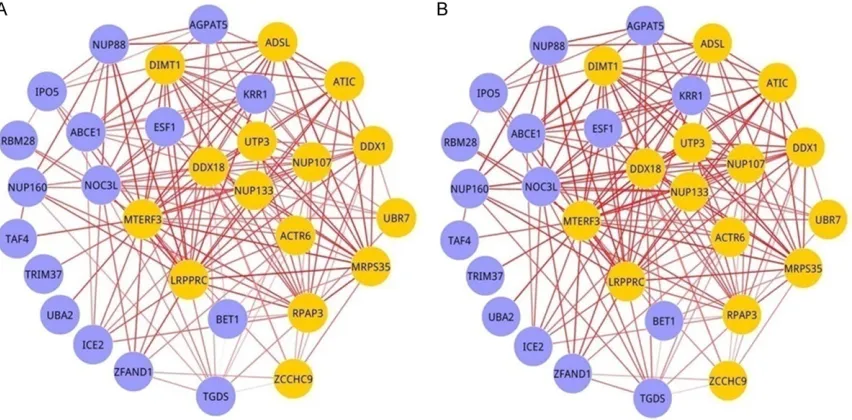
early and middle stages were shown in Figures
1 and 2. There were 31 nodes in child module
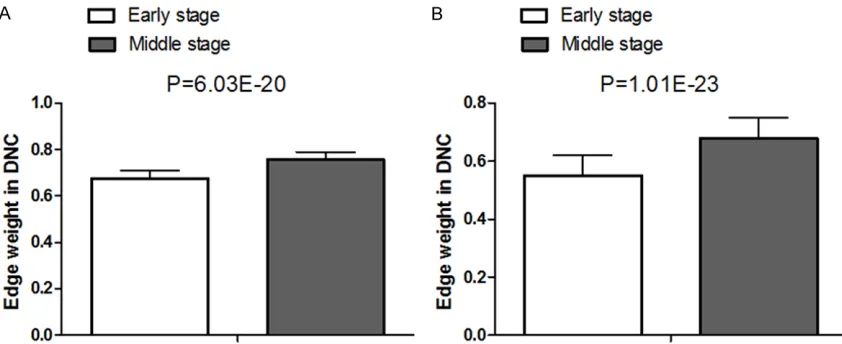
and 18 nodes in adult one including no gene intersection, most of which were immunoglobu-lin genes. With the same sides and edges, the red edges in the early stage were deeper and thicker than those in the middle stage both in child and adult groups. It suggested that as the burn injury progresses, multiple interactions in these modules are significantly changed, with P<0.01 between the two stages (Figure 3). Figure 3 showed the mean edge weights of the 4 modules in the two burn injury stages. The edge weights among the module genes in the early stage DCN were significantly smaller than those in the middle DCN, suggesting a signifi -cant role of pathway rewiring during the burn injury progression.
Discussion
[image:3.612.96.522.74.284.2]pathways. In Figure 1, most seeds in child M-modules such as NUP133, NUP107 and ACTR6 are immunoglobulin genes, which is consistent with changes in serum immunoglob-ulin levels in severely burned patients [5]. In addition, most seeds in adult M-modules such as RPS19, RPS5 and RPL11 are ribosom-al genes (Figure 2). Thereby, dramatic differ-ences are observed in genes and modules post burn between children and adults. These results provide age specific in burn response of modules.
Furthermore, as the burn injury progresses, multiple interactions in modules are significant
[image:4.612.93.522.72.269.2]-ly changed, which revealed by MCDS metric examining changes in edge weights that can be viewed as interaction strength among genes [1]. These two types of modules differ in the early and middle stages both in child and adult groups, suggesting dynamic modules may play a critically important role during burn progres-sion. M-modules were convinced that they have higher sensitivity and comparable specificity based on known pathway annotations [1]. More importantly, M-module-based features achieve significantly higher accuracy in predicting can -cer stages and heart failure phenotypic mea-sures. Our results emphasize the importance of joint analysis of multiple gene networks to more Figure 2. M-modules in adult burn injury group with different stages. Yellow circles indicated the seed genes and purple circles indicated un-seed genes. Deep and thick lines meant big weight values of edges. A: M-module in the early burn injury stage. B: M-module in the middle burn injury stage.
[image:4.612.95.516.335.507.2]accurately capture the dynamics of gene pathways.
Taken together, module analysis can lead to further insights and investigations of therapeu-tic options targeting specific age groups and disease stages.
Disclosure of conflict of interest
None.
Address correspondence to: Dr. Peng Wang, Depa- rtment of Aesthetic, Plastic and Burn Surgery, Yu- huangding Hospital, #20 Yuhuangding East Road, Yantai, 264000, Shandong, P.R. China. E-mail: [email protected]
References
[1] Ma X, Gao L, Karamanlidis G, Gao P, Lee CF, Garcia-Menendez L, Tian R, Tan K. Revealing Pathway Dynamics in Heart Diseases by Analyzing Multiple Differential Networks. PLoS Comput Biol 2015; 11: e1004332.
[2] Hart DW, Wolf SE, Mlcak R, Chinkes DL, Ramzy PI, Obeng MK, Ferrando AA, Wolfe RR, Herndon DN. Persistence of muscle catabolism after se-vere burn. Surgery 2000; 128: 312-319. [3] Williams FN, Herndon DN, Hawkins HK, Lee
JO, Cox RA, Kulp GA, Finnerty CC, Chinkes DL, Jeschke MG. The leading causes of death after burn injury in a single pediatric burn center. Crit Care 2009; 13: R183.
[4] Jeschke MG, Chinkes DL, Finnerty CC, Kulp G, Suman OE, Norbury WB, Branski LK, Gauglitz GG, Mlcak RP, Herndon DN. Pathophysiologic response to severe burn injury. Ann Surg 2008; 248: 387-401.
[5] Zhou B, Xu W, Herndon D, Tompkins R, Davis
R, Xiao W, Wong WH, Inflammation, Host
Response to Injury P, Toner M, Warren HS, Schoenfeld DA, Rahme L, McDonald-Smith GP, Hayden D, Mason P, Fagan S, Yu YM, Cobb JP, Remick DG, Mannick JA, Lederer JA, Gamelli RL, Silver GM, West MA, Shapiro MB, Smith R, Camp DG 2nd, Qian W, Storey J, Mindrinos M, Tibshirani R, Lowry S, Calvano S, Chaudry I, West MA, Cohen M, Moore EE, Johnson J, Moldawer LL, Baker HV, Efron PA, Balis UG, Billiar TR, Ochoa JB, Sperry JL, Miller-Graziano CL, De AK, Bankey PE, Finnerty CC, Jeschke MG, Minei JP, Arnoldo BD, Hunt JL, Horton J, Cobb JP, Brownstein B, Freeman B, Maier RV, Nathens AB, Cuschieri J, Gibran N, Klein M, O’Keefe G. Analysis of factorial time-course mi-croarrays with application to a clinical study of burn injury. Proc Natl Acad Sci U S A 2010; 107: 9923-9928.
[6] Bisson N, James DA, Ivosev G, Tate SA, Bonner R, Taylor L, Pawson T. Selected reaction moni-toring mass spectrometry reveals the dynam-ics of signaling through the GRB2 adaptor. Nat Biotechnol 2011; 29: 653-658.
[7] Ando T, Kato R, Honda H. Differential variability
and correlation of gene expression identifies
key genes involved in neuronal differentiation. BMC Syst Biol 2015; 9: 82.
[8] Zhang D, Chen P, Zheng CH, Xia J. Identification of ovarian cancer subtype-specific network
modules and candidate drivers through an in-tegrative genomics approach. Oncotarget 2016; 7: 4298-309.
[9] Muraro D, Simmons A. An integrative ana- lysis of gene expression and molecular interac-tion data to identify dys-regulated
sub-net-works in inflammatory bowel disease. BMC
Bioinformatics 2016; 17: 42.
[10] Lu J, Zeng H, Liang Z, Chen L, Zhang L, Zhang H, Liu H, Jiang H, Shen B, Huang M, Geng M, Spiegel S, Luo C. Network modelling reveals the mechanism underlying colitis-associated
colon cancer and identifies novel combinatori -al anti-cancer targets. Sci Rep 2015; 5: 14739. [11] Akavia UD, Benayahu D. Meta-analysis and
profiling of cardiac expression modules.
Physiol Genomics 2008; 35: 305-315. [12] Dewey FE, Perez MV, Wheeler MT, Watt C, Spin
J, Langfelder P, Horvath S, Hannenhalli S, Cappola TP, Ashley EA. Gene coexpression net-work topology of cardiac development, hyper-trophy, and failure. Circ Cardiovasc Genet 2011; 4: 26-35.
[13] Irizarry RA, Hobbs B, Collin F, Beazer-Barclay YD, Antonellis KJ, Scherf U, Speed TP. Exploration, normalization, and summaries of high density oligonucleotide array probe level data. Biostatistics 2003; 4: 249-264.
[14] Franceschini A, Szklarczyk D, Frankild S, Kuhn M, Simonovic M, Roth A, Lin J, Minguez P, Bork P, von Mering C, Jensen LJ. STRING v9.1: pro-teprotein interaction networks, with in-creased coverage and integration. Nucleic Acids Res 2013; 41: D808-815.
[15] Robinson MD, McCarthy DJ, Smyth GK. edgeR: a Bioconductor package for differential expres-sion analysis of digital gene expresexpres-sion data. Bioinformatics 2010; 26: 139-140.
[16] Ma X, Gao L, Tan K. Modeling disease progres-sion using dynamics of pathway connectivity. Bioinformatics 2014; 30: 2343-2350.
[17] Benjamini Y, Drai D, Elmer G, Kafkafi N, Golani