Proceedings of NAACL-HLT 2018, pages 1844–1853
ELDEN: Improved Entity Linking using Densified Knowledge Graphs
Priya Radhakrishnan+, Partha Talukdar*and Vasudeva Varma+
+IIIT Hyderabad, India
*Indian Institute of Science, Bangalore, India
[email protected], [email protected], [email protected]
Abstract
Entity Linking (EL) systems aim to automati-cally map mentions of an entity in text to the corresponding entity in a Knowledge Graph (KG). Degree of connectivity of an entity in the KG directly affects an EL system’s abil-ity to correctly link mentions in text to the entity in KG. This causes many EL systems to perform well for entities well connected to other entities in KG, bringing into focus the role of KG density in EL. In this paper, we propose Entity Linking using Densified Knowledge Graphs (ELDEN). ELDEN is an EL system which first densifies the KG with co-occurrence statistics from a large text cor-pus, and then uses the densified KG to train entity embeddings. Entity similarity measured using these trained entity embeddings result in improved EL. ELDEN outperforms state-of-the-art EL system on benchmark datasets. Due to such densification, ELDEN performs well for sparsely connected entities in the KG too. ELDEN’s approach is simple, yet effec-tive. We have made ELDEN’s code and data publicly available.
1 Introduction
Entity Linking (EL) is the task of mapping men-tionsof anentityin text to the corresponding entity in Knowledge Graph (KG) (Hoffart et al., 2011; Dong et al., 2014; Chisholm and Hachey, 2015). EL systems primarily exploit two types of infor-mation: (1) similarity of the mention to the candi-date entity string, and (2) coherence between the candidate entity and other entities mentioned in the vicinity of the mention in text. Coherence es-sentially measures how well the candidate entity is connected, either directly or indirectly, with other KG entities mentioned in the vicinity (Milne and Witten, 2008; Globerson et al., 2016). In the
state-✓
KN
O
W
LED
G
E
GR
A
P
H
Andrei Broder won best paper award at WWW
TE
X
T
WE
B
C
O
R
P
U
S
World_Wide_Web WWW_conference
Program Committee
PERTH, Australia, 5 April 2017: ... affiliation are Andrei Broder(Google/AltaVista),.. WWW9
Program Committee... WWW conferencewith more than 3,500 citations….
? ?
Andrei_Broder
Figure 1: Improving entity disambiguation per-formance using KG densification: edges to
WWW conference, a sparsely-connected entity in the KG, is increased by adding edges frompseudo
entity Program Committee whose mention
co-occurs with it in web corpus. ELDEN, the system proposed in this paper, uses such densified KG to successfully link ambiguous mention WWW to the correct entityWWW conference, instead of the more popular entityWorld Wide Web.
of-the-art EL system by (Yamada et al., 2016), co-herence is measured as distance between embed-dings of entities. This system performs well on entities which are densely-connected in KG, but not so well on sparsely-connected entities in the KG.
We demonstrate this problem using the exam-ple sentence in Figure 1. This sentence has two mentions: Andrei Broder and WWW. The figure also shows mention-entity linkages, i.e., mentions and their candidate entities in KG. Using a conven-tional EL system, the first mentionAndrei Broder1
can be easily linked to Andrei Broder using string similarity between the mention and candi-date entity strings. String similarity works well in this case as this mention is unambiguous in the given setting. However, the second mention
1We use italics to denote textual mentions and
typewriterto indicate an entity in KG.
WWW has two candidates, World Wide Web
andWWW conference, and hence is ambiguous. In such cases, coherence measure between the candidate entity and other unambiguously linked entity(ies) is used for disambiguation.
State-of-the-art EL systems measure coherence as similarity between embeddings of entities. The entity embeddings are trained based on the num-ber of common edges in KG2. In our example,
common edges are edges World Wide Web
shares with Andrei Broder and edges WWW conference shares with
Andrei Broder. But WWW conferencehas less number of edges (it is a sparsely-connected entity) compared to World Wide Web. This leads to poor performance3 whereby WWW is
erroneously linked toWorld Wide Webinstead of linking toWWW conference.
In this paper, we propose ELDEN, an EL sys-tem which increases nodes and edges of the KG by using information available on the web about enti-ties andpseudo entities. Pseudo Entities are words and phrases that frequently occur in Wikipedia, and co-occur with mentions of KG entities in the web corpus. Thus ELDEN uses a web cor-pus to find pseudo entities and refines the co-occurrences with Pointwise Mutual Information (PMI) (Church and Hanks, 1989) measure. EL-DEN then adds edges to the entity from pseudo en-tities. In Figure 1, pseudo entityProgram Commit-teeco-occurs with mentions ofAndrei Broder
and WWW conference in web corpus and has a positive PMI value with both. So EL-DEN adds edges from Program Committee to
Andrei BroderandWWW conference, den-sifying neighborhood of the entities. Coherence, now measured as similarity between entity embed-dings where embedembed-dings are trained on densified KG, leads to improved EL performance.
Density (number of KG edges) of candidate en-tity affects EL performance. In our analysis of density and number of entities having that density in the Wikipedia KG, we find that entities with 500 edges or less make up more than 90%. Thus, creat-ing an EL system that performs well on densely as well as sparsely-connected entities is a challeng-ing, yet unavoidable problem.
2Wikipedia Link based Measure (WLM) (Milne and
Wit-ten, 2008) used in Yamada et al.’s system is based on number of common edges in KG.
3This paper focuses on mention disambiguation. We
as-sume mention and candidate entities are detected already.
We make the following contributions:
• ELDEN presents a simple yet effective graph densification method which may be applied to improve EL involving any KG.
• By using pseudo entities and unambiguous mentions of entity in a corpus, we demon-strate how non-entity-linked corpus can be used to improve EL performance.
• We have made ELDEN’s code and data pub-licly available4.
2 Related Work
Entity linking: Most EL systems use coherence among entities (Cheng and Roth, 2013) to link mentions. We studied coherence measures and datasets used in six recent5EL systems (He et al.,
2013; Huang et al., 2015; Sun et al., 2015; Ya-mada et al., 2016; Globerson et al., 2016; Bar-rena et al., 2016). We see that the two popu-lar datasets used for evaluating EL (Chisholm and Hachey, 2015) on documents are CoNLL (Hoffart et al., 2011) and TAC2010 (Ji et al., 2010), here after TAC. The popular coherence measures used are (1) WLM, (2) Entity Embedding Similarity and (3) Jaccard Similarity (Chisholm and Hachey, 2015; Guo et al., 2013). WLM is widely acknowl-edged as most popular (Hoffart et al., 2012) with almost all the six approaches analyzed above using WLM or its variants. Entity embedding similarity (Yamada et al., 2016) is reported to give highest EL6performance and is the baseline of ELDEN.
Enhancing entity disambiguation: Among methods proposed in literature to enhance entity disambiguation utilizing KG (Bhattacharya and Getoor) uses additional relational information be-tween database references; (Han and Zhao, 2010) uses semantic relatedness between entities in other KGs; and (Shen et al., 2018) uses paths con-sisting of defined relations between entities in the KG (IMDB and DBLP). All these methods utilize structured information, while our method shows how unstructured data (web corpus about the en-tity to be linked) can be effectively used for enen-tity disambiguation.
Entity Embeddings: ELDEN presents a method to enhance embedding of entities and words in a
4https://github.com/
priyaradhakrishnan0/ELDEN
5(Shen et al., 2015) presents a survey of EL systems. 6Named Entity Disambiguation (NED) and EL are
common vector space. Word embedding meth-ods like word2vec (Mikolov et al., 2013) and Glove (Pennington et al., 2014) have been ex-tended to entities in EL (Yamada et al., 2016; Fang et al., 2016; Zwicklbauer et al., 2016; Huang et al., 2015). These methods use data about entity-entity co-occurrences to improve the entity embeddings. In ELDEN, we improve it with web corpus co-occurrence statistics. Ganea and Hofmann (2017) present a very interesting neural model for jointly learning entity embedding along with mentions and contexts.
KG densification with pseudo entities: KG den-sification using external corpus has been studied by Kotnis et al. (2015) and Hegde and Taluk-dar (2015). Densifying edge graph is also studied as ‘link prediction’ in literature (Mart´ınez et al., 2016). Kotnis et al. augment paths between KG nodes using ‘bridging entities’ which are noun phrases mined from an external corpus. ELDEN has a similar approach as it proposes densifying the KG edges of entities by adding edges from pseudo entities. However, densification is used for relation inference in the former methods whereas it is used for entity coherence measurement in EL-DEN.
Word co-occurrence measures: Chaudhari et al. (2011) survey several co-occurrence mea-sures for word association including PMI, Jac-card (Dice, 1945) and Co-occurrence Significance Ratio (CSR). Damani (2013) proves that consid-ering corpus level significant co-occurrences, PMI is better than others. Budiuet al. (2007) compare Latent Semantic Analysis (LSA), PMI and Gener-alized Latent Semantic Analysis (GLSA) and con-clude that for large corpora like web corpus, PMI works best on word similarity tests. Hence, we chose PMI to refine co-occurring mentions of en-tities in web corpus.
3 Definitions and Problem Formulation In this section, we present a few definitions and formulate the EL problem.
Knowledge Graph(KG): A Knowledge Graph is defined as G = (E, F) with entities E as nodes
and F as edges. In allegiance to EL literature
and baselines (Milne and Witten, 2008; Glober-son et al., 2016), we use the Wikipedia hyperlink graph as the KG in this paper, where nodes corre-spond to Wikipedia articles and edges are incom-ing links from one Wikipedia article to another. ELDEN ultimately uses a densified version of this
Wikipedia KG, as described in Section 4.
Sparsely connected entities: Following Hoffart
et al. (2012), we define an entity to be a sparsely connected entity, if the number of edges incident on the entity node in the KG is less than thresh-oldη7. Otherwise, the entity is called a densely-connected entity.
Entity Linking (EL): Given a set of mentions
MD = {m1, ..., mn} in a document D, and a
knowledge graphG= (E, F), the problem of
en-tity linking is to find the assignmentΛ : MD →
ED, whereEDis the set of entities linked to
men-tions in documentDsuch thatED ⊆E.
For mention mi ∈ MD, let the set of possible entities it can link to (candidate entities) be Ci. Then, the solution to the EL problem is an assign-mentΛwhere,
Λ(mi) = arg max e∈Ci
[φ(mi, e) +β·ψ(e, ED)]
(1) Here, φ(mi, e) ∈ [0,1] measures the contextual compatibility of mentionmiand entitye.φ(mi, e) is obtained by combining prior probability and context similarity. ψ(e, ED) measures the coher-ence ofewith entities inED. β is a variable
con-trolling inclusion ofψin the assignmentΛ.
Problem Formulation :(Yamada et al., 2016) is a recently proposed state-of-the-art EL system. We consider it as a representative EL system and use it as the main baseline for the experiments in this paper. In this section, we briefly describe Yamada
et al. (2016)’s two-step approach that solves the EL problem presented above.
Step 1: A mentionmi ∈ MD is defined to be
unambiguousif∃e∈ Ci such thatφ(mi, e) ≥ γ. Let MD(u) ⊆ MD be the set of such unambigu-ous mentions in documentD. For all
unambigu-ous mentions m ∈ MD(u), Yamada et al. freeze
the assignment by solving Equation 1 after set-tingβ = 0. In other words,ψ(e, ED)is not used while assigning entities to unambiguous mentions. Assigning entities first to unambiguous mentions has also been found to be helpful in prior research (Milne and Witten, 2008; Guo and Barbosa, 2014). LetAD be the set of entities linked to in this step. In Figure 1, mentionAndrei Broder is unambigu-ous8.
7Like (Hoffart et al., 2012) we setη= 500for the
exper-iments in this paper.
8Between mention Andrei Broder and entity
Notation Definition
ve entity embedding of entityewith dimension1∗d E set of all titles in Wikipedia
S set of all pseudo entities considered in ELDEN E+ set of all entities considered in ELDEN V word vectors ofE+whereV∈Rk∗d
ψELDEN Embedding similarity measured usingVtrained onGdense
ψYamada Embedding similarity measured usingVtrained on input
[image:4.595.73.290.59.161.2]KGG
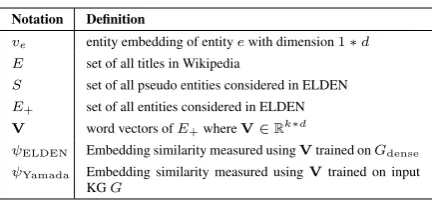
Table 1: Notation used in KG densification and learn-ing entity embeddlearn-ings (Please see Sec 4 for more de-tails).
Step 2: In this step, Yamadaet al. links all am-biguous mentions by solving Equation 2.
Λ(mi) =
arg max e∈Ci
φ(mi, e) + 1
|AD|
X
ej∈AD ve·vej
∀mi∈MD\MD(u) (2)
where ve, vej ∈ R
d are d-dimensional embed-dings of entities e and ej respectively. Please note that the equation above is a reformulation of Equation 1 with β = 1 and ψ(e, ED) =
1 |AD|
P
ej∈ADve·vej, whereAD is derived from ED as described in Step 1. As coherence
ψ(e, ED)is applied only in disambiguation of am-biguous mentions, we apply densification to only selective nodes of KG.
Embeddings of entities are generated using word2vec model and trained using WLM (Details in Section 5). Given a graph G = (E, F), the WLM coherence measure ψwlm(ei, ej) between two entities ei and ej is defined in Equation 3 whereCeis the set of entities with edge to entity
e.
ψwlm(ei, ej) = 1−
log(max(|Cei|,|Cej|))−log(|Cei∩Cej)|) log(|E|)−log(min(|Cei|,|Cej|))
(3)
4 Our Approach: ELDEN
In this section, we present ELDEN, our proposed approach. ELDEN extends (Yamada et al., 2016), with one important difference: rather than work-ing with the input KG directly, ELDEN works with the densified KG, created by selective den-sification of the KG with co-occurrence statistics extracted from a large corpus. Even though this
is a simple change, this results in improved EL performance. The method performs well even for sparsely connected entities.
Overview : Overview of the ELDEN system is shown in Figure 2. ELDEN starts off with densi-fication of the input KG, using statistics from web corpus. Embeddings of entities are then learned utilizing the densified KG in the next step. Em-bedding similarity estimated using the learned en-tity embeddings is used in calculating coherence measure in subsequent EL. Notation used is sum-marized in Table 1.
(i)KG Densification Figure 2 depicts densifica-tion of KG in ‘Input KG’ and ‘Densified KG’. It shows two Wikipedia titlesAndrei Broderand
WWW conference from our running example (Figure 1). There are no edges common between
Andrei BroderandWWW conference. In a web corpus, mentions of Andrei Broder and
WWW conferenceco-occur withProgram com-mittee and it has a positive PMI value with both the entities. So ELDEN adds an edge from Pro-gram committee to both the entities. Here Pro-gram committeeis a pseudo entity. Thus, ELDEN densifies the KG by adding edges from pseudo en-tities when the mentions of Wikipedia entity and pseudo entity co-occur in a web corpus and the pseudo entity has a positive PMI value with given entity.
Taking a closer look, KG densification pro-cess starts from ‘input KG’ which is Wikipedia hyperlink graph G = (E, F), where the nodes are Wikipedia titles (E) and edges are hyperlinks
(F). ELDEN processes Wikipedia text corpus and
identifies phrases (unigrams and bi-grams) that oc-cur frequently, i.e. more than 10 times in it. We denote these phrases as pseudo entities (S) and
add them as nodes to the KG. Let E+ = E ∪S
be the resulting set of nodes.
ELDEN then adds edges connecting entities in
E+ to entities in E. This is done by processing
a web text corpus looking for mentions of enti-ties inE+, and linking the mentions to entities in
KGG0 = (E+, F). ELDEN uses Equation 1 with β = 0 for this entity linking, i.e. only mention-entity similarity φ(m, e) is used during this link-ing9. Based on this entity linked corpus, a
co-occurrence matrixM of size|E+| × |E+|is con-structed. Each cellMi,j is set to the PMI between
9Since prior probabilities of pseudo entities are not
Input KG Densified KG
Densification Web Corpus
Andrei_Broder
WWW_conference
Andrei_Broder
WWW_conference Program Committee
Embedding similarity= 𝝍ELDEN = Cosine (vEntity1, vEntity2)
Cosine(vAndrei_Broder, vWWW_conference) > Cosine (vAndrei_Broder, vWorld_Wide_Web) Learn Entity Representation
.0.02,..0.11…0.14..
.0.05,..0.01...0.06..
vAndrei_Broder
vWWW_conference
[image:5.595.82.519.67.264.2].0.03,..0.12…0.15.. vWorld_Wide_Web Entity Embeddings (V)
Figure 2: ELDEN consists of KG densification, training entity embeddings on densified KG and building EL system that uses similarity between the trained embeddings as coherence measure. ELDEN’s difference from baseline method is that while baseline method uses input KG for trainingve, ELDEN uses densified KG for
trainingve. Hence, the improved performance of ELDEN is solely attributed to densification. Objective function
component FeatureGroup Feature Explanation
Contextual compati-bility φ(mi, ei)
Base
Entity Prior Fraction of edges that links to the entity
Prior Probability Of all possible pages a mention can link to, the probability that it links to a given page
Max Prior Probability Maximum value of prior probabilities for a mention Max Prior Probability in document Maximum value of prior probabilities for a document Num of candidates Candidate count of the mention
String
Similarity Exact matchPartial match Whether mention is an exact match of candidateWhether mention is part of candidate
Coherence ψ(ei, ej)
Coherence measures
ψwlm WLM (Please see Equation 3)
ψYamada Similarity between entity embeddings that are learned usingψwlm
ψdense ψwlmcalculated on densified KB
ψELDEN Similarity between entity embeddings that are trained usingψdense
ψELDEN++ Combination ofψwlm,ψYamada,ψdense, andψELDEN. ELDEN uses
this coherence feature.
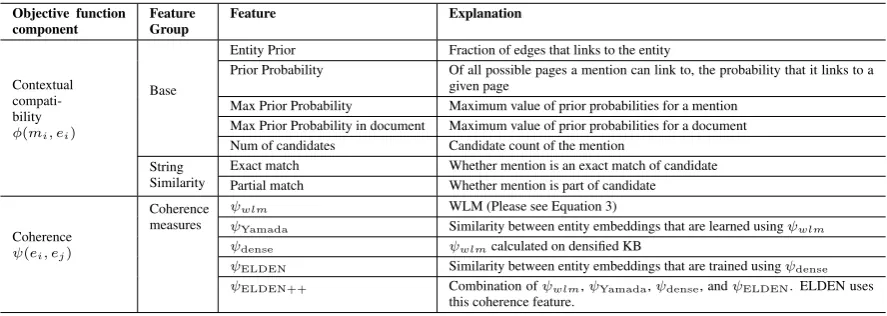
Table 2: Features used by various EL systems. Context compatibilityφ(mi, ei)and coherenceψ(ei, ej)of
Equa-tion 1 are parameterized using features as shown above. Context compatibility features are used by all systems. Coherence features used by Yamada16 areψwlmandψYamada. ELDEN usesψELDEN++as coherence feature.
the entitieseande0.
Me,e0 = PMI(e, e0) = logf(e, e 0
)×N f(e)×f(e0)
wheref(e)is the frequency of entityein web cor-pus, f(e, e0) is the sentence-constrained pair fre-quency of the entity pair(e, e0)in web corpus, and
N =Pe,e0∈E
+f(e, e 0
). Please note that PMI, and there byM, are symmetric. The expanded set of
edges,F+, is now defined as
F+=F∪{(e, e0),(e0, e)|e0 ∈E+, e∈E, Me,e0 >0}
In other words, we augment the set of initial edges
F with additional edges connecting entities inE+
with entities inE such that PMI between the
enti-ties is positive.
ELDEN now constructs the KG Gdense =
(E+, F+), which is a densified version of the
in-put KGG = (E, F). ELDEN uses this densified
KG Gdense for subsequent processing and entity
linking.
(ii)Learning Embeddings of Densified KG En-tities ELDEN derives entity embeddings using the same setup, corpus and Word2vec skip-gram with negative sampling model as in Yamadaet al., However, instead of training embeddings over the input KG, ELDEN trains embeddings of entities in the densified KGGdense. LetVbe the word2vec
matrix containing embeddings of entities in E+
whereV ∈ Rk∗d. v
e is the embedding of entity
einE+with dimension1∗d.
[image:5.595.77.521.330.488.2]to predict the target entity. ELDEN maximizes the objective function (Goldberg and Levy, 2014) of word2vec skip-gram model with negative sam-pling,L=P(t,c)∈PLt,cwhere
Lt,c=log θ(vc·vt) +
X
n∈N(t,c)
log θ(−vn·vt)
Here vt andvc are the entity embeddings of tar-get entity t and context entity c. P is the set
of target-context entity pairs considered by the model. N(t,c) is a set of randomly sampled
enti-ties used as negative samples with pair(t, c). This objective is maximized with respect to variables
vt’s andvc’s, whereθ(x) = 1+1e−x.
PandNare derived usingGdense.tandcare
en-tities inE+such thatcshares a common edge with t.vnis randomly sampled fromV, for entities that do not share a common edge witht. Entity
em-bedding similarity measured usingVtrained this way onGdense isψELDEN. Embedding similarity
is measured as cosine distance betweenves.
Em-beddings ofSare trained using positive and
nega-tive word contexts derived using context length.
(iii)Bringing it All Together: ELDEN
ELDEN is a supervised EL system which uses two sets of features: (1) contextual compatibility
φ(m, e); and (2) coherenceψ(ei, ej). These fea-tures are summarized in Table 2. Similarity be-tween entity embeddings is measured as cosine similarity betweenves.
5 Experiments
In this section, we evaluate the following:
• Is ELDEN’s corpus co-occurrence statistics-based densification helpful in disambiguating entities better? (Sec. 6.1)
• Where does ELDEN’s selective densification of KG nodes link entities better? (Sec. 6.3)
Setup : ELDEN is implemented using Random Forest ensemble 10 (Breiman, 1998). Parameter
values were set using CoNLL development set. Feature limit of 3 with number of estimators as 100 yielded best performance.
Knowledge Graph: Wikipedia Following prior EL literature, we use Wikipedia hypergraph as our KG (Milne and Witten, 2008; Globerson et al., 2016). This KG is enhanced with pseudo entities as explained in Section 4. We process
10http://scikit-learn.org
Specifics Value
Number of titles after cleaning (|E|) 4.6 M Number of pseudo entities (|S|) 1.3 M Total number of entities (|E+|) 5.9 M
Number of epochs 3
Learning rate 0.25 linearly reducing to 0.01
Number of negative samples (|N|) 5
Context window size 3
[image:6.595.309.524.60.161.2]Dimensions of embedding (d) 100
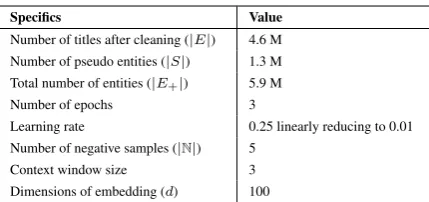
Table 3: Parameters used in Wikipedia processing and training KG.
the Wikipedia corpus following the same proce-dure as in Yamada et al. (2016). We cleaned 11
Wikipedia dump dated Nov 2015. We then parsed the Wikipedia article text to identify pseudo enti-ties. More details on KG and parameters used for training embeddings are in Table 3. Training took 4 days on gpu with 2 cores.
Preprocessing: Web corpus and Densified KG
For our experiments, we created a web corpus by querying Google12. Candidate entities of all
men-tions in the dataset are queried in Google and top ten search results are considered for unigram and bigram frequencies. This corpus occupied 6.8GB for candidate entities of TAC and CoNLL dataset mentions (54336 entities). Even for sparsely con-nected entities, an average corpus size of 670 lines or more13 was collected. We note that though
some of the entities mentioned in this dataset are ten or more years old, we are able to collect, on an average more than 670 lines of web content. Thus corpus proves to be a good source of additional links for densification, for both common and rare entities. As Taneva and Weikum (2013) also note, it is not hard to find content about sparsely con-nected entities on the web.
The web corpus is analyzed for mentions and pseudo entities. Co-occurrence matrixM is
cre-ated14 for mention and pseudo entities occurring
within window of size 10 for PMI calculation15.
Edges are added from pseudo entities with positive PMI to mention of given entity. In experiments we add edges from top 10 pseudo entities ordered by
11by removing disambiguation, navigation, maintenance
and discussion pages.
12https://www.google.com/
13A detailed analysis of knowledge gained from crawling
for common versus less common entities is present in Figure 1 of supplementary material.
14This co-occurrence matrix is downloadable with source
code.
15We experimented with window sizes 10, 25 and 50. We
PMI values16.
Evaluation Dataset: In line with prior work on EL, we test the performance of ELDEN on CoNLL and TAC datasets. As this paper fo-cuses on entity disambiguation, we tested ELDEN against datasets and baseline methods for disam-biguation. We note that the entity disambiguation evaluation part of other recent datasets like ERD 2014 and TAC 2015 is exactly same as the TAC 2010 evaluation (Ellis et al., 2014)17.
Training: ELDEN’s parameters were tuned us-ing trainus-ing (development) sets of CoNLL and TAC datasets. CoNLL and TAC datasets consist of documents where mentions are marked and en-tity to which the mention links to, is specified. We use only mentions that link to a valid Wikipedia title (non NIL entities) and report performance on test set. Some aspects of these datasets relevant to our experiments are provided below.
CoNLL: In CoNLL test set (5267 mentions), we report Precision of topmost candidate entity, ag-gregated over all mentions (P-micro) and aggre-gated over all documents (P-macro), i.e., if tp, fp and p are the individual true positives, false posi-tives and precision for each document in a dataset ofδdocuments, then
Pmicro=
δ P i=1
tpi
δ P i=1
tpi+ δ P i=1
fpi
andPmacro=
δ P i=1
pi
δ .
For CoNLL candidate entities, we use (Pershina et al., 2015) dataset18.
TAC: In TAC dataset, we report P-micro of top-ranked candidate entity on 1,020 mentions. P-macro is not applicable to TAC as most documents have only one mention as query mention ( or ’men-tion to be linked’). For TAC candidate entities, we index the Wikipedia word tokens and titles using solr19. We index terms in (1) title of the entity, (2)
title of another entity redirecting to the entity, and (3) names of anchors that point to the entity, in line with baselines. We are making this TAC candidate set publicly available.
Baseline: Yamada16Our baseline is the Yamada
et al. system explained in Section 3. Entity em-bedding distance measured usingvetrained on the
16This is a tunable parameter.
17These recent datasets consist of other evaluations, e.g.,
mention detection, multilinguality etc. which is beyond the scope of the paper and hence we didnt focus on them in the paper.
18https://github.com/masha-p/PPRforNED 19http://lucene.apache.org/solr/
Method CONLL
(P-micro)
CONLL (P-macro)
TAC (P-micro)
(Hoffart et al., 2011) 82.5 81.7
-(He et al., 2013) 85.6 84.0 81.0
(Ling et al., 2015) 67.5 - 86.8
(Barrena et al., 2016) 88.32 -
-(Chisholm and Hachey,
2015) 88.7 - 80.7
(Pershina et al., 2015) 91.8 89.9
-(Globerson et al., 2016) 91.7 - 87.2
(Yamada et al., 2016) 93.1 92.6 85.2
ELDEN 93.0 93.7 89.6
Table 4: Performance comparison with other recent EL approaches. ELDEN matches best results in CoNLL and outperforms the state-of-the-art in TAC dataset. (Please see Section 6.1 for details andψELDEN++row of Table 5 for ELDEN results.)
input KGGisψYamada.
6 Results
6.1 Does ELDEN’s selective densification help in disambiguation in EL?
In Table 4, we compare ELDEN’s EL performance with results of other recently proposed state-of-the-art EL methods that use coherence models. We see that ELDEN results matches best results on CoNLL and outperforms state-of-the-art in TAC dataset. In the table, the last four rows uses the Pershinaet al.(2015) candidate set and hence, we provide a comparison of their disambiguation per-formance. Improved results of ELDEN over base-line is attributed to the improved disambiguation due to KG densification.
6.2 Why does ELDEN’s selective densification work?
We conduct ablation analysis using various fea-ture and feafea-ture combinations and present perfor-mance of ELDEN and baseline in Table 5. Start-ing with base features, we add various features to ELDEN incrementally and report their impact on performance. The results when using base feature group alone, and base and string similarity groups together (φ) are presented in first and second rows
for each dataset. We compareψELDENto three
co-herence measures:ψwlm,ψYamadaandψdense,
de-tails of which are provided in Table 2. The perfor-mance improvement from each of the four coher-ence measures are in the next four rows. Perfor-mance of ELDEN from using all four coherence features is given inψELDEN++row.
Dataset Features P-micro P-macro
CoNLL
Base 87.0 88.3
φ 90.0 91.2
φ+ψwlm 91.0* 91.8
φ+ψYamada 90.0* 91.1
φ+ψdense 92.0* 93.0
φ+ψELDEN 91.0* 91.2
φ+ψwlm+ψYamada 91.0 91.8
φ+ψdense+ψELDEN 91.0 92.6
φ+ψELDEN++ 93.0 93.7
TAC
Base 78.2
φ 80.2
φ+ψwlm 82.5*
φ+ψYamada 83.1*
φ+ψdense 85.5*
φ+ψELDEN 87.3*
φ+ψwlm+ψYamada 84.4
φ+ψdense+ψELDEN 88.7
[image:8.595.339.494.61.107.2]φ+ψELDEN++ 89.6
Table 5: Ablation analysis involving various coher-ence measures (see Table 2 for definitions of these measures). Statistically significant improvements over φ are marked with an asterisk. ELDEN’s coherence measure,ψELDEN++, achieves the best overall perfor-mance. P-macro is not applicable to TAC as most docu-ments have only one mention marked as query. (Please see Section 6.2).
gave an improvement of 2.0 and 1.9 (P-micro and P-macro) over Yamada16 results. We note that Ya-mada16 results are from our re-implementation of (Yamada et al., 2016) system 20 and we are able
to almost reproduce the baseline results. We also present the results combining baseline’sψYamada
andψwlm versus ELDEN’sψELDENandψdense in
next two rows. We find the ELDEN’s KG densifi-cation features perform better than baselines.
On TAC dataset also, combined with φ, ψdense
is found to do better thanψwlmandψELDEN gives
a significant P-micro improvement of 4.2 over
ψYamada. TheψELDEN++P-micro in TAC dataset
is statistically significant21. In short, we find the
KG densification features, ψdense and ψELDEN,
as the features causing better performance of EL-DEN on both datasets.
6.3 Where does ELDEN’s selective densification work better?
While most EL systems give higher precision on CoNLL dataset than TAC dataset, ELDEN per-forms with high precision on TAC dataset too.
20We have re-implemented the Yamada et alsystem
us-ing hyper-parameters specified in the paper and these are our best-effort results.
21We performed two tailed t-test, with 2-tail 95% value of
1.96.
% sparsely connected Entities
Dataset Train Test
TAC 78.8 63.6
[image:8.595.75.289.61.273.2]CoNLL 48.4 48.2
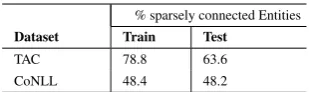
Table 6: Percentage of sparsely connected entities in evaluation datasets. TAC has higher composition of sparsely connected entities than CoNLL. Hence, EL-DEN results are better in TAC over CoNLL (Please see Table 4).
This is explained by analyzing distribution of densely-connected and sparsely connected entities in TAC and CoNLL datasets as presented in Ta-ble 6. We see that CoNLL test set has almost half as densely-connected and half as sparsely con-nected entities, whereas in TAC test set, 63.6% are sparsely connected entities. This higher con-stitution of sparsely connected entities in TAC, ex-plains ELDEN’s better results in TAC relative to CoNLL dataset. As the number of sparsely con-nected entities is more than the number of densely-connected entities in most KGs (Reinanda et al., 2016), our method is expected to be of significance for most KGs.
6.4 What type of EL errors are best fixed with ELDEN’s selective densification ?
We analyzed errors fixed by ELDEN on TAC dataset. We categorize the errors into four classes in line with error classes of Linget al.(2015). We
0 10 20 30 40 50 60 70
Synonym Acronym Specific label Miscellaneous
False Positive Analysis
FP FP after densification
Figure 3: False positives of ELDEN before and after KG densification. Errors reduce with use ofψdenseand ψELDENmeasures. (Please see Sec 6.4)
[image:8.595.307.527.469.589.2]7 Conclusion
We started this study by analyzing the perfor-mance of a state-of-the-art Entity Linking (EL) system and found that its performance was low when linking entities sparsely-connected in the KG. We saw that this can be addressed by densi-fying the KG with respect to the given entity. We proposed ELDEN, which densifies edge graph of entities using pseudo entities and mentions of en-tities in a large web corpus. Through our experi-ments, we find that ELDEN outperforms state-of-the-art baseline on benchmark datasets.
We believe that ELDENs combination of KG densification and entity embeddings is novel. Poor performance of EL systems on sparsely connected entities has been recognized as one of the open challenges by prior research. ELDEN performs well on sparsely connected entities too, as a val-idation of our method of combining KG densifica-tion followed by embedding. Our approach may be applied to any KG as the densification is per-formed with the help of unstructured data, and not any specific KG. We hope the simple graph densification method utilized in ELDEN will be of much interest to the research community.
Pseudo entities can be looked at as entity can-didates for KG expansion, as also noted by Farid
et al. (2016). In future, we plan to enhance EL-DEN using EL of pseudo entities to estimate en-tity prior of entities not present in KG. We also plan to explore entity embeddings obtained using other graph densifying methods.
8 Acknowledgments
We thank the Microsoft Research India Travel Grants for generous travel funds to attend and present this paper at NAACL.
References
Ander Barrena, Aitor Soroa, and Eneko Agirre. 2016. Allevi-ating poor context with background knowledge for named entity disambiguation. InACL (1). The Association for Computer Linguistics.
Indrajit Bhattacharya and Lise Getoor. ???? Online collective entity resolution.
Leo Breiman. 1998. Arcing classifier (with discussion and a rejoinder by the author). Ann. Statist.26(3):801–849.
https://doi.org/10.1214/aos/1024691079. Raluca Budiu, Christiaan Royer, and Peter Pirolli. 2007. Modeling information scent: A comparison of lsa, pmi and glsa similarity measures on common tests and cor-pora. In Large Scale Semantic Access to Content
(Text, Image, Video, and Sound). Paris, France, France, RIAO ’07, pages 314–332. http://dl.acm.org/ citation.cfm?id=1931390.1931422.
Dipak Chaudhari, Om P. Damani, and Srivatsan Laxman. 2011. Lexical co-occurrence, statistical significance, and word association.CoRRabs/1008.5287.
Xiao Cheng and Dan Roth. 2013. Relational inference for wikification. InEMNLP. ACL, pages 1787–1796. Andrew Chisholm and Ben Hachey. 2015. Entity
disambiguation with web links. Transactions of the Association for Computational Linguistics 3:145– 156. https://tacl2013.cs.columbia.edu/ ojs/index.php/tacl/article/view/494. Kenneth Ward Church and Patrick Hanks. 1989. Word
association norms, mutual information, and lexicogra-phy. ACL ’89, pages 76–83.https://doi.org/10. 3115/981623.981633.
Om P. Damani. 2013. Improving pointwise mutual infor-mation (PMI) by incorporating significant co-occurrence.
CoRRabs/1307.0596.
Lee R. Dice. 1945. Measures of the amount of ecologic association between species. Ecology 26(3):297–302.
https://doi.org/10.2307/1932409.
Xin Dong, Evgeniy Gabrilovich, Geremy Heitz, Wilko Horn, Ni Lao, Kevin Murphy, Thomas Strohmann, Shaohua Sun, and Wei Zhang. 2014. Knowledge vault: A web-scale approach to probabilistic knowledge fusion. ACM, New York, NY, USA, KDD ’14, pages 601–610. https: //doi.org/10.1145/2623330.2623623. Joe Ellis, Jeremy Getman, and Stephanie Strassel. 2014.
Overview of linguistic resource for the tac kbp 2014 eval-uations: Planning, execution, and results. Linguistic Data Consortium, University of Pennsylvania.
Weiyi Fang, Jianwen Zhang, Dilin Wang, Zheng Chen, and Ming Li. 2016. Entity disambiguation by knowledge and text jointly embedding. InCoNLL.
Mina Farid, Ihab F. Ilyas, Steven Euijong Whang, and Cong Yu. 2016. Lonlies: Estimating property values for long tail entities. In Proceedings of the 39th International ACM SIGIR Conference on Research and Development in Information Retrieval. ACM, New York, NY, USA, SI-GIR ’16, pages 1125–1128. https://doi.org/10. 1145/2911451.2911466.
Octavian-Eugen Ganea and Thomas Hofmann. 2017. Deep joint entity disambiguation with local neural attention. In Proceedings of the 2017 Conference on Empirical Methods in Natural Language Processing. Association for Computational Linguistics, pages 2609–2619. http: //www.aclweb.org/anthology/D17-1276. Amir Globerson, Nevena Lazic, Soumen Chakrabarti,
Amar-nag Subramanya, Michael Ringaard, and Fernando Pereira. 2016. Collective entity resolution with multi-focal attention. InACL.
Stephen Guo, Ming-Wei Chang, and Emre Kiciman. 2013. To link or not to link? a study on end-to-end tweet entity linking. In NAACL-HLT 2013.
http://research.microsoft.com/apps/ pubs/default.aspx?id=183909.
Zhaochen Guo and Denilson Barbosa. 2014. Robust entity linking via random walks. ACM, New York, NY, USA, CIKM ’14, pages 499–508. https://doi.org/10. 1145/2661829.2661887.
Xianpei Han and Jun Zhao. 2010. Structural semantic relat-edness: A knowledge-based method to named entity dis-ambiguation. InProceedings of the 48th Annual Meeting of the Association for Computational Linguistics. Asso-ciation for Computational Linguistics, Stroudsburg, PA, USA, ACL ’10, pages 50–59. http://dl.acm.org/ citation.cfm?id=1858681.1858687.
Zhengyan He, Shujie Liu, Yang Song, Mu Li, Ming Zhou, and Houfeng Wang. 2013. Efficient col-lective entity linking with stacking. EMNLP.
http://research.microsoft.com/apps/ pubs/default.aspx?id=202249.
Manjunath Hegde and Partha P. Talukdar. 2015. An entity-centric approach for overcoming knowledge graph spar-sity. Association for Computational Linguistics, Lis-bon, Portugal, EMNLP ’15, pages 530–535. http: //aclweb.org/anthology/D15-1061.
Johannes Hoffart, Stephan Seufert, Dat Ba Nguyen, Martin Theobald, and Gerhard Weikum. 2012. Kore: Keyphrase overlap relatedness for entity disambiguation. ACM, New York, NY, USA, CIKM ’12, pages 545–554. https: //doi.org/10.1145/2396761.2396832. Johannes Hoffart, Mohamed Amir Yosef, Ilaria Bordino,
Ha-gen F¨urstenau, Manfred Pinkal, Marc Spaniol, Bilyana Taneva, Stefan Thater, and Gerhard Weikum. 2011. Ro-bust disambiguation of named entities in text. Association for Computational Linguistics, Stroudsburg, PA, USA, EMNLP ’11, pages 782–792. http://dl.acm.org/ citation.cfm?id=2145432.2145521.
Hongzhao Huang, Larry Heck, and Heng Ji. 2015. Lever-aging deep neural networks and knowledge graphs for entity disambiguation. CoRRabs/1504.07678. http: //arxiv.org/abs/1504.07678.
Heng Ji, Ralph Grishman, Hoa Trang Dang, Kira Griffitt, and Joe Ellis. 2010. Overview of the tac 2010 knowledge base population track. In In Third Text Analysis Conference (TAC).
Bhushan Kotnis, Pradeep Bansal, and Partha P. Talukdar. 2015. Knowledge base inference using bridging enti-ties. InProceedings of the 2015 Conference on Empirical Methods in Natural Language Processing, EMNLP 2015, Lisbon, Portugal, September 17-21, 2015. pages 2038– 2043. http://aclweb.org/anthology/D/D15/ D15-1241.pdf.
Xiao Ling, Sameer Singh, and Dan Weld. 2015. Design chal-lenges for entity linking. Transactions of the Association for Computational Linguistics (TACL)3.
V´ıctor Mart´ınez, Fernando Berzal, and Juan-Carlos Cubero. 2016. A survey of link prediction in complex networks.
ACM Comput. Surv.49(4):69:1–69:33.https://doi. org/10.1145/3012704.
Tomas Mikolov, Ilya Sutskever, Kai Chen, Gregory S. Cor-rado, and Jeffrey Dean. 2013. Distributed representations of words and phrases and their compositionality. InNIPS 2013. pages 3111–3119.
David Milne and Ian H. Witten. 2008. Learning to Link with Wikipedia. ACM, CIKM’08, pages 509–518.
Jeffrey Pennington, Richard Socher, and Christopher D. Manning. 2014. Glove: Global vectors for word represen-tation. InEmpirical Methods in Natural Language Pro-cessing (EMNLP). pages 1532–1543. http://www. aclweb.org/anthology/D14-1162.
Maria Pershina, Yifan He, and Ralph Grishman. 2015. Per-sonalized page rank for named entity disambiguation, Association for Computational Linguistics (ACL), pages 238–243. NAACL HLT 2015.
Ridho Reinanda, Edgar Meij, and Maarten de Rijke. 2016. Document filtering for long-tail entities. ACM, CIKM’16. W. Shen, J. Han, J. Wang, X. Yuan, and Z. Yang. 2018. Shine+: A general framework for domain-specific en-tity linking with heterogeneous information networks.
IEEE Transactions on Knowledge and Data Engineer-ing 30(2):353–366. https://doi.org/10.1109/ TKDE.2017.2730862.
W. Shen, J. Wang, and J. Han. 2015. Entity linking with a knowledge base: Issues, techniques, and solutions.
IEEE Transactions on Knowledge and Data Engineer-ing 27(2):443–460. https://doi.org/10.1109/ TKDE.2014.2327028.
Yaming Sun, Lei Lin, Duyu Tang, Nan Yang, Zhen-zhou Ji, and Xiaolong Wang. 2015. Modeling mtion, context and entity with neural networks for en-tity disambiguation. In Qiang Yang and Michael Wooldridge, editors, IJCAI. AAAI Press, pages 1333– 1339. http://dblp.uni-trier.de/db/conf/ ijcai/ijcai2015.html#SunLTYJW15.
Bilyana Taneva and Gerhard Weikum. 2013. Gem-based entity-knowledge maintenance. ACM, New York, NY, USA, CIKM ’13, pages 149–158. https://doi. org/10.1145/2505515.2505715.
Ikuya Yamada, Hiroyuki Shindo, Hideaki Takeda, and Yoshiyasu Takefuji. 2016. Joint learning of the embed-ding of words and entities for named entity disambigua-tion. CoNLL 2016, pages 250–259.http://aclweb. org/anthology/K/K16/K16-1025.pdf. Stefan Zwicklbauer, Christin Seifert, and Michael