Proceedings of the 13th International Workshop on Semantic Evaluation (SemEval-2019), pages 678–682 678
LTL-UDE at SemEval-2019 Task 6:
BERT and Two-Vote Classification for Categorizing Offensiveness
Piush Aggarwal, Tobias Horsmann, Michael Wojatzki and Torsten Zesch Language Technology Lab
University of Duisburg-Essen
{tobias.horsmann, michael.wojatzki, torsten.zesch}@uni-due.de
Abstract
This paper describes LTL-UDE’s systems for theSemEval 2019 Shared Task 6. We present results for Subtask A and C. In Subtask A, we experiment with an embedding representation of postings and use a Multi-Layer Perceptron and BERT to categorize postings. Our best re-sult reaches the 10th place (out of 103) using BERT. In Subtask C, we applied a two-vote classification approach with minority fallback, which is placed on the 19th rank (out of 65).
1 Introduction
The Internet is frequently used for online debates and discussions, where individuals or groups are increasingly often verbally attacked. Online plat-form providers aim to remove such attacking posts or ideally, prevent them from being published. Manual verification of each posting by a human moderator is infeasible due to the high amount of postings created every day. Consequently, auto-mated detection of such attacking postings is the only feasible way to counter this kind of hostility. In this work, we present our results for the
SemEval 2019 Shared Task 6: Identifying and Categorizing Offensive Language in Social Me-dia(Zampieri et al.,2019b) on the OLID dataset (Zampieri et al., 2019a). Subtask A focuses on the binary distinction if a post is offensive or not, while Subtask C determines if the target is an indi-vidual, group, or other entity. Our submission for Subtask A ranks 10th, for Subtask C ranks 19th.
For Subtask A, we experiment with word list-based classification, using classifiers such as SVM or logistic regression based on sentence embed-dings, and neural network-based models such as a Multi-layer Perceptron (MLP) and Bidirec-tional Encoder Representations from Transform-ers (BERT) (Devlin et al.,2018). We find that the SVM performs best on our development set, but
BERT reaches the best result on the test dataset. Moreover, a learning curve experiment suggests that more training data will lead only to minor im-provements. In Subtask C, we choose a two-vote classification approach, where we let two systems compete with a fallback to the minority class in case the systems disagree. This fallback approach has a high robustness between our development and the official test dataset.
2 Related Work
Detection of offensive or potentially hurtful on-line postings is investigated under a variety of names. Waseem et al. (2017) focuses on abusive language, Kumar et al. (2018) tackles the prob-lem asaggressionwhileMacbeth et al.(2013) ap-proaches this problem ascyberbullyingto mention just a few. Furthermore, the field of hate speech detection is strongly related, which aims at detect-ing a similar kind of online statements (Waseem and Hovy,2016;Wojatzki et al.,2018).
Common approaches to detecting such socially unacceptable statements utilize rich feature sets consisting of word ngrams, surface forms and syn-tactical features (Warner and Hirschberg, 2012;
Nobata et al., 2016). Human-knowledge is pro-vided by word lists containing offenses as key words or phrases (Bassignana et al., 2018; Wie-gand et al.,2018b).Xiang et al.(2012) approaches the task as topic modelling problem using Latent Dirichlet Allocation (Blei et al.,2003).
These tasks are tackled with feature engineering-based approaches such as SVM or regression models but also with convolutional neural networks (Wiegand et al.,2018b).
3 Subtask A: Offensiveness
we experiment with the following approaches:
Preprocessing We lowercase all postings and use the Ark Tokenizer (Gimpel et al., 2011) for word splitting. These preprocessing steps are used in all experiments.
Lexical Matching We use the following hand-crafted word lists of abusive words: (i) Profane Word List1containing more than 1,300 English to-kens, (ii) UdS Lexicon of Abusive Words2 hav-ing 1,651 entries (Wiegand et al., 2018a), and (iii)Multilingual Lexicon of Words to Hurt from HurtLex (Bassignana et al., 2018) with 9,313 terms.3 A posting is classified as offensive if it contains any words in the before mentioned lists.
Posting Embeddings We represent each post-ing by a dense embeddpost-ing, which we create from word embeddings by summing up the vector val-ues of the word representations. The resulting posting vector is re-scaled into the range zero to one. We use the pre-trained embeddings provided byMikolov et al.(2018), which are trained on the common crawl corpus.
Classifiers We apply the following classifiers: SVM (Chang and Lin,2011), Logistic Regression (Fan et al.,2008), Random Forest (Breiman,2001) and a Decision Tree (Breiman et al.,1984). We use the implementation provided by scikit-learn ( Pe-dregosa et al.,2011) using default parameters.
Multi-Layer-Perceptron (MLP) With the same pre-processing and feature extraction steps used as for shallow models described above, we train a MLP with 100 hidden units in Scikit-Learn with ReLu as activation function and Adam optimizer (Kingma and Ba,2014). We initialize the neural network with the fasttext word embeddings pro-vided byMikolov et al.(2018).
BERT We use the provided pre-trained BERT-base model (Devlin et al., 2018) to create a vec-tor representation of a posting. We fine-tune the model on the training data set using a sequence-length of 128 and batches of 32. We also inves-tigate the impact of enriching the training dataset with additional data by using machine translation. We back and forth translate the training data to obtain paraphrases of the original training data,
1
https://www.cs.cmu.edu/∼biglou/resources/ 2
https://github.com/uds-lsv/lexicon-of-abusive-words 3
http://hatespeech.di.unito.it/resources.html
Set Approach F1 Acc
dev
SVM .795 .814
BERT .771 .799 Ensemble .767 .789 BERT-trans .732 .768 Logistic Reg. .704 .728
MLP .687 .705
Random Forest .641 .678 Lexical Matching .619 .680 Decision Tree .567 .585 Baseline - all NOT .400 .667
test
Ensemble .748 .782 BERT .798 .839
SVM .729 .761
[image:2.595.323.510.62.283.2]Baseline - all NOT .418 .720
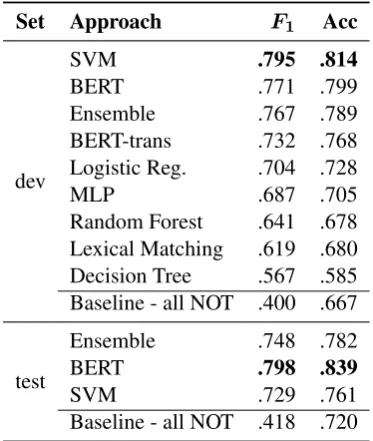
Table 1: Subtask A: Results in term of macroF1on a held-back development dataset containing 1,048 offen-sive postings and 2,192 not offenoffen-sive (NOT) ones.
which we expect to improve model performance. We translated the data into Russian, Chinese, and Arabic and back to English using Google’s trans-lation service. We repeated the fine-tuning with this enriched dataset.
Ensemble We combine the best three ap-proaches (BERT, SVM, and Logistic Regression) in an ensemble, which was reported to often ac-count for improvements in a similar shared task for German (Wiegand et al.,2018c). We use the majority vote of these classifiers as the prediction.
3.1 Results
Table 1 shows the results for Subtask A. We re-port results on a self-created development dataset (25% of the original training data, 3,240 postings of which 1,048 postings are labeled as offensive and 2,192 as not offensive). We use the majority class as a baseline. On our dev dataset, we find that a SVM with the posting vector-representation achieves the best F-Score, followed by BERT. Contrary to our expectation, BERT’s performance decreased by adding the machine-translated data. On the test dataset, we find BERT to perform best followed by the ensemble, which seems to add some additional robustness to the classification.
clas-10 20 30 40 50 60 70 80 90 clas-100
0.6 0.65 0.7 0.75 0.8
training data size in %
[image:3.595.85.281.61.223.2]F1
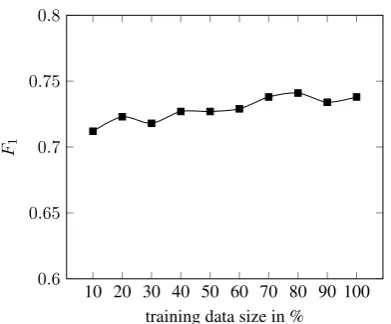
Figure 1: Learning curve on the training dataset. F-Score performance for adding an increasing amount of training data evaluated against the development set.
Set Approach F1 Acc
dev
MLP+MLP .565 .708 SVM+MLP .550 .688 MLP+SVM .541 .699 SVM+SVM .535 .701
MLP .523 .699
SVM .480 .733
BERT .492 .730
Random Forest ..461 .676 Decision Tree .462 .604 Logistic Regression .508 .707 Baseline - all IND .255 .621
test
MLP+MLP .556 .666
[image:3.595.84.279.283.508.2]SVM+MLP .498 .615 Baseline - all IND .213 .469
Table 2: Subtask C results
sifier. Figure1shows a learning curve computed over the provided training data with testing against the hold-out development set. We split the training data into equal-sized data blocks which are ran-domly distributed over labels and add an increas-ing number of data blocks to see the performance improvement by adding more data. The results shows that improving the machine learning model is a more promising strategy than providing even more data as the slope indicates only minor im-provements if more data is added.
4 Subtask C: Offense Targets
The goal in this subtask is to identify the kind of target at which a tweet is directed at (i.e. at this
point it is already known that the tweet is a tar-geted offense, just the target itself is not yet deter-mined). A target is either an individual (IND), a group (GRP), or other (OTH), if none of the previ-ously mentioned two categories apply. We apply the same approaches as already used in Subtask A.
Two-Vote Classification with Minority Fallback
Furthermore, an analysis of the class distribu-tion showed that the class for other has compar-atively few instances. This makes it challenging for a classifier to reliably detect such an under-represented class. Therefore, we attempt to re-define the problem as a binary classification prob-lem using two classifiers. If the two classifiers agree in their prediction, we take the predicted class (either individual or group). In case of an disagreement, we select the minority class,other, as prediction. Thus, we also alter the training data to contain only two classes. The labels of the under-representedother class are mapped for one classifier to individual and for the other one to group, which creates a kind of minority-class noise. Our intuition is, if both classifier overcome the uncertainty added by the (small) amount of noise, the prediction is considered reliable. Con-sequently, we consider a disagreement as evidence for assigning the minority class.
Results Table2shows the results. We find that our two vote classification approach, using two MLPs, reaches the highest F-Score on the devel-opment and test set. On the develdevel-opment set, we reach the best accuracy result with an SVM but the considerably lower F-Score shows a strong bias to-wards a single class. Moreover, MLP+MLP shows a high robustness when comparing the F-Score performance between development and test set.
5 Conclusion
In this paper, we presented our approach on identi-fying and categorizing offensive language in social media. We mostly rely on lexical and semantic features for all subtasks. Results shows that se-mantic features have a significant impact on sys-tem performance. In general, our syssys-tem leaves much room for improvement. Detection of offen-siveness could probably benefit from more seman-tically oriented features that go beyond the surface form of words. We make the source code of our experiments publicly available4.
4
References
Elisa Bassignana, Valerio Basile, and Viviana Patti. 2018. Hurtlex: A Multilingual Lexicon of Words to Hurt. InProceedings of the Fifth Italian Confer-ence on Computational Linguistics (CLiC-it 2018), Torino, Italy, December 10-12, 2018.
David M. Blei, Andrew Y. Ng, and Michael I. Jordan. 2003. Latent Dirichlet Allocation. J. Mach. Learn. Res., 3:993–1022.
Leo Breiman. 2001. Random Forests. Mach. Learn., 45(1):5–32.
Leo Breiman, Jerome H Friedman, Richard A Ol-shen, and Charles J Stone. 1984.
Classifica-tion and regression trees. The Wadsworth
statis-tics/probability series. Wadsworth and Brooks/Cole Advanced Books and Software, Monterey, CA.
Chih-Chung Chang and Chih-Jen Lin. 2011. LIBSVM: A Library for Support Vector Machines. ACM Trans. Intell. Syst. Technol., 2(3):27:1–27:27.
Jacob Devlin, Ming-Wei Chang, Kenton Lee, and Kristina Toutanova. 2018. BERT: Pre-training of Deep Bidirectional Transformers for Language Un-derstanding. arXiv preprint arXiv:1810.04805.
Rong-En Fan, Kai-Wei Chang, Cho-Jui Hsieh, Xiang-Rui Wang, and Chih-Jen Lin. 2008. LIBLINEAR: A Library for Large Linear Classification. J. Mach. Learn. Res., 9:1871–1874.
Kevin Gimpel, Nathan Schneider, Brendan O’Connor, Dipanjan Das, Daniel Mills, Jacob Eisenstein, Michael Heilman, Dani Yogatama, Jeffrey Flanigan, and Noah A. Smith. 2011. Part-of-Speech Tagging for Twitter: Annotation, Features, and Experiments. In Proceedings of the 49th Annual Meeting of the Association for Computational Linguistics: Human Language Technologies, pages 42–47. Association for Computational Linguistics.
Diederik P. Kingma and Jimmy Ba. 2014. Adam: A Method for Stochastic Optimization. CoRR, abs/1412.6980.
Ritesh Kumar, Atul Kr. Ojha, Shervin Malmasi, and Marcos Zampieri. 2018. Benchmarking Aggression Identification in Social Media. InProceedings of the First Workshop on Trolling, Aggression and Cyber-bullying (TRAC-2018), pages 1–11. Association for Computational Linguistics.
Jamie Macbeth, Hanna Adeyema, Henry Lieberman, and Christopher Fry. 2013. Script-based story matching for cyberbullying prevention. In ACM SIGCHI Conference on Human Factors in Comput-ing Systems, pages 901–906.
Tomas Mikolov, Edouard Grave, Piotr Bojanowski, Christian Puhrsch, and Armand Joulin. 2018. Ad-vances in Pre-Training Distributed Word Represen-tations. InProceedings of the International Confer-ence on Language Resources and Evaluation (LREC 2018).
Chikashi Nobata, Joel Tetreault, Achint Thomas, Yashar Mehdad, and Yi Chang. 2016. Abusive Lan-guage Detection in Online User Content. In Pro-ceedings of the 25th International Conference on World Wide Web, WWW ’16, pages 145–153, Re-public and Canton of Geneva, Switzerland. Interna-tional World Wide Web Conferences Steering Com-mittee.
F. Pedregosa, G. Varoquaux, A. Gramfort, V. Michel, B. Thirion, O. Grisel, M. Blondel, P. Pretten-hofer, R. Weiss, V. Dubourg, J. Vanderplas, A. Pas-sos, D. Cournapeau, M. Brucher, M. Perrot, and E. Duchesnay. 2011. Scikit-learn: Machine Learn-ing in Python. Journal of Machine Learning Re-search, 12:2825–2830.
William Warner and Julia Hirschberg. 2012. Detecting Hate Speech on the World Wide Web. In Proceed-ings of the Second Workshop on Language in Social Media, pages 19–26, Stroudsburg, PA, USA. Asso-ciation for Computational Linguistics.
Zeerak Waseem, Thomas Davidson, Dana Warmsley, and Ingmar Weber. 2017. Understanding Abuse: A Typology of Abusive Language Detection Sub-tasks. InProceedings of the First Workshop on Abu-sive Language Online, pages 78–84. Association for Computational Linguistics.
Zeerak Waseem and Dirk Hovy. 2016. Hateful Sym-bols or Hateful People? Predictive Features for Hate Speech Detection on Twitter. InProceedings of the NAACL Student Research Workshop, pages 88–93. Association for Computational Linguistics.
Michael Wiegand, Josef Ruppenhofer, Anna Schmidt, and Clayton Greenberg. 2018a. Inducing a Lexi-con of Abusive Words – a Feature-Based Approach. InProceedings of the 2018 Conference of the North American Chapter of the Association for Computa-tional Linguistics: Human Language Technologies, Volume 1 (Long Papers), pages 1046–1056. Associ-ation for ComputAssoci-ational Linguistics.
Michael Wiegand, Melanie Siegel, and Josef Ruppen-hofer. 2018b. Overview of the GermEval 2018 Shared Task on the Identification of Offensive Lan-guage. InProceedings of GermEval.
Michael Wiegand, Melanie Siegel, and Josef Ruppen-hofer. 2018c. Overview of the GermEval 2018 Shared Task on the Identification of Offensive Lan-guage.
Michael Wojatzki, Tobias Horsmann, Darina Gold, and Torsten Zesch. 2018. Do Women Perceive Hate Differently: Examining the Relationship Between Hate Speech, Gender, and Agreement Judgments. In Proceedings of the Conference on Natural Lan-guage Processing (KONVENS), pages 110–120, Vi-enna, Austria.
via Topical Feature Discovery over a Large Scale Twitter Corpus. InProceedings of the 21st ACM In-ternational Conference on Information and Knowl-edge Management, CIKM ’12, pages 1980–1984, New York, NY, USA. ACM.
Marcos Zampieri, Shervin Malmasi, Preslav Nakov, Sara Rosenthal, Noura Farra, and Ritesh Kumar. 2019a. Predicting the Type and Target of Offensive Posts in Social Media. InProceedings of NAACL.