Leveraging Annotators’ Gaze Behaviour for Coreference Resolution
Joe Cheri Ross, Abhijit Mishra, Pushpak Bhattacharyya
Department of Computer Science & Engineering Indian Institute of Technology Bombay, Mumbai
{joe,abhijitmishra,pb}@cse.iitb.ac.in
Abstract
This paper aims at utilizing cognitive in-formation obtained from the eye move-ments behavior of annotators for auto-matic coreference resolution. We first record eye-movement behavior of multi-ple annotators resolving coreferences in 22 documents selected from MUC dataset. By inspecting the gaze-regression pro-files of our participants, we observe how regressive saccades account for selec-tion of potential antecedents for a cer-tain anaphoric mention. Based on this observation, we then propose a heuris-tic to utilize gaze data to prune men-tion pairs in menmen-tion-pair model, a pop-ular paradigm for automatic coreference resolution. Consistent improvement in accuracy across several classifiers is ob-served with our heuristic, demonstrating why cognitive data can be useful for a dif-ficult task like coreference resolution. 1 Introduction
Coreference resolution deals with identifying the expressions in a discourse referring to the same entity. It is crucial to many information retrieval tasks (Elango, 2005). One of its main objectives of is to resolve the noun phrases to the entities they refer to. Though there exist many rule based (Kennedy and Boguraev, 1996; Mitkov, 1998; Raghunathan et al., 2010) and machine learning based (Soon et al., 2001; Ng and Cardie, 2002; Rahman and Ng, 2011) approaches to corefer-ence resolution, they are way behind imitating the human process of coreference resolution. Com-paring the performance of different existing sys-tems on a standard dataset,Ontonotes, released for CoNLL-2012 shared task (Pradhan et al., 2012), it is quite evident that the recent systems do not have much improvement in accuracy over the ear-lier systems (Bj¨orkelund and Farkas, 2012;
Dur-rett and Klein, 2013; Bj¨orkelund and Kuhn, 2014; Martschat et al., 2015; Clark and Manning, 2015). This paper attempts to gain insight into the cognitive aspects of coreference resolution to im-prove mention-pair model, a well-known super-vised coreference resolution paradigm. For this we employ eye-tracking technology that has been quite effective in the field of psycholinguistics to study language comprehension (Rayner and Sereno, 1994), lexical (Rayner and Duffy, 1986) and syntactic processing(von der Malsburg and Vasishth, 2011). Recently, eye-tracking studies have been conducted for various language pro-cessing tasks like Sentiment Analysis, Transla-tion and Word Sense DisambiguaTransla-tion. Joshi et al. (2014) develop a method to measure the sen-timent annotation complexity using cognitive ev-idence from eye-tracking. Mishra et al. (2013) measure complexity in text to be translated based on gaze input of translators which is used to label training data. Joshi et al. (2013) propose a studied the cognitive aspects if Word Sense Disambigua-tion (WSD) through eye-tracking.
Eye-tracking studies have also been conducted for the task of coreference resolution. Cunnings et al. (2014) check for whether the syntax or dis-course representation has better role in pronoun interpretation. Arnold et al. (2000) examine the effect of gender information and accessibility to pronoun interpretation. Vonk (1984) studies the fixation patterns on pronoun and associated verb phrases to explain comprehension of pronouns.
We perform yet another eye-tracking study to understand certain facets of human process in-volved in coreference resolution that eventually can help automatic coreference resolution. Our participants are given a set of documents to per-form coreference annotation and the eye move-ments during the exercise are recorded. Eye-movement patterns are characterized by two ba-sic attributes: (1) Fixations, corresponding to a longer stay of gaze on a visual object (like
ters, wordsetc. in text) (2) Saccades, correspond-ing to the transition of eyes between two fixations. Moreover, a saccade is called a Regressive Sac-cadeor simply, Regression if it represents a phe-nomenon of going back to a pre-visited segment. While analyzing these attributes in our dataset, we observe a correlation between the Total Regres-sion Count and the complexity of a mention be-ing resolved. Additionally, Mention Regression Count, i.e., the count of a previous mention get-ting visited while resolving for an anaphoric men-tion, proves to be a measure of relevance of that particular mention as antecedent to the anaphoric mention.
Following the insights, we try to enrich mention-pair model, a popular paradigm in auto-matic coreference resolution by performing tion pair pruning prior to classification using men-tion regression data.
2 Creation of Eye-movement Database We prepared a set of 22 short documents, each having less than 10 sentences. These were se-lected from the MUC-6 dataset1. Discourse size
is restricted in order to make the task simpler for the participants and to reduce eye movements er-ror caused due to scrolling.
The documents are annotated by 14 partici-pants. Out of them, 12 of them are graduate/post-graduate students with science and engineering background in the age group of 20-30 years, with English as the primary language of academic in-struction. The rest 2 are expert linguists and they belong to the age group of 47-50. To ensure that they possess good English proficiency, a small En-glish comprehension test is carried out before the start of the experiment. Once they clear the com-prehension test, they are given a set of instruc-tions beforehand and are advised to seek clarifi-cations before they proceed further. The instruc-tions mention the nature of the task, annotation in-put method, and necessity of head movement min-imization during the experiment.
The task given to the participants is to read one document at a time, and assign ids to mentions that are already marked in the document. Each id corresponding to a certain mention has to be unique, such that all the coreferent mentions in a single coreference chain are assigned with the
1http://www.cs.nyu.edu/cs/faculty/ grishman/muc6.html
same id. During the annotation, eye movements data of the participants (in terms of fixations, sac-cades and pupil-size) are tracked using an SR-Research Eyelink-1000 Plus eye-tracker (monoc-ular mode with sampling rate of 500 Hz). The eye-tracking device is calibrated at the start of each reading session. Participants are allowed to take breaks between two reading sessions, to prevent fatigue over time.
We observe that the average annotation ac-curacy in terms of CoNLL-score ranges be-tween 70.75%-86.81%. Annotation error, we believe, could be attributed to: (a) Lack of pa-tience/attention while reading, (b) Issues related to text comprehension and understanding, and (c) Confusion/indecisiveness caused due to lack of context. The dataset is freely available for aca-demic use2.
3 Analysis ofEye-regressionProfiles The cognitive activity involved in resolving coref-erences is reflected in the eye movements of the participants, especially in the movements to the previously visited words/phrases in the document, termed as regressive saccades or simply, regres-sions. Regression count refers to the number of times the participant has revisited a candidate antecedent mention while resolving a particular anaphoric mention. This is extracted from the eye movement events between the first gaze of the anaphoric mention under consideration and the an-notation event of this mention (when participants annotate the mention with a coreferent id).
Figure 1 shows the mention position (for a given mention id) in terms of the order of the mention in the document against count of regression going out from each mention to the previous mentions. The regression count for a particular mention is averaged over all the participants. As we see, av-erage regression count tends to increase with in-crease in mention id, except for some mentions which may not have required visiting to the previ-ous mentions for resolving them. The complexity of the content in MUC-6 dataset makes the spread of the regression counts dispersed. We also ob-serve that, towards the end of the document, par-ticipants tend to regress more to the earlier sec-tions because of limited working memory (Calvo, 2001). This increases the number of regressions performed from mentions appearing towards the
end of the document.
It is worth noting that intra-sentential mentions that have antecedents within the same sentence (as in ’Prime Minister Brian Mulroney and his
cabinet have been briefed today’) do not gener-ally elicit regressions. We believe, intra-sentential resolutions are connected to processing of syn-tactic constraints in an organized manner, as ex-plained by the binding theory (Chomsky, 1982). Though the number of intra-sentential mentions in our dataset is low, it is evident from figure 1, that they do not account for many regressions.
0 5 10 15 20 25 30 35
0 50 100 150 200
Mention id
R
egr
ession out
[image:3.595.343.483.113.266.2]count
Figure 1: MUC-6 dataset: Mention id Vs Regres-sion count
This above analysis on regression counts sup-ports our hypothesis that the mentions that are gressed to more frequently have a better say in re-solving an anaphoric mention.
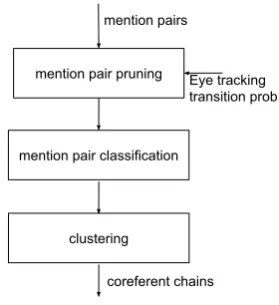
4 Leveraging Cognitive Information Automatic Coreference Resolution We experiment with a supervised system follow-ing a mention-pair model (Soon et al., 2001)-injecting the eye-movement information into it. Mention-pair model classifies mention pairs formed between mentions in a document as coref-erent or not, followed by clustering, forming clus-ters of coreferent mentions. Eye tracking infor-mation is utilized in the process of mention pair pruning prior to mention pair classification. 4.1 For Mention-pair Pruning
Given an anaphoric mention, the probability of each previous mention being selected as an-tecedent is computed as follows. Transitions done by a participant to potential antecedent mentions, while resolving an anaphoric mention, are first ob-tained from the regression profile. From this, we filter out the regressions to a candidate antecedent
mention that happen between two events- (a) first fixation lands on the anaphoric mention and (b) the anaphoric mention gets annotated with an id.
mention pair pruning
mention pair classification
clustering mention pairs
[image:3.595.71.300.254.372.2]coreferent chains Eye tracking transition prob
Figure 2: Mention-pair pruning
These regression counts from all the partici-pants are aggregated to compute the transition probability values, as follows:
Pmi,mj =
count(transitions mj →mi) P
kcount(transitions mj →mk) (1) In equation 1,Pmi,mjgives the transition
proba-bility value for an anaphoric mentionmjto a can-didate antecedent mention mi. count() computes the aggregated regression count over all partici-pants. Denominator part computes for all candi-date antecedents(k) of the anaphoric mention.
Transition probability thus computed for candi-date mention pairs, are utilized prior to mention pair classification, filtering out irrelevant men-tion pairs. In the menmen-tion pair model, a menmen-tion pair(mant, mana)is formed between an anaphoric mention (mana) and a candidate antecedent men-tion (mant). For an anaphoric mention, the thresh-old probability value is computed from the num-ber of potential candidate antecedents. Pthresh =
1
#candidate antecedents. Mentions pairs having probability less thanPthreshare pruned.
5 Experiments and Results
Eye movement data driven mention pair pruning, as discussed above, is experimented across dif-ferent classifiers, viz., Support Vector Machine (SVM), Naive Bayes, and Multi-layered Feed-Forward Neural Network (Neural Net). We use libsvm3 for SVM implementation and
Scikit-Learn4for Naive Bayes implementation. The
Experiments MUC B3 CEAFe CoNLL
P R F P R F P R F
[image:4.595.76.523.62.187.2]SVM (RBF) unprunedpruned 61.1362.67 68.9666.99 64.8164.76 62.6257.72 73.7175.39 67.7165.38 52.0047.33 57.8358.23 54.7652.22 60.8062.41 SVM (Linear) unprunedpruned 53.3354.71 70.9371.42 60.8861.96 39.6337.64 75.0775.02 51.8850.13 29.4426.56 53.1451.27 37.8934.99 48.6750.58 Naive Bayes unprunedpruned 62.8562.90 97.5396.05 76.4476.02 25.0623.23 96.6498.03 39.8037.56 13.5010.53 58.6454.22 21.9417.64 43.8845.92 Neural Net unprunedpruned 64.7366.35 71.4270.93 67.9168.57 66.5563.71 76.1577.20 71.0369.81 55.7652.60 62.0161.96 58.7256.90 64.8766.11 Berkeley coref unprunedpruned 84.8986.86 58.1258.62 69.070.0 87.1584.93 47.6447.86 61.661.22 82.782.45 39.2637.96 53.2551.99 60.7361.61
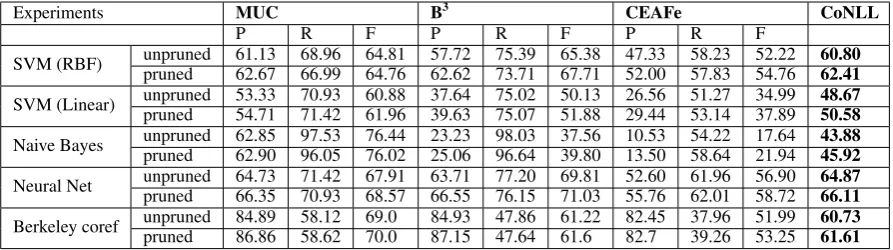
Table 1: Results with different classifiers and Berkeley coreference system with and without pruning of candidate mention pairs (P,R,F)→(Precision, R:Recall, F:F-measure), CoNLL:CoNLL Score
ral network classifier having an input layer, a hid-den layer and an output layer is implemented us-ing Keras5. For training, we consider a subset of
English section of OntoNotes (v5.0) data (Pradhan et al., 2012) with 1634 documents. Testing is done with the 22 documents taken from MUC-6 dataset. Since the main aspect of our work is mention pair pruning, we first check the mention pair prun-ing accuracy. We find that mention pair prunprun-ing has a precision of87.24%. Pruning errors may be attributed to increased number of regressions hap-pening to mentions towards the end of the docu-ments (refer section 3).
Performance of the system is evaluated using MUC, B3 and CEAFe metrics. CoNLL score is
computed as the average of F1s of all the men-tioned metrics. Table 1 shows the results across different classifiers with and without mention pair pruning. Considering the CoNLL score, there is an improvement in performance across all clas-sifiers. This improvement is contributed by the increase in precision , despite the fall in recall. Table 2 shows a few instances of non-coreferent antecedent-anaphora pairs which are correctly pre-dicted as non-coreferent because of pruning.
Antecedent Anaphora
here a treaty
Paramount
Communica-tions Inc an after-tax gain ofbillion $1.2 Rogers Communications A Spokesman
Table 2: Instances of precision errors corrected by pruning
Among all the classifiers neural network gives better accuracy, but the effective performance gain is higher with classifiers with lesser accu-racy. Naive Bayes giving the least accuracy, gives
5http://keras.io/
the best accuracy improvement of 2.04% with mention-pair pruning. This gives the impression that systems with lower performance, are likely to benefit from the eye movement based heuristics.
The performance improvement of mention pair pruning is also verified with the state of the art Berkeley Coreference Resolution system (Durrett and Klein, 2013). The choice of the system was based on the code accessibility to make the mod-ification required for mention pair pruning. Re-sults of Berkeley system in table 1 shows that there is an improvement in CoNLL score , mainly con-tributed by the increase in precision.
6 Conclusion and Future Work
Acknowledgments
We thank for the support of CFILT lab at IIT Bom-bay and the annotators who helped us with coref-erence annotation experiment.
References
Jennifer E Arnold, Janet G Eisenband, Sarah Brown-Schmidt, and John C Trueswell. 2000. The rapid use of gender information: Evidence of the time course of pronoun resolution from eyetracking. Cognition, 76(1):B13–B26.
Anders Bj¨orkelund and Rich´ard Farkas. 2012. Data-driven multilingual coreference resolution using re-solver stacking. InJoint Conference on EMNLP and CoNLL-Shared Task, pages 49–55. Association for Computational Linguistics.
Anders Bj¨orkelund and Jonas Kuhn. 2014. Learn-ing structured perceptrons for coreference resolution with latent antecedents and non-local features. In Proceedings of the Association for Computational Linguistics.
Manuel G Calvo. 2001. Working memory and infer-ences: Evidence from eye fixations during reading. Memory, 9(4-6):365–381.
Noam Chomsky. 1982. Some concepts and conse-quences of the theory of government and binding, volume 6. MIT press.
Kevin Clark and Christopher D Manning. 2015. Entity-centric coreference resolution with model stacking. InAssociation of Computational Linguis-tics (ACL).
Ian Cunnings, Clare Patterson, and Claudia Felser. 2014. Variable binding and coreference in sentence comprehension: evidence from eye movements. Journal of Memory and Language, 71(1):39–56. Greg Durrett and Dan Klein. 2013. Easy victories and
uphill battles in coreference resolution. InEMNLP, pages 1971–1982.
Pradheep Elango. 2005. Coreference resolution: A survey. University of Wisconsin, Madison, WI. Salil Joshi, Diptesh Kanojia, and Pushpak
Bhat-tacharyya. 2013. More than meets the eye: Study of human cognition in sense annotation. In HLT-NAACL, pages 733–738.
Aditya Joshi, Abhijit Mishra, Nivvedan Senthamilsel-van, and Pushpak Bhattacharyya. 2014. Measuring sentiment annotation complexity of text. InACL (2), pages 36–41.
Christopher Kennedy and Branimir Boguraev. 1996. Anaphora for everyone: pronominal anaphora res-oluation without a parser. InProceedings of the 16th
conference on Computational linguistics-Volume 1, pages 113–118. Association for Computational Lin-guistics.
Sebastian Martschat, Patrick Claus, and Michael Strube. 2015. Plug latent structures and play coref-erence resolution. ACL-IJCNLP 2015, page 61. Abhijit Mishra, Pushpak Bhattacharyya, Michael Carl,
and IBC CRITT. 2013. Automatically predicting sentence translation difficulty. In ACL (2), pages 346–351.
Ruslan Mitkov. 1998. Robust pronoun resolution with limited knowledge. InProceedings of the 36th Annual Meeting of the Association for Computa-tional Linguistics and 17th InternaComputa-tional Conference on Computational Linguistics-Volume 2, pages 869– 875. Association for Computational Linguistics. Vincent Ng and Claire Cardie. 2002. Improving
ma-chine learning approaches to coreference resolution. InProceedings of the 40th Annual Meeting on Asso-ciation for Computational Linguistics, pages 104– 111. Association for Computational Linguistics. Sameer Pradhan, Alessandro Moschitti, Nianwen Xue,
Olga Uryupina, and Yuchen Zhang. 2012. Conll-2012 shared task: Modeling multilingual unre-stricted coreference in ontonotes. InJoint Confer-ence on EMNLP and CoNLL-Shared Task, pages 1– 40. Association for Computational Linguistics. Karthik Raghunathan, Heeyoung Lee, Sudarshan
Ran-garajan, Nathanael Chambers, Mihai Surdeanu, Dan Jurafsky, and Christopher Manning. 2010. A multi-pass sieve for coreference resolution. In Proceed-ings of the 2010 Conference on Empirical Methods in Natural Language Processing, pages 492–501. Association for Computational Linguistics.
Altaf Rahman and Vincent Ng. 2011. Syntactic pars-ing for rankpars-ing-based coreference resolution. In IJCNLP, pages 465–473.
Keith Rayner and Susan A Duffy. 1986. Lexical com-plexity and fixation times in reading: Effects of word frequency, verb complexity, and lexical ambiguity. Memory & Cognition, 14(3):191–201.
Keith Rayner and Sara C Sereno. 1994. Eye move-ments in reading: Psycholinguistic studies. Hand-book of Psycholinguistics.
Wee Meng Soon, Hwee Tou Ng, and Daniel Chung Yong Lim. 2001. A machine learning ap-proach to coreference resolution of noun phrases. Computational linguistics, 27(4):521–544.
Titus von der Malsburg and Shravan Vasishth. 2011. What is the scanpath signature of syntactic reanaly-sis? Journal of Memory and Language, 65(2):109– 127.